
Life, 1895-08-22 · page 4 of 16
Life — August 22, 1895 — page 4: what you’re looking at
What you’re looking at
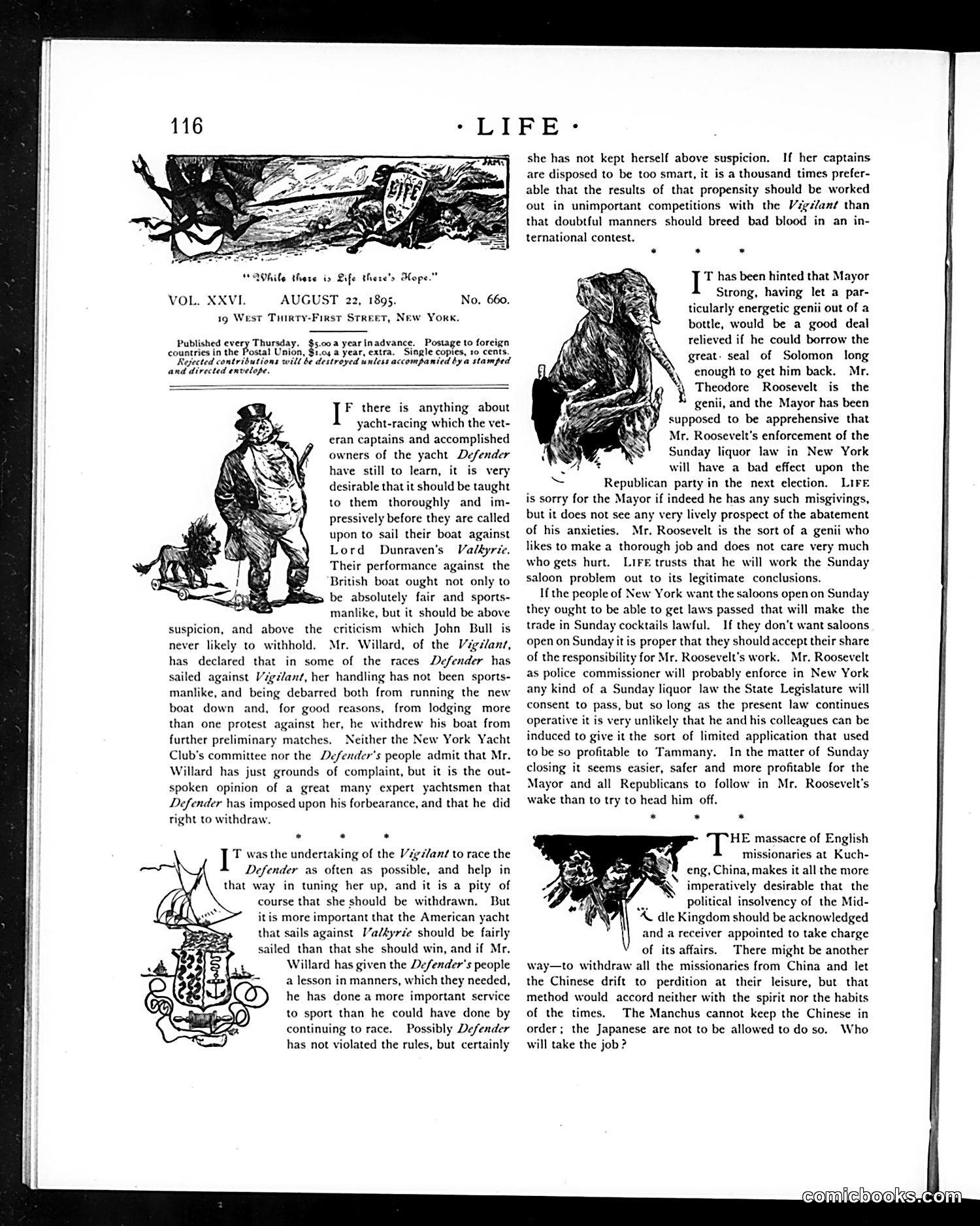
This page satirizes yacht racing and New York Republican politics. The text critiques the yacht *Defender's* owners and the New York Yacht Club's handling of a match against the British yacht *Vigilant*. The accompanying sketches appear to show figures involved in yacht racing—likely depicting yacht club members or competitors, though specific identities aren't clearly labeled in the visible portions. The article discusses Mayor Strong's potential anxieties about Theodore Roosevelt's enforcement of New York's Sunday liquor laws, suggesting this could hurt Republicans in upcoming elections. The satire targets both the yacht racing establishment's class pretensions and political concerns about prohibition enforcement during the Gilded Age. The final section shifts to discussing English missionaries in China, appearing unrelated to the main satirical content.
📄 Transcribed text from this page (OCR, searchable)
Machine-transcribed from the original scan — historical spelling and the odd misread are preserved.
> LIFE: “While there is Life there's Hope.” XXVI. AUGUST 22, 1895. 19 West Tirty-First Street, ) Published every Thursday. $5.00 year inadvance. Postage to foreign countries in the Postal Union, $1.04 a year, extra. Single copies, 10 cents Rejected contributions will be destroyed unless accompanied bya stamped and directed envelope. No. 660. York. VOL. F there is anything about yacht-racing which the vet- eran captains and accomplished owners of the yacht Defender have still to learn, it is very desirable that it should be taught to them thoroughly and im- pressively before they are called upon to sail their boat against Lord Dunraven's Valkyrie. Their performance against the British boat ought not only to be absolutely fair and sports- manlike, but it should be above suspicion, and above the criticism which John Bull is never likely to withhold. Mr. Willard, of the Vegé/ant, has declared that in some of the races Defender has sailed against Vig¢/ant, her handling has not been sports- manlike, and being debarred both from running the new boat down and, for good reasons, from lodging more than one protest against her, he withdrew his boat from further preliminary matches. Neither the New York Yacht Club's committee nor the Defender's people admit that Mr. Willard has just grounds of complaint, but it is the out- spoken opinion of a great many expert yachtsmen that Defender has imposed upon his forbearance, and that he did right to withdraw. I T was the undertaking of the Vigd/ant to race the Defender as often as possible, and help in that way in tuning her up, and it is a pity of course that she should be withdrawn. But itis more important that the American yacht that sails against Vadtyrée should be fairly sailed than that she should win, and if Mr. Willard has given the Defender's people a lesson in manners, which they needed, he has done a more important service to sport than he could have done by continuing to race. Possibly Defender has not violated the rules, but certainly she has not kept herself above suspicion. If her captains are disposed to be too smart, it is a thousand times prefer- able that the results of that propensity should be worked out in unimportant competitions with the Vigz/ant than that doubtful manners should breed bad blood in an in- ternational contest. . . T has been hinted that Mayor Strong, having let a par- ticularly energetic genii out of a bottle, would be a good deal relieved if he could borrow the great. seal of Solomon long enough to get him back. Mr. Theodore Roosevelt is the genii, and the Mayor has been supposed to be apprehensive that Mr. Roosevelt's enforcement of the Sunday liquor law in New York will have a bad effect upon the Republican party in the next election. LIFE is sorry for the Mayor if indeed he has any such misgivings, but it does not see any very lively prospect of the abatement of his anxieties. Mr. Roosevelt is the sort of a genii who likes to make a thorough job and does not care very much who gets hurt. LIFE trusts that he will work the Sunday saloon problem out to its legitimate conclusions. If the people of New York want the saloons open on Sunday they ought to be able to get laws passed that will make the trade in Sunday cocktails lawful. If they don’t want saloons open on Sunday it is proper that they should accept their share of the responsibility for Mr. Roosevelt's work. Mr. Roosevelt as police commissioner will probably enforce in New York any kind of a Sunday liquor law the State Legislature will consent to pi but so long as the present law continues operative it is very unlikely that he and his colleagues can be induced to give it the sort of limited application that used to be so profitable to Tammany. In the matter of Sunday closing it seems easier, safer and more profitable for the Mayor and all Republicans to follow in Mr. Roosevelt's wake than to try to head him off. . . HE massacre of English missionaries at Kuch- eng, China, makes it all the more imperatively desirable that the on political insolvency of the Mid- A dle Kingdom should be acknowledged and a receiver appointed to take charge of its affairs. There might be another Wway—to withdraw all the missionaries from China and let the Chinese drift to perdition at their leisure, but that method would accord neither with the spirit nor the habits of the times. The Manchus cannot keep the Chinese in order; the Japanese are not to be allowed to do so. Who will take the job ?