
A complete issue · 14 pages · 1895
Life — August 8, 1895
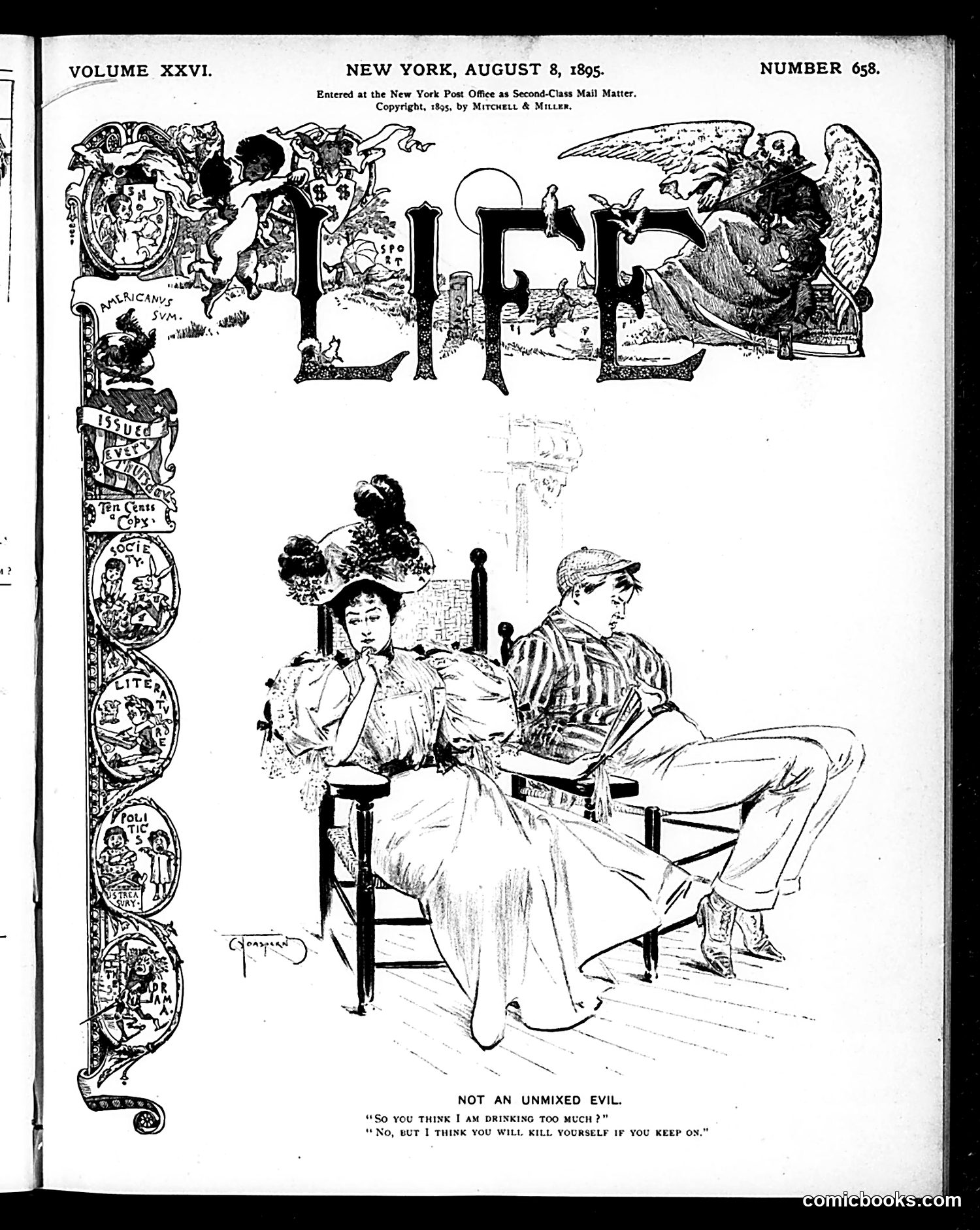
This 1895 Life magazine cartoon satirizes excessive drinking. The illustration shows a well-dressed woman and a working-class man sitting together, with the woman expressing concern: "So you think I am drinking too much?" The man responds: "No, but I think you will kill yourself if you keep on." The satire operates on class contrast—the woman's elaborate hat and refined appearance suggest she's from a privileged background, while the man's flat cap and striped shirt mark him as working-class. The title "Not an Unmixed Evil" ironically suggests drinking has some benefits, but the dialogue indicates serious health dangers. The ornate left border contains small vignettes advertising Life's various features and content sections.
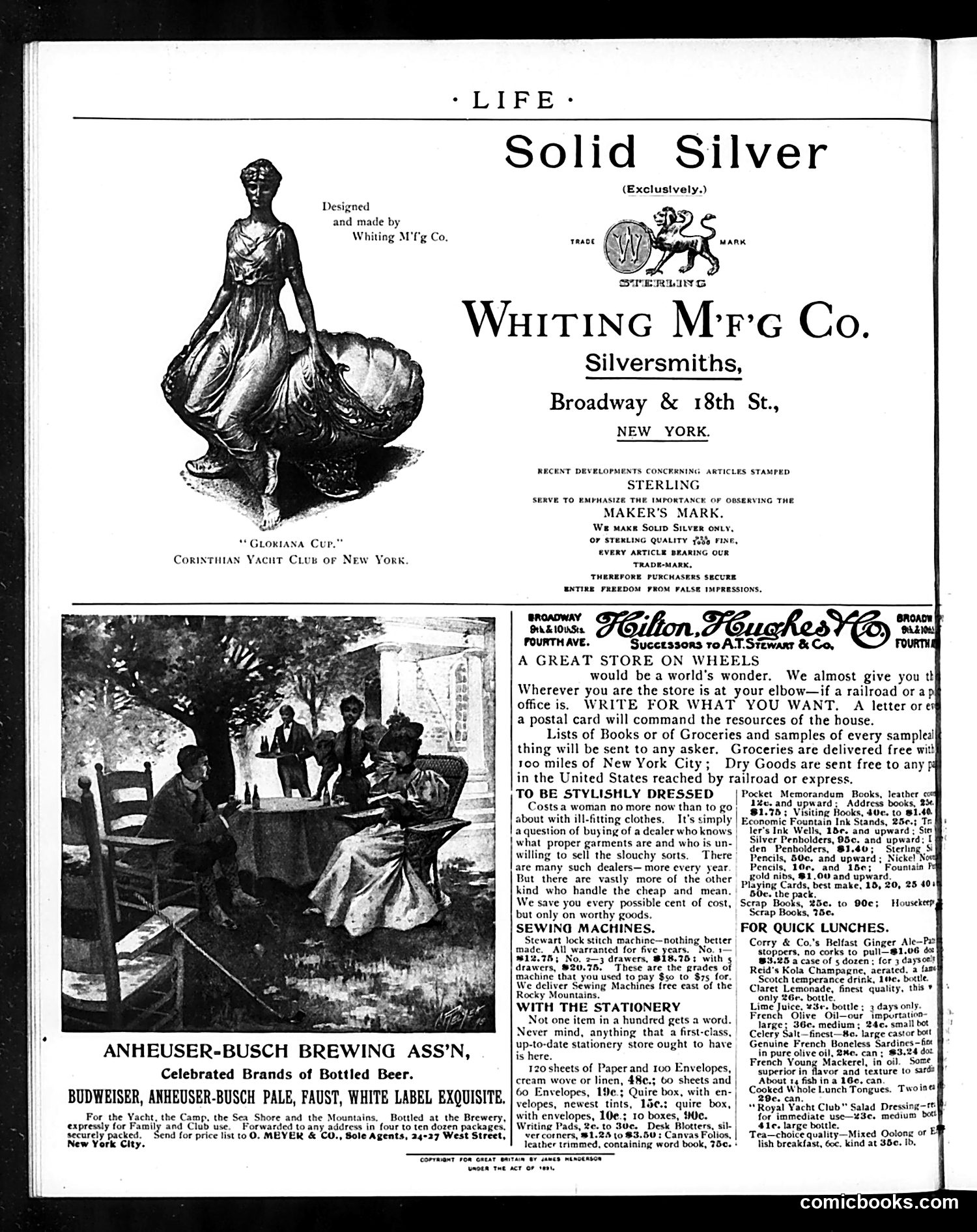
This page is predominantly **advertising** rather than editorial satire. The top features an ad for Whiting Manufacturing Company's solid silver goods, with an allegorical female figure and the "Gloriana Cup" from the Corinthian Yacht Club of New York. The lower half contains various commercial advertisements: Anheuser-Busch beer, Hilton Houckes & Co. (a mail-order store), sewing machines, and food products. These ads emphasize convenience and mail delivery—typical early 20th-century appeals to consumers who lacked easy retail access. While *Life* magazine was known for satirical cartoons, **this particular page contains no political or social satire**—it's a straightforward advertising section aimed at the magazine's readers.
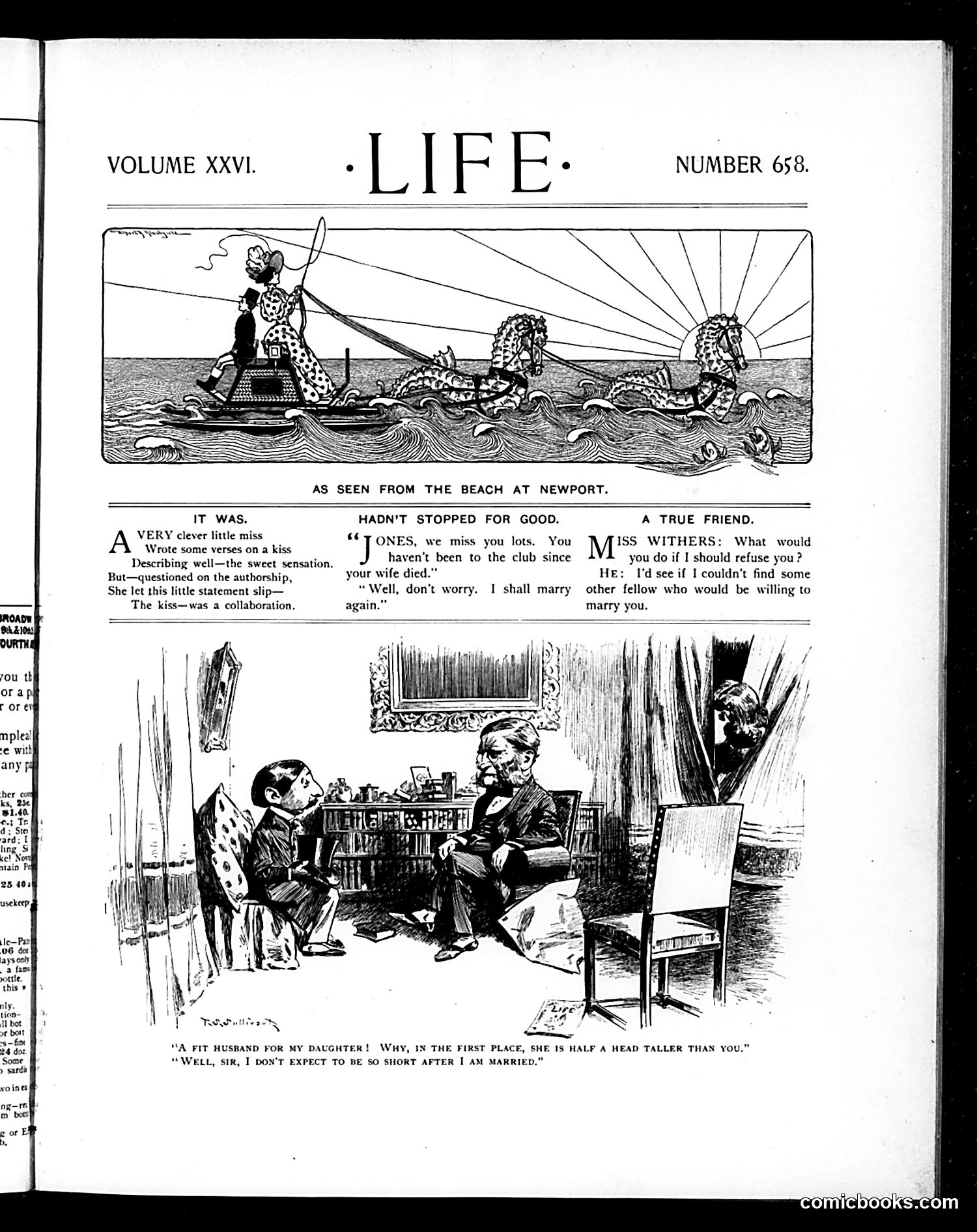
This page contains three separate humorous pieces typical of early 20th-century Life magazine satire. **Top illustration** ("As Seen from the Beach at Newport"): A satirical seaside scene, likely mocking Newport's wealthy social scene and the extravagant displays of the elite during bathing season. **Three short jokes** play on romantic/marital themes common to the era's humor—a woman cleverly describing a kiss, friends commenting on someone's remarriage prospects, and a gentleman offering to find a replacement spouse. **Bottom cartoon**: A father objects to a suitor's height relative to his daughter, with the young man quipping he'll grow taller after marriage. This exploits period anxieties about marriage, class, and physical suitability—humor that assumes readers find the premise of height-based marriage qualification reasonable. The overall tone reflects upper-class social preoccupations of the era.
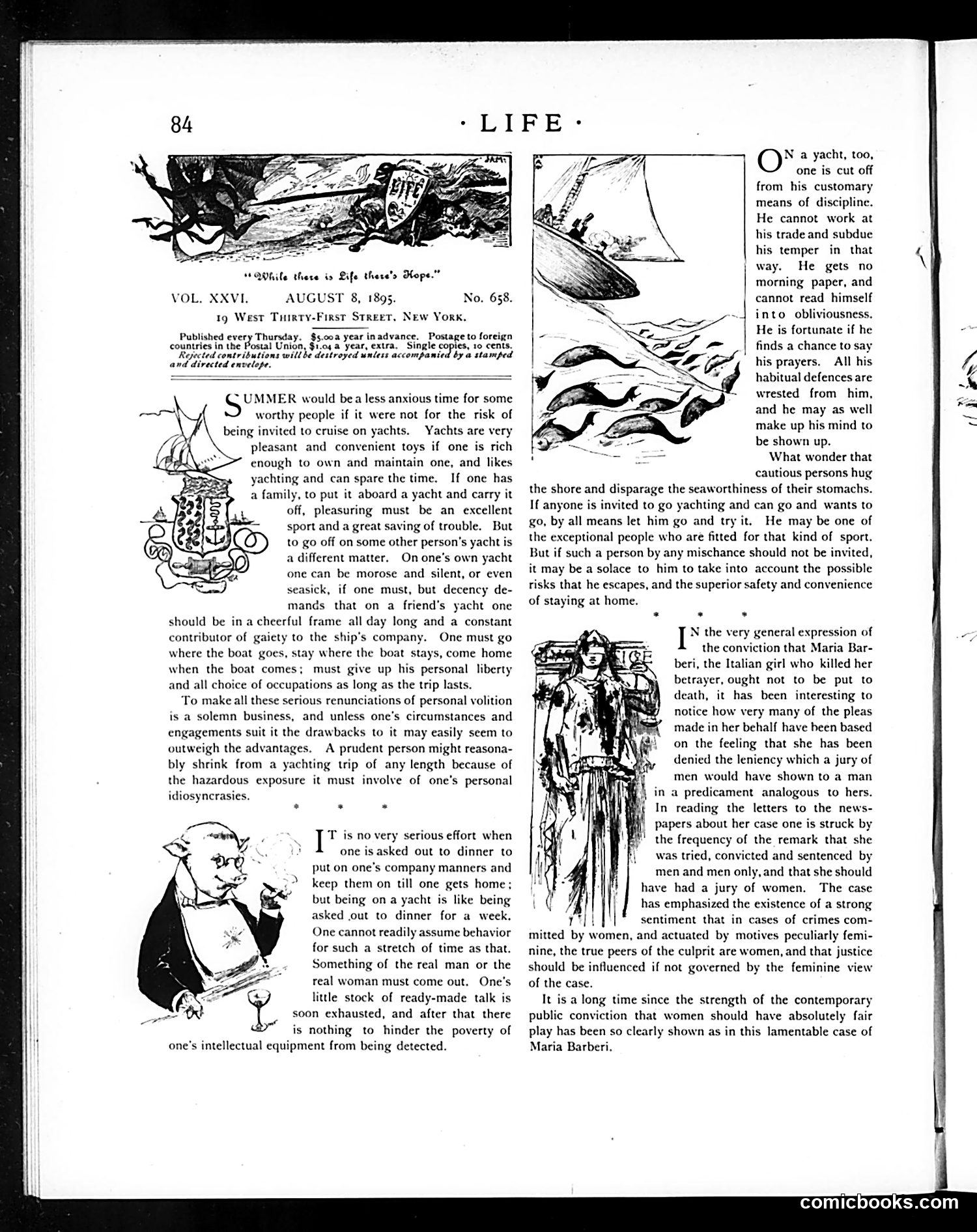
This page discusses yacht etiquette and social expectations among wealthy Americans. The satirical cartoons mock the pretensions and discomforts of yacht culture for the newly rich. The left illustration depicts a portly gentleman struggling during a yacht dinner—the text humorously notes that maintaining "company manners" while seasick reveals one's true character, as "the real man or real woman must come out." The right section transitions to discussing Maria Barberi, an Italian woman executed for killing her seducer. The text argues that her trial highlighted contemporary debates about women's legal equality and justice—specifically that she was tried and sentenced by men exclusively, raising questions about fair legal representation for women in cases involving female defendants. The overall tone combines social satire with serious commentary on gender and the law.
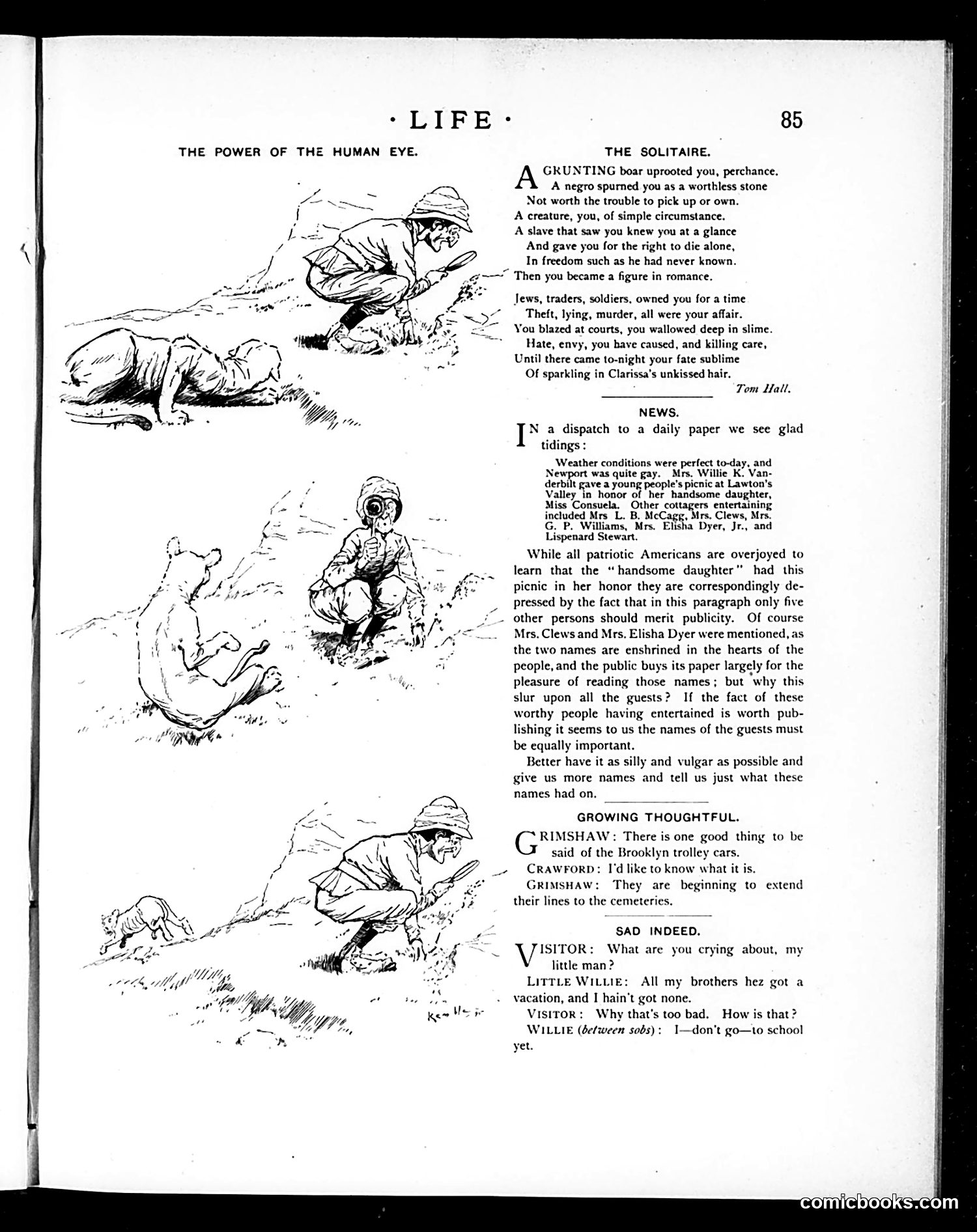
The page contains three distinct sections: **"The Power of the Human Eye"** (left): Sketches showing a person using a magnifying glass to examine objects, illustrating how optical instruments enhance vision—a straightforward instructional illustration rather than satire. **"The Solitaire"** (top right): A poem by Tom Hall about a freed slave experiencing independence after bondage, written from the perspective of the formerly enslaved person reflecting on their newfound freedom. **"News" and humor sections** (bottom right): Brief satirical items mocking social pretension, including criticism of a newspaper's selective name-dropping at a society picnic, and humorous dialogue between characters named Grimshaw and Little Willie about summer vacations and school. The overall tone reflects early 20th-century American magazine satire targeting social vanity and class pretension.
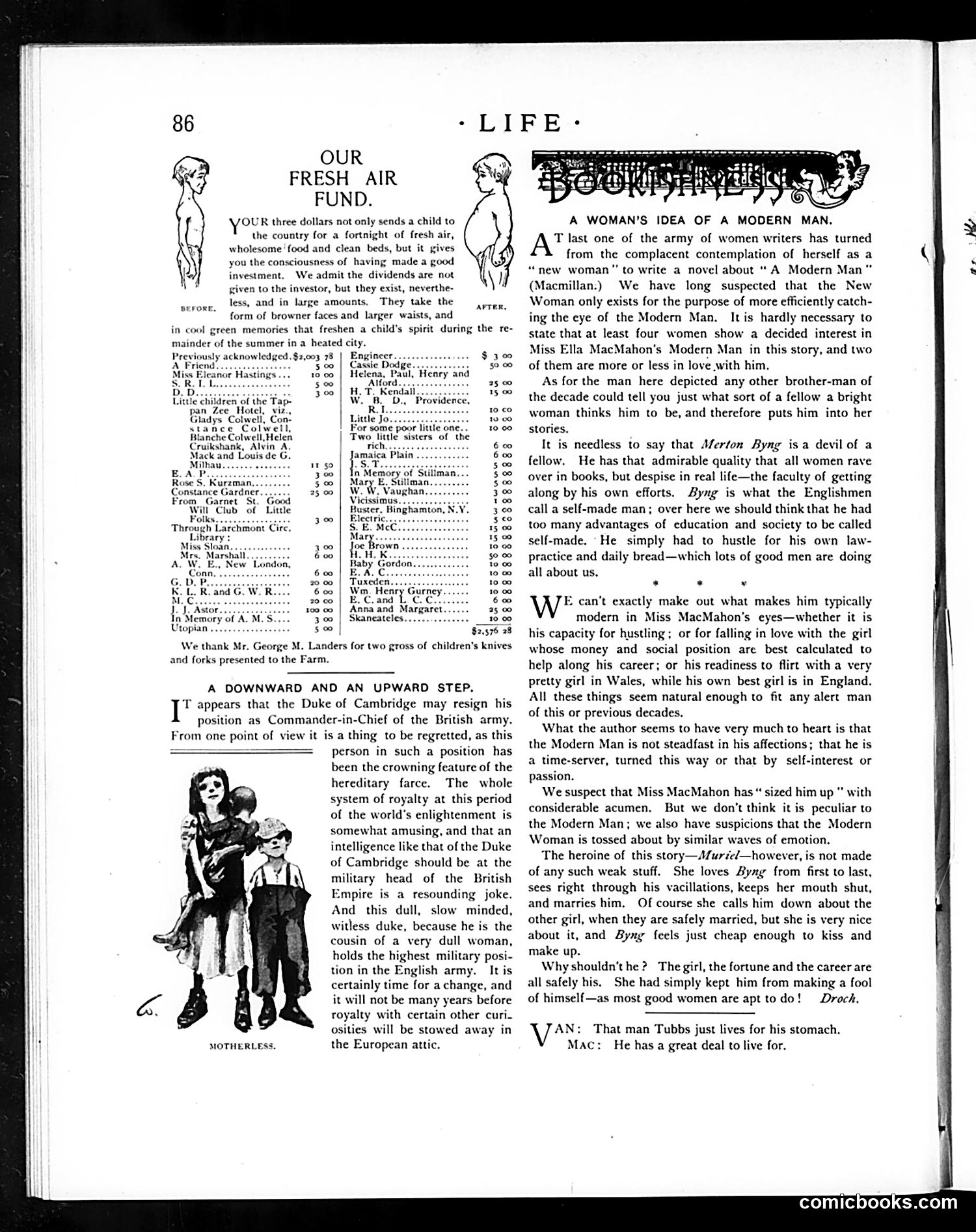
**"Our Fresh Air Fund"** (left): A satirical fundraising list mocking wealthy donors' modest contributions to send poor children to the country. The amounts ($1-6) are trivial, suggesting the wealthy give pittance while congratulating themselves for charity. **"A Woman's Idea of a Modern Man"** (right): A lengthy article critiquing Ella MacMahon's novel *Drac*, which portrays an idealized "Modern Man." The piece sardonically examines what qualities this fictional character embodies—apparently self-made ambition, wealth, and romantic appeal—while questioning whether MacMahon's "Modern Woman" character is equally compelling or merely another literary cliché. **"A Downward and an Upward Step"** (bottom left): Brief commentary on the Duke of Cambridge's potential resignation as British Army head, questioning whether royalty should hold military command positions during wartime.
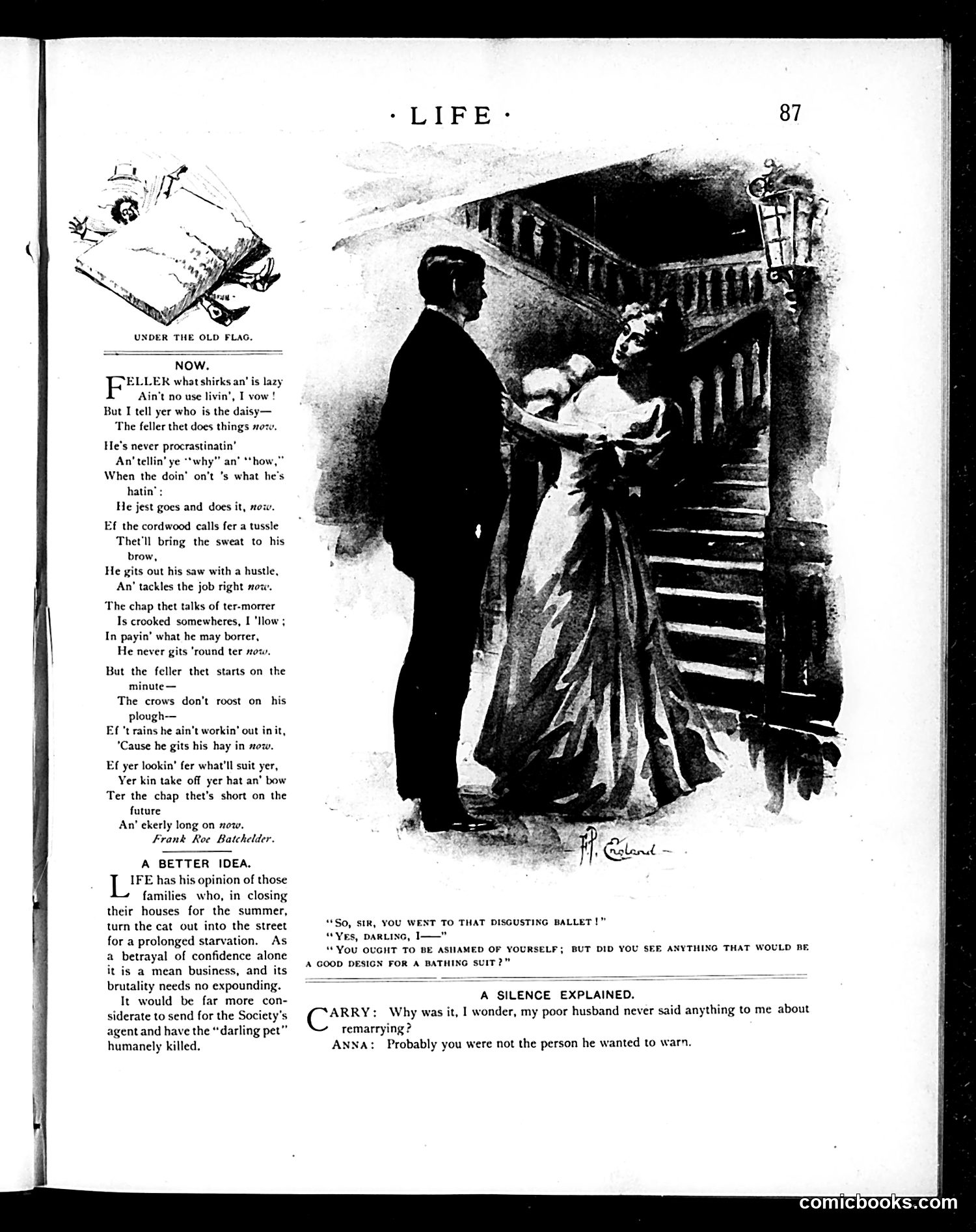
This page contains two distinct pieces of satire: **"NOW"** (left): A poem by Frank Roe Batchelder mocking lazy laborers. The "feller" described works sporadically, makes excuses ("'ow"), and procrastinates—he "never gits 'round ter now." This satirizes working-class attitudes toward labor and responsibility. **"A BETTER IDEA"** (lower left): Social commentary criticizing families who abandon pets during summer vacations, calling it a "mean business" and suggesting they hire the Society's agent instead to humanely handle the "darling pet." **The illustration** (right) depicts a man and woman on stairs in what appears to be a domestic scene, captioned with dialogue about a "disgusting ballet" and bathing suit design. **"A SILENCE EXPLAINED"** (bottom): A brief joke where Anna explains Carry's husband's silence about remarrying by suggesting he didn't consider her worth warning.
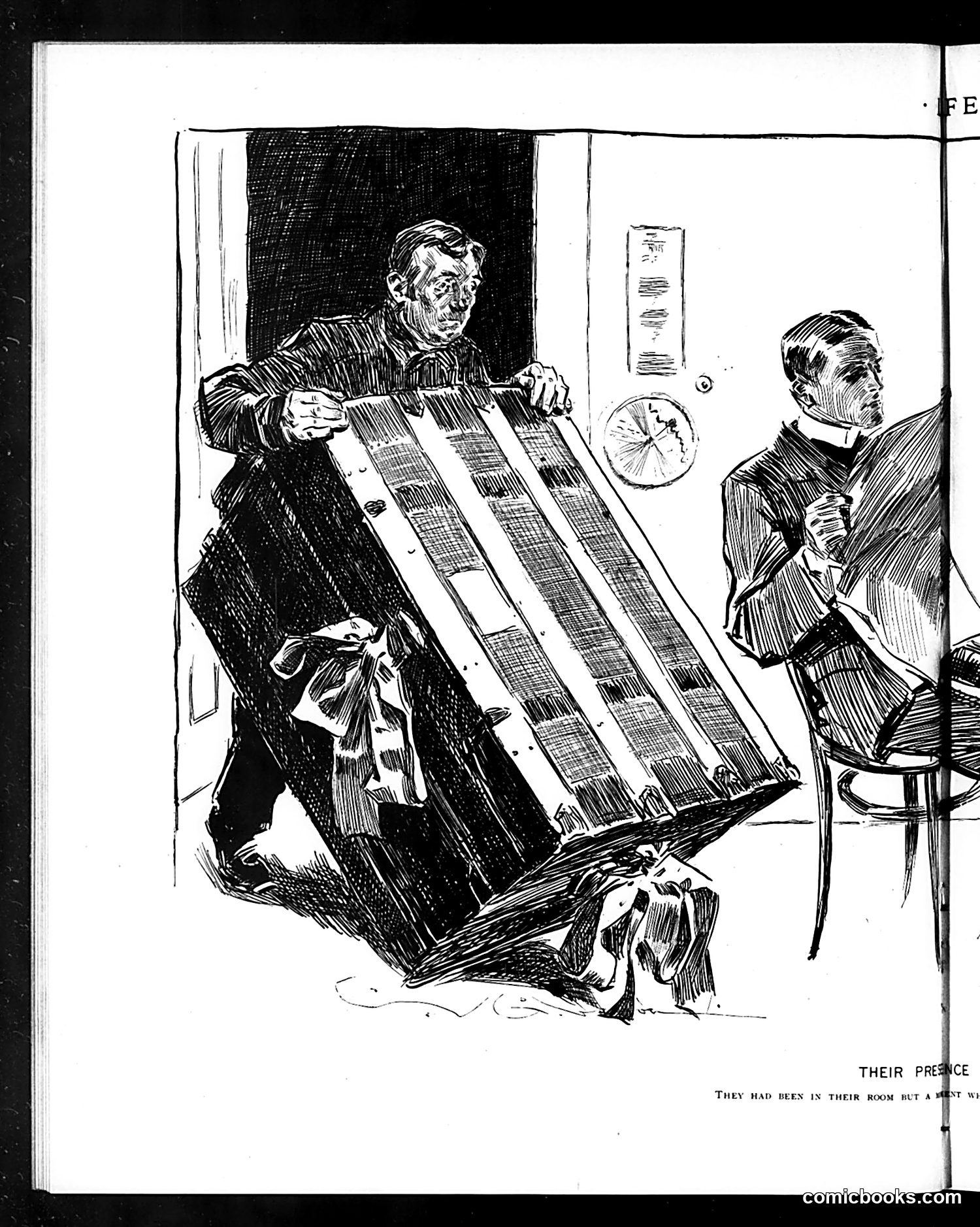
This illustration, titled "Their Presence," depicts two men in an interior space. The man on the left displays a large striped fabric or garment to a seated man on the right, who observes with apparent interest or approval. A clock hangs on the wall, and the setting suggests a tailor's shop or similar commercial space. The partial caption reads: "They had been in their room but a short w[hile]..." (text cut off). Without the complete caption or publication date visible, I cannot definitively identify the specific political or social reference this satirizes. The image appears to be illustrating a narrative scene—possibly commentary on commerce, tailoring, or social interaction—but the precise satirical point remains unclear from the visible page alone. The style suggests early-to-mid 20th century American cartooning.
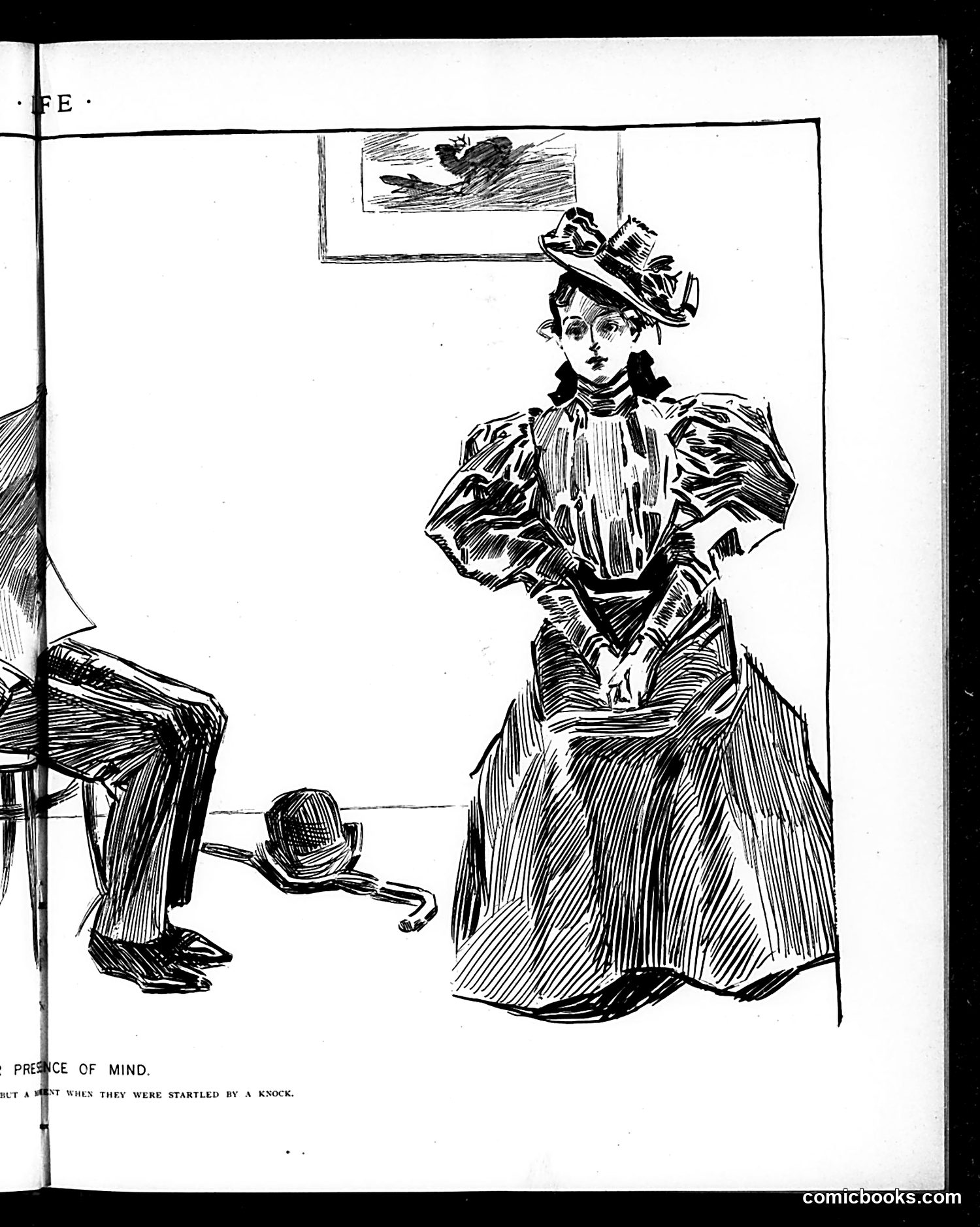
This illustration depicts a Victorian-era social scene showing a woman displaying composure during an awkward moment. The visible text fragment reads "...BUT A JEST WHEN THEY WERE STARTLED BY A KNOCK," suggesting the cartoon illustrates a comedic situation where unexpected visitors have interrupted a private moment. The woman stands in a composed, dignified pose wearing fashionable 1890s attire (puffed sleeves, long skirt, decorative hat), while a man's legs are visible on the left side, apparently hastily concealing himself—likely under furniture or behind a door. The title "Presence of Mind" satirizes the woman's ability to maintain propriety and composure despite the compromising situation, a common theme in period humor about Victorian social etiquette and the gap between public respectability and private behavior.
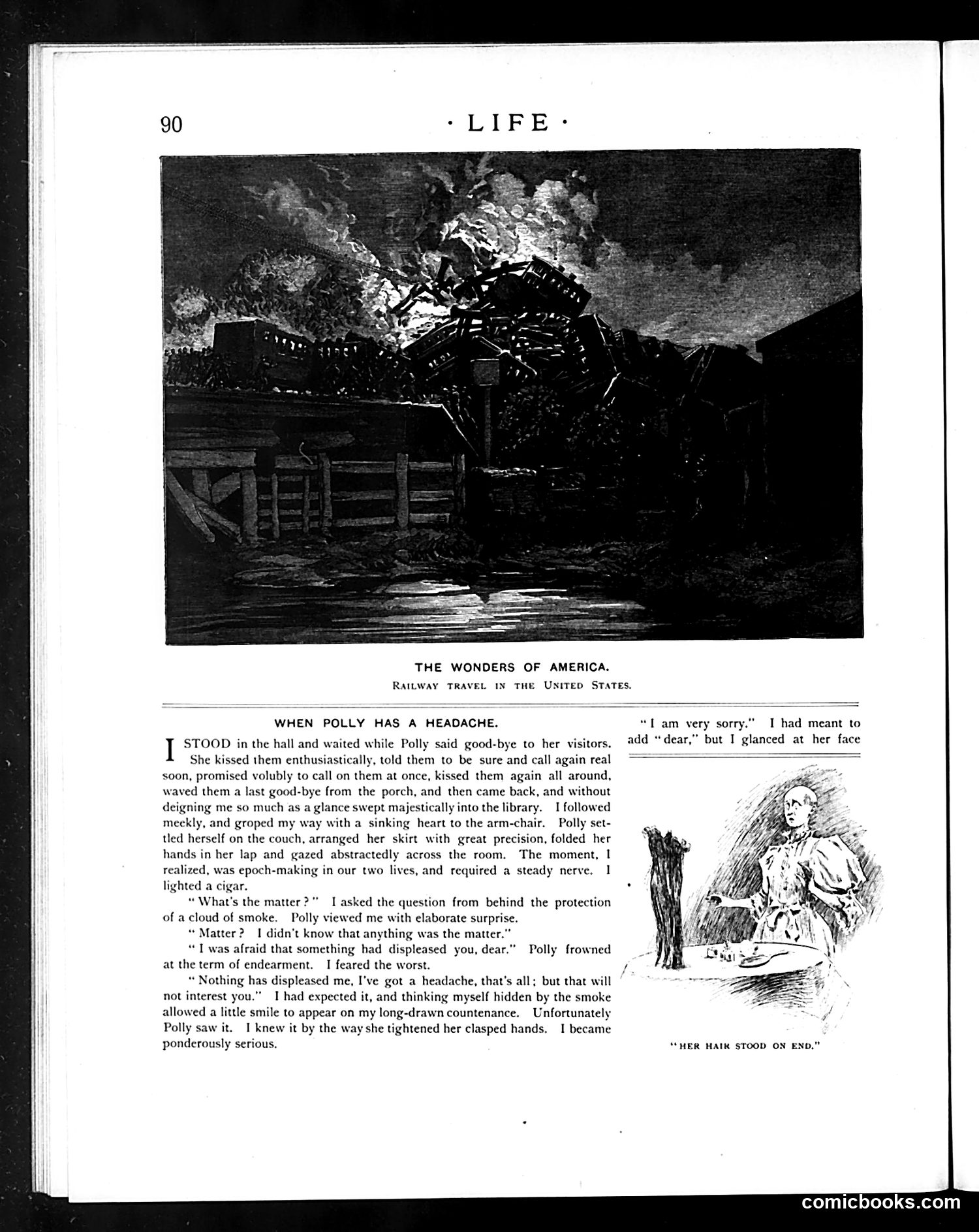
This page contains a narrative story titled "When Polly Has a Headache," illustrated with sketches. It's not political satire but rather domestic fiction about a woman named Polly who has a headache and dismisses her visitor's concerns. The narrator (apparently male) worries silently about her condition while she maintains a composed exterior. The top image showing a steam locomotive crossing a bridge is part of a separate feature titled "The Wonders of America: Railway Travel in the United States"—likely celebrating American industrial and technological achievement, a common topic in early 20th-century Life magazine. This page is primarily light entertainment and industrial boosterism rather than political commentary.
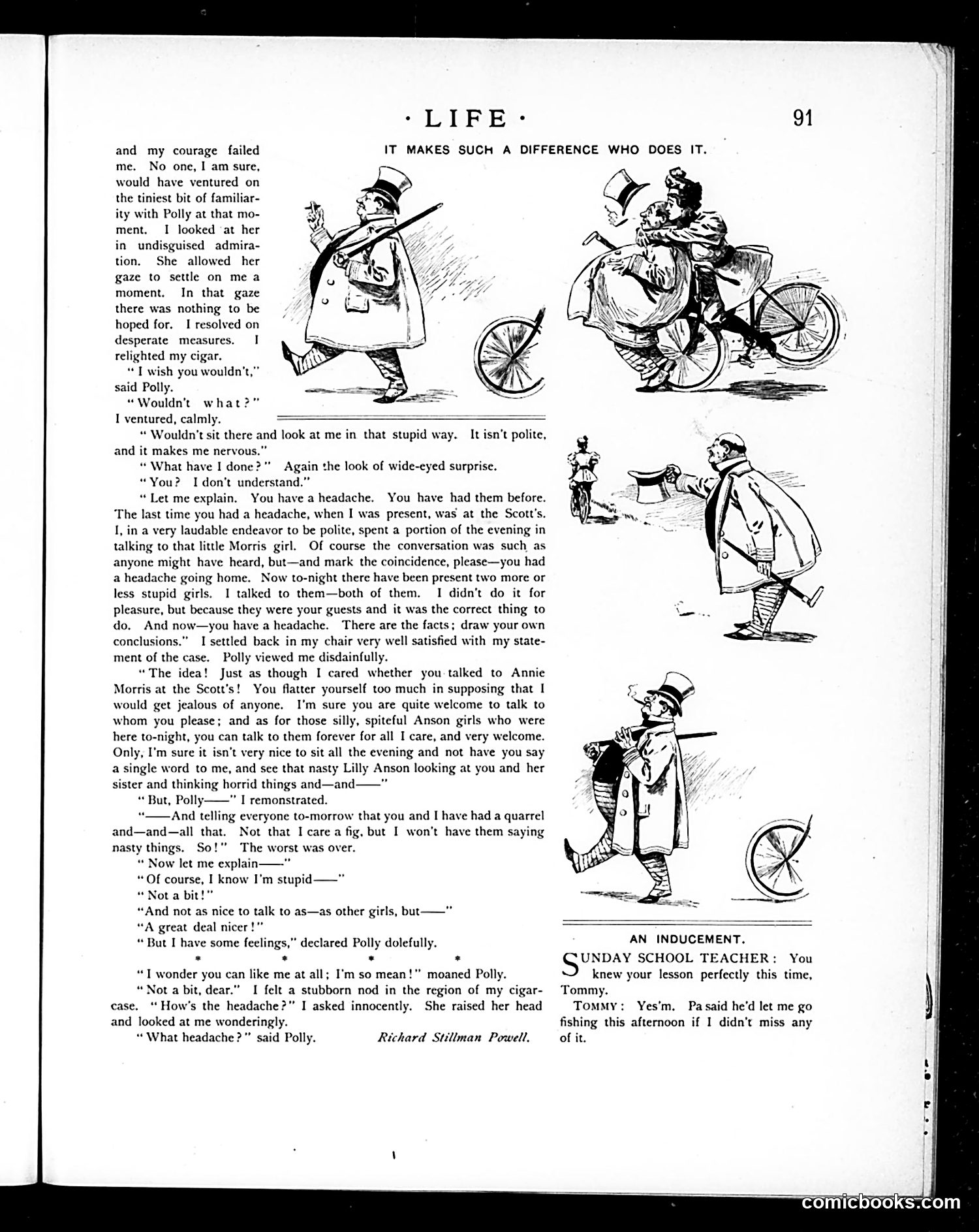
This page contains a fictional narrative by Richard Stillman Powell about social awkwardness, illustrated with six cartoon vignettes showing people with bicycles and top hats. The main narrative concerns a character explaining to "Polly" why she has a headache—apparently caused by the narrator's polite conversation with other girls at a social gathering. The humor stems from the narrator's oblivious, self-absorbed logic: he assumes Polly is jealous, when actually she simply has a headache from an earlier event unrelated to him. The cartoons appear to illustrate various scenarios involving bicycles and gentlemen in formal dress, likely depicting the social mishaps and misunderstandings referenced in the text. The bottom section includes a separate joke about a Sunday school teacher and a boy named Tommy skipping lessons to go fishing.
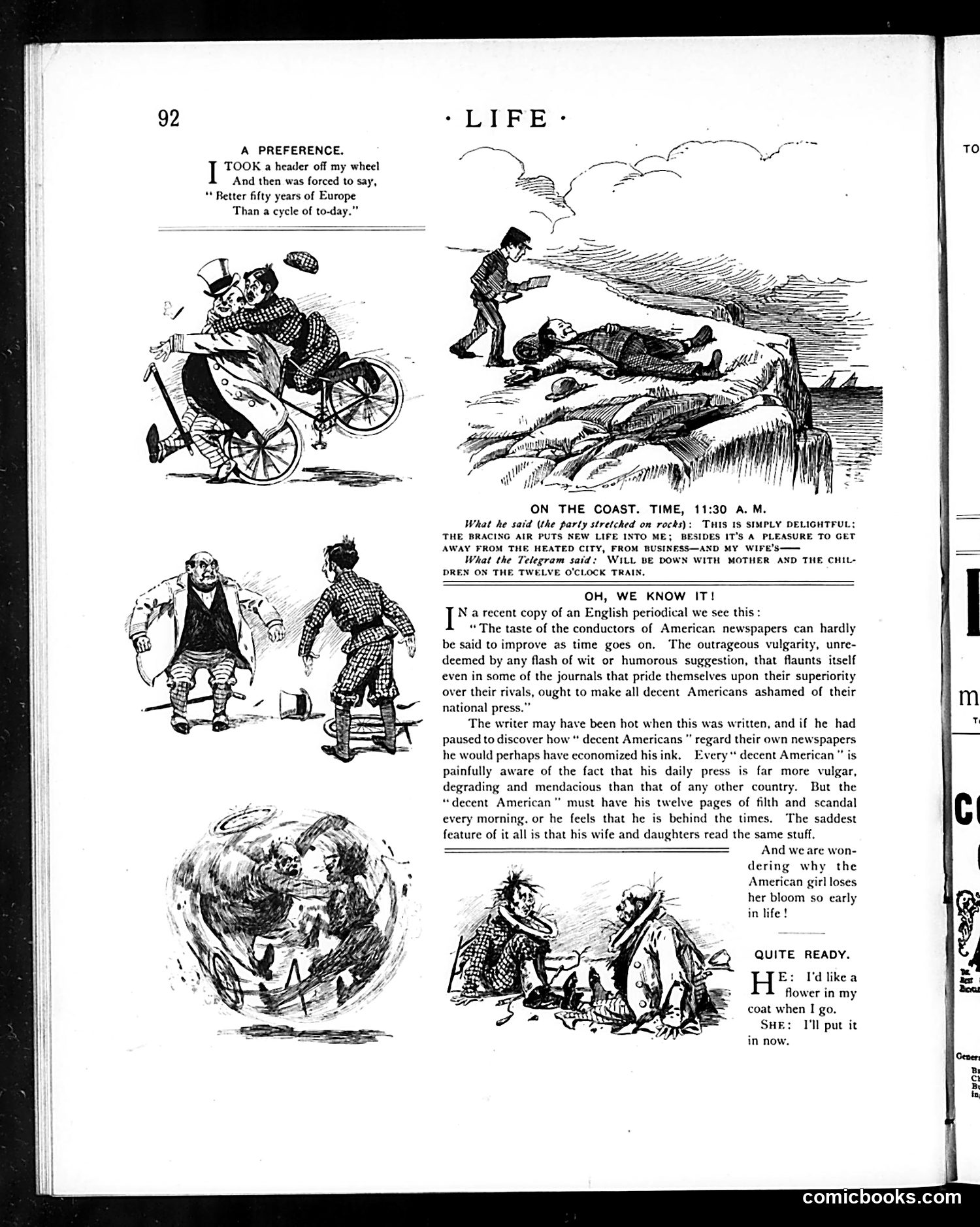
This page satirizes American society's contradictions and moral decline through several connected sketches: **"A Preference"** mocks bicycle accidents as preferable to modern life, quoting Tennyson to suggest nostalgia for European culture over contemporary American conditions. **"On the Coast"** depicts a man claiming to enjoy peaceful seaside leisure while a telegram summons him back to family obligations—satirizing the gap between aspirations and reality. **"Oh, We Know It!"** is the page's centerpiece: an English periodical criticizes American newspapers' vulgarity. The text agrees, arguing that "decent Americans" hypocritically condemn their press while consuming its twelve daily pages of scandal. It darkly suggests this media diet causes American girls to lose their youth prematurely. **"Quite Ready"** shows a couple's brief exchange about a decorative flower, likely commenting on superficial concerns amid deeper social problems. Overall, the page critiques American hypocrisy: citizens claim moral superiority while enabling the sensationalist press they publicly deplore, with harmful effects on society, particularly young women.
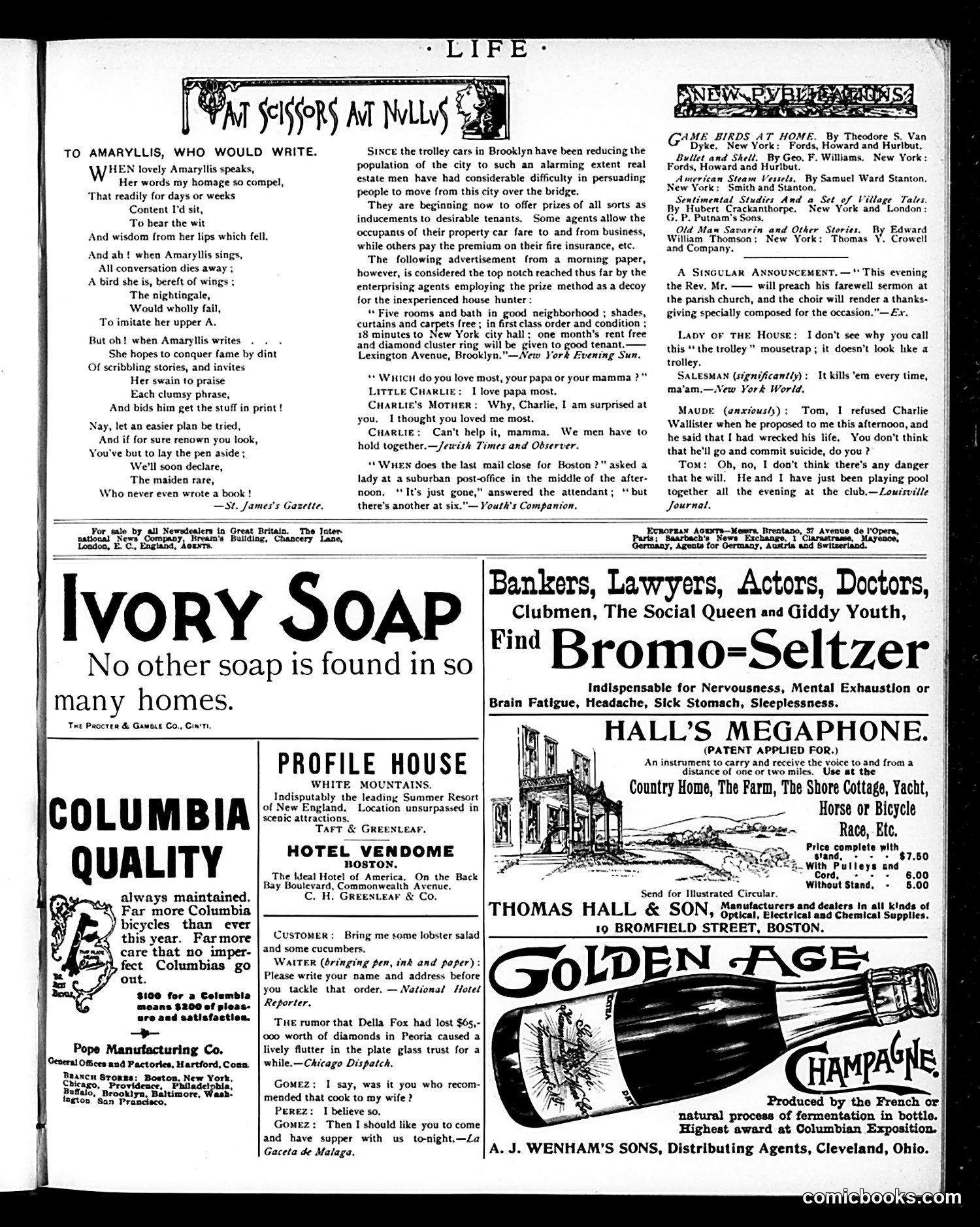
This page is primarily **advertising and humorous filler content** rather than political cartooning. The main elements include: **Literary Content:** A poem titled "Pat Scissors at Nulls" (addressed to "Amaryllis") satirizes women writers—suggesting that an unmarried woman who *never* wrote would gain more fame than one who labors over clumsy prose. This reflects period attitudes dismissing female authorship. **Humorous Anecdotes:** Several brief jokes mock domestic life and social pretension: a child preferring his father, a woman's rejected suitor immediately playing pool afterward (suggesting his "heartbreak" was insincere), and a real estate agent's absurd inducement (offering a diamond ring with a Brooklyn apartment rental). **The Brooklyn Trolley Reference:** A satirical article notes that Brooklyn trolley car accidents were so frequent they discouraged people from moving there—leading desperate real estate agents to offer increasingly ridiculous incentives. **Advertisements:** The page features prominent ads for Ivory Soap, Columbia bicycles, Bromo-Seltzer, Hall's Megaphone, and Golden Age Champagne—typical early-1900s consumer goods. The overall tone is light social satire with no significant political content.
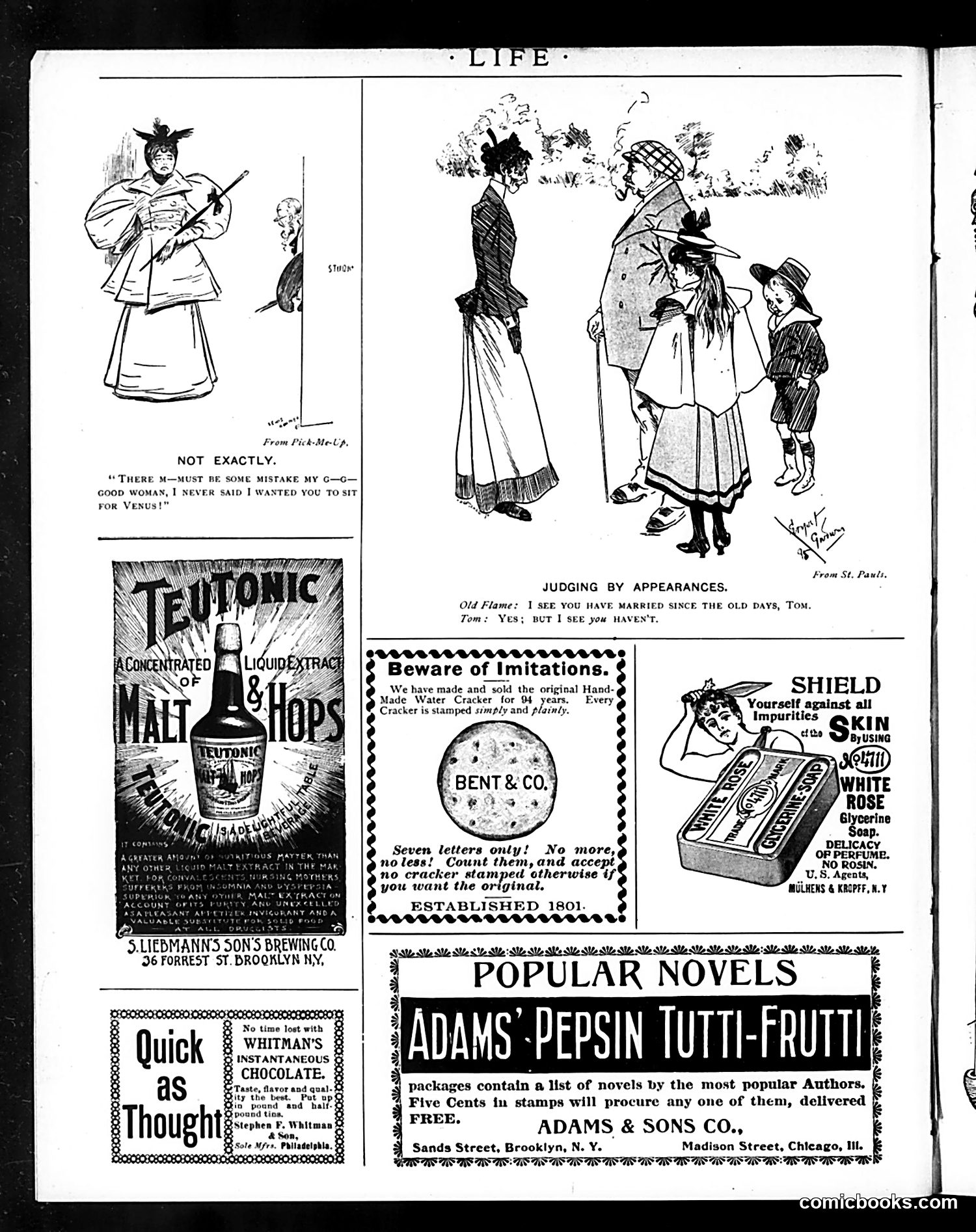
This page combines satirical cartoons with period advertisements. **Top Left Cartoon ("Not Exactly"):** A woman confronts a man about supposedly wanting her to "sit for Venus"—likely a reference to posing for artistic portraits. The humor relies on the man's stammering denial, suggesting he made an inappropriate advance disguised as an artistic request. **Main Cartoon ("Judging by Appearances"):** An old flame encounters a married couple. She notes the man has aged poorly ("haven't" married well), while he's clearly aged worse than she has. The satire targets vanity and how marriage—or lack thereof—affects appearance. **Advertisements:** The bulk of the page comprises period ads: Liebmann's brewing company, Whitman's chocolate, Bent & Co. crackers (warning against imitations), Shield perfume, and Adams' Pepsin Tutti-Frutti novels. These reflect late-19th/early-20th-century consumer goods and mail-order book services typical of Life's revenue model. The page is primarily advertising-driven with two brief, mild humor pieces about courtship and aging.