
Life, 1895-08-08 · page 4 of 14
Life — August 8, 1895 — page 4: what you’re looking at
What you’re looking at
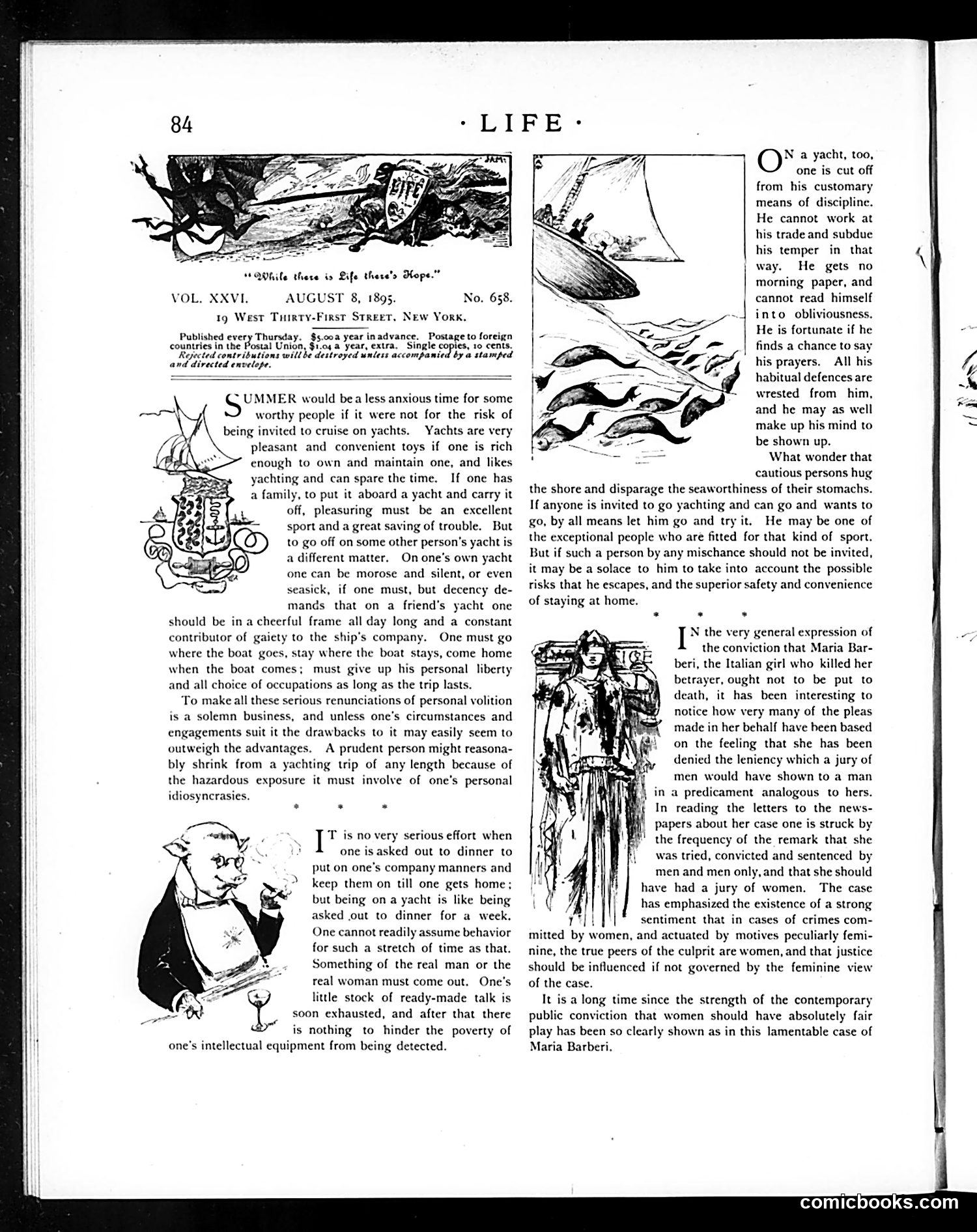
This page discusses yacht etiquette and social expectations among wealthy Americans. The satirical cartoons mock the pretensions and discomforts of yacht culture for the newly rich. The left illustration depicts a portly gentleman struggling during a yacht dinner—the text humorously notes that maintaining "company manners" while seasick reveals one's true character, as "the real man or real woman must come out." The right section transitions to discussing Maria Barberi, an Italian woman executed for killing her seducer. The text argues that her trial highlighted contemporary debates about women's legal equality and justice—specifically that she was tried and sentenced by men exclusively, raising questions about fair legal representation for women in cases involving female defendants. The overall tone combines social satire with serious commentary on gender and the law.
📄 Transcribed text from this page (OCR, searchable)
Machine-transcribed from the original scan — historical spelling and the odd misread are preserved.
VOL. XXVI. AUG 1g West Tuirty-First Street, New York. Published every Thursday. $5.00a year inadvance. Postage to foreign countries in the Postal Union, $1.04 a year, extra. Single copies, 10 cents. Rejected contributions will be destroyed unless accompanied by a stamped and directed envelope. SOMMER would bea less anxious time for some worthy people if it were not for the risk of being invited to cruise on yachts. Yachts are very pleasant and convenient toys if one is rich enough to own and maintain one, and likes yachting and can spare the time. If one has a family, to put it aboard a yacht and carry it off, pleasuring must be an excellent sport and a great saving of trouble. But to go off on some other person's yacht is a different matter. On one’s own yacht one can be morose and silent, or even seasick, if one must, but decency de- mands that on a friend's yacht one should be in a cheerful frame all day long and a constant contributor of gaicty to the ship's company. One must go where the boat goes, stay where the boat stays, come home when the boat comes; must give up his personal liberty and all choice of occupations as long as the trip lasts. To make all these serious renunciations of personal volition is a solemn business, and unless one’s circumstances and engagements suit it the drawbacks to it may easily seem to outweigh the advantages. A prudent person might reasona- bly shrink from a yachting trip of any length because of the hazardous exposure it must involve of one’s personal idiosyncrasies. T is no very serious effort when one is asked out to dinner to put on one’s company manners and keep them on till one gets home; but being ona yacht is like being asked .out to dinner for a week. One cannot readily assume behavior for such a stretch of time as that. Something of the real man or the real woman must come out. One's little stock of ready-made talk is soon exhausted, and after that there is nothing to hinder the poverty of one’s intellectual equipment from being detected. N a yacht, too, one is cut off from his customary means of discipline. He cannot work at his trade and subdue his temper in that way. He gets no morning paper, and cannot read himself into obliviousness. He is fortunate if he finds a chance to say his prayers. All his habitual defences are wrested from him, and he may as well make up his mind to be shown up. What wonder that cautious persons hug the shore and disparage the seaworthiness of their stomachs. If anyone is invited to go yachting and can go and wants to go, by all means let him go and try it. He may be one of the exceptional people who are fitted for that kind of sport. But if such a person by any mischance should not be invited, it may be a solace to him to take into account the possible risks that he escapes, and the superior safety and convenience of staying at home. . . . I N the very general expression of the conviction that Maria Bar- beri, the Italian girl who killed her betrayer, ought not to be put to death, it has been interesting to notice how very many of the pleas made in her behalf have been based on the feeling that she has been denied the leniency which a jury of men would have shown to a man in a predicament analogous to hers. In reading the letters to the news- | papers about her case one is struck by the frequency of the remark that she was tried, convicted and sentenced by men and men only, and that she should have had a jury of women. The case has emphasized the existence of a strong sentiment that in cases of crimes com- mitted by women, and actuated by motives peculiarly femi- nine, the true peers of the culprit are women, and that justice should be influenced if not governed by the feminine view of the case. It is a long time since the strength of the contemporary public conviction that women should have absolutely fair play has been so clearly shown as in this lamentable case of Maria Barberi. comicbooks.com