
Life, 1895-08-08 · page 5 of 14
Life — August 8, 1895 — page 5: what you’re looking at
What you’re looking at
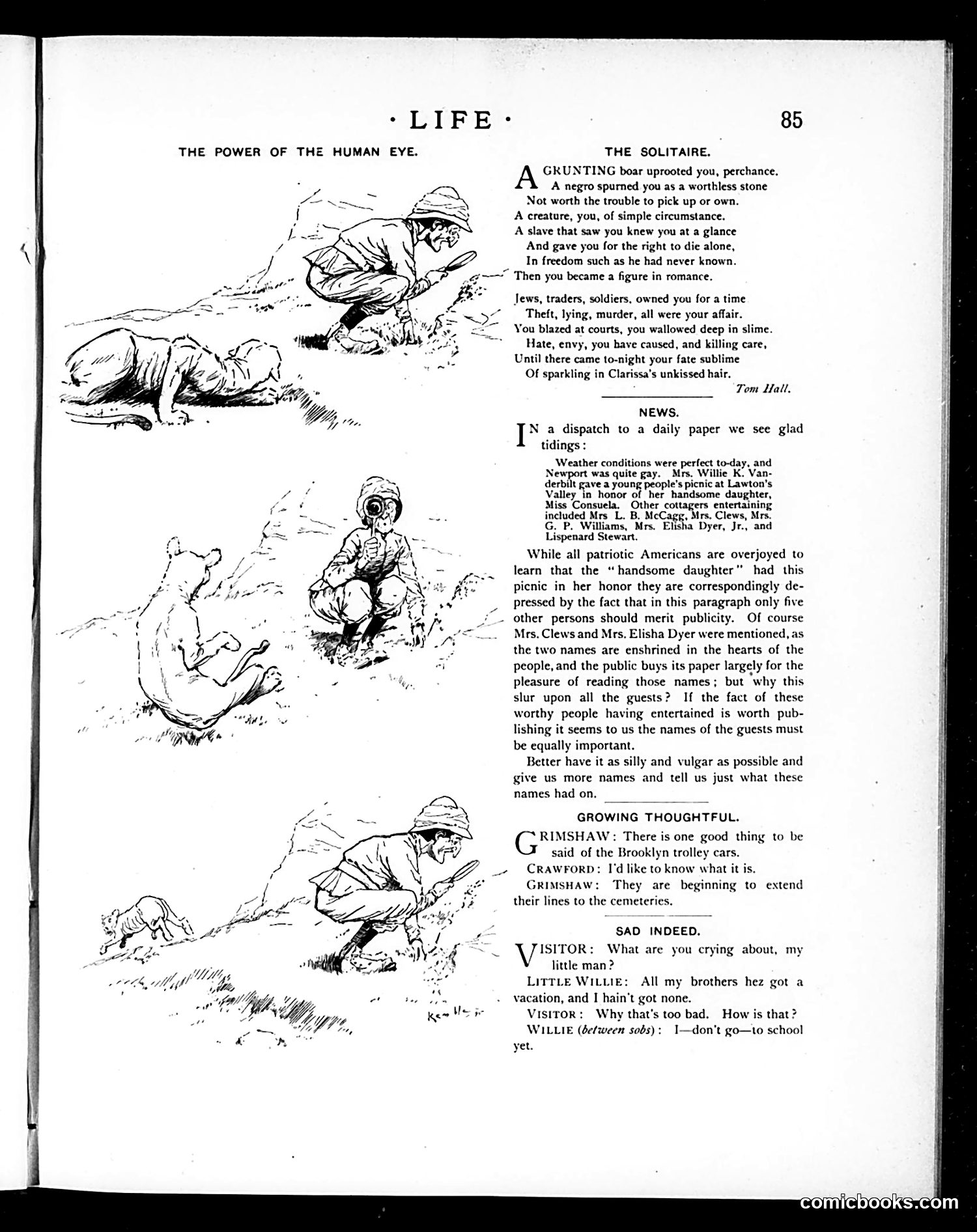
The page contains three distinct sections: **"The Power of the Human Eye"** (left): Sketches showing a person using a magnifying glass to examine objects, illustrating how optical instruments enhance vision—a straightforward instructional illustration rather than satire. **"The Solitaire"** (top right): A poem by Tom Hall about a freed slave experiencing independence after bondage, written from the perspective of the formerly enslaved person reflecting on their newfound freedom. **"News" and humor sections** (bottom right): Brief satirical items mocking social pretension, including criticism of a newspaper's selective name-dropping at a society picnic, and humorous dialogue between characters named Grimshaw and Little Willie about summer vacations and school. The overall tone reflects early 20th-century American magazine satire targeting social vanity and class pretension.
📄 Transcribed text from this page (OCR, searchable)
Machine-transcribed from the original scan — historical spelling and the odd misread are preserved.
*> LIFE: 85 THE POWER OF THE HUMAN EYE. THE SOLITAIRE, GRUNTING boar uprooted you, perchance. A negro spurned you as a worthless stone Not worth the trouble to pick up or own. A creature, you, of simple circumstance. A slave that saw you knew you at a glance And gave you for the right to die alone, In freedom such as he had never known. “ Then you became a figure in romance. Jews, traders, soldiers, owned you for a time Theft, lying, murder, all were your affair. You blazed at courts, you wallowed deep in slime. Hate, envy, you bave caused, and killing care, Until there came to-night your fate sublime Of sparkling in Clarissa’s unkissed hair. Tom Hall. NEWS. a dispatch to a daily paper we see glad tidings : Weather conditions were perfect to-day, and Newport was quite gay. Mrs. Willie K. Van- derbilt gave a young people's picnic at Lawton's Valley in honor of her handsome daughter, Miss Consuela, Other cottagers entertaining included Mrs L. B. McCagg, Mrs. Clews, Mrs. G, P. Williams, Mrs. Elisha Dyer, Jr., and Lispenard Stewart. While all patriotic Americans are overjoyed to learn that the “handsome daughter” had this picnic in her honor they are correspondingly de- pressed by the fact that in this paragraph only five other persons should merit publicity. Of course Mrs. Clews and Mrs. Elisha Dyer were mentioned, as the two names are enshrined in the hearts of the people, and the public buys its paper largely for the pleasure of reading those names; but why this slur upon all the guests? If the fact of these worthy people having entertained is worth pub- lishing it seems to us the names of the guests must be equally important. Better have it as silly and vulgar as possible and give us more names and tell us just what these names had on, GROWING THOUGHTFUL. RIMSHAW: There is one good thing to be said of the Brooklyn trolley cars. CRAWFORD: I'd like to know what it is. GRIMSHAN They are beginning to extend their lines to the cemeteries. Os 0 SAD INDEED. eyo was . \ ISITOR: What are you crying about, my ° 4 little man ? LITTLE WILL! All my brothers hez got a vacation, and I hain't got none. VISITOR: Why that’s too bad. How is that? WILLIE (de/ween sobs): 1—don't go—to school yet.