
A complete issue · 14 pages · 1895
Life — July 25, 1895
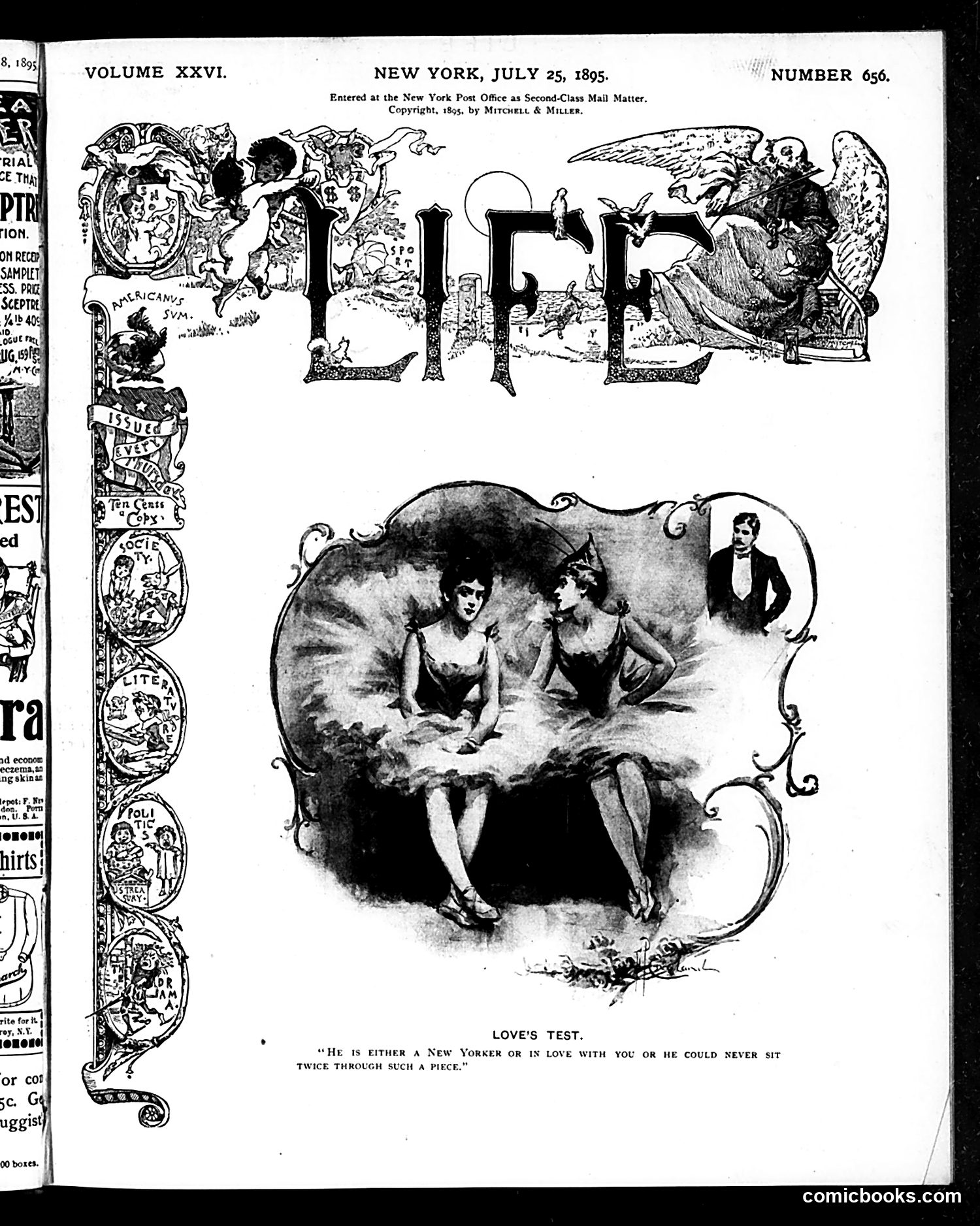
The main illustration depicts a romantic scenario with the caption: "He is either a New Yorker or in love with you or he could never sit twice through such a piece." This is a theatrical satire. The joke critiques either a specific Broadway play or the quality of contemporary theater in New York. The humor relies on the idea that sitting through the same performance twice would be unbearably tedious—unless the viewer is either a devoted New Yorker (culturally obligated to attend) or deeply in love (willing to endure anything for romantic company). The ornate decorative border on the left side is typical of Life's visual style during this period. The piece mocks both theatrical mediocrity and romantic devotion in equal measure.
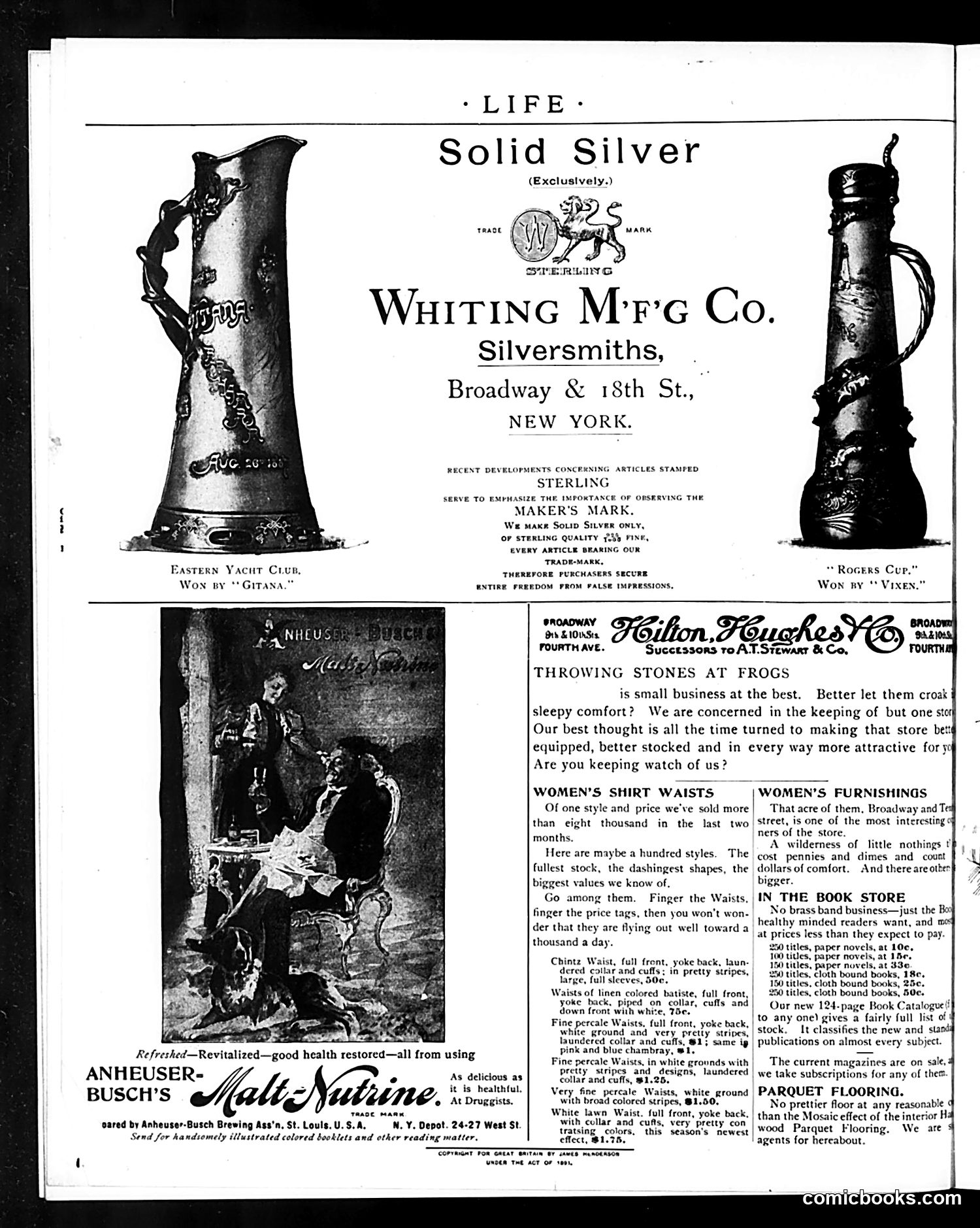
This page is primarily **advertising rather than editorial content**. The top half features a Whiting Manufacturing Company advertisement for sterling silver trophies (the Eastern Yacht Club and Rogers Cup are shown as examples). The lower half contains an **Anheuser-Busch advertisement** for Malt Nutrine, depicting what appears to be a theatrical or medieval scene with figures in period costume. The ad claims the product "refreshed," "revitalized," and "restored good health." The remaining space includes store advertisements (Hilton, Hunkes & Co., a book store, and flooring company) with product descriptions for women's clothing and household goods. There is **no political satire or cartoon commentary** on this particular page—it's a commercial advertising section typical of early 20th-century magazine layouts.
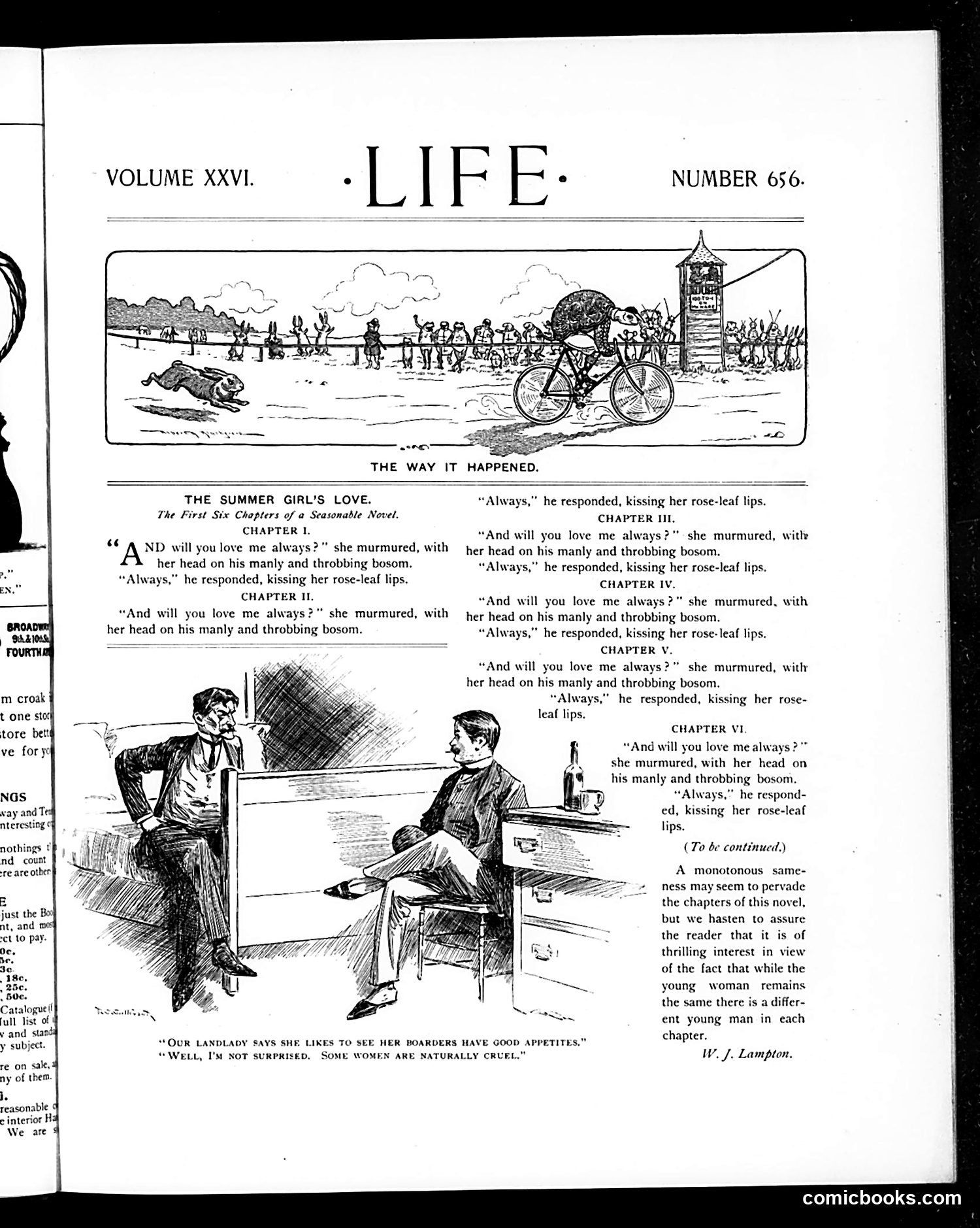
This page features "The Summer Girl's Love," a serialized novel by W.J. Lampton. The content is primarily **literary rather than satirical or political**. The page includes: 1. **Top illustration**: A beach scene showing a bicycle and gathering crowd—likely depicting the story's setting. 2. **Main illustration**: Two figures in what appears to be a boat or seaside setting, with the caption joking about a landlady's observation regarding boarders' appetites and women's cruelty. 3. **Text**: Six short chapters of romantic dialogue, repetitively alternating the same exchange between a couple about eternal love and rose-leaf kisses. The commentary notes the "monotonous sameness" while assuring readers of the story's "thrilling interest." This appears to be **light entertainment fiction** rather than social or political satire.
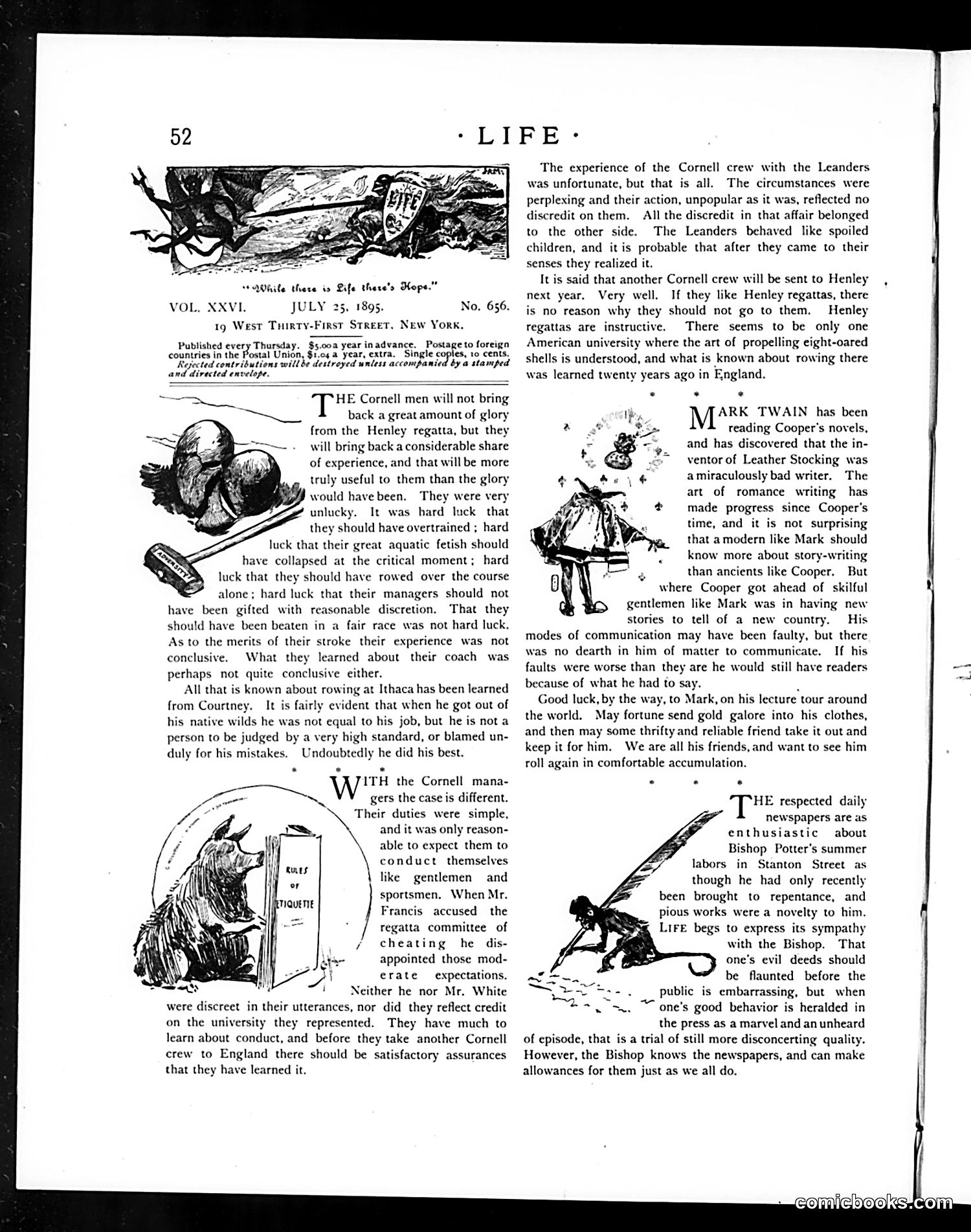
This page contains three satirical cartoons about rowing competitions and social commentary: 1. **Cornell Crew Cartoon (left)**: Mocks Cornell University's rowing team's poor performance at Henley Regatta in England. The text suggests their managers failed to properly prepare them, comparing their "hard luck" to their incompetence. 2. **Middle Cartoon**: Shows a figure labeled with "Rules of Etiquette"—appears to satirize gentlemanly conduct expectations, though the specific reference is unclear. 3. **Right Cartoons**: Include commentary on Mark Twain's literary criticism of James Fenimore Cooper, and a separate item about Bishop Potter's recent conversion to Christianity, mocking the novelty of his "repentance." The overall tone is typical 1890s satirical humor targeting institutional failures and social hypocrisy.
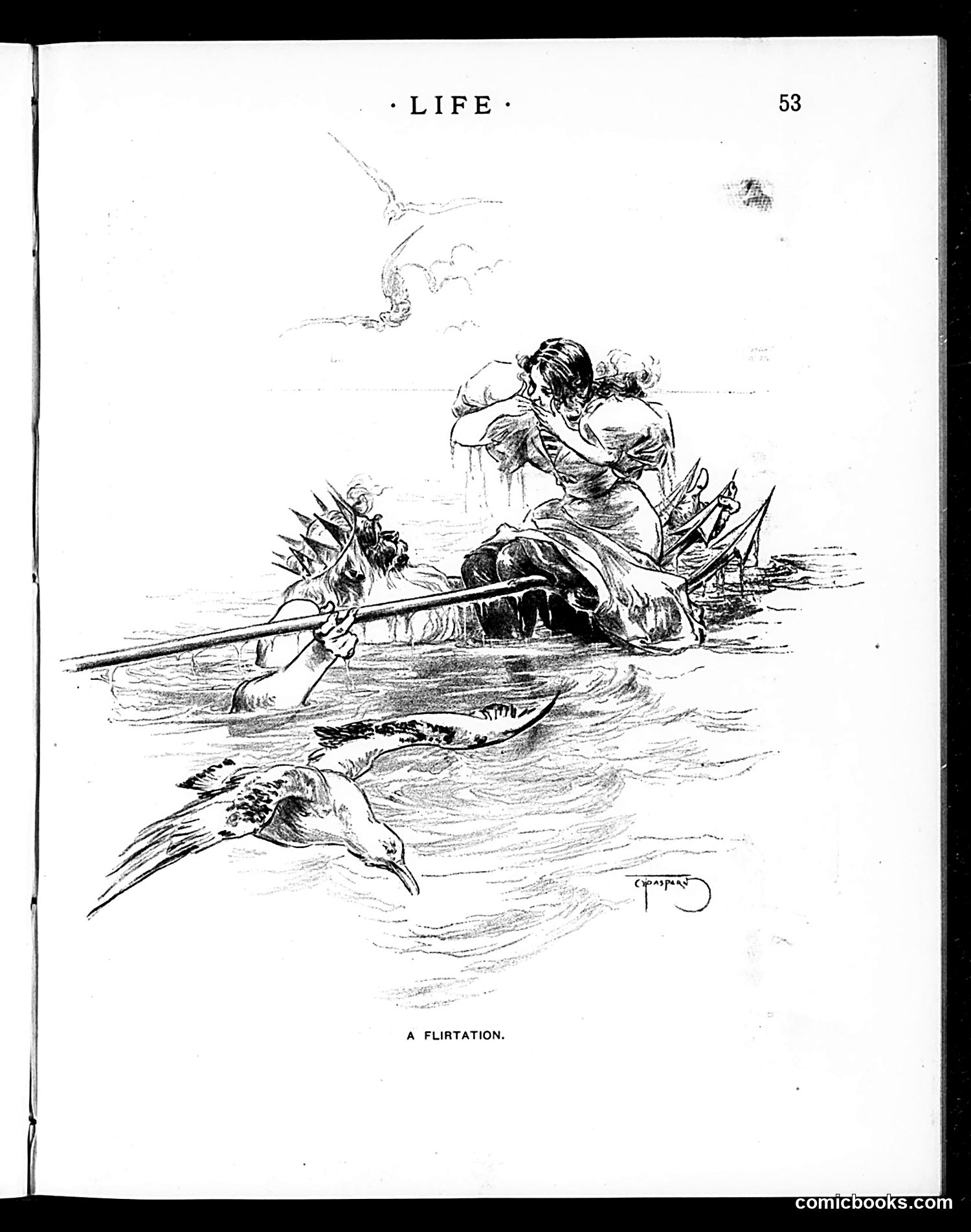
This satirical illustration depicts a romantic scene between two figures by water, titled "A Flirtation." The drawing shows a woman and man in an intimate moment, with the woman appearing to recline or lean toward the man. Various sea creatures—including what appear to be fish or marine life—are visible in the water below them. The cartoon's humor likely operates on multiple levels: a visual pun playing with the notion of "flirtation" in a literal aquatic setting, or possibly commentary on courtship rituals. Without additional context about the specific issue's date or political climate, the precise satirical target remains unclear, though the art style and composition suggest early-to-mid 20th century American humor focused on romantic or social conventions.
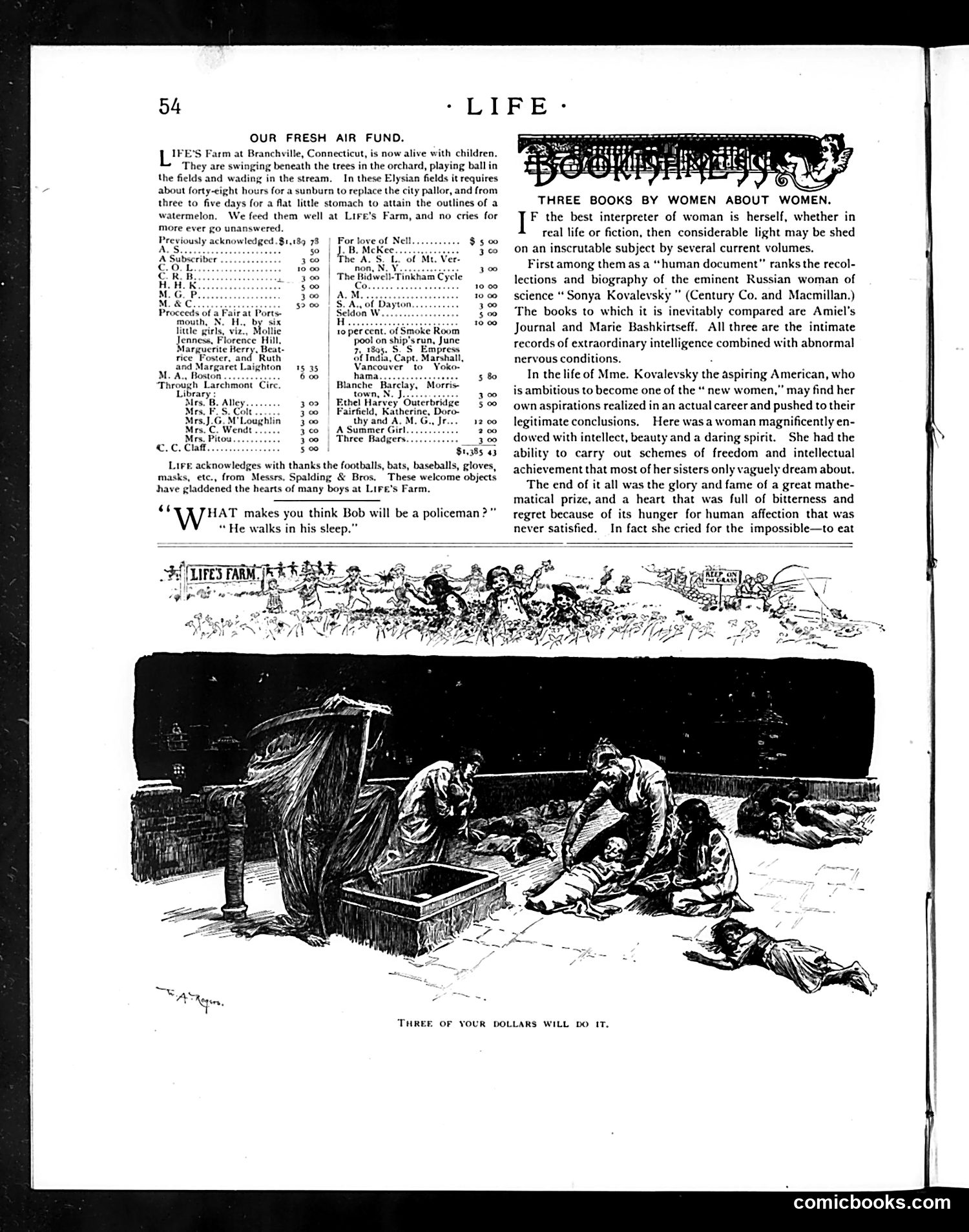
This page combines a charitable appeal with social commentary. The upper section discusses "Our Fresh Air Fund," soliciting donations for children's vacations from city life. A list of contributors and their donations appears alongside. The main cartoon below depicts extreme poverty—emaciated children and adults in what appears to be a slum or tenement setting. A figure in tattered clothing stands over a coffin or box, while desperate figures cluster nearby. The caption reads "THREE OF YOUR DOLLARS WILL DO IT," linking the Fresh Air Fund appeal directly to this harsh visual reality. The satire critiques the contrast between wealth and urban poverty in early 20th-century America, suggesting that modest donations could alleviate such suffering. The cartoon's unflinching depiction of deprivation serves as both a moral call and implicit indictment of systemic inequality.
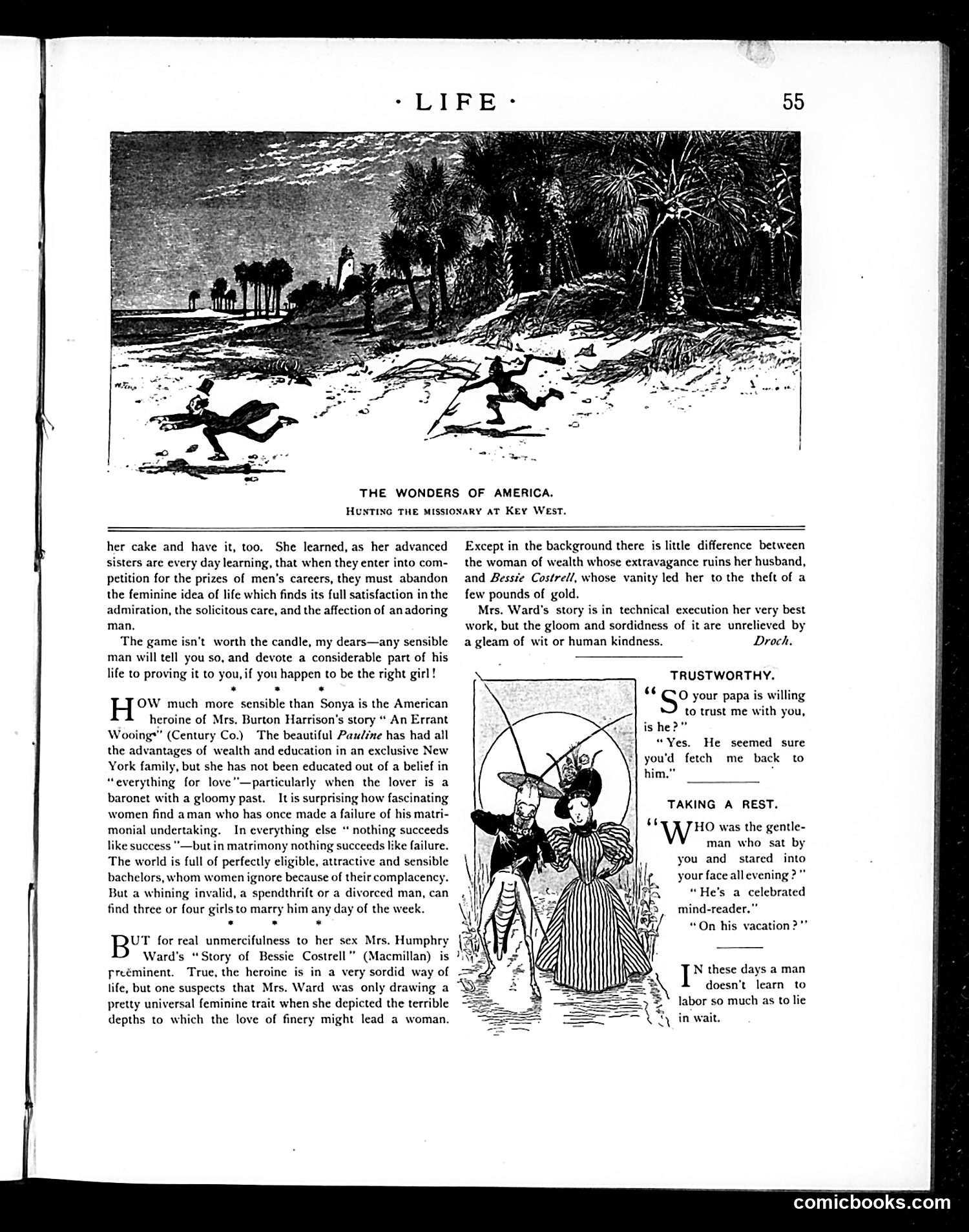
This page from *Life* magazine contains **book reviews** rather than political cartoons. The main content discusses two novels about women: 1. **"Pauline"** by Mrs. Harrison's story—praised as more sensible than typical heroines, depicting an American woman who chooses not to marry despite pressure, rejecting the notion that "everything for love" defines feminine success. 2. **"Story of Bessie Costrell"** by Mrs. Humphry Ward—critiqued as depicting how far a woman's love might lead her into moral compromise, described as exploring "sordid" depths of feminine emotion. The satirical point appears to be commentary on **late-Victorian/Edwardian attitudes toward women's choices**: the contrast between idealized feminine self-sacrifice and realistic depictions of women's moral agency. The small illustrations are decorative rather than satirical.
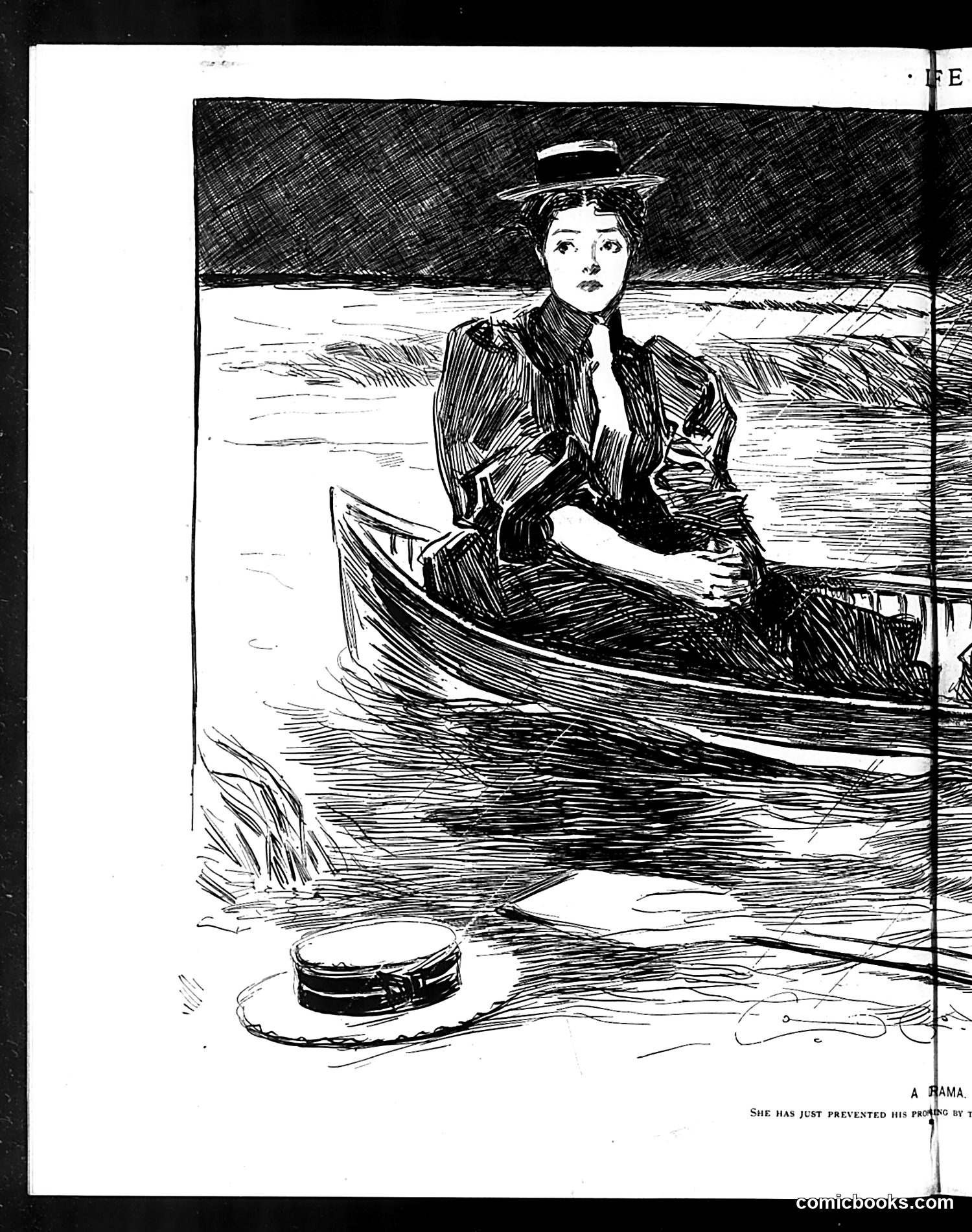
This is a satirical illustration from *Life* magazine showing a woman in a small rowboat on water, wearing a boater hat and striped jacket. She has just knocked a man's hat overboard—visible floating in the water below. The caption reads: "She has just prevented his proposing by..." (text cuts off). The satire targets late 19th/early 20th-century courtship conventions. The joke depicts a woman taking decisive action to reject an unwanted marriage proposal before it can be made—by creating an awkward situation (the lost hat) that disrupts the romantic moment. This mocks both the inevitability of male proposals and suggests women's growing agency in controlling their own romantic futures, satirizing traditional gender roles and courtship rituals of the era.
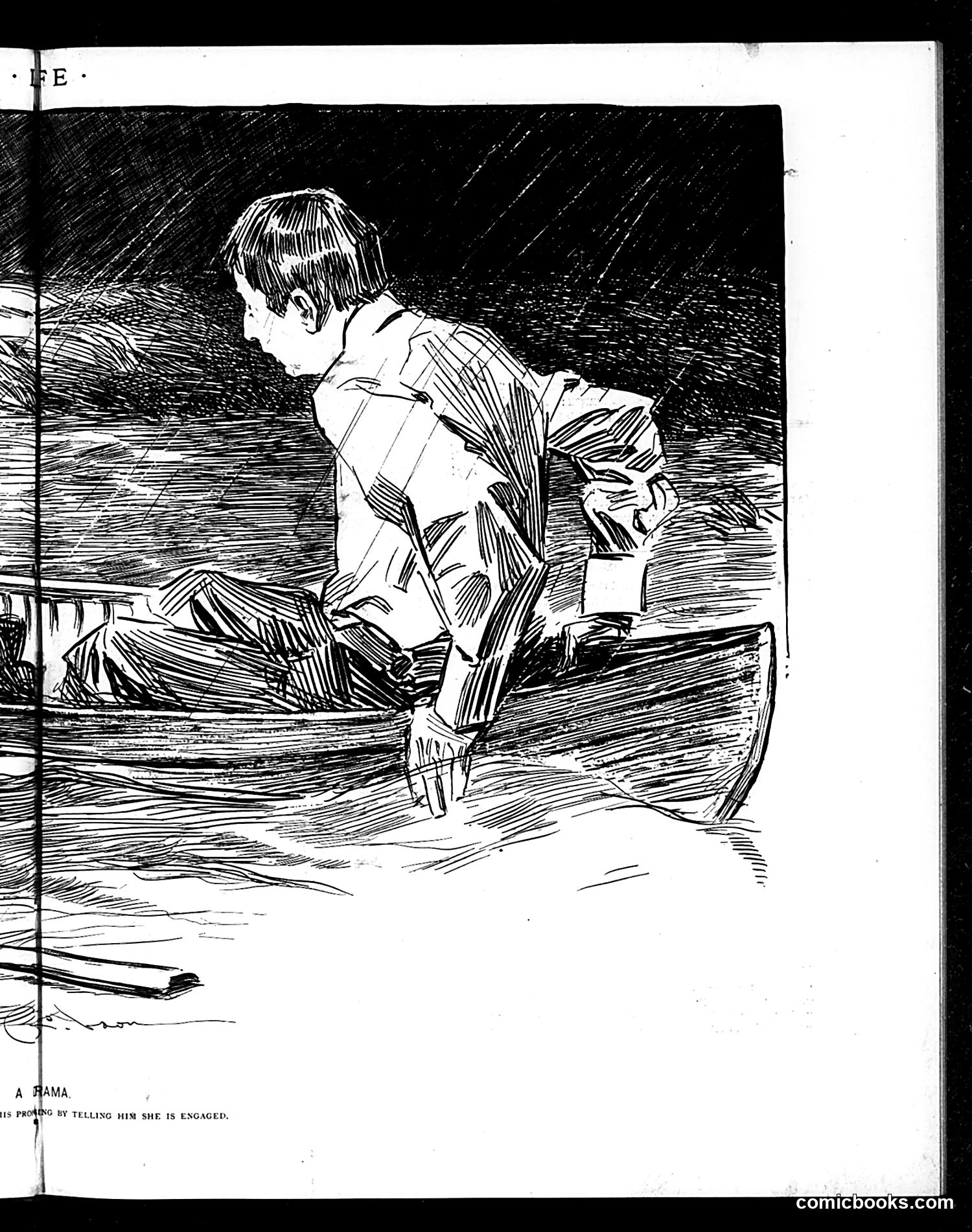
This page shows a single illustration titled "A DRAMA" with caption "HIS PROVING BY TELLING HIS SHE IS ENGAGED." The sketch depicts a man in formal attire (suit and tie) leaning toward a woman seated on what appears to be a bench or seat. The artistic style uses cross-hatching typical of early 20th-century satirical prints. The satire appears to target social awkwardness around marriage proposals or romantic announcements. The caption suggests the man is "proving" something by informing the woman of an engagement—likely his own engagement to her, or possibly revealing a complication in their relationship. The dramatic, emotional body language and setting suggest this is meant as humorous commentary on Victorian or Edwardian courtship customs and the anxiety surrounding such declarations. The specific context or identity of any real figures is unclear from the image alone.
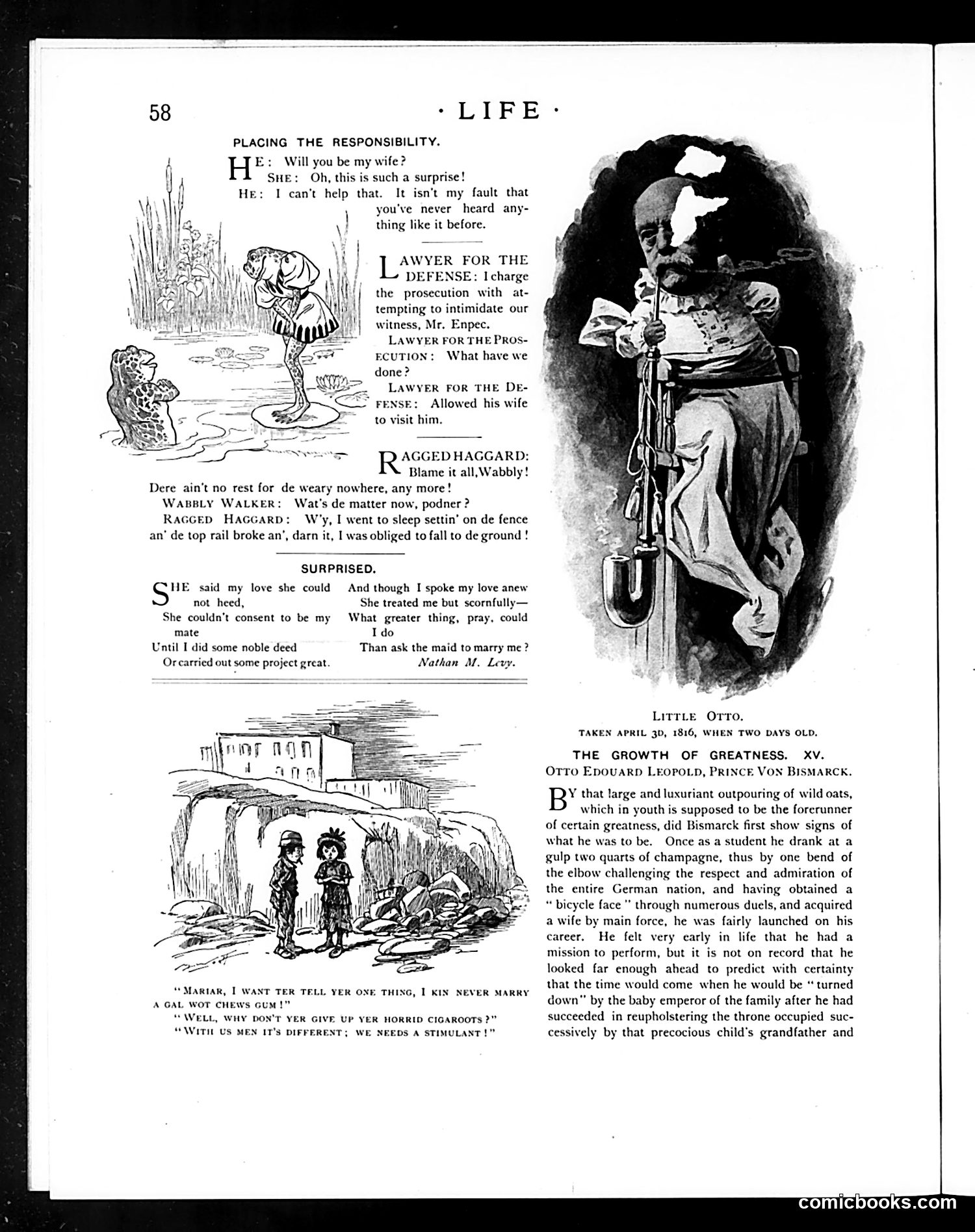
This page contains three distinct sections of satirical humor: 1. **"Placing the Responsibility"** (top): A dialogue-based cartoon about a marriage proposal, with lawyers debating blame for the unexpected engagement. The satire mocks legal procedures and courtroom language applied to romantic matters. 2. **"Surprised"** (middle): A poem by Nathan M. Levy about love and marriage, suggesting a man performed great deeds hoping to win a woman's hand—only to have her request he ask the maid to marry him instead. The humor derives from the twist ending and inverted expectations. 3. **"Little Otto"** (bottom right and text): A biographical sketch about Otto Eduard Leopold, Prince von Bismarck, emphasizing his youthful wildness and aggressive personality that foreshadowed his later political dominance. The accompanying street scene illustration shows children in poverty. The page blends romantic comedy with historical commentary typical of Life's satirical approach.
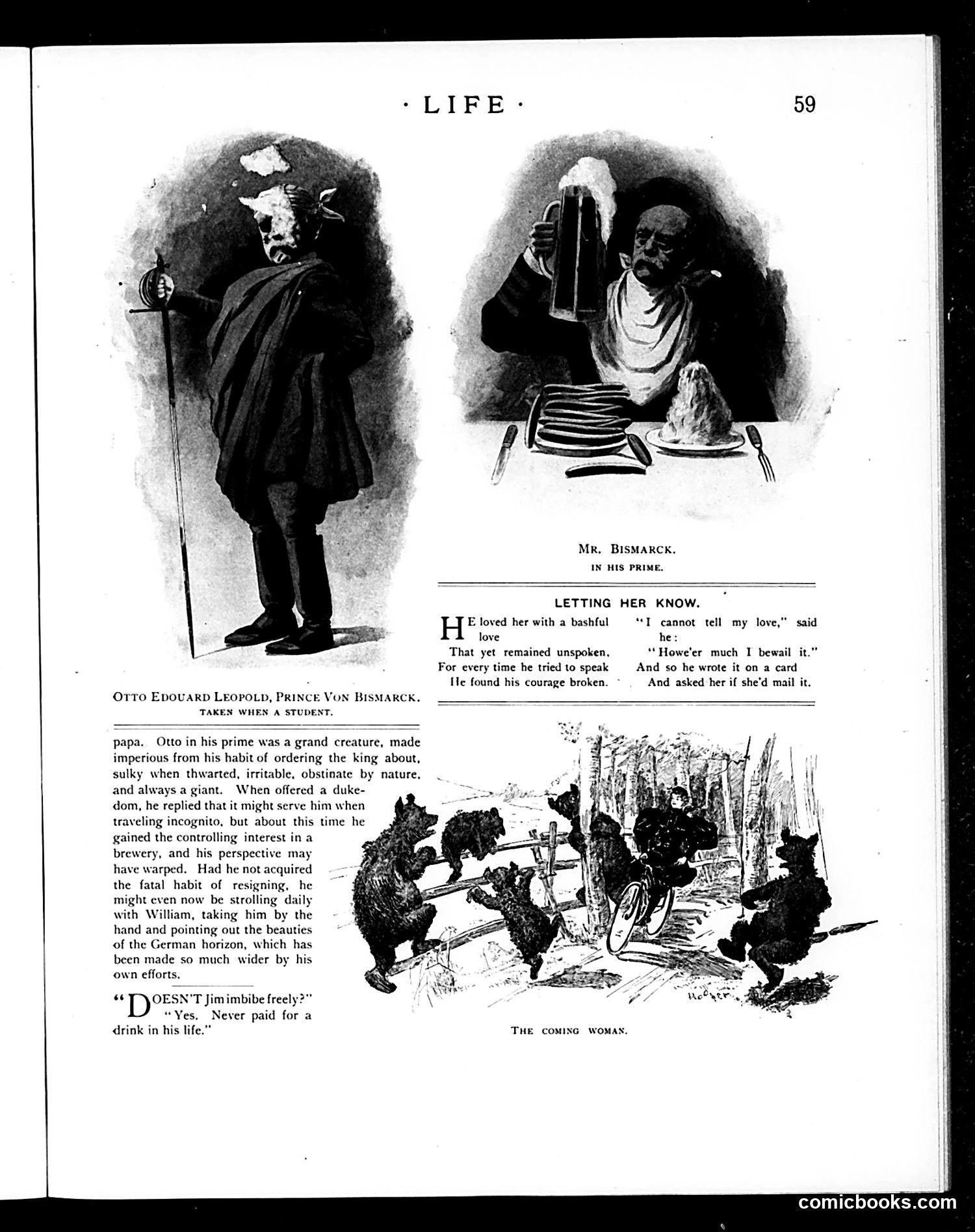
This page features caricatures of **Otto Eduard Leopold, Prince von Bismarck**, the Prussian statesman. The left illustration shows him as a student, depicted in a characteristic pose with a cane—emphasizing his imperious personality and habit of ordering authority figures around. The right illustration, titled "Mr. Bismarck in His Prime," shows him at a dining table, illustrating the accompanying text's characterization of him as commanding and dominant even in casual settings. The satirical text mocks Bismarck's arrogance and his control over those around him, including a narrative about him attempting to express love but being too proud to do so directly. The humor derives from portraying this powerful political figure as emotionally constrained by his own domineering nature—a pointed critique of his personality and influence.
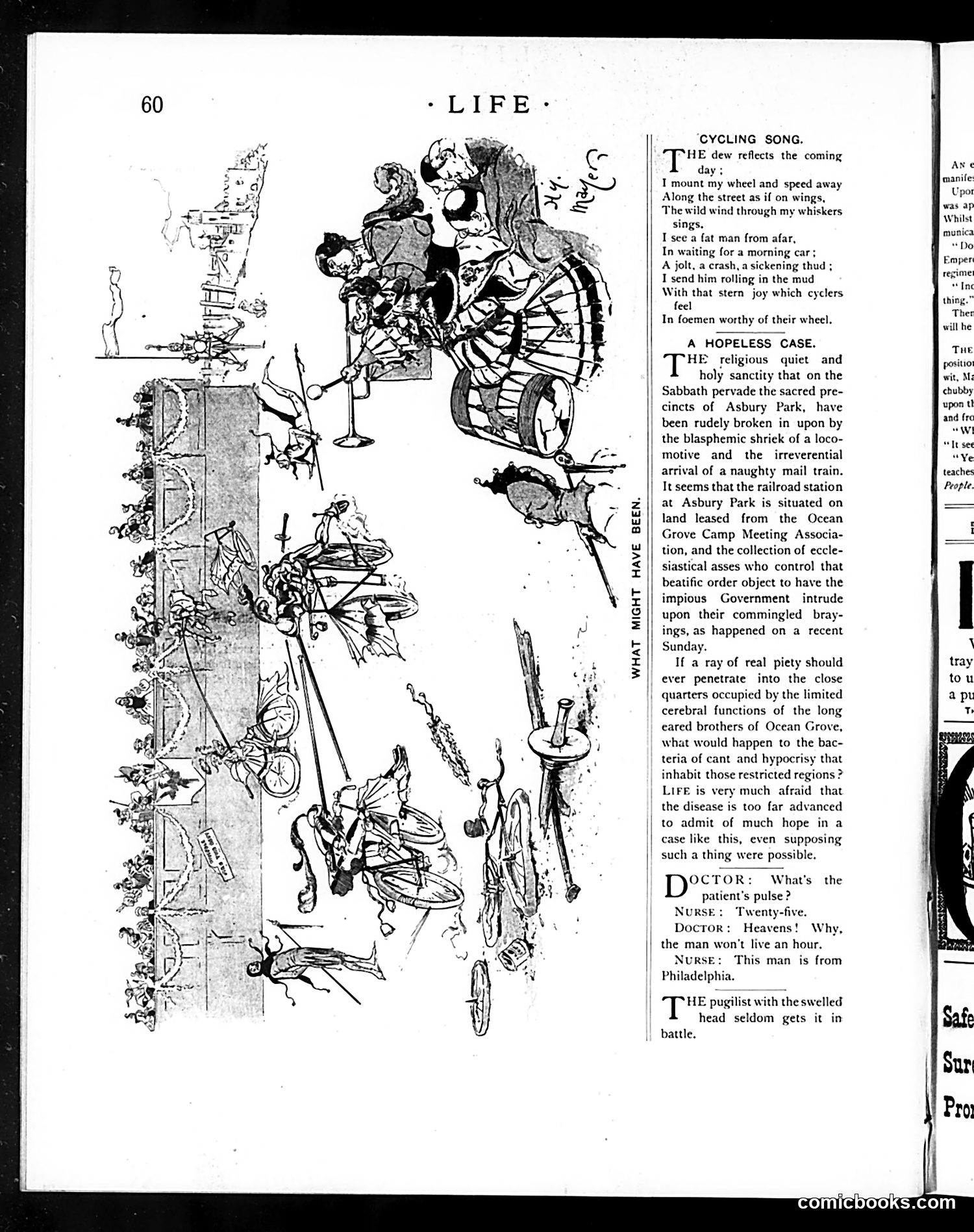
This page from *Life* magazine contains humorous commentary on contemporary issues, primarily through text rather than political cartoons. The **"Cycling Song"** celebrates the new bicycle craze, depicting cyclists as reckless—the narrator gleefully describes hitting a "fat man" and sending him rolling in mud, viewing him as a worthy "foe." This satirizes the dangerous behavior of cyclists in urban areas and their dismissive attitude toward pedestrians. **"A Hopeless Case"** attacks religious hypocrisy at Asbury Park and Ocean Grove, New Jersey—a Methodist resort town. The piece mocks church leaders who object to a railroad station operating on Sabbath-leased land, calling them "ecclesiastical asses" and "long eared brothers." The satire suggests their supposed piety masks hypocrisy and cant so entrenched it cannot be reformed. The remaining brief items offer general social commentary—a medical joke about a man's low pulse, and a quip about pugilists with inflated egos. The page reflects *Life's* role as a satirical voice criticizing both emerging urban dangers (cycling) and institutional religious pretension.
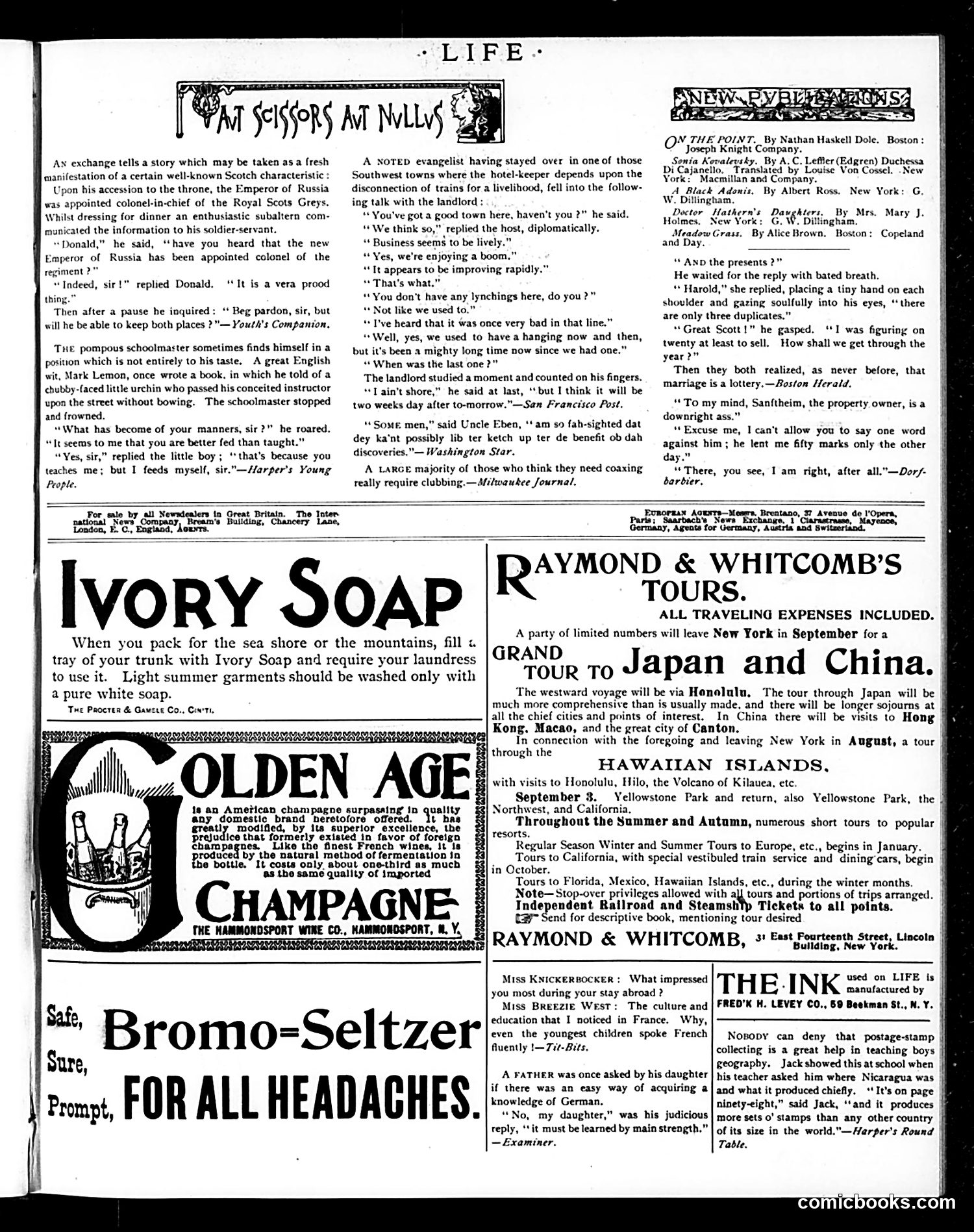
This page contains **multiple short humorous anecdotes** rather than political cartoons. The jokes satirize human nature and social pretense: 1. **The Scottish Colonel anecdote**: A soldier-servant questions whether Russia's new emperor can hold two military positions simultaneously—satirizing Scottish practicality and literal-mindedness. 2. **The Schoolmaster story**: A conceited teacher is snubbed by a street urchin, mocking pompous authority figures who overestimate their importance. 3. **The Evangelist and Innkeeper dialogue**: Dark humor about a town's history of lynchings and hangings, presented as casual conversation. The evangelist's gentle questioning contrasts absurdly with the innkeeper's matter-of-fact admission that the last execution was "two weeks day after to-morrow"—satirizing frontier violence normalized into everyday speech. The remaining content consists primarily of **period advertisements** (Ivory Soap, Bromo-Seltzer, champagne, touring services) and book reviews.
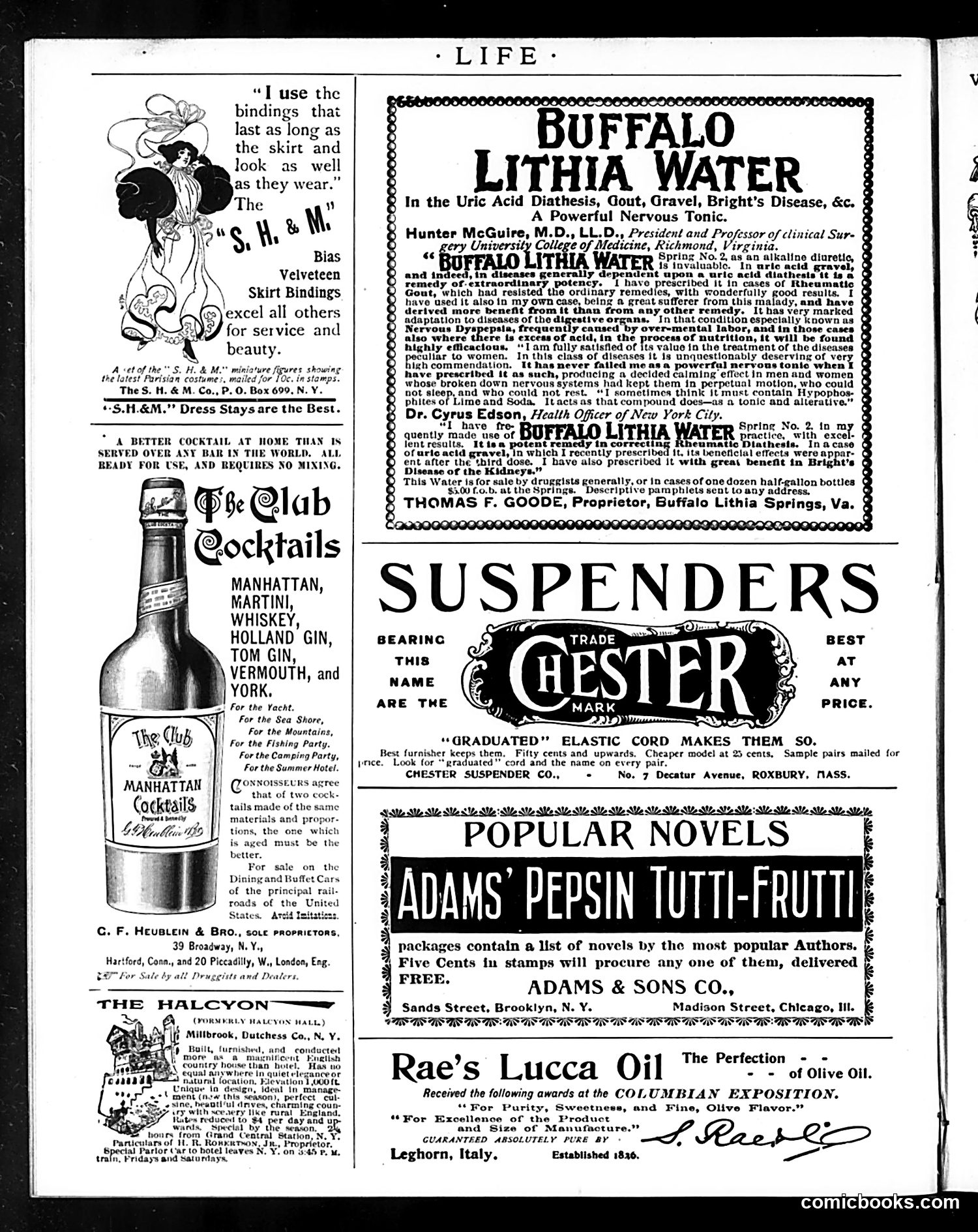
This page is primarily **advertisements** with no political cartoons or satirical content. The top-left features a small fashion illustration promoting "S. H. & M." dress bindings and skirt stays, playing on contemporary concerns about women's clothing durability and appearance. The remaining content advertises consumer products typical of the era: "The Club" cocktails (pre-mixed drinks for home use), Chester brand suspenders, Adams' Pepsin Tutti-Frutti novels (a mail-order book series), Buffalo Lithia Water (a medicinal mineral water marketed for gout and digestive ailments, endorsed by physicians), and Rae's Lucca Oil. The medical testimonials and product endorsements reflect early 20th-century advertising practices, when doctors regularly endorsed patent medicines and commercial products with detailed claims about health benefits—a practice later regulated as such claims became increasingly dubious. This is essentially a commercial page with no satirical commentary.