
Life, 1895-07-25 · page 7 of 14
Life — July 25, 1895 — page 7: what you’re looking at
What you’re looking at
This page from *Life* magazine contains **book reviews** rather than political cartoons. The main content discusses two novels about women: 1. **"Pauline"** by Mrs. Harrison's story—praised as more sensible than typical heroines, depicting an American woman who chooses not to marry despite pressure, rejecting the notion that "everything for love" defines feminine success. 2. **"Story of Bessie Costrell"** by Mrs. Humphry Ward—critiqued as depicting how far a woman's love might lead her into moral compromise, described as exploring "sordid" depths of feminine emotion. The satirical point appears to be commentary on **late-Victorian/Edwardian attitudes toward women's choices**: the contrast between idealized feminine self-sacrifice and realistic depictions of women's moral agency. The small illustrations are decorative rather than satirical.
📄 Transcribed text from this page (OCR, searchable)
Machine-transcribed from the original scan — historical spelling and the odd misread are preserved.
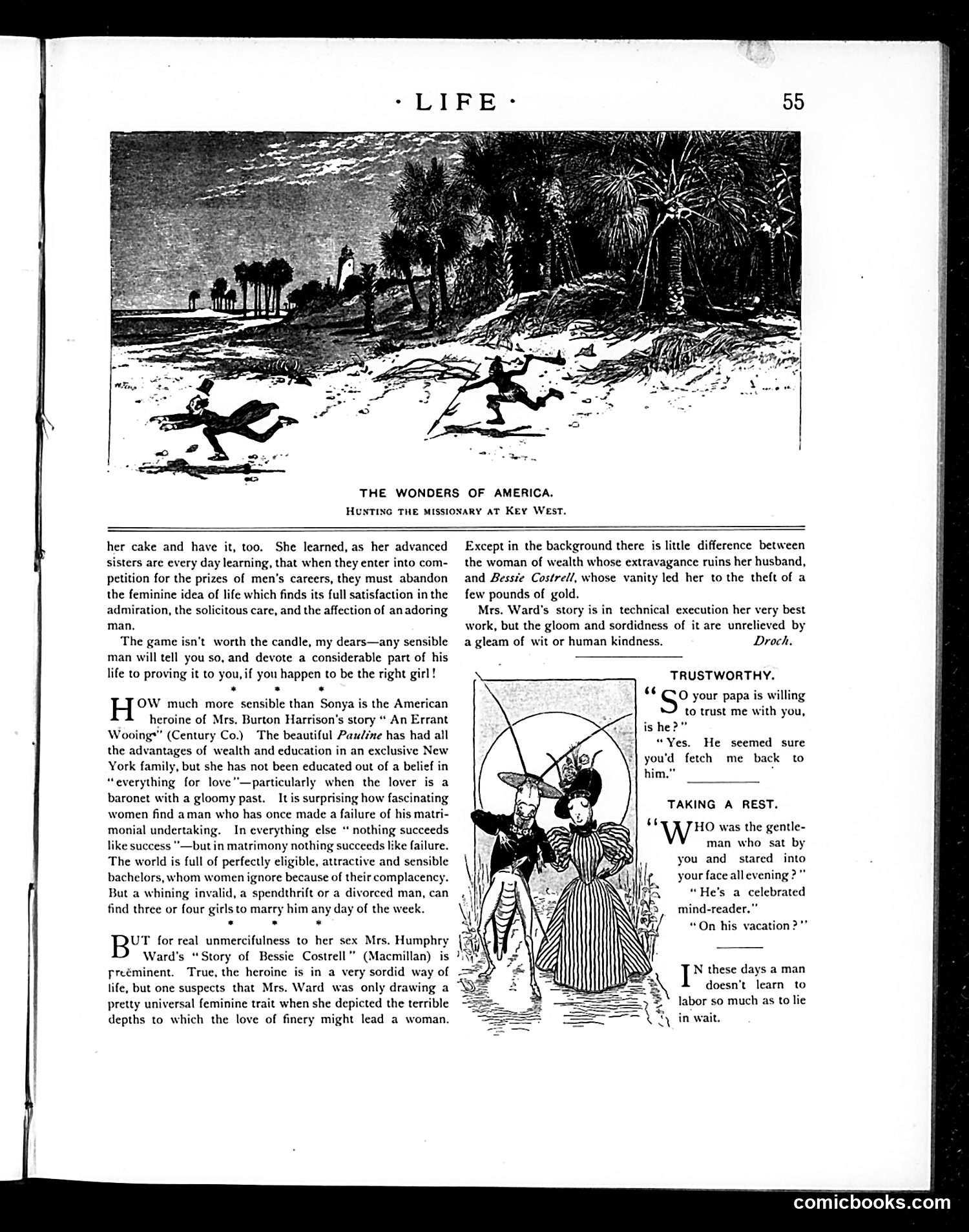
THE WONDERS OF AMERICA. HUNTING THE MISSIONARY AT KEY WEST. her cake and have it, too. She learned, as her advanced sisters are every day learning, that when they enter into com- petition for the prizes of men’s careers, they must abandon the feminine idea of life which finds its full satisfaction in the admiration, the solicitous care, and the affection of an adoring man. The game isn’t worth the candle, my dears—any sensible man will tell you so, and devote a considerable part of his life to proving it to you, if you happen to be the right girl! * . . OW much more sensible than Sonya is the American heroine of Mrs. Burton Harrison's story “ An Errant Wooing*” (Century Co.) The beautiful Paxdine has had all the advantages of wealth and education in an exclusive New York family, but she has not been educated out of a belief in “everything for love’—particularly when the lover is a baronet with a gloomy past. It is surprising how fascinating women find aman who has once made a failure of his matri- monial undertaking. In everything else “ nothing succeeds like success "—but in matrimony nothing succeeds like failure. The world is full of perfectly eligible, attractive and sensible bachelors, whom women ignore because of their complacency. But a whining invalid, a spendthrift or a divorced man, can find three or four girlsto marry him any day of the week. . . . UT for real unmercifulness to her sex Mrs. Humphry Ward's “Story of Bessie Costrell” (Macmillan) is Freéminent. True, the heroine is in a very sordid way of life, but one suspects that Mrs. Ward was only drawing a pretty universal feminine trait when she depicted the terrible depths to which the love of finery might lead a woman. Except in the background there is little difference between the woman of wealth whose extravagance ruins her husband, and Bessie Costrell, whose vanity led her to the theft of a few pounds of gold. Mrs. Ward's story is in technical execution her very best work, but the gloom and sordidness of it are unrelieved by a gleam of wit or human kindness. Droch. TRUSTWORTHY. O your papa is willing to trust me with you, is he?” “Yes. He seemed sure you'd fetch me back to him.” . “ TAKING A REST. HO was the gentle- man who sat by you and stared into your face allevening ?"” “He's a celebrated mind-reader.” “On his vacation?" if N these days a man N doesn’t learn to labor so much as to lie fy in wait. comicbooks.com