
A complete issue · 18 pages · 1895
Life — April 18, 1895
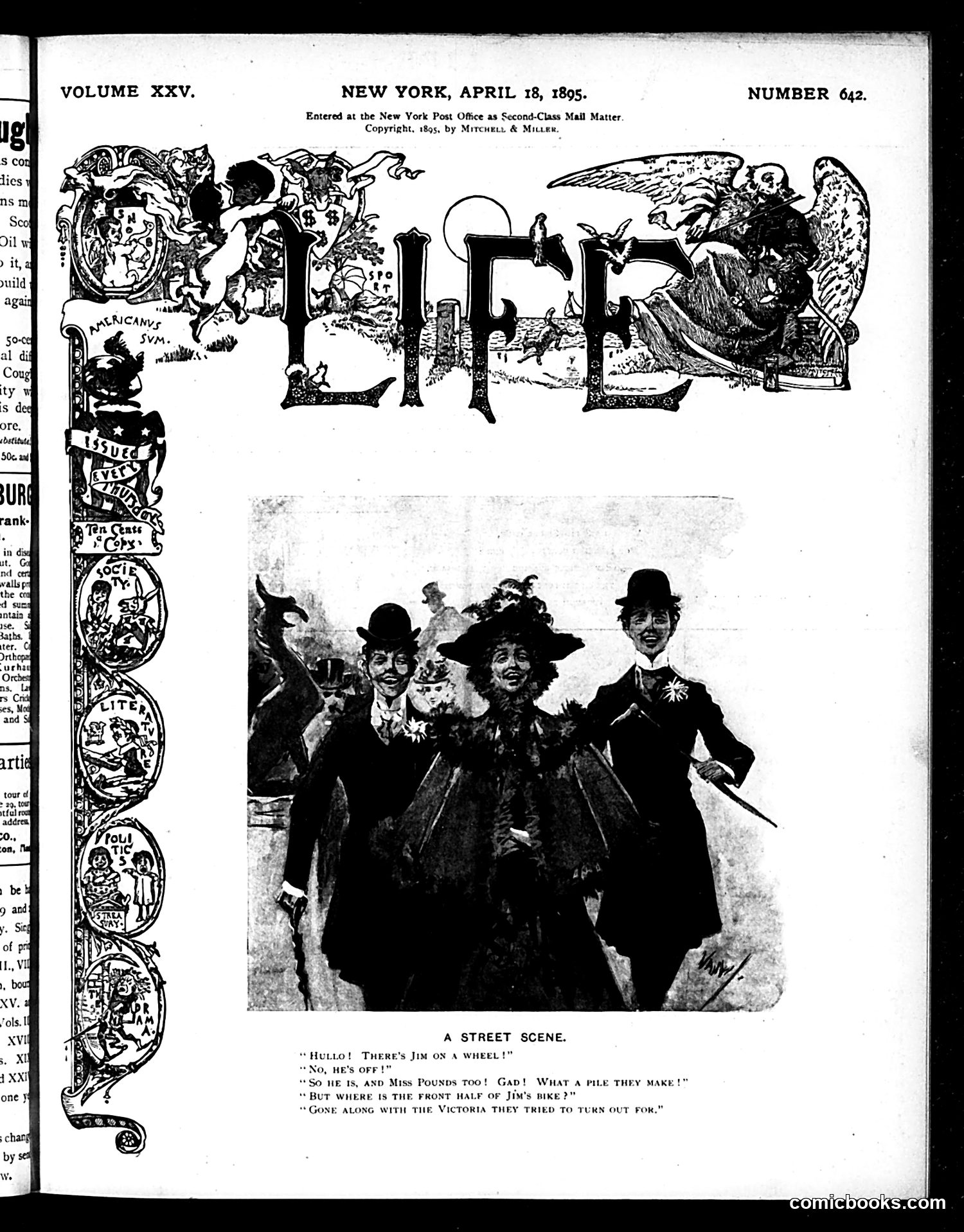
This page contains a decorative title "LIFE" with ornamental borders and a photograph labeled "A STREET SCENE" showing three well-dressed figures in late Victorian attire (bowler hats, formal coats) walking together. The dialogue beneath appears to reference bicycles—specifically someone named "Jim" and a "Victoria" bicycle. The exchanges mock the fashionable bicycle craze of the 1890s, with humor about a broken bicycle ("front half of Jim's bike") and social pretension around cycling as a leisure activity. The ornamental left border contains heraldic or emblematic designs typical of Life's decorative style. Without clearer context about the specific individuals pictured, the precise satirical target remains unclear, though the humor targets the popularity and social aspects of 1890s bicycling culture among the upper classes.
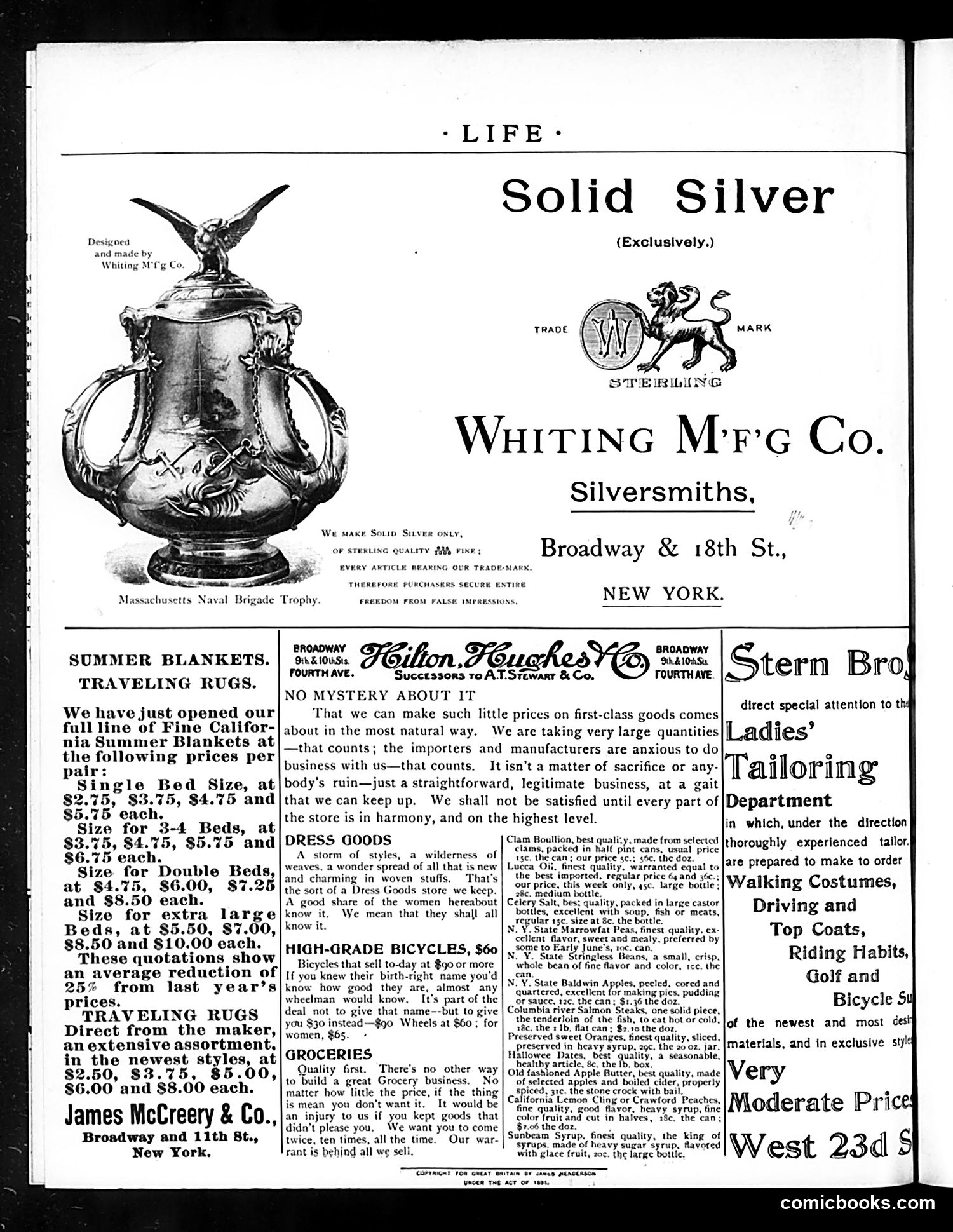
This page is primarily **advertising**, not satire or political commentary. It contains multiple commercial advertisements from late 19th or early 20th-century New York businesses: - **Whiting M'fg Co.** advertises solid silver goods and flatware, emphasizing quality and their "Sterling" trademark - **Hilton, Houckes & Co.** promotes dress goods and groceries with competitive pricing - **James McCreery & Co.** sells summer blankets and traveling rugs at reduced prices - **Stern Bros.** announces their ladies' tailoring department for custom garments The only non-commercial image is the **Massachusetts Naval Brigade Trophy** at top left—a decorative silver vessel designed by Whiting M'fg Co., featuring an eagle and ornamental handles. This appears to be product showcase rather than satirical content.
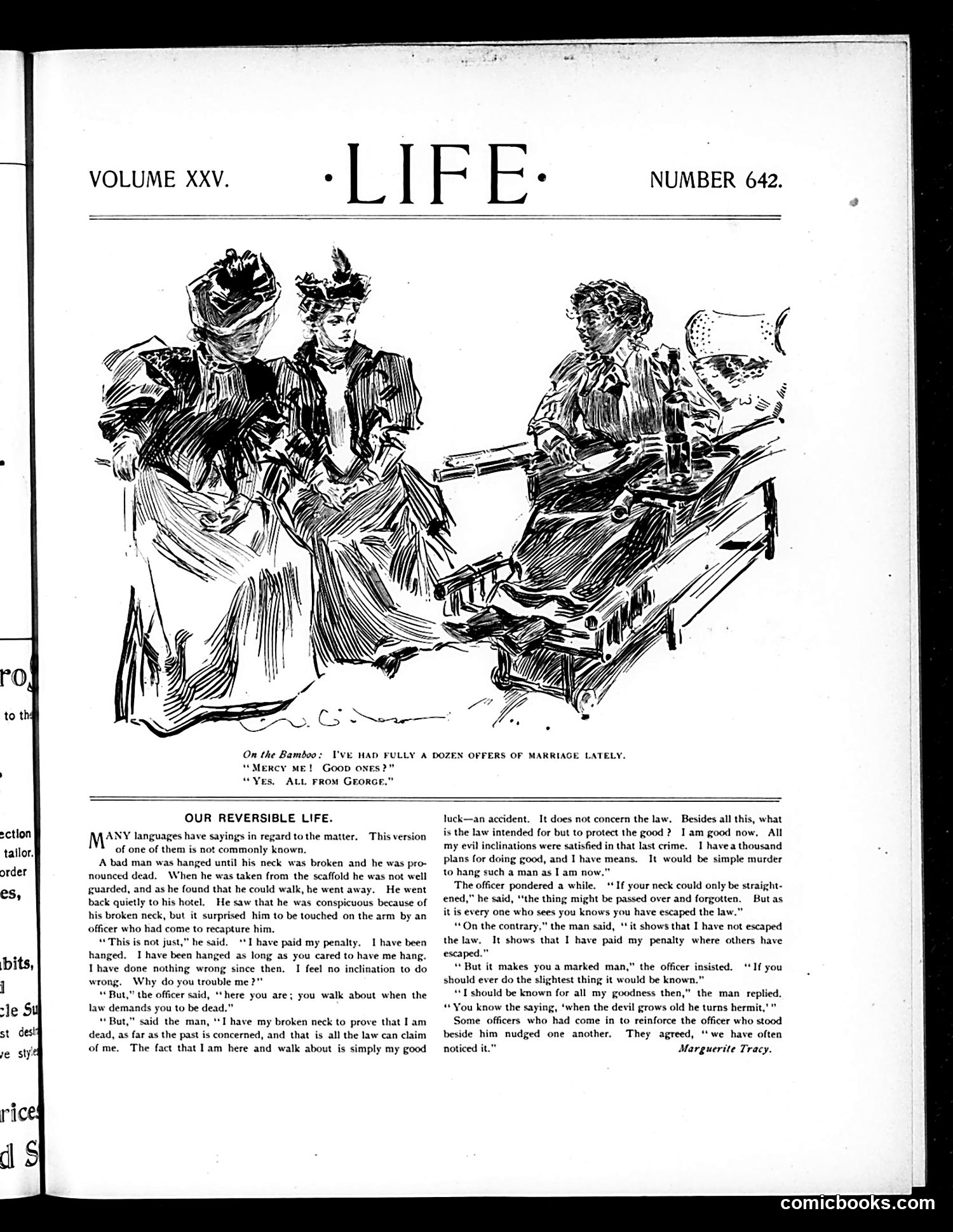
This page from *Life* magazine features a satirical piece about a man facing legal consequences. The cartoon shows three fashionably dressed women in conversation, with dialogue indicating one has received multiple marriage proposals. The accompanying story "Our Reversible Life" discusses a man pronounced dead who later reappears alive, creating legal confusion. The narrative explores whether he can be prosecuted for crimes committed while presumed dead—a paradoxical legal situation. The officer argues the man is now "marked" by this experience, suggesting permanent social stigma regardless of legal technicalities. The satire appears to mock both the absurdities of legal systems and society's harsh judgment of those who escape prosecution through circumstance rather than innocence. The "reversible life" title suggests life's unpredictable reversals and their consequences.
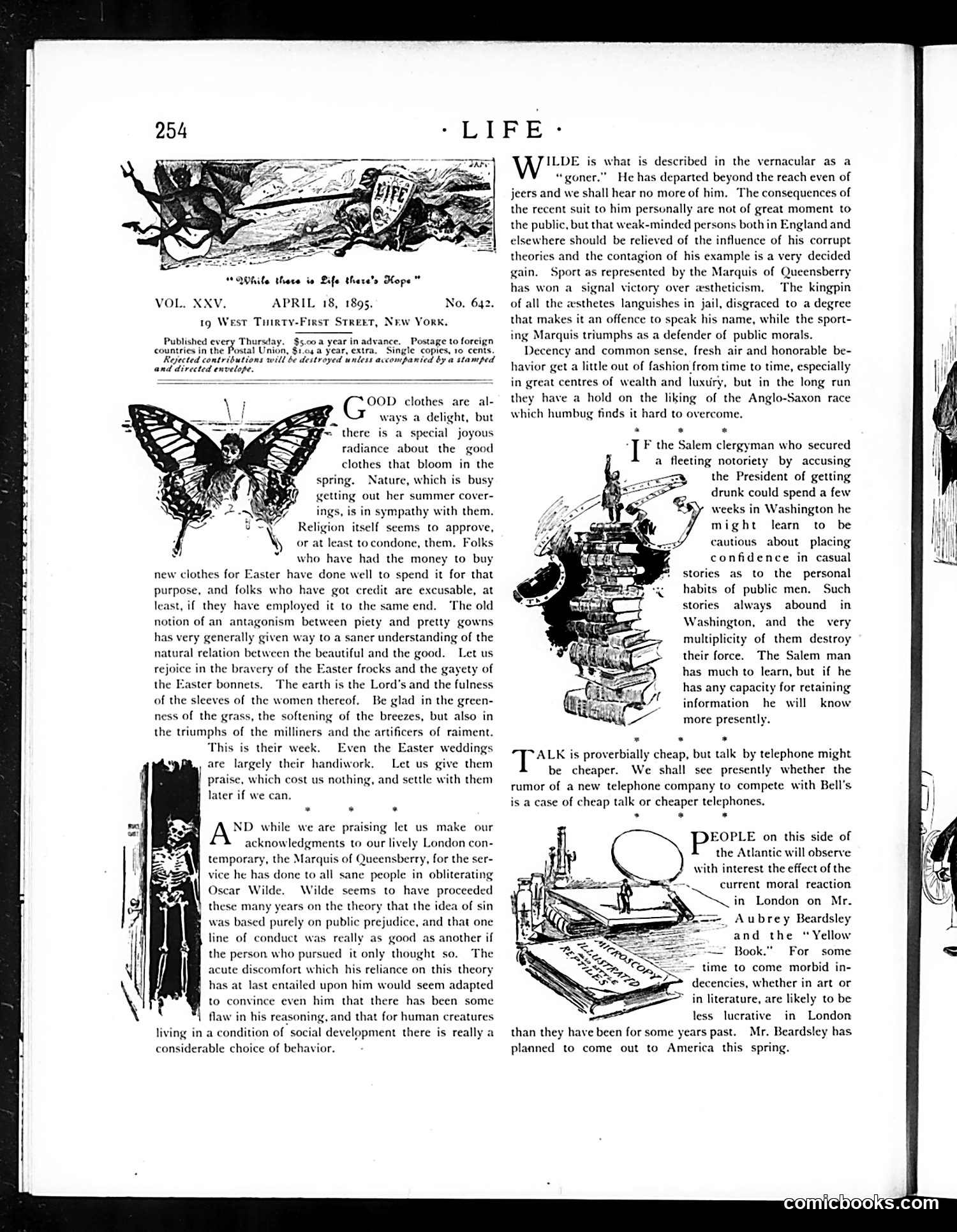
The page contains three satirical sections rather than unified cartoons: 1. **Top illustration**: "Wilde Gone to Life there's Hopes"—likely referencing Oscar Wilde's departure from public life, suggesting redemption is possible even for disgraced figures. 2. **Main text passages** discuss: - Fashion and Easter clothing as reflecting social values - The Marquis of Queensberry (referenced as defending public morals against aestheticism) - A Salem clergyman's alleged drunkenness involving the President - Telephone company competition and cost 3. **Butterfly and illustration**: Decorative elements accompanying fashion discussion. The satire targets hypocrisy among public figures, class anxieties about respectability, and commercial competition. The scattered format typifies Life's miscellaneous commentary style mixing social criticism with gossip.
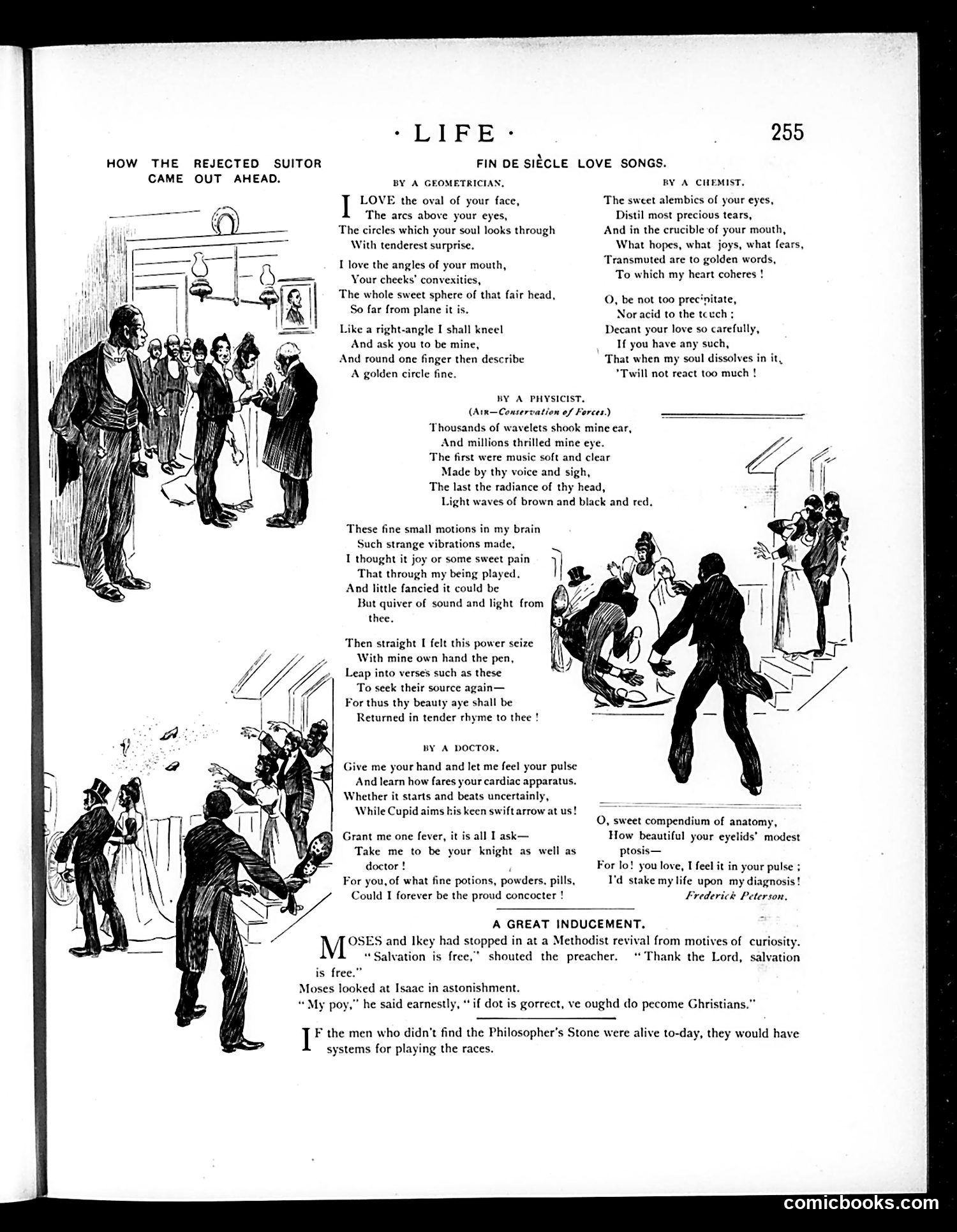
This page contains humorous "fin de siècle love songs" written by different professionals—a geometer, chemist, physicist, and doctor—each applying their specialized knowledge to romantic verse. The satirical point: these experts attempt to woo by reducing love to their technical disciplines (geometry, chemistry, physics, medicine) rather than genuine emotion. The left-side illustrations show a rejected suitor being escorted out by others, humorously depicting the failure of such overly-intellectual courtship approaches. The bottom anecdote about "Moses and Ikey" mocks naive religious conversion, suggesting salvation claims miss practical reality. The overall satire ridicules the Victorian era's tendency toward pseudo-scientific pretension and the gap between technical knowledge and human understanding of love and faith.
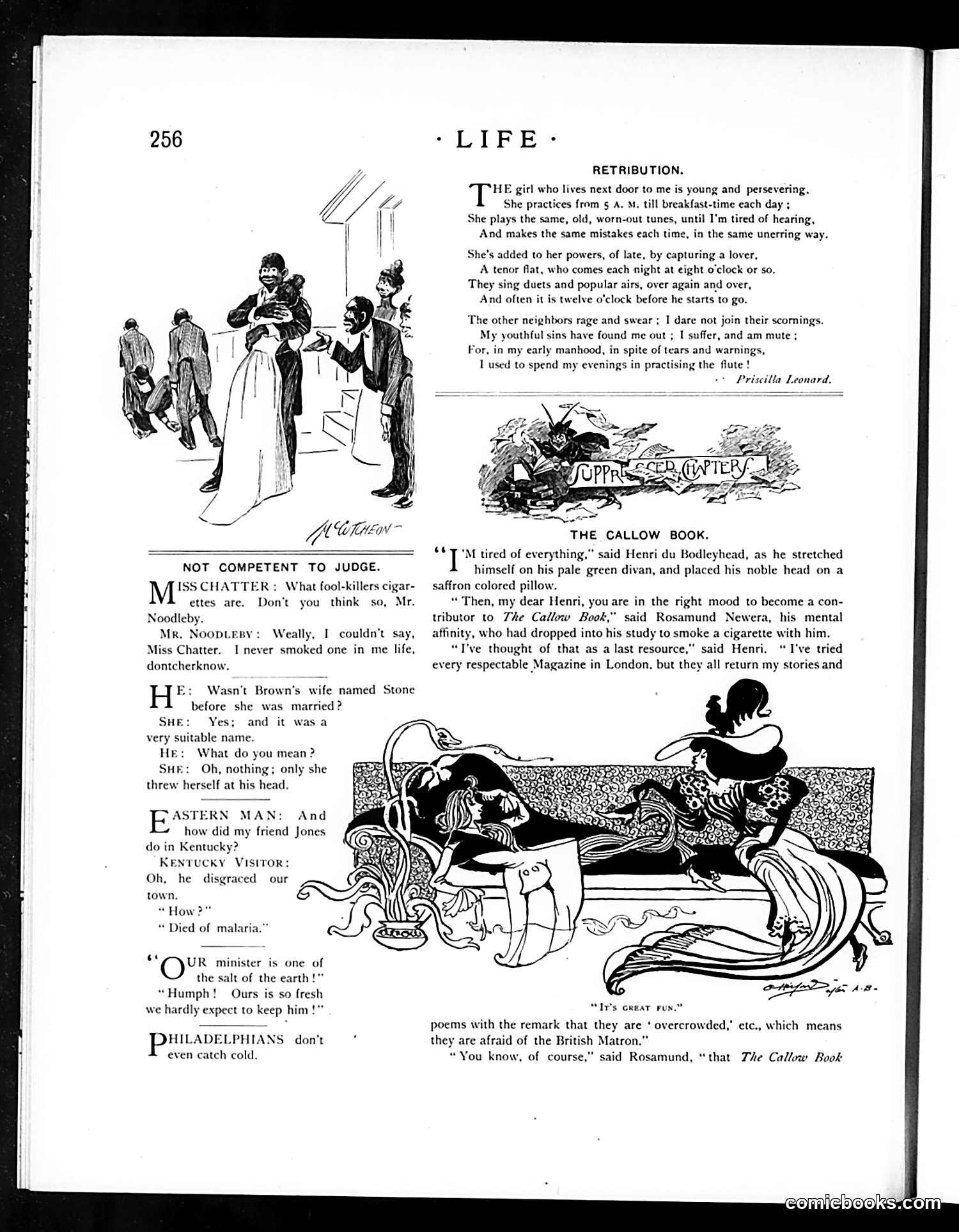
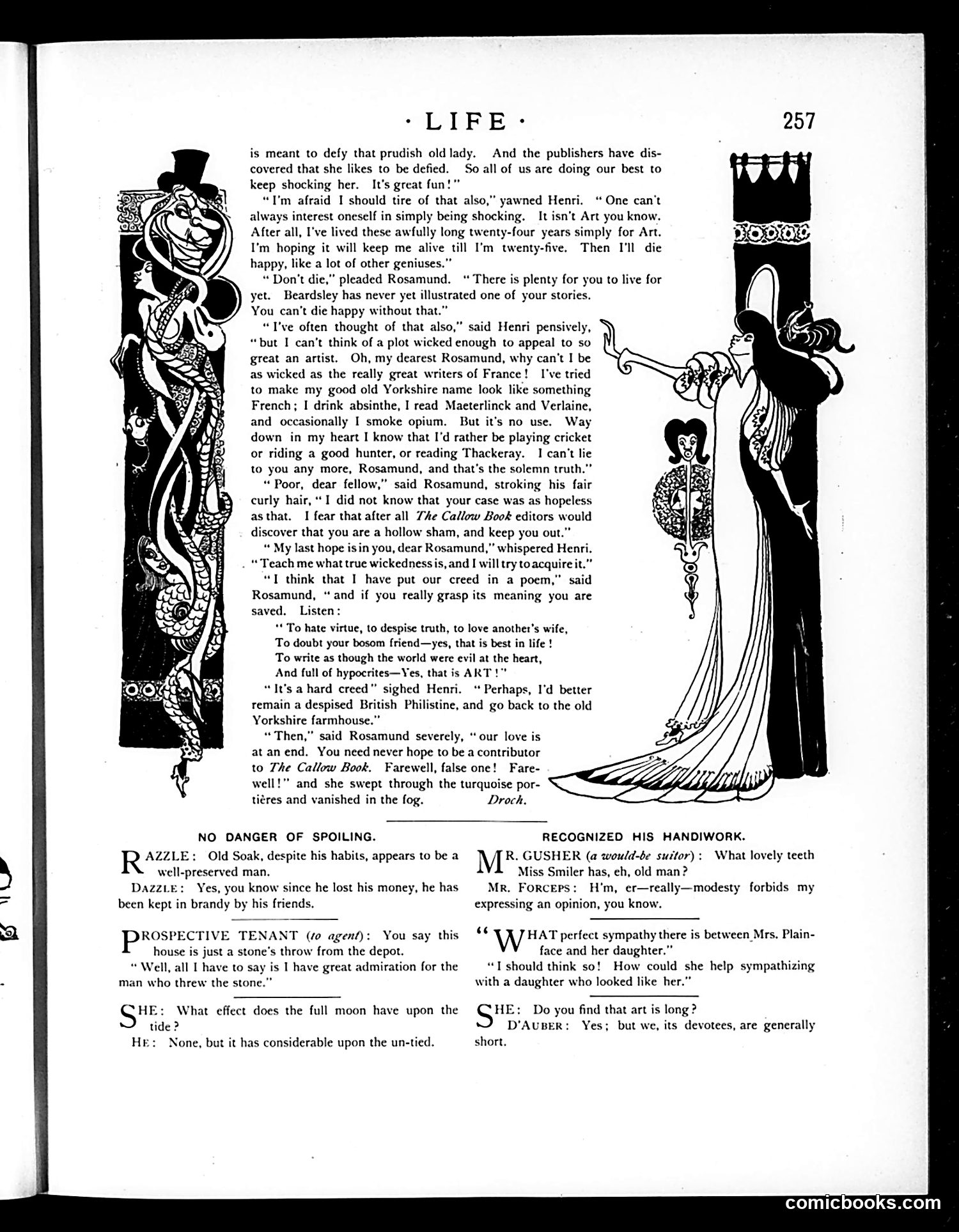
This page from *Life* magazine contains a literary dialogue between characters named Henri and Rosamund, likely fictional. The conversation satirizes pretentious artistic aspirations: Henri claims he's lived "twenty-four years simply for Art" and aspires to wickedness matching "great writers of France," citing Maeterlinck and Verlaine while admitting he actually prefers cricket and Thackeray. Rosamund mocks his pretense, ultimately rejecting him. The ornate art-nouveau style illustrations frame characters in dramatic poses, emphasizing the affected aesthetics being ridiculed. The joke targets young bohemians who adopt continental artistic personas while remaining fundamentally English and conventional. The lower section contains unrelated humorous exchanges about teeth, sympathy, and art's duration—typical *Life* magazine humor snippets of the era.
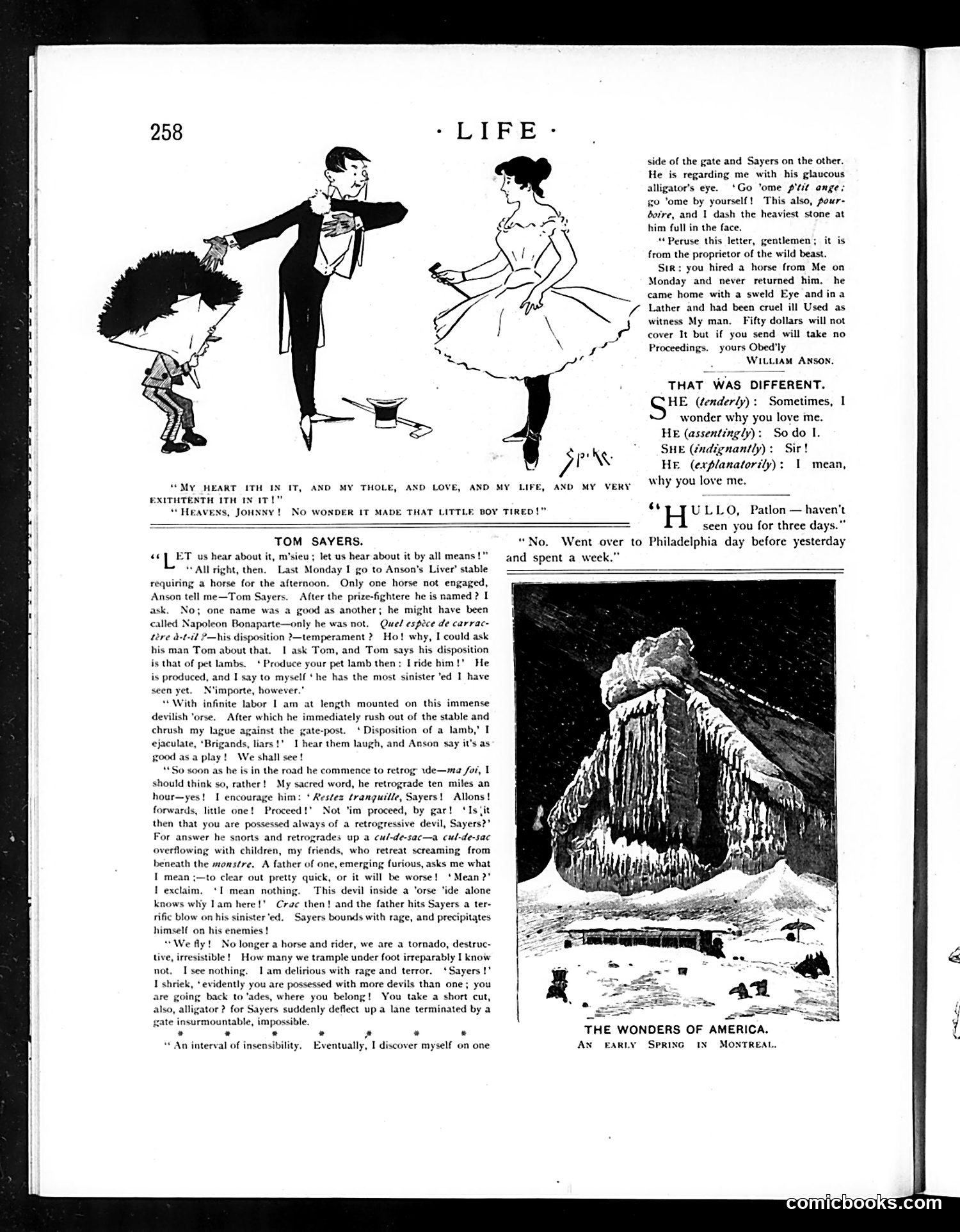
This page features a satirical dialogue between a couple debating love and commitment. The upper cartoon shows a man gesturing dramatically while a woman sits primly—illustrating their discussion about why he loves her. The main text is titled "TOM SAYERS" and appears to be a humorous monologue about acquiring a horse from "Anson's Livery" stable. The speaker compares the horse's temperament to "Napoleon Bonaparte," describing it as sinister and difficult to manage. The narrative builds comedically through increasingly exaggerated descriptions of the horse's unmanageable behavior, culminating in the speaker's frustrated conclusion that riding the horse is like being caught in an "impossible" tornado. The lower image shows "The Wonders of America: An Early Spring in Montreal"—likely a scenic illustration rather than satire.
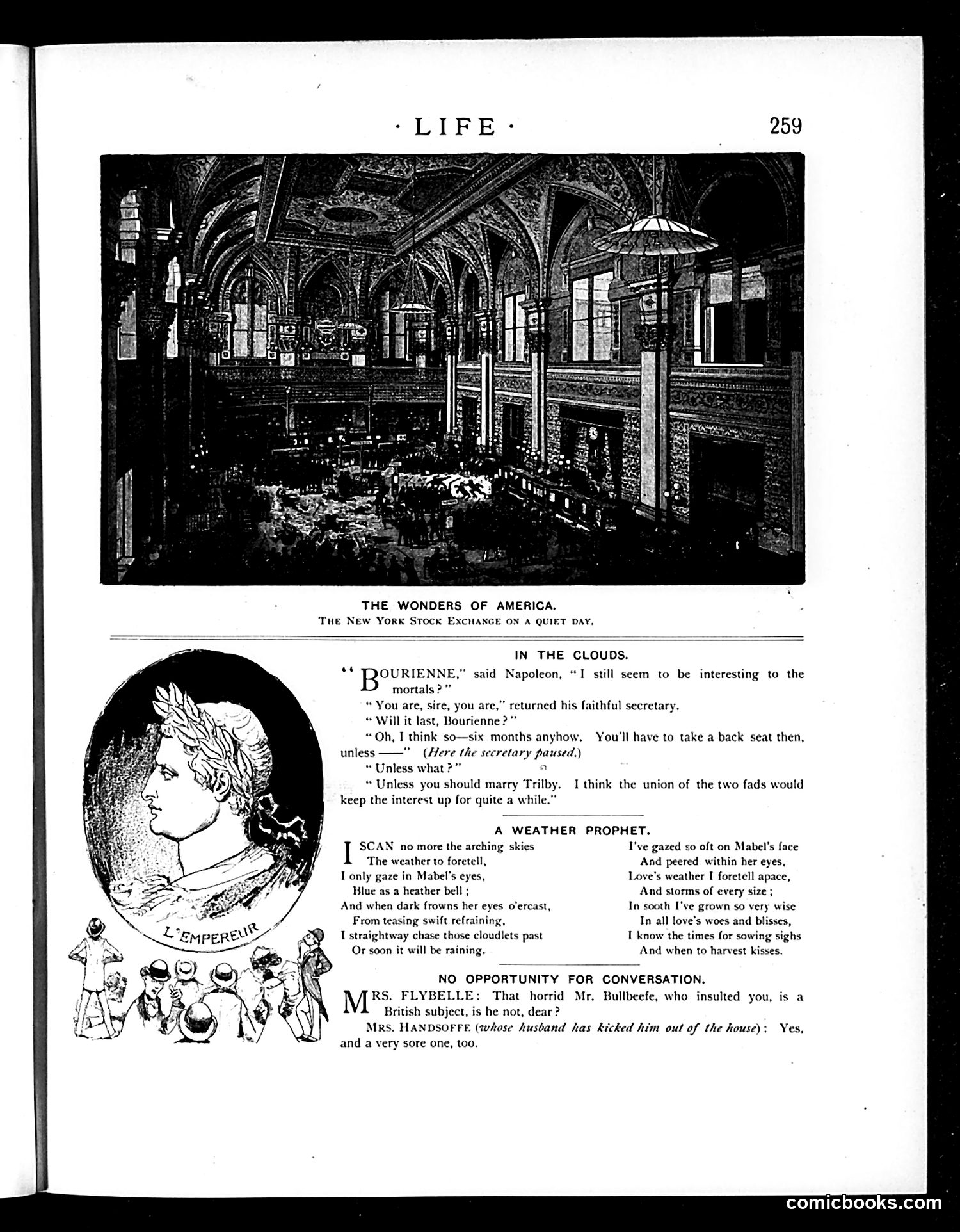
**Top image:** "The Wonders of America - The New York Stock Exchange on a Quiet Day" shows the ornate interior of the stock exchange filled with crowds of traders. This satirizes American wealth and commerce as a spectacle worthy of tourist attention. **"In the Clouds"** features a profile portrait labeled "L'EMPEREUR" (Napoleon), presenting a dialogue where Napoleon questions whether he remains interesting to mortals. His secretary suggests marriage to keep public interest alive—likely satirizing how celebrities (or historical figures' legacies) maintain relevance through sensational personal news. **"A Weather Prophet"** is a poem about predicting weather through observing a woman's facial expressions rather than meteorological science—a sexist joke suggesting women's moods are as changeable and predictable as weather. **"No Opportunity for Conversation"** jokes about a British subject being kicked out of his house by his own husband.
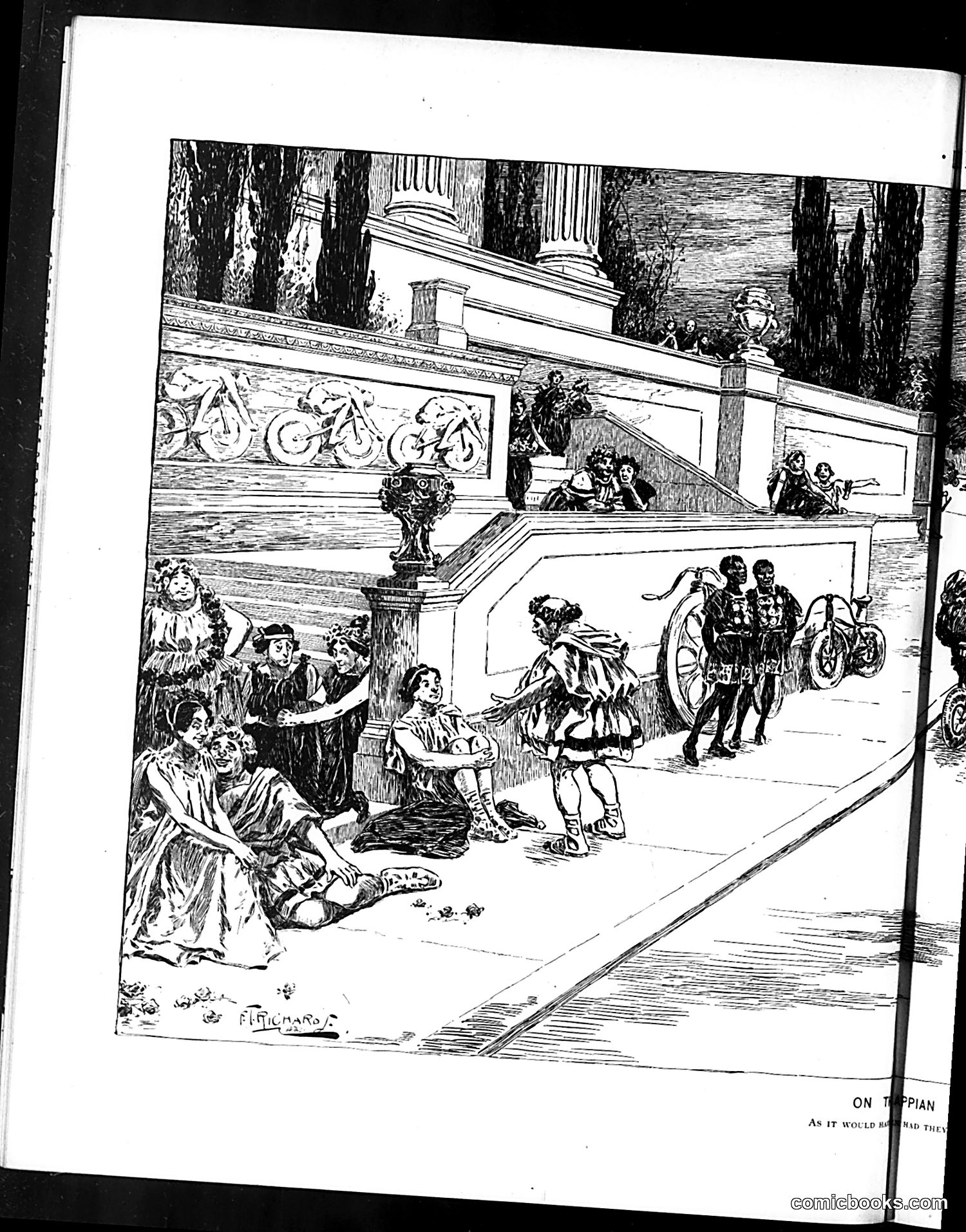
This is a satirical illustration depicting an Olympic Games scene. The drawing shows spectators in tiered seating viewing athletic competition below, with cyclists visible on an upper track and what appears to be chariot racing or similar events in the lower arena. The caption reads "ON THE PIAN" (likely "ON THE PLAN" or similar), with text below suggesting "AS IT WOULD BE HAD THEY..." — the complete phrase is cut off. The satire appears to mock a proposed modernization or redesign of Olympic Games facilities or organization. The detailed architectural setting and formal arrangement suggest this critiques some contemporary proposal about how Olympic events should be structured or presented. Without the complete caption text visible, the specific target of the satire remains unclear, though the juxtaposition of classical Olympic imagery with modern elements (bicycles) suggests commentary on mixing ancient and modern athletic traditions.
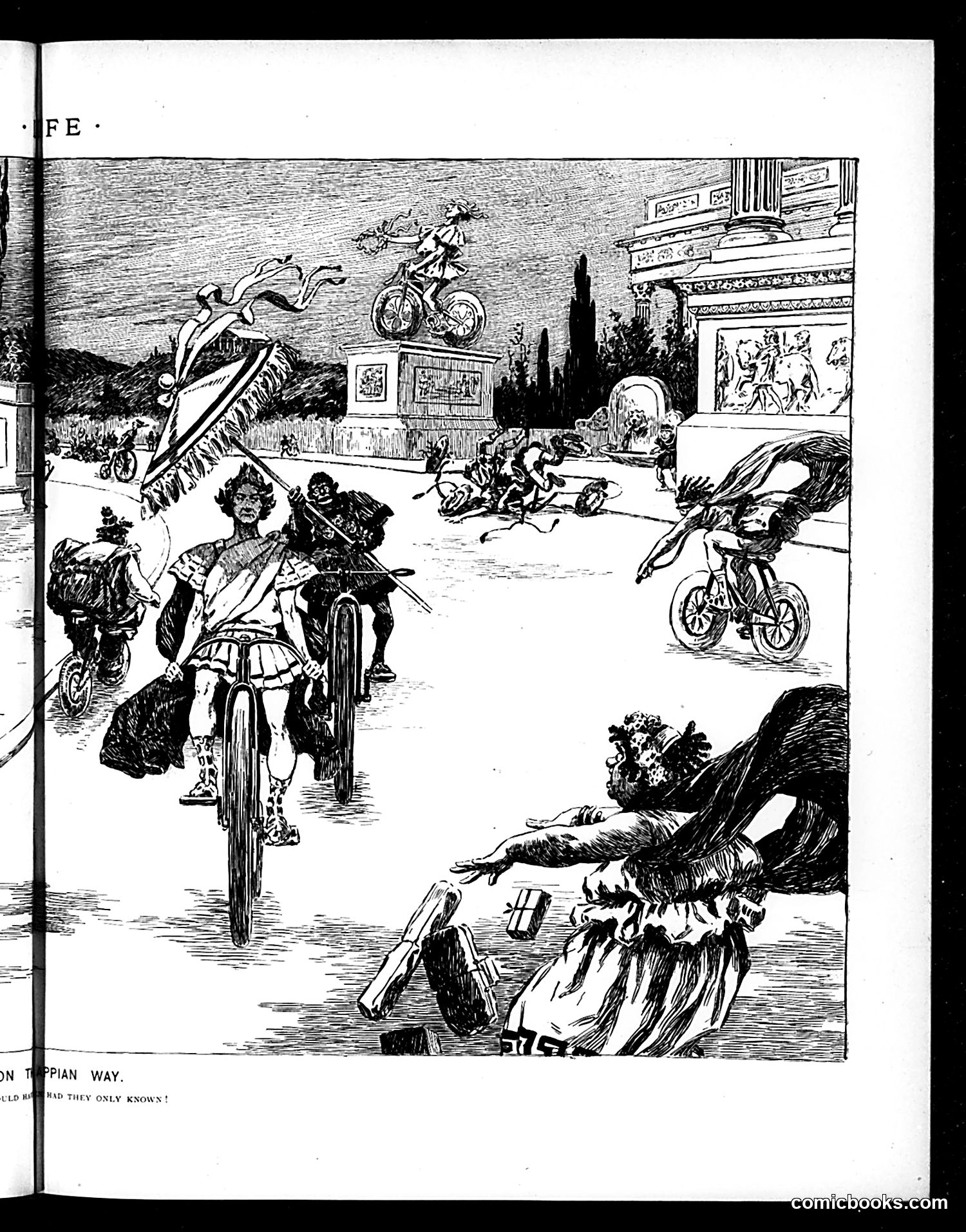
This appears to be a satirical illustration showing a fantastical circus or carnival scene with figures on bicycles performing acrobatic stunts. The text fragment "ON TIPPIAN WAY" and "WOULD BAD THEY ONLY KNEW!" suggests social or political commentary, though the complete context is unclear from this partial page. The drawing depicts what looks like classical or mythological figures (possibly Roman soldiers or gladiators based on their dress) engaged in impossible bicycle stunts in an ornate setting with architecture and cypress trees. This likely satirizes contemporary society—possibly mocking pretension, dangerous fashions, or reckless behavior presented as entertainment. Without the full page context and complete caption, I cannot definitively identify the specific political figures or events being referenced. The style suggests early 20th-century American satirical commentary on popular culture or society.
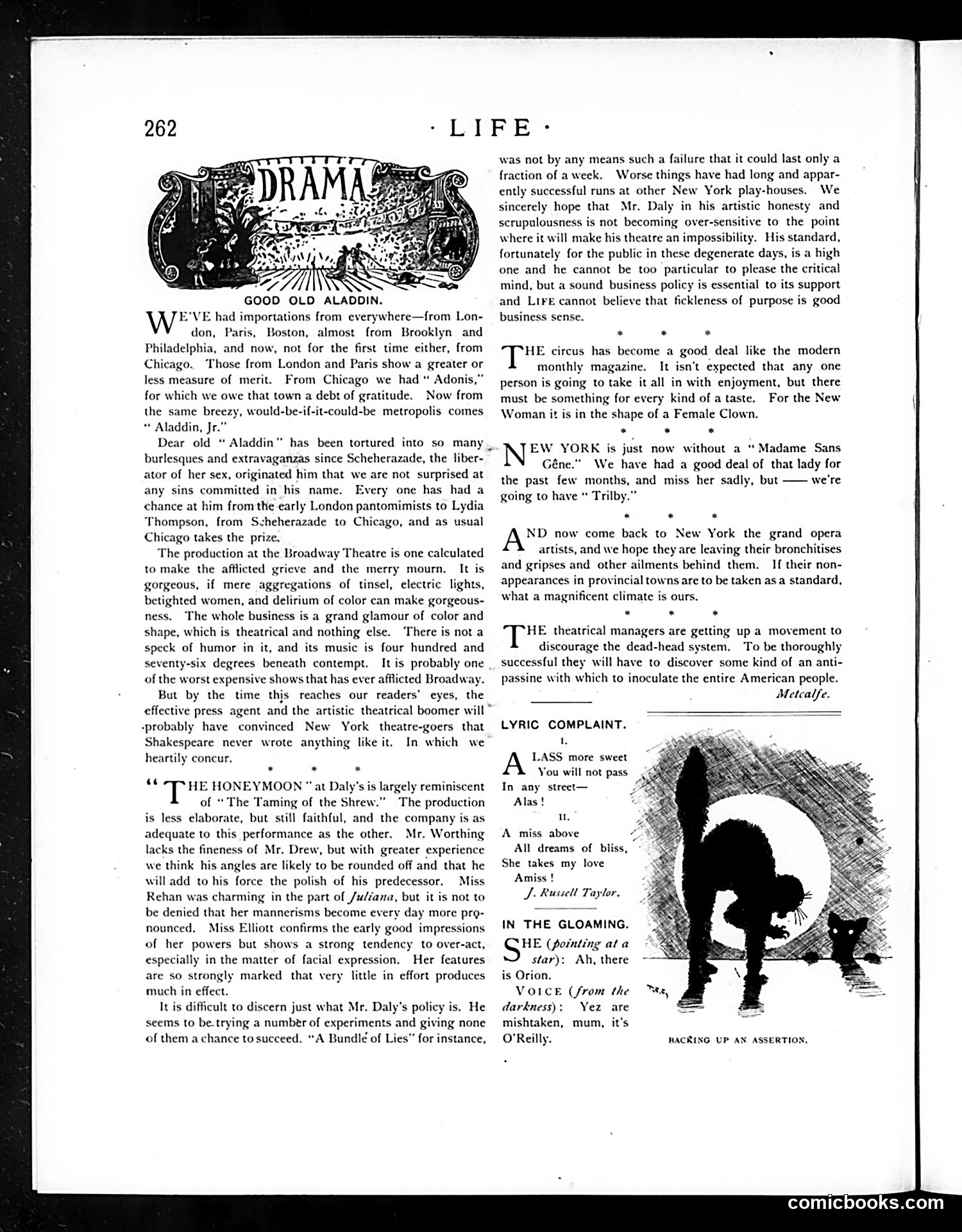
This page contains theatre criticism rather than political cartoons. The main content critiques Broadway productions, particularly: **"Aladdin, Jr."** — A Chicago-produced burlesque at the Broadway Theatre. The critic dismisses it as lavish but humorless spectacle, filled with "tinsel, electric lights, betighted women," lacking any real wit. The satire targets Chicago's pretensions as a cultural rival to New York and London, sarcastically suggesting the city "takes the prize" for worst theatre. **"The Honeymoon"** at Daly's Theatre receives mixed reviews of its Shakespeare adaptation and cast performances. The brief illustrated items below—"Lyric Complaint," "In the Gloaming," and "Hacking Up an Assertion"—appear to be humorous sketches, likely theatrical or social commentary. The overall tone mocks both provincial American theatre ambitions and the gap between flashy production values and actual artistic merit—a concern about substance versus spectacle that remains relevant today.
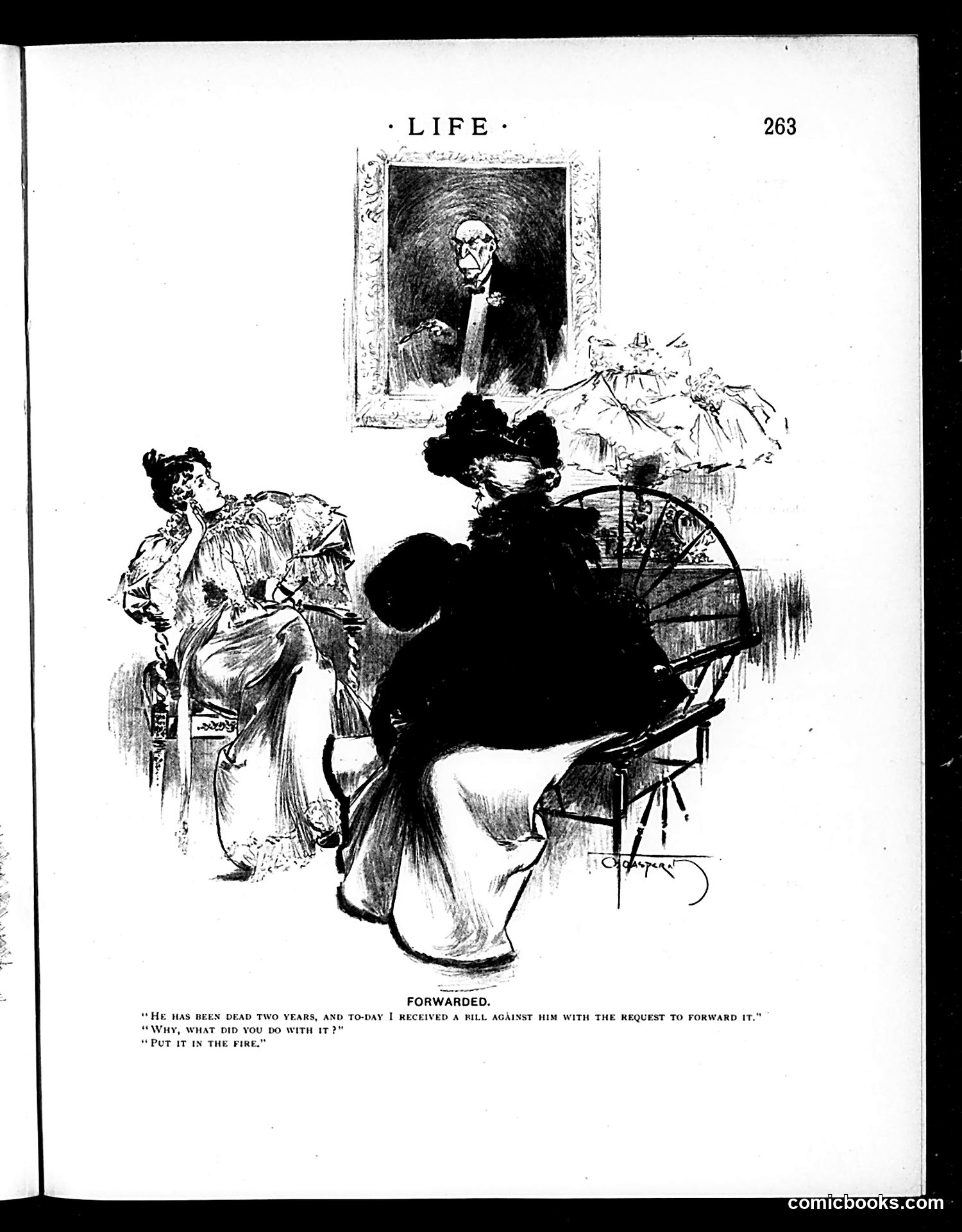
This cartoon depicts a woman receiving a bill for someone who has been dead for two years, with a request to forward it. When asked what she did with it, she replies she threw it in the fire. The satire mocks the impersonal machinery of bill collection and bureaucracy—how companies mechanically pursue debts without updating their records, sending notices to deceased individuals. The humor lies in the absurdity of creditors' indifference to death itself; they continue collecting even after two years have passed. The well-dressed woman's pragmatic solution (burning the bill) represents the common person's exasperation with unreasonable institutional demands. This reflects early 20th-century American frustration with growing corporate and financial systems that treated debtors as mere account numbers rather than human beings.
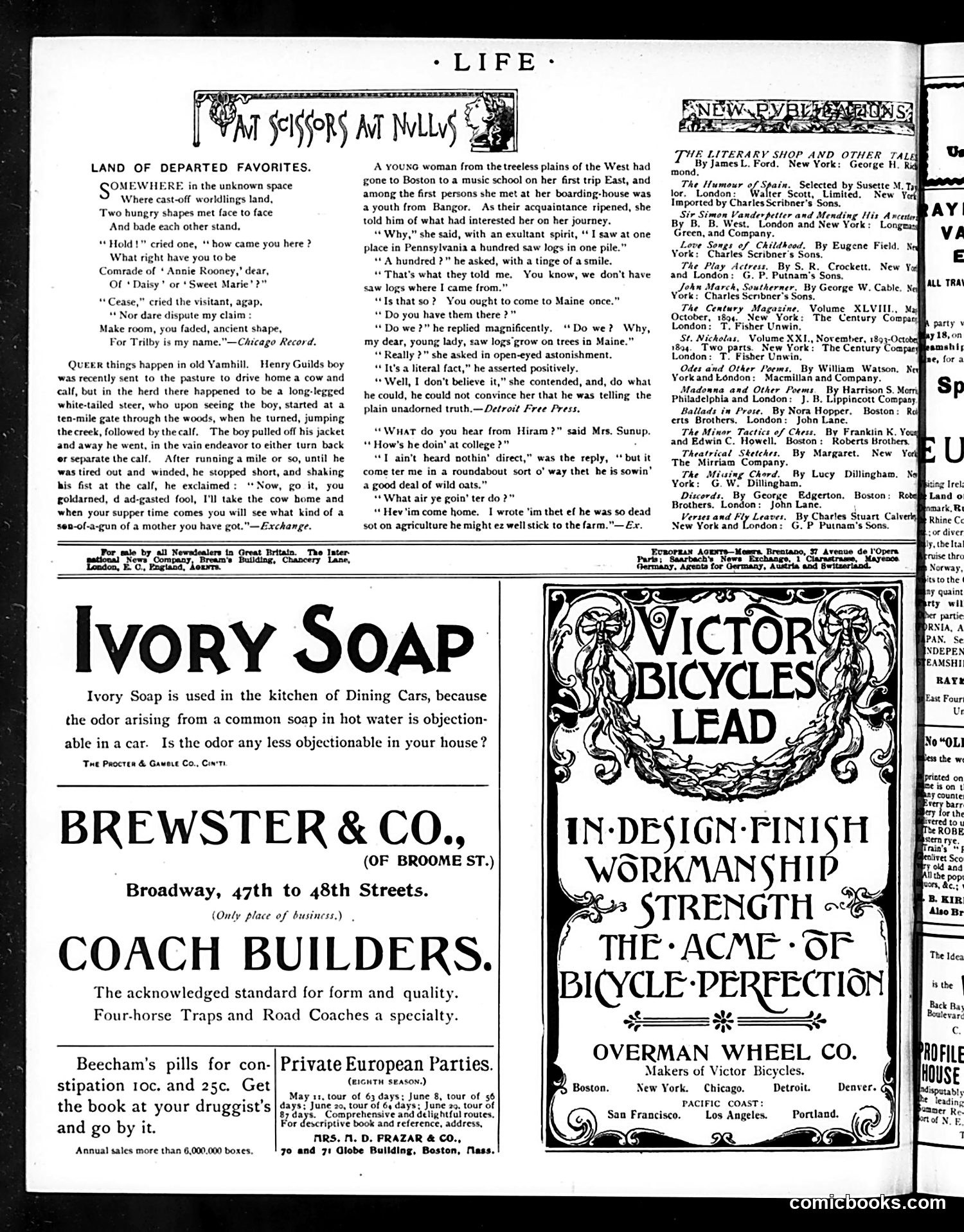
This is primarily an **advertising and literary review page** with three separate humorous anecdotes, not political cartoons. The content consists of: 1. **"Land of Departed Favorites"** — A poem satirizing the obsolescence of popular entertainment. Two fictional characters ("Annie Rooney," "Daisy," "Sweet Marie"—apparently popular songs or entertainments of the era) encounter "Trilby" (a character from George du Maurier's 1894 novel), implying that newer cultural products quickly displace previous favorites. 2. **Three brief humorous stories** involving regional American dialects and misunderstandings: a Maine youth exaggerates about "saw logs growing on trees"; a farm boy's chase with a steer; a college student's misbehavior. 3. **Multiple advertisements** for Ivory Soap, Victor Bicycles, Coach Builders, and other products. The humor reflects late-Victorian attitudes toward rural simplicity and regional stereotypes. The page documents popular culture and consumer products of the 1890s rather than offering political satire.
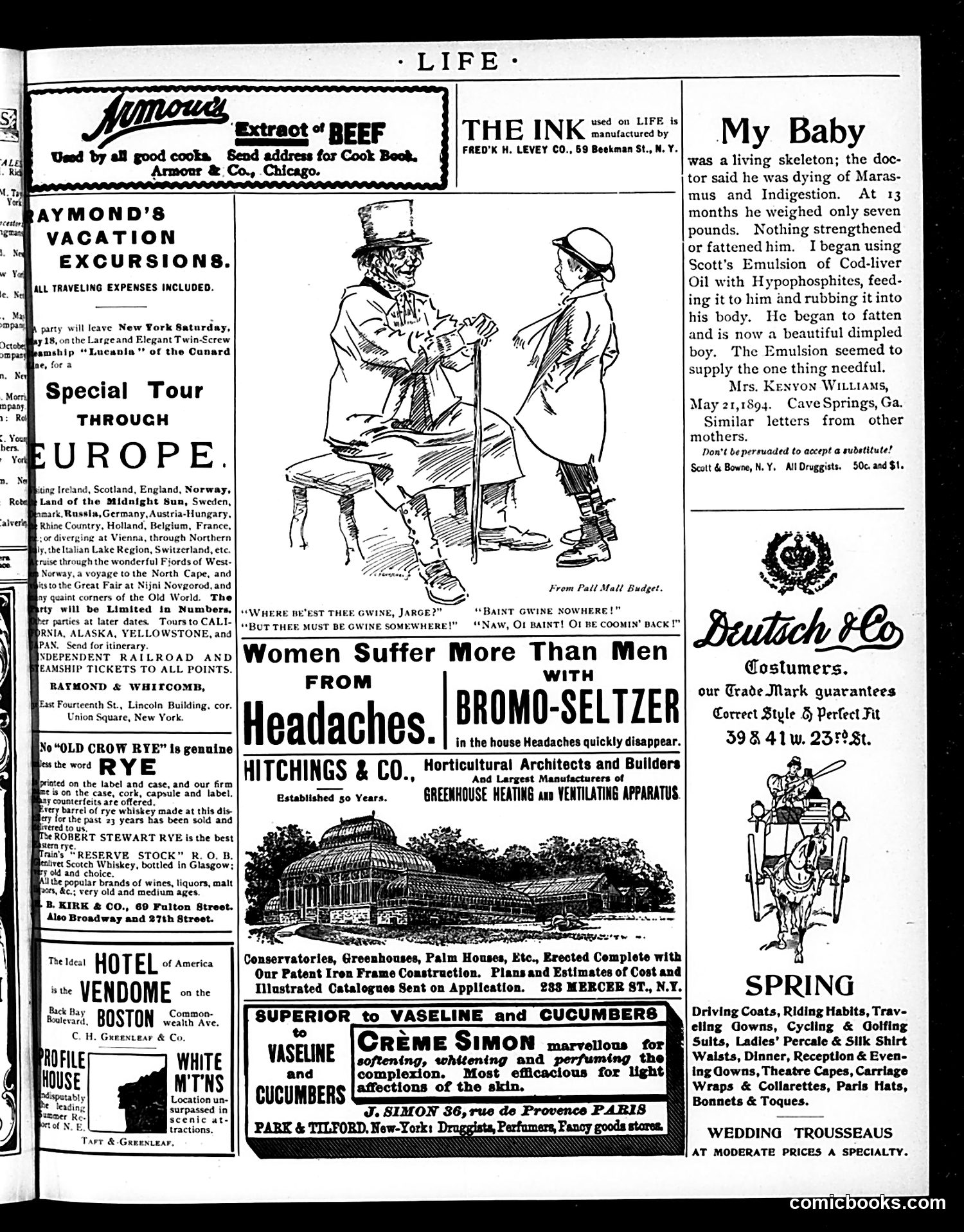
This page is primarily **advertisements with one cartoon**. The main satirical image shows two figures in what appears to be a dialect-heavy conversation about travel plans. Based on the caption—"Where be'est thee gwine, Jarge?" / "But thee must be gwine somewhere!"—this depicts working-class or rural characters, likely portrayed with stereotypical speech patterns common to 1890s American humor. The joke hinges on the absurdity of someone claiming they're "not going nowhere" while obviously preparing to travel. The exaggerated dialect suggests social satire aimed at lower-class speakers, reflecting period attitudes about education and social standing. The page itself is dominated by commercial advertising: vacation tours, liquor brands (Old Crow Rye, Robert Stewart), hotels, and patent medicines (Bromo-Seltzer, Scott's Emulsion). One notable ad addresses "Women Suffer More Than Men from Headaches," promoting Bromo-Seltzer as remedy—reflecting Victorian assumptions about female fragility.
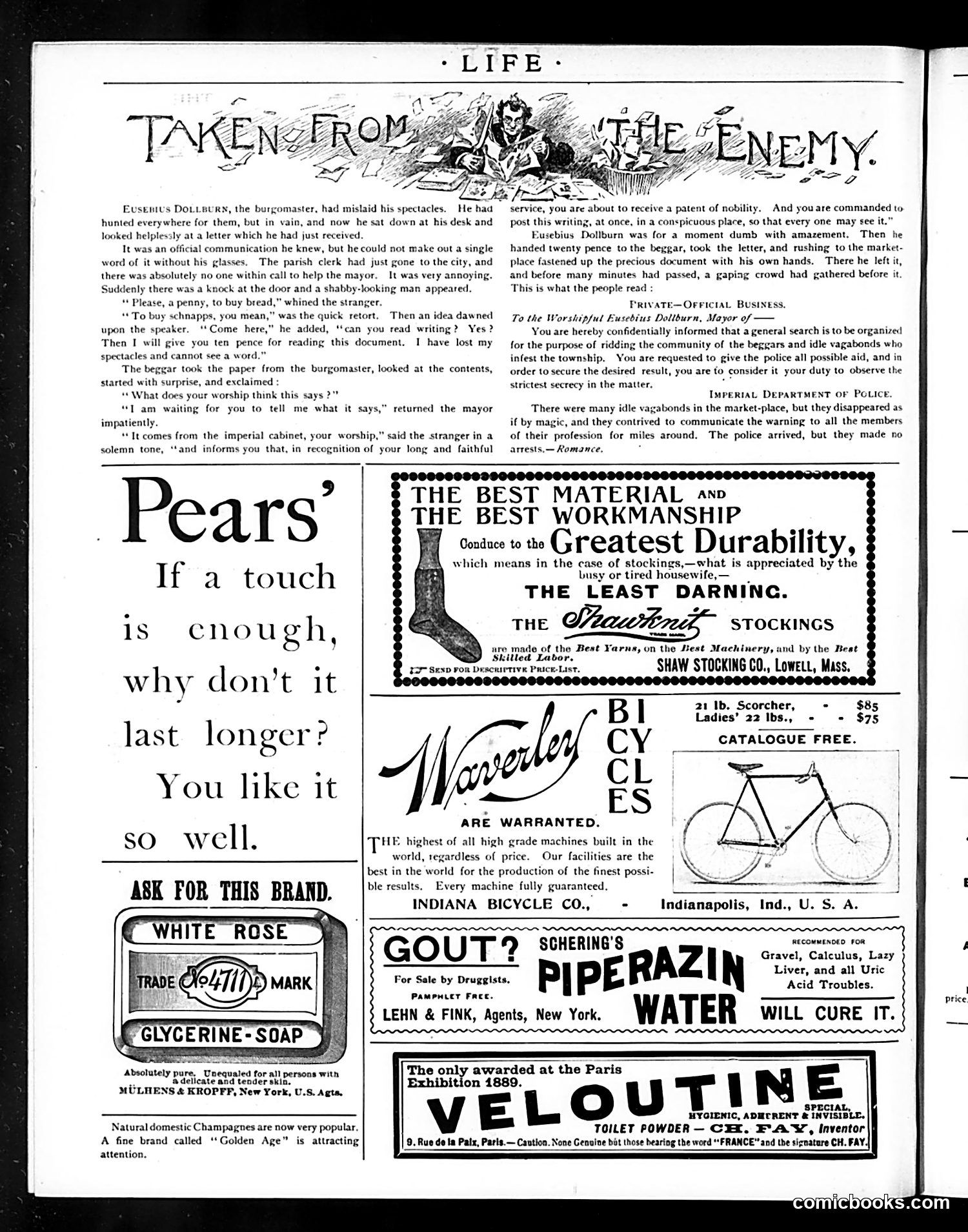
This is a satirical story about Eusebius Dollburn, a mayor who loses his glasses and cannot read an official letter. A beggar he hires to read it tells him it announces his promotion to nobility. Excited, Dollburn posts the letter publicly. However, the actual document—unbeknownst to him—is a police notice ordering him to secretly round up vagabonds and beggars in the township. The irony: by publicly displaying confidential police orders meant for his eyes alone, he accidentally warns the entire vagrant population, who vanish before authorities arrive. The satire targets bureaucratic incompetence and the humorous collision between class pretense (the mayor's vanity about nobility) and practical consequences (criminals escaping due to his carelessness). The "enemy" of the title refers to the beggars and vagabonds who inadvertently benefit from the mayor's foolishness. The page is otherwise filled with period advertisements (soap, bicycles, patent medicines).
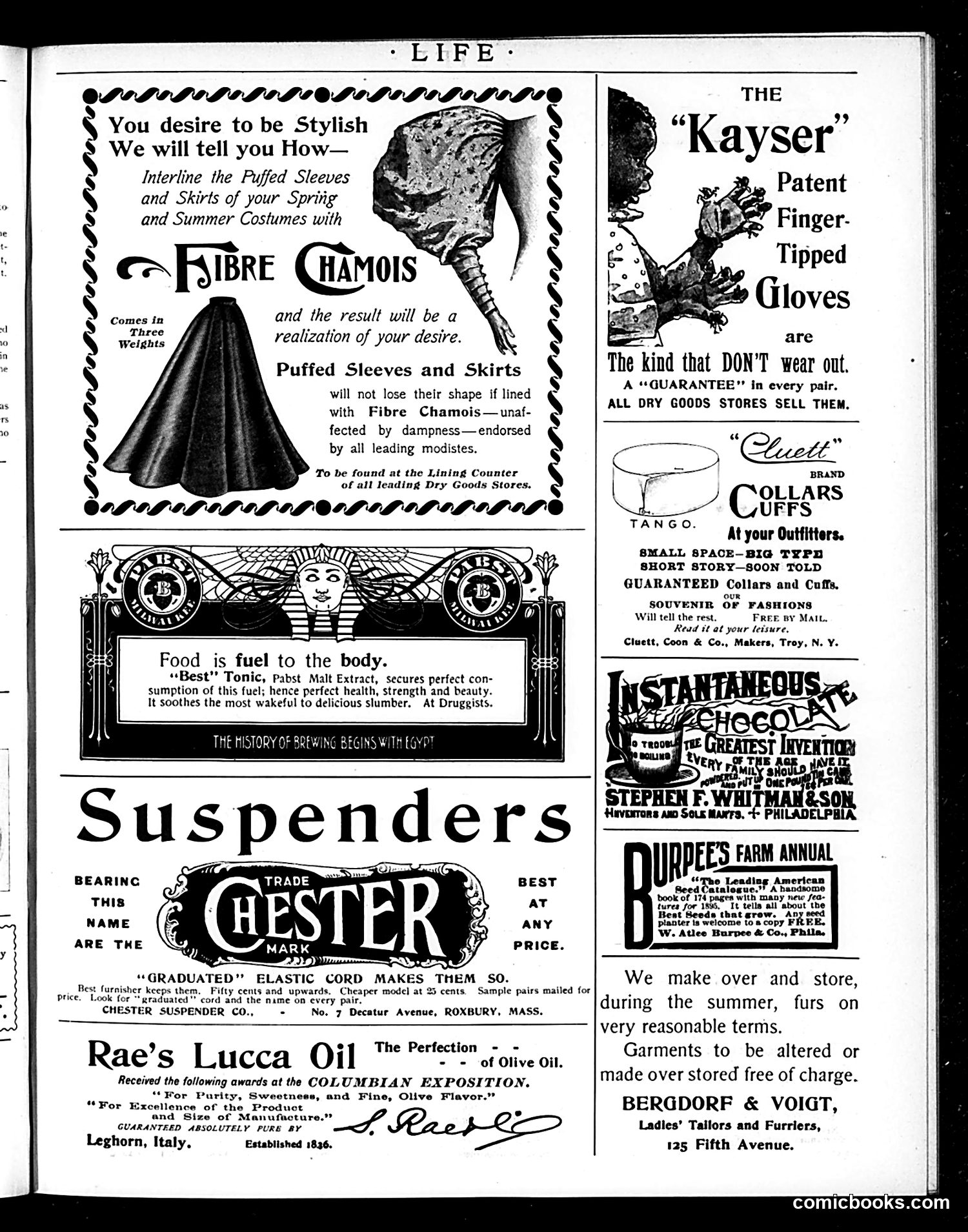
This is primarily an **advertising page** from Life magazine, not a political cartoon. It features various commercial advertisements typical of early 20th-century print media. The ads promote fashion items and consumer goods relevant to the era: - **Fibre Chamois** lining for women's puffed sleeves and skirts (fashionable silhouettes of the period) - **Kayser gloves** with reinforced fingertips - **Cluett collars and cuffs** for men - **Chester suspenders** with elastic cord - Patent medicines like **Pabst Malt Extract** tonic - **Instantaneous Chocolate** candy - **Rae's Lucca Oil** (olive oil) - **Burpee's Farm Annual** seed catalog - **Bergdorf & Voigt** tailoring services The page reflects consumer culture and advertising conventions of the period, with decorative borders and ornate typography. There is **no political satire or cartoon commentary**—it's a standard commercial advertising section.
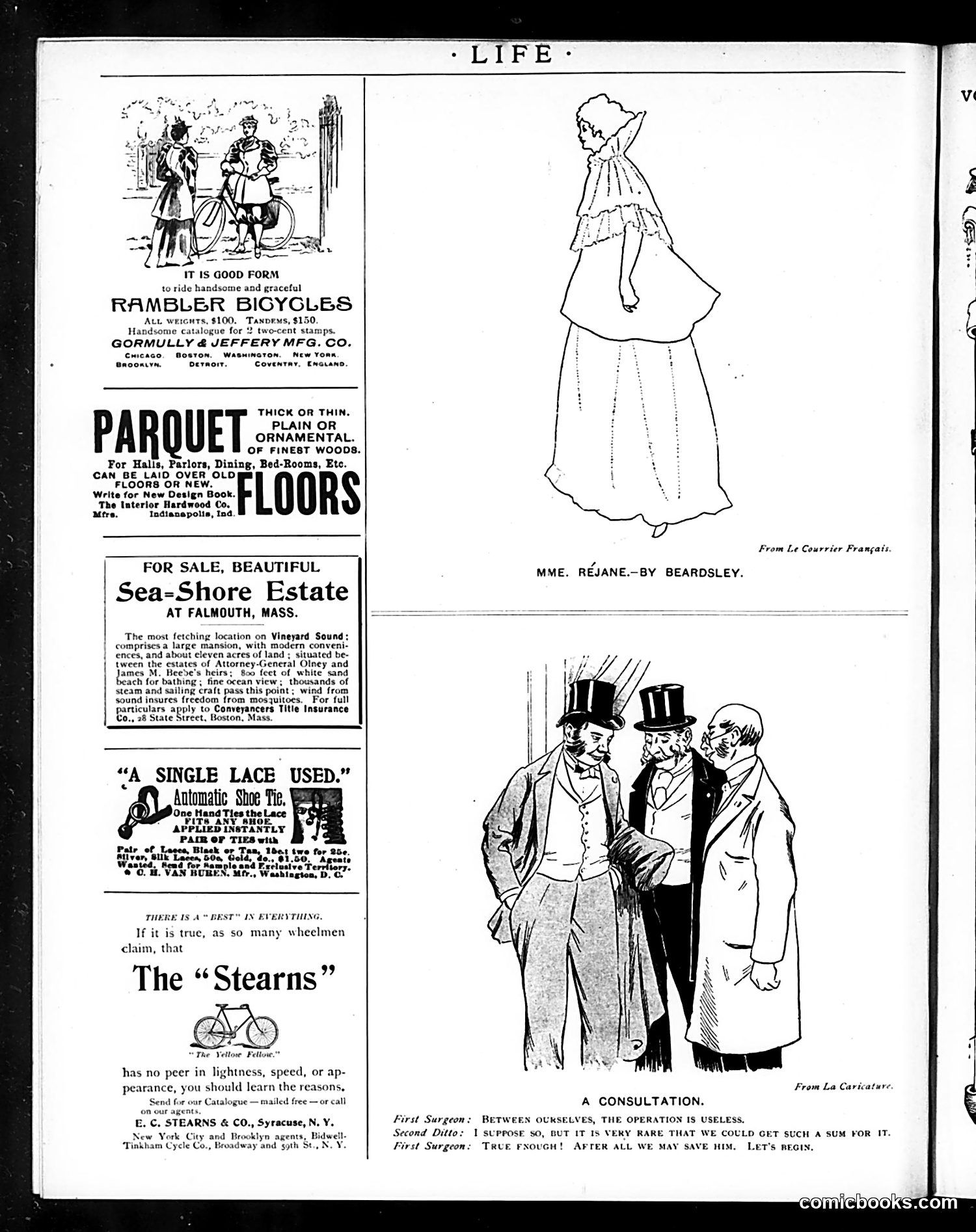
The lower cartoon, titled "A Consultation," depicts three men in top hats—apparently wealthy surgeons or doctors—discussing a patient. The satire mocks medical professionals' financial self-interest: the first surgeon declares the operation "useless," the second notes they rarely get paid such sums, and the first agrees to proceed anyway ("let's begin"). This reflects late 19th-century public skepticism about doctors' motives during the Gilded Age. The cartoon suggests physicians prioritized fees over patient welfare, performing unnecessary procedures on wealthy patients who could afford them. The formal dress and top hats emphasize the surgeons' pretense to respectability despite their mercenary conversation. The page is otherwise dominated by period advertisements for bicycles, flooring, and real estate—typical Life magazine content mixing satirical cartoons with commercial appeals to affluent readers.