
A complete issue · 18 pages · 1895
Life — March 21, 1895
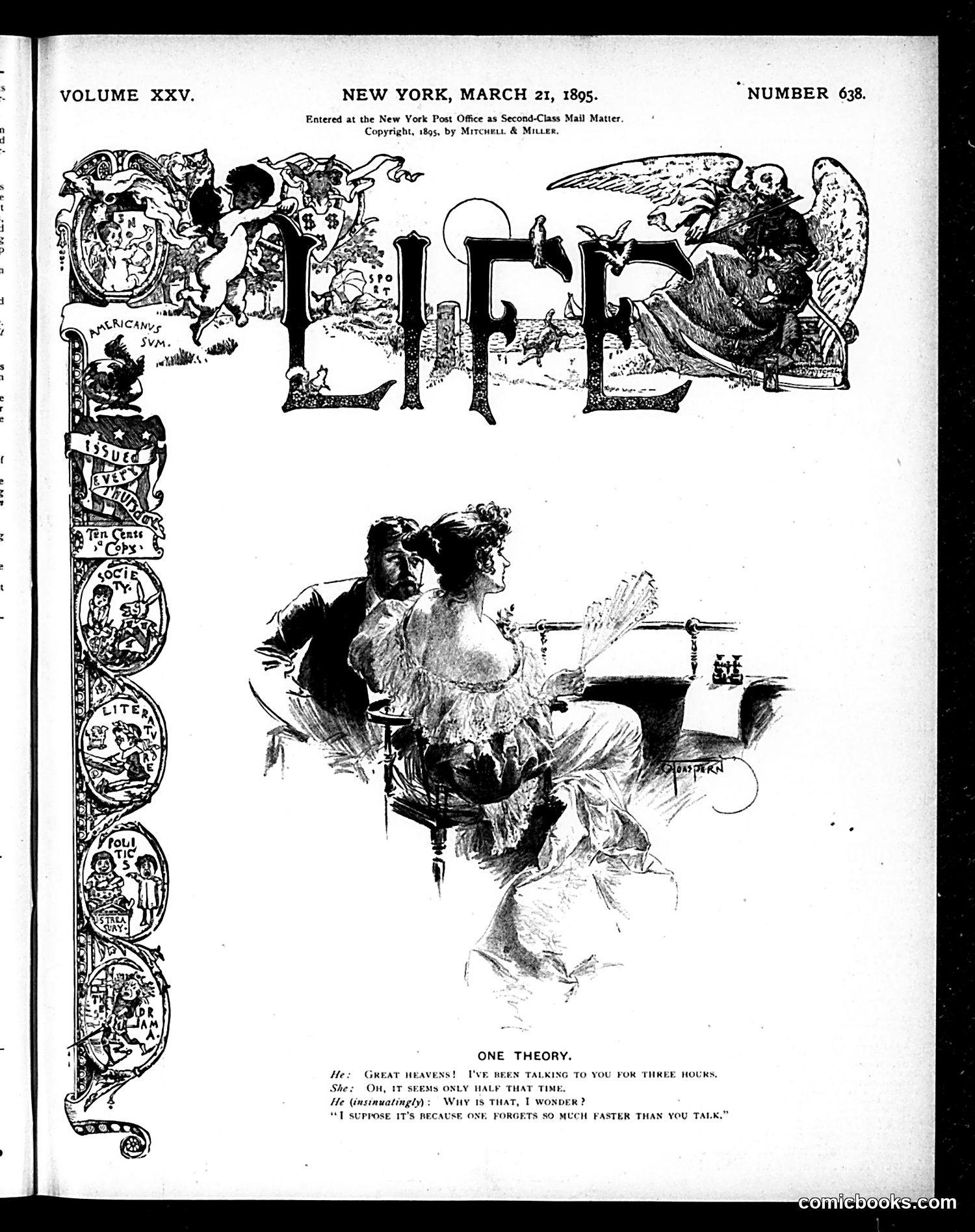
This page features a single cartoon titled "One Theory," illustrating a domestic dispute about conversation speed. The sketch shows a woman at a desk or vanity while a man leans toward her. The dialogue reads: "Great heavens! I've been talking to you for three hours." / "Oh, it seems only half that time." / "Why is that, I wonder?" / "I suppose it's because one forgets so much faster than you talk." The satire targets a common marital complaint: a husband's verbose, tedious monologues that feel interminable to his wife. She suggests she "forgets" his words almost as quickly as he speaks them—a cutting remark about the unimportance or tedium of his conversation. This reflects late-Victorian anxieties about gender relations and domestic communication, presenting the wife as cleverly retaliating against masculine self-importance through wit rather than direct confrontation.
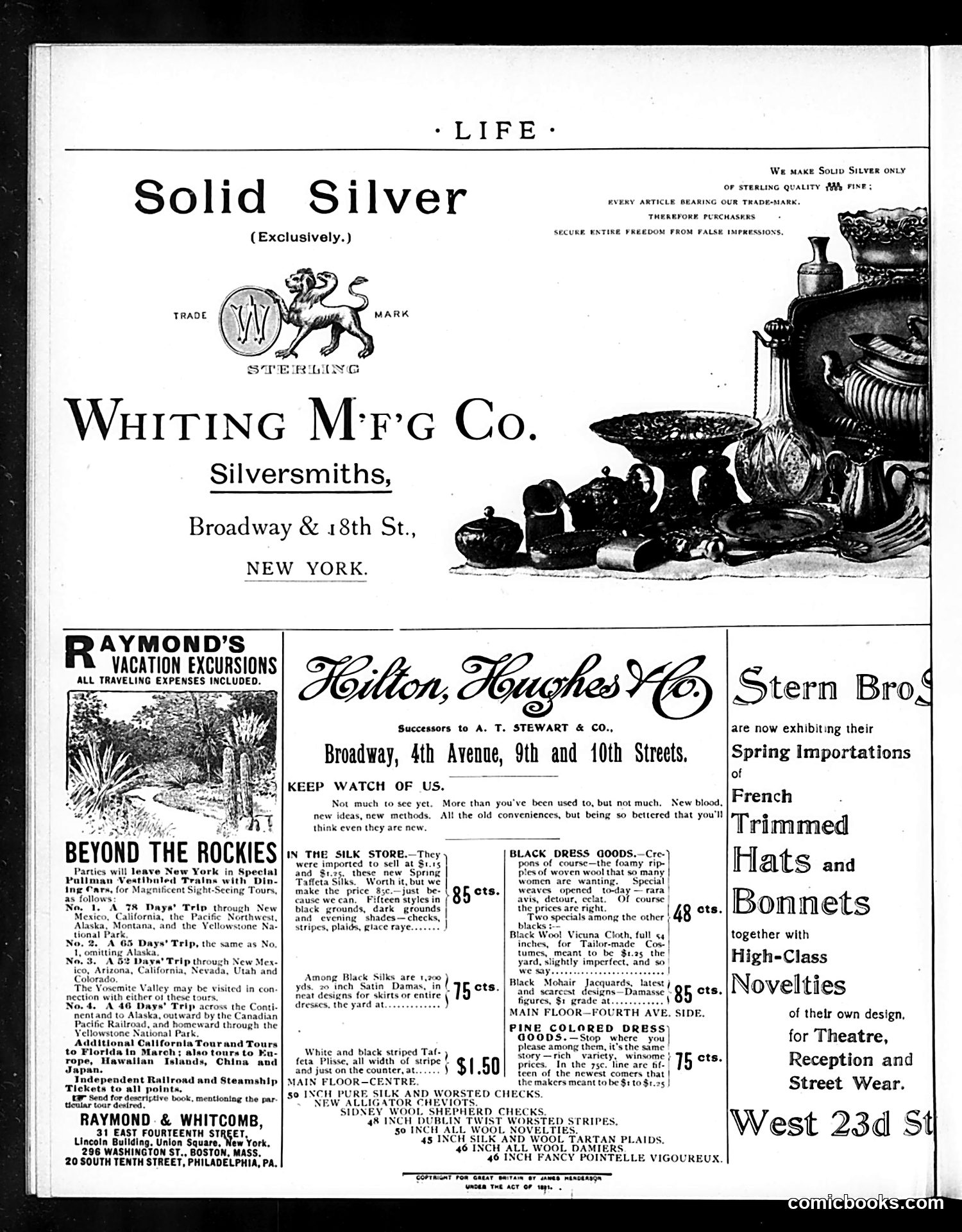
This page is **primarily advertising**, not satirical content. It features ads for luxury goods typical of early 20th-century Life magazine: - **Whiting Mfg Co.** advertises sterling silver tableware - **Hilton, Hughes & Co.** promotes silk fabrics and dress goods - **Stern Bros.** showcases imported French trimmed hats and bonnets - **Raymond & Whitcomb** offers vacation tours to destinations like California and Japan The decorative header reading "Solid Silver (Exclusively)" and the illustrated silverware display are product marketing rather than political commentary. This reflects Life's evolution from pure satire toward a lifestyle magazine for affluent readers, blending editorial content with high-end consumer advertising targeting upper-class audiences.
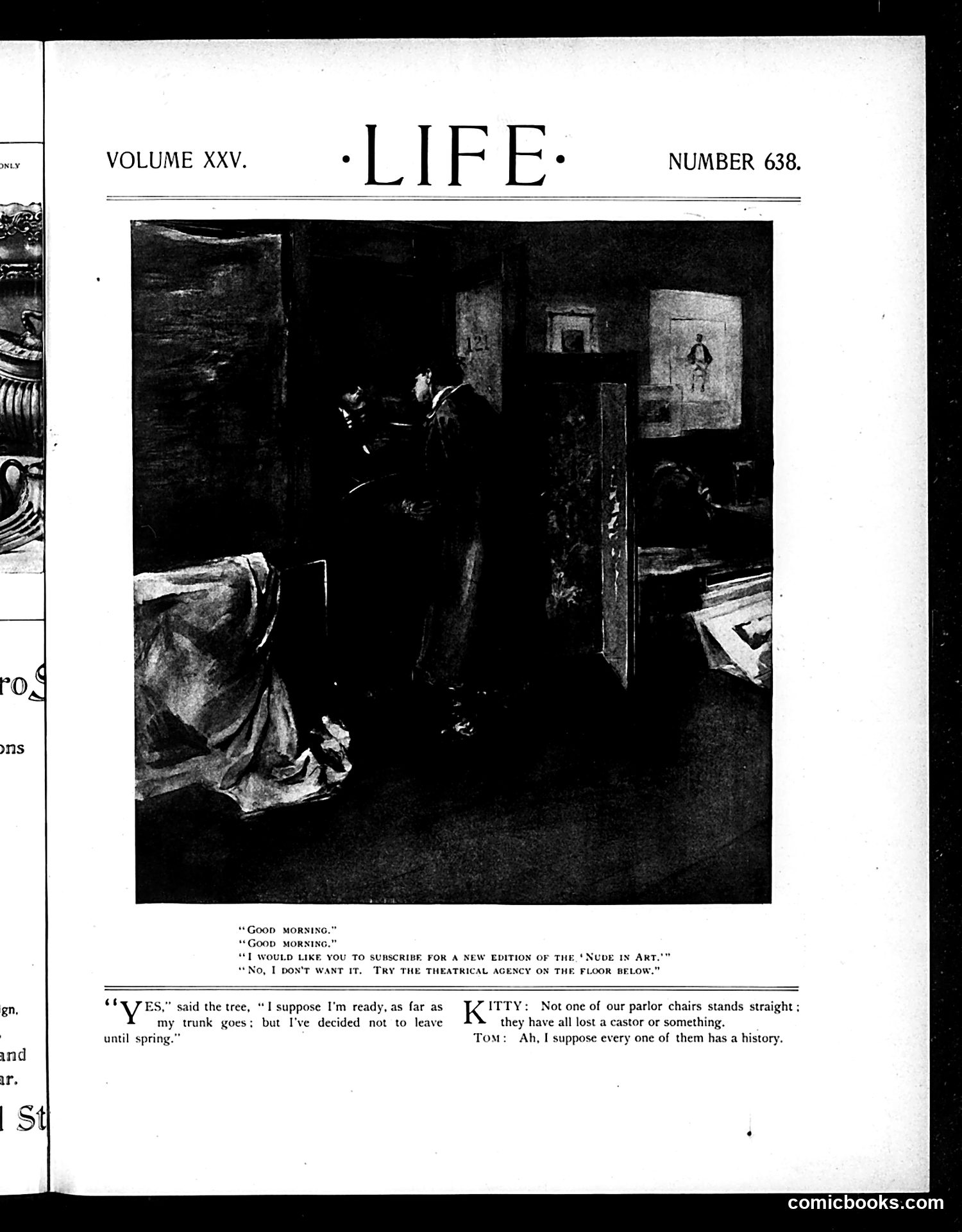
This page from *Life* magazine (Volume XXV, Number 638) contains a theatrical scene photograph with accompanying dialogue. The image shows figures in what appears to be an interior setting, with discussion of furniture and a theatrical agency. The dialogue involves characters named Kitty and Tom discussing parlor chairs that have "lost a castor or something," with Tom suggesting "every one of them has a history." This appears to be satirizing theatrical or bohemian circles where worn or damaged furniture carries accumulated experience and stories. The opening lines reference subscribing to a "Nude in Art" publication and "the theatrical agency on the floor below," suggesting the scene depicts a theatrical world where such details matter. Without additional context about the specific production or date, the exact satirical target remains unclear, though it mocks pretentious attitudes within theater culture.
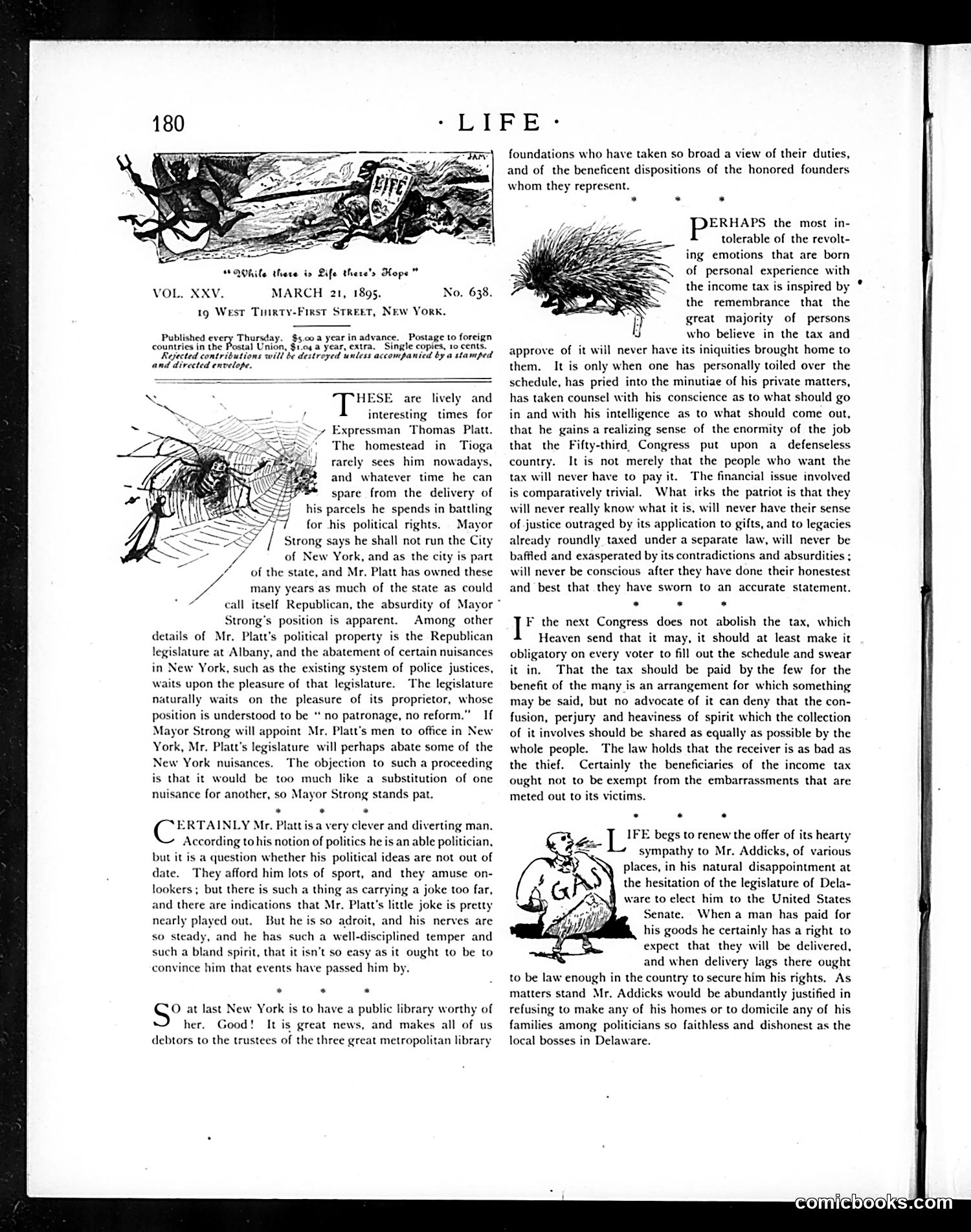
This page contains political commentary rather than cartoons. The main topic is **Thomas Platt**, a Republican politician and New York state power broker. The text criticizes Platt's control over New York politics and his influence on Mayor Strong's administration. The article discusses Platt's wealth from real estate and his ability to manipulate state legislation. It satirizes how politicians like Platt use their influence to remove political opponents—here, the text suggests Mayor Strong will remove nuisances that displease Platt, who effectively controls him. The final section addresses **Mr. Addicks**, a Delaware politician facing election difficulties, sympathizing with his frustration when local bosses prevent honest politicians from winning office. The satire targets **machine politics** and the corrupting influence of wealthy power brokers.
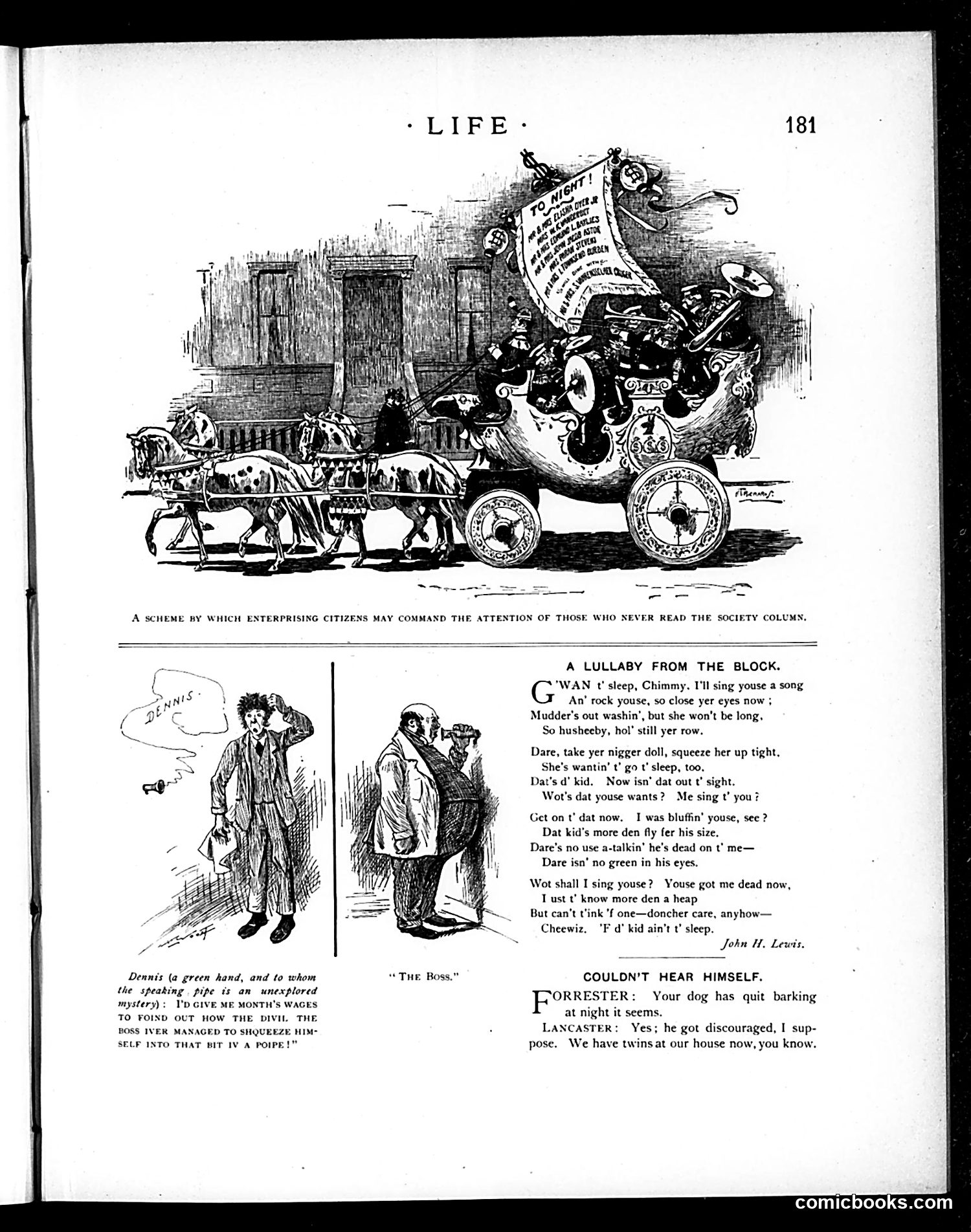
**Top Cartoon:** A satirical "scheme" depicting a giant carnival wagon pulled by horses, labeled "TO THE NIGHT" with cherubs and decorative elements. The caption explains it's a device "by which enterprising citizens may command the attention of those who sever read the society column"—mocking the obsession with society page coverage and the absurd lengths people will go to for publicity. **Bottom Section:** Contains two unrelated pieces: a sketch captioned "The Boss" showing a speaking-pipe mystery, and "A Lullaby from the Block"—working-class poetry by John H. Lewis about urban life, followed by a brief comedic dialogue ("Couldn't Hear Himself") about a neighbor's discouraged dog. The page satirizes both high-society vanity and everyday urban humor.
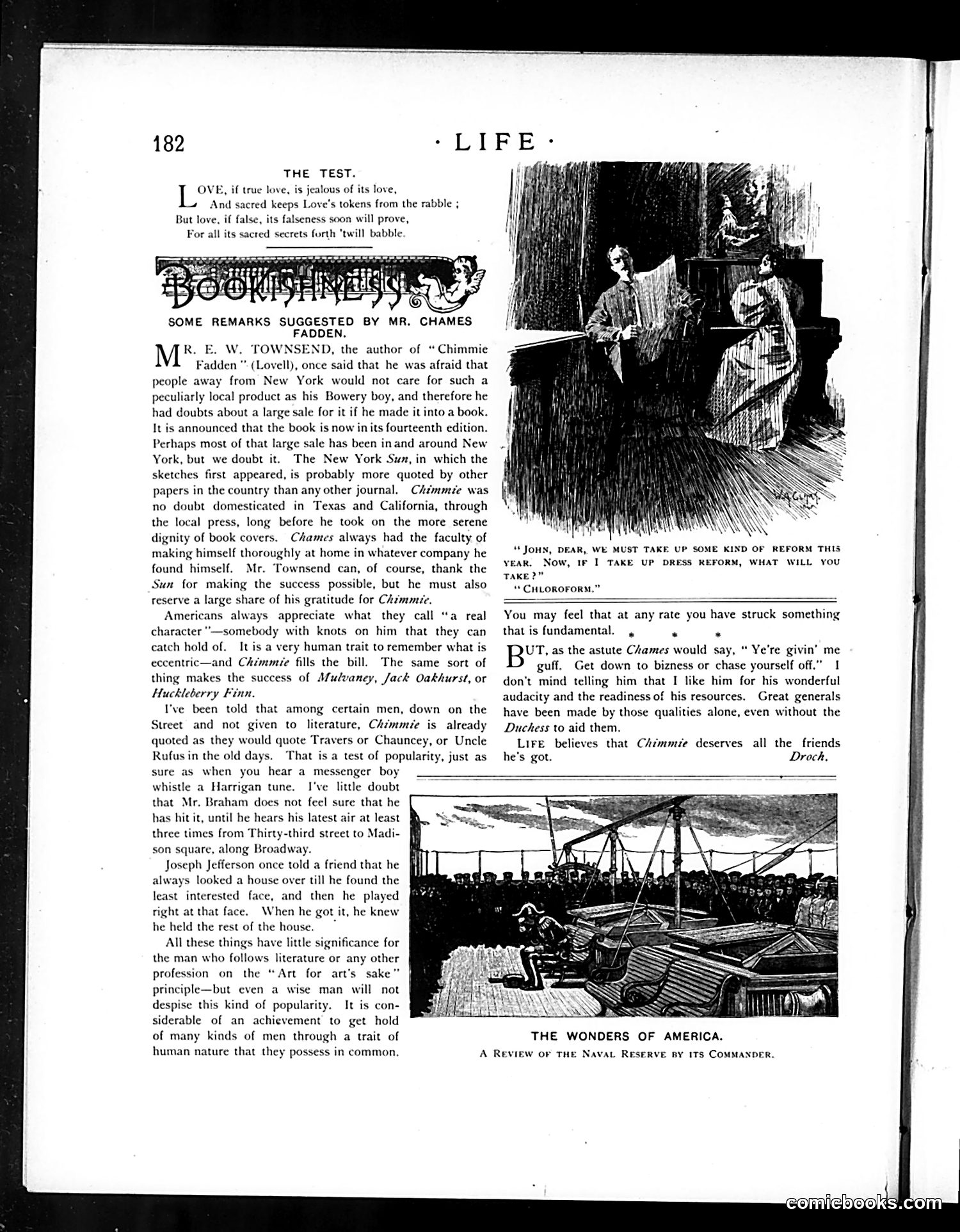
This page contains two distinct elements: **"The Test" (poem)**: A brief poem about love's authenticity, appearing above a decorative "Bookishness" header. **"Some Remarks Suggested by Mr. Chames Caden"**: The main text praises E.W. Townsend's book *Chimmie Fadden*, noting its fourteenth edition and popularity in New York and beyond. The piece humorously addresses concerns that a "local product" about a "flowery boy" wouldn't merit publication, but celebrates its success. It discusses how Americans appreciate "real character"—citing examples like Artemus Ward and Mark Twain—and notes that *Chimmie* is already quoted on the street alongside classic literary figures. **Lower illustrations**: A domestic scene showing what appears to be a conversation about dress reform, and below that, "The Wonders of America: A Review of the Naval Reserve by Its Commander," showing a naval vessel. The page promotes Townsend's work as authentically capturing American urban character.
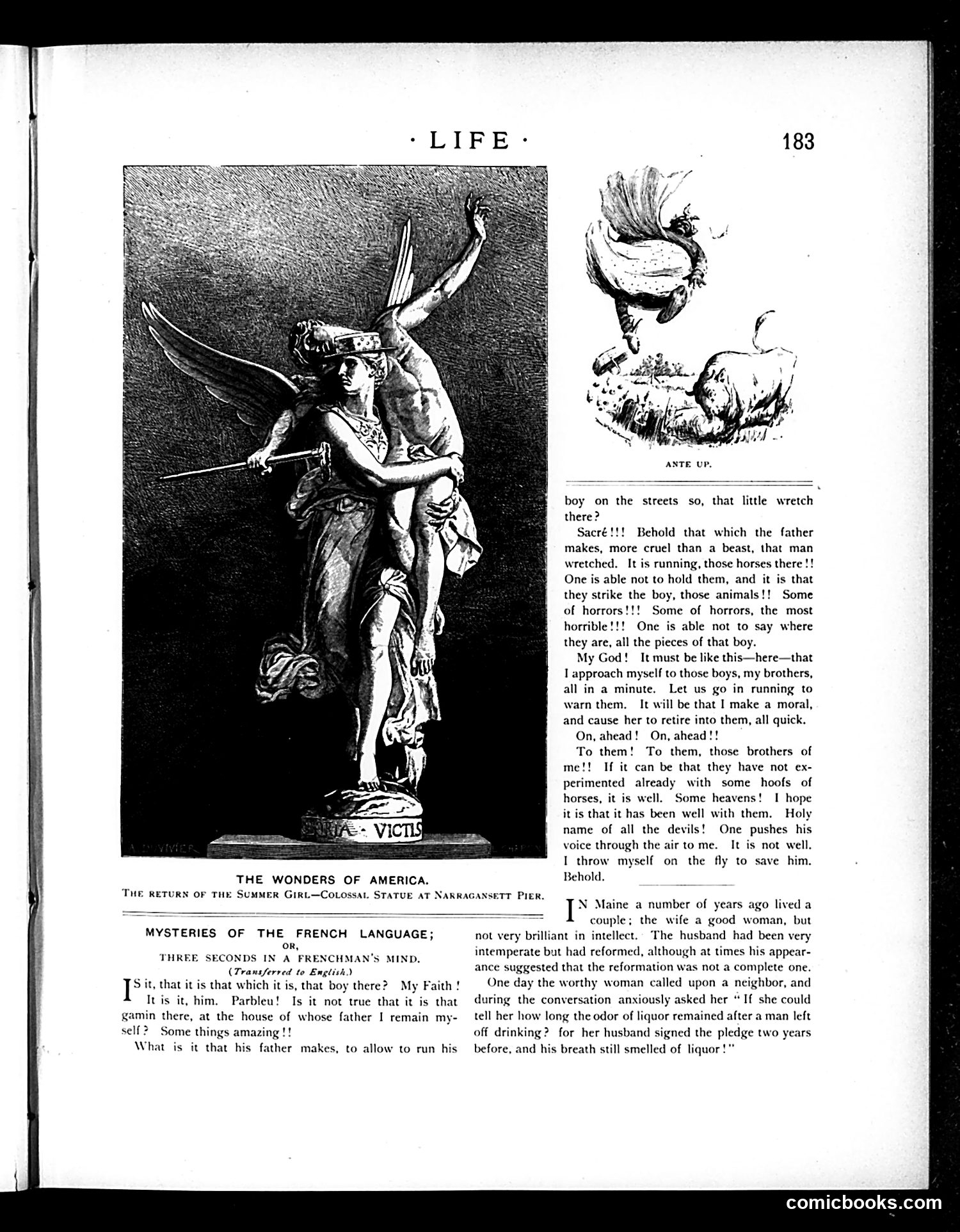
**The Main Image**: "The Wonders of America: The Return of the Summer Girl—Colossal Statue at Narragansett Pier" depicts a classical winged female figure (likely Liberty or Victory) holding weapons, posed as a monumental statue. This appears to satirize the contrast between idealized American monuments celebrating freedom and virtue versus the chaotic reality described in the adjacent text. **The Text Content**: The surrounding passages—"Mysteries of the French Language" and a Maine anecdote about a man's drinking problem—are humorous vignettes about everyday American life and human weakness. **The Satire**: The juxtaposition mocks the gap between America's grand self-image (represented by the imposing statue) and ordinary Americans' actual behavior (domestic dysfunction, alcoholism, moral failings). The statue's austere idealism contrasts sharply with the mundane human struggles described beside it.
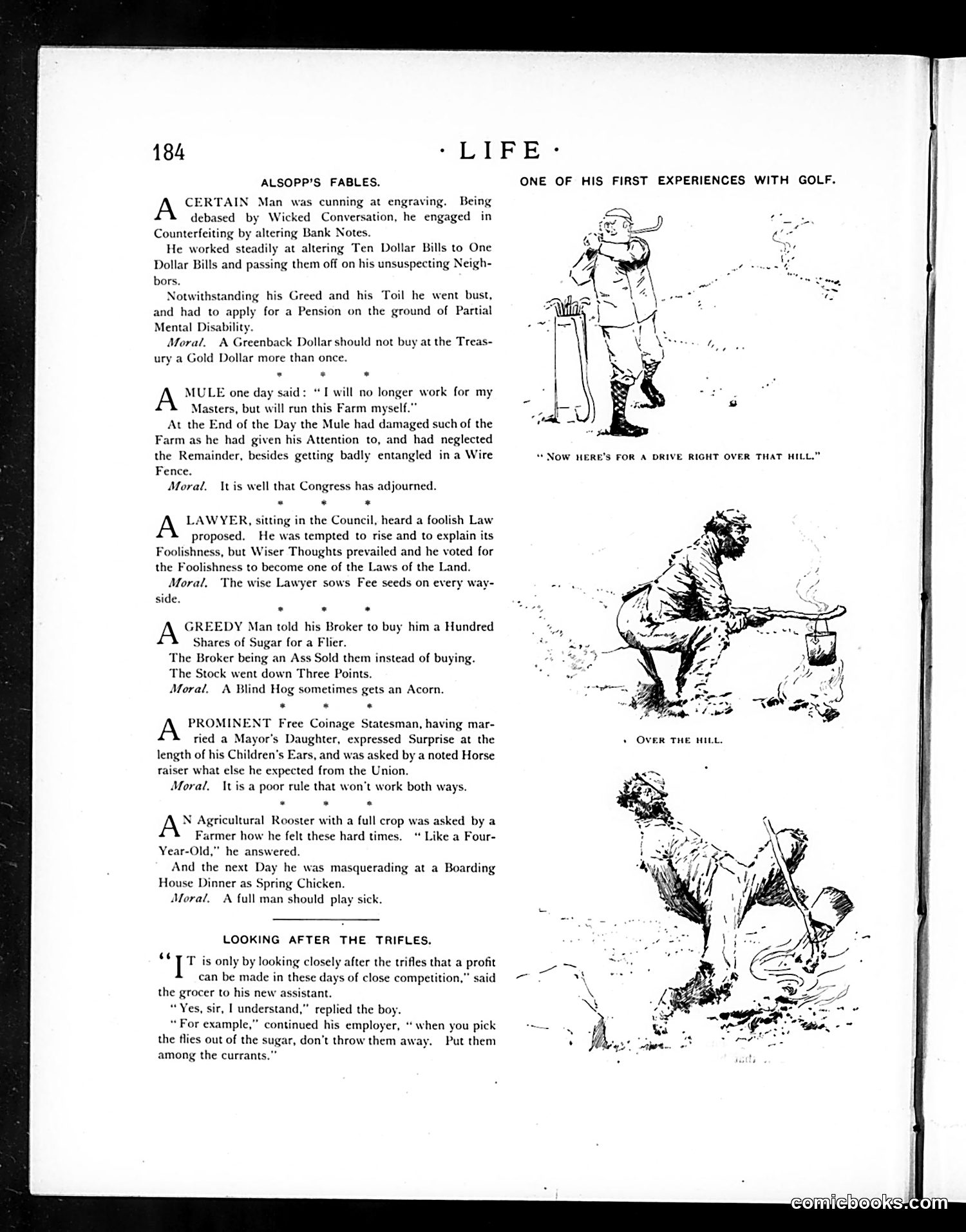
This page from *Life* magazine contains **Aesop's Fables**—moral tales using animal characters—rather than political cartoons. The three sketches on the right illustrate "One of His First Experiences with Golf," showing a beginner's comical struggles with the sport. The fables on the left are brief satirical stories with morals targeting contemporary issues: counterfeiting, Congressional incompetence, foolish lawmakers, stock market speculation, political nepotism, and agricultural hardship. Each concludes with a pointed moral lesson. The golf illustrations use visual humor to mock amateur golfers' awkwardness—a relatable subject for *Life's* educated readership. The page blends traditional fable morality with topical social criticism typical of early 20th-century American satire.
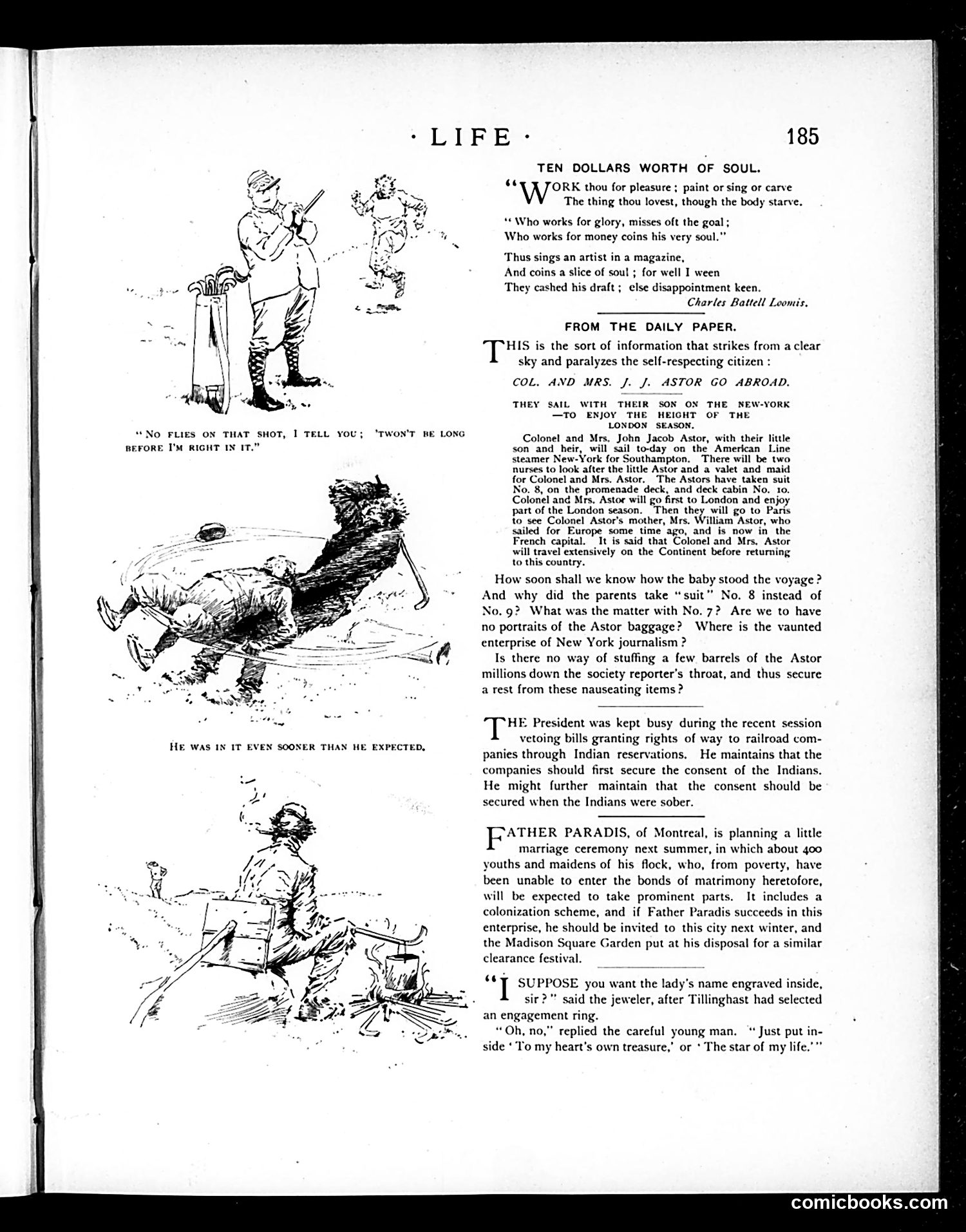
The page contains three humorous cartoon vignettes about hunting and fishing, each with a caption below. The first shows a man with a gun claiming "No flies on that shot, I tell you; 'twon't be long before I'm right in it." The second cartoon depicts someone who "was in it even sooner than he expected"—showing the hunter knocked backward, apparently by recoil or accident. The third shows a fisherman with his catch, illustrating the recurring joke about overconfidence versus reality in outdoor pursuits. The satirical point is straightforward: amateur sportsmen boast about their skill but promptly fail through incompetence or mishap. The humor targets the gap between self-image and actual performance among recreational hunters and fishermen.
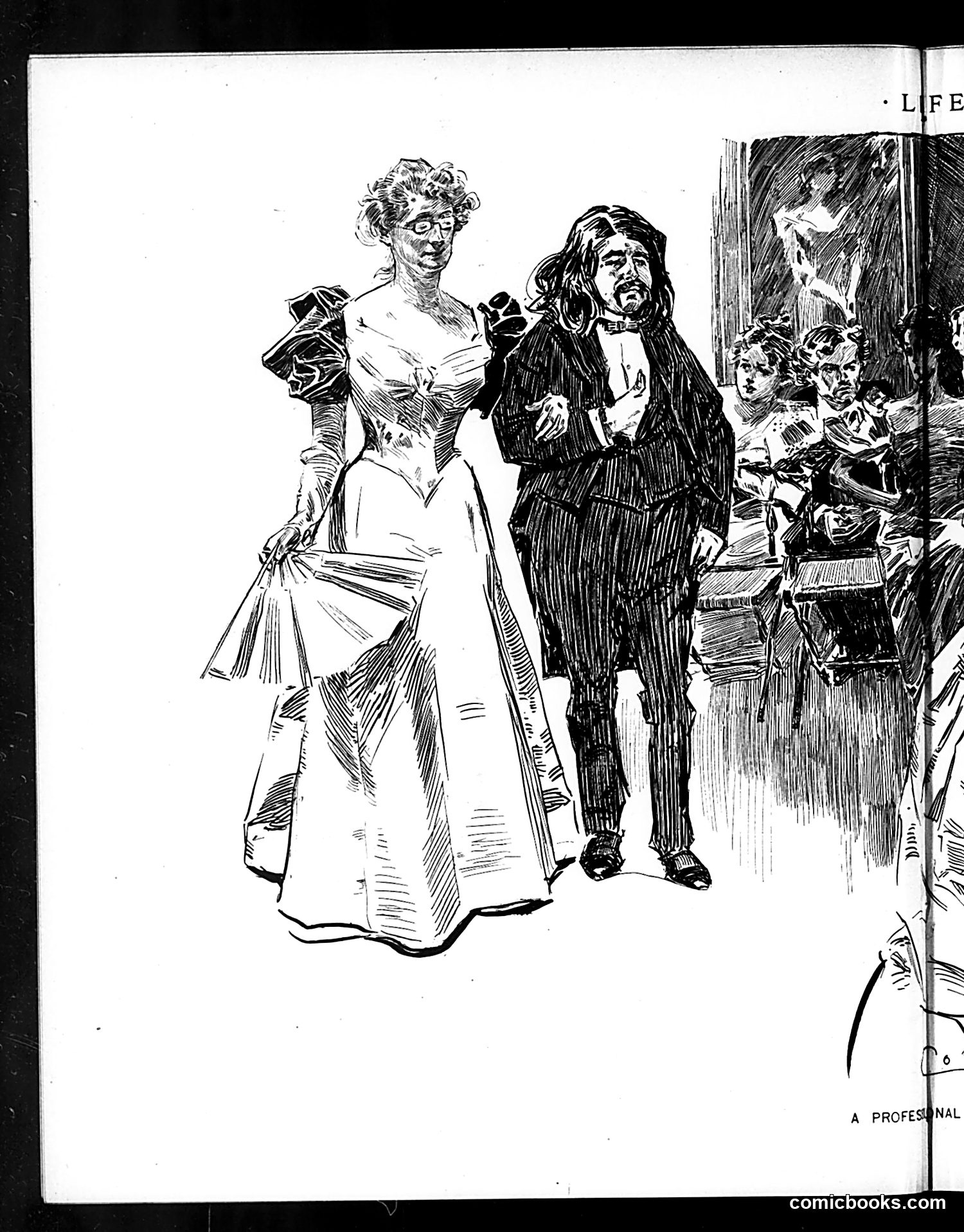
This is a satirical illustration from Life magazine titled "A Professional" (visible at bottom). The cartoon depicts a well-dressed woman in an elegant white gown with puffed sleeves escorting a disheveled man in a dark suit through what appears to be a social gathering or theater setting. Other figures are visible in the background. The satire likely mocks either social climbing, marital dynamics, or the commodification of companionship—suggested by the woman's poised, professional demeanor contrasted with the man's unkempt appearance. The title "A Professional" implies critique of her role or status, possibly commenting on women entering paid professional work or engaging in transactional relationships during the era when this was published (likely early 1900s based on style). Without additional context, the precise social commentary remains somewhat unclear.
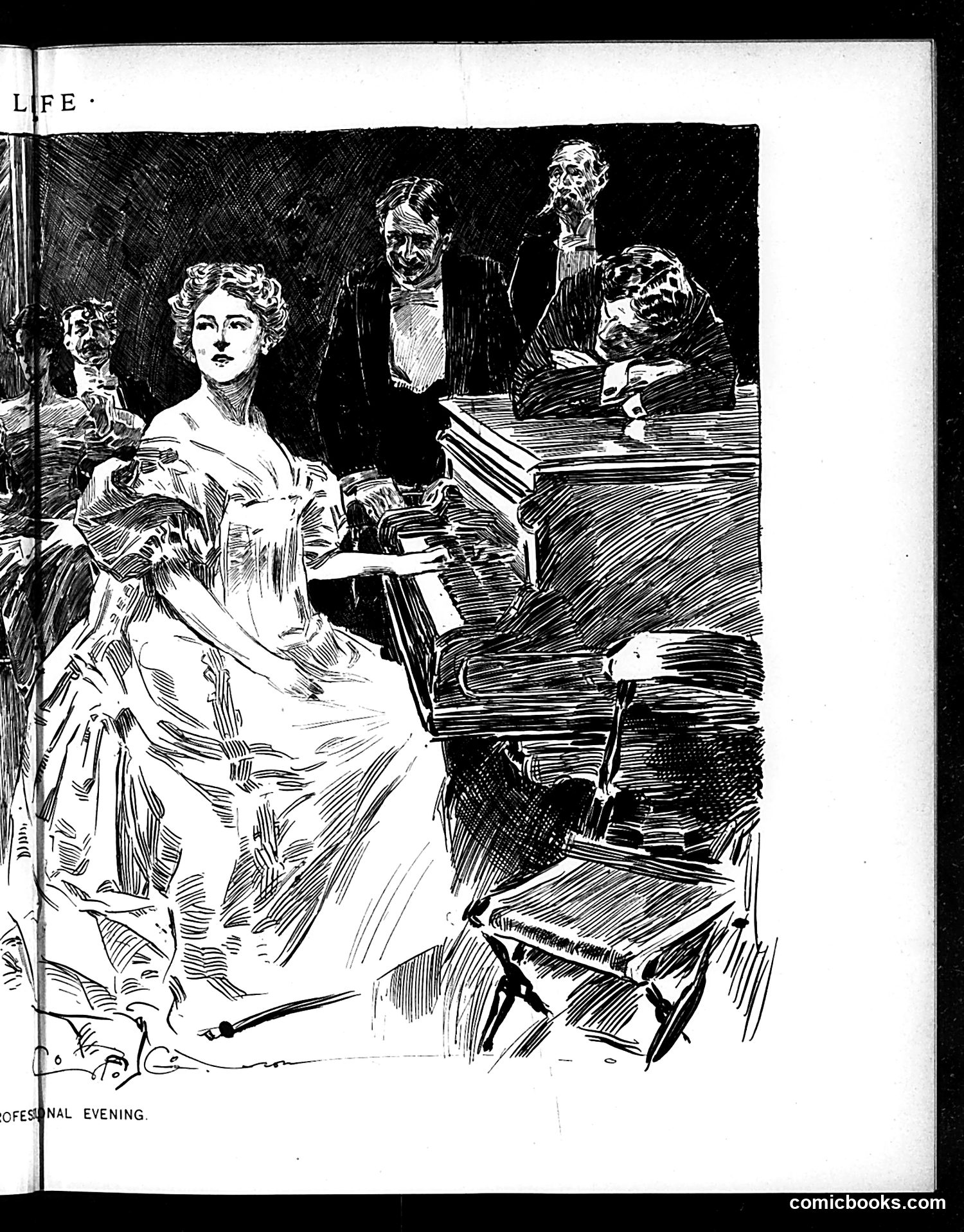
This ink illustration depicts a social scene at what appears to be a formal gathering or salon. A well-dressed woman in an elegant gown sits prominently on the left, holding what looks like a fan or document. Several men in formal attire stand behind and around her—one appears to be speaking or presenting something. The caption "A Professional Evening" suggests satire about intellectual or artistic society gatherings of the early 20th century. The composition emphasizes the woman as a central figure of attention, possibly commenting on gender dynamics in "professional" social circles, though without additional context or visible byline, the specific satirical target remains unclear. The sketch style is characteristic of *Life* magazine's editorial illustrations.
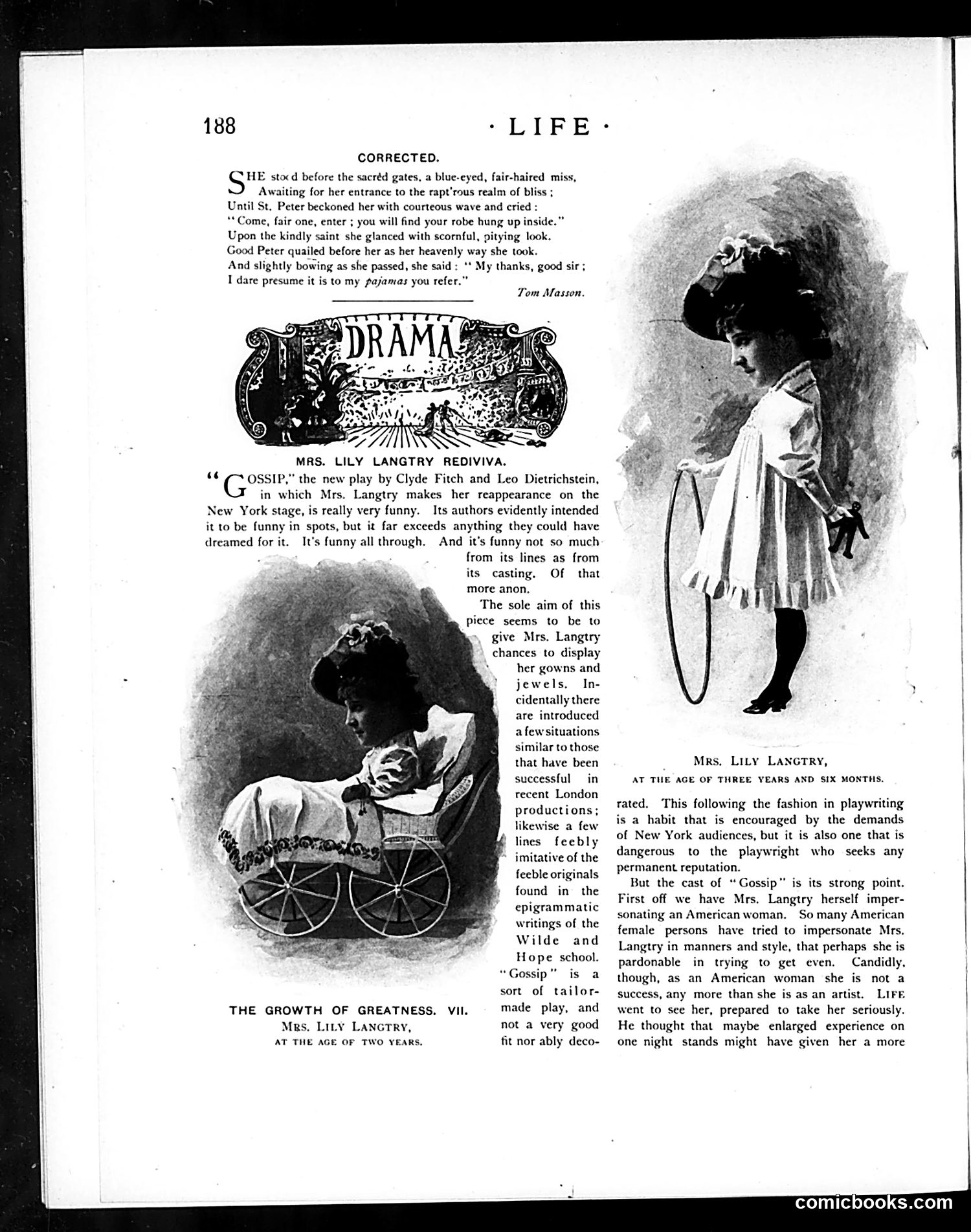
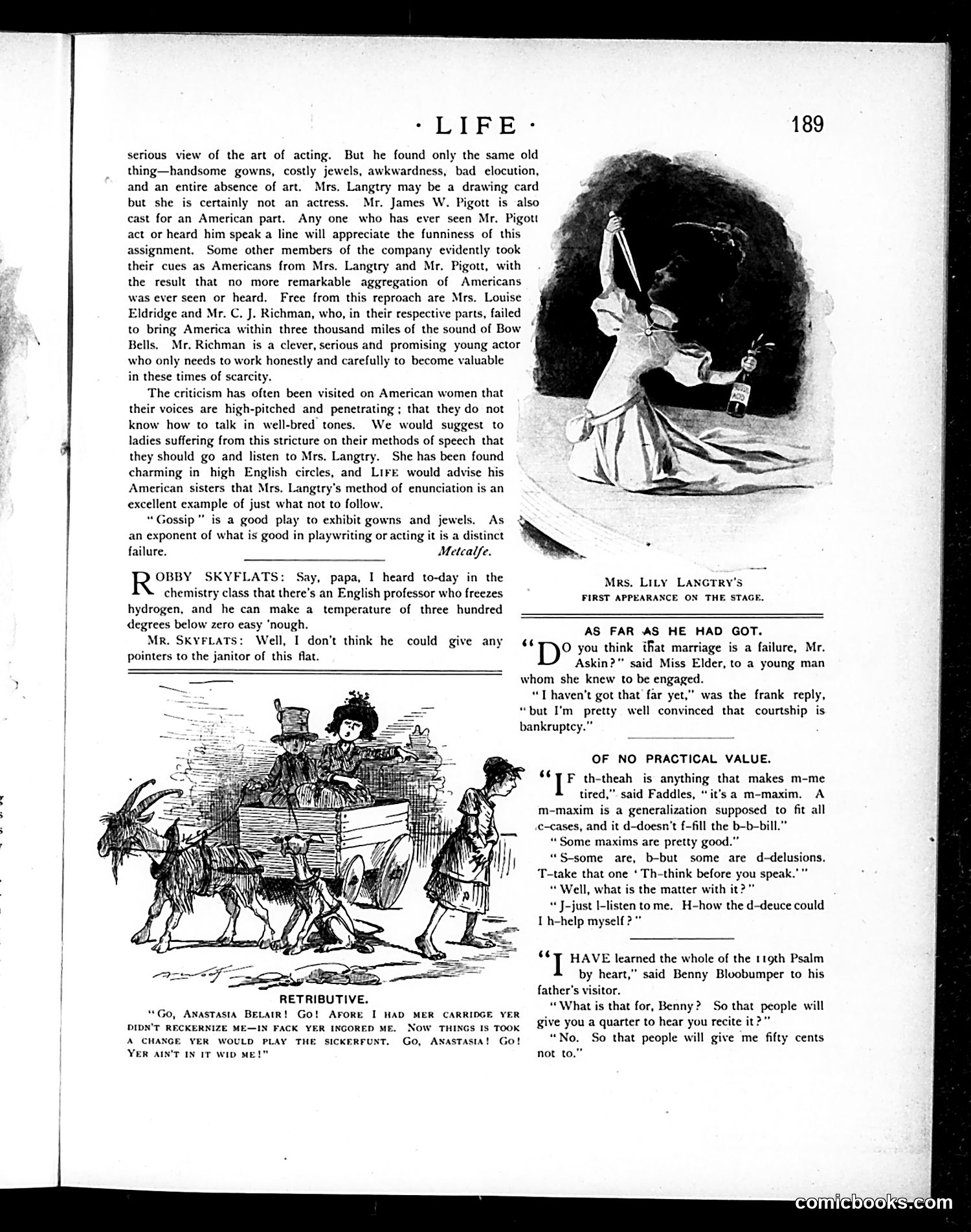
This page reviews a Broadway play called "Gossip" featuring the famous actress Mrs. Lily Langtry making a comeback. The satirical critique argues the play's sole purpose is displaying Langtry's costumes and jewels rather than serving legitimate drama. The review mocks Langtry's attempt to play an American woman, suggesting she fails at this role as much as other actresses have failed imitating *her*. The accompanying photographs show Langtry at different ages (two and three-and-a-half years old), likely used humorously to contrast her youthful appearance with her actual stage maturity. The top poem jokes about vanity and modernity—a woman entering heaven corrects St. Peter about her "pajamas," suggesting contemporary women prioritize fashionable nightwear over spiritual concerns. The satire targets both the play's frivolous production values and theatrical trends prioritizing star vehicles over genuine artistic merit.
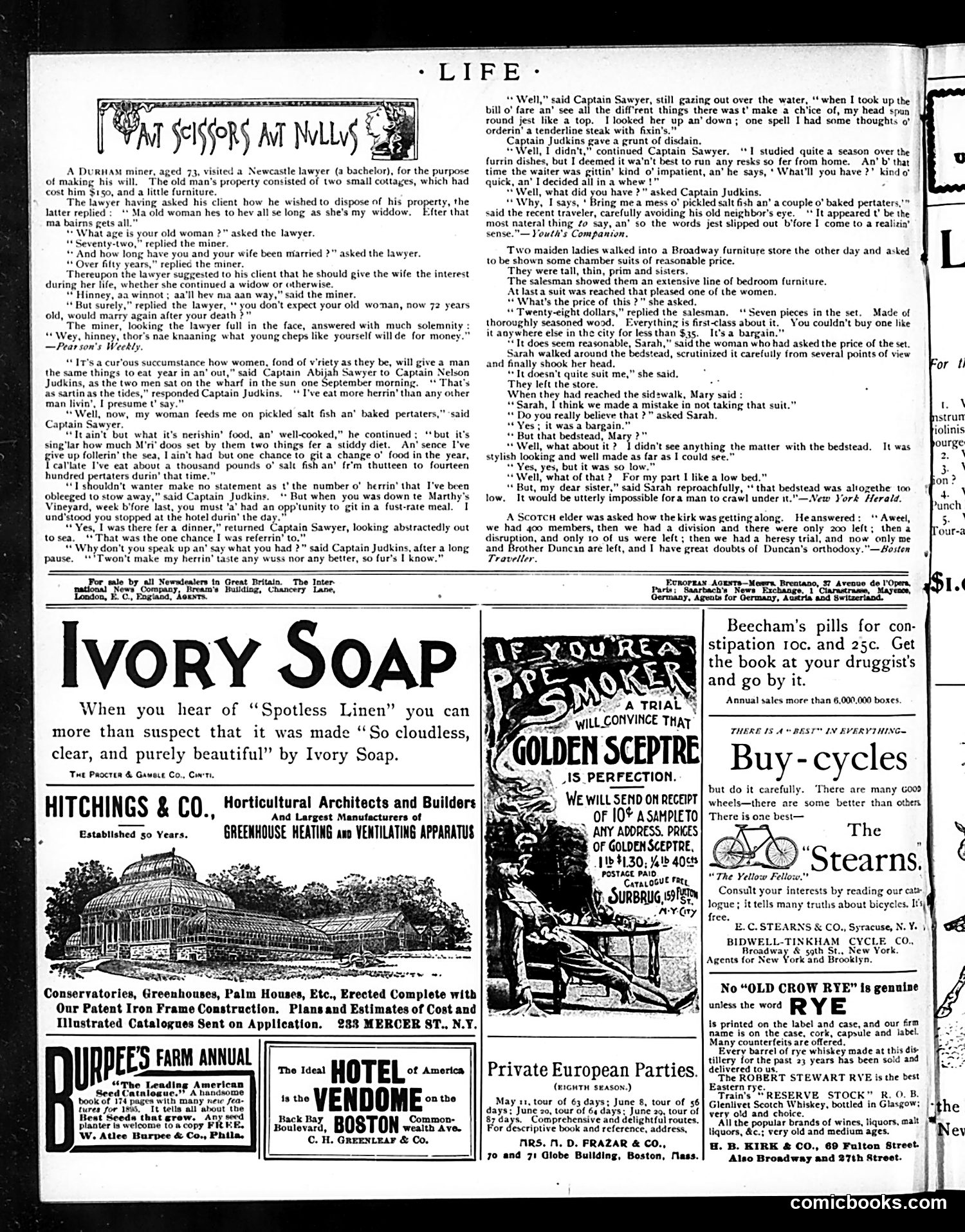
This page contains three humorous anecdotes typical of Life magazine's satirical content. The main cartoon story, "Am Scissors at Nullus," features seafaring New England captains (Sawyer and Judkins) discussing monotonous diets—specifically pickled salt fish and baked potatoes served repeatedly. The joke satirizes working-class male acceptance of repetitive, unvaried food without complaint, contrasting with the captains' anxiety when faced with fancy restaurant menus. The surrounding short stories mock similar provincial attitudes: a 73-year-old Durham miner's suspicion of remarriage despite his wife's age, and two prim spinster sisters who reject a reasonably-priced bedroom set, then regret it immediately. The satire targets rural/working-class conservatism, reluctance to embrace variety or change, and the gap between hesitant deliberation and impulsive second-guessing. The page is otherwise filled with period advertisements (Ivory Soap, bicycles, greenhouses).
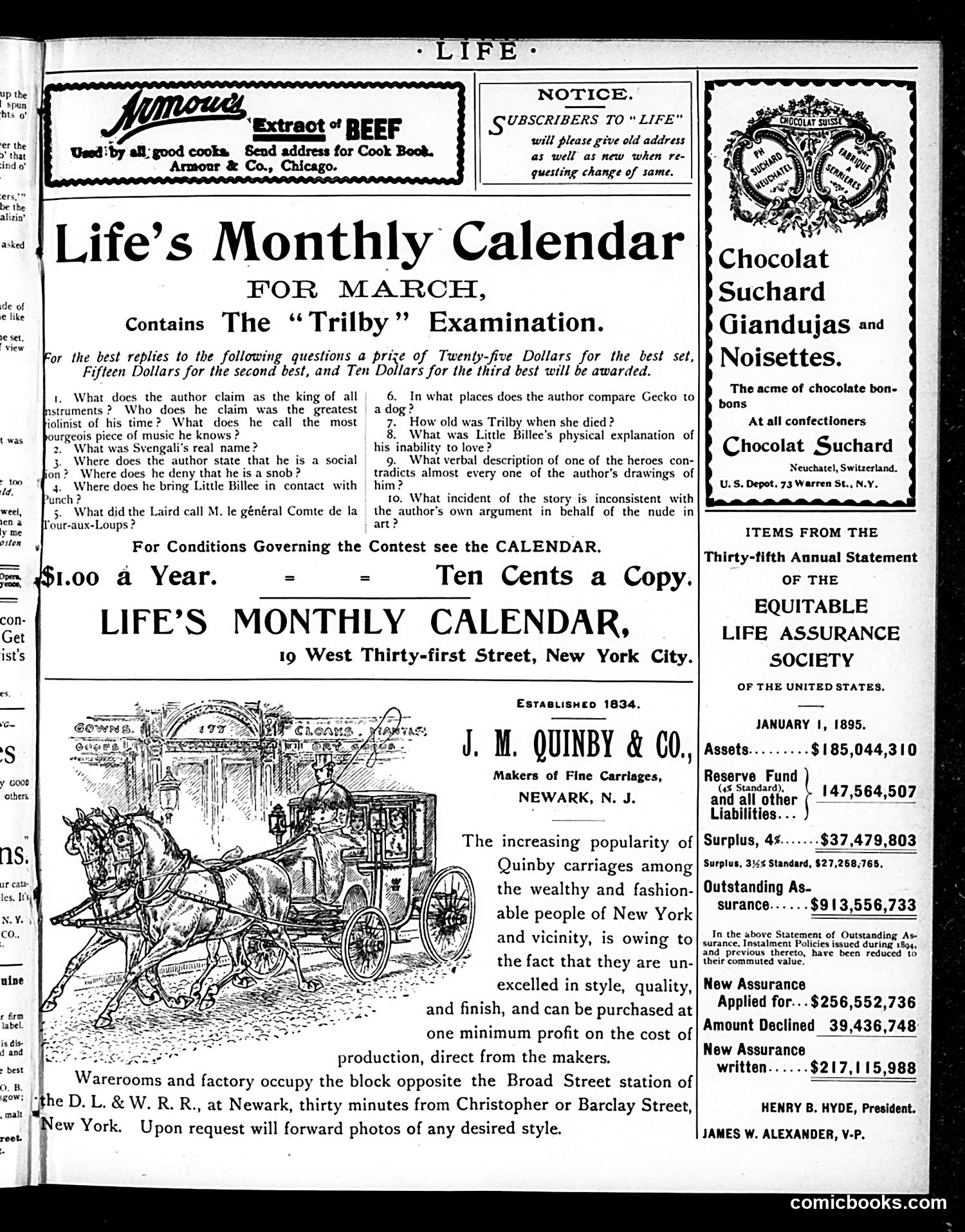
This page is primarily **advertising and administrative content** rather than satirical cartoon material. The main feature is **Life's Monthly Calendar for March**, which advertises a contest based on "Trilby," a popular 1894 novel by George du Maurier. The contest asks readers ten questions about the book's plot, characters (Svengali, Little Billee), and artistic themes—offering cash prizes ($25, $15, $10) for the best answers. This reflects *Trilby*'s contemporary cultural prominence and Life's strategy of engaging readers through interactive literary contests. The page also contains period advertisements: Armour beef extract, J.M. Quinby & Co. carriages (marketed to wealthy New Yorkers), Chocolate Suchard confections, and financial statements from the Equitable Life Assurance Society. There are **no political cartoons visible**. The only illustration is a decorative engraving of a fine carriage, functioning as product advertising rather than satire.
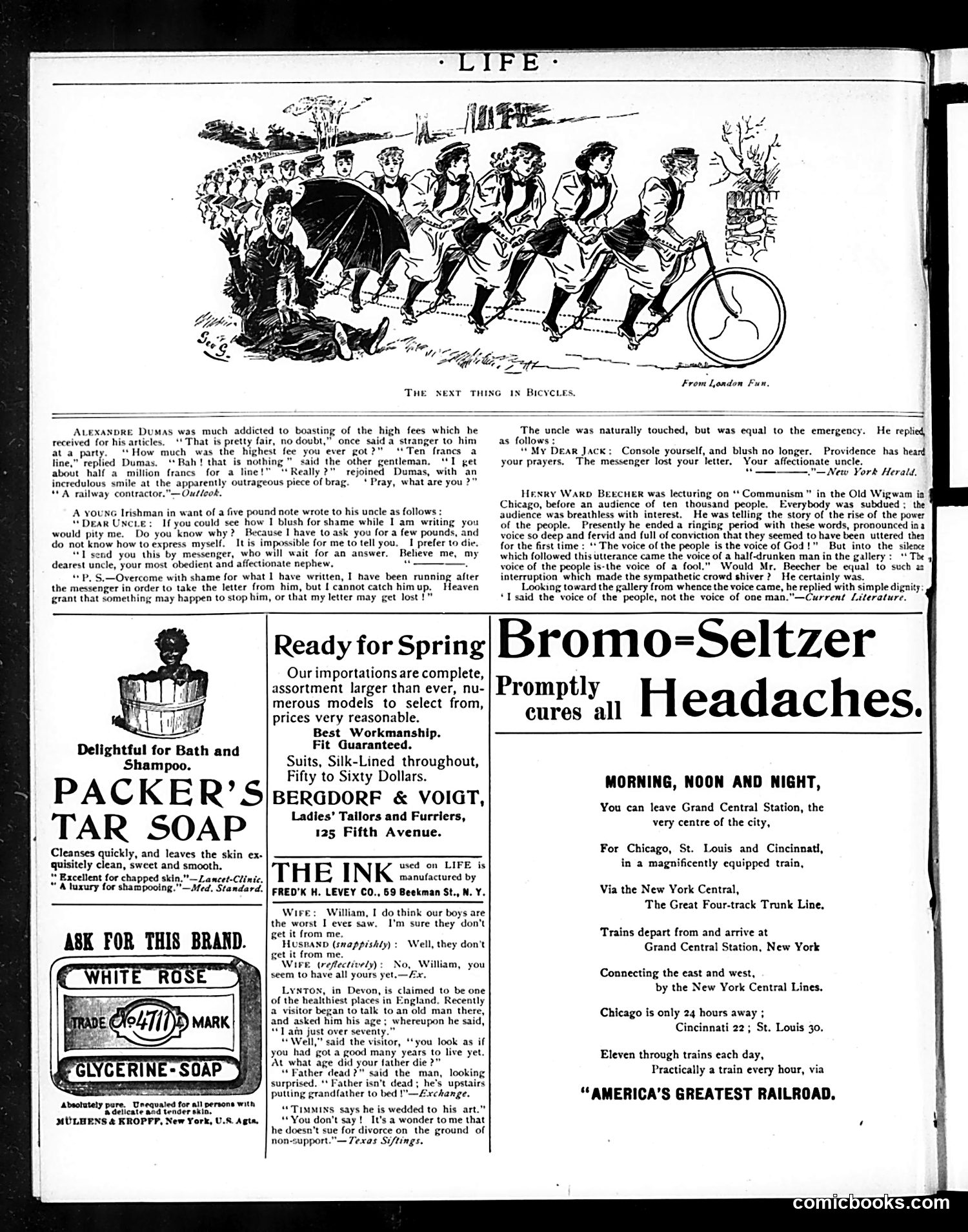
This cartoon satirizes the bicycle craze of the late 19th century. It shows a line of women in athletic bloomers pedaling frantically, having abandoned traditional restrictive clothing. The "next thing" is their liberation through cycling—a social commentary on how bicycles enabled women's independence and challenged Victorian dress codes. The page also contains humorous anecdotes mocking pretension (Alexandre Dumas bragging about fees), Irish awkwardness (a young man too embarrassed to ask his uncle for money), and provincial ignorance (an old Devonshire man so long-lived his grandson is caring for him). These joke sections represent *Life* magazine's satirical approach to social foibles and human nature rather than explicit political commentary.
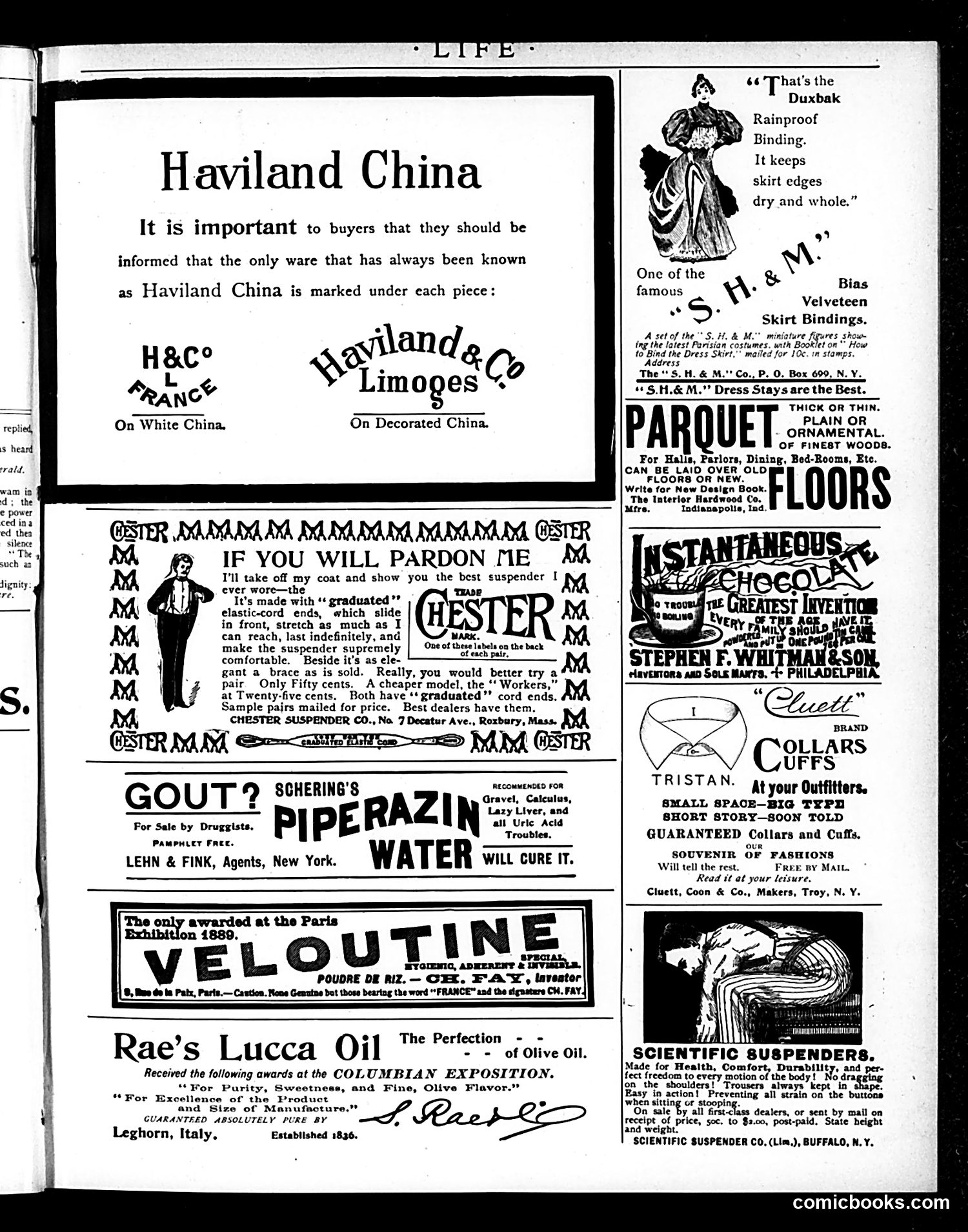
This page is primarily **advertising**, not political satire. It contains multiple commercial advertisements typical of late 19th-century American magazines. The main content includes: - **Haviland China** announcement distinguishing French versus decorated china brands - **Chester Suspenders** ad featuring a man removing his coat to demonstrate elastic suspenders—a practical product pitch emphasizing durability and comfort at various price points - **Patent medicine ads**: Schering's Piperazin Water (claiming to cure gout and uric acid troubles) and Rae's Lucca Oil (olive oil with Columbian Exposition awards) - **Fashion/haberdashery items**: dress stays, skirt bindings, collars, cuffs - **Home products**: parquet flooring, scientific suspenders The only quasi-humorous element is the Chester Suspenders illustration showing a gentleman's sales pitch. Otherwise, this reflects the commercial culture of the period—products marketed through claims of quality, awards, and practical benefits rather than modern advertising techniques. The page demonstrates how Life magazine sustained itself through paid advertisements alongside editorial content.
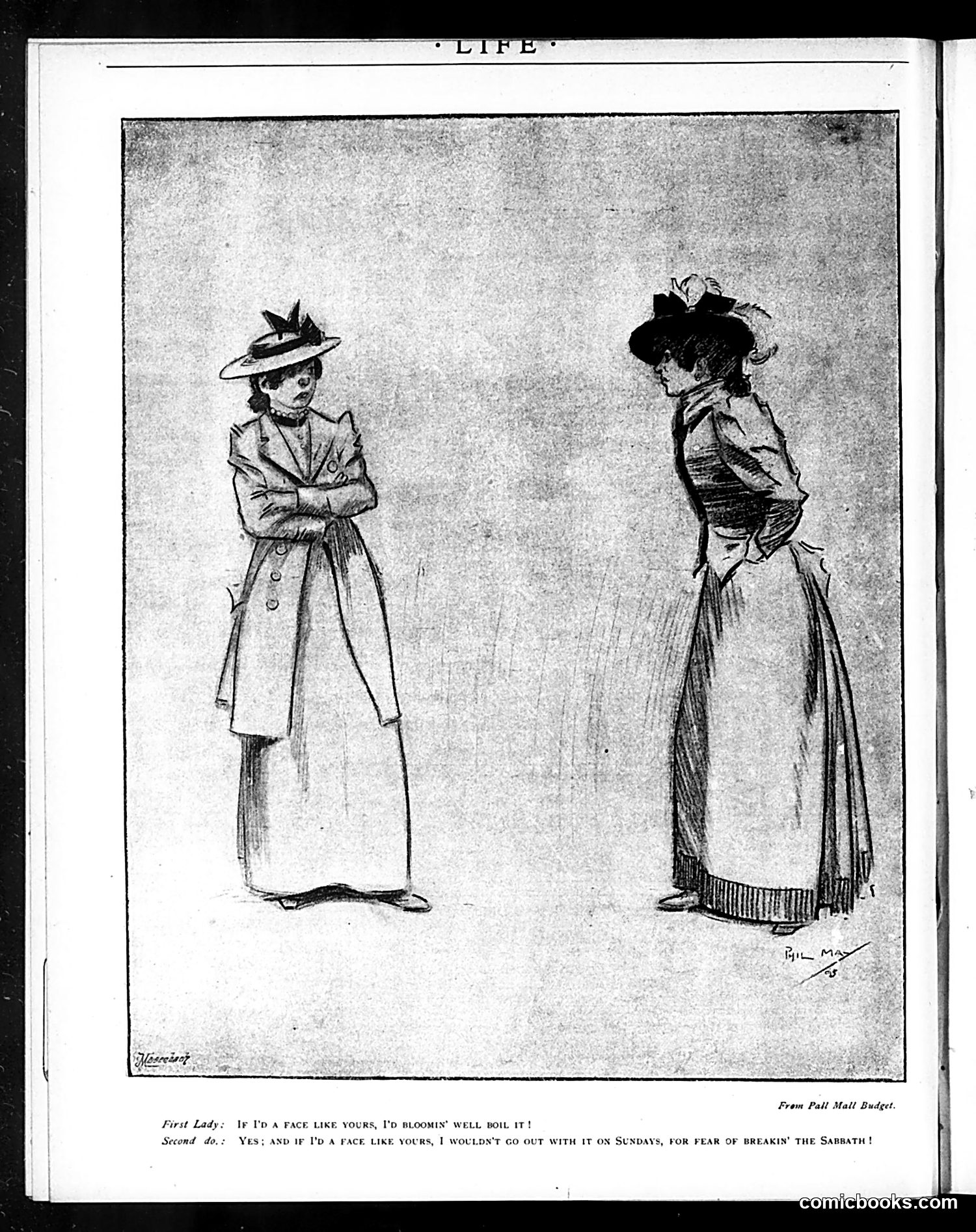
This is a satirical cartoon from *Life* magazine featuring two women in Edwardian-era dress engaged in a cutting insult exchange. The dialogue presents a "burn battle" where each woman attacks the other's appearance with increasingly elaborate put-downs. The first woman suggests the second's face is so ugly it should be boiled. The second retorts that if she had such an ugly face, she wouldn't dare display it publicly on Sundays, as doing so would constitute breaking the Sabbath (violating religious observance). The humor relies on late Victorian/Edwardian comedy conventions—witty insults and class-conscious banter between women. The attribution to *Pall Mall Budget* (a British publication) suggests this satirizes British social manners and the period's obsession with propriety, particularly regarding religious observation and feminine appearance. The exaggerated clothing and poses emphasize the artificiality of upper-class social conventions being mocked.