
Life, 1895-03-21 · page 4 of 18
Life — March 21, 1895 — page 4: what you’re looking at
What you’re looking at
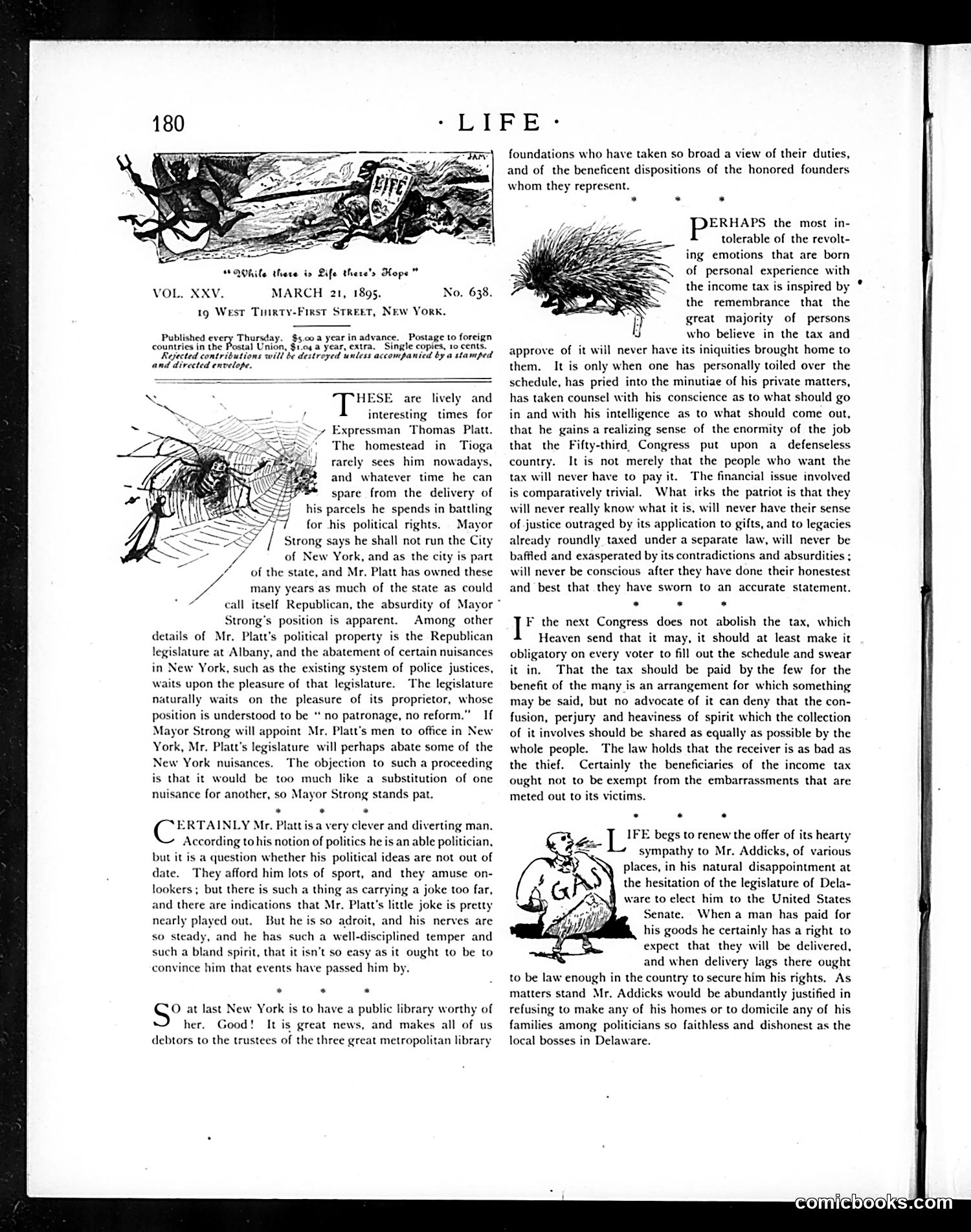
This page contains political commentary rather than cartoons. The main topic is **Thomas Platt**, a Republican politician and New York state power broker. The text criticizes Platt's control over New York politics and his influence on Mayor Strong's administration. The article discusses Platt's wealth from real estate and his ability to manipulate state legislation. It satirizes how politicians like Platt use their influence to remove political opponents—here, the text suggests Mayor Strong will remove nuisances that displease Platt, who effectively controls him. The final section addresses **Mr. Addicks**, a Delaware politician facing election difficulties, sympathizing with his frustration when local bosses prevent honest politicians from winning office. The satire targets **machine politics** and the corrupting influence of wealthy power brokers.
📄 Transcribed text from this page (OCR, searchable)
Machine-transcribed from the original scan — historical spelling and the odd misread are preserved.
* LIFE: “QOHife there io Life there’s Hope” V MARCH 21, 1895. No. 638. 1g West Tuirty-First STREET, New York. Published every Thursday. $5.00a year in advance. Postage to foreign countries in the Postal Union, $1.04 a year, extra. Single copies, 10 cents. Rejected contributions will be destroyed unless accompanied by a stamped and directed envelope. HESE are lively and interesting times for y Expressman Thomas Platt. The homestead in Tioga rarely sees him nowadays, and whatever time he can spare from the delivery of parcels he spends in battling for his political rights. Mayor ay / Strong says he shall not run the City of New York, and as the city is part of the state, and Mr, Platt has owned these many years as much of the state as could call itself Republican, the absurdity of Mayor * Strong’s position is apparent. Among other details of Mr. Platt’s political property is the Republican legislature at Albany, and the abatement of certain nuisances in New York, such as the existing system of police justices, waits upon the pleasure of that legislature. The legislature naturally waits on the pleasure of its proprietor, whose position is understood to be * no patronage, no reform.” If Mayor Strong will appoint Mr. Platt’s men to office in New York, Mr. Platt’s legislature will perhaps abate some of the New York nuisan The objection to such a proceeding is that it would be too much like a substitution of one nce for another, so Mayor Strong stands pat. . * * RTAINLY Mr. Platt isa very clever and diverting man. According to his notion of politics he is an able politician, but it is a question whether his political ideas are not out of date. They afford him lots of sport, and they amuse on- lookers ; but the: such a thing as carrying a joke too far, and there are indications that Mr. Platt’s little joke is pretty nearly played out. But he is so adroit, and his nerve so steady, and he has such a well-disciplined temper and such a bland spirit, that it isn’t so easy as it ought to be to convince him that events have passed him by. * * * S° at last New York is to have a public library worthy of her. Good! It is great news, and makes all of us debtors to the trustees of the three great metropolitan library foundations who have taken so broad a view of their duties, and of the beneficent dispositions of the honored founders whom they represent. * ERHAPS the most in- tolerable of the revolt- ing emotions that are born of personal experience with the income tax is inspired by the remembrance that the great majority of persons who believe in the tax and approve of it will never have its iniquities brought home to them. It is only when one has personally toiled over the schedule, has pried into the minutiae of his private matters, has taken counsel with his conscience as to what should go in and with his intelligence as to what should come out, that he gains a realizing sense of the enormity of the job that the Fifty-third Congress put upon a defenseless country. It is not merely that the people who want the tax will never have to pay it. The financial issue involved is comparatively trivial. What irks the patriot is that they will never really know what it is, will never have their sense of justice outraged by its application to gifts, and to legacies already roundly taxed under a separate law, will never be baffled and exasperated by its contradictions and absurdities ; will never be conscious after they have done their honestest and best that they have sworn to an accurate statement. . . . It the next Congress does not abolish the tax, which Heaven send that it may, it should at least make it obligatory on every voter to fill out the schedule and swear it in. That the tax should be paid by the few for the benefit of the many is an arrangement for which something may be said, but no advocate of it can deny that the con- fusion, perjury and heaviness of spirit which the collection of it involves should be shared as equally as possible by the whole people. The law holds that the receiver is as bad as the thief. Certainly the beneficiaries of the income tax ought not to be exempt from the embarrassments that are meted out to its victims. . . . IFE begs to renew the offer of its hearty sympathy to Mr. Addicks, of various places, in his natural disappointment at the hesitation of the legislature of Dela- ¢ to elect him to the United States Senate. When a man has paid for his goods he certainly has a right to expect that they will be delivered, and when delivery lags there ought to be law enough in the country to secure him his rights. As matters stand Mr. Addicks would be abundantly justified in refusing to make any of his homes or to domicile any of his families among politicians so faithless and dishonest as the local bosses in Delaware.