
A complete issue · 18 pages · 1894
Life — November 1, 1894
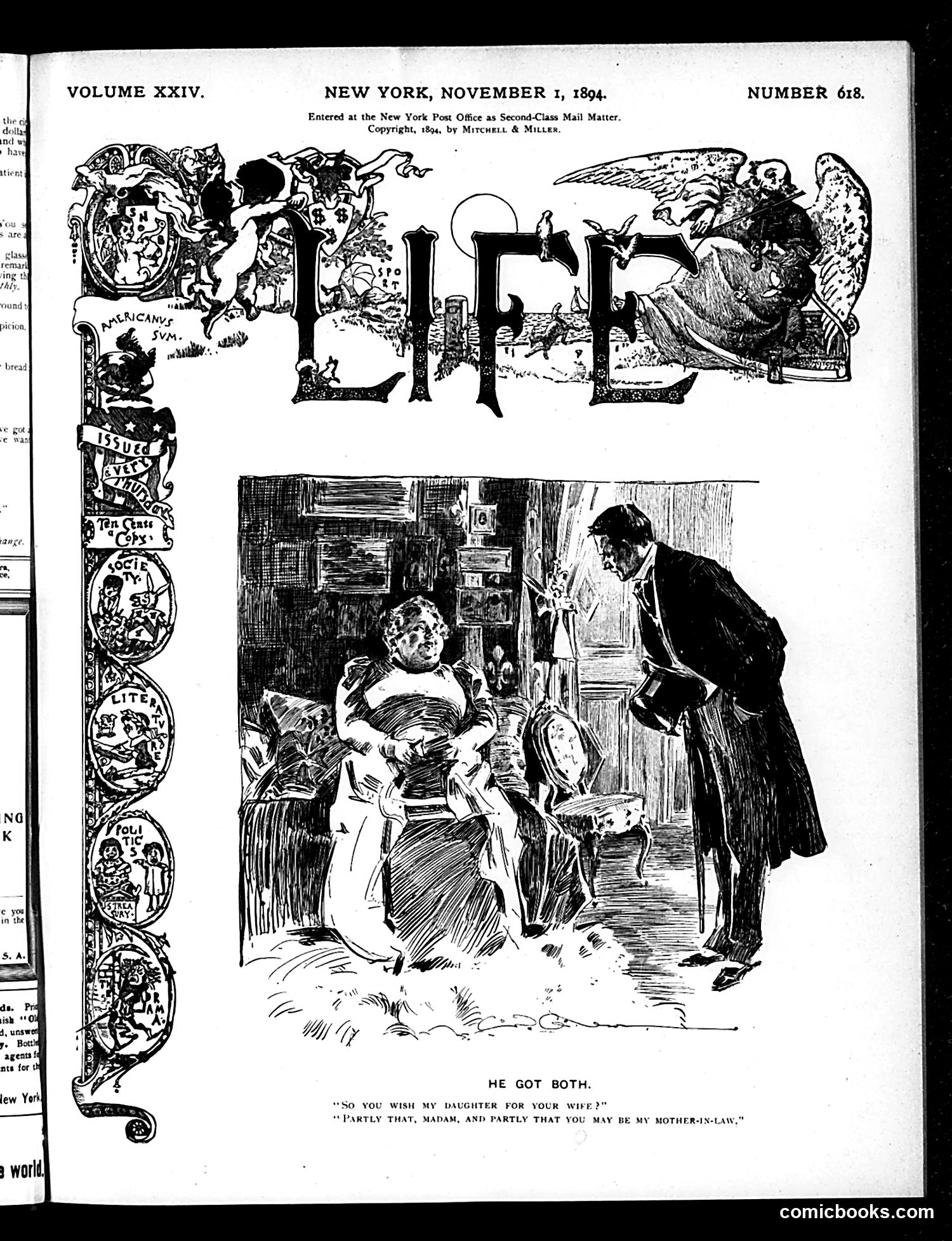
This cartoon satirizes a domestic situation using the caption's wordplay. The scene depicts a man confronting a woman (likely his wife) who is holding a child, with another figure (possibly a servant or family member) present in a modest interior. The joke's punchline—"He got both"—plays on the man's stated wish: he wanted his daughter for his wife, but "partly" wanted her as his mother-in-law instead. The humor relies on the ambiguity of dual relationships through marriage (daughter becoming wife, creating a mother-in-law situation). This reflects Victorian-era satirical humor about marriage complications and family relationships, typical of Life magazine's domestic comedy content during the 1890s.
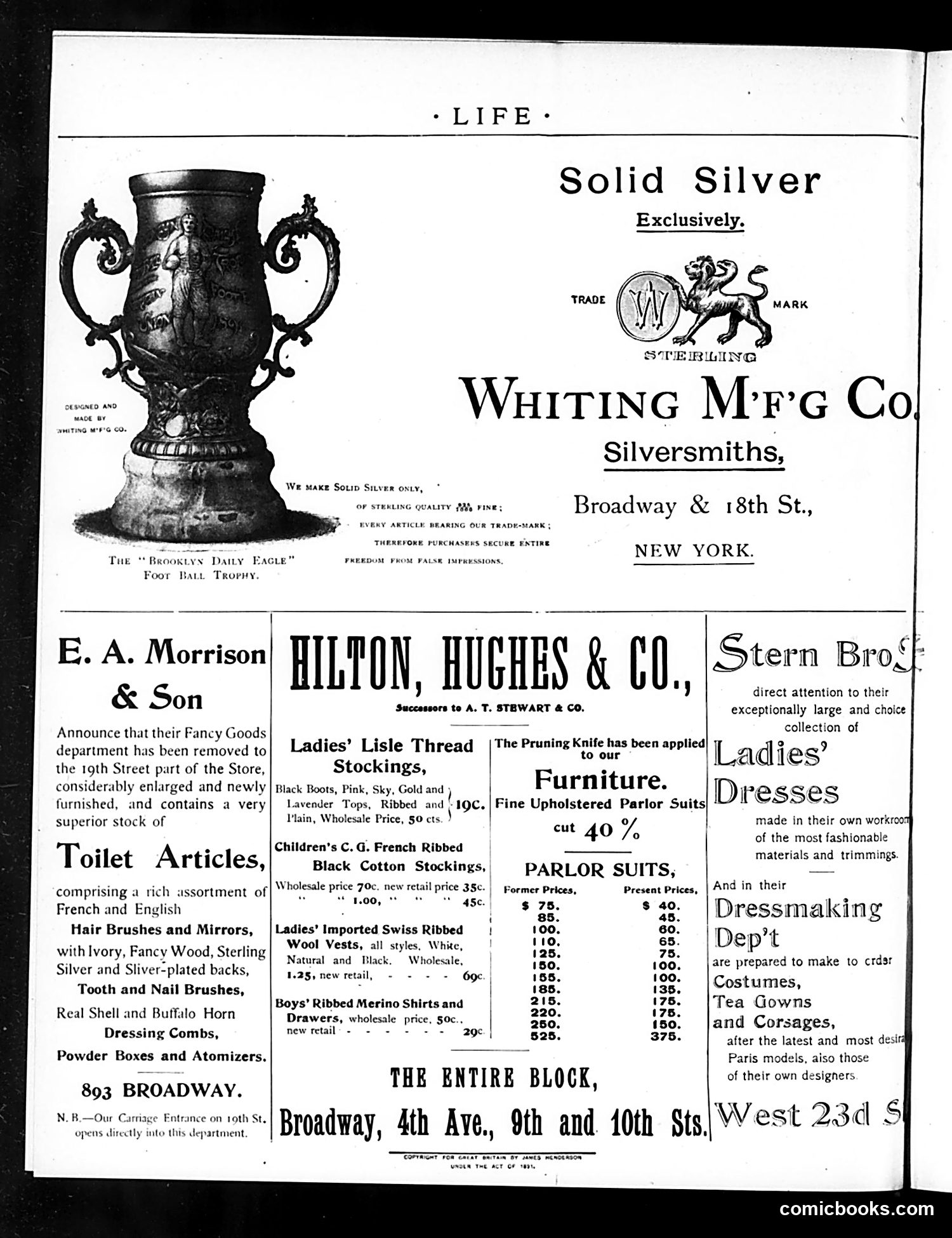
This page is primarily **advertising**, not political satire or comics. It features multiple commercial advertisements from late 19th or early 20th-century New York businesses: - **Whiting Mfg Co** (silversmiths) advertises sterling silver goods, featuring an ornate silver trophy labeled "The Brooklyn Daily Eagle Foot Ball Trophy" - **E.A. Morrison & Son** promotes toilet articles and grooming supplies - **Hilton, Hughes & Co.** sells women's stockings and furniture with significant discounts (40% off parlor suits) - **Stern Bros** advertises ladies' dresses and dressmaking services The only illustrative element is the decorative silver urn/trophy at top. There is no political cartoon, satire, or humor—this is a straightforward commercial advertising page typical of magazine layout from this era.
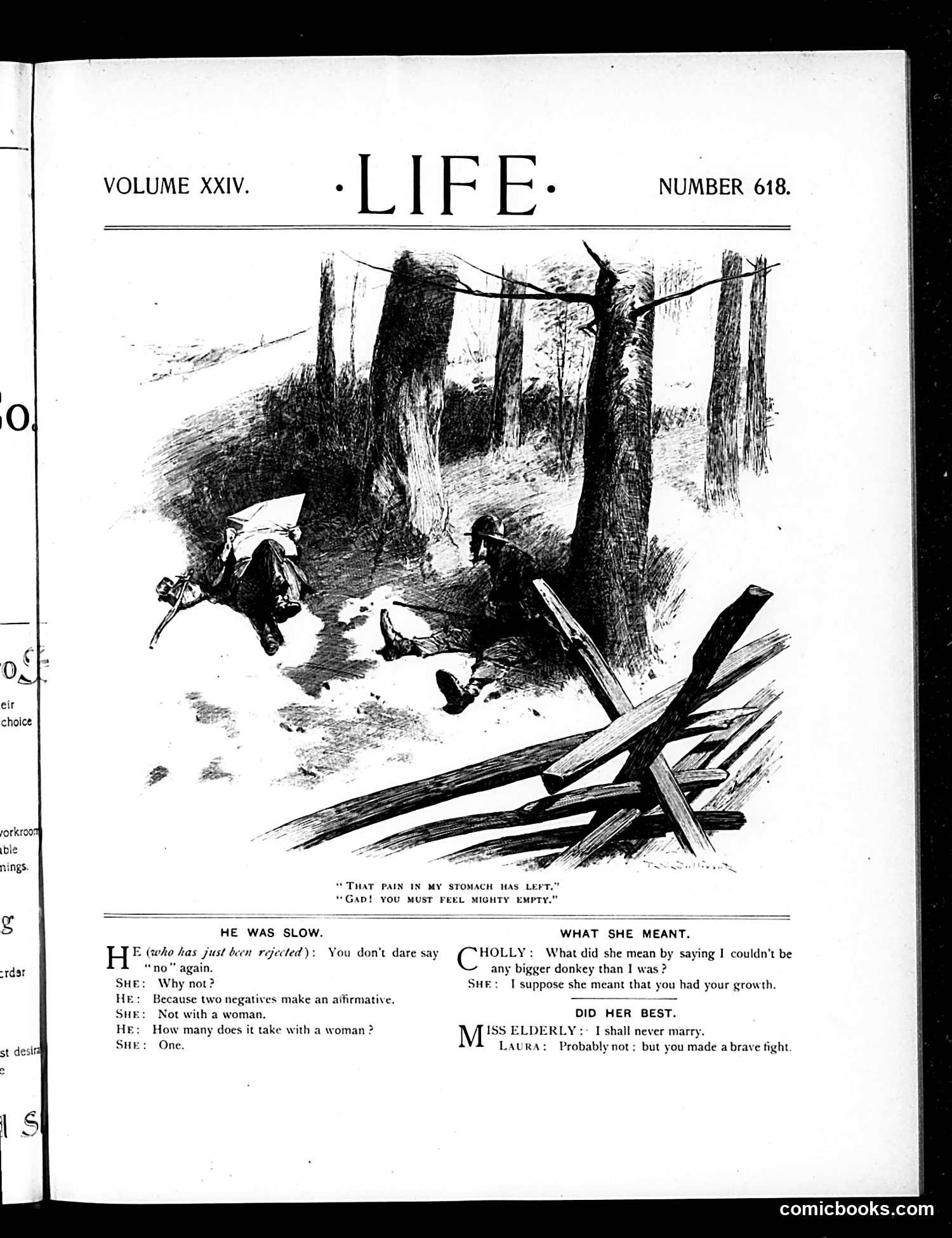
This page contains humor sketches depicting romantic rejection and courtship dynamics. The top illustration shows two figures in a wooded setting, with dialogue about physical pain and emptiness—likely depicting a rejected suitor. Below are three separate comic vignettes: **"He Was Slow"** presents a logic puzzle about persistence in romantic pursuit, with a woman rejecting a man's repeated proposals. **"What She Meant"** and **"Did Her Best"** explore miscommunication between courting couples—one woman's critique about growth, another's reluctant admission of a man's bravery despite her refusal to marry. The humor centers on early-20th-century courtship conventions: male persistence, female rejection, and the gap between what people say and mean. The satire gently mocks both romantic persistence and female ambivalence toward marriage proposals.
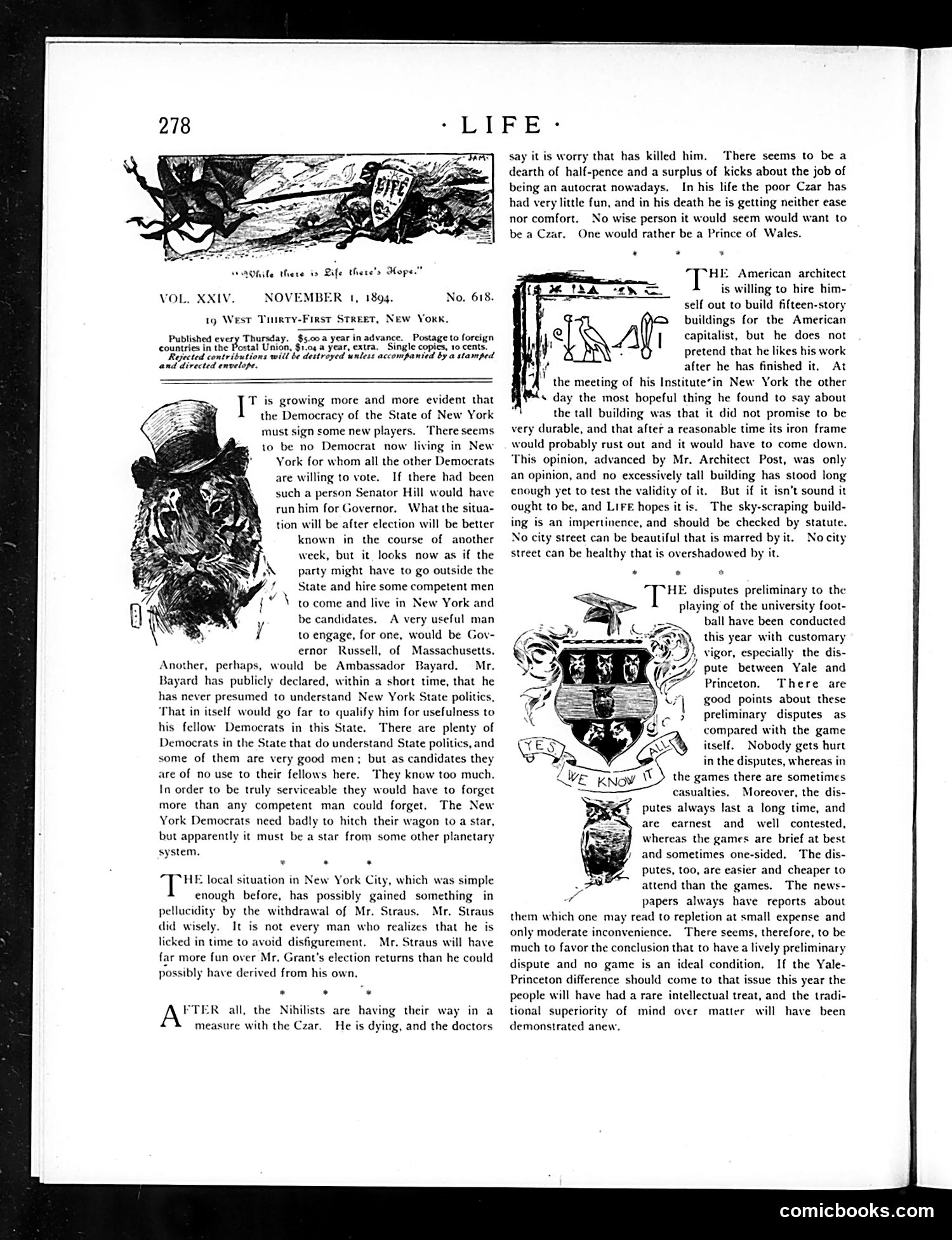
The page contains editorial commentary on New York Democratic politics. The left cartoon depicts a bearded figure (likely Governor Roswell P. Flower or another New York Democrat) wearing a top hat, apparently representing concerns about Democratic leadership and candidate selection for governor. The text discusses the Democratic Party's difficulty finding qualified candidates in New York, suggesting they should recruit competent men from outside the state rather than relying on existing party figures. It mentions Ambassador Bayard as a potential candidate and criticizes the party's internal struggles. The right section shifts to Yale-Princeton football disputes, arguing that preliminary disputes are less consequential than the games themselves, and noting that Yale's intellectual superiority should be demonstrated through victory.
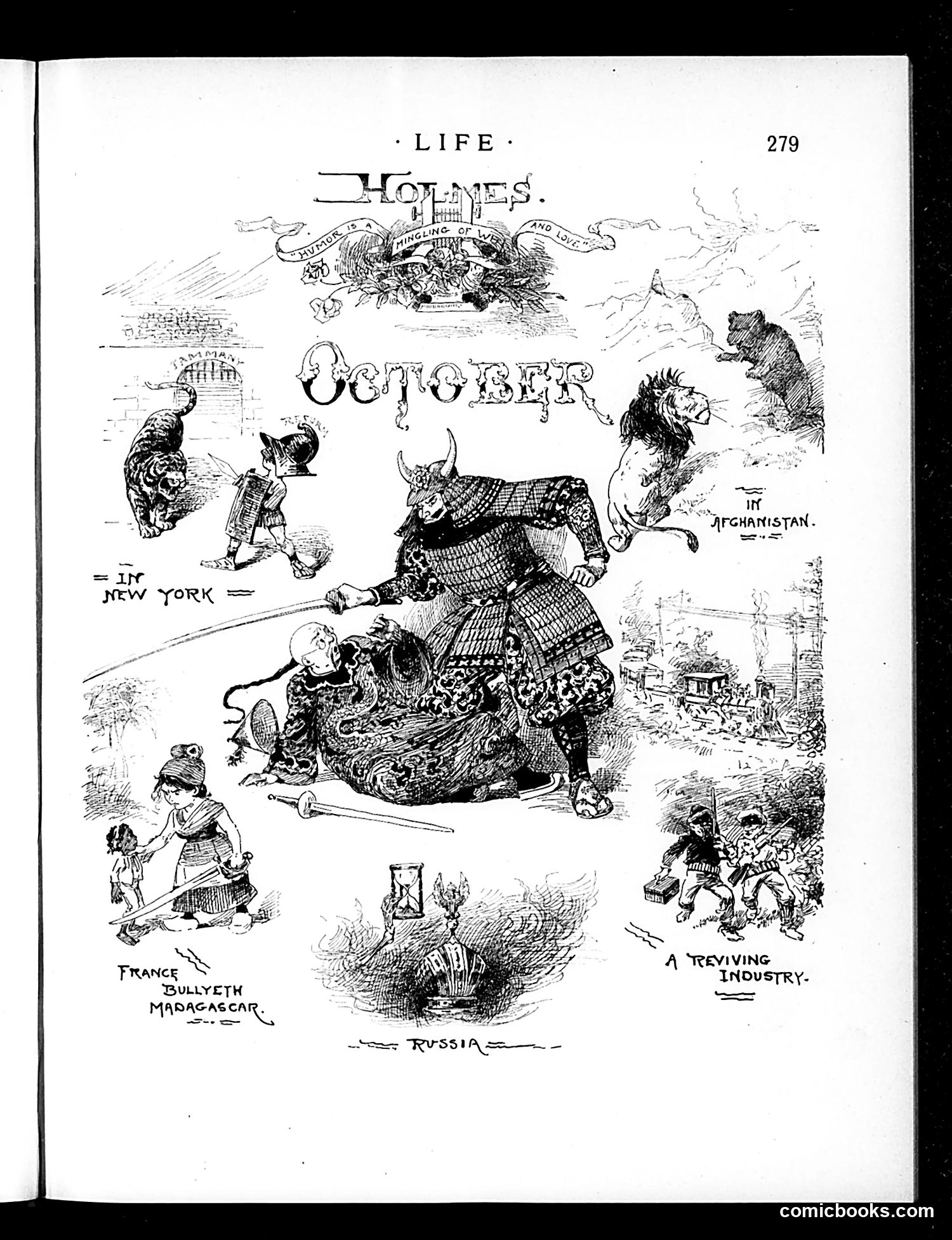
This appears to be a Sherlock Holmes-themed satirical cartoon from *Life* magazine, with "Holmes" as the central figure dressed in Scottish attire, investigating global conflicts of the era. The cartoon references several geopolitical situations: - **New York**: depicted with animals (possibly representing political figures or factions) - **France**: shown with "Bullyeth Madagascar," referencing French colonial ambitions - **Russia**: illustrated below, likely referencing Russian imperial expansion - **Afghanistan**: shown in the upper right, suggesting ongoing conflicts in that region - **"A Reviving Industry"** (lower right): unclear reference, possibly satirizing war or conflict as profitable The central Holmes figure appears to investigate these various international crises simultaneously, satirizing either Holmes' detective methods or America's observation of world affairs during a period of imperial competition.
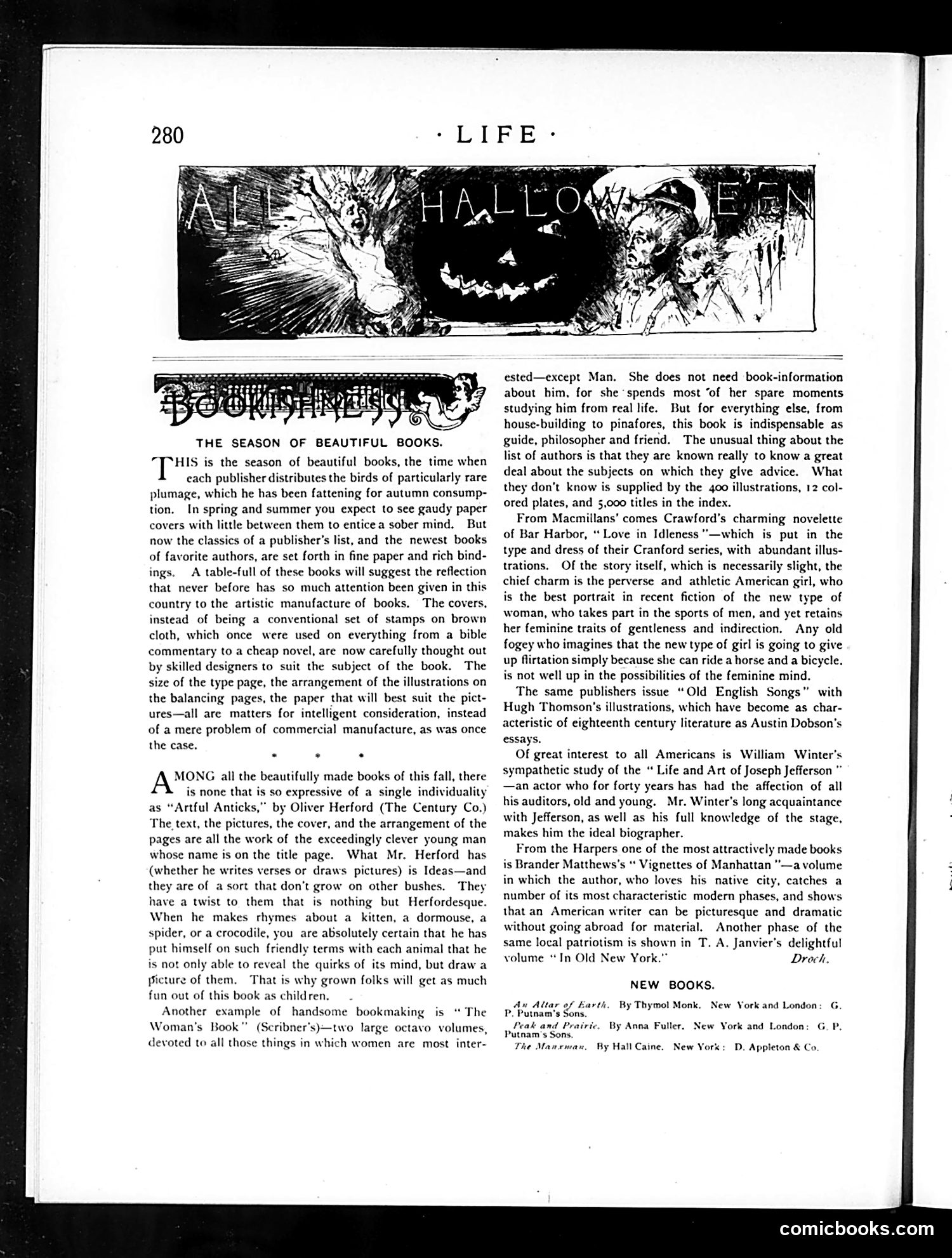
The top banner features "ALL HALLOW E'EN" with three illustrated figures in a Halloween-themed design, likely representing traditional spooky imagery associated with the holiday. The main content discusses beautiful book publishing, focusing on attractive cover design and artistic layout. The text praises Oliver Herford's "Artist's Life" and mentions William Winter's sympathetic study of "Life and Art of Joseph Jefferson"—an actor with forty years of audience affection. The page highlights that publishers are investing more artistic attention in book design, moving beyond standard stamped covers. It celebrates what the writer calls an unusually creative season for quality publications, emphasizing how skilled designers now carefully consider typography, illustrations, and paper selection to create attractive volumes. This appears to be a straightforward book review column rather than political satire.
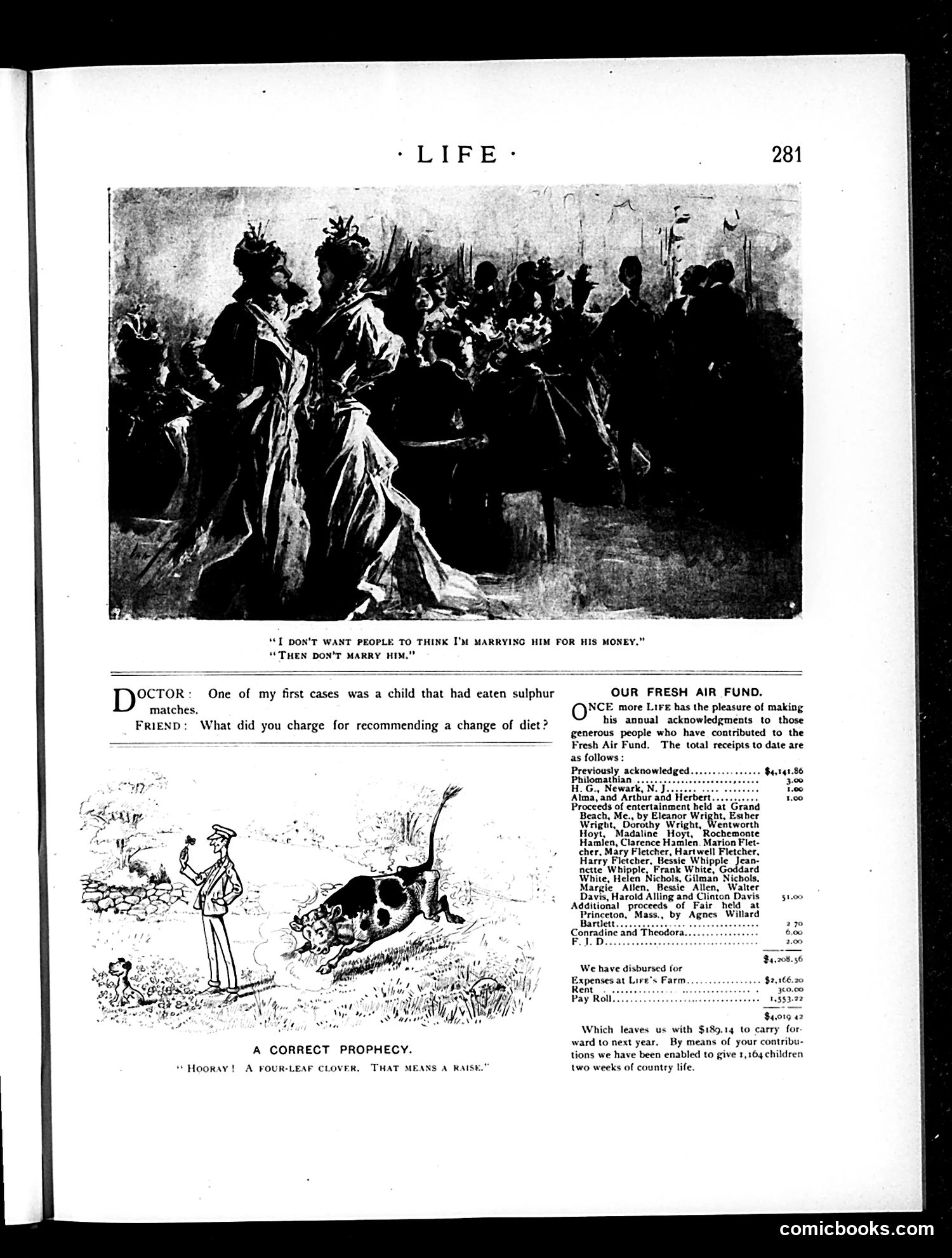
This page contains two separate humorous items from *Life* magazine: **Top illustration:** A silhouetted scene showing a formal court or social gathering. The caption quotes a woman saying "I don't want people to think I'm marrying him for his money" with the response "Then don't marry him." This is a joke about mercenary marriages—satirizing women who marry wealthy men while pretending their motivation is love rather than financial gain. **Bottom illustration:** Titled "A Correct Prophecy," it shows a man discovering a four-leaf clover. The caption reads: "Hooray! A four-leaf clover. That means a raise." The joke is ironic—finding a lucky charm supposedly predicts good fortune (a raise), but the man's excitement suggests he desperately needs one, making the "prophecy" darkly humorous about economic hardship. The right column contains acknowledgments for the *Fresh Air Fund*, a charitable organization.
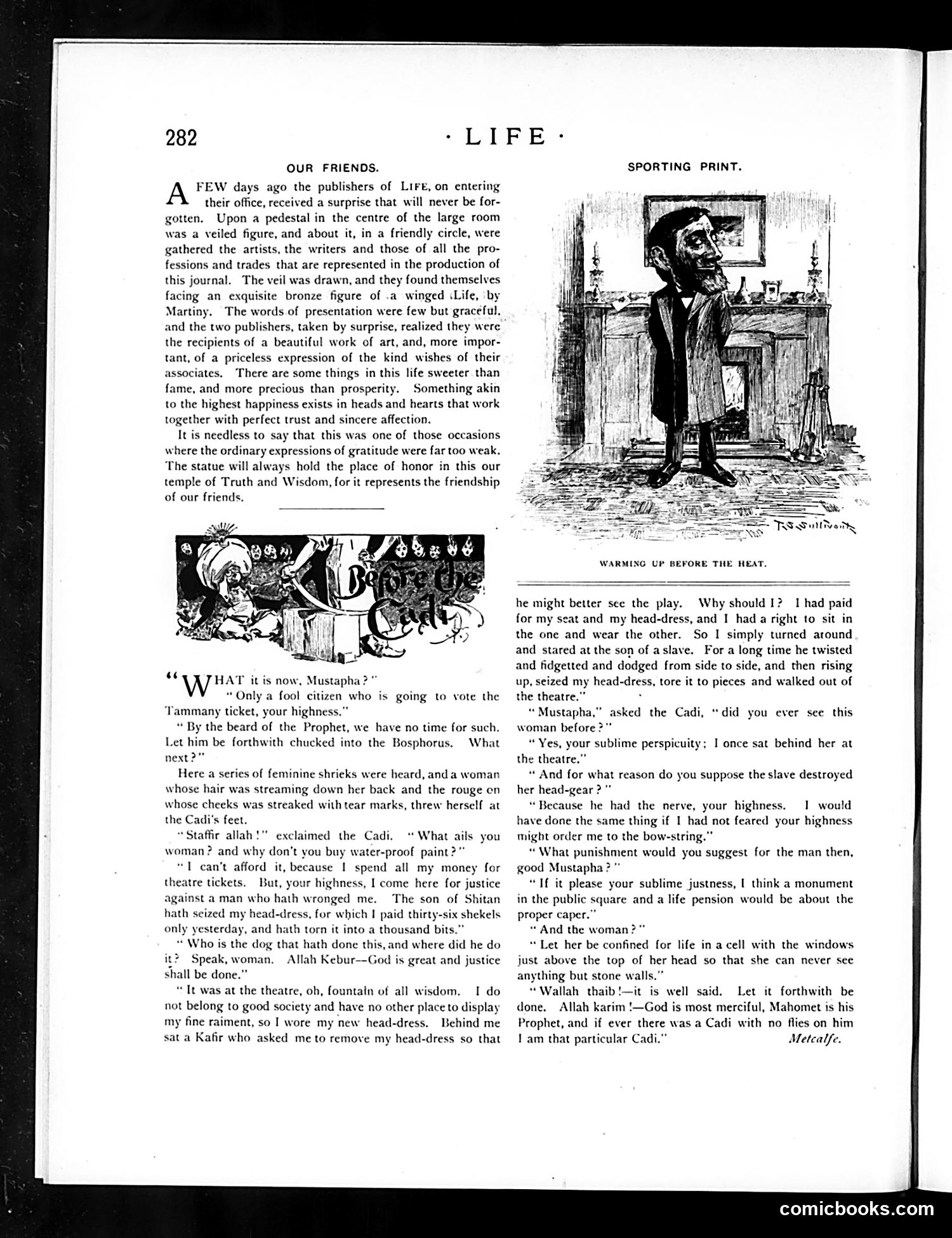
This page contains two distinct sections: **Left side ("Our Friends"):** An editorial piece praising Life magazine's publishers, describing a surprise gift presentation. It's essentially house advertising—not a political cartoon. **Right side ("Warming Up Before the Heat"):** A dramatic dialogue between a woman, a Cadi (Islamic judge), and Mustapha about a theater incident. A woman destroyed her head-dress at the theater rather than sit behind a slave. The Cadi debates appropriate punishment—ultimately suggesting lifetime confinement with only stone-wall views. The satire appears to critique rigid Islamic legal traditions and gender segregation practices through this heated debate. The woman's defiant act and the Cadi's harsh response illustrate tensions between modernizing social attitudes and conservative religious law—a relevant Early 20th-century American satirical concern about non-Western societies.
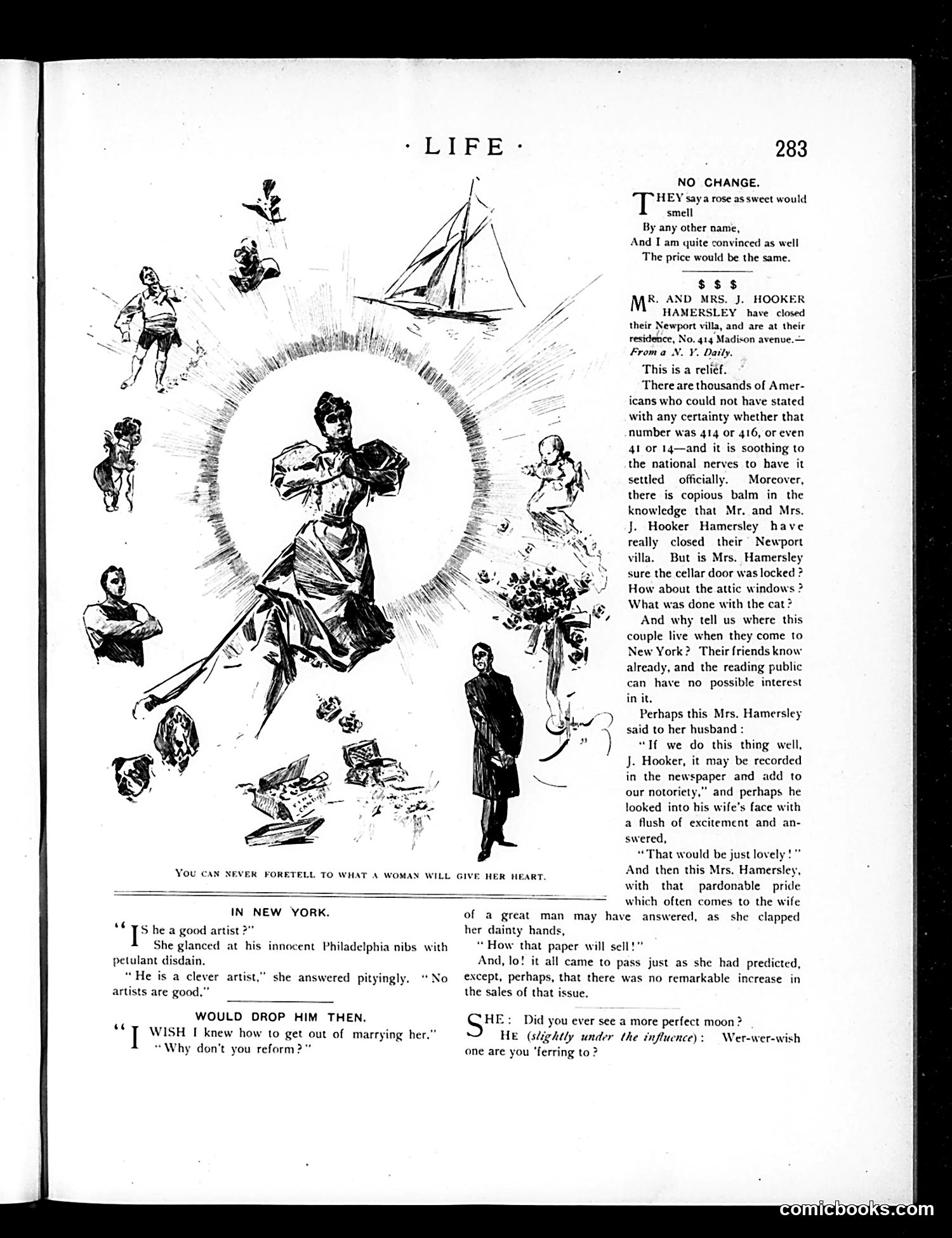
This page from *Life* magazine contains several satirical pieces about social customs and relationships: **"No Change"** mocks the famous Shakespeare quote about roses by name. The text critiques a Newport society couple (the Hamersleys) for publicly announcing they'd closed their villa, suggesting their announcement was merely for social prestige rather than genuine privacy. **"In New York"** presents brief comedic dialogues: one about an artist's worth, another ("Would Drop Him Then") about marriage reform through humor. The central illustration depicts figures in leisure activities—children playing, a sailboat, fashionable people—surrounding a woman in classical pose, likely representing capricious female nature or romantic whimsy. These pieces satirize upper-class pretension, gender dynamics, and the performative nature of society announcements—typical *Life* magazine targets of the early 20th century.
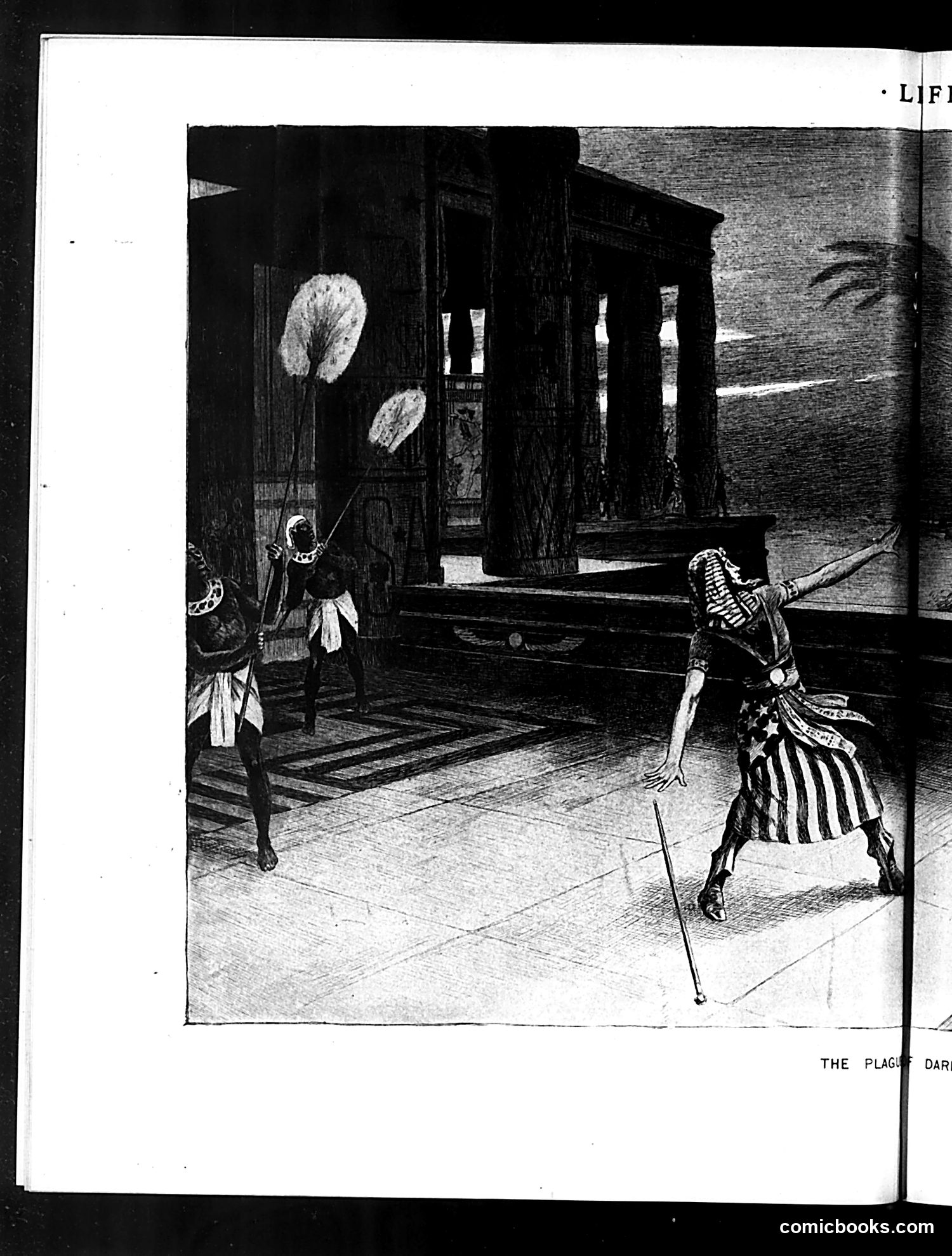
This appears to be an illustration from Life magazine titled "The Plague of Darkness" (visible at bottom right). The image depicts figures in classical or period costume within an architectural setting with columns and draped fabrics. The figures appear to be engaged in some form of dramatic action or conflict. Two costumed characters are shown, one wielding what looks like a staff or rod. The composition suggests this is illustrating a biblical or historical narrative—likely referencing one of the plagues from the Book of Exodus, given the title's reference to darkness. Without additional visible text or dating information on this page, I cannot definitively identify the specific political or social satire intended, though the classical theatrical styling suggests this may be commentary on a contemporary event or figure using historical or biblical allegory. The exact target of satire remains unclear from the image alone.
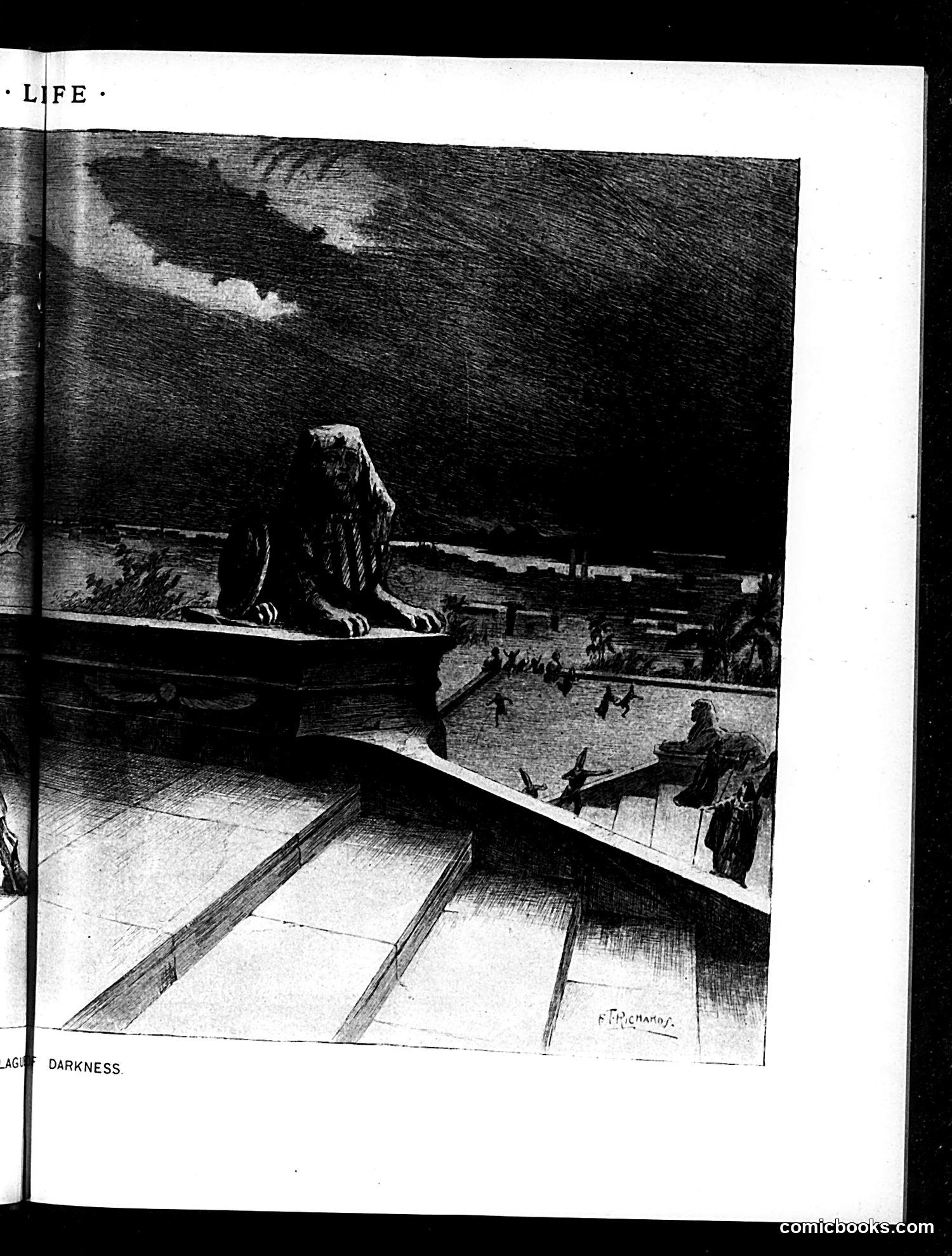
This illustration depicts a large eagle perched on a platform overlooking what appears to be an amphitheater or arena with spectators below. The dramatic nighttime setting—with dark clouds and minimal lighting—suggests ominous circumstances. The eagle likely represents American power or authority. The composition suggests surveillance or dominion over the crowd below, while the oppressive darkness and stormy atmosphere convey foreboding or moral darkness. Without additional context or caption text visible, the precise political message remains unclear. The satire appears critical of American power or leadership, possibly suggesting overreach, moral corruption, or dangerous authority. The artist's signature reads "E.F. Dichano" (or similar). The page title "DARKNESS" reinforces themes of moral or political gloom.
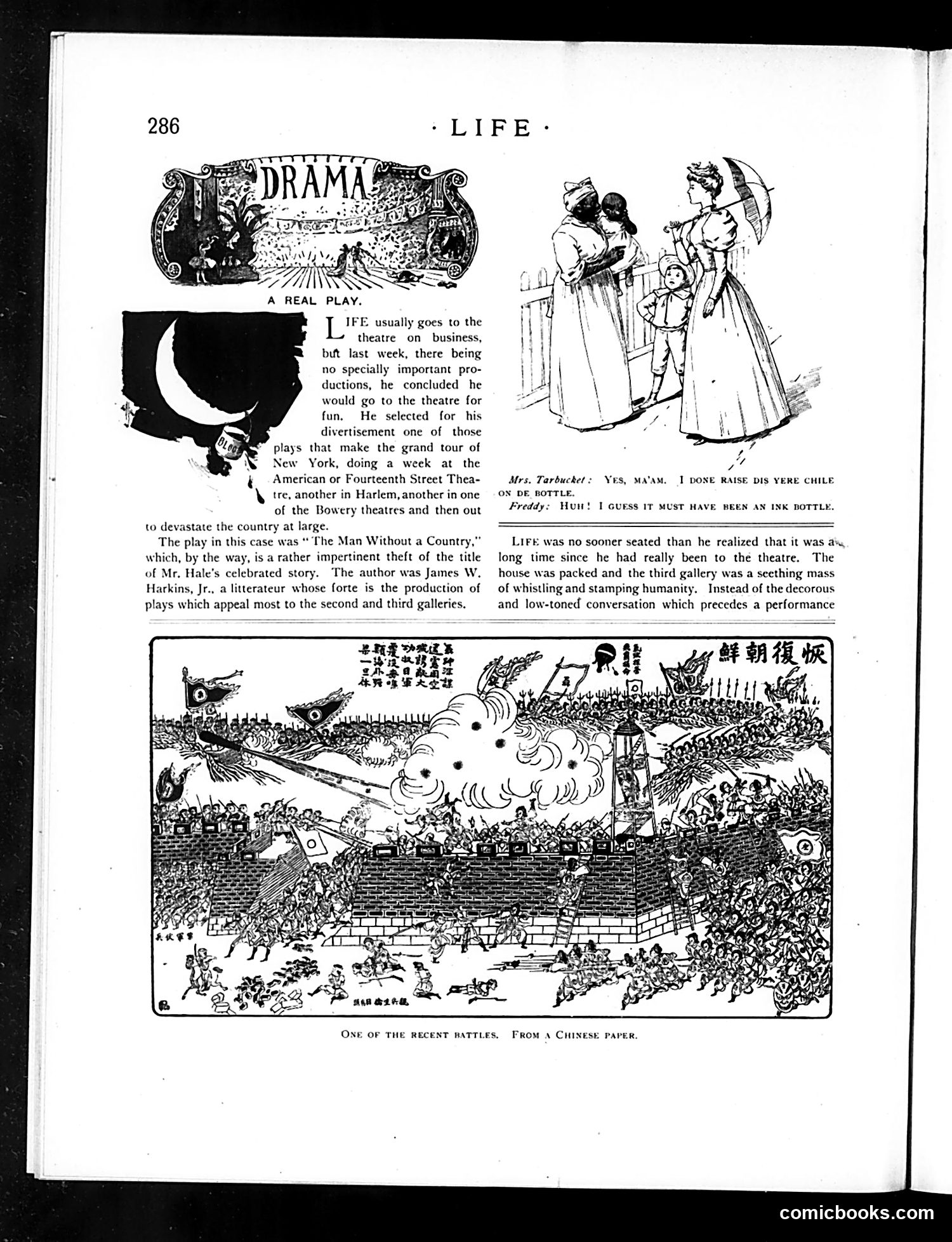
This page satirizes popular theater and contains two distinct elements: **"A Real Play"** mocks lowbrow theatrical entertainment. Life's personified character attends "The Man Without a Country"—a play the author criticizes as derivative of Edward Hale's celebrated story. The play toured cheap theaters (American, Fourteenth Street, Harlem, Bowery venues) appealing to "second and third galleries" (cheap upper balcony seats). Life discovers the audience consists of raucous crowds engaged in "whistling and stamping" rather than decorous behavior—satirizing the crude tastes of working-class theatergoers. **The Cartoon** features a dialogue where Mrs. Tarbucket mentions raising a child "on de bottle" (using dialect suggesting a Black character), and Freddy quips it must've been an "ink bottle"—likely a racial stereotype joke, though the exact reference is unclear. **The Chinese Battle Image** appears unrelated—captioned as depicting recent warfare from a Chinese source, possibly referencing turn-of-century Asian conflicts.
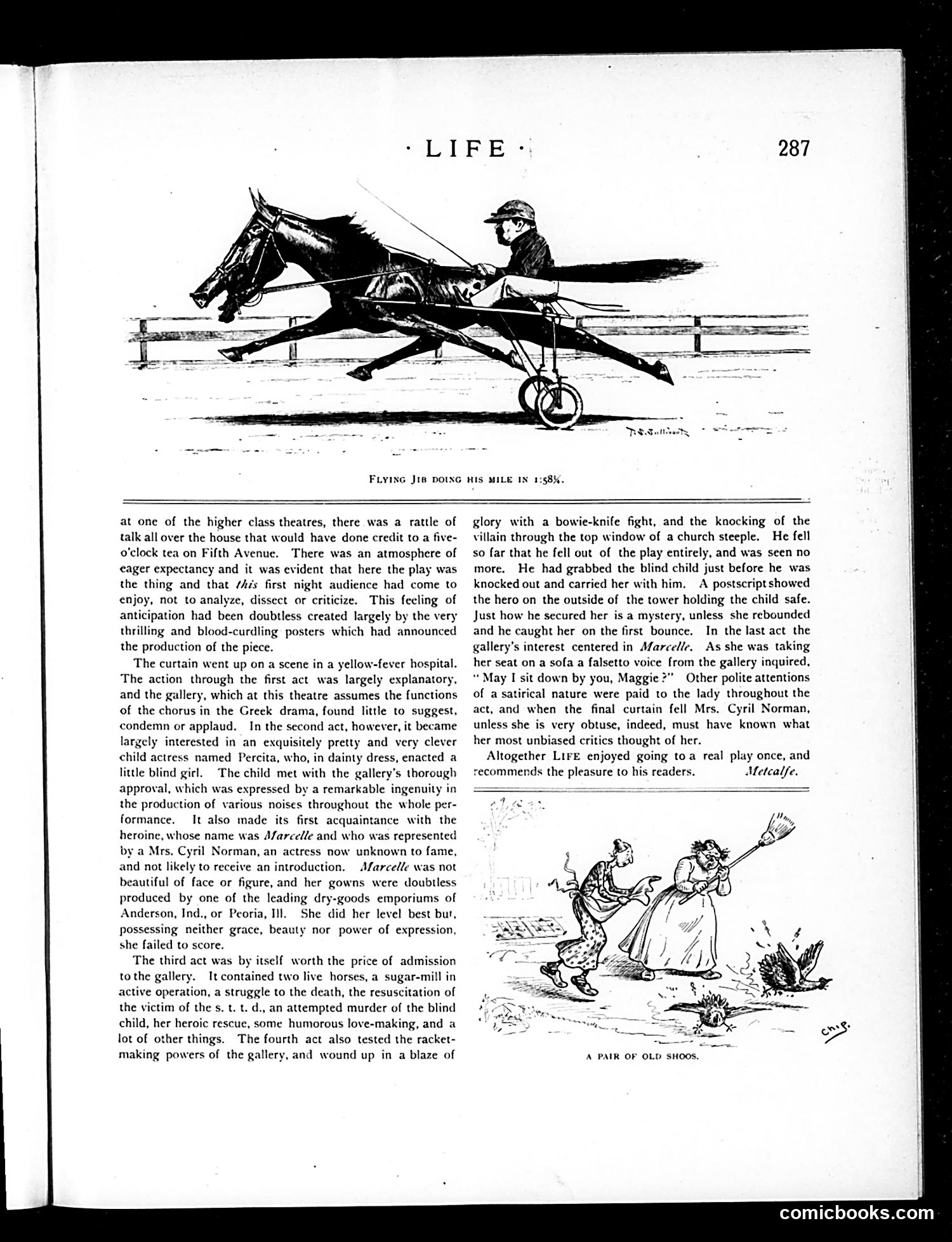
This page contains two distinct pieces: **Top Image:** "Flying Jib Doing His Mile in 1:58" depicts a harness racing horse with driver, likely celebrating a record-breaking performance. The illustration shows the specialized sulky cart used in trotting races. **Main Text:** A theater review by Metcalfe satirizing a melodramatic play at a "higher class theatre." The satire targets: - **The play itself**: An absurdly over-the-top melodrama featuring yellow-fever hospitals, live horses, sugar mills, bowie-knife fights, and a villain thrown through a church steeple window - **Mrs. Cyril Norman** (playing "Marcelle"): An obscure actress from small-town department stores (Anderson, Indiana or Peoria, Illinois) lacking grace, beauty, or talent - **The gallery's behavior**: Working-class theatergoers who heckle mercilessly, treating the performance as entertainment through their own vocal commentary rather than respectful attention The joke is that Life's critic found genuine pleasure in this theatrical disaster—not for its artistic merit, but for the unintentional comedy created by bad acting, absurd plotting, and audience mockery.
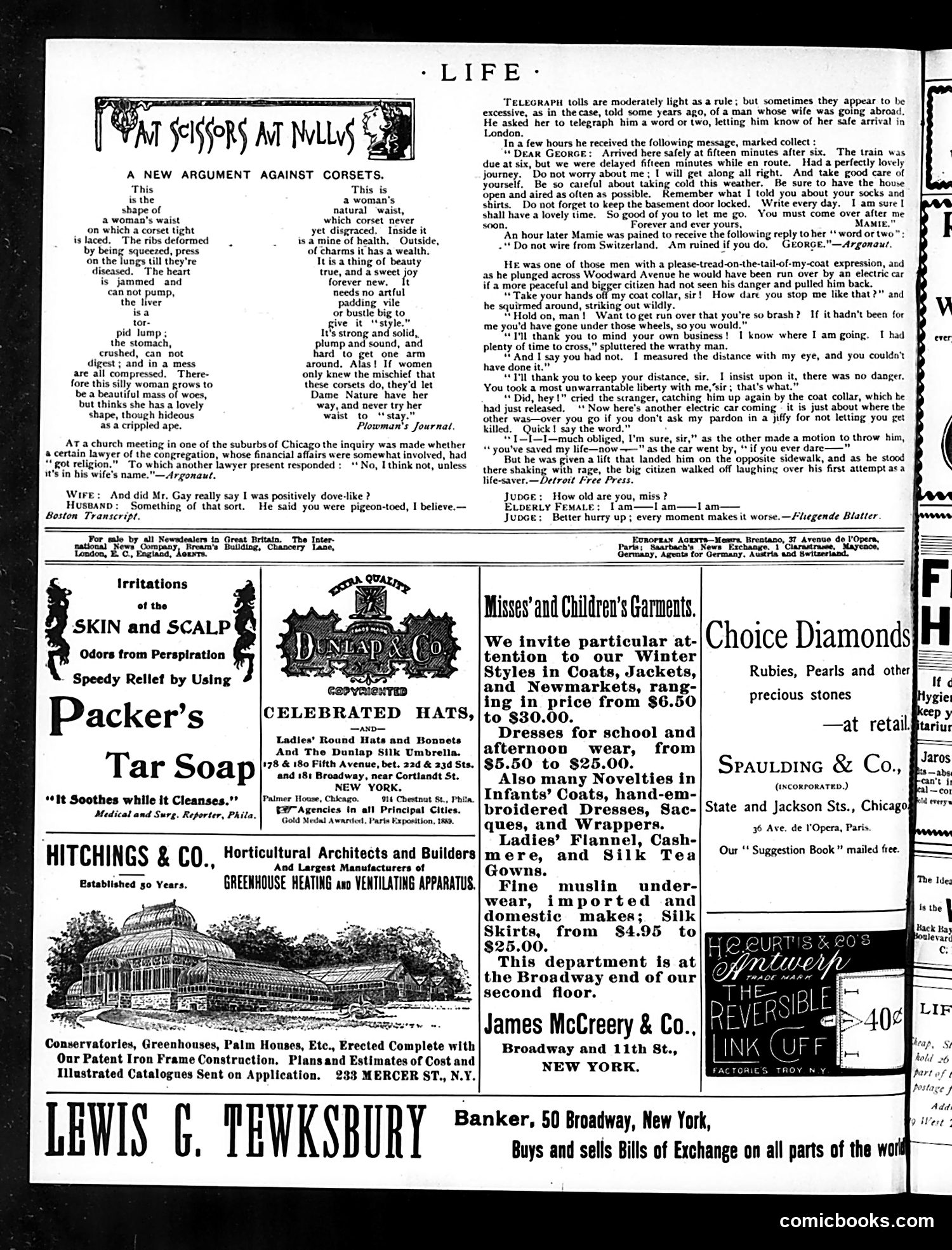
This page contains two main satirical pieces: **"A New Argument Against Corsets"** (top): A visual argument showing a woman's corseted waist (deformed, unhealthy) versus her natural waist (healthy, beautiful). The text criticizes corsets as harmful to women's health—crushing organs, deforming ribs, and damaging the heart, lungs, and digestion—while claiming to create beauty. This reflects genuine 1890s-1900s medical and social reform concerns about corset dangers. **Three short humorous anecdotes** below satirize: 1. A lawyer claiming "religion" but only owning assets in his wife's name (critique of financial hypocrisy) 2. A wife's "word or two" telegram that's comically verbose and expensive, bankrupting the husband (satire of women's chattiness and expense) 3. A rude pedestrian refusing help from someone saving him from traffic, insulting his rescuer (mockery of stubbornness and ingratitude) The rest is period advertising for hats, diamonds, and other goods.
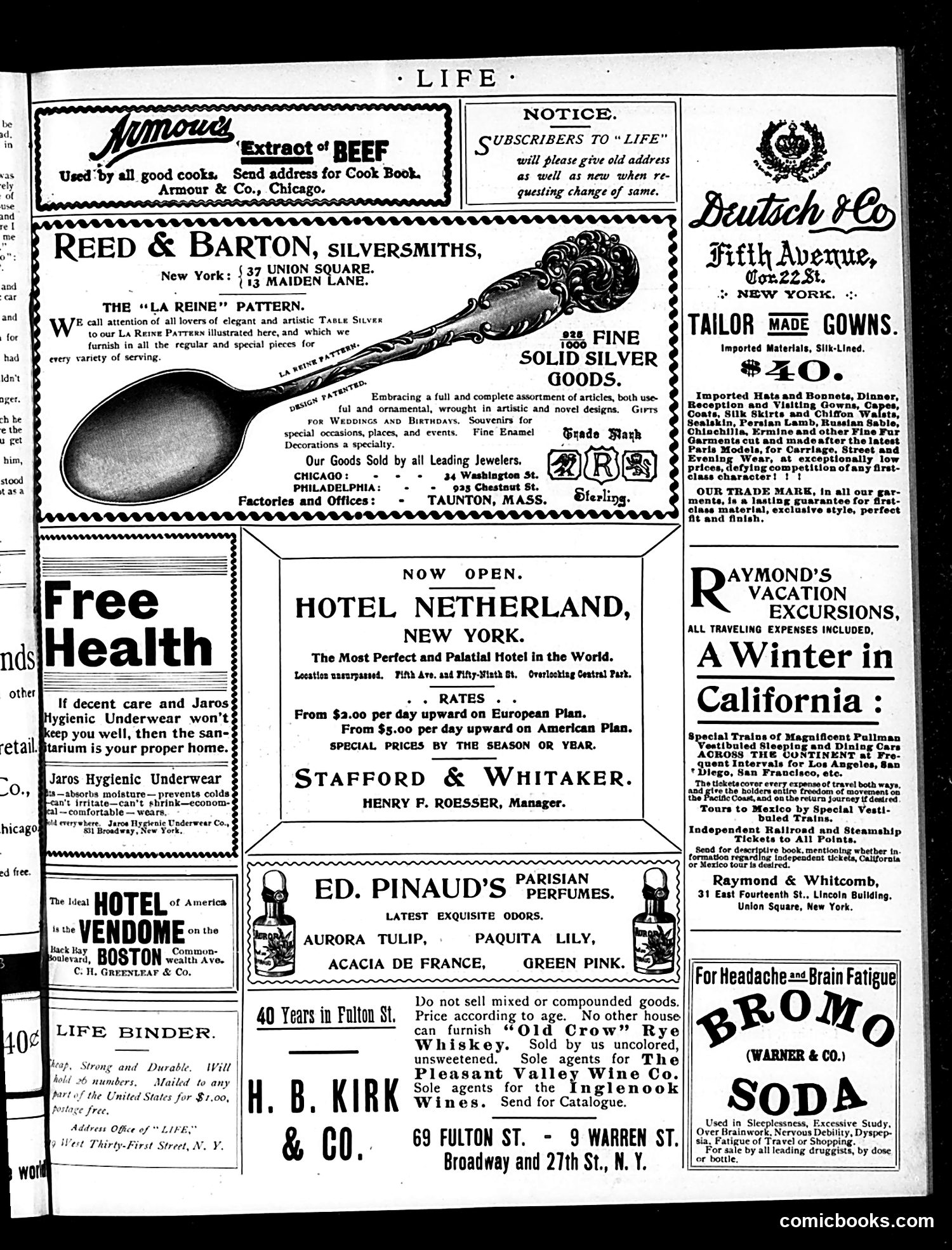
This is primarily an **advertising page** from Life magazine, circa early 1900s, with no political cartoons or satirical content. The page features commercial advertisements for luxury goods and services typical of the Gilded Age: fine silver serving pieces (Reed & Barton), high-end hotels (Hotel Netherland in New York), imported French perfumes, tailor-made gowns, and vacation excursions to California. There's also an ad for "Jaros Hygienic Underwear" and "Bromo Soda" (a headache remedy). The only satirical element is minimal—a small notice reminding Life subscribers to provide both old and new addresses when changing residence, a practical administrative note rather than humor. The page reflects the magazine's dual role as both satirical publication and vehicle for advertising luxury products to its affluent readership. The ads reveal what upper-class Americans valued: European imports, resort travel, and medicinal patent products popular in that era.
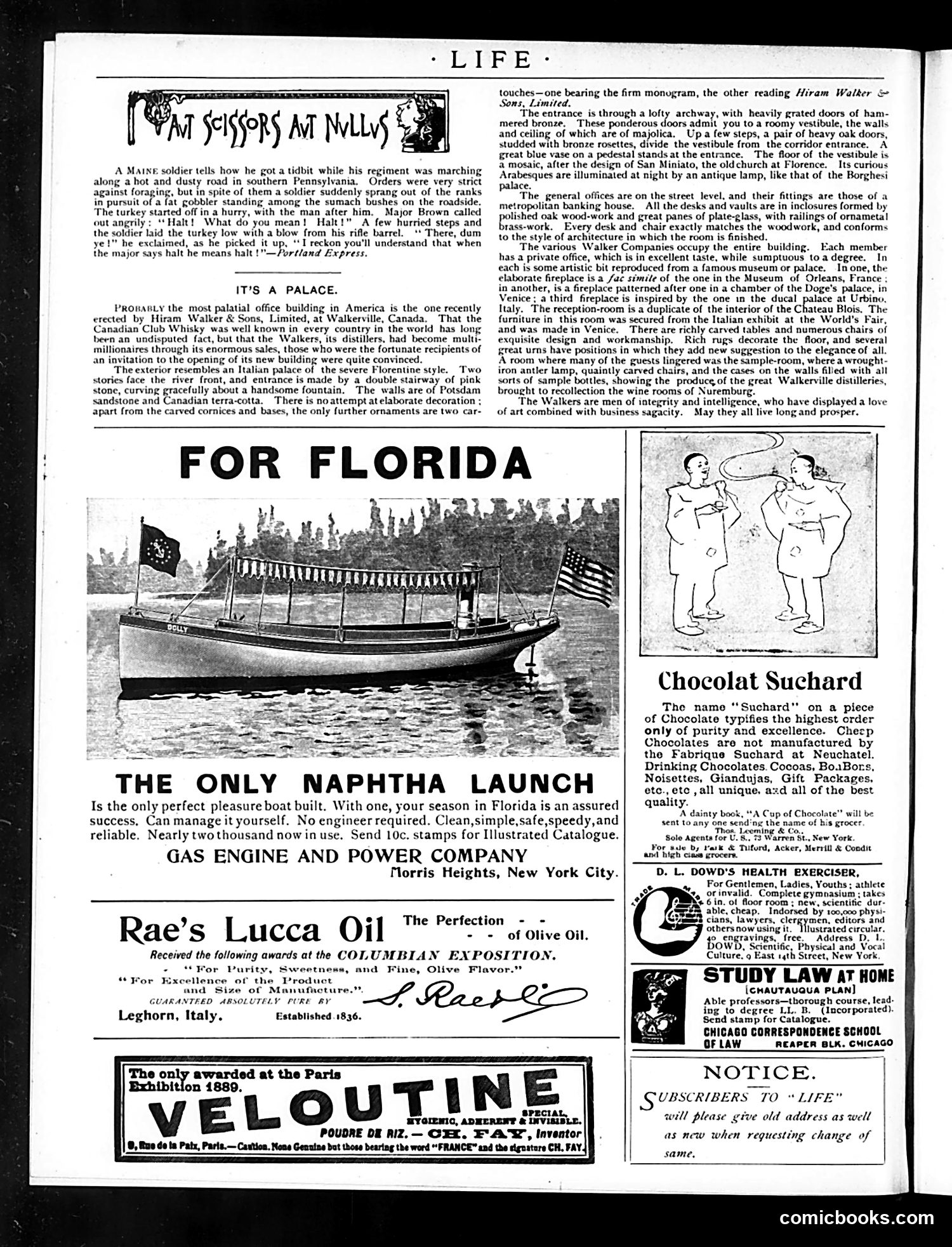
This page is primarily **advertising and promotional content** rather than political satire. It contains: 1. **"I'm Scissors at Nully's"** — A brief humorous anecdote about a Maine soldier who shoots a turkey during a march, misinterpreting a major's "halt" command as applying only to the turkey, not himself. It's a simple joke about literal interpretation. 2. **"It's a Palace"** — A lengthy promotional article describing Hiram Walker & Sons' newly built corporate headquarters in Walkerville, Canada. The piece celebrates the building's Italian Renaissance architecture and lavish interior design (modeled after European palaces and museums), emphasizing the company's wealth and sophistication. 3. **Advertisements** — Including "For Florida" (Naphtha Launch boat engines), Rae's Lucca Oil, Chocolat Suchard, and other products. The page demonstrates Life's mixed format: entertainment/humor alongside corporate advertising. The "palace" article is designed to impress readers with capitalist achievement and refined taste.
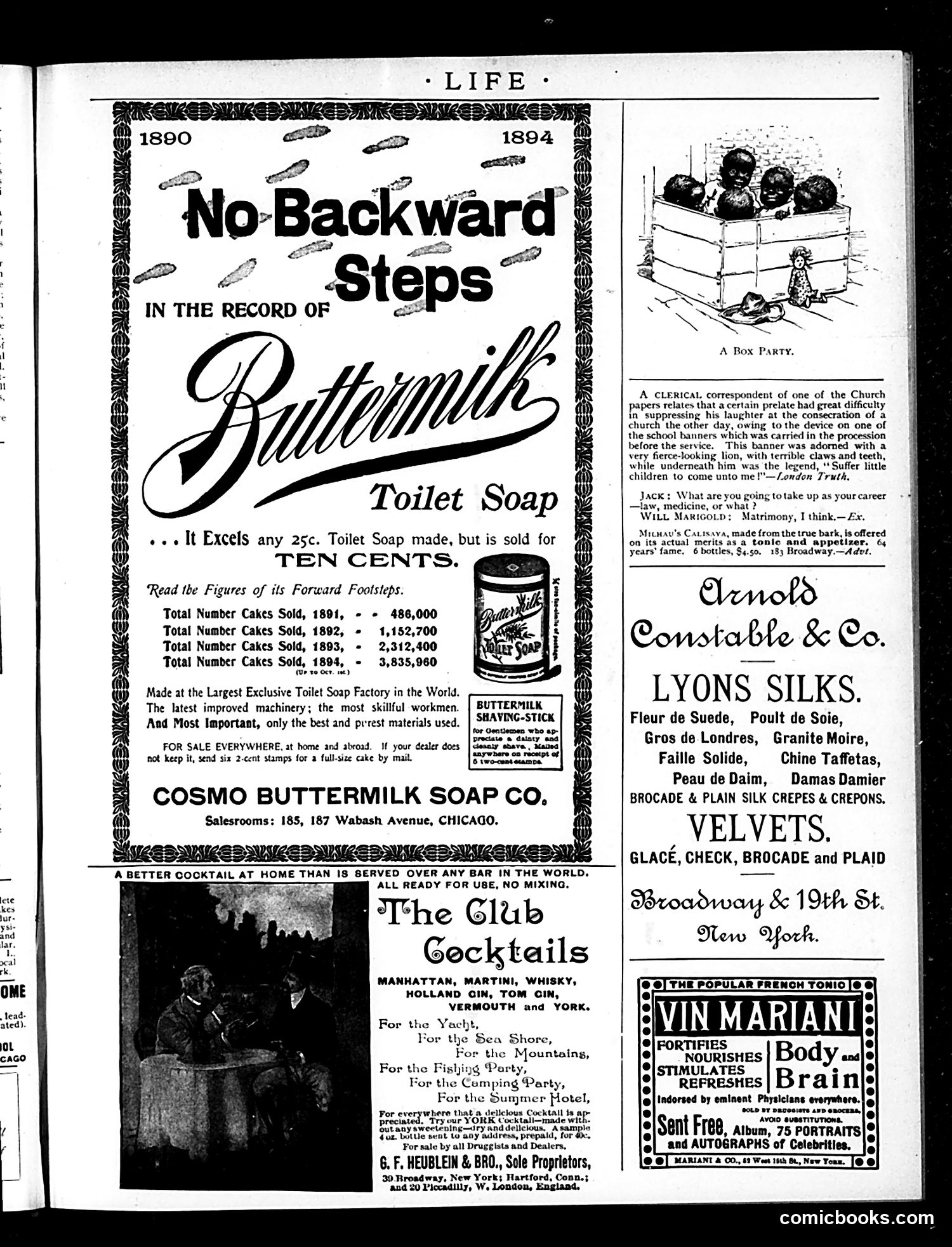
This page is primarily **advertising**, not satire or political commentary. It features period product advertisements with minimal cartoon content. The notable humor appears in two small text items: 1. **"A Box Party"** anecdote: A church prelate struggles to suppress laughter during a consecration service because a school banner depicts a fierce lion with the caption "Suffer little children to come unto me!"—the joke being the incongruity between the terrifying image and the gentle biblical passage. 2. **Career joke**: A brief exchange where "Will Marigold" says he'll pursue "Matrimony" as a career—a mild jab at marriage as a life pursuit. The bulk of the page showcases Buttermilk Toilet Soap (emphasizing sales growth from 1891-1894), The Club Cocktails, Vin Mariani tonic, and luxury goods (silks, velvets) from Arnold Constable & Co. The advertisements reflect 1890s consumer culture and patent medicine marketing common to the era.
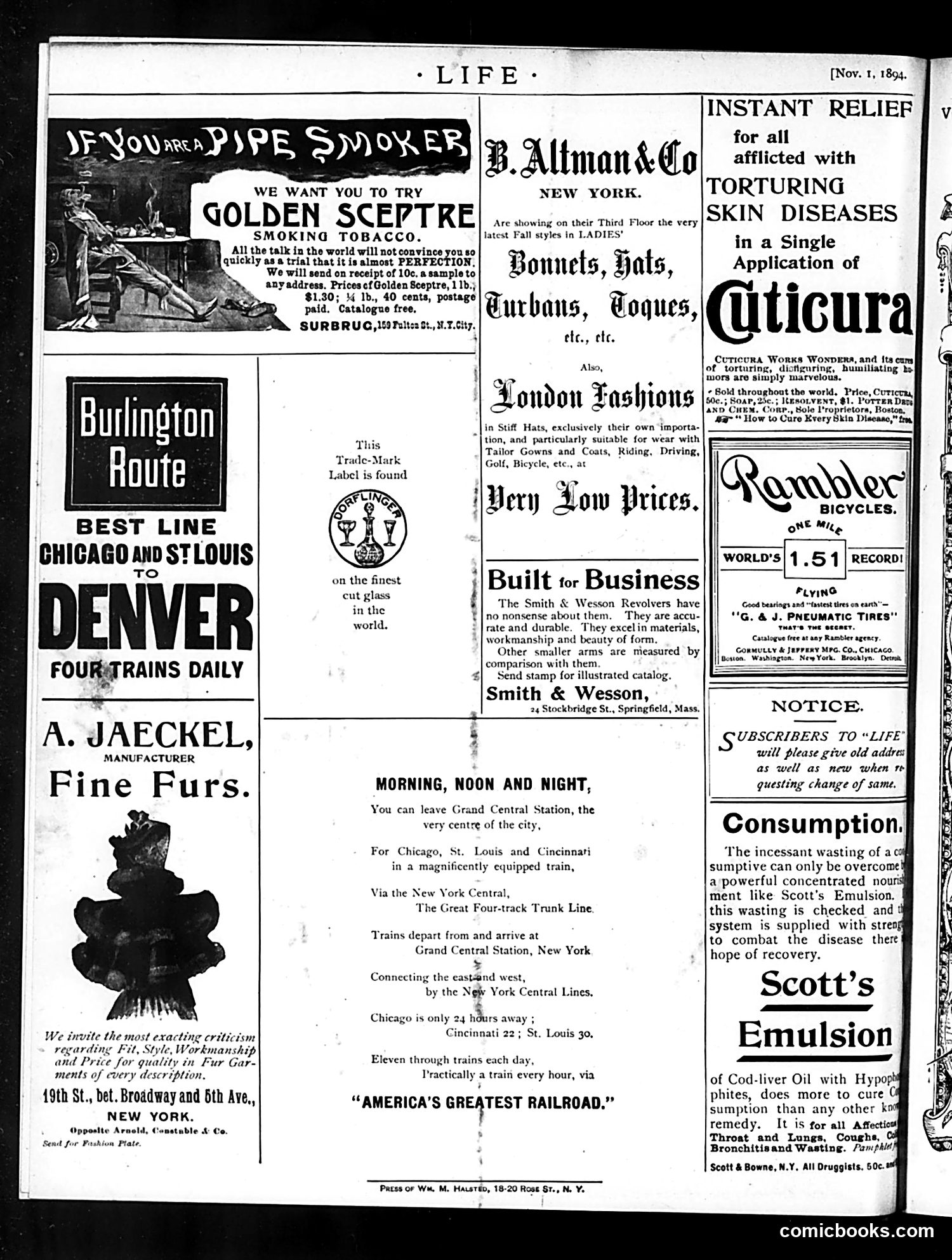
This is primarily an **advertising page** from Life magazine's early period, not a political cartoon page. The page consists almost entirely of commercial advertisements typical of the 1890s. Notable ads include: - **Golden Sceptre Smoking Tobacco**: Appeals to pipe smokers with claims of "perfection" - **Burlington Route**: Promotes Chicago-Denver rail service with "four trains daily" - **A. Jaeckel Fine Furs**: High-end fur garments for wealthy New Yorkers - **B. Altman & Co.**: Department store advertising women's hats and fashions - **Smith & Wesson Revolvers**: Marketed as accurate and durable firearms - **New York Central Railroad**: Emphasizes fast service to western cities - **Cuticura, Rambler Bicycles, Scott's Emulsion**: Patent medicines and consumer goods The page reflects **1890s consumer culture and technological optimism**—railroads, bicycles (the "Rambler" claims a world record), and dubious medical treatments dominate. The ads target middle-to-upper-class readers with disposable income for luxuries like furs, bicycles, and patent medicines.