
Life, 1894-11-01 · page 13 of 18
Life — November 1, 1894 — page 13: what you’re looking at
What you’re looking at
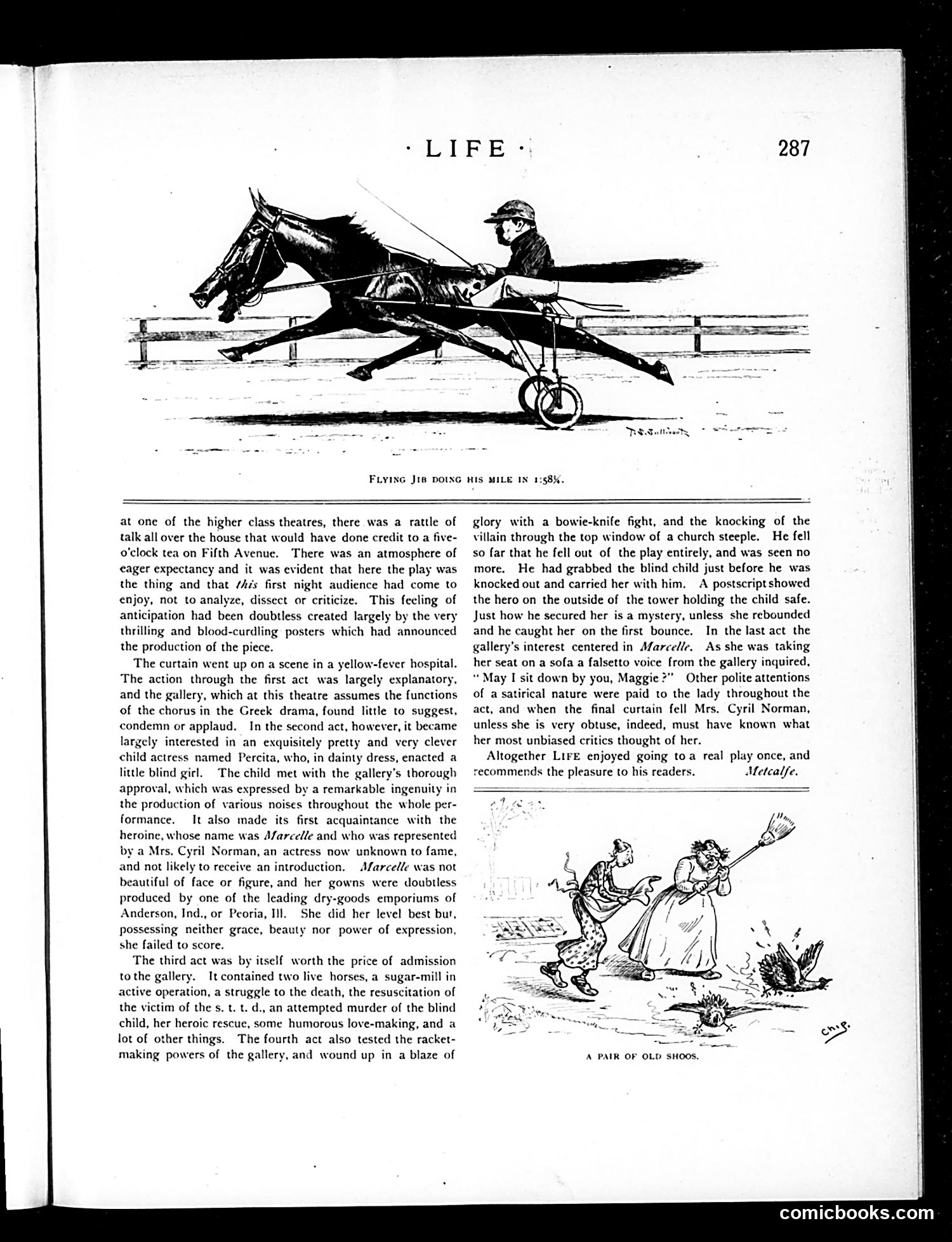
This page contains two distinct pieces: **Top Image:** "Flying Jib Doing His Mile in 1:58" depicts a harness racing horse with driver, likely celebrating a record-breaking performance. The illustration shows the specialized sulky cart used in trotting races. **Main Text:** A theater review by Metcalfe satirizing a melodramatic play at a "higher class theatre." The satire targets: - **The play itself**: An absurdly over-the-top melodrama featuring yellow-fever hospitals, live horses, sugar mills, bowie-knife fights, and a villain thrown through a church steeple window - **Mrs. Cyril Norman** (playing "Marcelle"): An obscure actress from small-town department stores (Anderson, Indiana or Peoria, Illinois) lacking grace, beauty, or talent - **The gallery's behavior**: Working-class theatergoers who heckle mercilessly, treating the performance as entertainment through their own vocal commentary rather than respectful attention The joke is that Life's critic found genuine pleasure in this theatrical disaster—not for its artistic merit, but for the unintentional comedy created by bad acting, absurd plotting, and audience mockery.
📄 Transcribed text from this page (OCR, searchable)
Machine-transcribed from the original scan — historical spelling and the odd misread are preserved.
FLYING J1® DOING HIS MILE IN 1:58K. at one of the higher class theatres, there was a rattle of talk all over the house that would have done credit to a five- o'clock tea on Fifth Avenue. There was an atmosphere of eager expectancy and it was evident that here the play was the thing and that /Azs first night audience had come to enjoy, not to analyze, dissect or criticize. This fecling of anticipation had been doubtless created largely by the very thrilling and blood-curdling posters which had announced the production of the piece. The curtain went up on a scene in a yellow-fever hospital. The action through the first act was largely explanatory, and the gallery, which at this theatre assumes the functions of the chorus in the Greek drama, found little to suggest, condemn or applaud. In the second act, however, it became largely interested in an exquisitely pretty and very clever child actress named Percita, who, in dainty dress, enacted a little blind girl. The child met with the gallery’s thorough approval, which was expressed by a remarkable ingenuity in the production of various noises throughout the whole per- formance. It also made its first acquaintance with the heroine, whose name was Afarcelle and who was represented by a Mrs. Cyril Norman, an actress now unknown to fame, and not likely to receive an introduction. Afarcelle was not beautiful of face or figure, and her gowns were doubtless produced by one of the leading dry-goods emporiums of Anderson, Ind., or Peoria, Ill. She did her level best but, possessing neither grace, beauty nor power of expression, she failed to score. The third act was by itself worth the price of admission tothe gallery. It contained two live horses, a sugar-mill in active operation, a struggle to the death, the resuscitation of the victim of the s. t. t. d., an attempted murder of the blind child, her heroic rescue, some humorous love-making, and a lot of other things. The fourth act also tested the racket- making powers of the gallery, and wound up in a blaze of glory with a bowie-knife fight, and the knocking of the villain through the top window of a church steeple. He fell so far that he fell out of the play entirely, and was seen no more, He had grabbed the blind child just before he was knocked out and carried her with him. A postscript showed the hero on the outside of the tower holding the child safe. Just how he secured her is a mystery, unless she rebounded and he caught her on the first bounce. In the last act the gallery’s interest centered in Marcelle, As she was taking her seat on a sofa a falsetto voice from the gallery inquired, “May I sit down by you, Maggie?” Other polite attentions of a satirical nature were paid to the lady throughout the act, and when the final curtain fell Mrs. Cyril Norman, unless she is very obtuse, indeed, must have known what her most unbiased critics thought of her. Altogether L1rE enjoyed going toa real play once, and recommends the pleasure to his readers. Metcalfe. comicbooks.com