
Life, 1894-11-01 · page 6 of 18
Life — November 1, 1894 — page 6: what you’re looking at
What you’re looking at
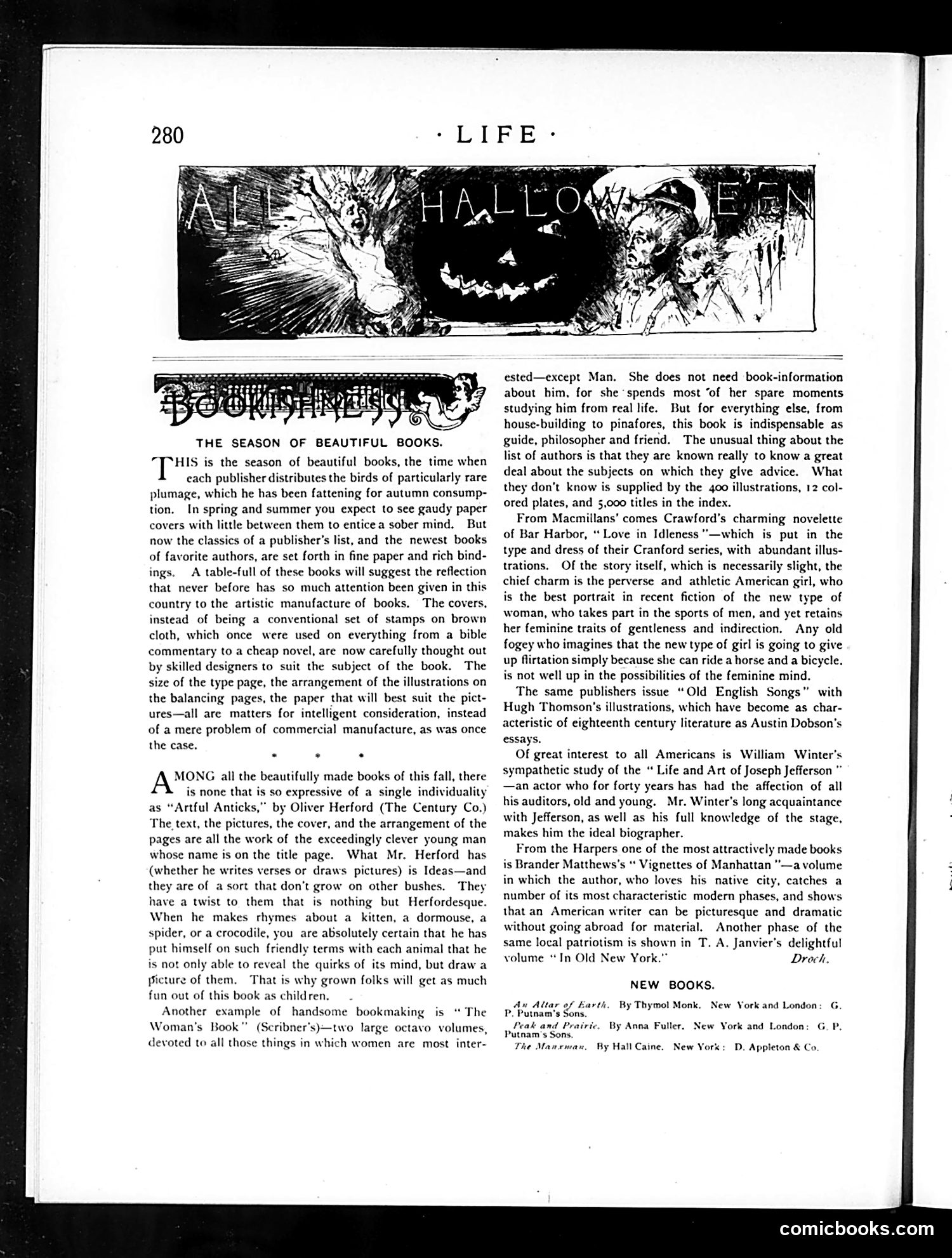
The top banner features "ALL HALLOW E'EN" with three illustrated figures in a Halloween-themed design, likely representing traditional spooky imagery associated with the holiday. The main content discusses beautiful book publishing, focusing on attractive cover design and artistic layout. The text praises Oliver Herford's "Artist's Life" and mentions William Winter's sympathetic study of "Life and Art of Joseph Jefferson"—an actor with forty years of audience affection. The page highlights that publishers are investing more artistic attention in book design, moving beyond standard stamped covers. It celebrates what the writer calls an unusually creative season for quality publications, emphasizing how skilled designers now carefully consider typography, illustrations, and paper selection to create attractive volumes. This appears to be a straightforward book review column rather than political satire.
📄 Transcribed text from this page (OCR, searchable)
Machine-transcribed from the original scan — historical spelling and the odd misread are preserved.
THE SEASON OF BEAUTIFUL BOOKS. TTTHIS is the season of beautiful books, the time when each publisher distributes the birds of particularly rare plumage, which he has been fattening for autumn consump- tion. In spring and summer you expect to see gaudy paper covers with little between them to entice a sober mind. But now the classics of a publisher's list, and the newest books of favorite authors, are set forth in fine paper and rich bind- ings. A table-full of these books will suggest the reflection that never before has so much attention been given in this country to the artistic manufacture of books. The covers, instead of being a conventional set of stamps on brown cloth, which once were used on everything from a bible commentary to a cheap novel, are now carefully thought out by skilled designers to suit the subject of the book. The size of the type page, the arrangement of the illustrations on the balancing pages, the paper that will best suit the pict- ures—all are matters for intelligent consideration, instead of a mere problem of commercial manufacture, as was once the case. MONG all the beautifully made books of this fall, there is none that is so expressive of a single individuality Artful Anticks,” by Oliver Herford (The Century Co.) The, text, the pictures, the cover, and the arrangement of the pages are all the work of the exceedingly clever young man whose name is on the title page. What Mr. Herford has (whether he writes verses or draws pictures) is Ideas—and they are of a sort that don’t grow on other bushes. They have a twist to them that is nothing but Herfordesque. When he makes rhymes about a kitten, a dormouse, a spider, or a crocodile, you are absolutely certain that he has put himself on such friendly terms with cach animal that he is not only able to reveal the quirks of its mind, but draw a Picture of them. That is why grown folks will get as much fun out of this book as children. Another example of handsome bookmaking is * The Woman's Book" (Scribner’s)}—two large octavo volumes, devoted to all those things in which women are most inter- ested—except Man, She does not need book-information about him, for she “spends most ‘of her spare moments studying him from real life. But for everything else, from house-building to pinafores, this book is indispensable as guide, philosopher and friend. The unusual thing about the list of authors is that they are known really to know a great deal about the subjects on which they give advice. What they don’t know is supplied by the 400 illustrations, 12 col- ored plates, and 5,000 titles in the index. From Macmillans’ comes Crawford’s charming novelette of Bar Harbor, “ Love in Idleness""—which is put in the type and dress of their Cranford series, with abundant illus- trations. Of the story itself, which is necessarily slight, the chief charm is the perverse and athletic American girl, who is the best portrait in recent fiction of the new type of woman, who takes part in the sports of men, and yet retains her feminine traits of gentleness and indirection. Any old fogey who imagines that the new type of girl is going to give up flirtation simply because she can ride a horse and a bicycle. is not well up in the possibilities of the feminine mind. The same publishers issue “Old English Songs” with Hugh Thomson's illustrations, which have become as char- acteristic of eighteenth century literature as Austin Dobson's essays. Of great interest to all Americans is William Winter's sympathetic study of the “ Life and Art of Joseph Jefferson ” —an actor who for forty years has had the affection of all his auditors, old and young. Mr. Winter's long acquaintance with Jefferson, as well as his full knowledge of the stage, makes him the ideal biographer. From the Harpers one of the most attractively made books is Brander Matthews’s * Vignettes of Manhattan "—a volume in which the author, who loves his native city, catches a number of its most characteristic modern phases, and shows that an American writer can be picturesque and dramatic without going abroad for material. Another phase of the same local patriotism is shown in T. A. Janvier’s delightful volume “In Old New York.” Droch. NEW BOOKS. An Altar of Earth, By Thymol Monk. P. Putnam's Sons. Peak and Prairie Putnam's Sons, The Mansman, New York and London: G. By Anna Fuller. New York and London: G. P. By Hall Caine. New York: D. Appleton & Co. comicbooks.com