
A complete issue · 18 pages · 1894
Life — October 4, 1894
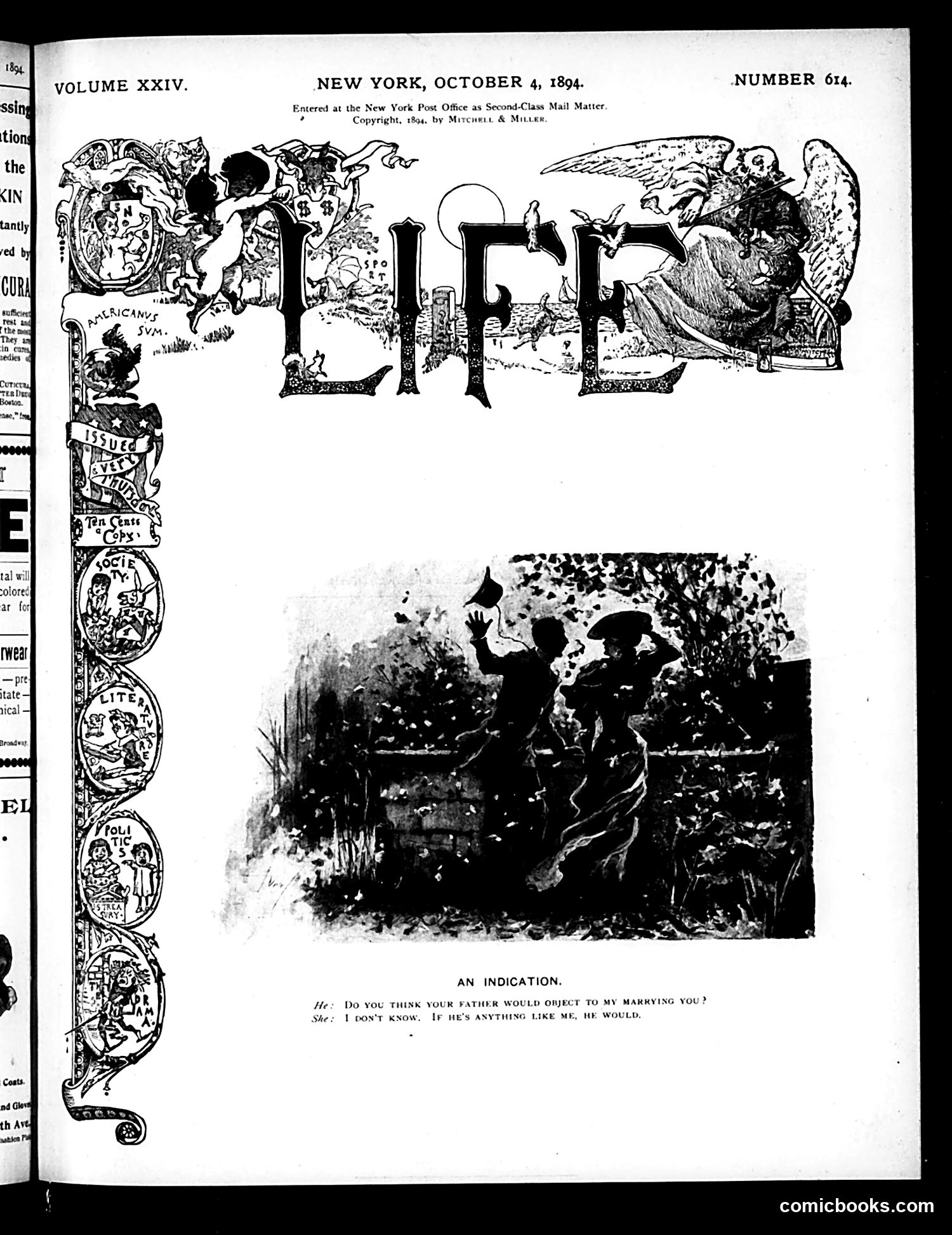
This cartoon satirizes courtship and marriage prospects. The silhouetted scene shows a couple in a romantic outdoor setting, likely a garden or wooded area. The caption presents dialogue between "He" and "She": **He**: "Do you think your father would object to my marrying you?" **She**: "I don't know. If he's anything like me, he would." The joke subverts romantic expectations: rather than expressing confidence in winning approval, the woman suggests her father would reject the suitor for the same reason she implicitly might—implying some undesirable quality the suitor possesses. It's a humorous commentary on both self-awareness and the unpredictability of parental approval in matters of romance, with a slightly cutting edge about the suitor's prospects.
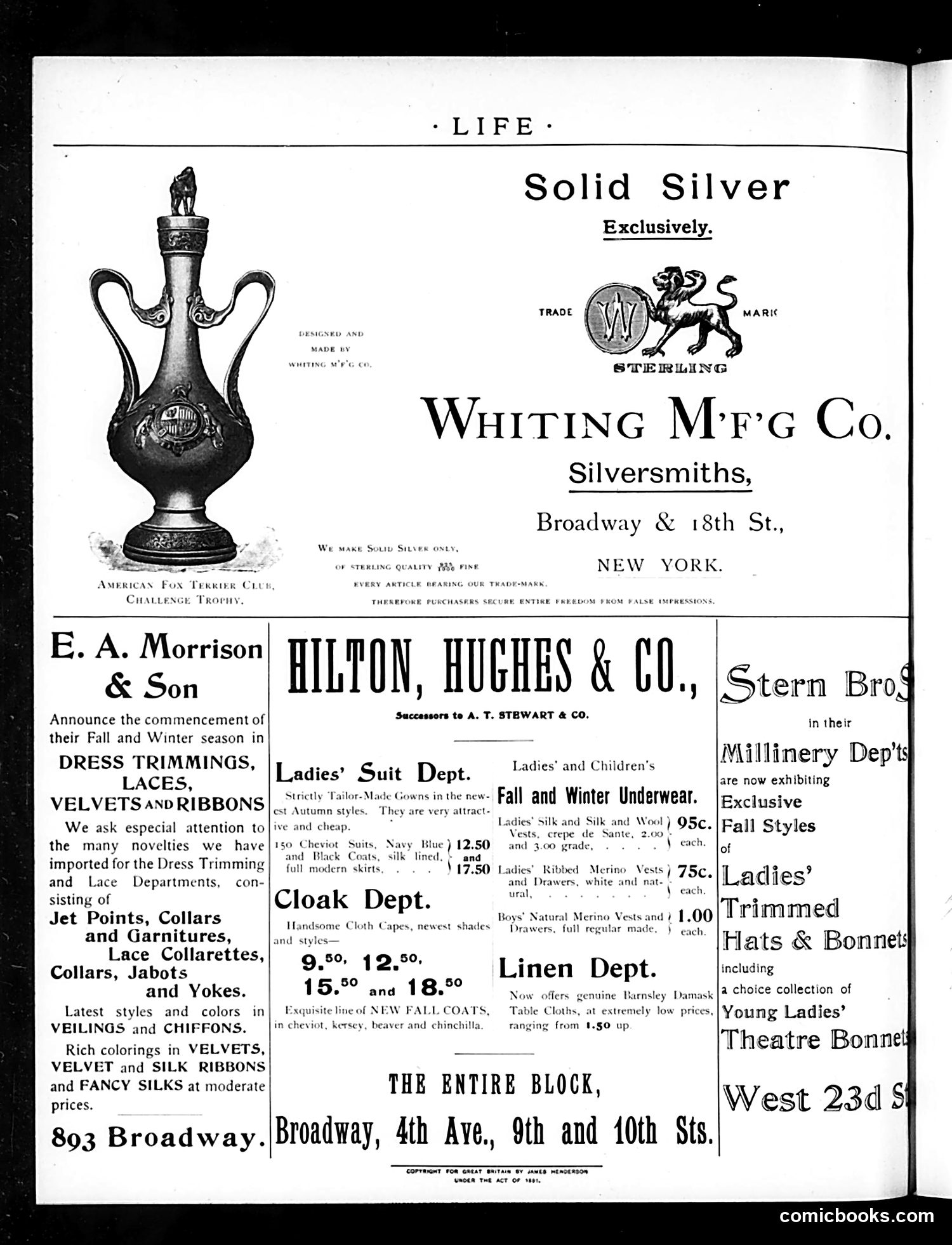
This page is **primarily advertising**, not satirical content. It contains several commercial advertisements from late 19th-century New York retailers: - **Whiting M'fg Co.** advertises solid sterling silver goods at Broadway & 18th St. - **E.A. Morrison & Son** promotes dress trimmings and laces at 893 Broadway - **Hilton, Hughes & Co.** features a ladies' suit department with tailored gowns - **Stern Bros.** advertises exclusive fall millinery and trimmed hats for ladies The page header reads "LIFE," identifying it as the satirical magazine, but this particular page contains no visible political cartoons or social satire—only period fashion and luxury goods advertisements targeting wealthy urban consumers in New York City.
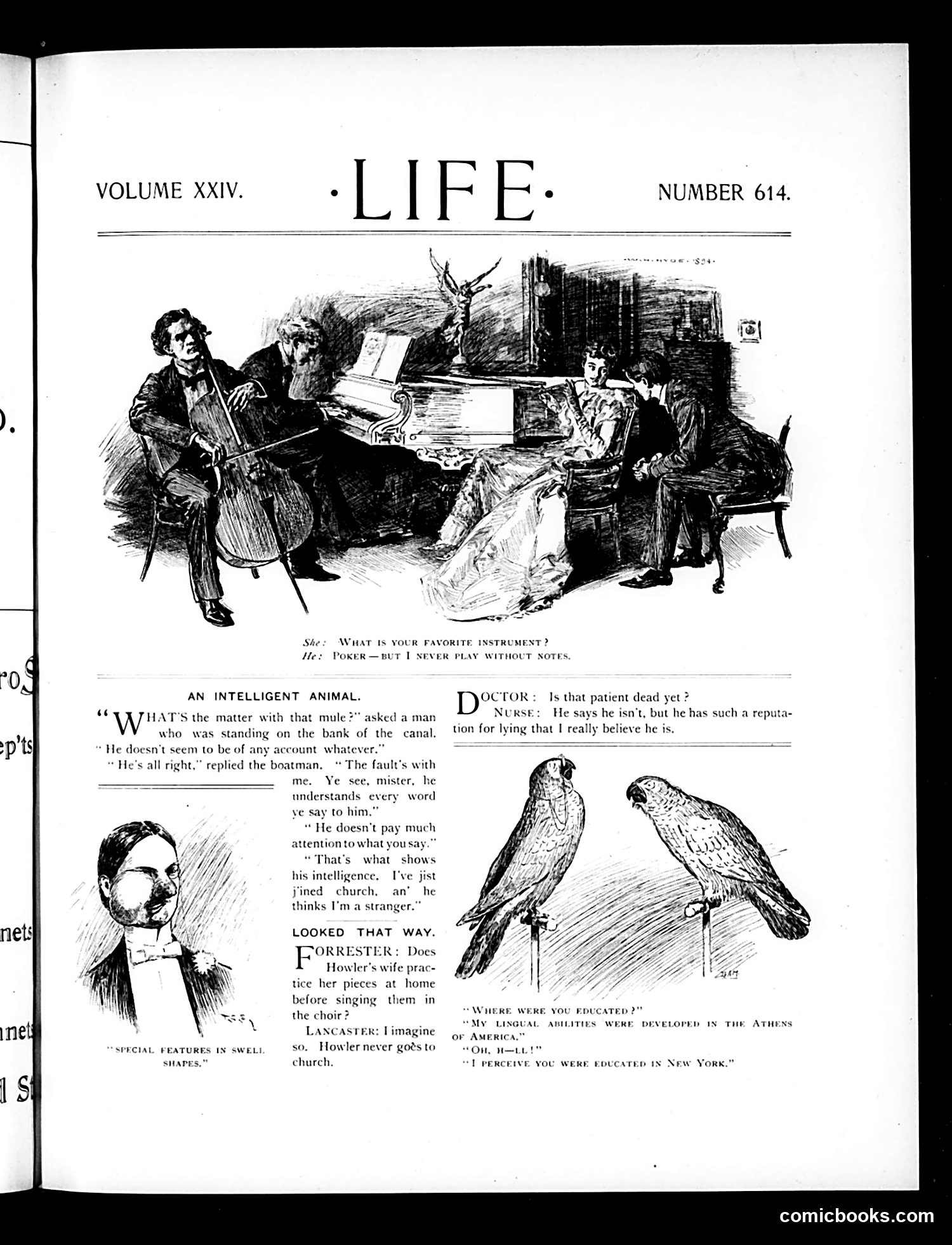
This page contains three separate humorous items typical of Life's satirical format: 1. **"An Intelligent Animal"**: A boatman explains a mule's intelligence by noting it doesn't listen to people, ignores what they say, and never goes to church—presenting selective hearing as a sign of cleverness. 2. **Top cartoon**: A drawing-room scene captioned "What is your favorite instrument?" with the punchline "Poker—but I never play without notes," suggesting card-game cheating. 3. **Two parakeets illustration**: Dialogue between birds discussing education: one claims abilities "developed in the Athens of America," the other responds "I perceive you were educated in New York"—mocking New York's pretensions to cultural superiority over other American cities. All three items employ gentle social satire common to early 20th-century American humor magazines.
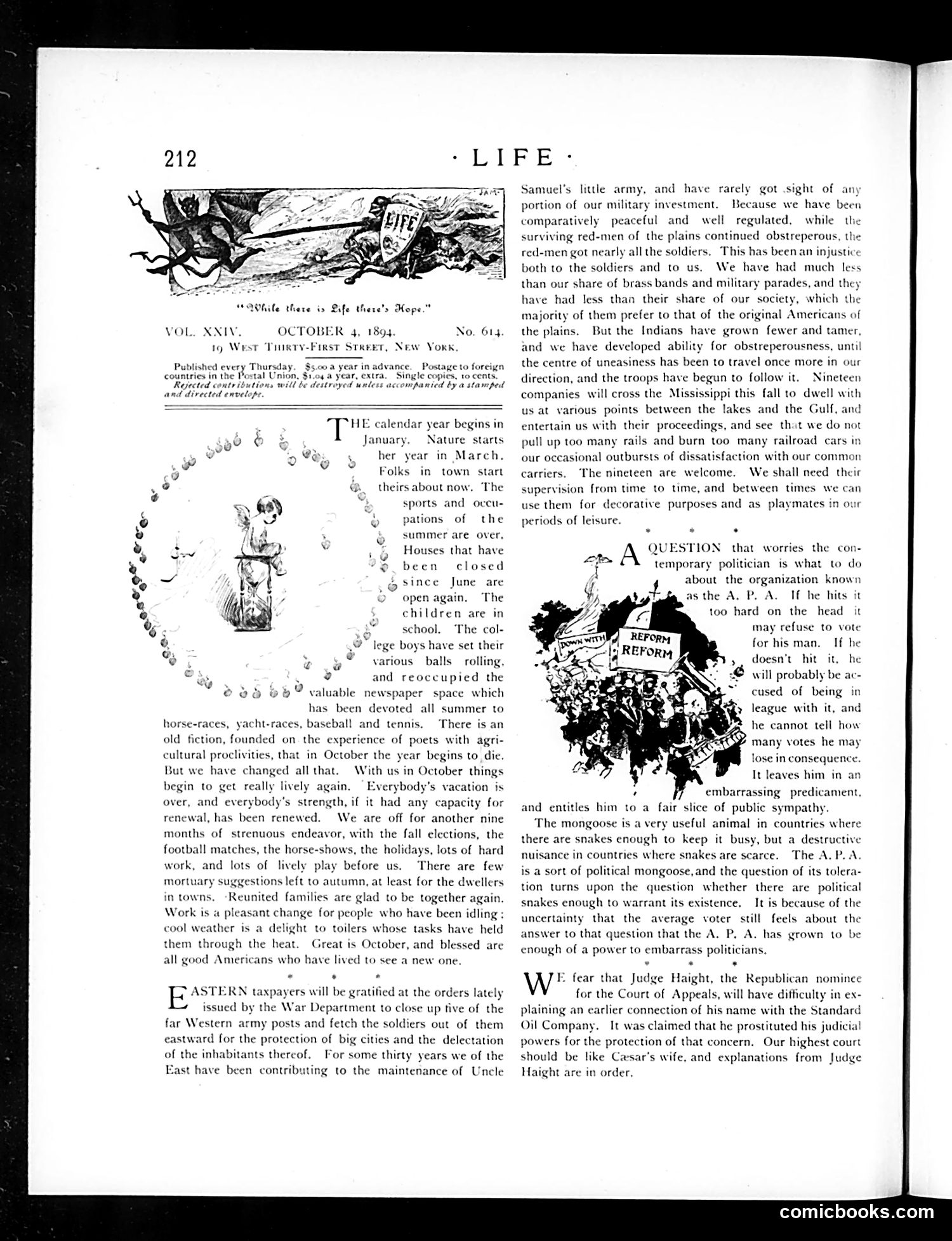
The main cartoon depicts the **A.P.A. (American Protective Association)**, a nativist political organization of the 1890s, as a destructive "political mongoose" attacking a snake labeled "Reform." The text explains the satirist's concern: politicians worry the A.P.A.'s single-issue focus on opposing Catholic immigration will embarrass candidates by splitting votes unpredictably. The accompanying article discusses Judge Haight's Republican nomination for the Court of Appeals, warning that his alleged past connection to Standard Oil Company creates judicial credibility problems. The satire suggests both that fringe political movements like the A.P.A. destabilize elections and that corporate influence compromises judicial independence—key Progressive Era anxieties about American democracy's integrity.
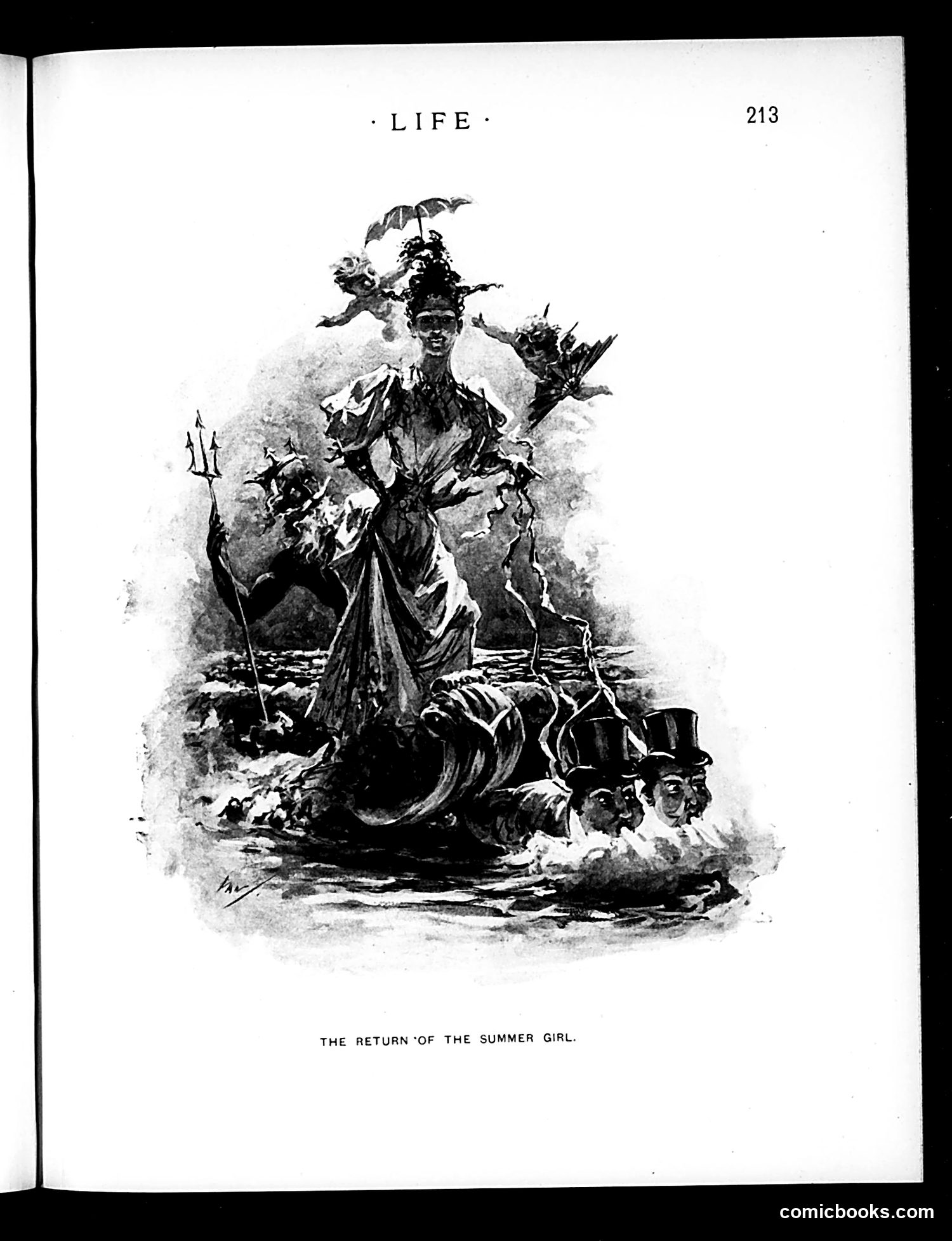
This satirical illustration depicts a grotesque, exaggerated female figure emerging from the sea—a caricatured "summer girl" returning from vacation. The figure is deliberately unflattering: gaunt, skeletal, and disheveled, laden with parasols and fashionable accessories. Two well-dressed gentlemen in top hats flee in terror at the bottom right, their horror emphasizing the visual joke. The satire likely mocks 1890s-era anxieties about women's independence during summer vacation seasons, when affluent women traveled independently. The grotesque depiction suggests male anxiety about women away from social constraints—transformed into something monstrous upon their return. The title's expectation of a pleasant "summer girl" contrasts sharply with this horrifying apparition, creating the cartoon's humorous commentary on contemporary gender relations and male discomfort with female autonomy.
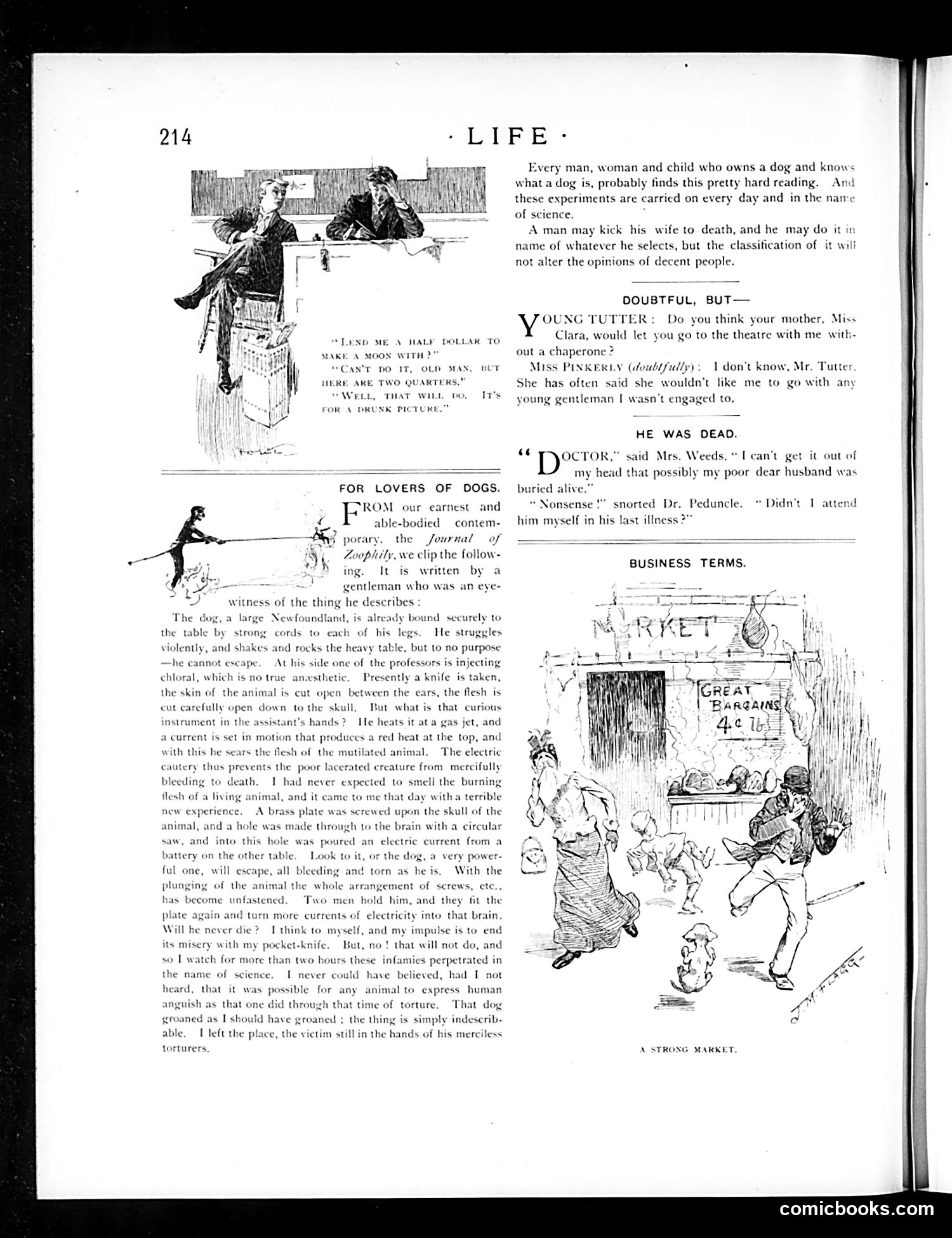
This page contains three distinct sections: **Top cartoon**: Two men at a desk in a dialogue about money. One asks to "lend me a half dollar to make a noon shift," and the other refuses, saying "here are two quarters" instead—a joke about refusing to help someone properly. **"For Lovers of Dogs"**: A lengthy editorial excerpt from the *Journal of Zoophily* describing vivisection experiments on a Newfoundland dog. The passage graphically details surgical procedures performed without anesthesia, condemning animal cruelty in the name of science. This reflects late 19th/early 20th-century animal welfare activism. **"Business Terms"**: A sketch showing a market scene labeled "Great Bargains 4 cts" with busy shoppers, satirizing aggressive commercial sales tactics. The page combines social commentary on class economics, animal welfare, and consumer culture.
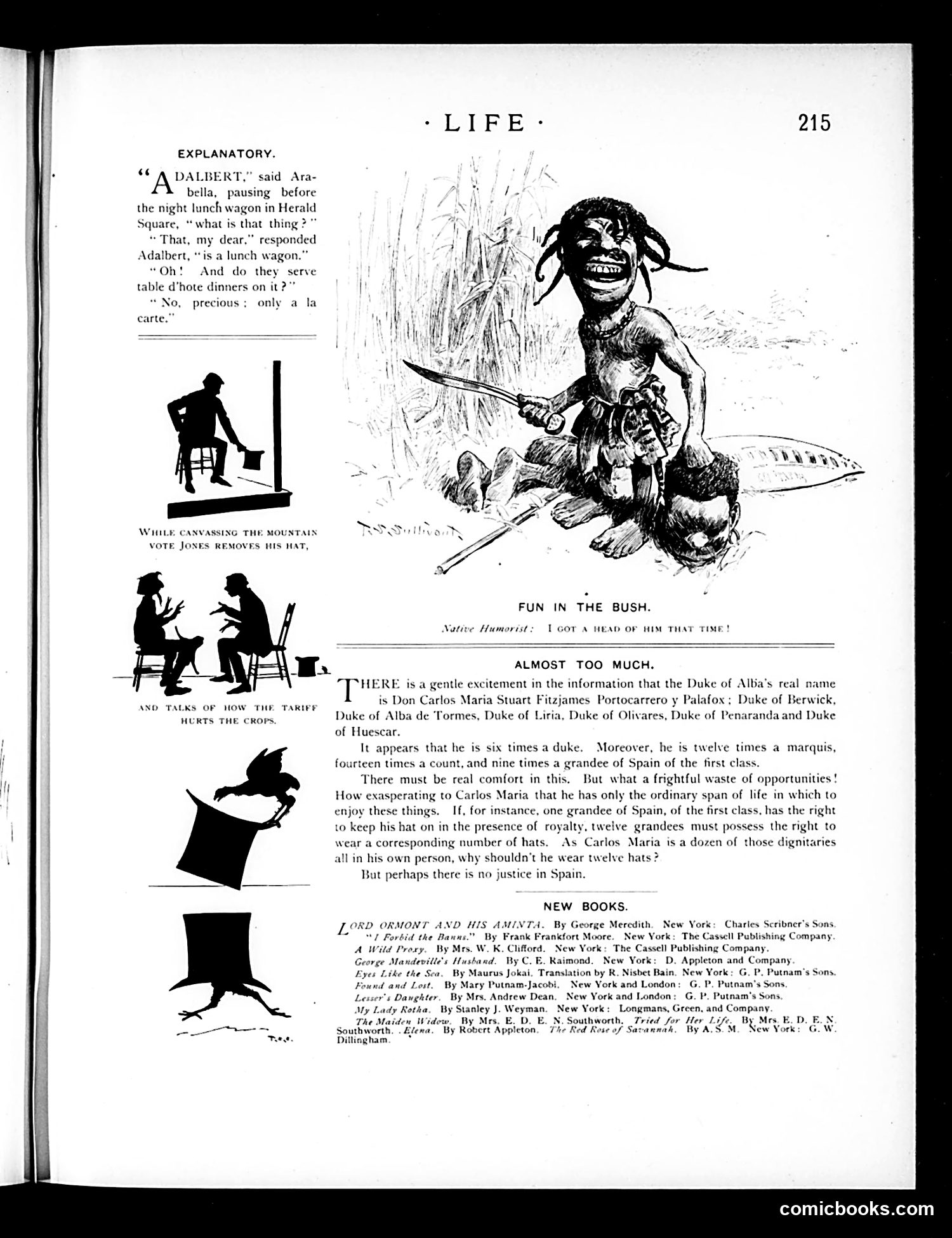
This page contains satirical cartoons and commentary from Life magazine. The main section "Almost Too Much" discusses the Duke of Alba's titles and honors—he holds six dukedoms, twelve marquisates, fourteen counties, and nine grandeeships of Spain. The satire suggests this accumulation of titles is excessive; the joke implies the Duke of Alba would need to wear twelve hats simultaneously to properly represent all his dignities, which is impractical and absurd. The left-side cartoons appear to be political satire involving voting and canvassing, though specific figures are unclear. The "Fun in the Bush" illustration depicts a caricatured colonial figure, likely satirizing British imperial attitudes. The "New Books" section lists contemporary publications, indicating this is a book review page rather than purely comic content.
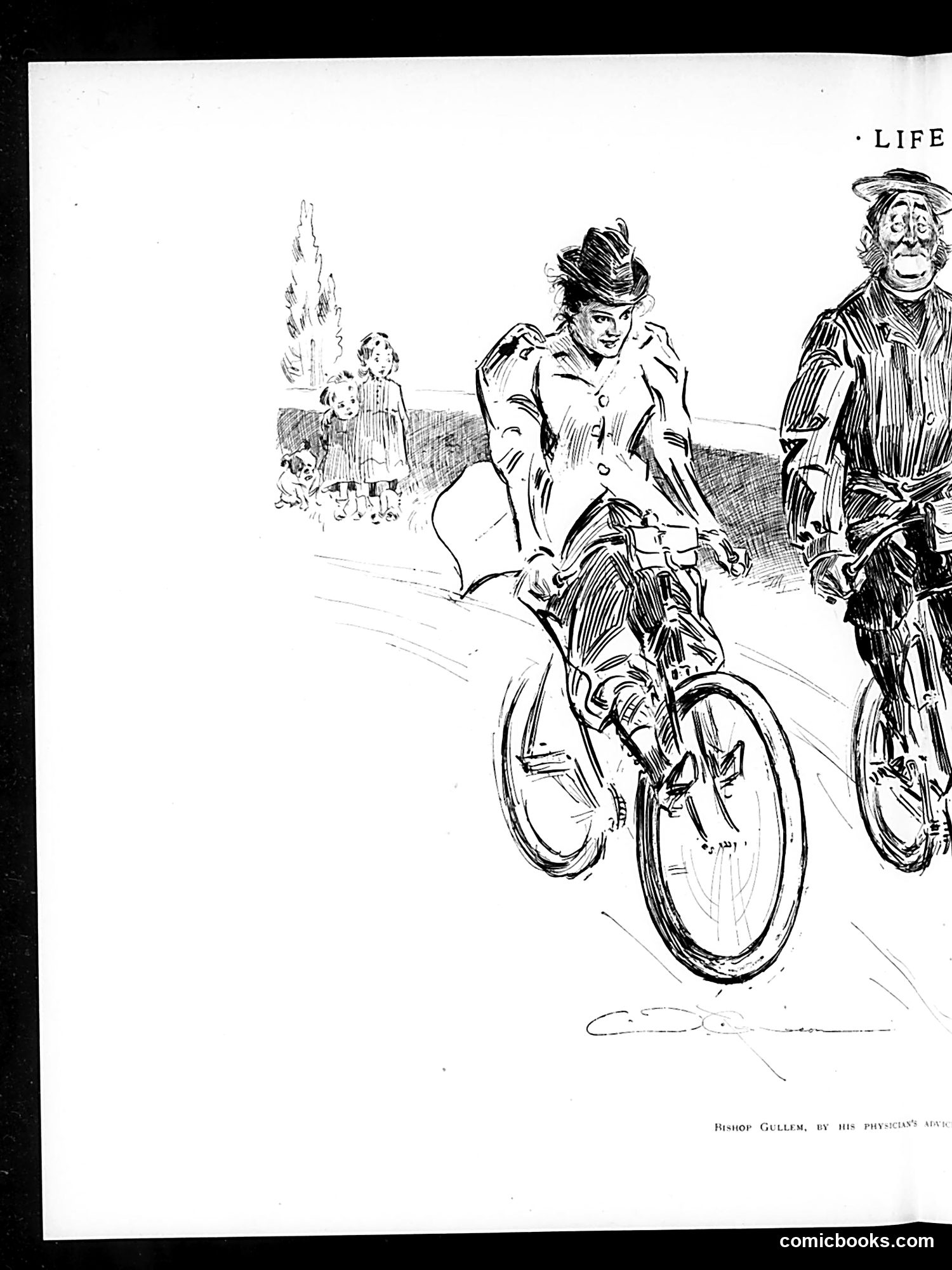
This appears to be a satirical illustration from Life magazine titled "Bishop Gullem, by His Physician's Advice." The image shows a woman in fashionable dress riding a bicycle, flanked by two men on bicycles—one appearing to be a physician (left) and another older gentleman (right). The satire likely mocks either: 1. A specific bishop named Gullem taking up cycling on medical advice, or 2. The broader trend of clergy adopting modern activities The humor targets the incongruity between ecclesiastical authority and contemporary leisure pursuits. The woman's prominent central position and fashionable attire may also satirize women's increasing public participation in cycling—a relatively controversial activity for women in the late 19th/early 20th century, when this appears published. The cartoon reflects tensions between tradition and modernity in that era.
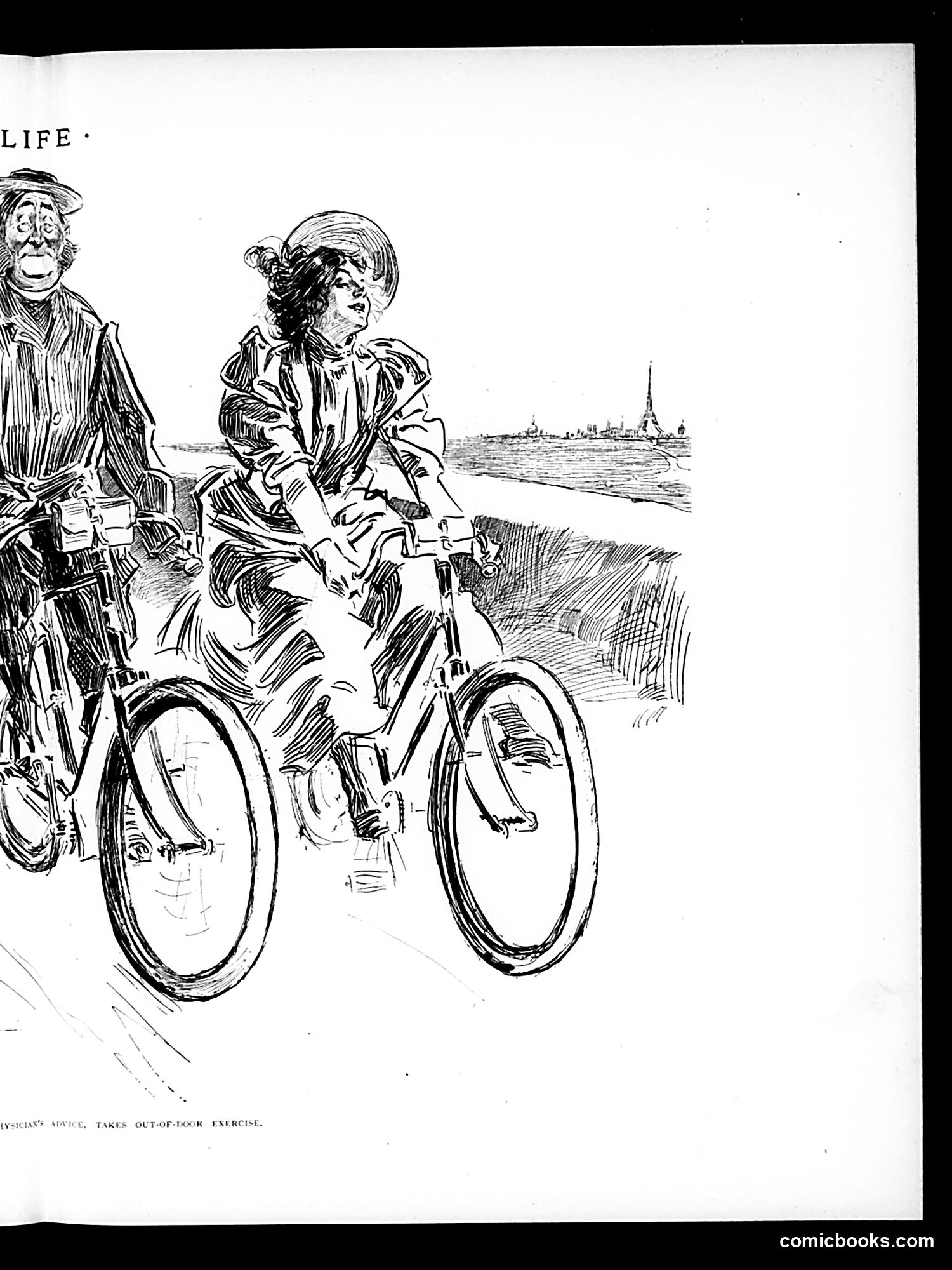
This is a satirical illustration from *Life* magazine titled "Physician, Heal Thyself: Takes Out-of-Door Exercise." The cartoon depicts a woman on a bicycle accompanied by a man on the left. The caption suggests ironic commentary on health and exercise advice. The illustration appears to critique the fashion or behavior of wealthy or leisured classes taking up cycling as a health trend. The woman's elaborate hat, tailored jacket, and overall fashionable appearance contrast with the supposedly healthful activity of outdoor cycling. The riverside setting (possibly the Seine, given the Eiffel Tower in the background) and the well-dressed male companion suggest this is commentary on how fashionable society adopts exercise trends more for social display than genuine health concerns—the "physician healing thyself" through performative fitness.
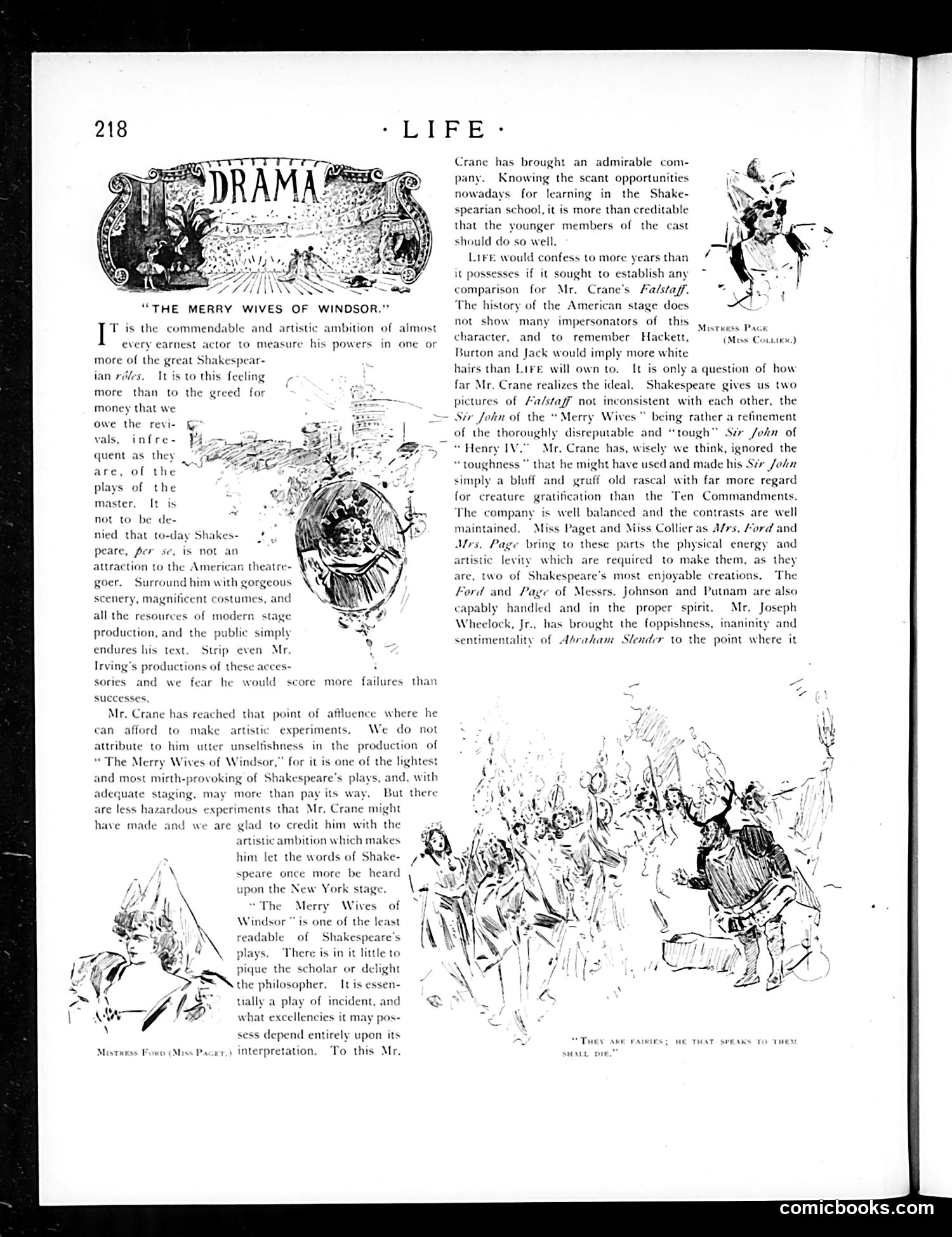
This page reviews William Crane's theatrical production of Shakespeare's "The Merry Wives of Windsor." The text praises Crane's artistic ambitions in staging this classic play, noting it represents a significant undertaking for American theater. The sketches illustrate scenes from the production, showing actors in period costume performing various scenes. The caption "They are fairies; he that speaks to them shall die" references a specific moment from the play. The review discusses the cast's quality, particularly praising actresses Miss Collier (as Mistress Page) and Miss Ford, and actor Joseph Wheelock Jr. The critique evaluates whether Crane's theatrical resources and modern staging adequately serve Shakespeare's comedy, suggesting his interpretation represents a noteworthy artistic experiment for the American stage of that era.
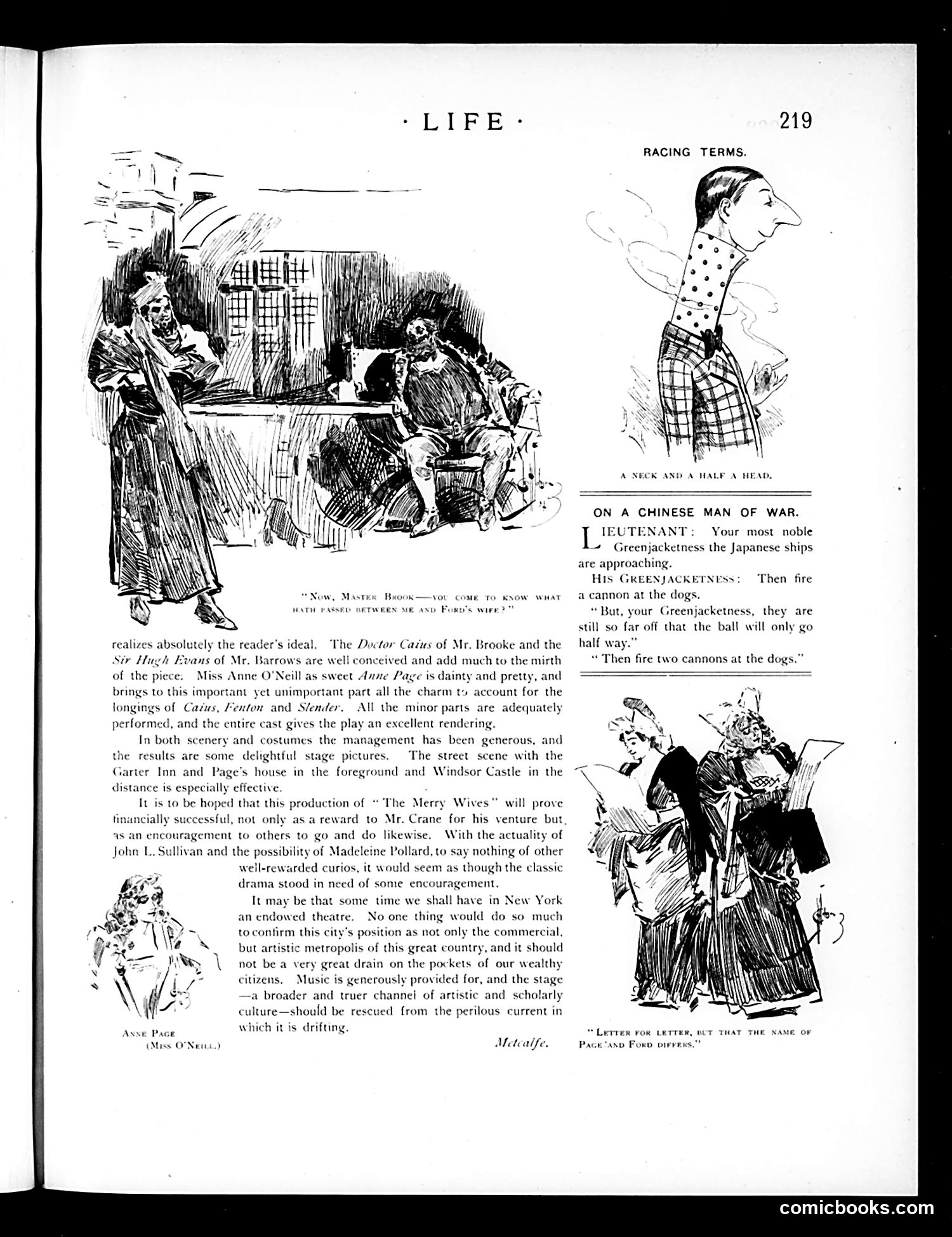
This page contains theatrical reviews and satirical sketches. The left side discusses "The Merry Wives" production, praising performances by actors including Miss Anne O'Neill and others, with commentary on scenery and costumes at venues like the Garrick Inn and Windsor Castle. The right side features a "Racing Terms" cartoon mocking a military dialogue between a Lieutenant and His Greenjacketness about Japanese ships, where incompetence is shown through their ineffective cannon fire. Below is a separate cartoon labeled "Letters for Letters, Not That the Name of Page and Ford Differs," apparently satirizing confusion about correspondence or naming conventions. The sketches use exaggeration and absurdist humor typical of Life's satirical style, though specific historical references require additional context to fully decode.
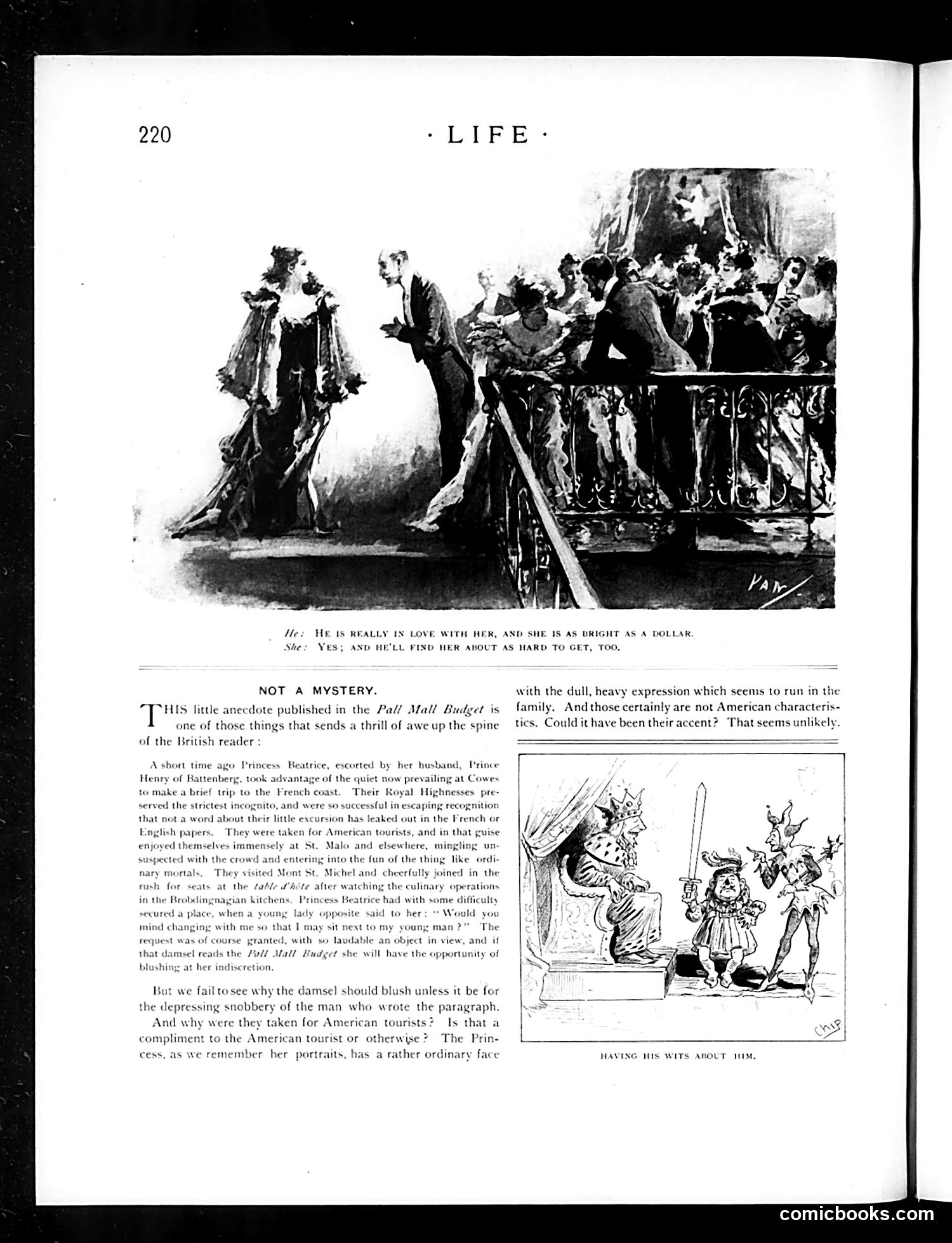
This 1890s *Life* magazine page satirizes British snobbery and American tourists. **The Main Article ("Not a Mystery"):** A British publication (*Pall Mall Budget*) recounted how Princess Beatrice and her husband traveled incognito to the French coast, successfully avoiding recognition. However, a young woman at a restaurant asked to switch seats with the Princess to sit near "my young man." **The Satire's Point:** The *Life* writer mocks the British writer's tone—he seems scandalized that royalty wasn't recognized and mingled with ordinary people. *Life* asks sarcastically: why should the young woman blush? The British author then adds that the royals were *mistaken for American tourists*, which *Life* ridicules as either insulting Americans or revealing British class anxiety. **The Cartoon ("Having His Wits About Him"):** Unclear without caption context, but appears to show a character dealing with multiple figures, possibly illustrating another social situation. The overall message: British snobbery about class distinction is absurd, especially their condescension toward Americans.
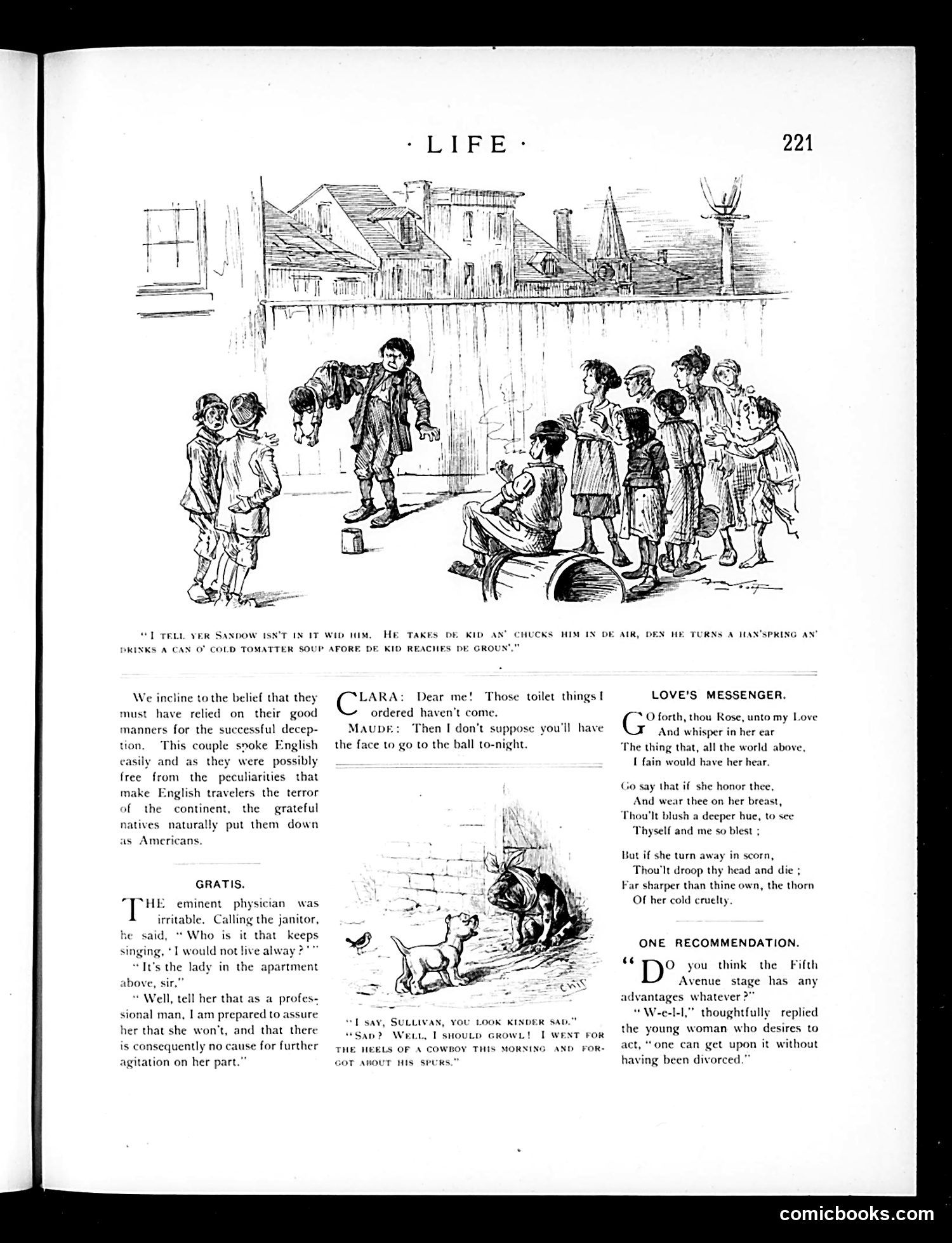
This page contains several unrelated satirical pieces typical of early Life magazine humor: **Top cartoon**: Depicts street children, likely referencing "Sandow" (probably Eugen Sandow, the famous strongman). The joke concerns a child's exaggerated claims about someone's strength, using period dialect ("Kid," "chucks him in de air"). **"Gratis"**: A physician's irritated exchange with his janitor about a neighbor's constant singing of melancholic songs—satire on urban apartment living and class-based annoyance. **"One Recommendation"**: A joke about Fifth Avenue social status, where a young woman quips that one cannot board a Fifth Avenue stage coach without having been divorced—satirizing the prevalence of divorce among wealthy New York society and their shamelessness about it. **Other pieces**: Include poetry ("Love's Messenger") and a dialogue between Clara and Maude about missing toilet articles and social obligations. The overall tone reflects Life's satirical commentary on American manners, urban life, and social pretension.
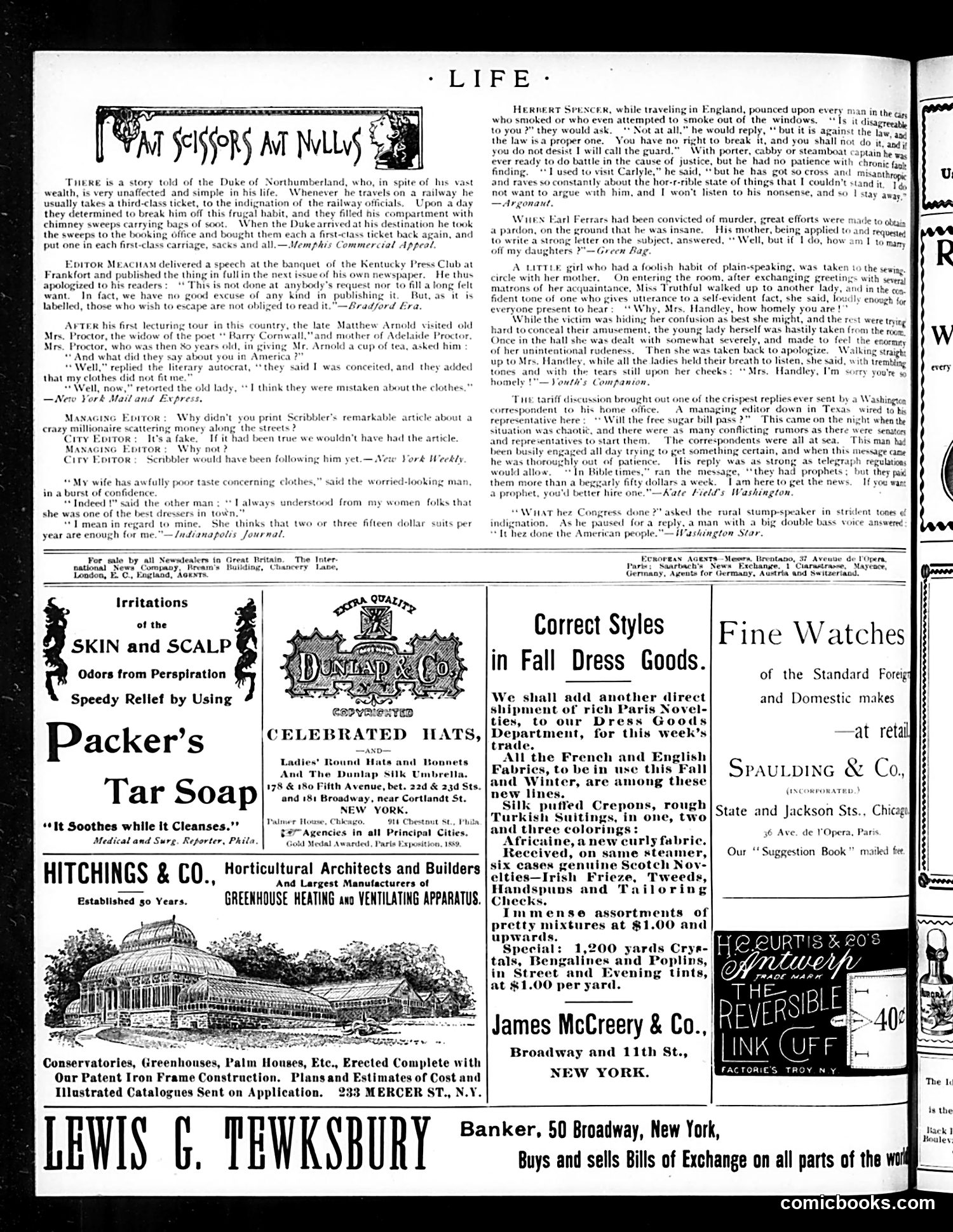
This page from *Life* magazine contains primarily **advertisements and brief humorous anecdotes** rather than political cartoons. The text includes several short jokes and stories typical of the era's satirical humor: - A anecdote about Herbert Spencer traveling third-class on trains, contrasting his wealth with his frugality - Editor Meacham's embarrassing publication of a poor speech at a Kentucky Press Club banquet - Matthew Arnold's dismissive response when told his clothes didn't fit properly - A city editor's cynical joke about not printing a story of a millionaire giving away money because the writer would have followed him to beg The **humor relies on class commentary** (Spencer's eccentricity, poor taste in dress) and **journalism satire** (the editor's admission that real news is sometimes too good to print because it would attract unwanted attention). The remainder of the page consists of **period advertisements** for Packer's Tar Soap, Hitchings & Co. greenhouse equipment, and various retail businesses—typical commercial content filling space in early 20th-century magazines.
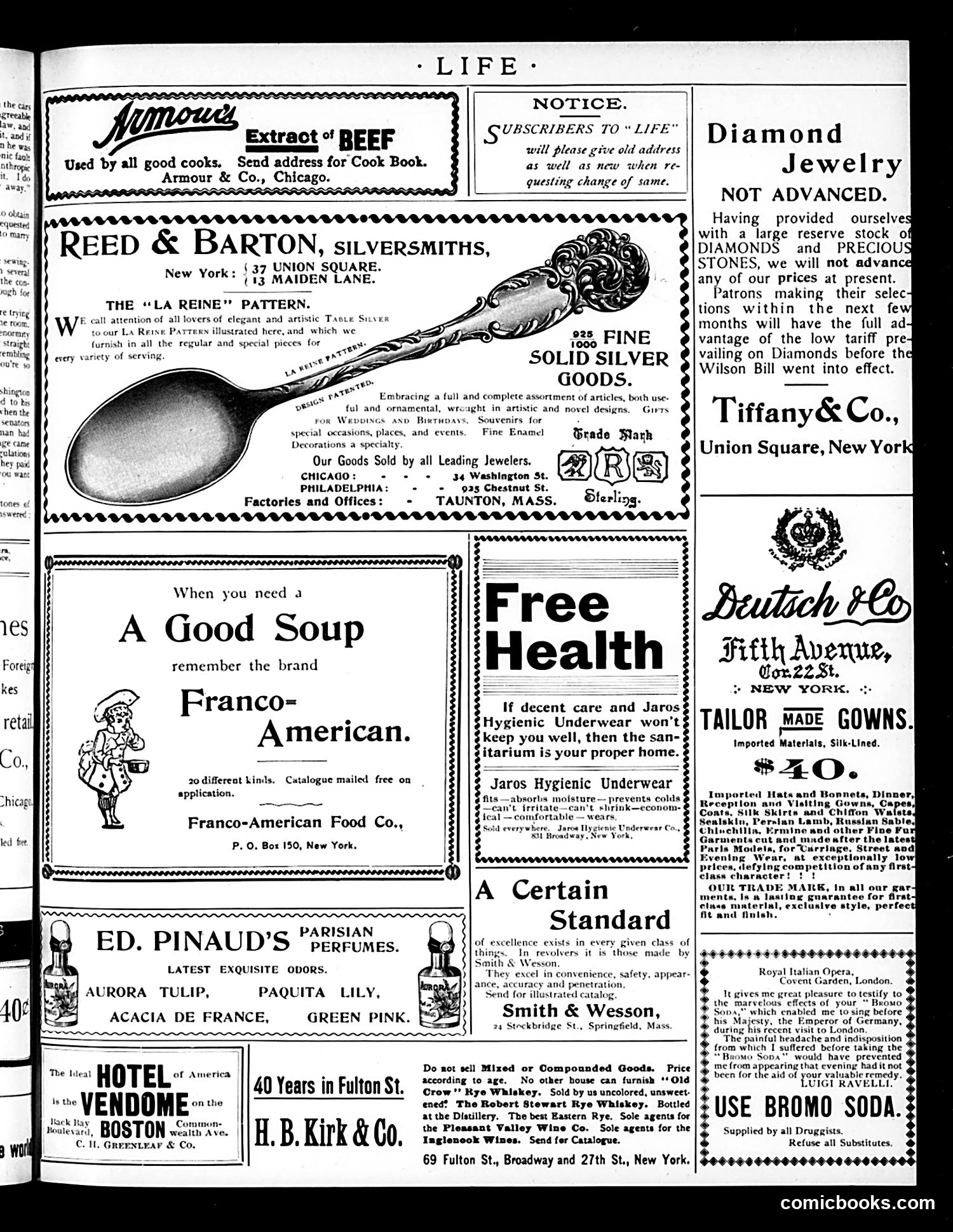
This is primarily an **advertisement page** from Life magazine, not a satirical cartoon. The page contains no political commentary or satire—it's a collection of period product advertisements typical of late 19th/early 20th-century magazines. **Notable content includes:** - **Armour Extract of Beef** and **Franco-American Soup** ads (food products) - **Reed & Barton silverware** with ornate period illustrations - **Diamond jewelry from Tiffany & Co.** with a specific note: prices won't advance because they stocked diamonds before the Wilson Bill's tariff took effect—a historical reference to protective tariff legislation - **Smith & Wesson revolvers** marketed as a "certain standard of excellence" - **Jaros Hygienic Underwear**, perfumes, tailor-made gowns, and liquor ads - A testimonial from "Sig. Ravelli" endorsing Bromo Soda The Tiffany ad is the only item with clear **economic/political context**: it appeals to customers to buy *now* before tariff protections expire, suggesting price increases were anticipated. Otherwise, this reflects typical Gilded Age consumer marketing with emphasis on imported luxury goods.
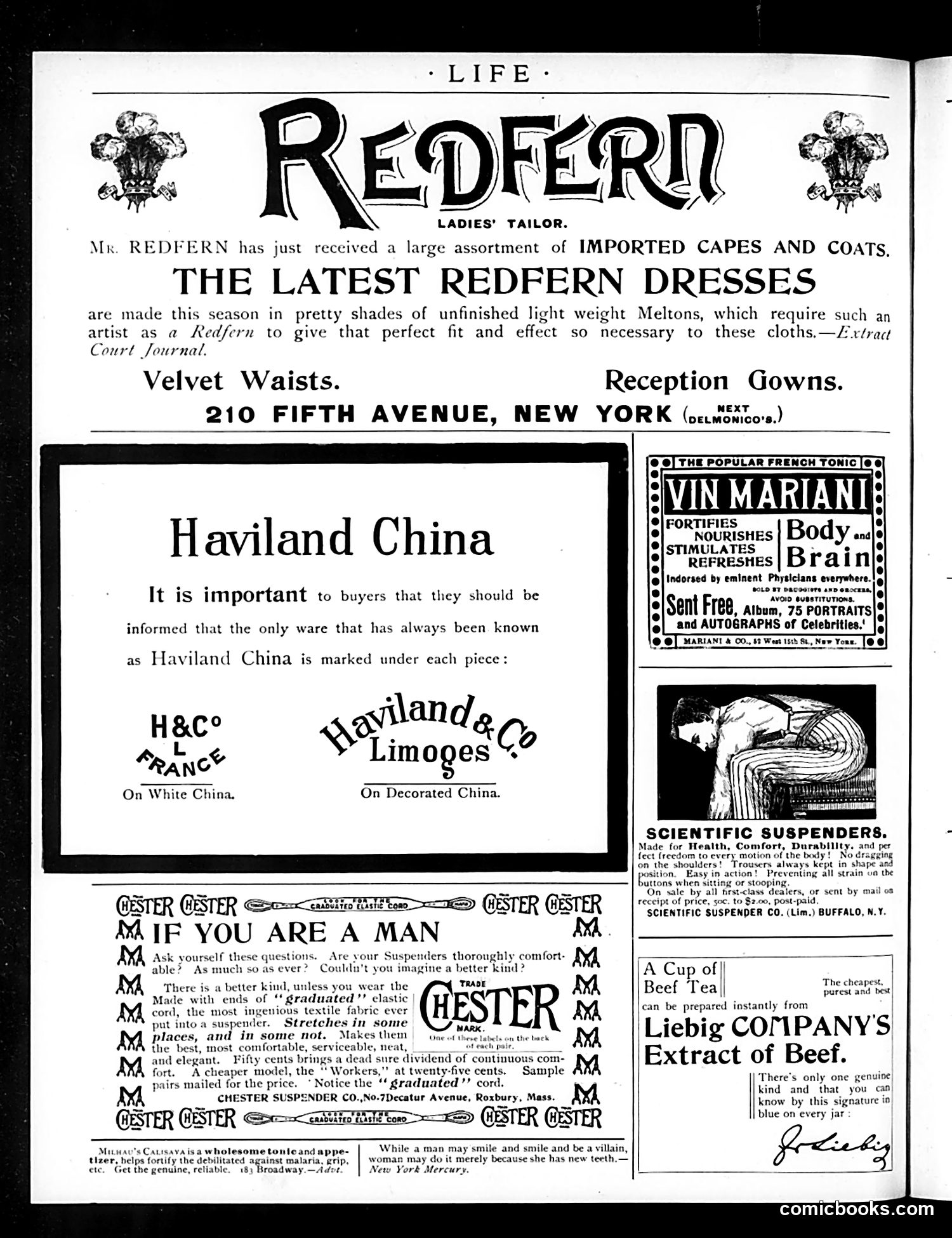
This page is primarily **advertisements** with no political cartoon. The content reflects turn-of-the-century consumer culture and social attitudes. **Key advertisements:** - **Redfern** (top): A high-end ladies' tailor advertising imported capes and dresses made from fine fabrics requiring expert tailoring - **Haviland China**: Emphasizing the importance of authentic marks on porcelain to verify genuineness - **Chester Suspenders**: Marketing improved suspender design with "graduated" cord for comfort and dignity - **Vin Mariani**: A French tonic wine claimed to fortify body and brain, endorsed by physicians (a dubious "health" product common in this era) - **Scientific Suspenders**: Competing product emphasizing health benefits - **Liebig Extract of Beef**: Instant beef tea product **Social context:** The ads reflect Gilded Age consumer aspirations—imported luxury goods, patent medicines with exaggerated claims, and products emphasizing genteel appearance and masculine respectability. A small joke at bottom mocks women's vanity regarding new teeth.
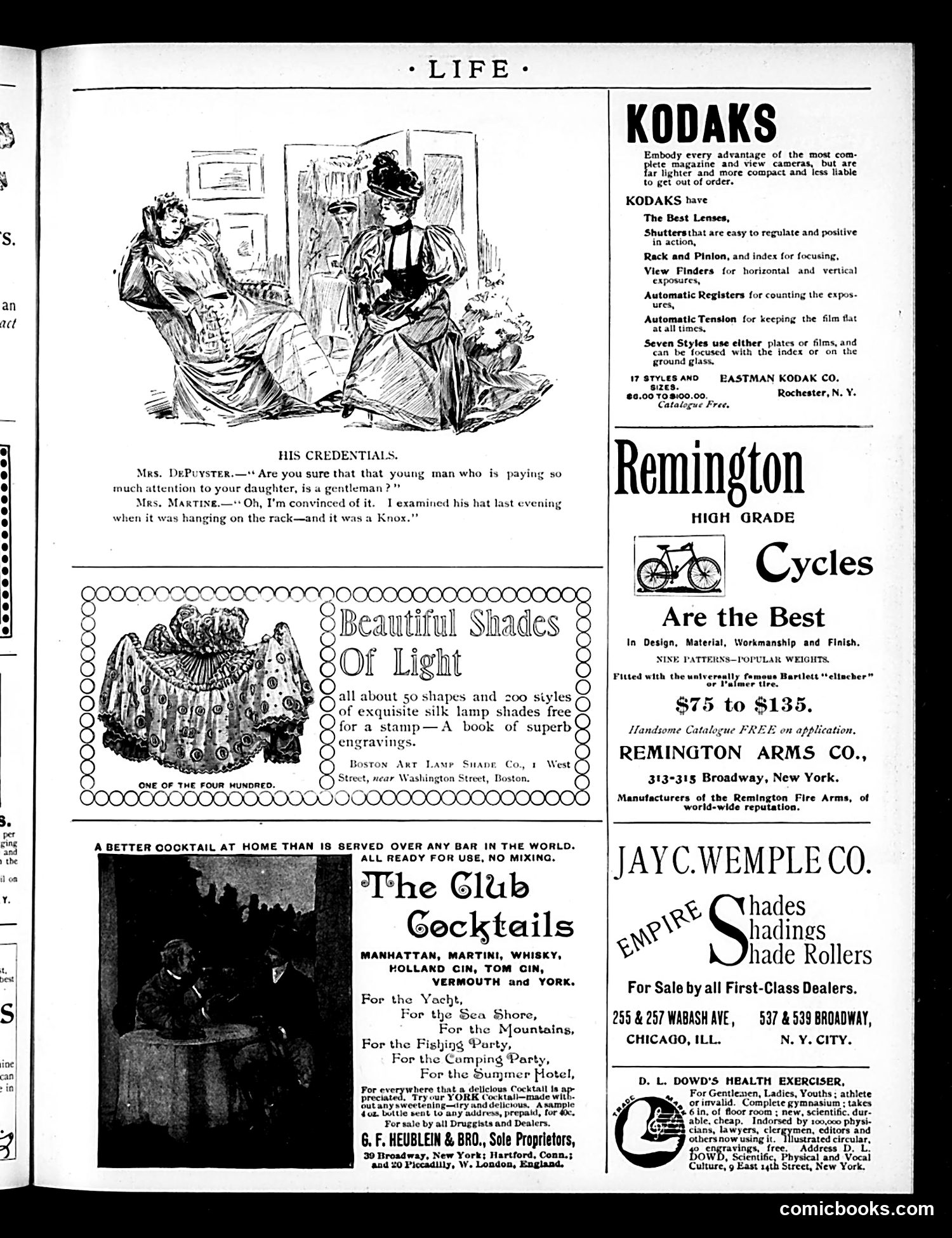
This brief cartoon jokes about how the upper class judged a suitor's respectability. Mrs. DePuyster worries whether a young man courting someone's daughter is truly a "gentleman." Mrs. Martine reassures her by explaining she examined his *hat* when it hung on the rack—and it was a Knox. The joke relies on understanding that Knox was an expensive, prestigious hat brand. A gentleman would wear a quality hat; therefore, the hat itself becomes proof of gentlemanly status and breeding. The satire mocks how superficially the wealthy assessed character: rather than observing his behavior or moral qualities, they simply checked his millinery. For modern readers, this highlights Victorian-era class anxiety and the belief that material goods and brands signaled (and could verify) one's social position.
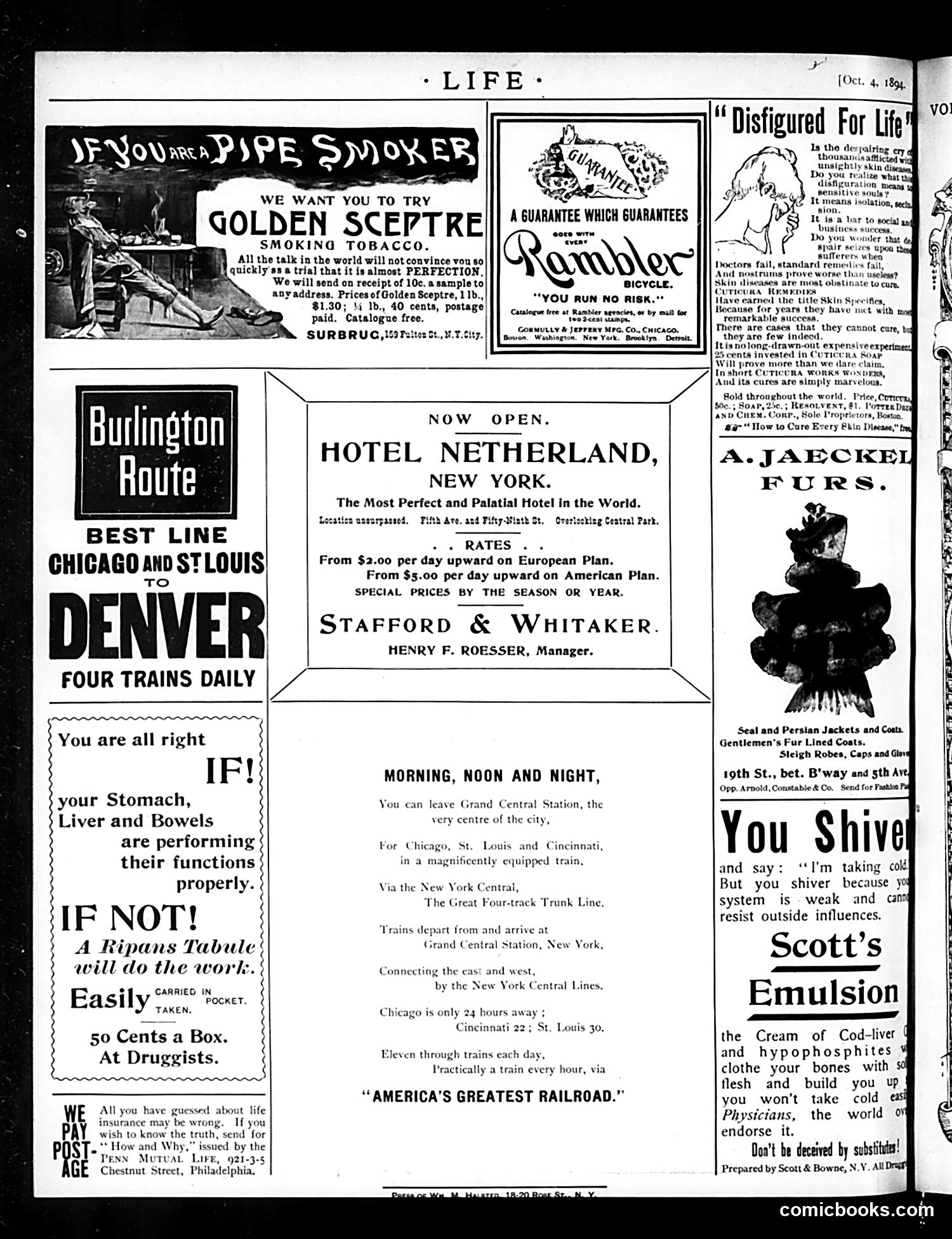
This page is primarily **advertising**, not editorial content or satire. It contains commercial notices typical of the 1890s: **Key advertisements include:** - **Golden Sceptre Smoking Tobacco**: A pitch promising near-perfection, offering free samples to convince skeptics—reflecting 19th-century marketing optimism. - **Ripans Tabule**: A patent medicine promising digestive relief (stomach, liver, bowels), representing the era's ubiquitous "cure-all" remedies before FDA regulation. - **Burlington Route/New York Central Railroad**: Competing rail services advertising speed and frequency (trains "every hour"). - **Hotel Netherland**: Luxury hotel in New York promoting itself as "the most perfect." - **Scott's Emulsion**: Cod-liver oil supplement claiming to build strength and prevent colds—typical of Victorian health tonics. - **A. Jaeckel Furs**: Luxury furrier advertisement. The page reflects 1890s consumer culture and the prevalence of unregulated patent medicines making exaggerated health claims—now historically interesting for showing what people then believed could cure ailments.