
A complete issue · 16 pages · 1894
Life — September 27, 1894
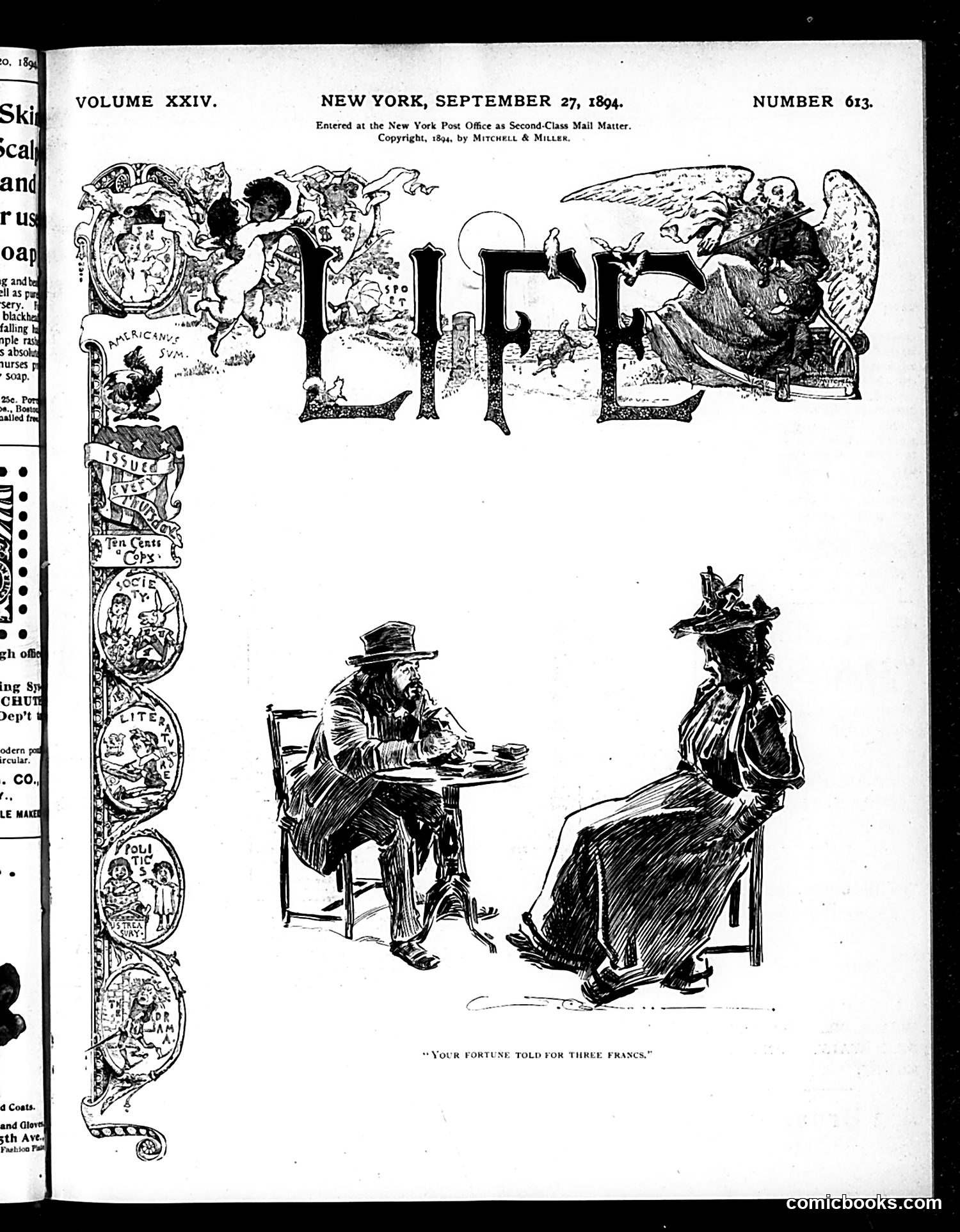
The main cartoon depicts a fortune teller and client with the caption "Your fortune told for three francs." The setting and French currency reference suggest this satirizes European fortune-telling practices, likely popular among Americans of the 1894 era who were fascinated by such mysticism. The elaborate decorative border on the left contains multiple small vignettes—appears to be Life magazine's recurring design element featuring allegorical or humorous scenes. The large ornamental "LIFE" masthead at top uses typical 1890s Art Nouveau styling with cherubs and fantastical creatures, standard for the publication's branding during this period. Without additional context from surrounding articles, the specific political or social satire remains unclear, though the fortune-telling theme likely mocks contemporary interest in spiritualism or superstition.
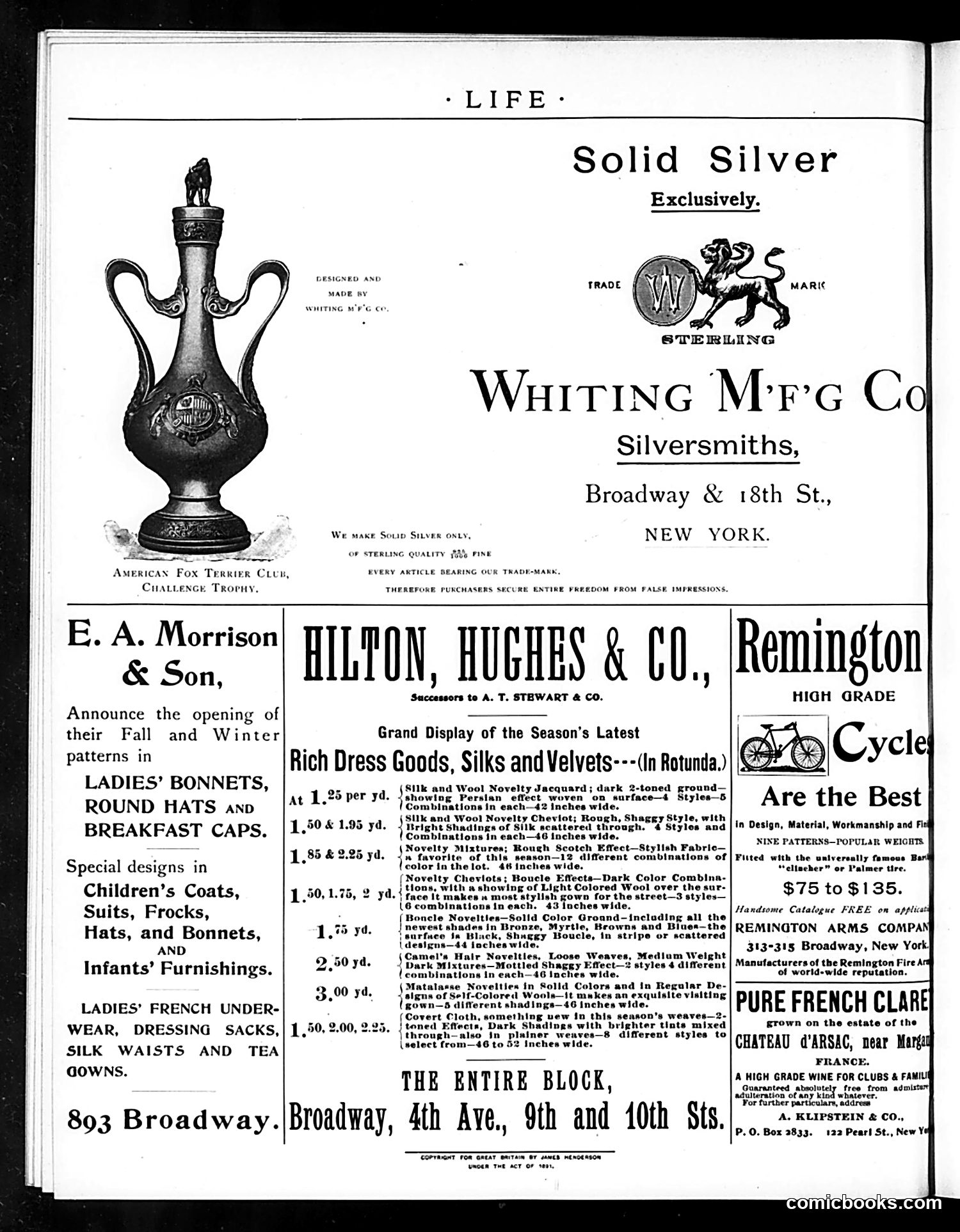
This page is primarily **advertising, not editorial content or satire**. It contains five distinct advertisements: 1. **Whiting Mfg Co** — promoting solid silver goods and trophies (top) 2. **E.A. Morrison & Son** — ladies' bonnets, caps, and children's clothing 3. **Hilton, Hughes & Co** — dress goods, silks, and velvets 4. **Remington** — bicycles marketed as "the Best" 5. **Pure French Claret** — wine from Château d'Arsac The only non-advertising image is an ornamental silver trophy cup at top left labeled "American Fox Terrier Club Challenge Trophy." **There is no political cartoon or satirical content on this page.** It represents a typical Life magazine advertising section from the early 1900s, featuring high-end consumer goods for affluent urban readers in New York City.
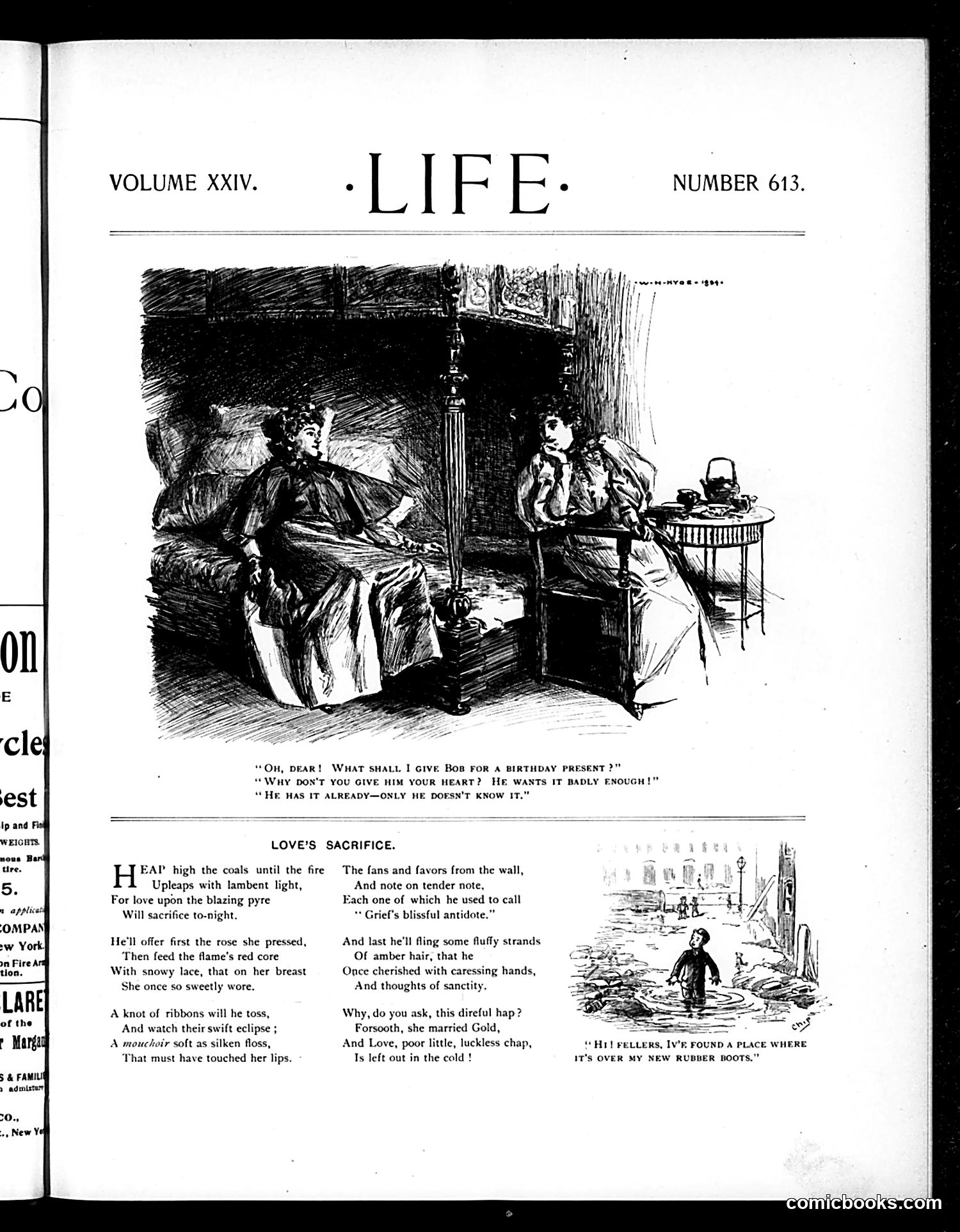
The top cartoon depicts two women in conversation about a birthday gift for "Bob." One woman suggests giving him "your heart," implying romantic love, while the other responds that he wants it "badly enough" without needing that gift—a joke about male romantic interest versus female emotional investment. Below this is a poem titled "Love's Sacrifice," illustrated with sketches. The poem describes a woman burning her romantic mementos (love letters, ribbons, amber hair) after marrying someone else named Gold, suggesting themes of renounced love and domestic duty. The final illustration shows a man discovering new rubber boots, likely commenting on practical marriage replacing romance. The satire critiques romantic idealization versus marital reality and women's constrained choices in relationships.
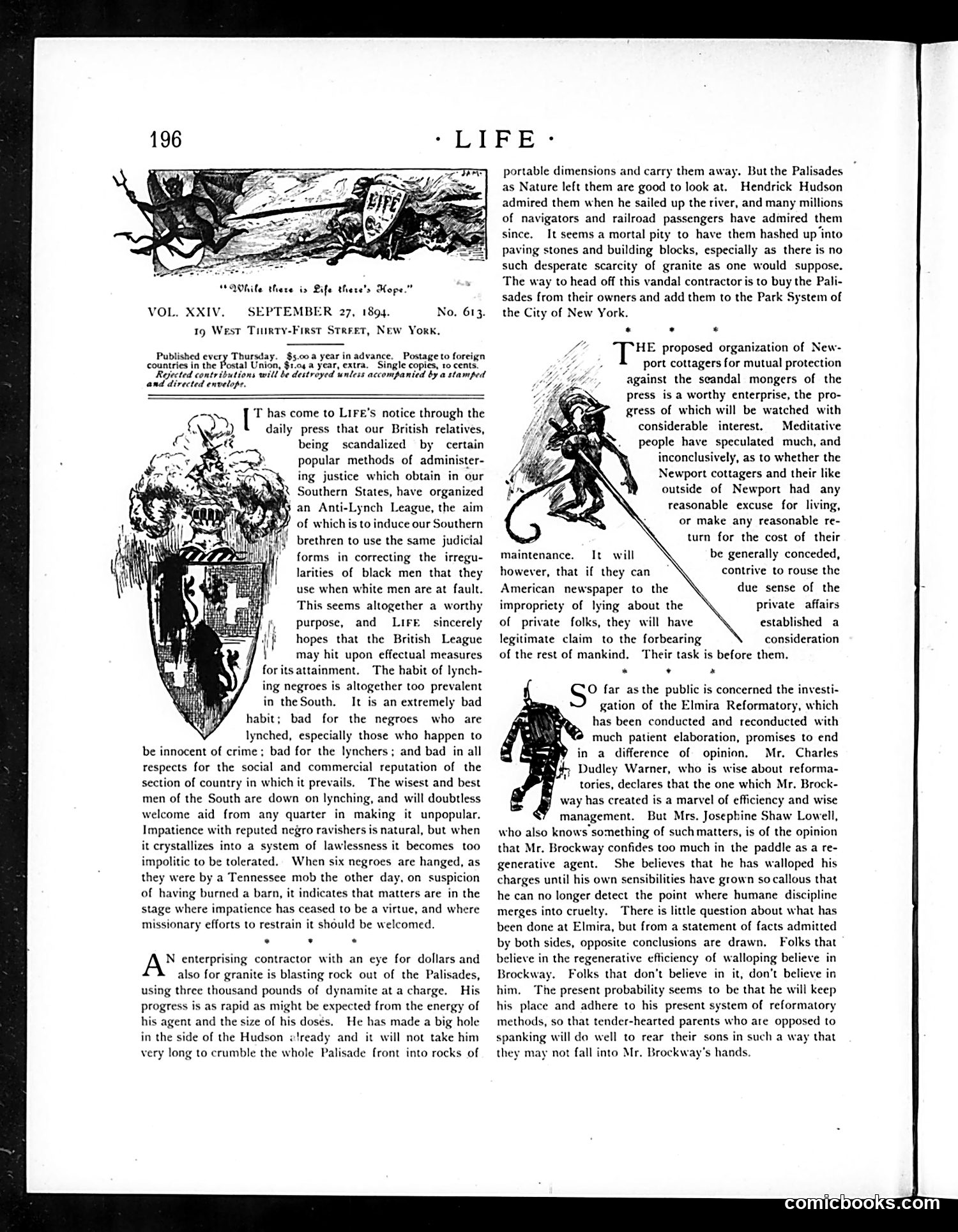
This page contains two distinct editorial pieces with accompanying illustrations. **Upper section**: Criticizes an "Anti-Lynch League" in the Southern United States, advocating for legal reforms to address mob lynching of Black citizens. The illustration shows a grotesque caricature depicting lynching victims. Life argues that while lying about private citizens is unethical, exposing such violence is justified. **Lower section**: Discusses the Elmira Reformatory in New York, debating the management methods of superintendent Mr. Brockway. The illustration shows a figure in what appears to be a reformatory setting. Life questions whether Brockway's disciplinary approach has become excessively harsh, noting criticism from reformer Josephine Shaw Lowell about potential cruelty masquerading as rehabilitation. Both pieces address institutional violence and reform effectiveness.
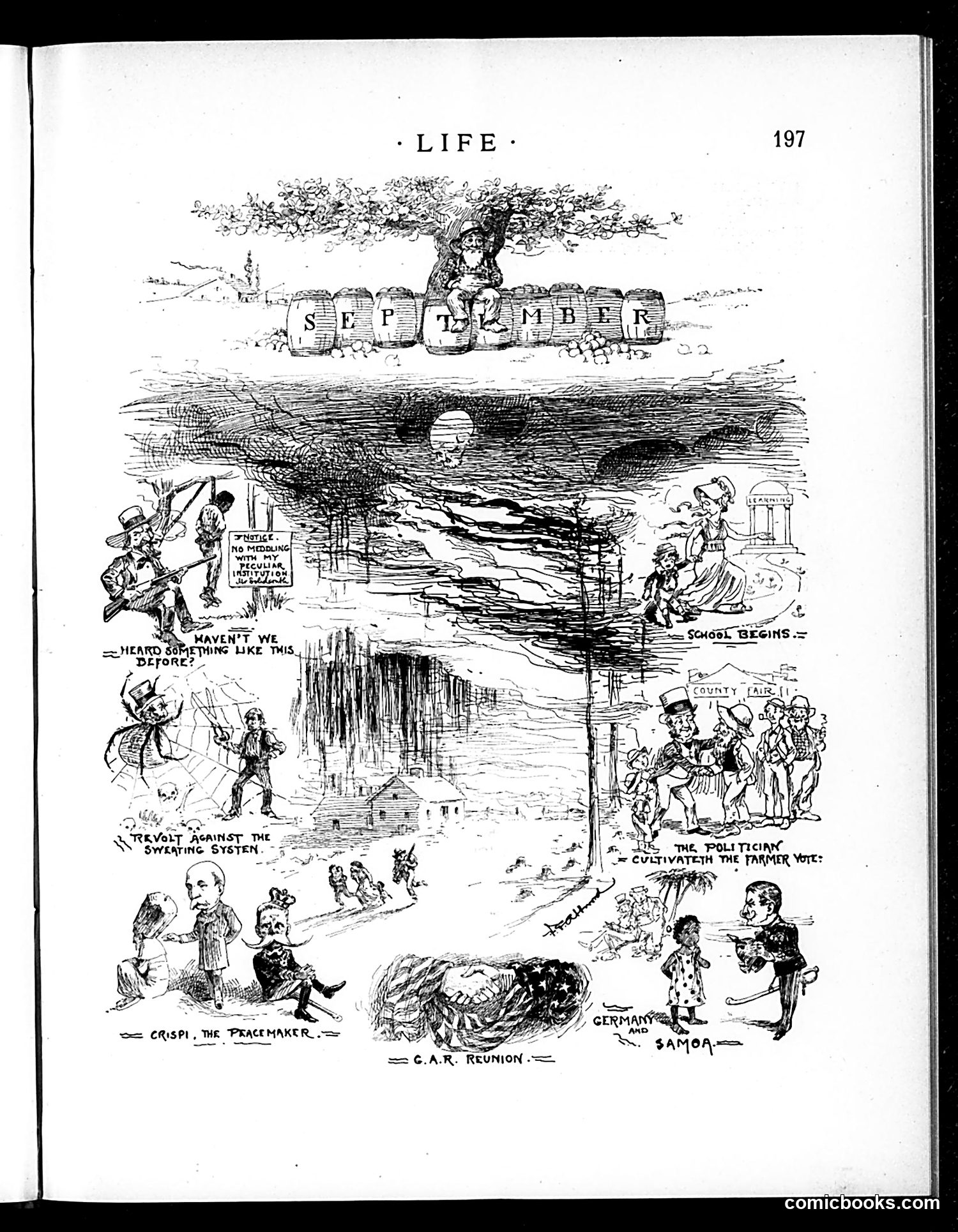
This page presents September vignettes mocking American life's seasonal rhythms. Central scenes include "Justice in Perilous Times" (legal system dysfunction), "School Begins" (returning students), and "The Politicking Cultivateth the Farmer's Vote" (politicians courting rural voters). Peripheral sketches mock "Crispi the Peacemaker" (likely Italian PM Francesco Crispi's foreign policy), a "G.A.R. Reunion" (Grand Army of the Republic veterans), and references to "Germany and Samoa" (colonial/imperial competition). The left panel shows a figure warning "Haven't we heard something like this before?" regarding "Revolt Against Sweatshop System"—suggesting cyclical labor reform debates. Overall, the cartoon satirizes recurring September phenomena: educational disruption, political opportunism, labor unrest, and international conflicts.
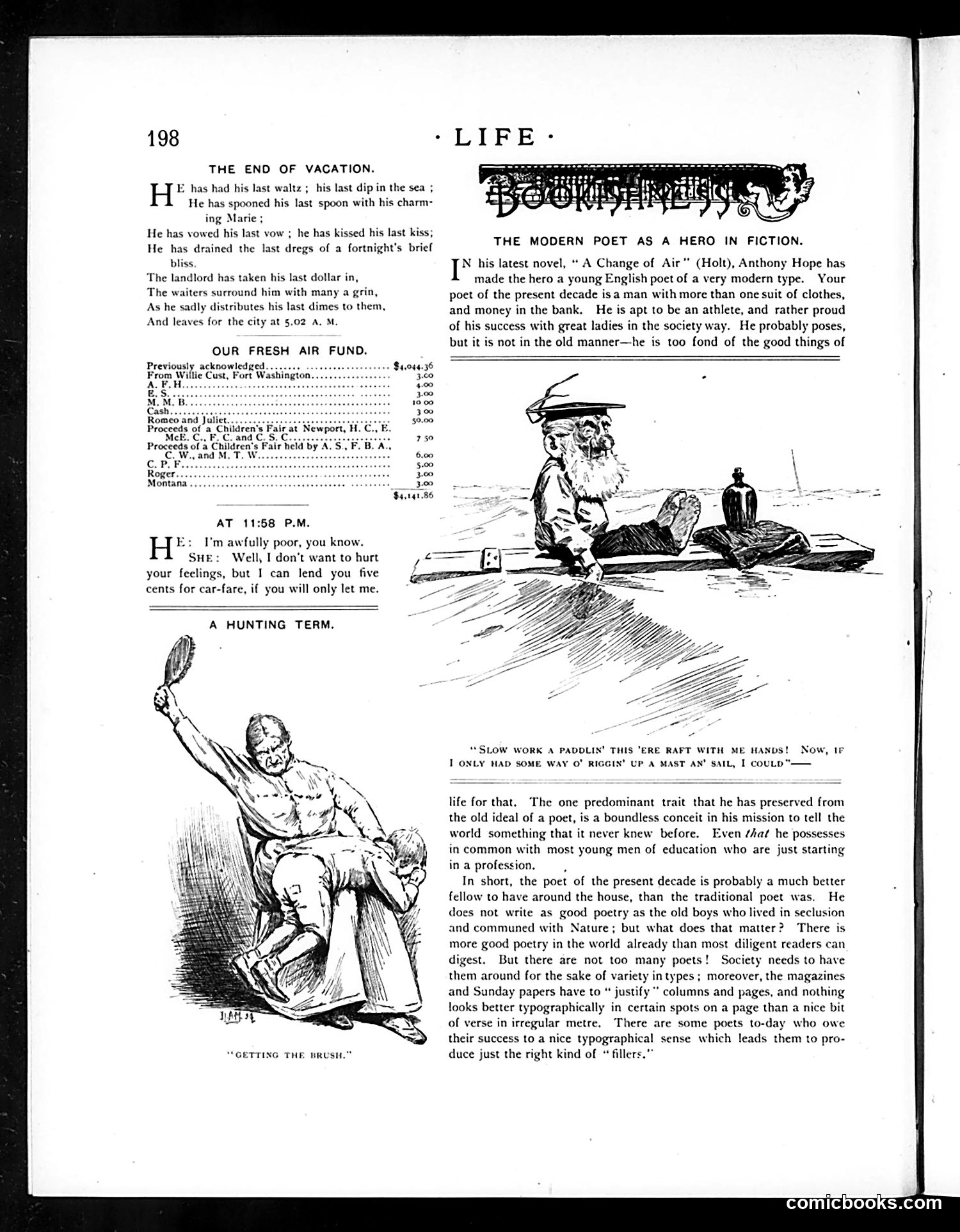
This page contains three distinct satirical items: 1. **"The End of Vacation"**: A poem mocking the melancholy conclusion of a seaside holiday, with humorous descriptions of last kisses and depleted finances. 2. **"Our Fresh Air Fund"**: A donation list showing contributions to a charitable cause, totaling $1,141.86. 3. **"At 11:58 P.M." and "A Hunting Term"**: Short humorous dialogues and sketches depicting working-class figures—one showing a poor man requesting five cents for cab fare, another showing someone "getting the brush" (being rejected). The main article discusses **"The Modern Poet as Hero in Fiction,"** analyzing Anthony Hope's novel "A Change of Air." It argues that contemporary poets are more practical and socially engaged than traditional romantic poets, better suited to modern society despite being less exclusively literary. The sketches use working-class characters for gentle social comedy typical of early 20th-century American humor magazines.
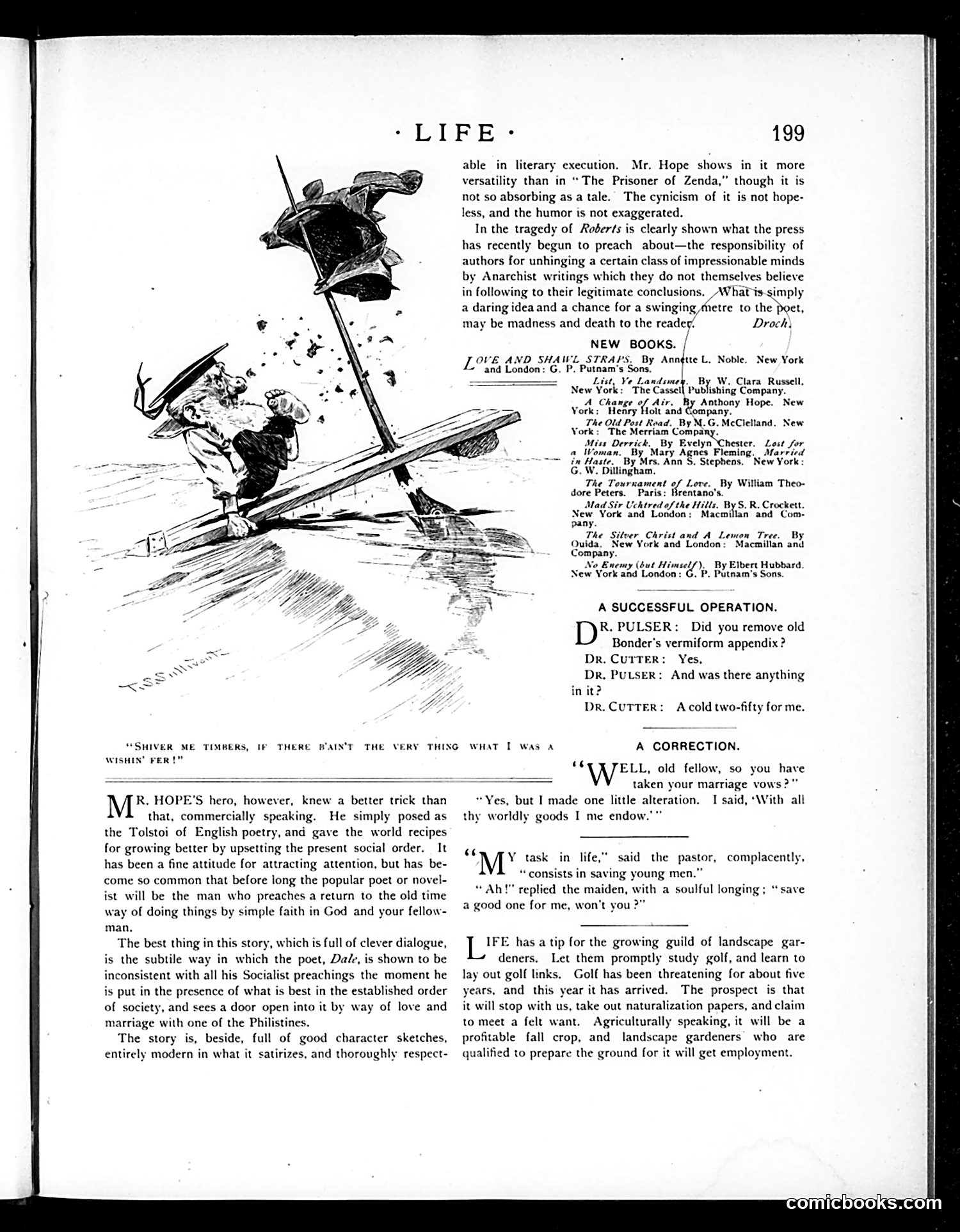
The illustration depicts anthropomorphic insects being violently thrown or blown apart, with the caption "SHIVER ME TIMBERS, IF THERE N'AIN'T THE VERY THING WHAT I WAS A WISHIN' FER!" This appears to be satirical commentary on pest control or extermination. The cartoon mocks the enthusiasm for killing insects, personifying them to highlight the casual violence of the sentiment. The crude dialect in the caption suggests the speaker is working-class. The page also contains literary reviews and social commentary pieces, including discussion of a work called *Roberts* and critique of "anarchist writers" promoting dangerous ideas. The overall content reflects early 20th-century concerns about social order and literary responsibility. Without a visible date, the exact historical context remains unclear.
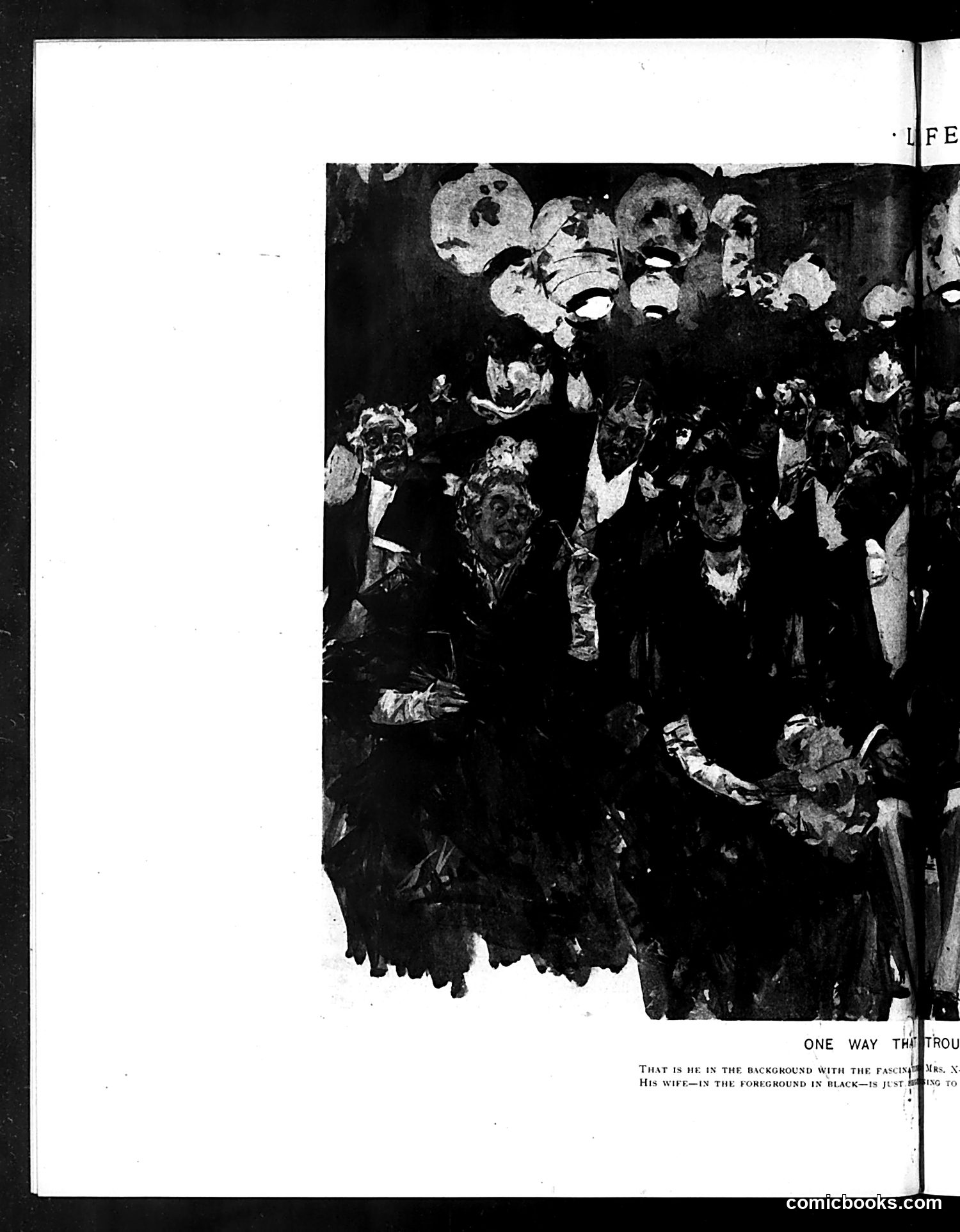
This appears to be a page from Life magazine featuring a political cartoon about fascism. The image shows a grotesque procession of figures wearing what appear to be fascist regalia and masks, depicted in dark, menacing tones. The caption references "the background with the fascists" and mentions "his wife—in the foreground in black," suggesting this satirizes fascist leadership and ideology. The cartoon likely critiques fascist movements, possibly Italian or European fascism of the interwar period. The grotesque artistic style and nightmarish quality are characteristic of anti-fascist satire from that era. The masks and formal dress parody fascist pageantry and dehumanization. Without a visible date, the specific historical moment remains unclear, though the content suggests 1920s-1930s political commentary.
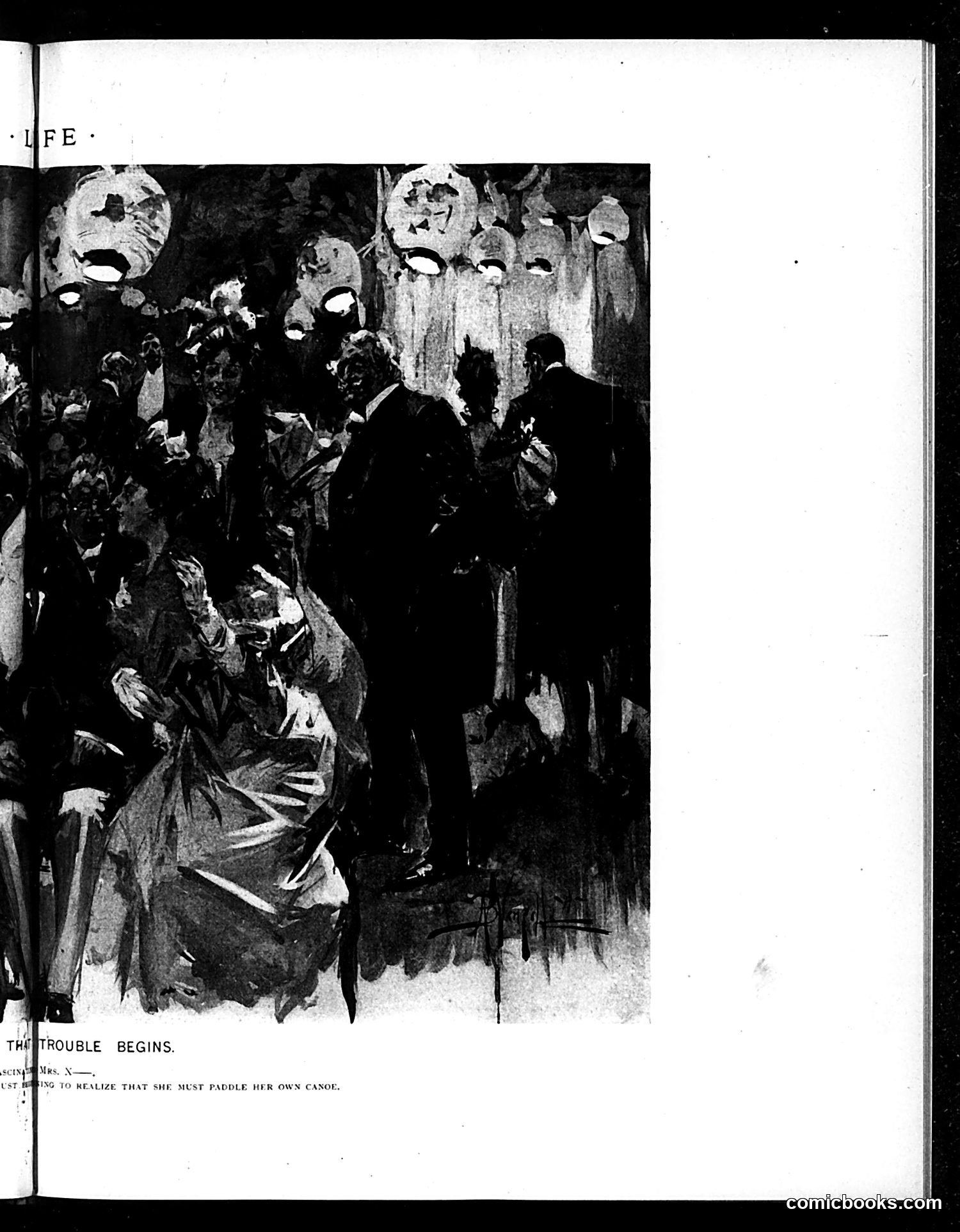
This satirical cartoon depicts a formal social gathering where a woman appears to be realizing an awkward situation. The caption indicates she "is beginning to realize that she must paddle her own canoe." The phrase "paddle her own canoe" was a period idiom meaning to be self-reliant or independent. The cartoon satirizes gender roles and changing social expectations—likely commenting on women's increasing independence or challenges to traditional domestic roles in early 20th-century America. The formal setting with well-dressed figures suggests this is about a woman of means confronting the expectation that she manage her own affairs rather than rely on male support. The "trouble" referenced appears to be the discomfort or complications arising from this realization of newfound or demanded self-sufficiency.
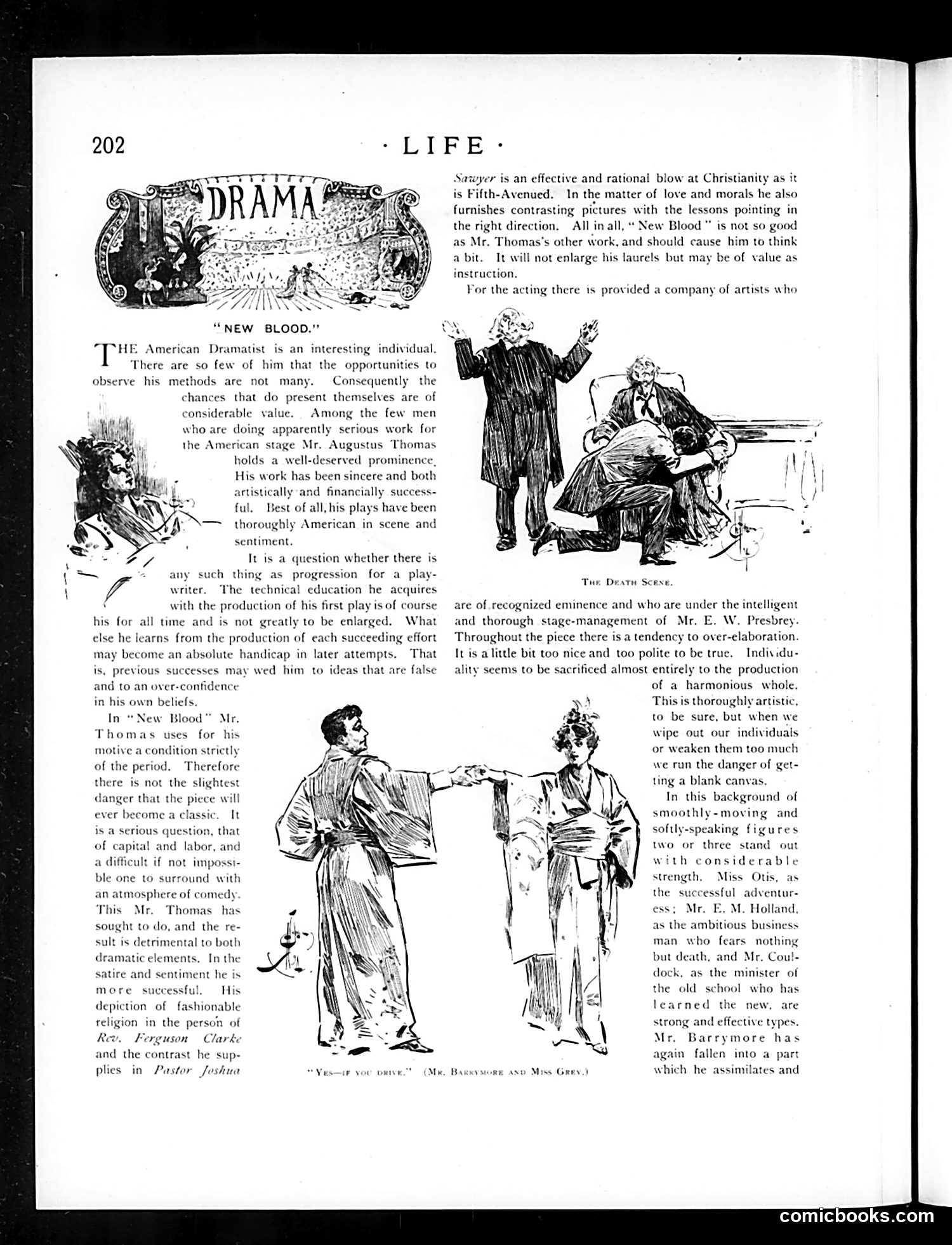
This page reviews Augustus Thomas's play *"New Blood,"* critiquing Thomas as one of few serious American dramatists. The text praises his work's sincerity and American themes while noting the challenge of achieving "progression" for playwrights. The review is mixed: Thomas successfully balances comedy and sentiment, though the piece risks being overly polite and sacrificing individuality for harmony. The accompanying sketches show actors in period costume performing various scenes—including "The Death Scene" and what appears to be a confrontation between characters (captioned "Ye—if you dare"). The critic acknowledges talented supporting actors but suggests the production prioritizes ensemble polish over bold artistic risk-taking—a common critique of well-managed theatrical productions of the era.
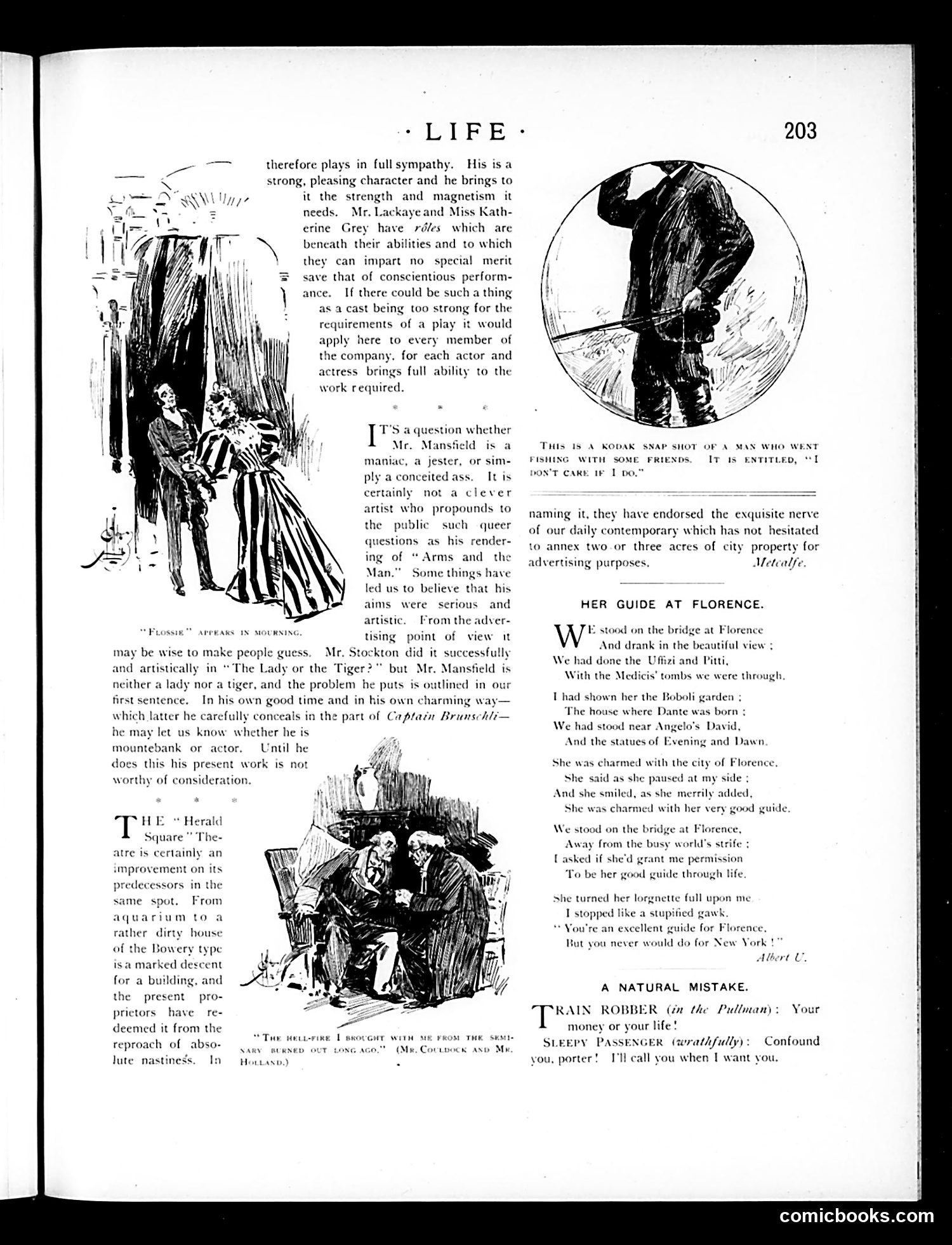
This page contains theatrical criticism and illustrations rather than political satire. The text discusses stage performances, specifically analyzing actors' abilities in various roles. It mentions Mr. Mansfield (likely the actor Richard Mansfield) and debates whether he's a "maniac, a jester, or simply a conceited ass." The illustrations show dramatic scenes: one depicts figures in period costume at a doorway (labeled "Flossi appears in mourning"), and another shows characters in what appears to be a comedic situation involving a hell-fire brought "from the series been out long ago." The page also includes poetry about Florence and a brief humorous exchange between a train robber and sleepy passenger. This appears to be entertainment criticism and light humor content, not political commentary.
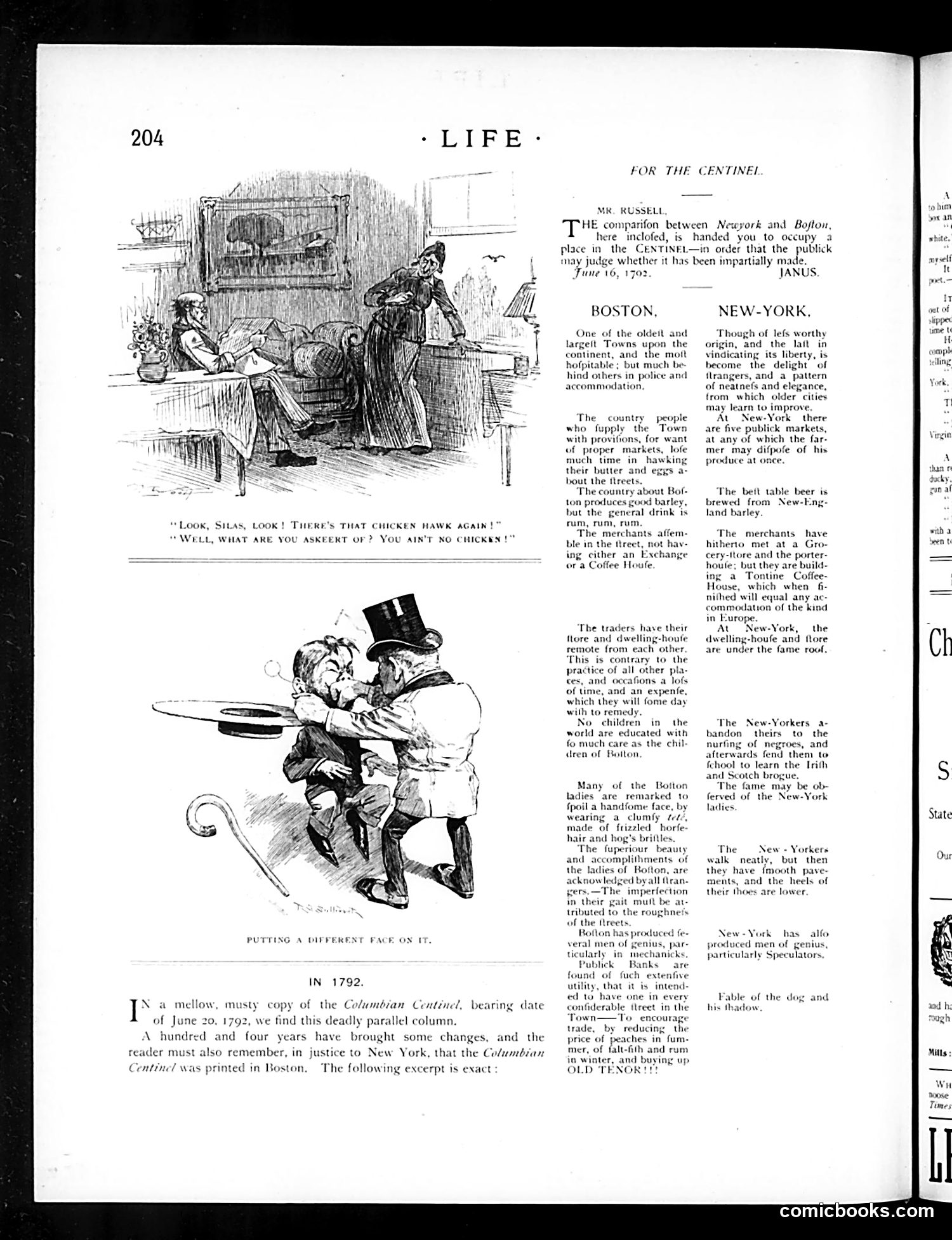
This 1792 *Life* magazine page presents a satirical comparison between Boston and New York, reprinted from the *Columbian Centinel* (a Boston paper). The text frames this as "putting a different face on it"—suggesting Boston's original account was biased. **The satire works through contrast:** Boston's self-congratulatory description (educated children, accomplished ladies, public banks) is juxtaposed with New York's pointed retorts. Boston appears provincial and self-satisfied; New York emerges as more progressive and practical. **Key jabs at Boston:** outdated dress fashions, reliance on rum, inefficient markets, traders' separated homes and shops. **New York's advantages:** five public markets, the new Tontine Coffee House (symbol of commercial modernity), neater streets, talented speculators. The accompanying cartoons show two figures in a confrontation—likely representing the two cities personified—mockingly questioning each other's courage and competence. The 1892 reprinting suggests enduring East Coast regional rivalries and reflects 19th-century amusement at how little had changed in a century.
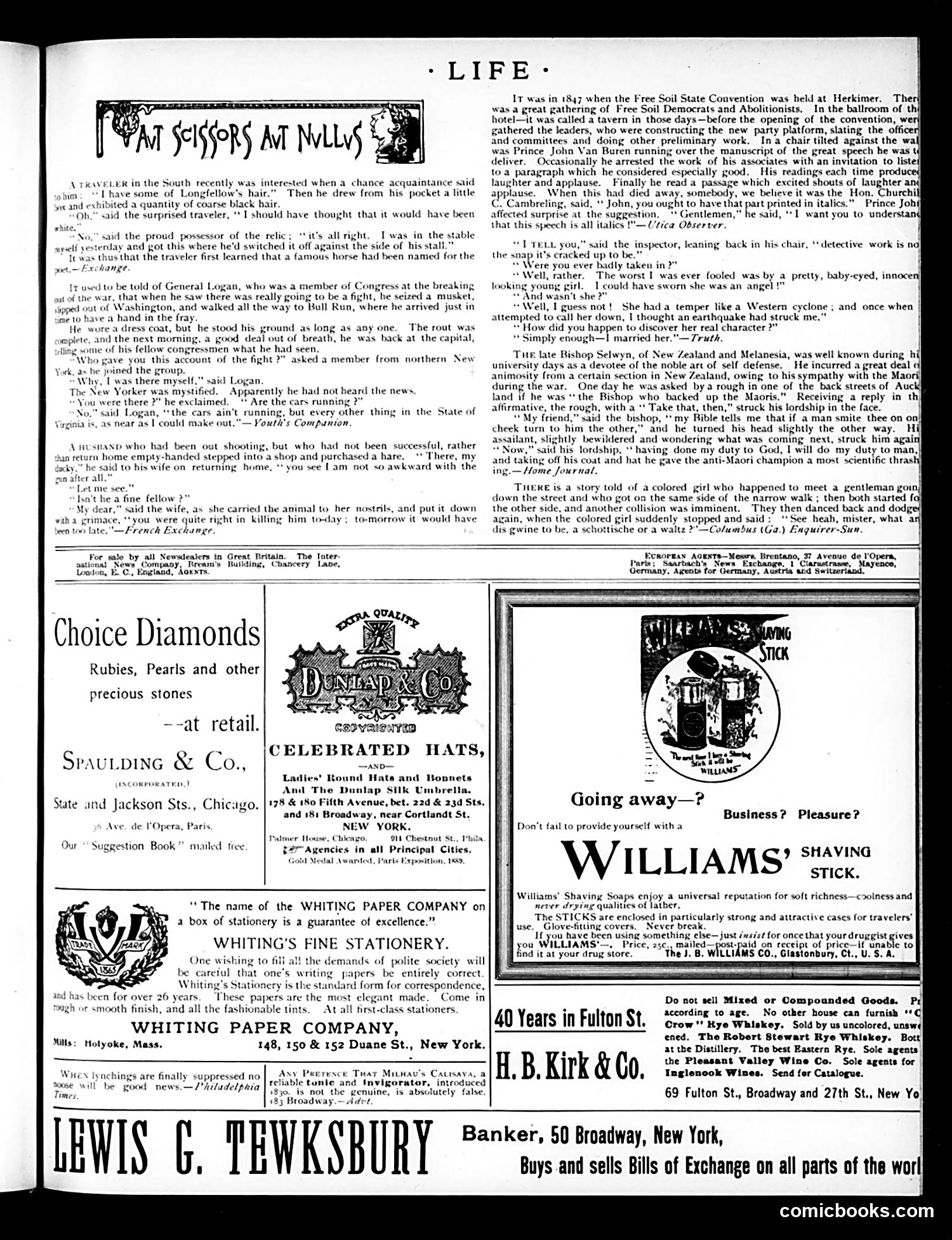
This page contains **primarily advertisements and humorous anecdotes**, with no identifiable political cartoon. The content consists of several short comedic stories typical of Life magazine's satirical humor: 1. **"Scissors at Nulls"** (top): A traveler in the South discovers a horse was named after Longfellow and owns the horse's hair as a "relic"—mocking both relic-collecting and perhaps pretentious claims about literary figures. 2. **Congressional anecdote**: A congressman ran all the way to Bull Run during the Civil War, then rushed back—satirizing either his eagerness or cowardice. 3. **Other brief jokes**: About a husband buying a hare to appear successful at hunting, and a detective fooled by an attractive woman who turned out to have a terrible temper. The **advertisements** (Spaulding diamonds, Dunlap hats, Williams shaving stick, etc.) dominate the lower half, typical of Life's revenue model. The humor relies on wordplay, irony, and mild social commentary rather than visual satire or caricature.
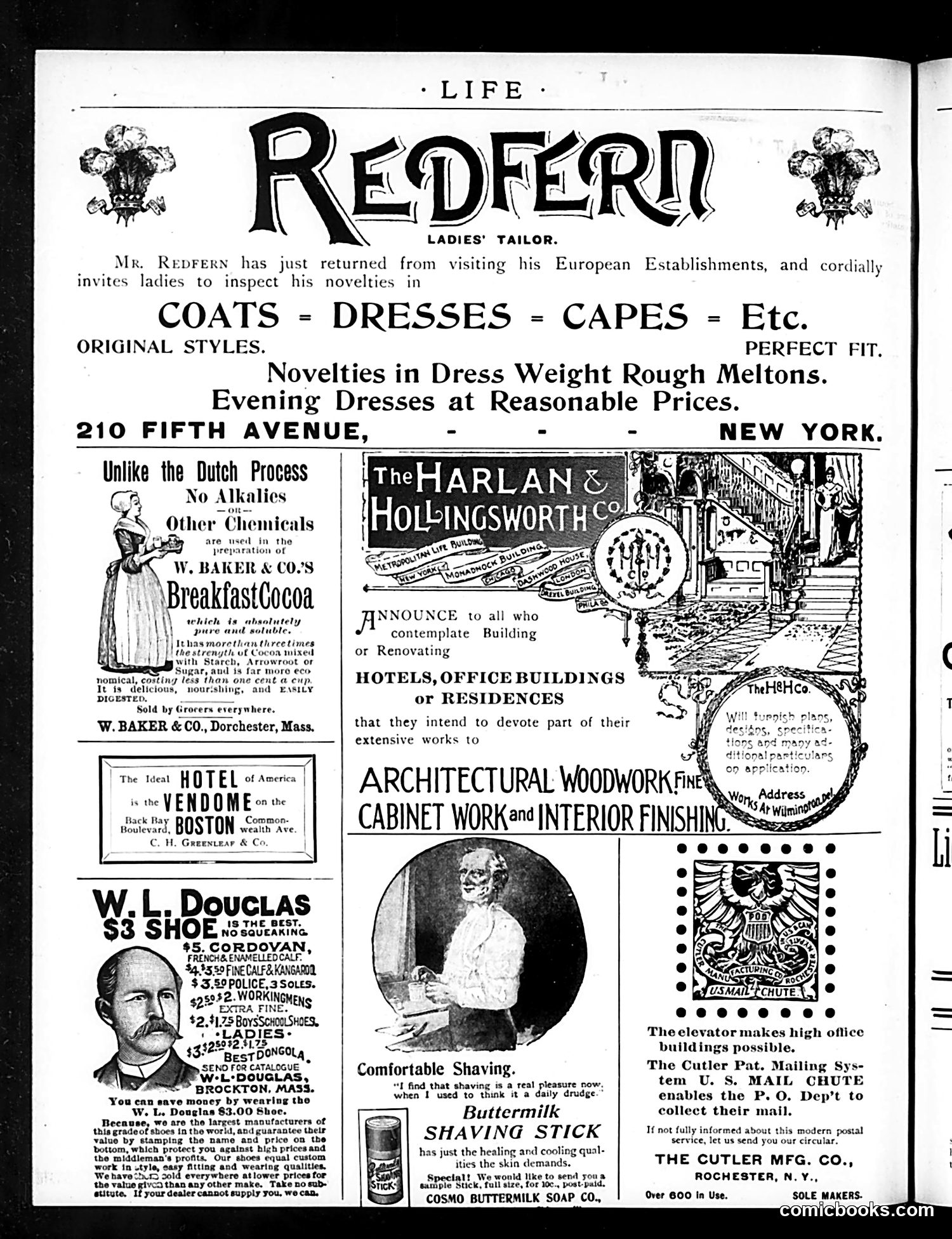
This page is primarily **advertising**, not satire or political commentary. It's a typical early 20th-century magazine advertisement spread featuring: **Main Ads:** - **Redfern** (top): A ladies' tailor advertising European fashions - **W.L. Douglas Shoes**: Emphasizing affordable quality and value ("$3 shoe") - **W. Baker & Co. Cocoa**: Highlighting purity (no alkalies or chemicals) - **Harlan & Hollingsworth Co.**: Architectural woodwork services - **Buttermilk Shaving Stick**: A personal grooming product - **Cutler Mailing System**: An office innovation for mail collection **The only illustration with a figure** shows a man's portrait next to the Douglas shoe ad—likely W.L. Douglas himself, used as a trademark/trust-builder. **Modern context:** These ads emphasize manufacturing efficiency, product purity, affordability, and emerging technology (elevators, mail systems)—reflecting late 19th/early 20th-century consumer concerns about industrialization and quality assurance.
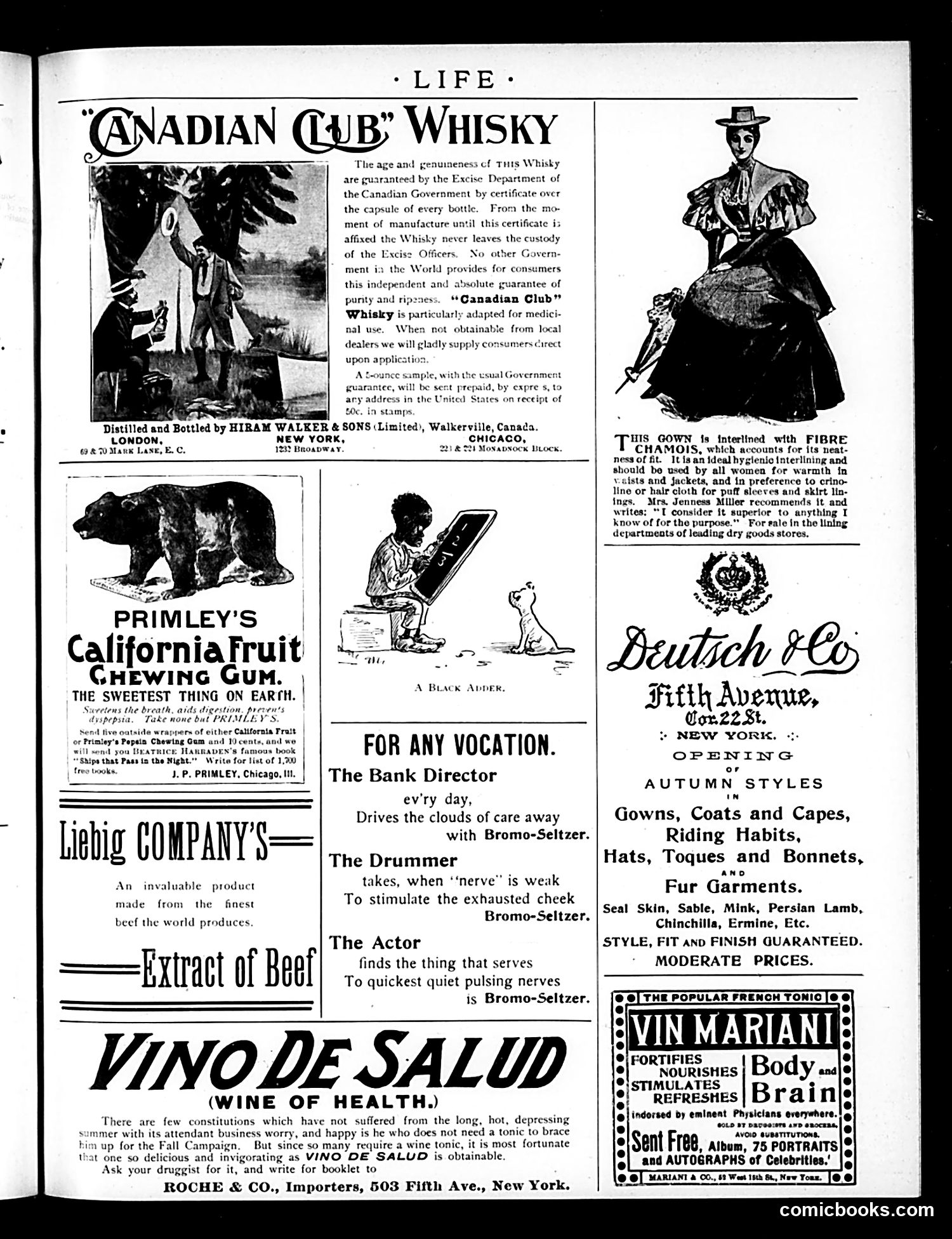
This page is **primarily advertising** with one small cartoon. The advertisements promote various products targeting early 1900s consumers: Canadian Club Whisky (with government purity guarantees), Primley's chewing gum, Liebig's beef extract, Bromo-Seltzer (a digestive remedy), Vino de Salud (a wine tonic), and high-end fashion at Deutsch & Co. The one cartoon, titled "A Black Adder," shows a small figure encountering a snake—likely a visual pun or moral lesson, though its specific satirical point is unclear from context alone. The ads reveal period anxieties: digestive problems, "nerve" weakness, summer depression, and the need for tonics. Notably, products like Bromo-Seltzer are pitched to specific professions (bank directors, drummers, actors), suggesting stress was occupationally diagnosed. The emphasis on government certification for whisky reflects contemporary food safety concerns following scandals of the era.
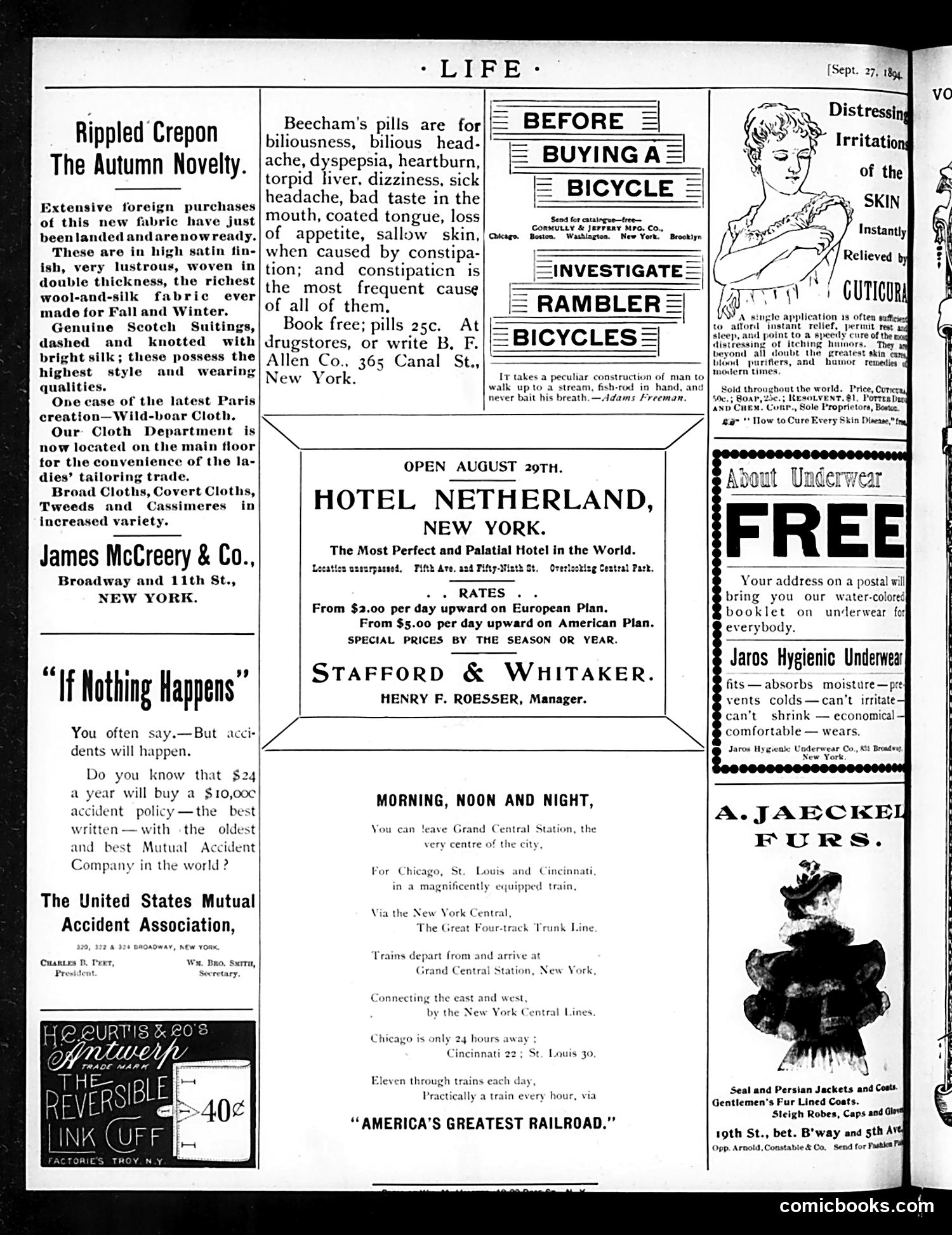
This is primarily an **advertising page** from Life's early period, containing no political cartoons or satirical content requiring historical interpretation. The page features: - **Fashion advertisements** (James McCreery & Co.) promoting fall fabrics like "Rippled Crepon" and Scotch suitings - **Patent medicine ads** (Beecham's pills for digestive complaints—typical 19th-century remedies) - **Bicycle advertisements** encouraging readers to "investigate" before purchasing - **Hotel and railroad promotions** (Hotel Netherland opening; New York Central Railroad) - **Underwear and fur coat advertisements** - **Accident insurance pitch** ("If Nothing Happens") promoting a $24/year policy for $10,000 coverage—illustrating early American casualty insurance marketing The only quasi-humorous element is a small fishing quote: "It takes a peculiar construction of man to walk up to a stream, fish-rod in hand, and never bait his breath." This reflects Life's original function as a **society magazine combining fashion, consumer goods, and light humor** before its later evolution into primarily satirical content.