
Life, 1894-09-27 · page 4 of 16
Life — September 27, 1894 — page 4: what you’re looking at
What you’re looking at
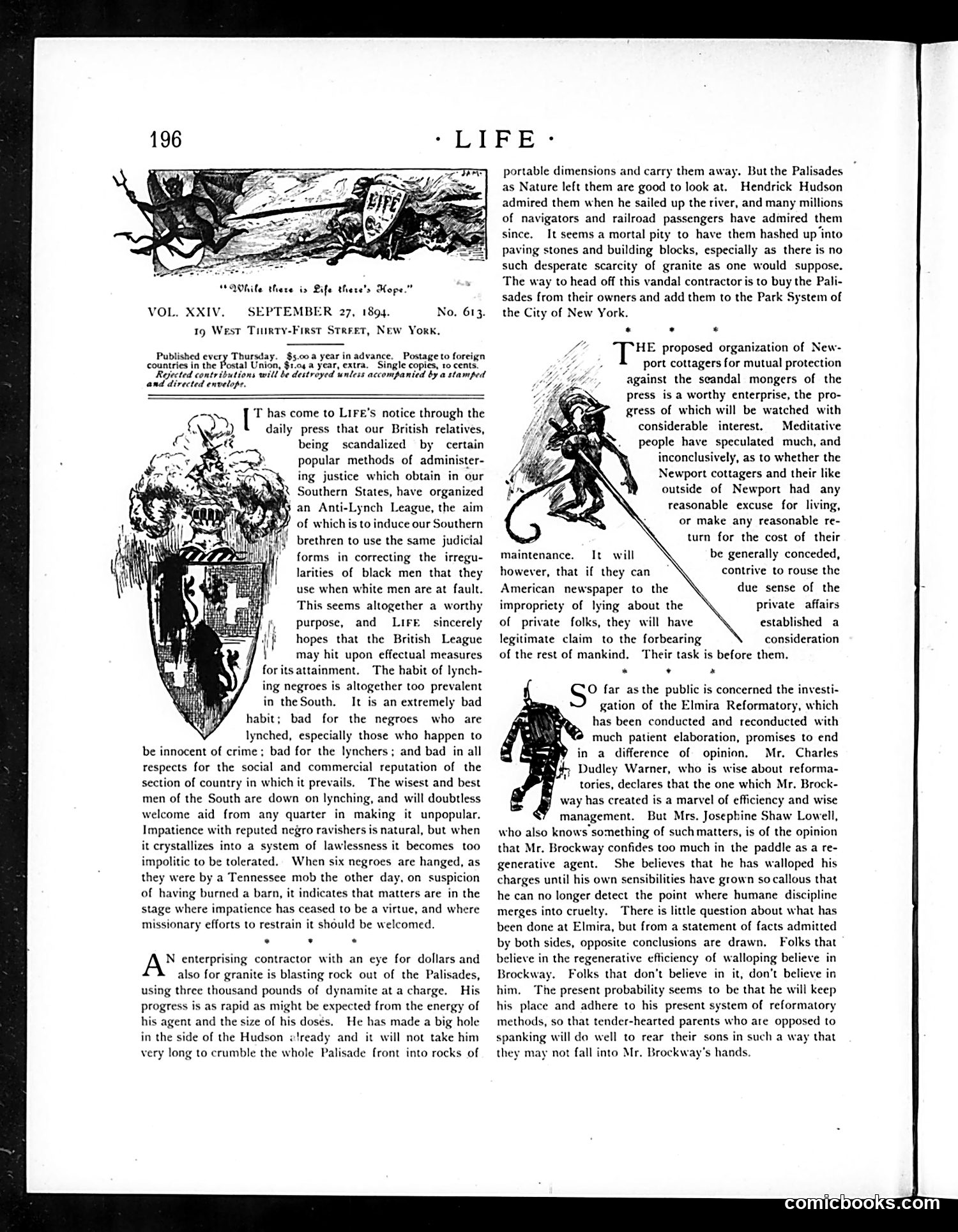
This page contains two distinct editorial pieces with accompanying illustrations. **Upper section**: Criticizes an "Anti-Lynch League" in the Southern United States, advocating for legal reforms to address mob lynching of Black citizens. The illustration shows a grotesque caricature depicting lynching victims. Life argues that while lying about private citizens is unethical, exposing such violence is justified. **Lower section**: Discusses the Elmira Reformatory in New York, debating the management methods of superintendent Mr. Brockway. The illustration shows a figure in what appears to be a reformatory setting. Life questions whether Brockway's disciplinary approach has become excessively harsh, noting criticism from reformer Josephine Shaw Lowell about potential cruelty masquerading as rehabilitation. Both pieces address institutional violence and reform effectiveness.
📄 Transcribed text from this page (OCR, searchable)
Machine-transcribed from the original scan — historical spelling and the odd misread are preserved.
* LIFE: “While there is Life there's Hope.” XXIV. SEPTEMBER 27, 1894. No. 613. 1g West Tirty-First Street, New York. VOL. Published every Thursday. $5.00 a year in advance. Postage to foreign countries in the Postal Union, $1.04 a year, extra. Single copies, to cents. Rejected contributions will be destroyed unless accompanied by a stamped and directed envelopt. T has come to LiFe’s notice through the daily press that our British relatives, being scandalized by certain popular methods of administer- ing justice which obtain in our Southern States, have organized an Anti-Lynch League, the aim of which is to induce our Southern ' brethren to use the same judicial forms in correcting the irregu- larities of black men that they use when white men are at fault. This seems altogether a worthy purpose, and Lire sincerely hopes that the British League may hit upon effectual measures for its attainment. The habit of lynch- ing negroes is altogether too prevalent in theSouth, It is an extremely bad habit; bad for the negroes lynched, especially those who happen to be innocent of crime; bad for the lynchers; and bad in all respects for the social and commercial reputation of the section of country in which it prevails. The wisest and best men of the South are down on lynching, and will doubtless welcome aid from any quarter in making it unpopular. Impatience with reputed negro ravishers is natural, but when it crystallizes into a system of lawlessness it becomes too impolitic to be tolerated. When six negroes are hanged, as they were by a Tennessee mob the other day, on suspicion of having burned a barn, it indicates that matters are in the stage where impatience has ceased to be a virtue, and where missionary efforts to restrain it should be welcomed. who are N enterprising contractor with an eye for dollars and also for granite is blasting rock out of the Palisades, using three thousand pounds of dynamite at a charge. His progress is as rapid as might be expected from the energy of his agent and the size of his dosés, He has made a big hole in the side of the Hudson v!ready and it will not take him very long to crumble the whole Palisade front into rocks of portable dimensions and carry them away, But the Palisades as Nature left them are good to look at. Hendrick Hudson admired them when he sailed up the river, and many millions of navigators and railroad passengers have admired them since. It seems a mortal pity to have them hashed up into paving stones and building blocks, especially as there is no such desperate scarcity of granite as one would suppose. The way to head off this vandal contractor is to buy the Pali- sades from their owners and add them to the Park System of the City of New York. . . « f7 TH proposed organization of New- g , port cottagers for mutual protection against the seandal mongers of the press is a worthy enterprise, the pro- gress of which will be watched with considerable interest. Meditative people have speculated much, and inconclusively, as to whether the Newport cottagers and their like outside of Newport had any reasonable excuse for living, or make any reasonable re- turn for the cost of their be generally conceded, contrive to rouse the due sense of the private affairs maintenance. It will however, that if they can American newspaper to the impropriety of lying about the of private folks, they will have established a legitimate claim to the forbearing consideration of the rest of mankind, Their task is before them. . * * O far asthe public is concerned the investi- gation of the Elmira Reformatory, which has been conducted and reconducted with much patient elaboration, promises to end in a difference of opinion, Mr, Charles Dudley Warner, who is wise about reforma- tories, declares that the one which Mr. Brock- way has created is a marvel of efficiency and wise management. But Mrs. Josephine Shaw Lowell, who also knows something of such matters, is of the opinion that Mr. Brockway confides too much in the paddle as a re- generative agent. She believes that he has walloped his charges until his own sensibilities have grown so callous that he can no longer detect the point where humane discipline merges into cruelty. There is little question about what has been done at Elmira, but from a statement of facts admitted by both sides, opposite conclusions are drawn. Folks that believe in the regenerative efficiency of walloping believe in Brockway. Folks that don’t believe in it, don’t believe in him. The present probability seems to be that he will keep his place and adhere to his present system of reformatory methods, so that tender-hearted parents who ate opposed to spanking will do well to rear their sons in such a way that they may not fall into Mr. Brockway’s hands.