
Life, 1894-09-27 · page 10 of 16
Life — September 27, 1894 — page 10: what you’re looking at
What you’re looking at
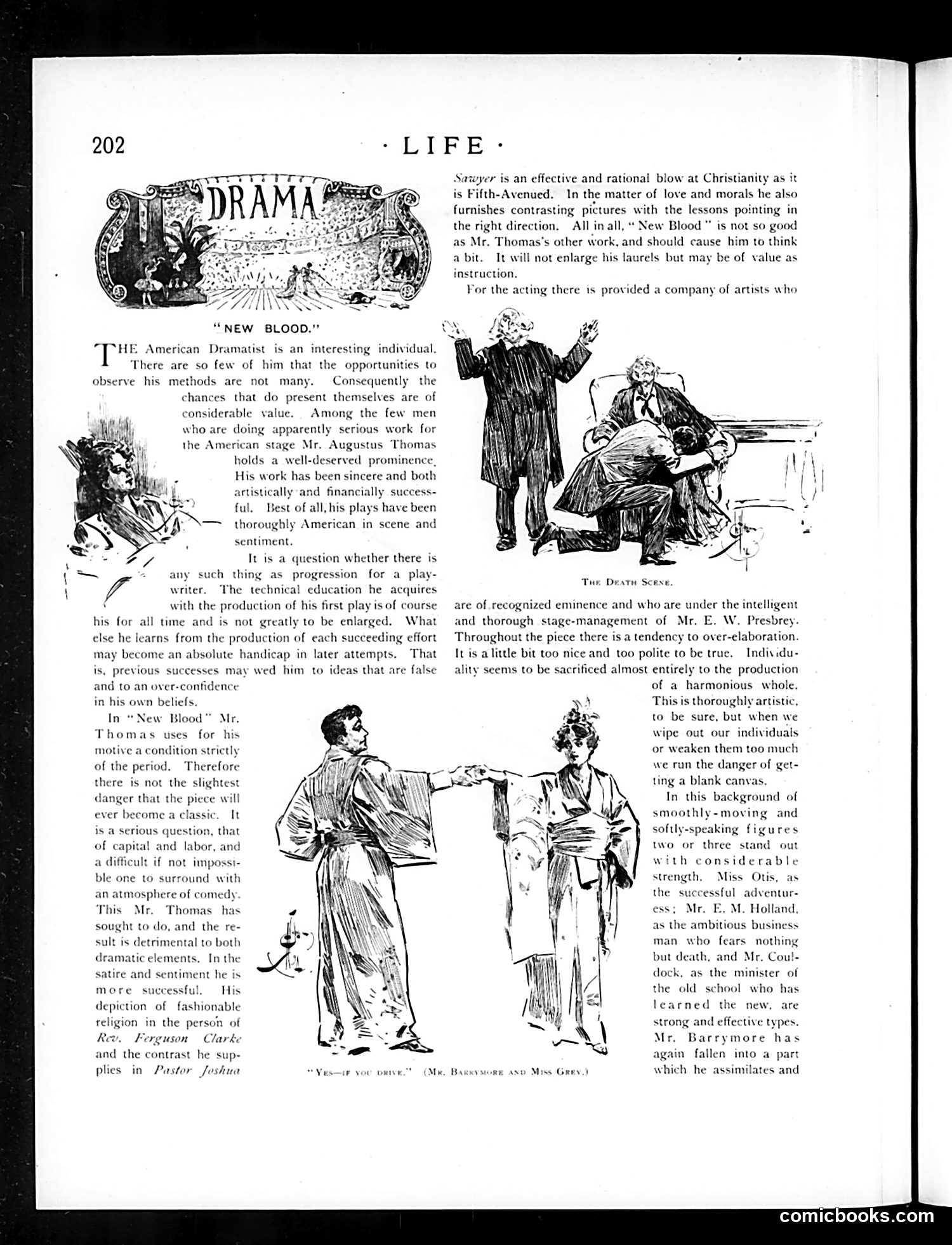
This page reviews Augustus Thomas's play *"New Blood,"* critiquing Thomas as one of few serious American dramatists. The text praises his work's sincerity and American themes while noting the challenge of achieving "progression" for playwrights. The review is mixed: Thomas successfully balances comedy and sentiment, though the piece risks being overly polite and sacrificing individuality for harmony. The accompanying sketches show actors in period costume performing various scenes—including "The Death Scene" and what appears to be a confrontation between characters (captioned "Ye—if you dare"). The critic acknowledges talented supporting actors but suggests the production prioritizes ensemble polish over bold artistic risk-taking—a common critique of well-managed theatrical productions of the era.
📄 Transcribed text from this page (OCR, searchable)
Machine-transcribed from the original scan — historical spelling and the odd misread are preserved.
- LIFE: “NEW BLOOD.” “TCHE American Dramatist is an interesting individual. There observe his methods are not are so few of him that the opportunities to many. Consequently the chances that do present themselves are of considerable value. Among the few men who are doing apparently serious work for the American stage Mr. Augustus Thomas holds a well-deserved prominence, e and both artistically and financially success- His work has been since ful. Best of all, his plays have been thoroughly American in scene and sentiment. a question whether there is any such thing as for a play- The technical education he acquires with the production of his first play is of course What else he learns from the production of each succeeding effort may become an absolute handicap in later attempts. That is, previous successes may wed him to ideas that are false It is progression writer. his for all time and is not greatly to be enlarged. and to an over-contidence in his own beliefs. In “New Blood” Mr. Thomas uses for his motive a condition strictly Therefore there is not the slightest of the period. danger that the piece will ever become a classic. It is a serious question, that of capital and labor, and a difficult if not impossi- ble one to surround with an atmosphere of comedy This Mr. sought to do, and the re- s' Thomas has sult is detrimental to both dramatic elements. In the satire and sentiment he is His fashionable more successful, depiction of religion in the person of Rev, Fer, Clarke and the contrast he sup- plies in Pastor Joshua SON iF you peive.” Sawyer is an effective and rational blow at Christianity as it is Fifth-Avenued. In the matter of love and morals he also furnishes contrasting pictures with the lessons pointing in All in all, * New Blood ™ is not so good as Mr. Thomas's other work, and should cause him to think abit. It will not enlarge his laurels but may be of value as instruction, the right direction. For the acting there is provided a company of artists who Tur Death Scexe. are of recognized eminence and who are under the intelligent and thorough stage-management of Mr. E. W. Presbrey. Throughout the piece there is a tendency to over-elaboration It is alittle bit too nice and too polite to be true. Individu- ality seems to be sacrificed almost entirely to the production harmonious whole. This is thoroughly artistic, of a to be sure, but when we wipe out our individuals or weaken them too much we run the danger of get- ting a blank canvas. In this background of smoothly-moving and softly-speaking figures two or three with considerable strength, Miss Otis, as stand out the successful adventur- 2. M. Holland, as the ambitious business man ess; Mr. who fears nothing but death, and Mr. Coul- dock, as the minister of the old school who has learned the new, are strong and effective types. Mr. again fallen into a part Barrymore has which he assimilates and comicbooks.com