
A complete issue · 14 pages · 1894
Life — July 26, 1894
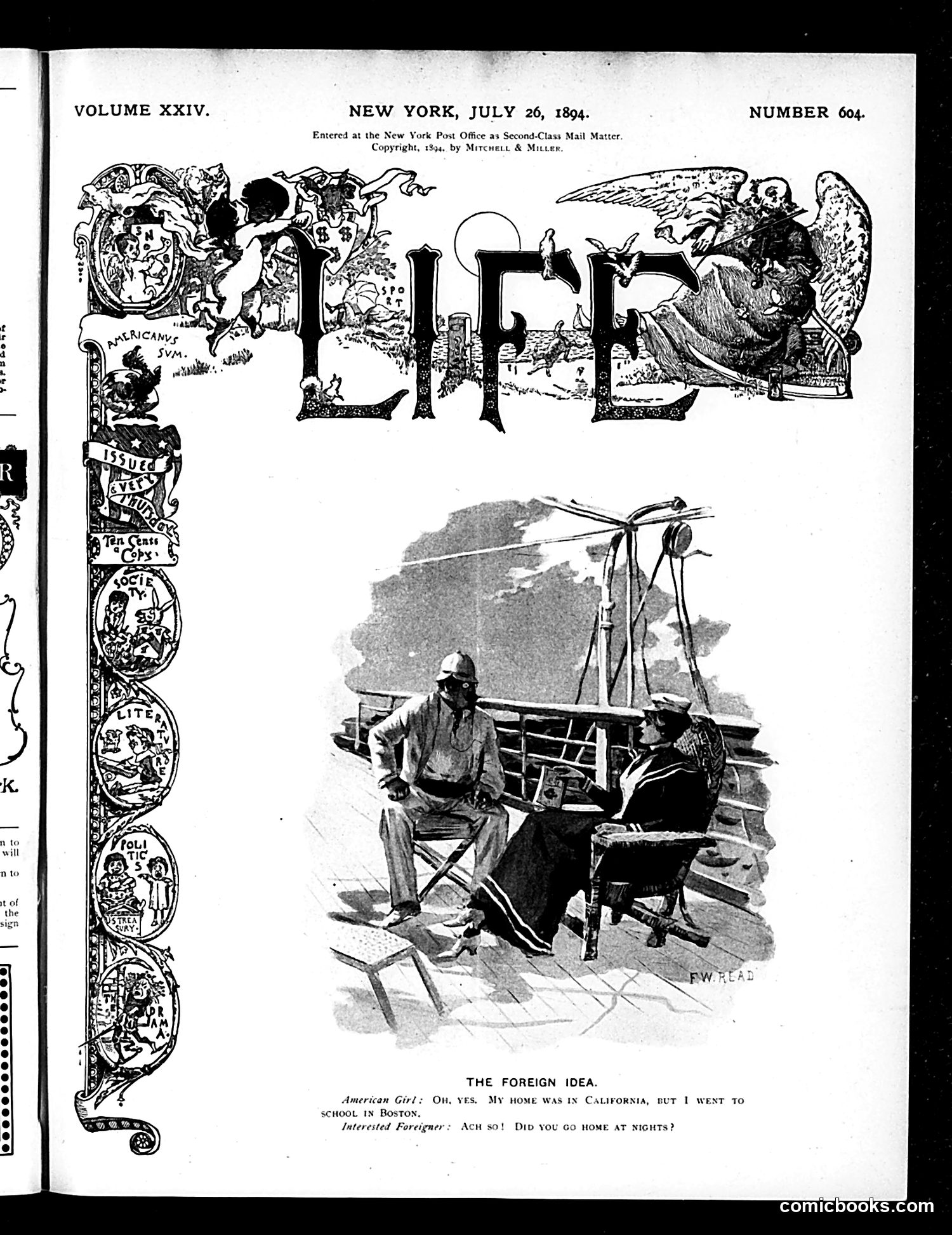
This cartoon satirizes cultural differences between Americans and Europeans through a shipboard conversation. An American girl explains she attended school in Boston despite her California home, prompting a curious foreign gentleman to ask if she "went home at nights?" The joke hinges on a transatlantic misunderstanding about boarding schools. The American assumes "home" means her actual residence; the foreigner assumes "home" means her home country (likely England or Europe, where boarding schools were standard). The cartoon mocks both American parochialism (not understanding European educational customs) and foreign assumptions about American behavior, playing on 1890s stereotypes about cultural sophistication and the differences between Old World and New World practices.
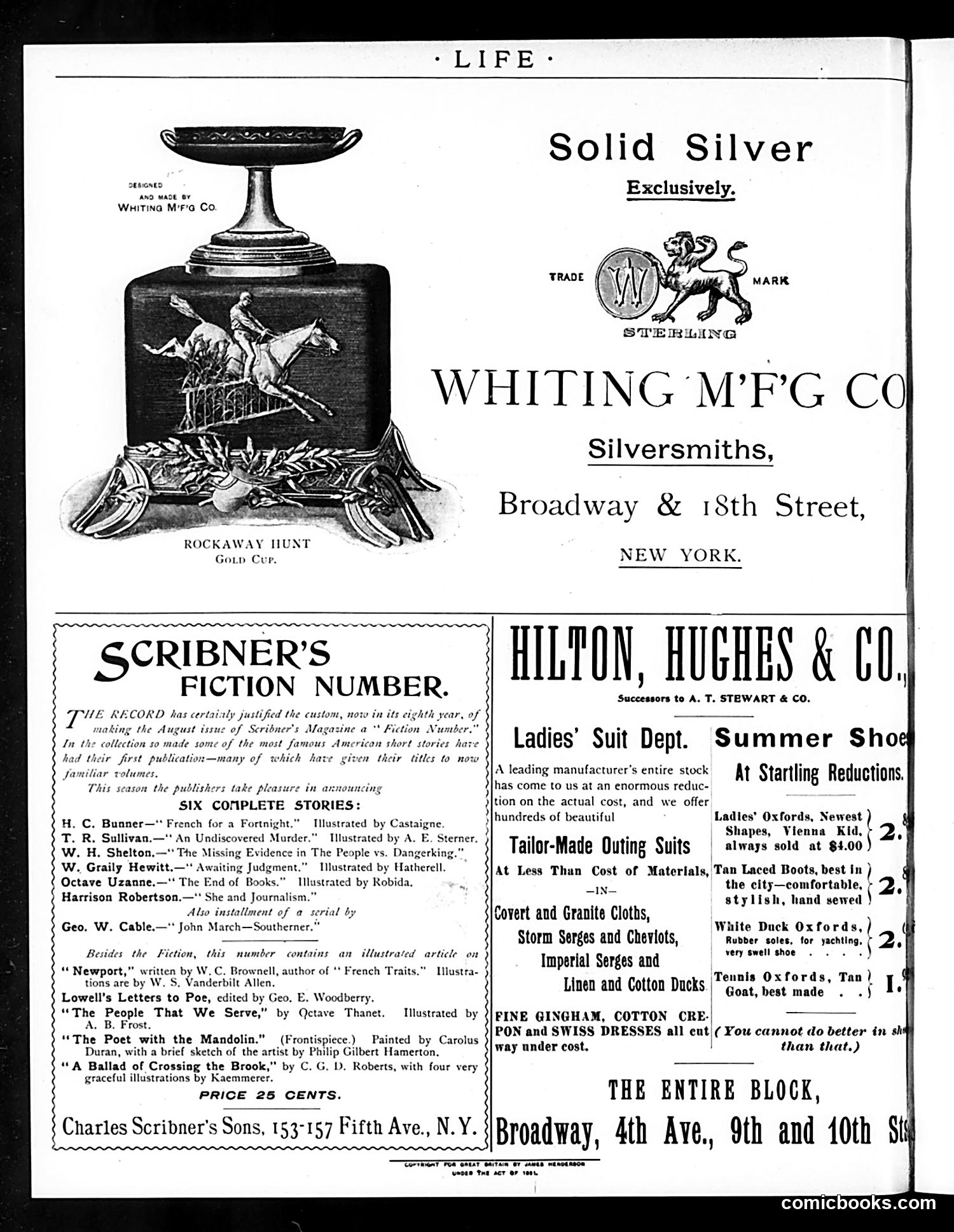
This page is primarily **advertising, not political satire**. The main content features: 1. **Whiting Mfg Co advertisement** (top right): Promotes solid silver tableware with a sterling silver trademark, located at Broadway & 18th Street, New York. 2. **Rockaway Hunt Gold Cup** (left): An ornamental trophy cup depicting equestrian hunters, illustrating the company's craftsmanship. 3. **Scribner's Fiction Number** (bottom left): Announces six complete stories in an August magazine issue, priced 25 cents, published by Charles Scribner's Sons. 4. **Hilton, Hughes & Co advertisement** (right): Promotes ladies' clothing and shoes at reduced prices across their Broadway location. The page reflects late 19th/early 20th-century consumer culture, showcasing luxury goods and popular literature marketed to affluent readers.
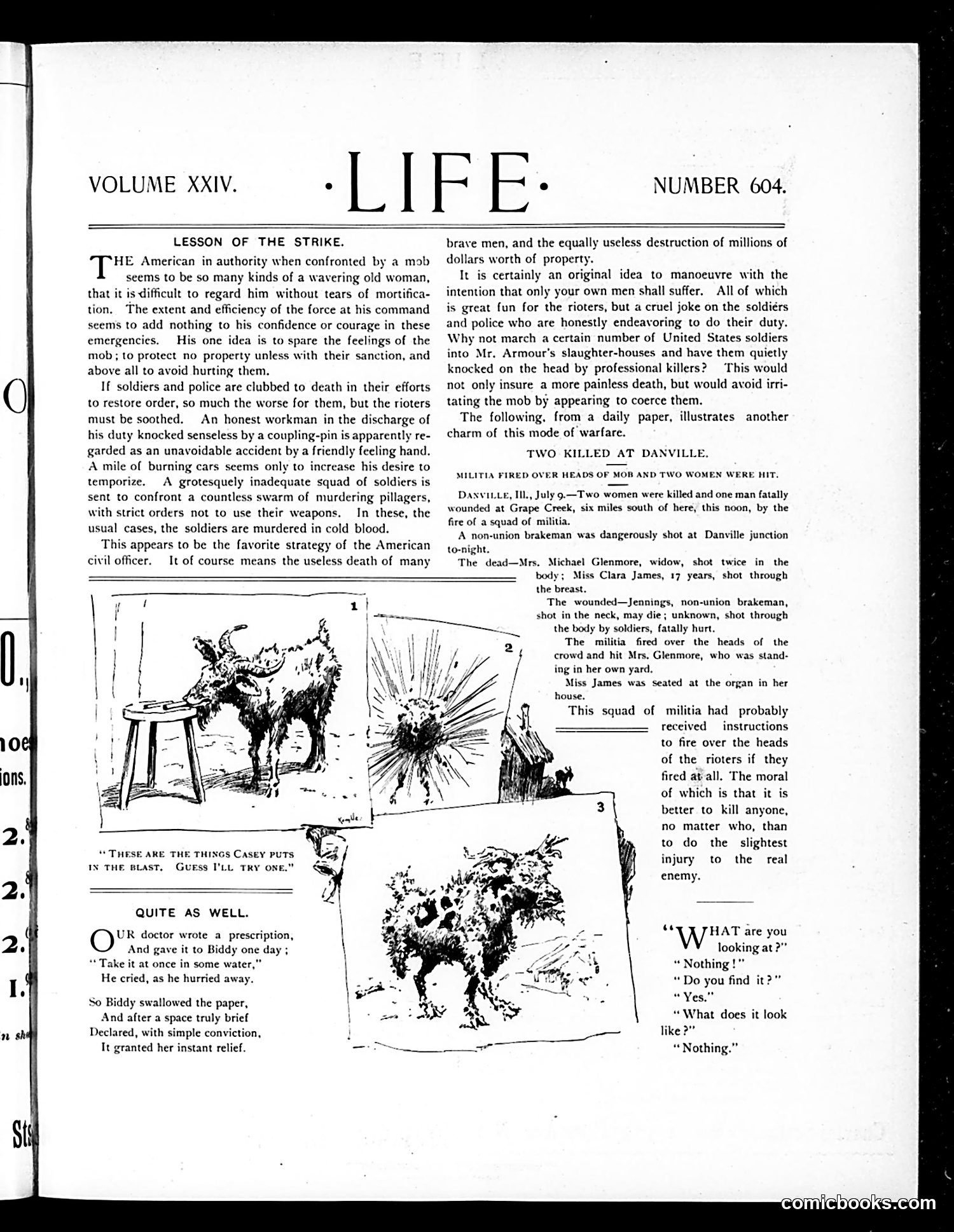
This page critiques American authorities' handling of civil unrest, likely during labor strikes or riots of the early 1900s. The main article "Lesson of the Strike" mocks officials who send inadequately trained soldiers to confront mobs, resulting in civilian deaths. It sarcastically notes this strategy ensures "only your own men shall suffer." "Two Killed at Danville" reports a specific incident where militia fired on rioters, killing two women—Mrs. Michael Glenmore and Miss Clara James—and wounding a union brakeman. The three cartoons (numbered 1-3) appear to show someone named Casey demonstrating explosives or violent devices with the caption "These are the things Casey puts in the blast. Guess I'll try one"—likely satirizing dangerous tactics or anarchist associations with labor unrest. The page criticizes both rioters and authorities for needless violence.
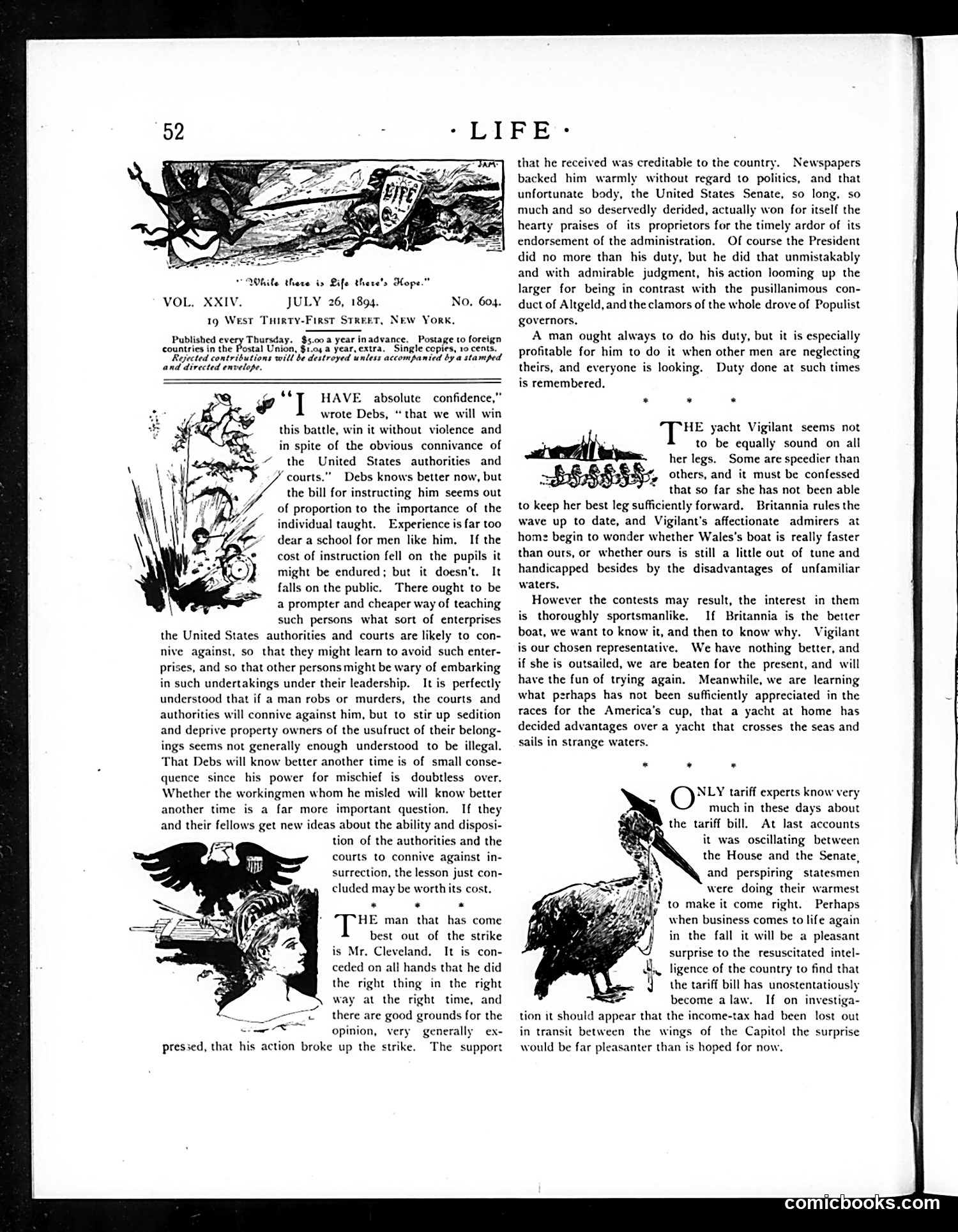
The page contains three political cartoons satirizing American governance and labor disputes during the 1894 Pullman Strike era. **Left cartoon**: Depicts a figure (likely representing judicial/government authority) entangled with a serpent, criticizing courts' handling of labor disputes and insurrection law. **Center cartoon**: Shows an eagle with a shield, praising President Cleveland's decision to end the strike, suggesting his action "broke up the strike" and was "the right thing in the right way." **Right cartoon**: Illustrates a bird (possibly representing the Vigilant yacht) discussing America's Cup racing, contrasting British maritime superiority with domestic yacht competitions. The text advocates for judicial reform and praises Cleveland's strike intervention while celebrating American sporting competition.
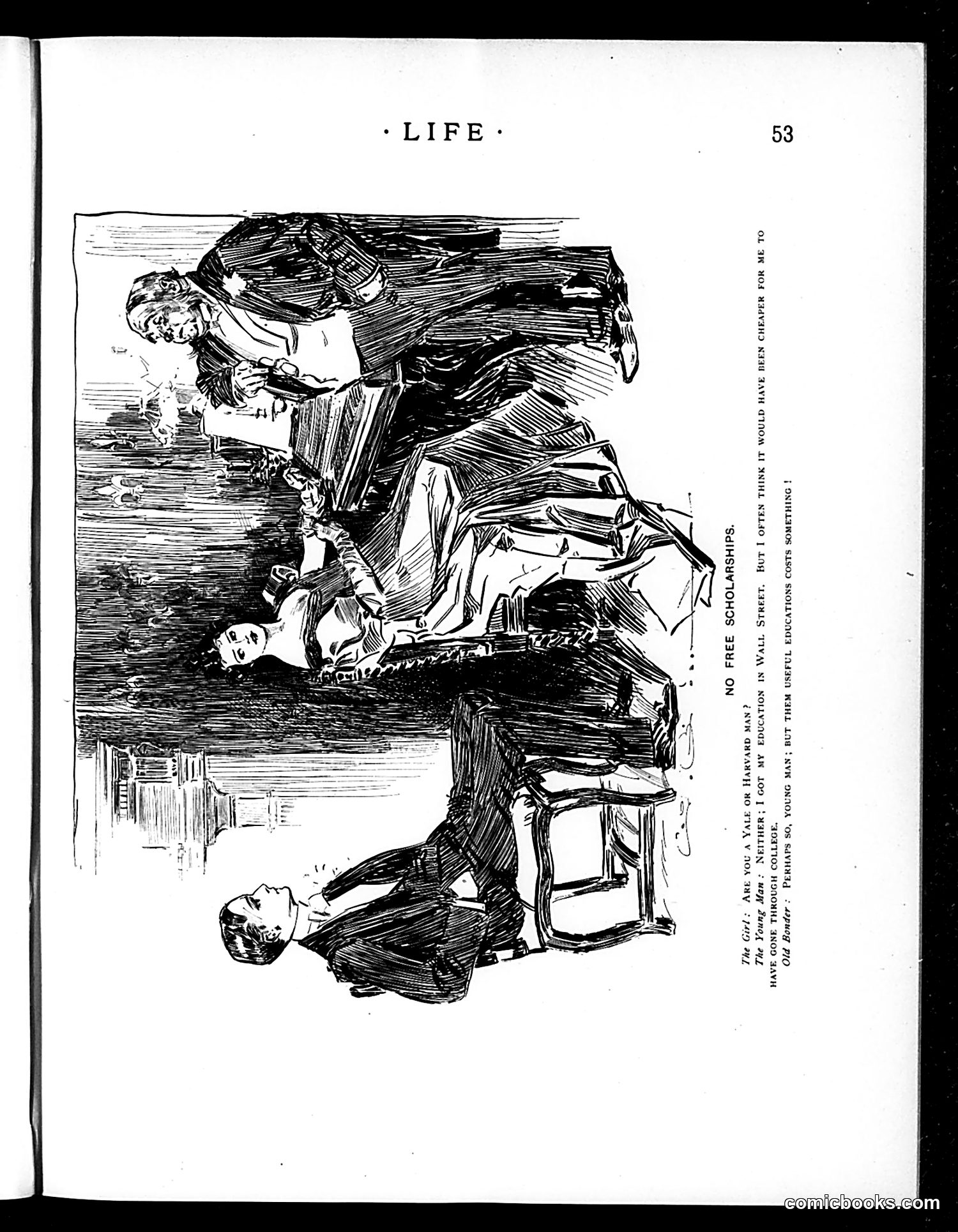
This page from *Life* magazine (page 53) contains a satirical cartoon drawn in ink. The image depicts what appears to be a domestic or social scene with multiple figures in period dress, shown upside-down relative to the page's normal orientation. The OCR text is largely illegible in the provided transcription, making it difficult to identify the specific political or social reference with certainty. The cartoon's style suggests early-to-mid 20th century American satire, likely commenting on social manners, domestic life, or contemporary public figures. Without clearer text or additional context, I cannot confidently identify which specific individuals or events are being satirized here. The inverted presentation itself may be part of the joke, suggesting disorder or social upheaval, but the precise meaning remains unclear from this image alone.
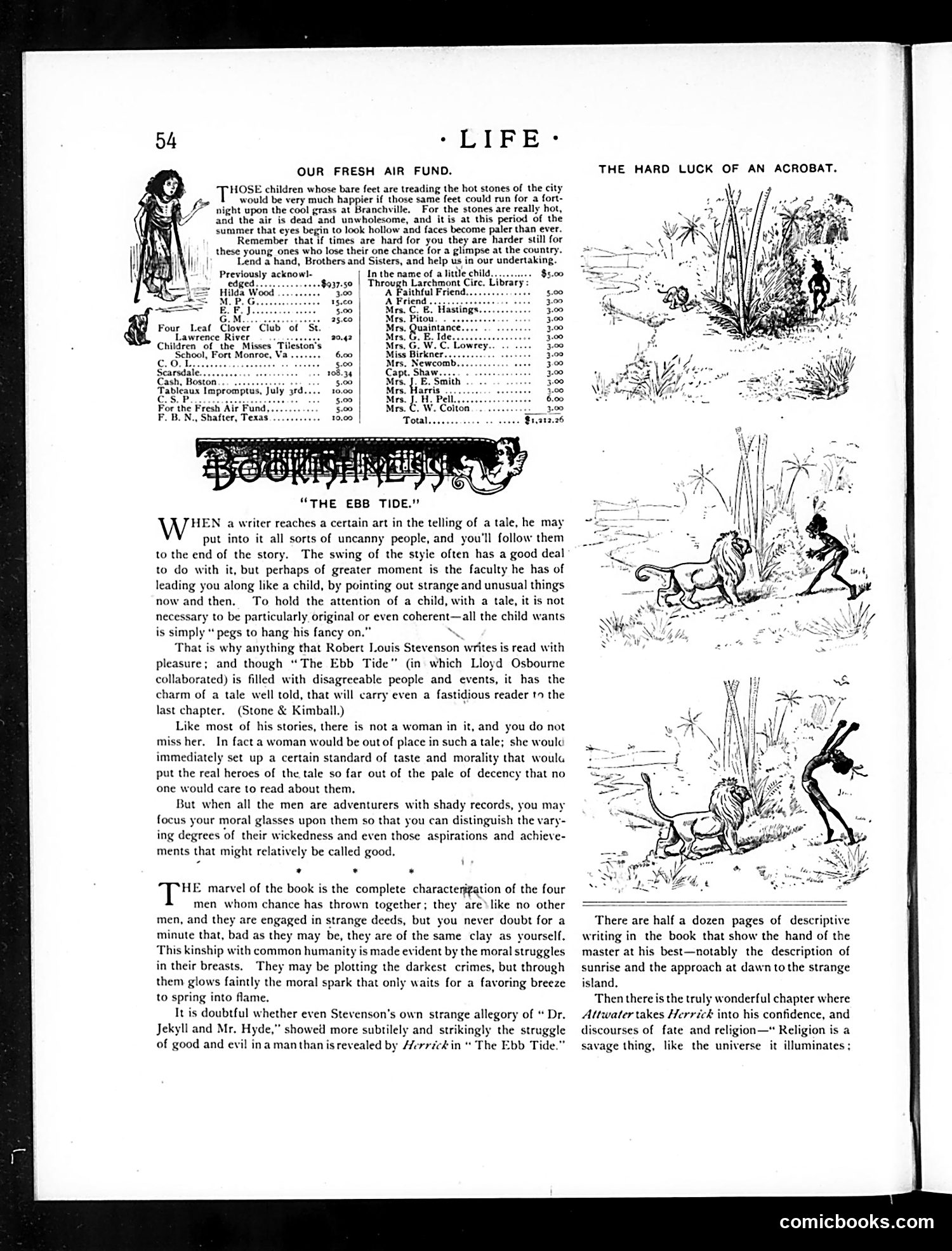
**"The Hard Luck of an Acrobat"** (right side): A series of illustrated vignettes showing an acrobat performing increasingly dangerous stunts that consistently backfire—he lands badly, gets hit by objects, or fails spectacularly. The humor derives from slapstick physical comedy: the acrobat's repeated misfortunes and the visual exaggeration of his injuries. This represents classic early-20th-century magazine humor relying on visual gags rather than political commentary. **"The Ebb Tide"** (left side): A lengthy review of a Robert Louis Stevenson story, discussing its literary merits and moral character. This appears to be cultural criticism rather than satire—evaluating the book's artistic qualities and ethical dimensions. **"Our Fresh Air Fund"** (top left): A charitable fundraising list, not satirical content. The page mixes entertainment, literature criticism, and philanthropy typical of Life magazine's format.
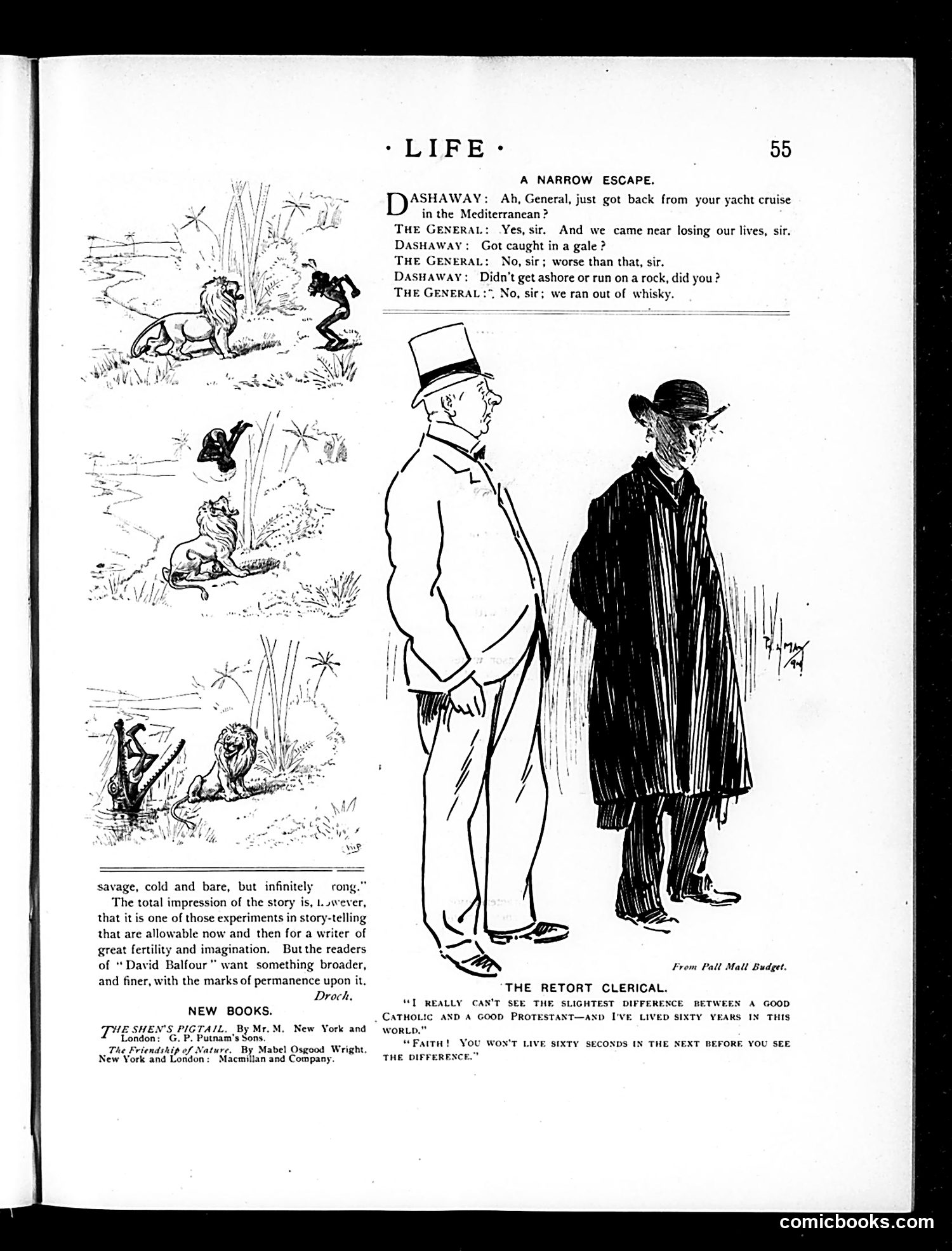
This page contains two separate satirical cartoons from *Life* magazine. **Top cartoon** depicts a conversation between a Dashaway (an attendant) and a General discussing a Mediterranean yacht cruise. The General admits they "ran out of whisky"—the humorous implication being that running out of alcohol was worse than actual maritime danger. **Bottom cartoon**, titled "The Retort Clerical," shows two men in conversation. One claims he "can't see the slightest difference between a good Catholic and a good Protestant" after sixty years. The other responds that he'll see the difference "in the next" sixty seconds—a joke about religious division and sectarian tensions. The cartoon satirizes claimed religious tolerance by suggesting fundamental differences remain regardless of such protestations.
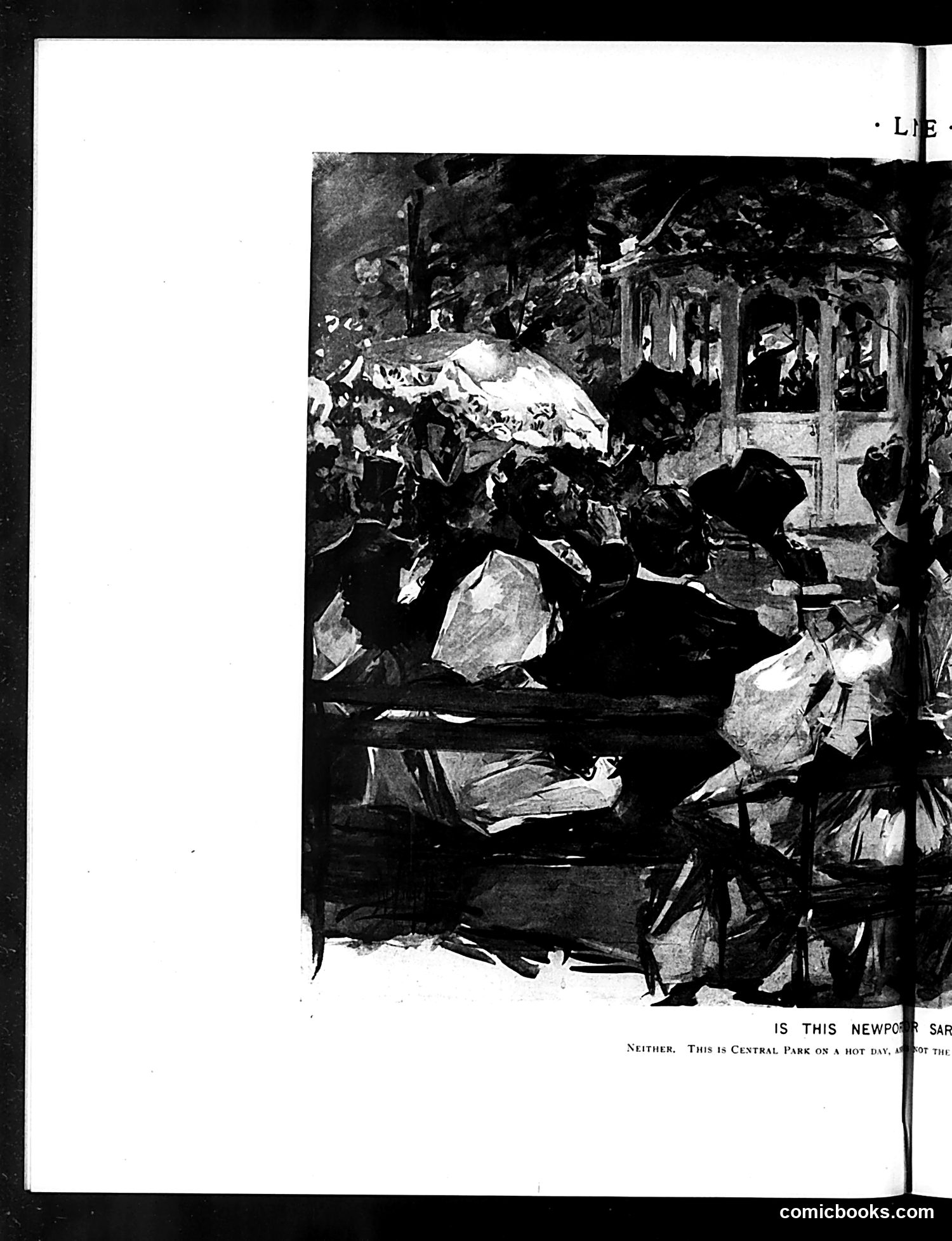
The partial caption reads "IS THIS NEWPORT SAR[?]" and "NEITHER. THIS IS CENTRAL PARK ON A HOT DAY, [?] OF THE..." This appears to be a satirical commentary contrasting Newport (the exclusive Rhode Island resort town for the wealthy) with Central Park in New York City. The crowded, chaotic scene depicted—with many people packed together, some holding parasols or umbrellas for shade—suggests the ironic point: Central Park on a hot summer day becomes so densely populated that it resembles the chaos of ordinary public life rather than offering the exclusive refinement associated with wealthy Newport leisure. The satire mocks either Newport's pretensions or the democratization of public space.
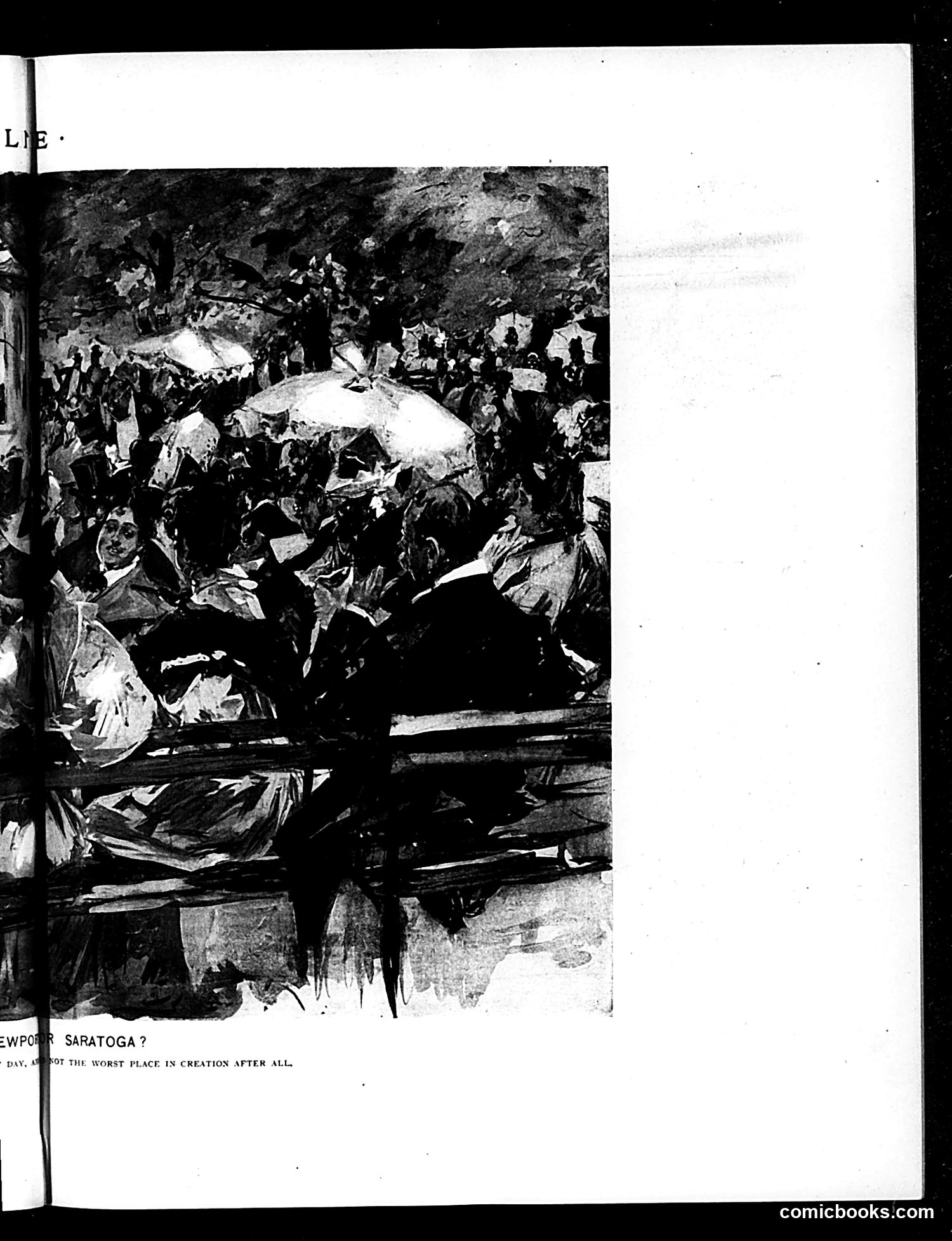
This appears to be a satirical illustration from *Life* magazine depicting a crowded outdoor social scene, likely from the late 19th or early 20th century. The caption references "Saratoga," a famous New York resort town known for wealthy leisure activities, racing, and high society gatherings. The text fragment "DAY, IS NOT THE WORST PLACE IN CREATION AFTER ALL" suggests social commentary—possibly ironic praise or criticism of Saratoga as a destination. The dense crowd of figures with period clothing (notably the women's large parasols and elaborate dress) depicts the fashionable elite assembled together. Without seeing the complete caption or article text, the exact satirical target remains unclear, but *Life* typically mocked wealthy social pretension and exclusive leisure culture during this era.
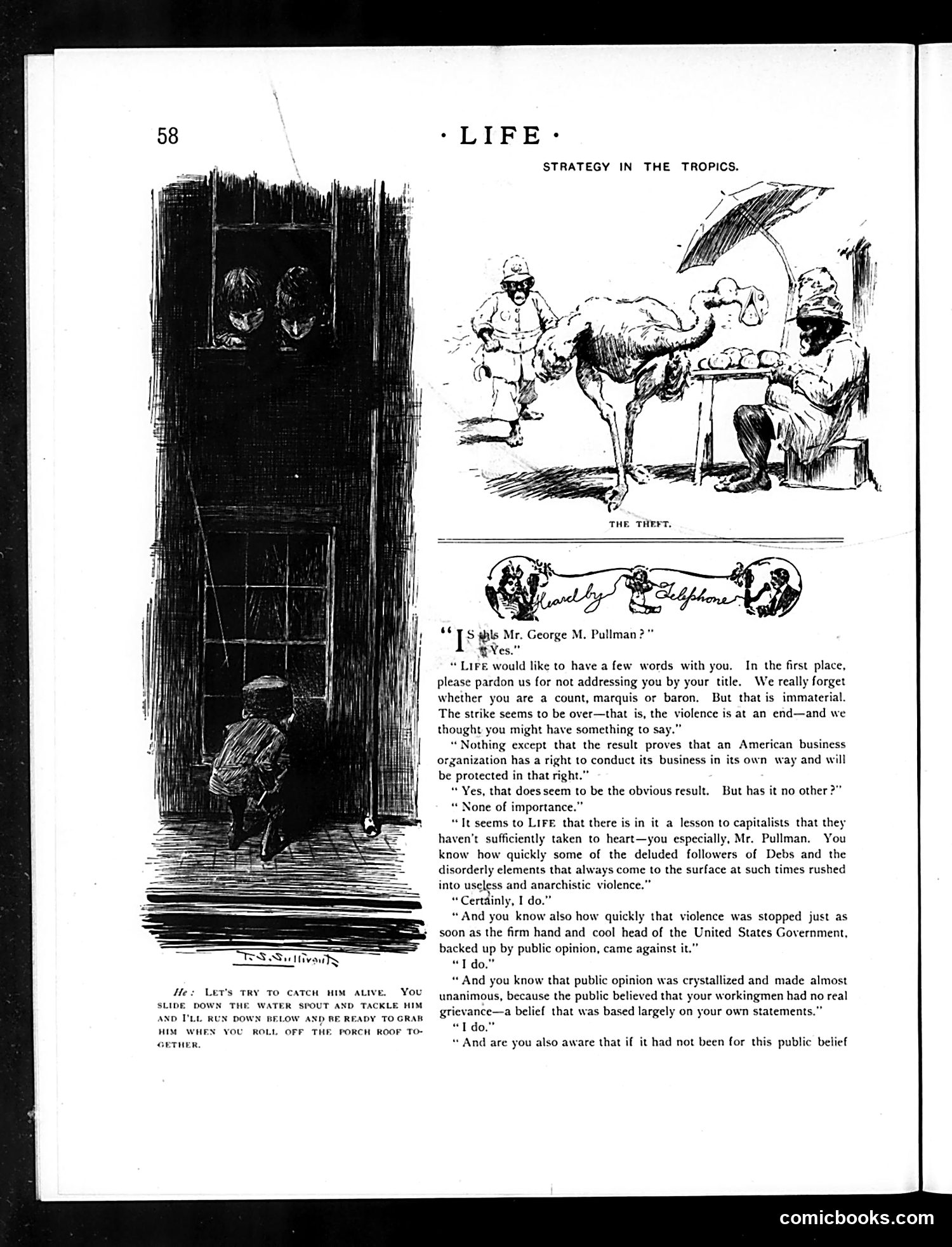
This page contains two cartoons about labor unrest and "Strategy in the Tropics." **Left cartoon**: Shows a figure climbing down a drainpipe from a building while another waits below with the caption "LET'S TRY TO CATCH HIM ALIVE." This appears to reference labor violence or a strike, with the imagery suggesting an escape during conflict. **Right cartoon**: Titled "THE THRIFT" and "STRATEGY IN THE TROPICS," depicts colonial-era figures (one holding an umbrella) with what appears to be an ostrich. The satire seems to mock imperialist attitudes or resource exploitation in tropical regions. **Text**: A dialogue addressing "Mr. George M. Pullman" discusses labor strikes, violence, and the government's role in suppressing them through public opinion. The piece argues capitalists haven't adequately considered workers' grievances and that public belief shaped the strike's outcome. This likely references the 1894 Pullman Strike.
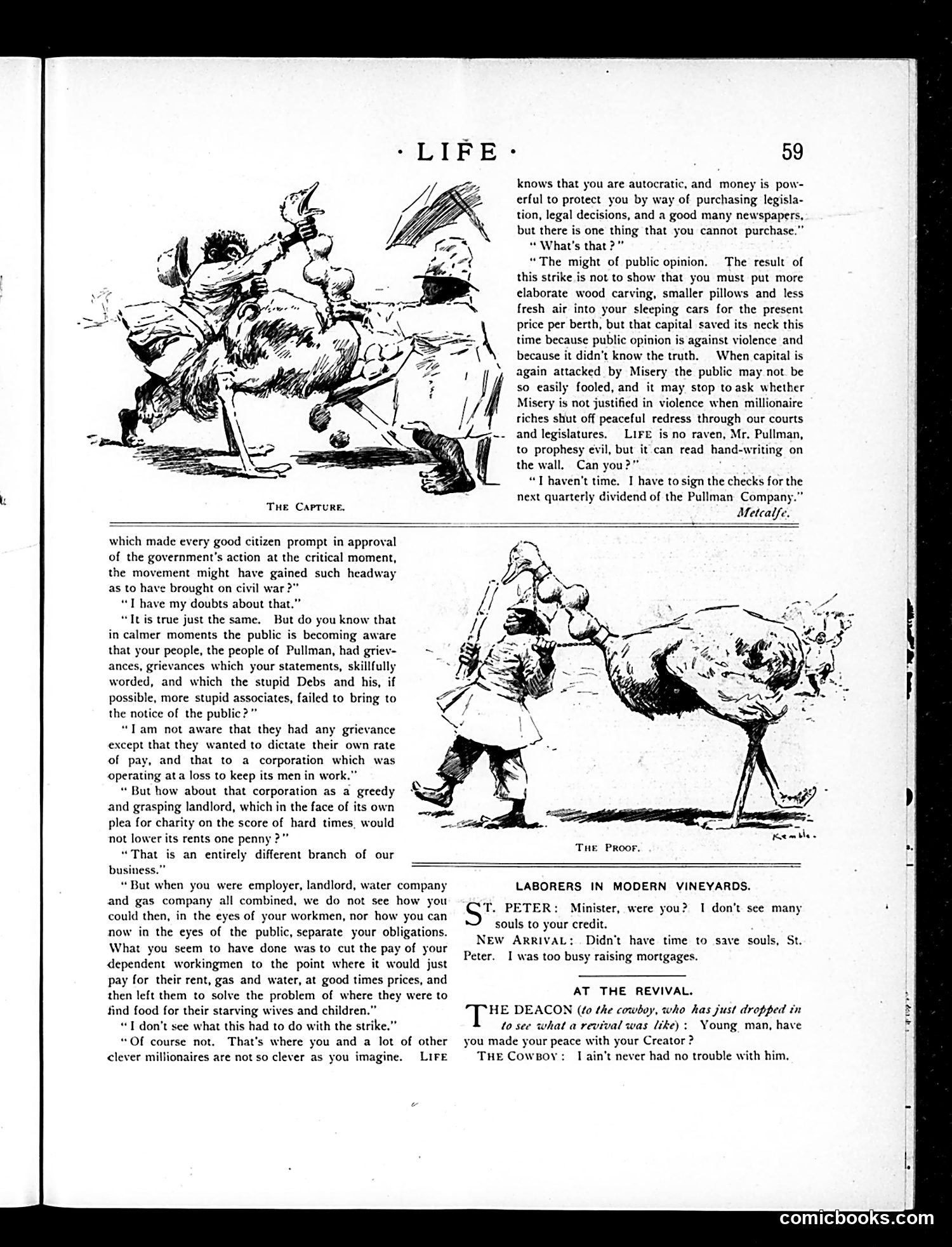
**"The Capture"** (top): A caricatured figure representing Capital or a wealthy industrialist is subdued by labor activists. This satirizes labor strikes and working-class resistance to corporate power. **"The Proof"** (middle): Depicts a confrontation between figures, likely representing labor and management disputes during the Pullman strike era (referenced in the dialogue). The accompanying dialogue criticizes wealthy industrialists and the Pullman Company specifically. The text argues that public opinion—not money or legislation—is labor's strongest weapon against corporate exploitation. It references grievances over wages, working conditions, and landlord profiteering. **"Laborers in Modern Vineyards"** and **"At the Revival"**: Brief comedic sketches mocking clergy and working-class struggles with economic hardship. The page overall advocates for labor rights and public awareness against corporate abuses.
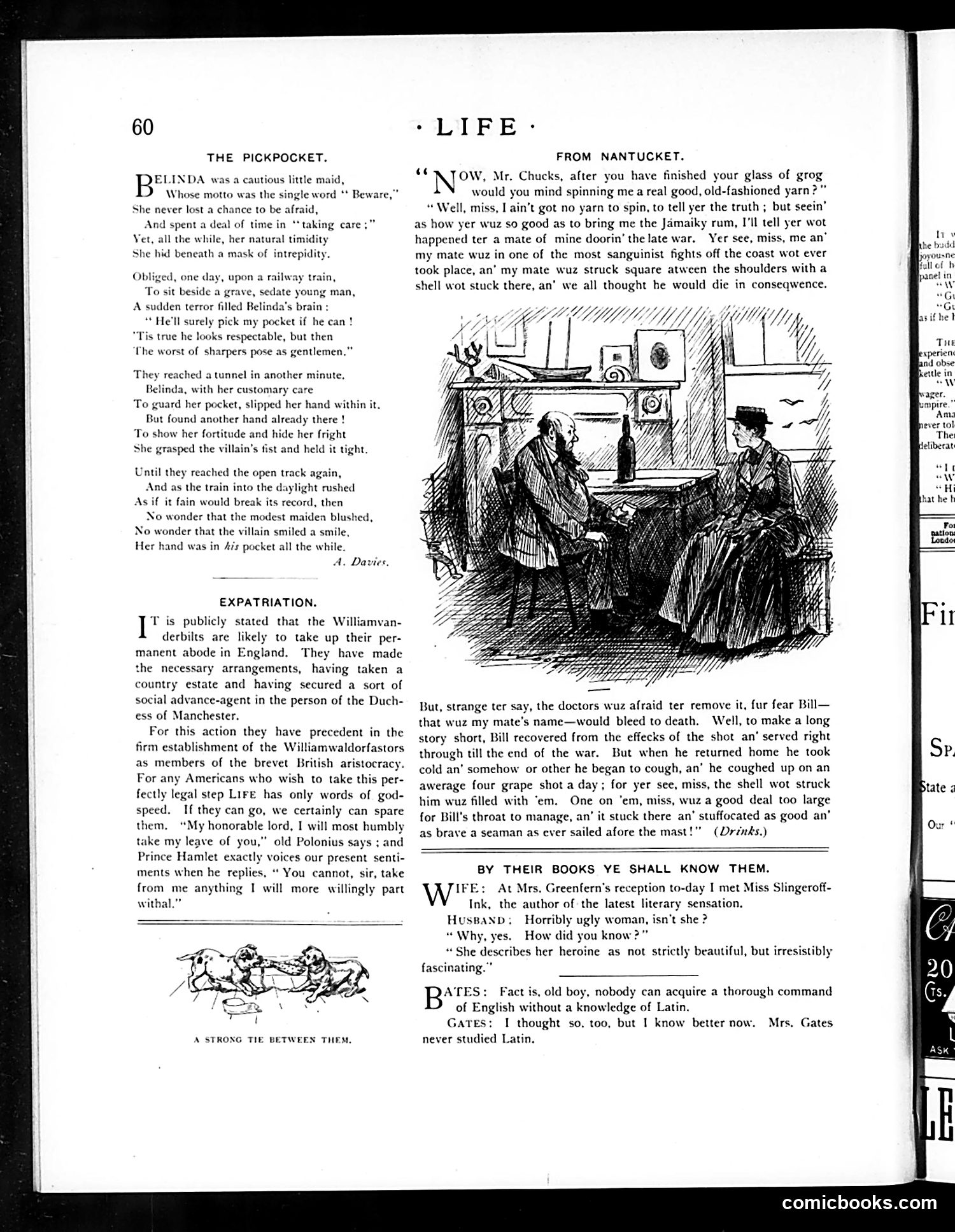
This page contains three separate satirical pieces: **"The Pickpocket"** (poem with illustration): A humorous narrative about Belinda, a cautious young woman riding a train who fears being robbed. The ironic twist: she discovers *her own hand* in another passenger's pocket—she's been pickpocketing him the entire time while thinking *he* was the thief. **"Expatriation"** (prose): Satirizes wealthy Americans, particularly the Vanderbilts, relocating permanently to England. Life mocks their social climbing by quoting Shakespeare to suggest the magazine happily encourages them to leave America, sarcastically wishing them well. **"From Nantucket"** (dialogue): A sailor's tall tale about a comrade who survived a cannonball lodged in his shoulder during wartime. The absurdist punchline: he later coughs up grapeshot pieces daily until one lodges in his throat and suffocates him. **"By Their Books Ye Shall Know Them"** (brief dialogue): A joke about judging authors by their work—a husband knows a woman author is ugly because she describes her heroine as plain but "irresistibly fascinating." All pieces exemplify *Life*'s trademark satirical humor targeting vanity, pretension, and human folly.
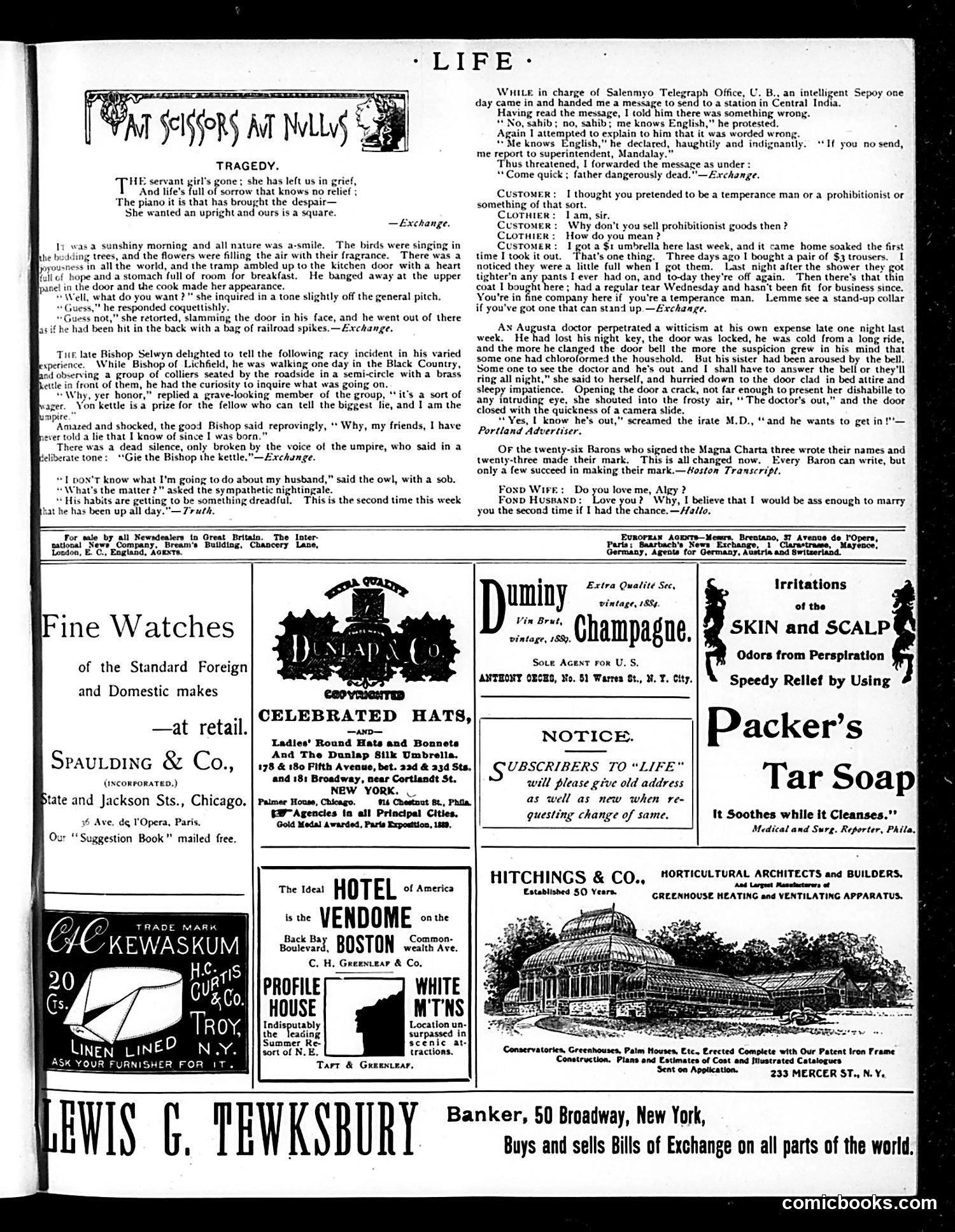
This page contains several short satirical anecdotes rather than visual political cartoons. The humor targets social absurdities of the era: 1. **"Tragedy"**: Mocks trivial domestic complaints—a servant girl quits because the family's piano is square rather than upright, ruining everyone's happiness. 2. **The Tramp story**: A vagrant asks the cook for "breakfast" (or possibly shelter); rejected harshly, he leaves "as if he had been hit in the back with a bag of railroad spikes"—exaggerating his humiliation. 3. **Bishop Selwyn anecdote**: A bishop encounters colliers wagering over who can tell the biggest lie for a brass kettle prize. When the bishop claims he's never lied, the umpire awards him the kettle—suggesting even the "virtuous" unwittingly participate in falsehood. 4. **The Owl dialogue**: An owl complains her husband stays awake all day—inverting normal animal behavior for absurdist humor. The remaining anecdotes mock poor product quality and linguistic confusion. The page emphasizes human folly through ironic reversals and exaggeration typical of turn-of-the-century satirical magazines.
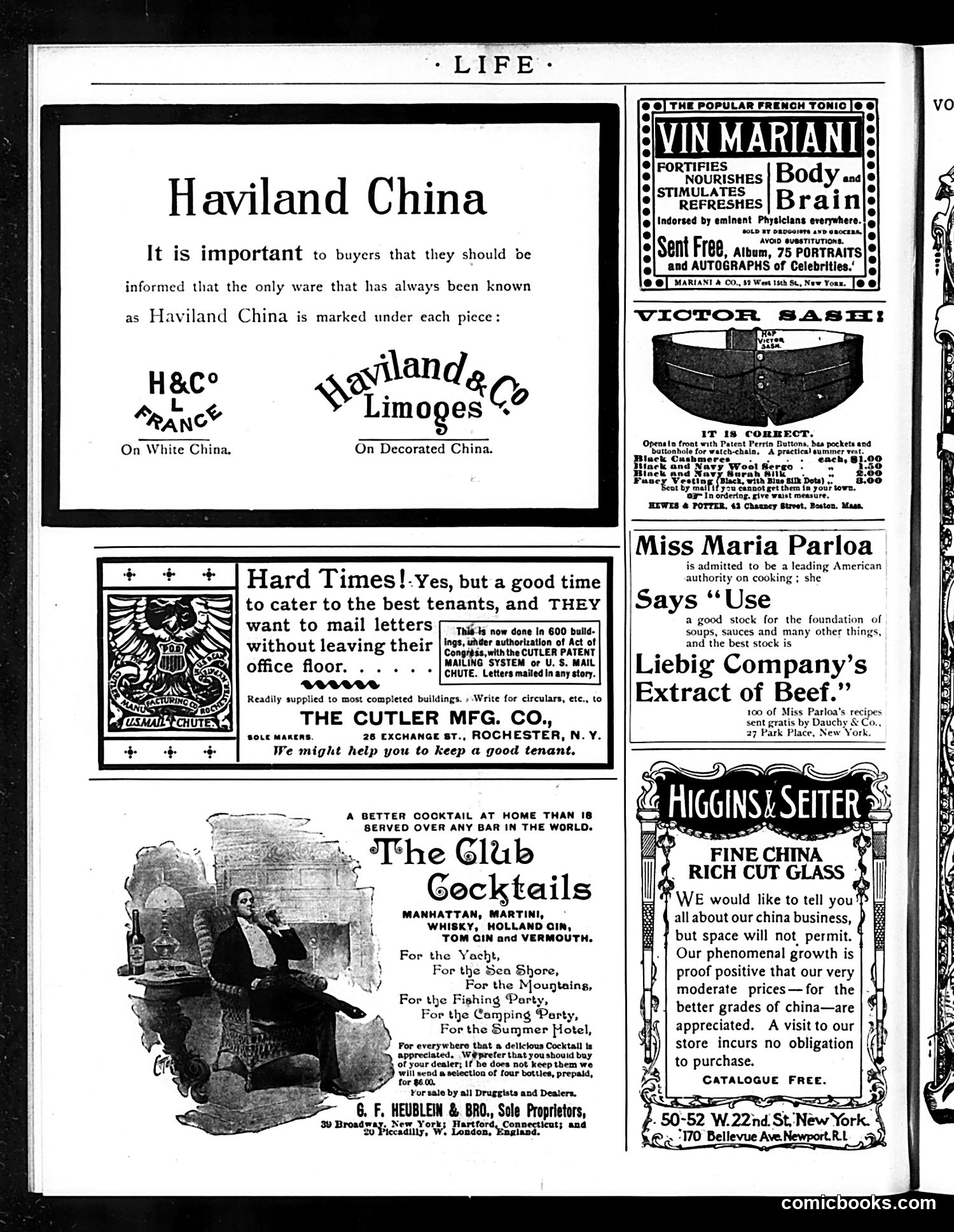
This page is primarily **advertising**, not political satire. It contains six commercial advertisements typical of early 20th-century Life magazine: 1. **Haviland China** — distinguishing authentic French porcelain by maker's marks (H&C vs. Haviland & Co.) 2. **Cutler Manufacturing** — a mail chute system for office buildings, presented as a tenant-retention feature 3. **The Club Cocktails** — pre-mixed cocktail bottles by Heublein & Bro., marketed for social occasions (yacht parties, camping, etc.) 4. **Vin Mariani** — a "French tonic" health drink with celebrity endorsements 5. **Victor Sash** — window hardware 6. **Miss Maria Parloa's endorsement** of Liebig Company's beef extract for cooking stock 7. **Higgins & Seitler** — fine china and glassware retailer The page reflects consumer culture of the era, emphasizing convenience, quality brands, and entertaining at home. No political cartoon or satire is present—this is purely commercial content.