
A complete issue · 14 pages · 1894
Life — June 21, 1894
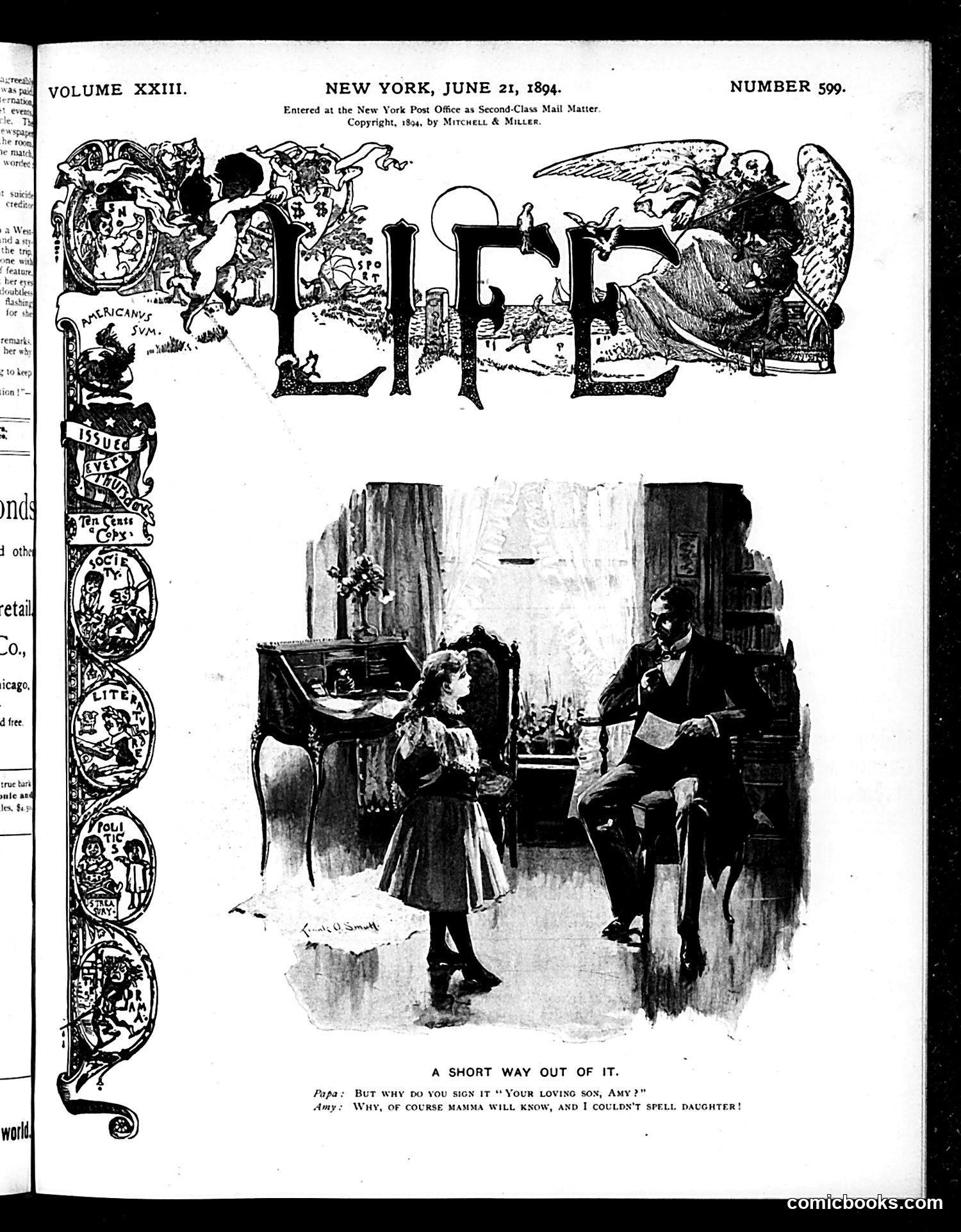
This page contains a single cartoon titled "A Short Way Out of It," depicting a domestic scene. A young girl stands between two adults—a woman (seated at a desk) and a man (standing). The dialogue reveals the girl has been asked to sign a document stating "Your loving son, Amy," apparently to deceive someone (likely the mother's husband or the girl's father). The joke hinges on the girl's innocent but damning response: she refuses to sign because she "couldn't spell daughter"—exposing that she's actually a daughter, not a son, thus undermining whatever deception the adults were attempting. The satire mocks adult dishonesty and the absurdity of trying to involve a child in a lie, while the child's straightforward logic exposes the scheme's fundamental flaw.
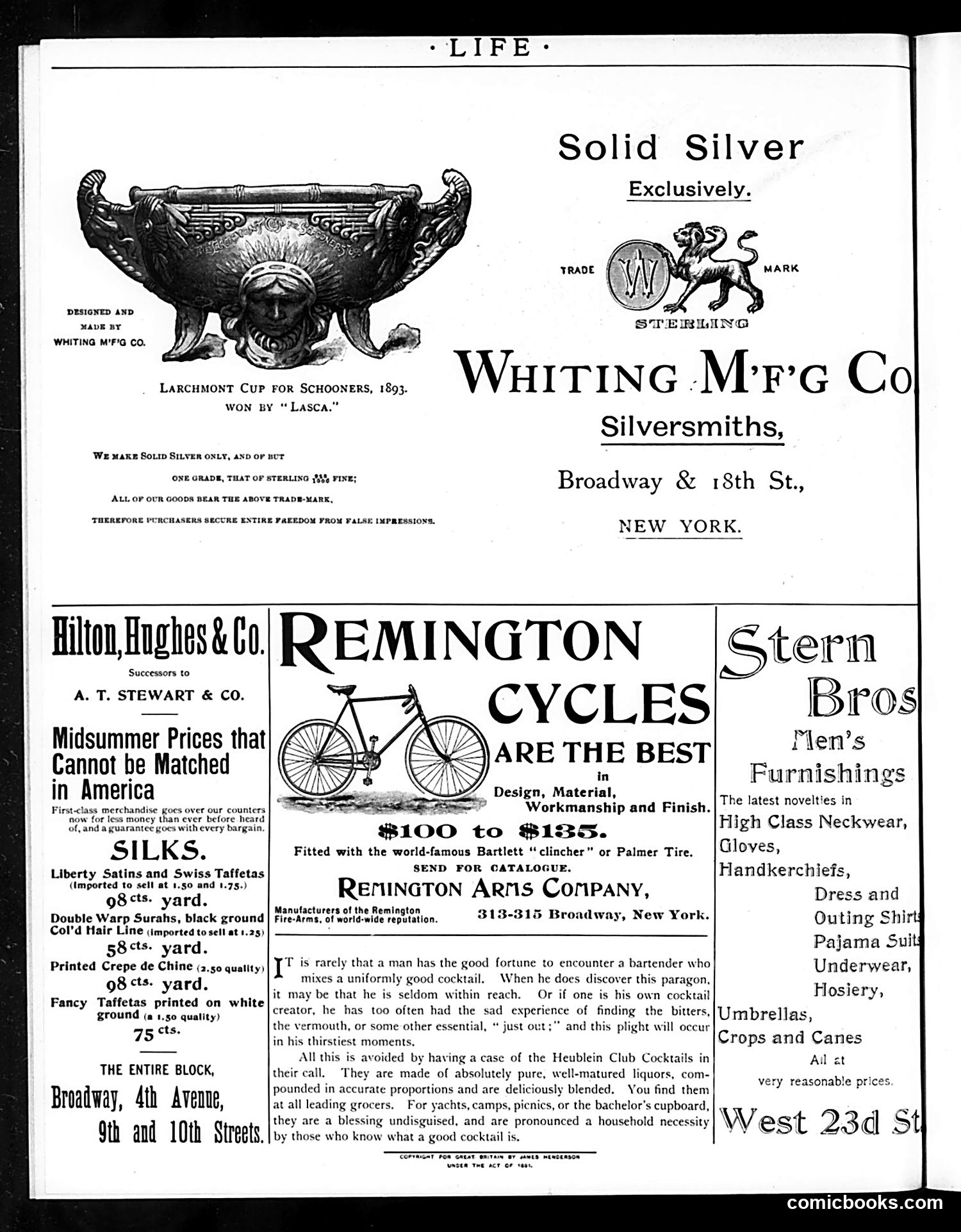
This page is primarily **advertising, not editorial content or satire**. It contains four advertisements from circa 1890s New York: 1. **Whiting Mfg Co** (top): Promotes solid sterling silver goods, featuring the Larchmont Cup for Schooners from 1893. 2. **Hilton, Hughes & Co** (left): Silk merchants offering midsummer prices on fabrics like Liberty Satins and Swiss Taffetas. 3. **Remington Cycles** (center): Bicycle advertisement emphasizing quality design and Bartlett tires, priced $100-$135. 4. **Stern Bros** (right): Men's furnishings store advertising neckwear, gloves, and other accessories. A brief article about cocktails appears at bottom center, but this is essentially a commercial page with no political cartoons or satirical content.
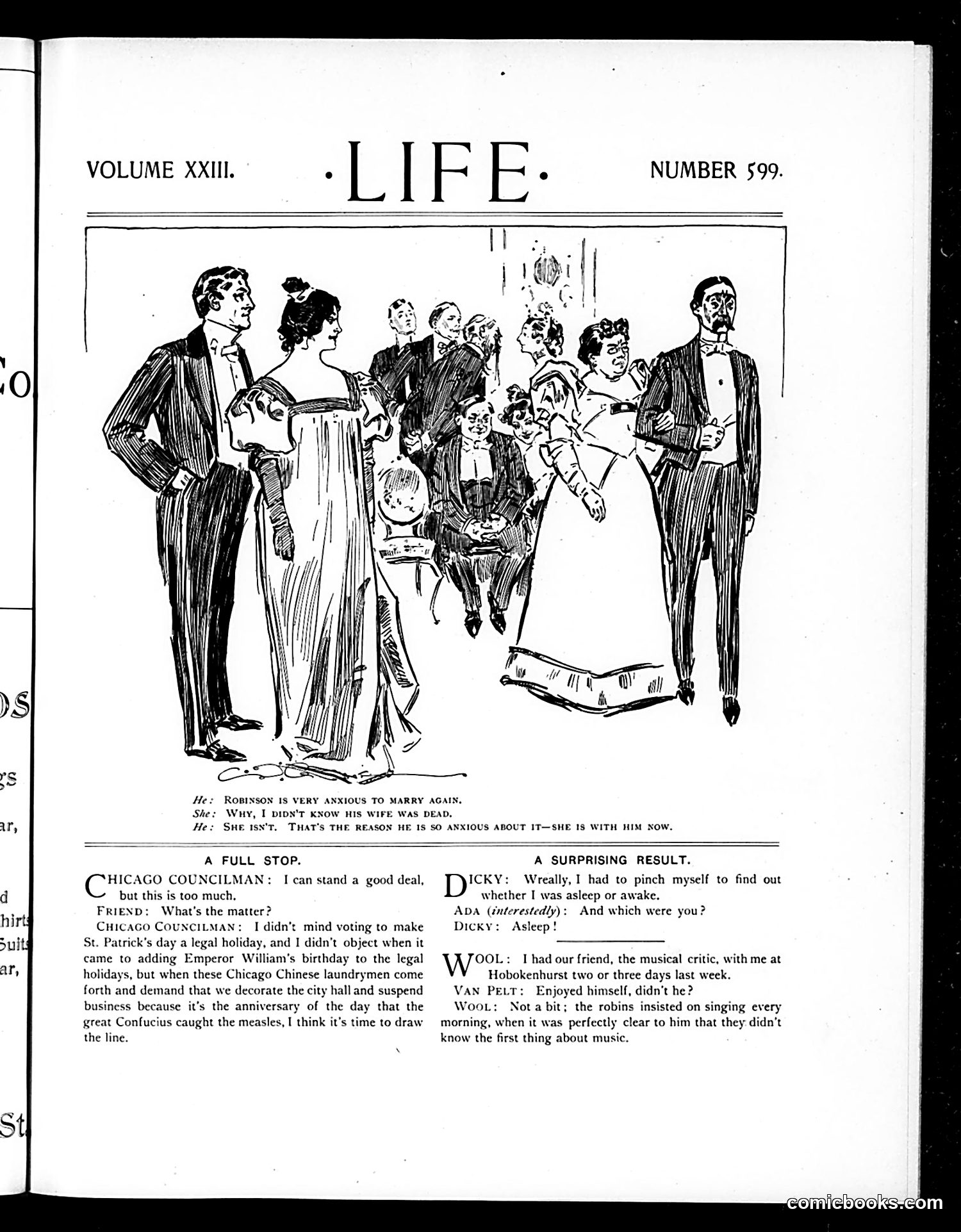
This page contains two separate humorous sketches from Life's satirical section: **"A Full Stop"** depicts a Chicago Councilman objecting to adding Emperor William's birthday to legal holidays alongside St. Patrick's Day, arguing it's excessive and would disrupt city business. The joke satirizes political absurdity—the councilman's complaint about holiday accumulation and the apparent incongruity of celebrating a German emperor's birthday in Chicago. **"A Surprising Result"** presents a brief dialogue where "Dicky" pinches himself to verify he's awake after Ada supposedly wasn't aware of their situation. The humor appears to derive from marital confusion or miscommunication. Both sketches use the typical early-20th-century Life magazine format: witty social commentary through dialogue and situation humor, targeting contemporary politics and middle-class domestic life.
This page discusses police corruption in New York City under Superintendent Byrnes. The article criticizes how the police department allegedly tolerated vice and blackmail operations, with officers extorting money from criminals in exchange for protection. **Key figures referenced:** - **John W. Goff**: Prosecutor investigating the Lexow Committee's findings on police corruption - **Superintendent Byrnes**: Police leader accused of enabling corruption, though the article notes his unexplained wealth suggests possible complicity **The satire's point:** Despite New York's major newspapers knowing about systematic police corruption for years, they remained silent—likely due to police intimidation. The article sardonically suggests only brave individuals would expose this abuse, calling out the press's cowardice in not challenging police authority sooner. This reflects the genuine Lexow Committee investigations (1894-1895) that exposed widespread NYPD corruption.
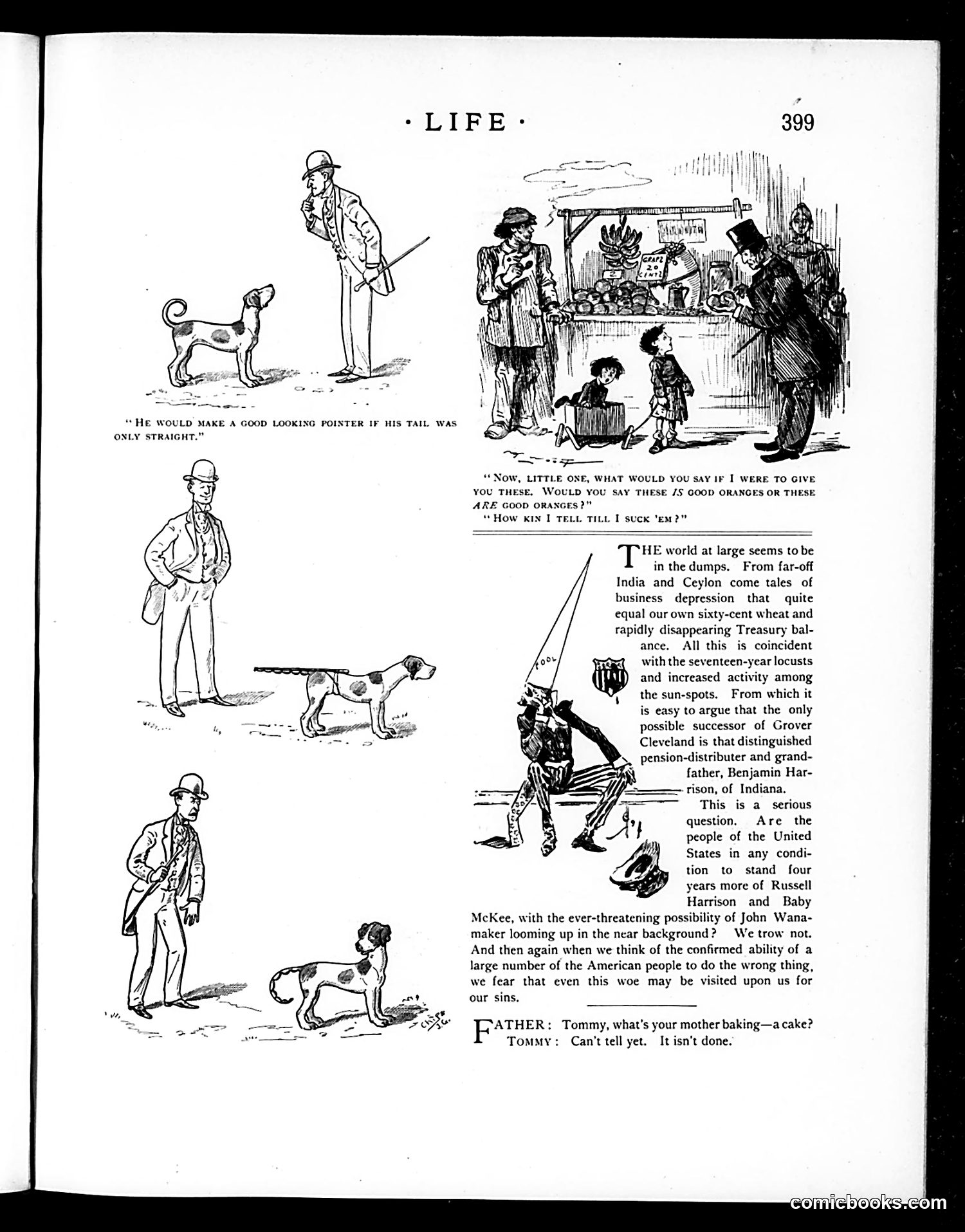
**Top Section - Dog Cartoons:** Four sequential panels show a well-dressed man attempting to straighten a dog's tail for a portrait. The humor derives from the dog's resistance and the man's futile efforts—a commentary on appearance versus nature. **Center Cartoon:** A street vendor selling oranges to children, with dialogue about whether the oranges are "good" or asking "How kin I tell till I suck 'em?" This plays on working-class dialect and consumer skepticism. **Main Text Article:** Discusses American political and economic anxieties—mentions Grover Cleveland, Benjamin Harrison, business depression, and concerns about potential successors. References threats from "John Wanamaker" and "Russell McKee," expressing worry about future leadership capacity. **Bottom Joke:** A brief domestic exchange about baking. The page reflects 1890s-era political uncertainty and economic concerns.
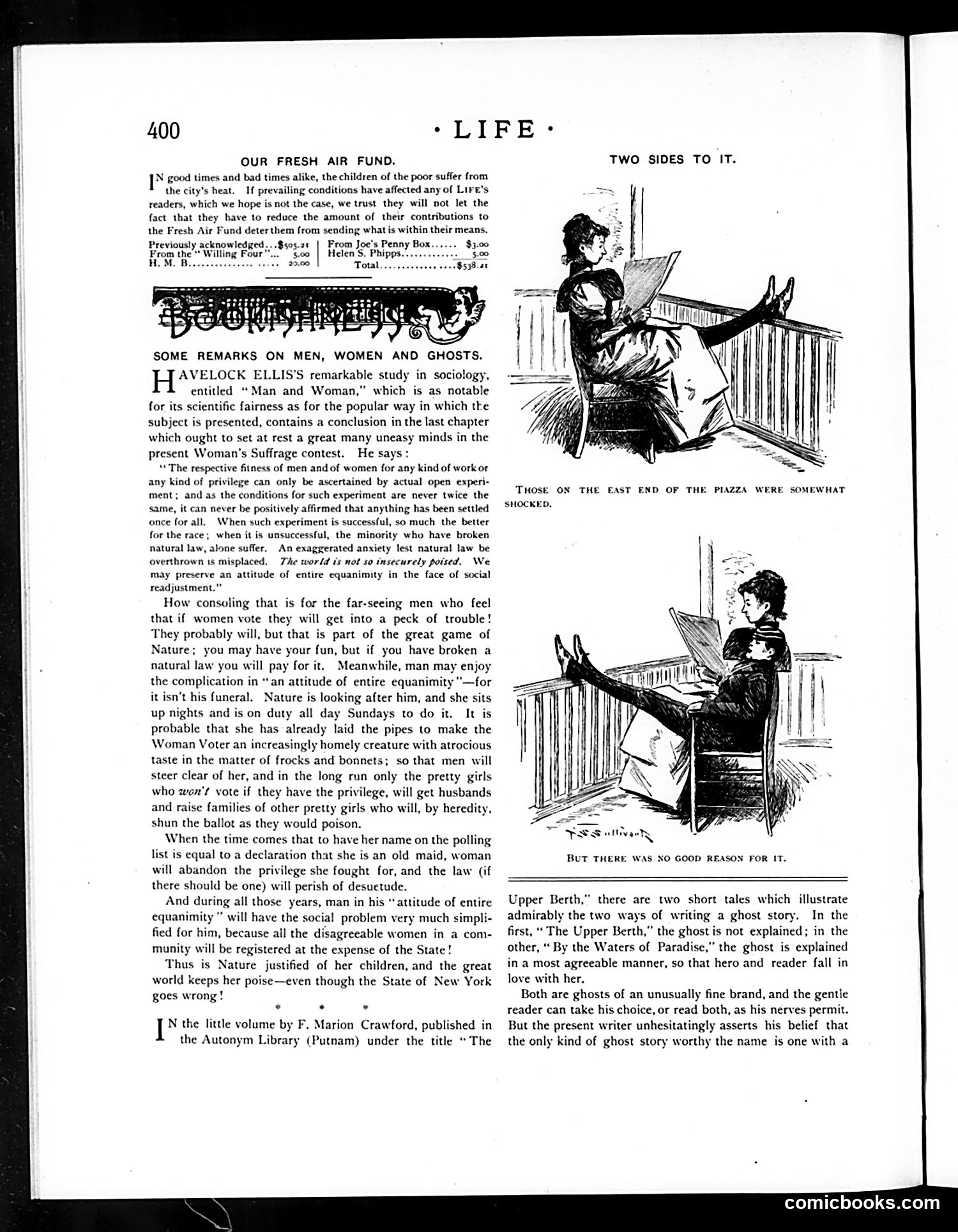
This page contains two distinct sections: **Left side:** An article titled "Some Remarks on Men, Women and Ghosts" discusses Havelock Ellis's sociological work "Man and Woman." The text sarcastically argues that women obtaining voting rights will create social chaos—claiming men will face trouble and that Nature itself will punish women for breaking natural law. The satire mocks anti-suffrage arguments by presenting them absurdly. **Right side:** Two sketched vignettes illustrate "Two Sides to It," contrasting reactions to a woman on a balcony. The captions suggest different interpretations of the same scene. Below, text introduces two ghost stories titled "Upper Berth." The page satirizes contemporary anxieties about women's suffrage through exaggerated anti-feminist rhetoric, while the illustrations humorously present how perspective shapes interpretation.
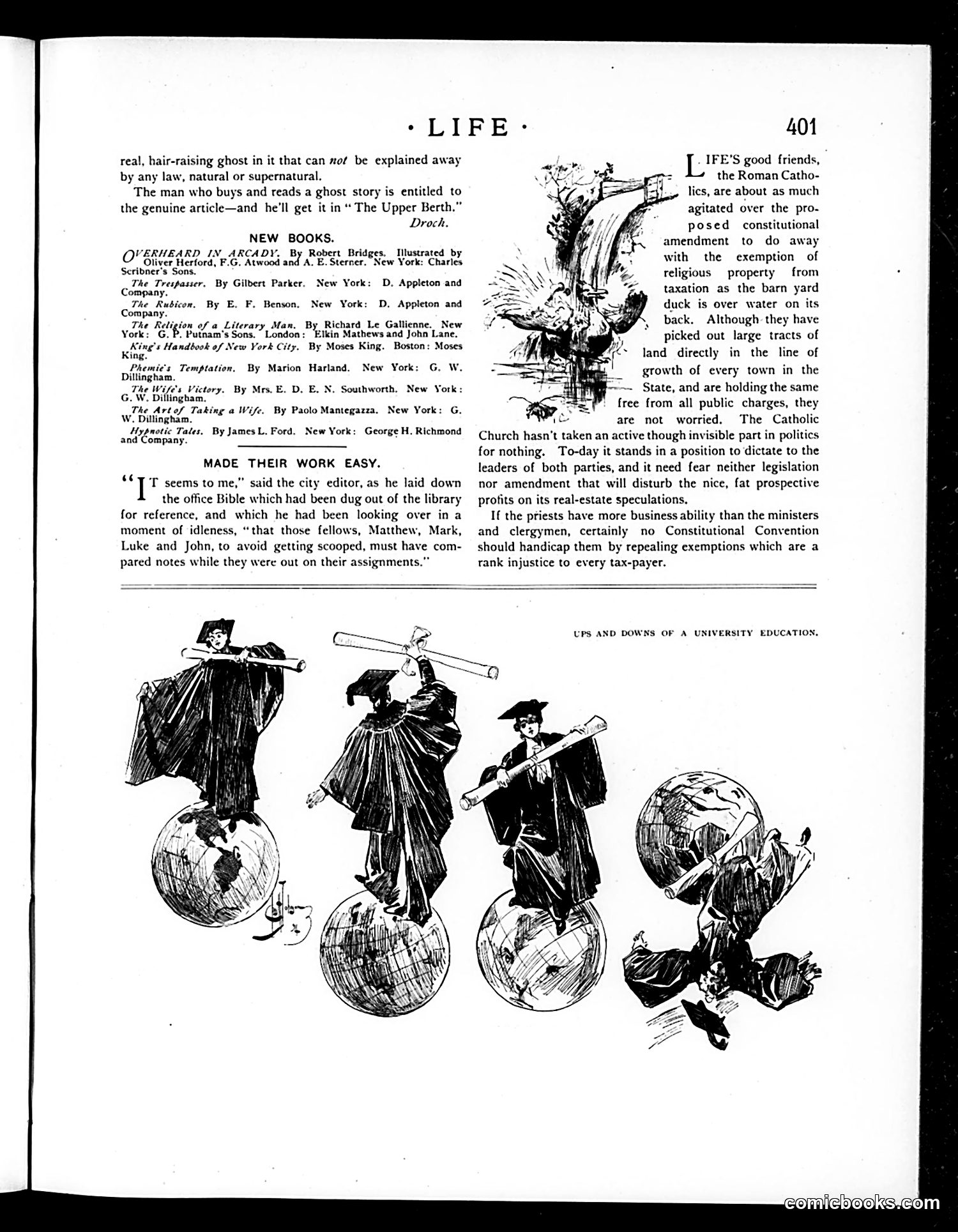
This cartoon satirizes the stages of academic progress through four figures standing on globes, each wearing academic robes and holding telescopes or similar instruments. The caption suggests a commentary on the trajectory of university education—likely contrasting idealistic aspirations with practical outcomes. The progression appears to show students at different stages, with the final figure appearing to fall or struggle, implying that university education doesn't always deliver on its promises. The globes may represent worldly knowledge or expanding horizons that students pursue. The satire likely critiques either the gap between educational ideals and reality, or the competitive, uncertain nature of academic advancement in the era when *Life* magazine published this piece.
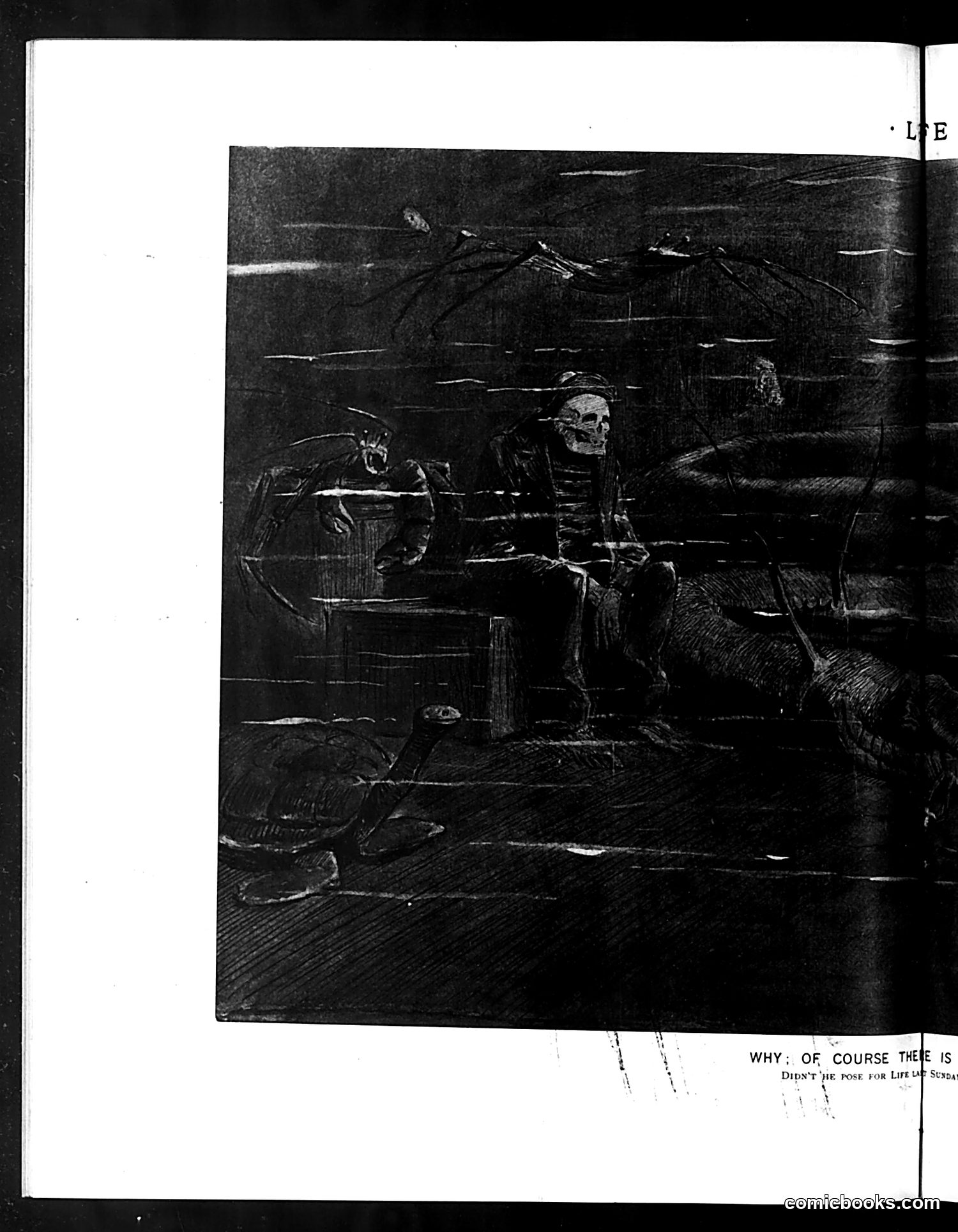
This appears to be an illustration from Life magazine showing a dramatic interior scene. The partial caption reads "WHY, OF COURSE THERE IS" with text below mentioning "DIDN'T HE POSE FOR LIFE'S SCHOOL" (OCR uncertain on exact wording). The image depicts what appears to be a skeleton or death figure seated in a room with other figures present. The style suggests early 20th-century satirical illustration. Without the complete caption and full context, the specific political or social commentary is unclear. The reference to "Life's School" and the presence of skeletal imagery suggests this may be satirizing death, danger, or a cautionary lesson about some contemporary practice or institution, but I cannot confidently identify which specific event, person, or policy is being critiqued based solely on what's visible here.
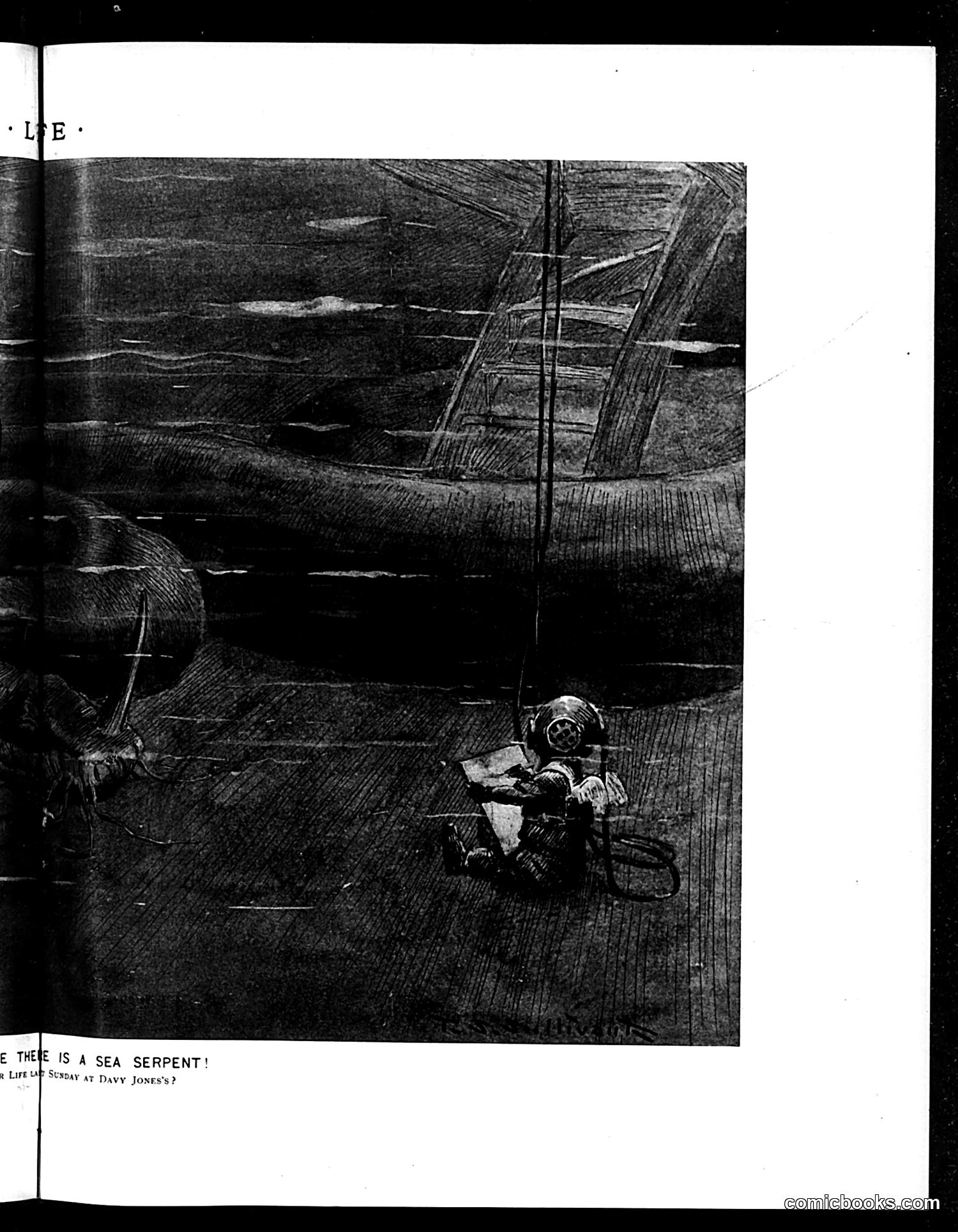
This appears to be an illustration from *Life* magazine's humorous section, depicting a diver or deep-sea explorer in a diving suit on the ocean floor, discovering what looks like a sea serpent in the murky depths. The caption reads "Life Up Sunday at Davy Jones's" (likely a play on "Davy Jones's Locker," the nautical term for the ocean floor/death at sea). The satire likely mocks sensationalist newspaper stories or public fears about sea serpents—creatures frequently reported but never scientifically verified. The diving figure's alarmed discovery format parodies the breathless tone of contemporary adventure tales. Without additional context about the specific publication date, the exact satirical target remains unclear, though it appears to be poking fun at credulous public interest in maritime myths.
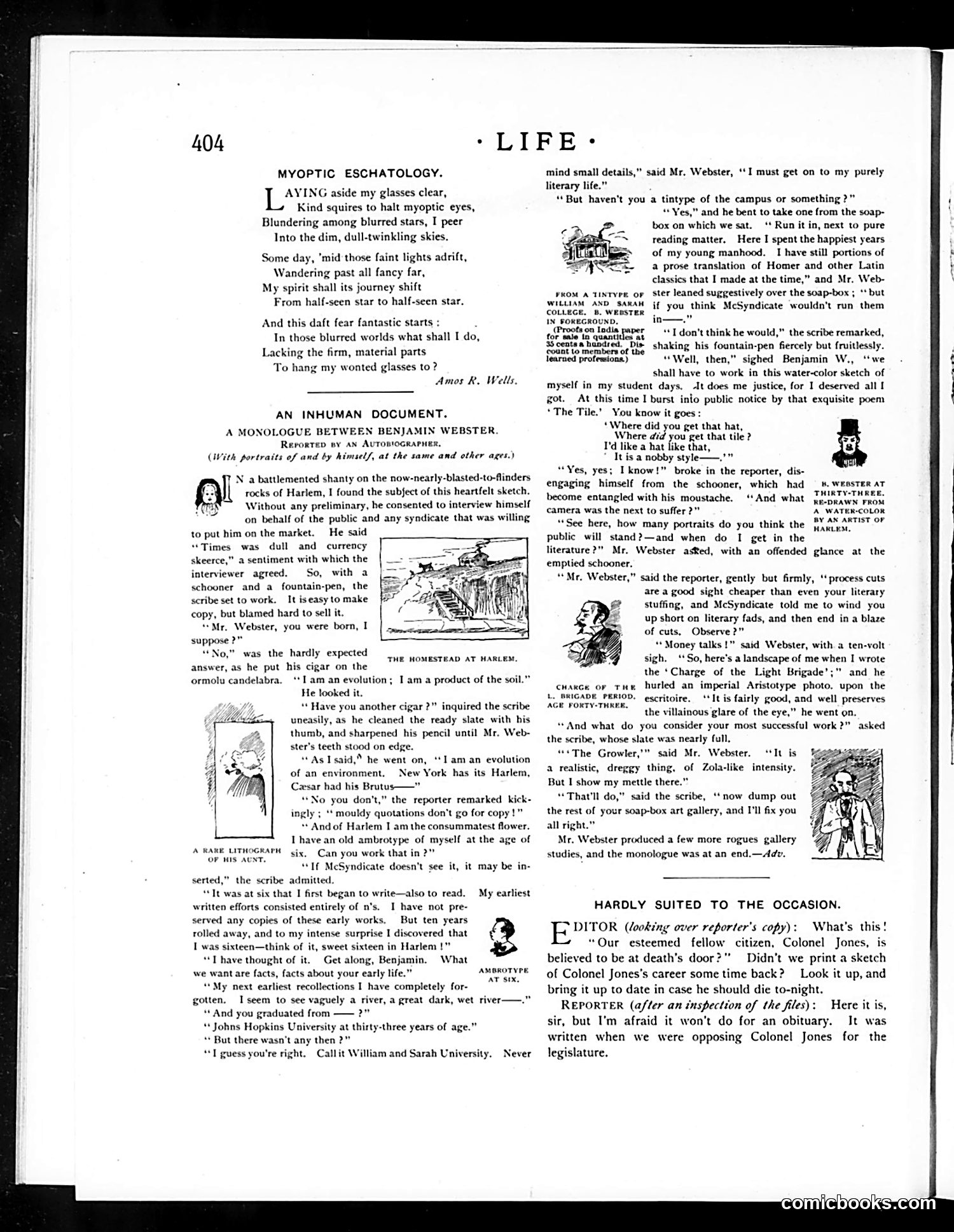
This page contains a satirical monologue titled "An Inhuman Document," featuring **Benjamin Webster**, a writer/artist shown in illustrations throughout. The piece mocks Webster's pretentious literary ambitions. The scribe interviews him about his "Schooner"—apparently an art project—which Webster describes with grandiose language ("I am an evolution; I am a product of the soil"). The reporter responds with biting skepticism, calling Webster's claims absurd and his artwork derivative ("Zola-like intensity"). The satire targets **artistic self-importance** and the gap between an artist's inflated self-perception and reality. Webster's grandiose proclamations about his work are repeatedly undercut by the reporter's practical, dismissive responses, suggesting the piece ridicules pretentious bohemian artists who use pseudo-intellectual language to justify mediocre work.
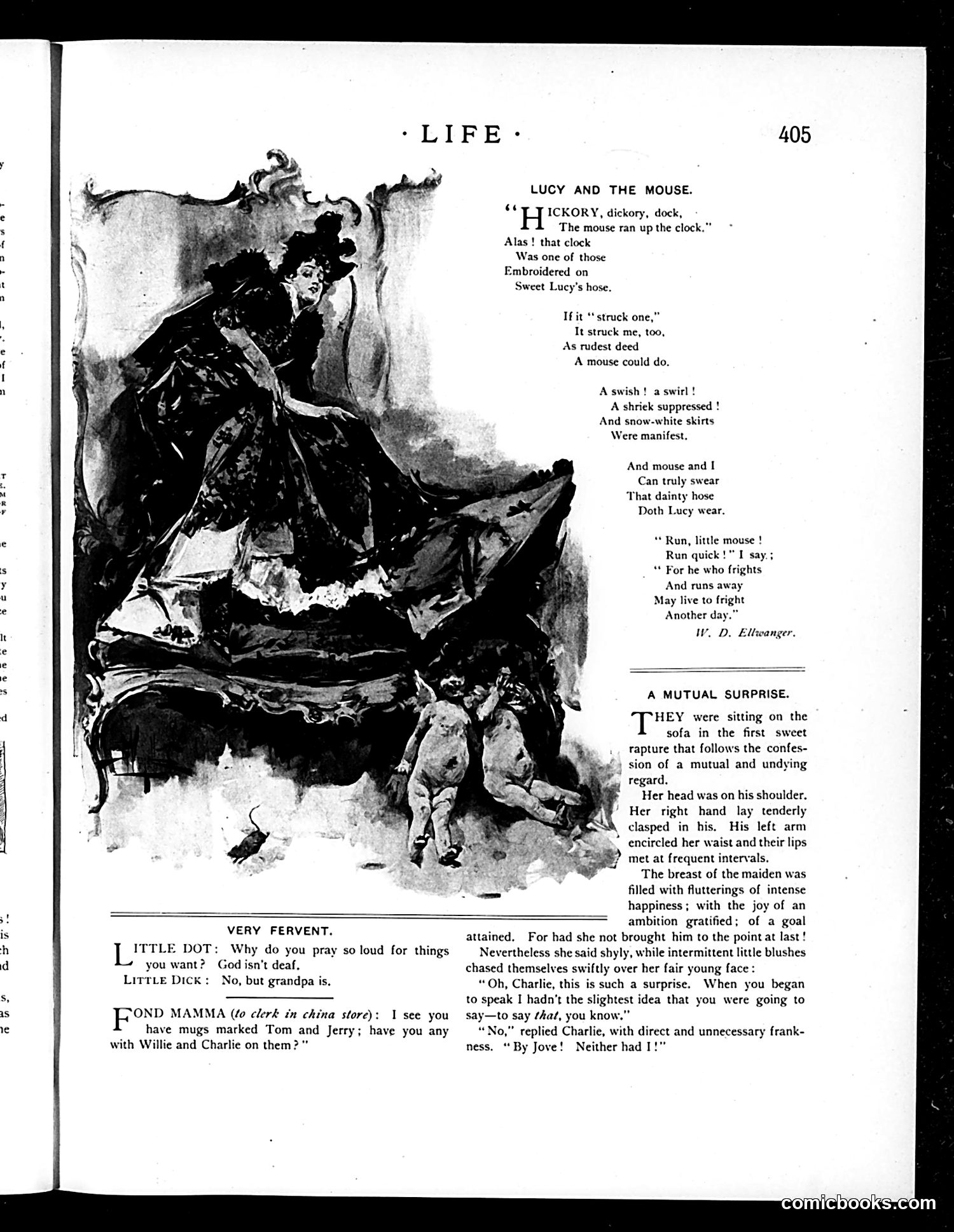
This is a romantic short story or serialized fiction piece, not political satire. The page features an illustration of a woman in elaborate dress sitting on a sofa with a young man, accompanied by poetry titled "Lucy and the Mouse." The narrative describes a moment of romantic affection between two people. The accompanying dialogue sections—"Very Fervent" and "A Mutual Surprise"—depict flirtation and intimate conversation, with exchanges about whether the woman said something unexpected to the man. This appears to be light, sentimental entertainment typical of Life magazine's content during this era, mixing romantic fiction with illustrations rather than political commentary or social satire.
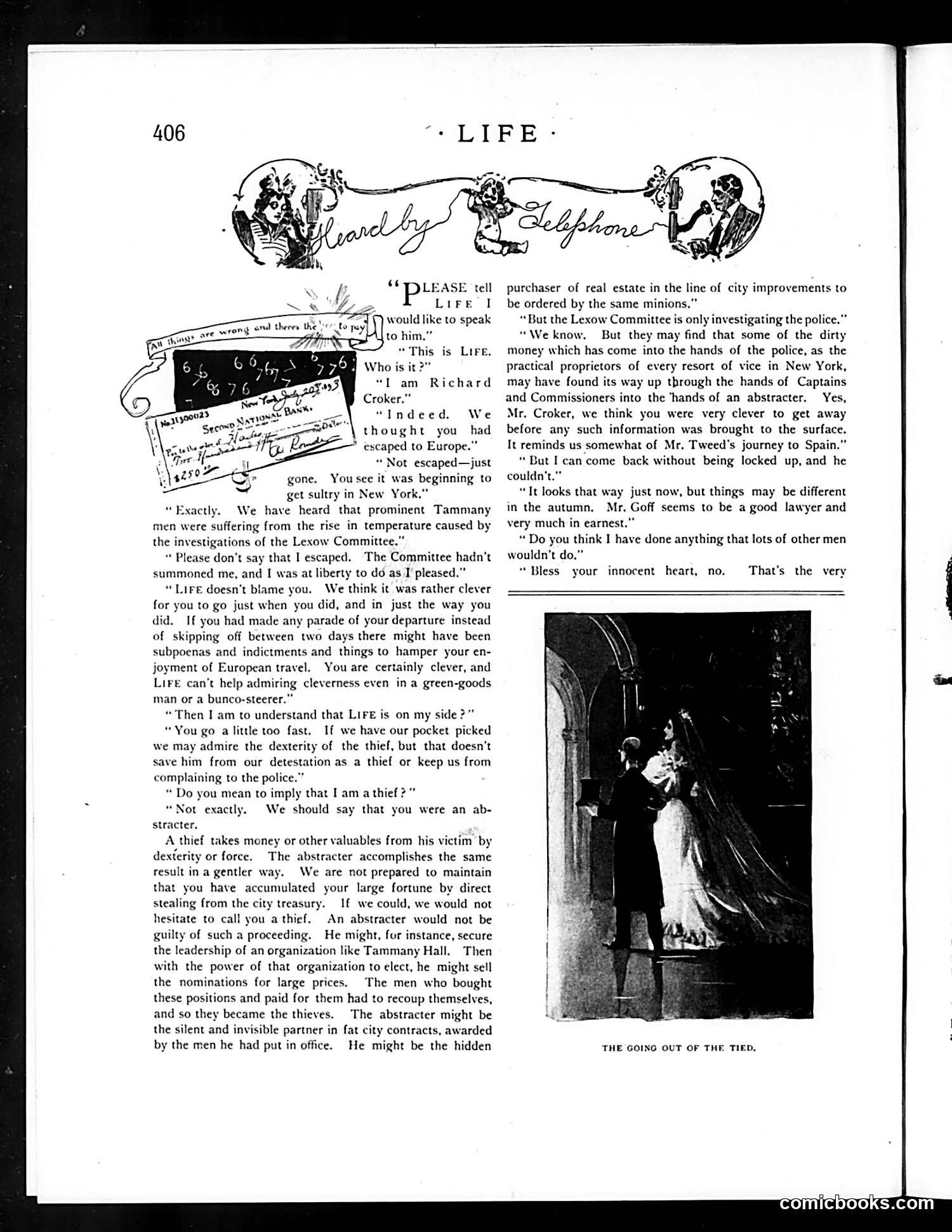
This is a satirical dialogue between Life magazine and **Richard Croker**, the powerful boss of Tammany Hall (New York's Democratic political machine). The cartoon lampoons Croker's convenient departure to Europe during the **Lexow Committee investigation**—a probe into police corruption tied to Tammany's control. Life's genius is distinguishing between a common "thief" and an "abstracter"—someone who steals indirectly through political power: selling nominations for office, skimming city contracts, and controlling vice operations through police. Croker denies wrongdoing while admitting he fled to avoid scrutiny, which Life presents as damning self-evidence. The satire references **Boss Tweed**, an earlier Tammany corruption figure who couldn't return from exile. Life suggests Croker's escape may be temporary—implying autumn could bring indictments. The irony: Life "admires" his cleverness while condemning his corruption.
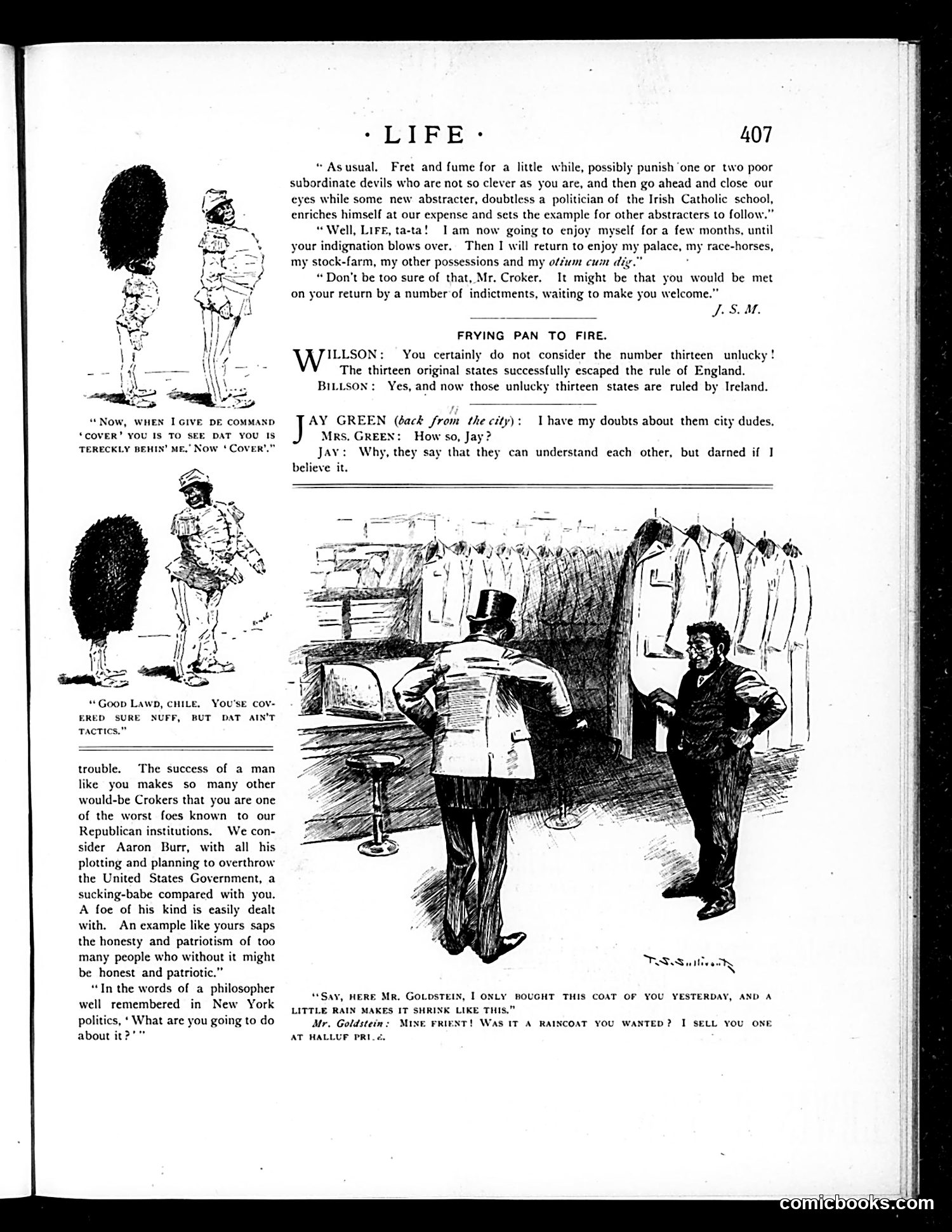
This page contains multiple satirical pieces targeting political corruption and ethnic stereotypes typical of early 20th-century American humor. **Main cartoon**: Depicts "Mr. Croker" (likely Richard Croker, New York's Tammany Hall boss), who is accused of embezzlement and corruption. Life warns that his continued success despite scandals corrupts American democracy worse than Aaron Burr's treason. Croker dismisses the criticism, expecting to escape consequences and enjoy his ill-gotten wealth ("my palace, my race-horses"). Life threatens future indictments upon his return. **Lower cartoons** use offensive dialect humor: - A military drill joke in exaggerated African American vernacular - An anti-Irish political jab suggesting Irish immigrants now "rule" America - A stereotypical Jewish merchant joke about a shrinking coat The page's satire targets genuine Gilded Age corruption (Tammany Hall graft) but relies heavily on ethnic caricatures—typical of Life's contemporary approach—making crude generalizations about Irish, Jewish, and Black Americans.
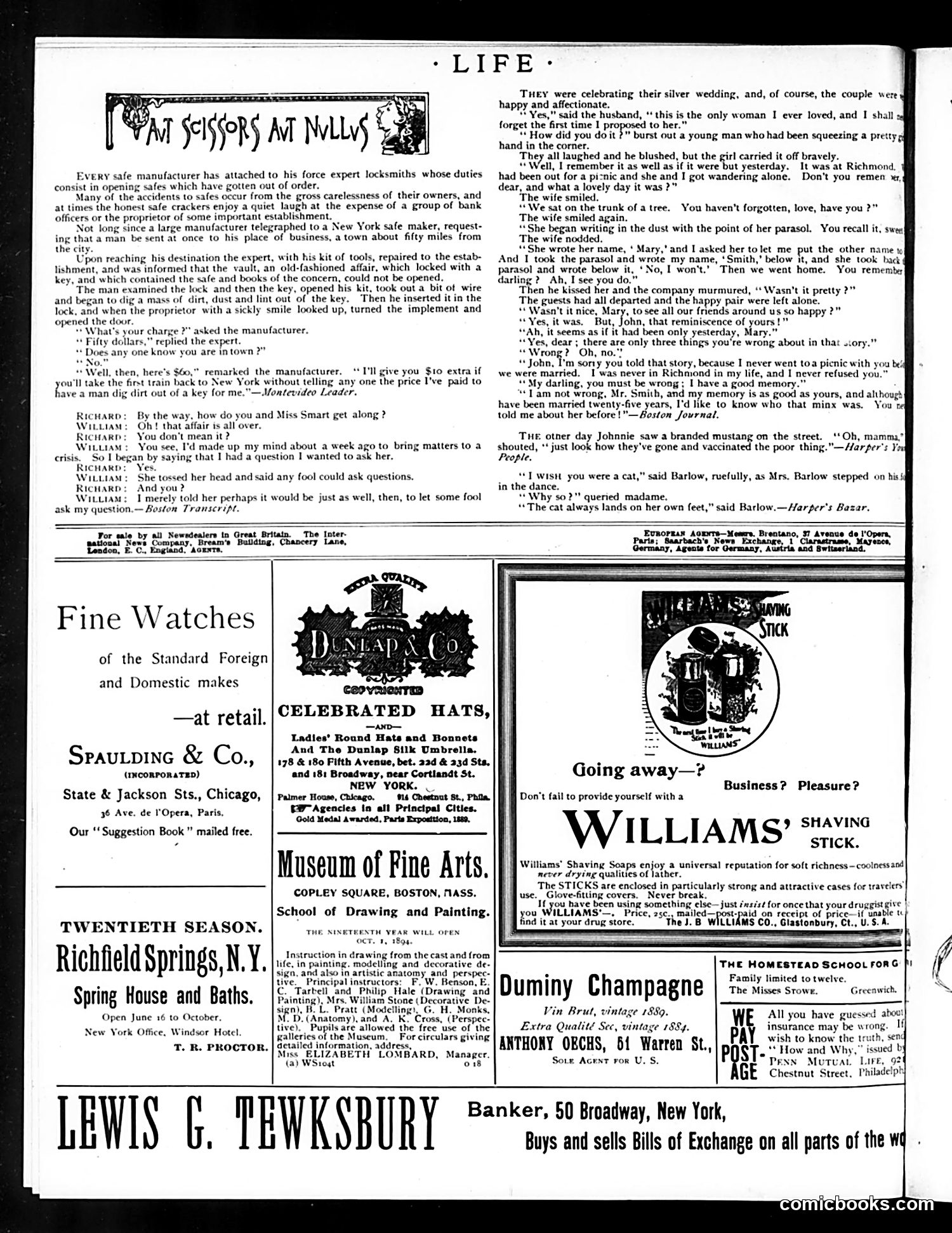
This page contains two distinct pieces: **Left side: A humorous anecdote** about a safe manufacturer's locksmith expert. When summoned to repair a jammed safe fifty miles away, the expert discovers the problem isn't the lock itself—it's dirt clogged in the key. He extracts the debris with a wire tool, solves the problem instantly, then negotiates payment upward when he realizes no one knows he's in town. The joke satirizes **expert overcharging**: the locksmith exploits his specialized knowledge and the manufacturer's desperation, doubling his fee once he confirms anonymity protects him from reputation damage. **Right side: A dialogue** (likely adapted from *Boston Transcript*) between Richard and William about relationship crisis and reconciliation, with William recounting a romantic proposal story set in Richmond involving a parasol and names written in dust—though the page's fragmentation makes the full narrative unclear. The main satire targets **professional expertise as leverage for fraud**—the locksmith's moral compromise when assured no oversight exists.