
Life, 1894-06-21 · page 10 of 14
Life — June 21, 1894 — page 10: what you’re looking at
What you’re looking at
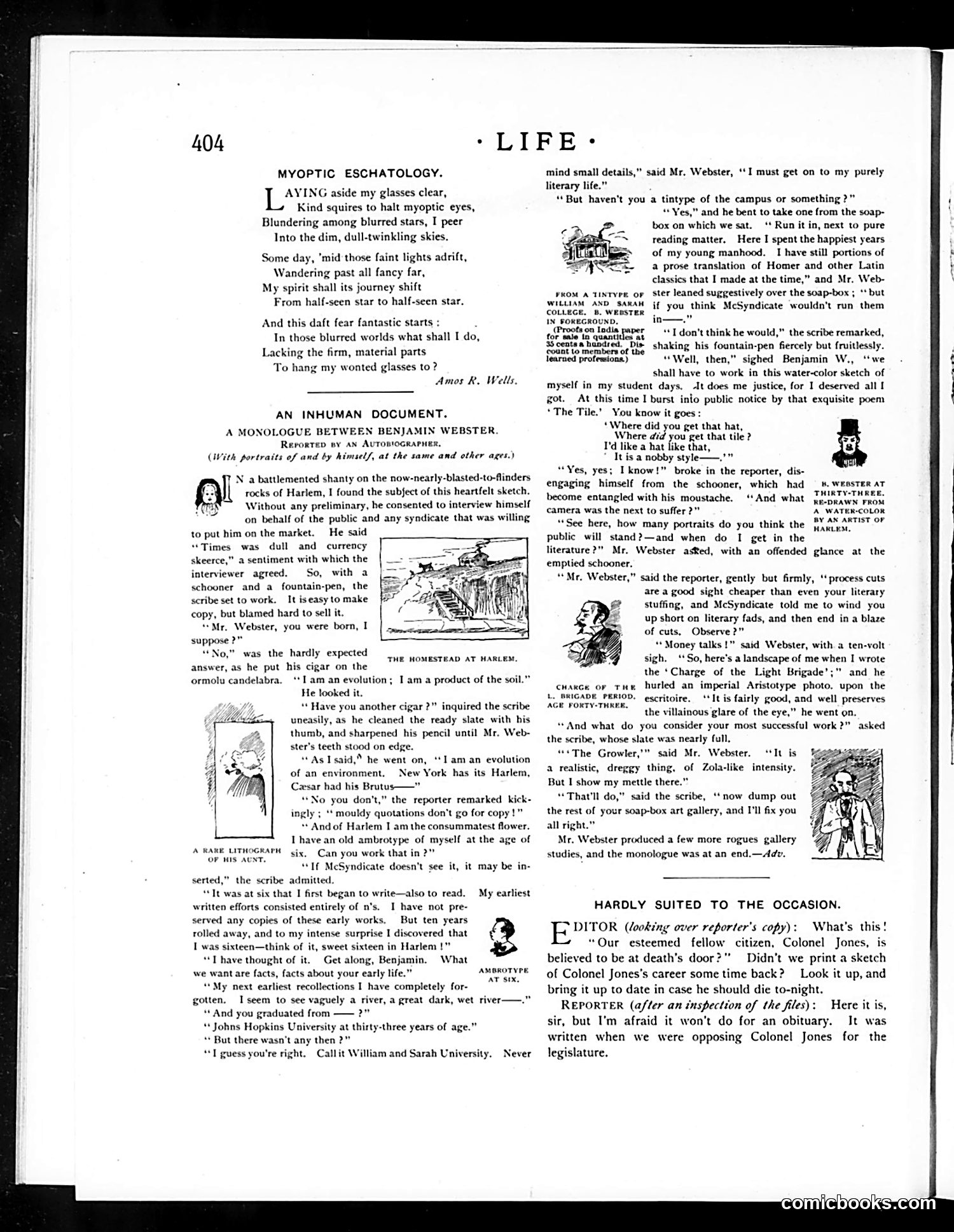
This page contains a satirical monologue titled "An Inhuman Document," featuring **Benjamin Webster**, a writer/artist shown in illustrations throughout. The piece mocks Webster's pretentious literary ambitions. The scribe interviews him about his "Schooner"—apparently an art project—which Webster describes with grandiose language ("I am an evolution; I am a product of the soil"). The reporter responds with biting skepticism, calling Webster's claims absurd and his artwork derivative ("Zola-like intensity"). The satire targets **artistic self-importance** and the gap between an artist's inflated self-perception and reality. Webster's grandiose proclamations about his work are repeatedly undercut by the reporter's practical, dismissive responses, suggesting the piece ridicules pretentious bohemian artists who use pseudo-intellectual language to justify mediocre work.
📄 Transcribed text from this page (OCR, searchable)
Machine-transcribed from the original scan — historical spelling and the odd misread are preserved.
- LIFE: MYOPTIC ESCHATOLOGY. Laue aside my glasses clear, Kind squires to halt myoptic eyes, Blundering among blurred stars, I peer Into the dim, dull-twinkling skies. Some day, ‘mid those faint lights adrift, Wandering past all fancy far, My spirit shall its journey shift From half-seen star to half-seen star. And this daft fear fantastic starts : : In those blurred worlds what shall I do, Lacking the firm, material parts To hang my wonted glasses to? Amos R. Wells. AN INHUMAN DOCUMENT. A MONOLOGUE BETWEEN BENJAMIN WEBSTER. Rerortep py AN AvTontocrarnen, (With portraits of and by himself, at the same and other ages.) N a battlemented shanty on the now-nearly-blasted-to-linders rocks of Harlem, I found the subject of this heartfelt sketch. Without any preliminary, he consented to interview himself ‘on behalf of the public and any syndicate that was willing to put him on the market. He said “Times was dull and currency skeerce,” a sentiment with which the interviewer agreed. So, with a schooner and a fountain-pen, the scribe set to work. It iseasy to make copy, but blamed hard to sell it. ‘Mr. Webster, you were born, I suppose?" “No,” was the hardly expected answer, as he put his cigar on the ormoly candelabra. ‘1am an evolution; Iam a product of the soil.” He looked it. “ Have you another cigar ?” inquired the scribe uneasily, as he cleaned the ready slate with bis thumb, and sharpened his pencil until Mr. Web- ster's teeth stood on edge. ‘As Isaid,® he went on, ‘1am an evolution of an environment. New York has its Harlem, Cxsar had his Brutus—” “No you don't,” the reporter remarked kick- ingly ; “ mouldy quotations don’t go for copy!” + And of Harlem I am the consummatest flower. Thave an old ambrotype of myself at the age of six, Can you work that in?” “If McSyndicate doesn't see it, it may be in- serted,” the scribe admitted. “It was at six that I first began to write—also to read. My earliest written efforts consisted entirely of n's. I have not pre- served any copies of these early works, But ten years rolled away, and to my intense surprise I discovered that I was sixteen—think of it, sweet sixteen in Harlem !" “Thave thought of it, Get along, Benjamin, What we want are facts, facts about your early life.” “My next earliest recollections I have completely for- gotten, Iseem to see vaguely a river, a great dark, wet river—." “And you graduated from — ?” “ Johns Hopkins University at thirty-three years of age.” * But there wasn't any then 2” “1 guess you're right. Callit William and Sarah University, Never THE HOMESTEAD AT MARLESt. A RARE LITHOGRAPH OF MIS AUNT. AMBROTYPE AT Six, mind small details,” said Mr, Webster, ‘(1 must get on to my purely literary life.” “But haven't you a tintype of the campus or something ?” “Yes,” and he bent to take one from the soap- box on which we sat.‘ Run it in, next to pure reading matter. Here I spent the happiest years of my young manhood. I have still portions of a prose translation of Homer and other Latin classics that I made at the time,” and Mr. Web- yeom A tintyre op ster leaned suggestively over the soap-box ; ** but WILLIAM AND SAKA if you think McSyndicate wouldn't run them COLLEGE. B. WEOSTER © IN BOKEGROUND. in—. on tadia paper «« I don't think he would,” the scribe remarked, shaking his fountain-pen fiercely but fruitlessly. “Well, then,” sighed Benjamin W. shall have to work in this water-color sketch of myself in my student days, It does me justice, for I deserved all I got. At this time I burst into public notice by that exquisite poem ‘The Tile.’ You know it goes : ‘Where did you get that hat, Where did you get that tile? I'd like a hat like that, It isa nobby style——."" “Yes, yes; Iknow!” broke in the reporter, dis- engaging himself from the schooner, which had _¥. WessTeR AT become entangled with his moustache. ‘And what jntbeawn pron camera was the next to suffer?” A WATER-COLOR “See here, how many portraits do you think the ume public will stand?—and when do I get in the literature?” Mr. Webster asfed, with an offended glance at the emptied schooner, “Mr, Webster,” said the reporter, gently but firmly, “process cuts are a good sight cheaper than even your literary stuffing, and McSyndicate told me to wind you up short on literary fads, and then end ina blaze of cuts, Observe ?” “ Money talks 1” said Webster, with a ten-volt sigh, ‘So, here's a landscape of me when I wrote the ‘Charge of the Light Brigade’;" and he cuaxce or te hurled an imperial Aristotype photo. upon the Lu BRIGADE PERIOD. escritoire, ‘It is fairly good, and well preserves the villainous glare of the eye,” he went on. “And what do you consider your most successful work ?” asked the scribe, whose slate was nearly full, “<The Growler," said Mr. Webster. “It is a realistic, dreggy thing, of Zola-like intensity. But I show my mettle there.” “That'll do,” said the scribe, ‘now dump out the rest of your soap-box art gallery, and I'll fix you all right.” Mr. Webster produced a few more rogues gallery studies, and the monologue was at an end.—Adv. ‘count to members of the learned professions) HARDLY SUITED TO THE OCCASION. DITOR (looking over reporter's copy): What's this! “Our esteemed fellow zen, Colonel Jones, is believed to be at death’s door? Didn’t we print a sketch of Colonel Jones's career some time back? Look it up, and bring it up to date in case he should die to-night. REPORTER (after an inspection of the files): Here it is, but I'm afraid it won't do for an obituary. It was en when we were opposing Colonel Jones for the legislature. ‘