
Life, 1894-06-21 · page 4 of 14
Life — June 21, 1894 — page 4: what you’re looking at
What you’re looking at
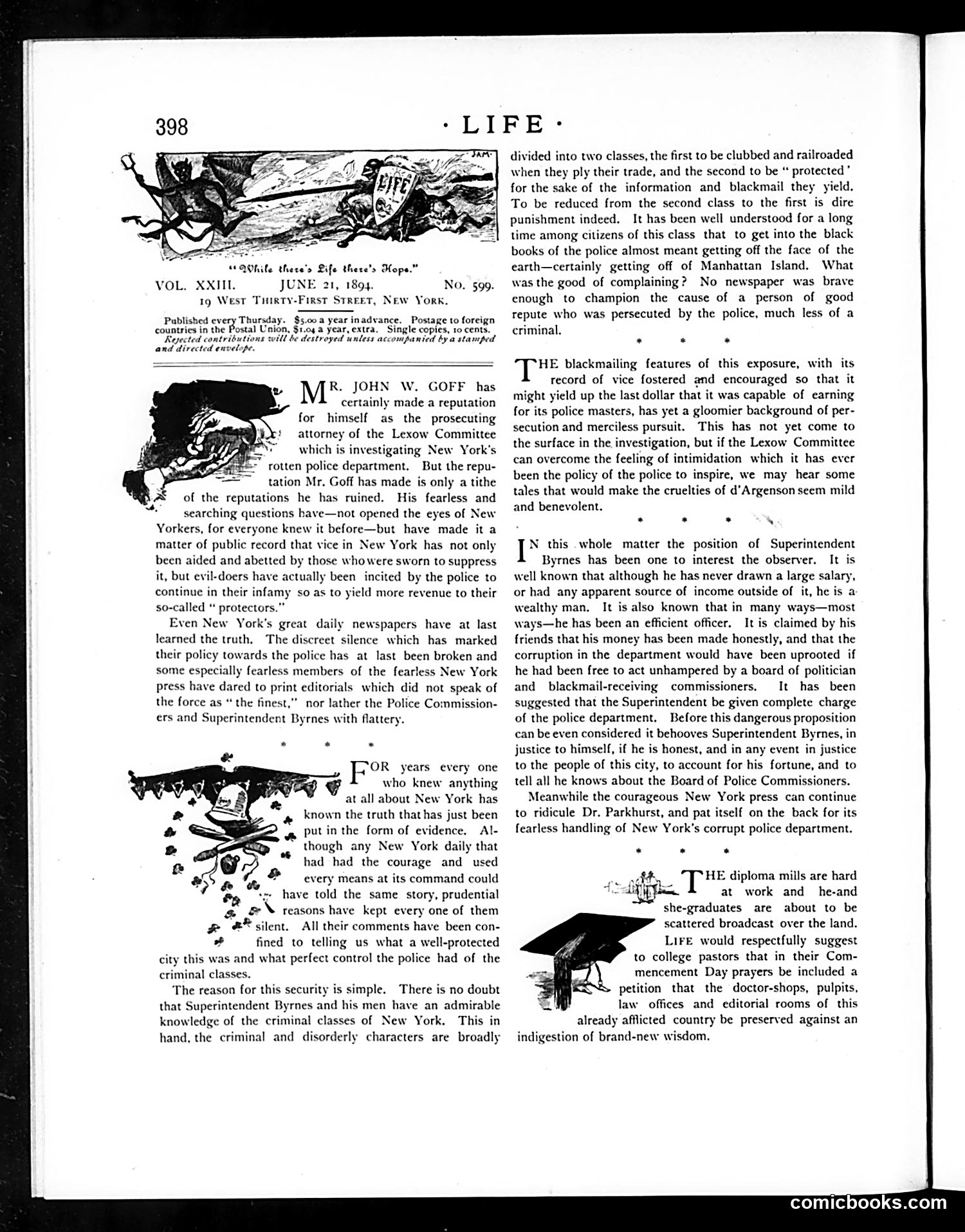
This page discusses police corruption in New York City under Superintendent Byrnes. The article criticizes how the police department allegedly tolerated vice and blackmail operations, with officers extorting money from criminals in exchange for protection. **Key figures referenced:** - **John W. Goff**: Prosecutor investigating the Lexow Committee's findings on police corruption - **Superintendent Byrnes**: Police leader accused of enabling corruption, though the article notes his unexplained wealth suggests possible complicity **The satire's point:** Despite New York's major newspapers knowing about systematic police corruption for years, they remained silent—likely due to police intimidation. The article sardonically suggests only brave individuals would expose this abuse, calling out the press's cowardice in not challenging police authority sooner. This reflects the genuine Lexow Committee investigations (1894-1895) that exposed widespread NYPD corruption.
📄 Transcribed text from this page (OCR, searchable)
Machine-transcribed from the original scan — historical spelling and the odd misread are preserved.
‘LIFE: While th VOL. XXIII. jun 2 Sife there's Hope.” = 21, 1894. No. 599. 19 West Tiirty-First STREET, New York. Published every Thursday. $5.00 a year inadvance. Postage to foreign countries in the Postal Union, $1.04 a year,extra. Single copies, to cents. Reyected contributions will be destroyed untess accompanied bya stamped and directed envelope, R. JOHN W. GOFF has certainly made a reputation for himself as the prosecuting attorney of the Lexow Committee which is investigating New York's rotten police department, But the repu- tation Mr. Goff has made is only a tithe of the reputations he has ruined. His fearless and searching questions have—not opened the eyes of New Yorkers, for everyone knew it before—but have made it a matter of public record that vice in New York has not only been aided and abetted by those who were sworn to suppress it, but evil-doers have actually been incited by the police to continue in their infamy so as to yield more revenue to their so-called “ protectors.” Even New York's great daily newspapers have at last learned the truth, The discreet silence which has marked their policy towards the police has at last been broken and some especially fearless members of the fearless New York press have dared to print editorials which did not speak of the force as “ the finest,” nor lather the Police Commission- ers and Superintendent Byrnes with flattery. [OR years every one who knew anything at all about New York has known the truth that has just been put in the form of evidence. Al- though any New York daily that had had the courage and used every means at its command could sp have told the same story, prudential & g& \ reasons have kept every one of them F #* silent. All their comments have been con- e fined to telling us what a well-protected city this was and what perfect control the police had of the criminal classes. The reason for this security is simple. There is no doubt that Superintendent Byrnes and his men have an admirable knowledge of the criminal classes of New York, This in hand, the criminal and disorderly characters are broadly divided into two classes, the first to be clubbed and railroaded when they ply their trade, and the second to be “ protected’ for the sake of the information and blackmail they yield. To be reduced from the second class to the first is dire punishment indeed. It has been well understood for a long time among citizens of this class that to get into the black books of the police almost meant getting off the face of the earth—certainly getting off of Manhattan Island. What was the good of complaining? No newspaper was brave enough to champion the cause of a person of good repute who was persecuted by the police, much less of a criminal. . . . Tt blackmailing features of this exposure, with its record of vice fostered and encouraged so that it might yield up the last dollar that it was capable of earning for its police masters, has yet a gloomier background of per- secution and merciless pursuit. This has not yet come to the surface in the investigation, but if the Lexow Committee can overcome the feeling of intimidation which it has ever been the policy of the police to inspire, we may hear some tales that would make the cruelties of d’Argenson seem mild and benevolent. . . . \ I N this whole matter the position of Superintendent Byrnes has been one to interest the observer. It is well known that although he has never drawn a large salary, or had any apparent source of income outside of it, he is a wealthy man. It is also known that in many ways—most ways—he has been an efficient officer. It is claimed by his friends that his money has been made honestly, and that the corruption in the department would have been uprooted if he had been free to act unhampered by a board of politician and blackmail-receiving commissioners. It has been suggested that the Superintendent be given complete charge of the police department. Before this dangerous proposition can be even considered it behooves Superintendent Byrnes, in justice to himself, if he is honest, and in any event in justice to the people of this city, to account for his fortune, and to tell all he knows about the Board of Police Commissioners. Meanwhile the courageous New York press can continue to ridicule Dr. Parkhurst, and pat itself on the back for its fearless handling of New York's corrupt police department. * * HE diploma mills are hard at work and he-and she-graduates are about to be scattered broadcast over the land. Lire would respectfully suggest to college pastors that in their Com- mencement Day prayers be included a petition that the doctor-shops, pulpits, P law offices and editorial rooms of this already afflicted country be preserved against an indigestion of brand-new wisdom. comicbooks.com