
A complete issue · 20 pages · 1894
Life — May 31, 1894
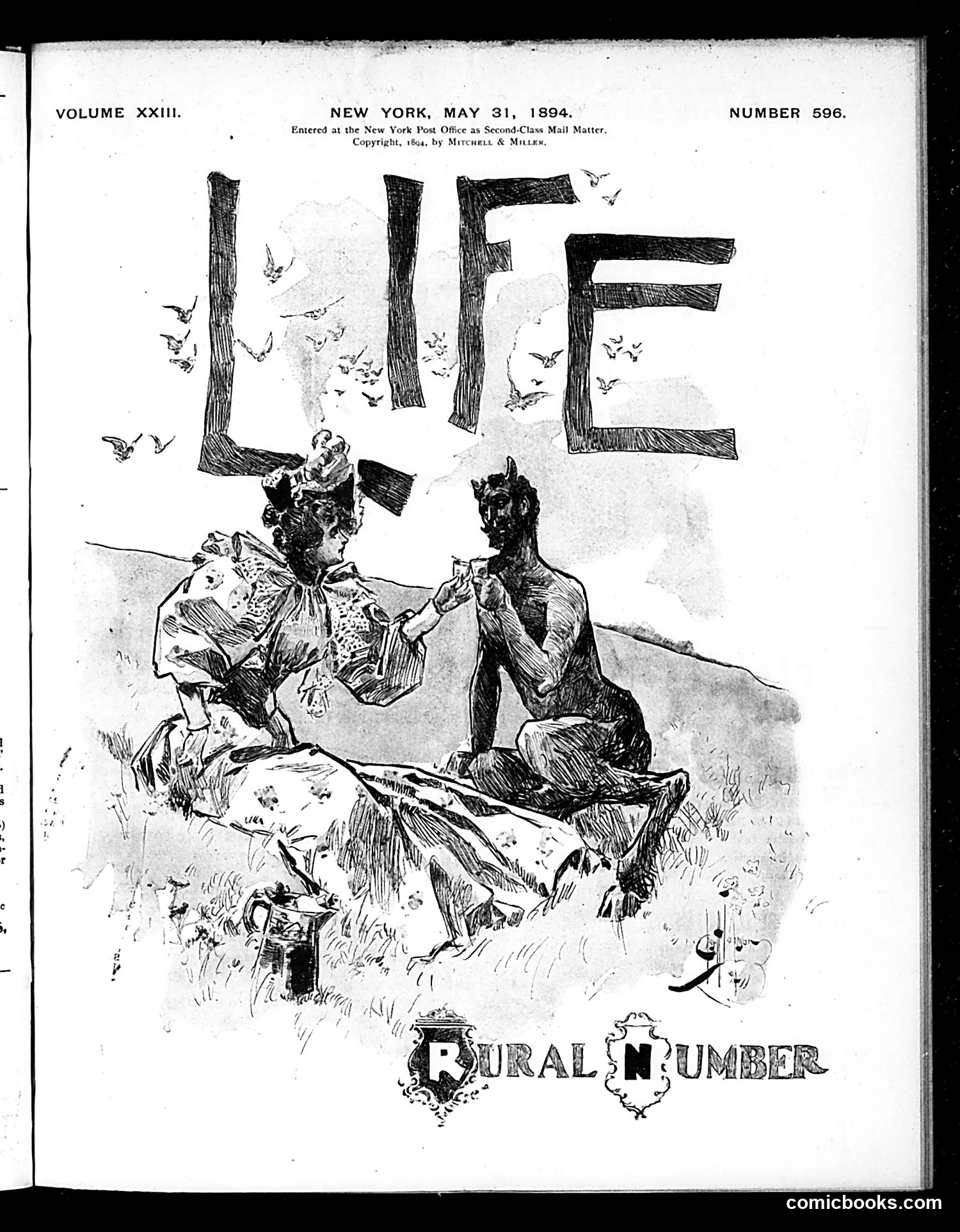
This cover depicts two figures in a rural setting beneath the large word "LIFE." The subtitle reads "RURAL NUMBER," indicating this issue focuses on countryside themes. The illustration shows what appears to be a woman (left, dressed elaborately) and a man (right, depicted with exaggerated features suggesting caricature) sitting together outdoors. Flying birds and grassland suggest an idyllic rural scene. Without additional context from the magazine's interior, the specific satirical point remains unclear. However, given Life's consistent focus on social satire, this likely comments on urban-rural contrasts, courtship customs, or social class differences during the 1890s. The exaggerated character portrayals suggest mockery of either rural life itself or urban misconceptions about countryside society.
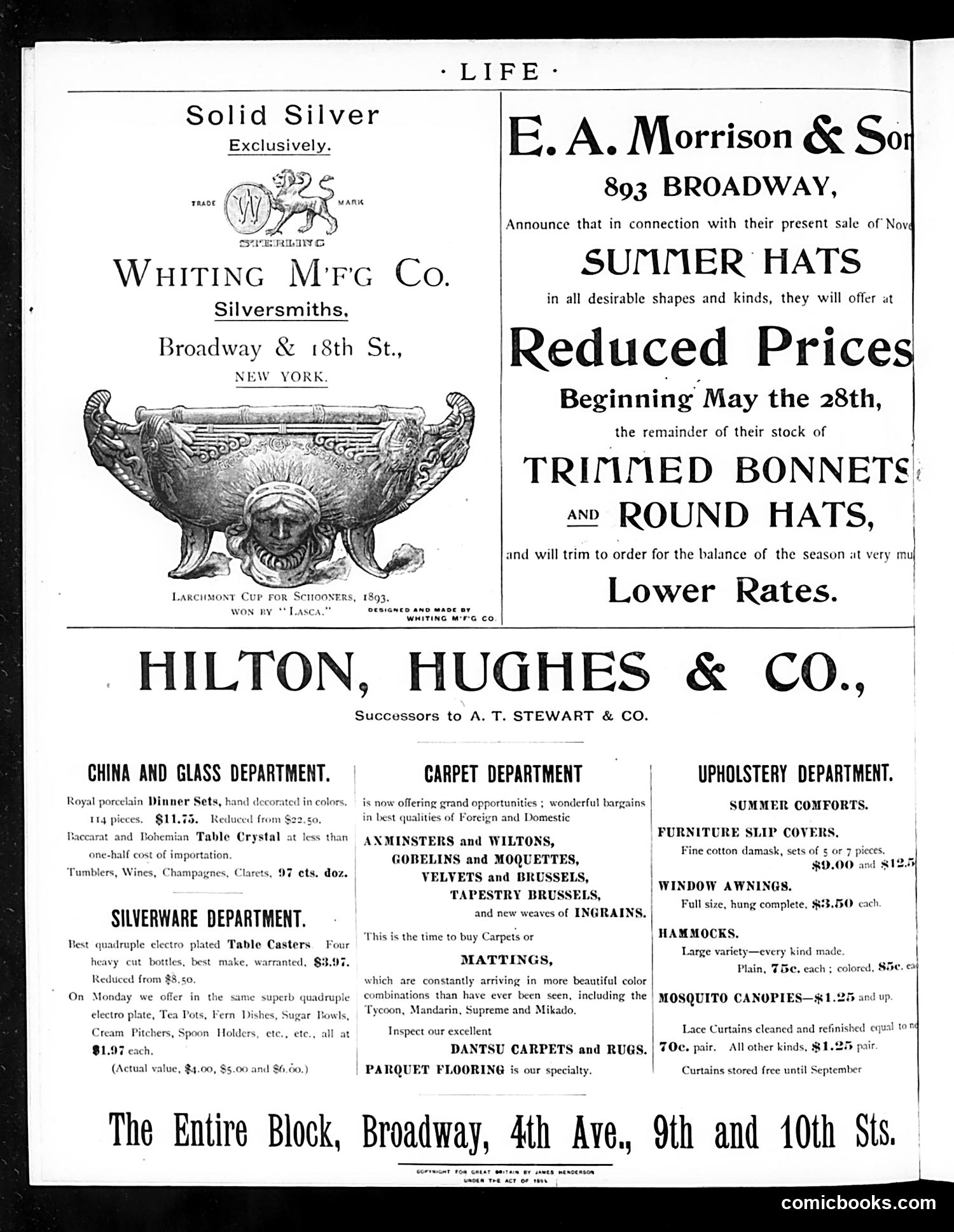
This page is **primarily advertising**, not political satire or editorial content. It contains four commercial advertisements: 1. **Whiting Mfg Co.** (silversmiths) — promotes solid silver goods with an ornamental cup illustration 2. **E.A. Morrison & Son** (Broadway) — advertises summer hats and trimmed bonnets at reduced prices 3. **Hilton, Hughes & Co.** — a major department store offering china, glassware, carpets, upholstery, silverware, and other household goods across multiple departments The page reflects late 19th-century retail commerce, with period-specific products (Tycoon carpets, Dantsu rugs, mosquito canopies). There is **no political cartoon or satire present** — this is a straightforward commercial advertising section from *Life* magazine's back pages.
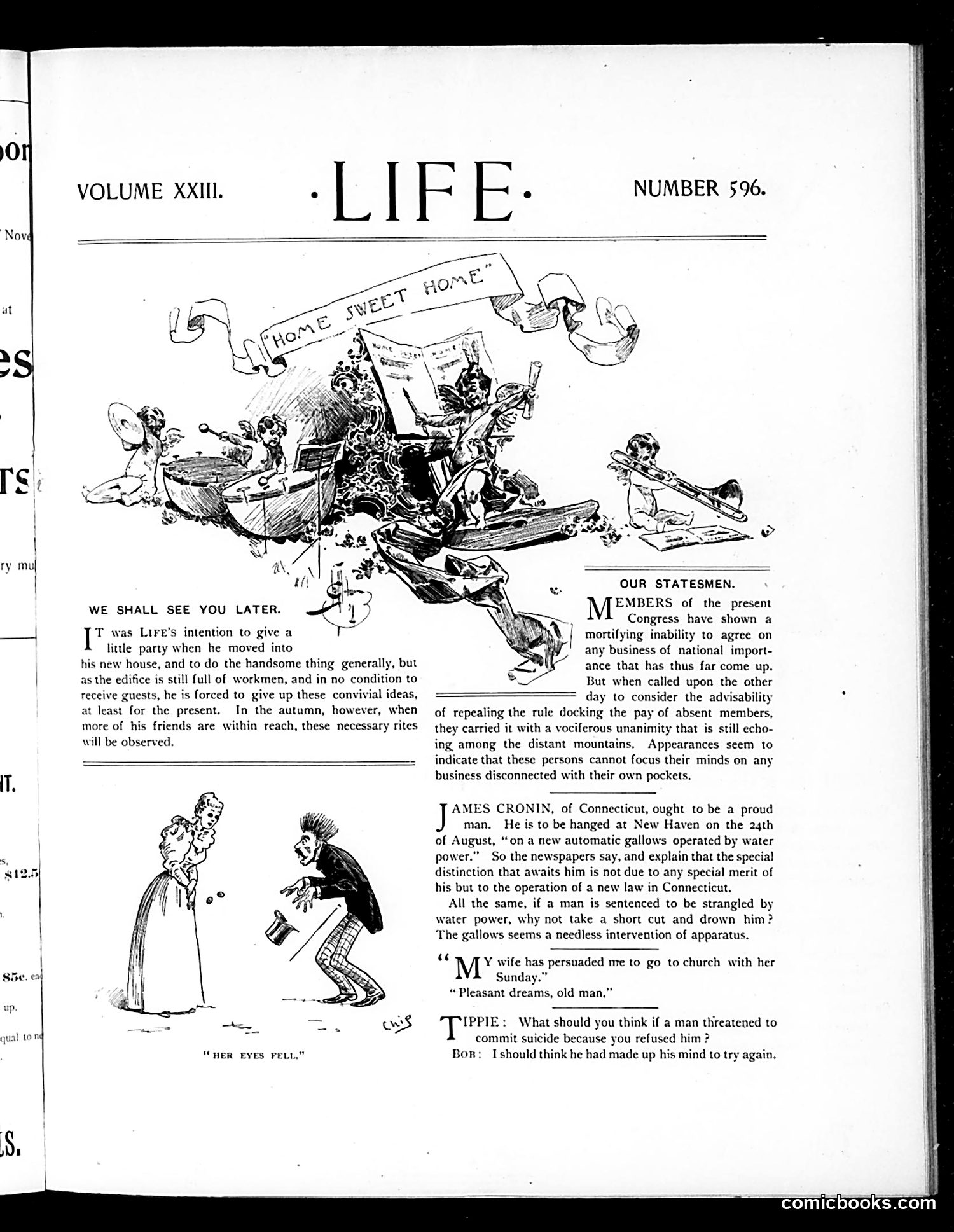
This page from *Life* magazine (Volume XXIII, Number 596) contains two distinct sections: **"We Shall See You Later"** (top): A satirical cartoon showing cherubs/putti amid household items and a "Home Sweet Home" banner. The caption suggests *Life* magazine's editor postponed a housewarming party because the building remained under construction with workers present—a humorous commentary on domestic chaos and imperfect timing. **"Our Statesmen"** (bottom): A political commentary criticizing Congress members for their inability to focus on important national business, particularly regarding a rule about docking pay for absent members. The piece sarcastically suggests these politicians cannot concentrate on matters beyond their own financial interests. **"Her Eyes Fell"** (left): A small comic sketch showing a woman's emotional reaction, likely depicting romantic or social disappointment. The page demonstrates *Life*'s satirical approach to both domestic life and political critique.
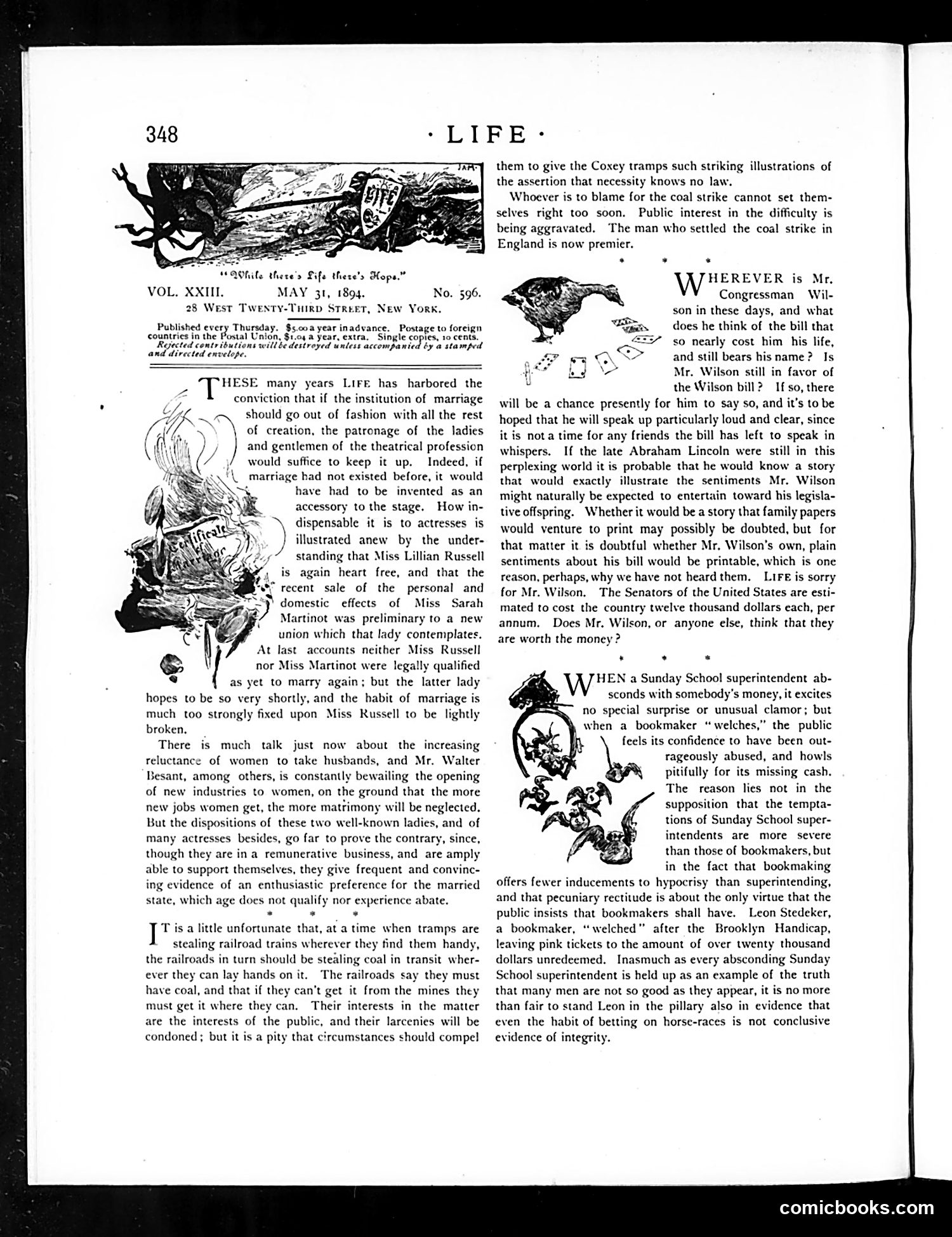
The page contains three satirical commentaries on contemporary issues: 1. **Marriage and the Stage** (main left article): Discusses whether stage actresses should marry, prompted by Miss Sarah Martinot's recent sale of "personal and domestic effects" preceding a rumored remarriage. The text argues actresses prove capable of self-support, contrary to assumptions about women needing husbands. 2. **The Wilson Bill** (right section, marked "WHEREVER"): References Congressman Wilson's nearly-fatal involvement with legislation (unclear which specific bill), questioning whether he still supports it—implying the near-death experience should have changed his position. 3. **Sunday School Superintendent vs. Bookmaker** (bottom right): Compares integrity levels, noting a bookmaker ("welched" on Brooklyn Handicap bets) proves no worse than a superintendent held accountable for embezzled funds—satirizing hypocrisy about morality.
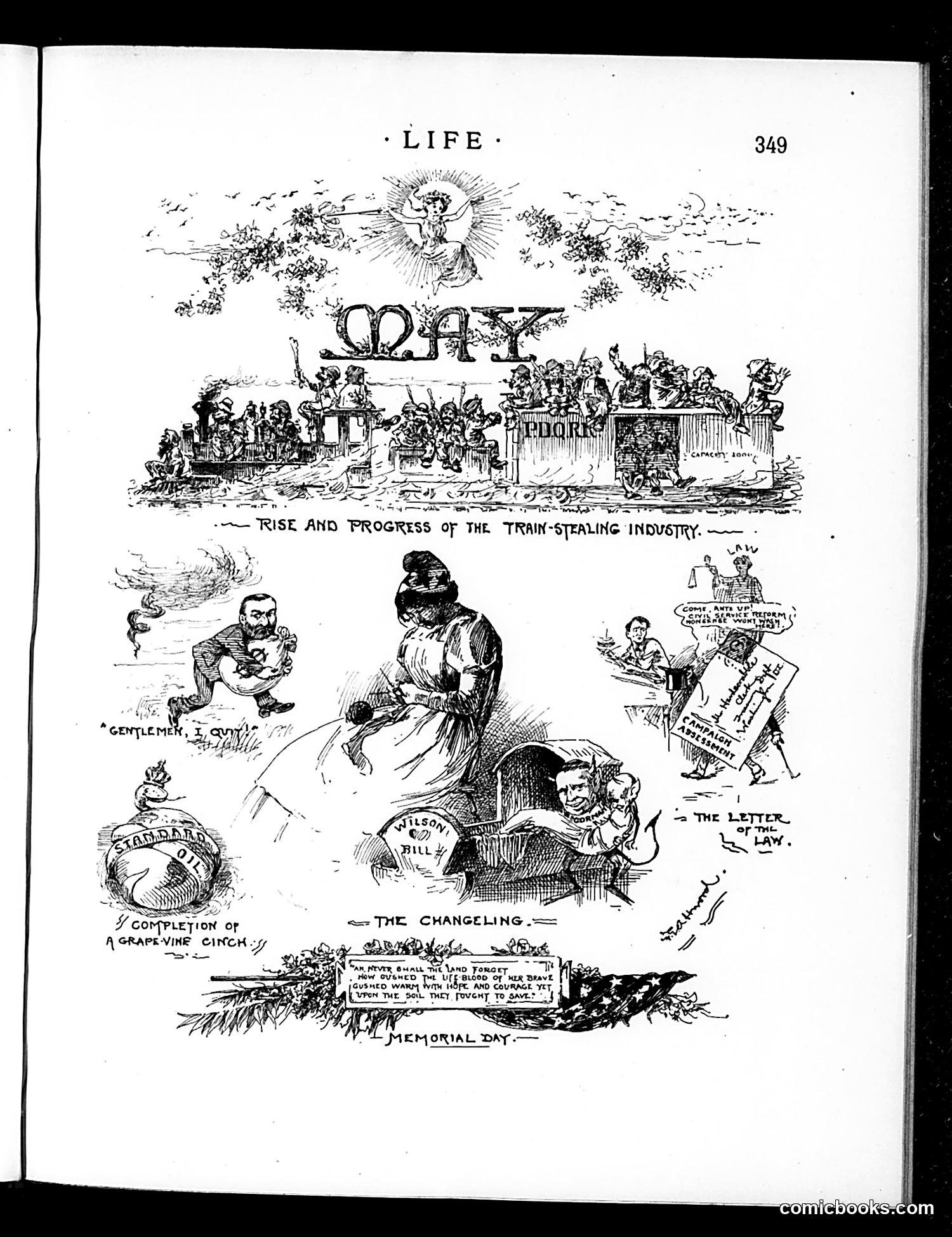
This page presents satirical commentary on turn-of-the-century American politics and society. **Top section** depicts the "Rise and Progress of the Train-Stealing Industry"—likely referencing railroad scandals or labor disputes of the era. **"The Changeling"** cartoon (center) appears to criticize political leadership, showing a woman (possibly representing the nation or public interest) with a man labeled "Wilson" and another figure labeled "Bill." This likely references President Woodrow Wilson and political maneuvering. **"The Letter of the Law"** (right) suggests hypocrisy in legal/governmental enforcement. **"Completion of a Grapevine Bunch"** and **"Memorial Day"** (bottom) reference patriotic observance, possibly critiquing superficial commemoration versus genuine sacrifice. The overall theme appears to satirize political corruption, corporate malfeasance, and gap between ideals and practice in early-20th-century America.
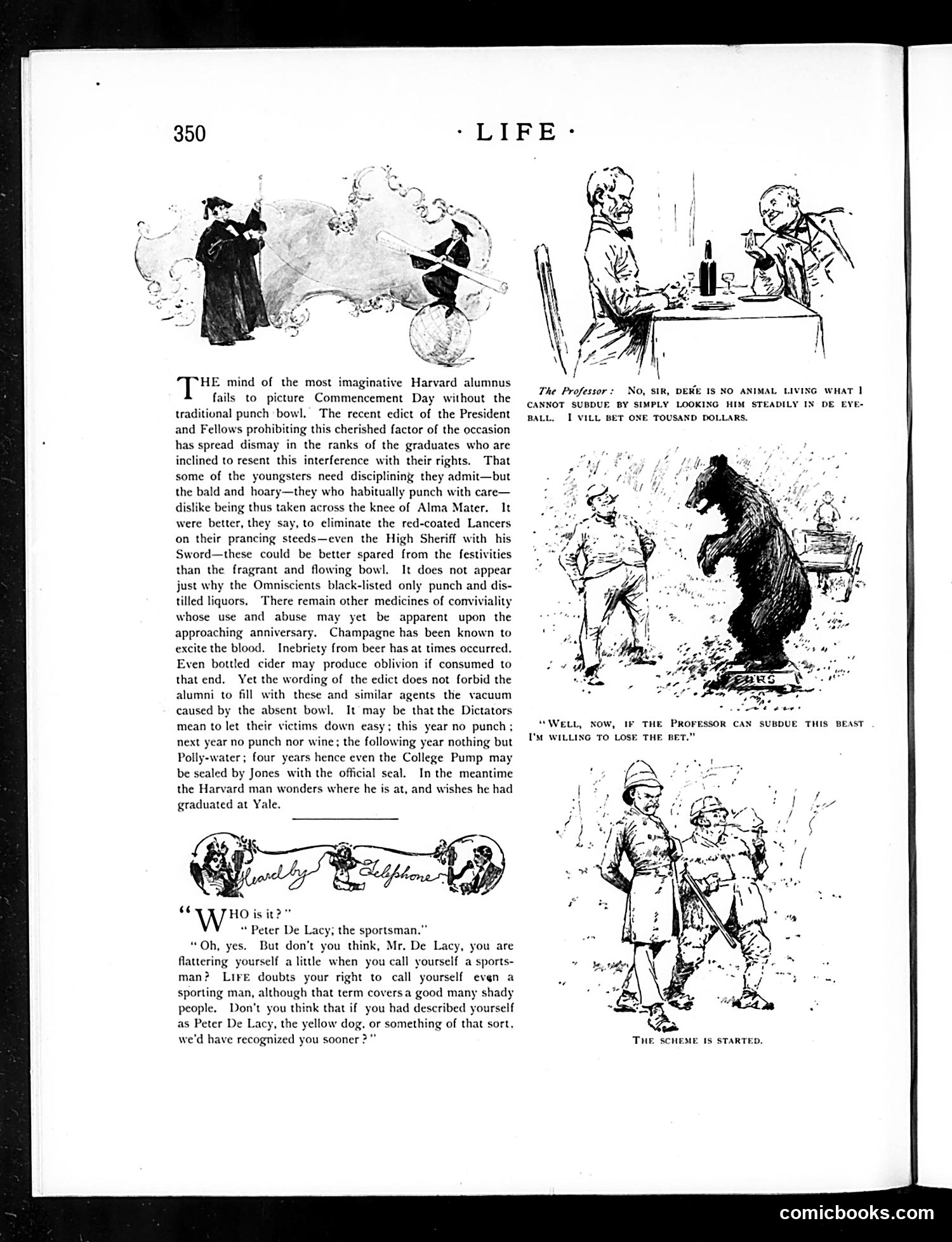
This page satirizes Harvard's Commencement Day traditions. The main article criticizes the recent elimination of the ceremonial punch bowl—a cherished fixture at Harvard graduations. The author mocks the decision, suggesting it reflects overly strict discipline imposed on alumni who traditionally enjoyed this convivial beverage. The cartoons illustrate the consequences: graduates attempting to smuggle in alcohol or find alternative ways to celebrate without the official punch. One caption reads "Well, now, if the Professor can subdue this beast I'm willing to lose the bet," suggesting wagers involving alcohol consumption. The "Who is it?" section briefly discusses Peter De Lacy, a sportsman, with satirical commentary about self-aggrandizing claims. Overall, the page mocks Harvard's austere new policies regarding alcohol at graduation celebrations.
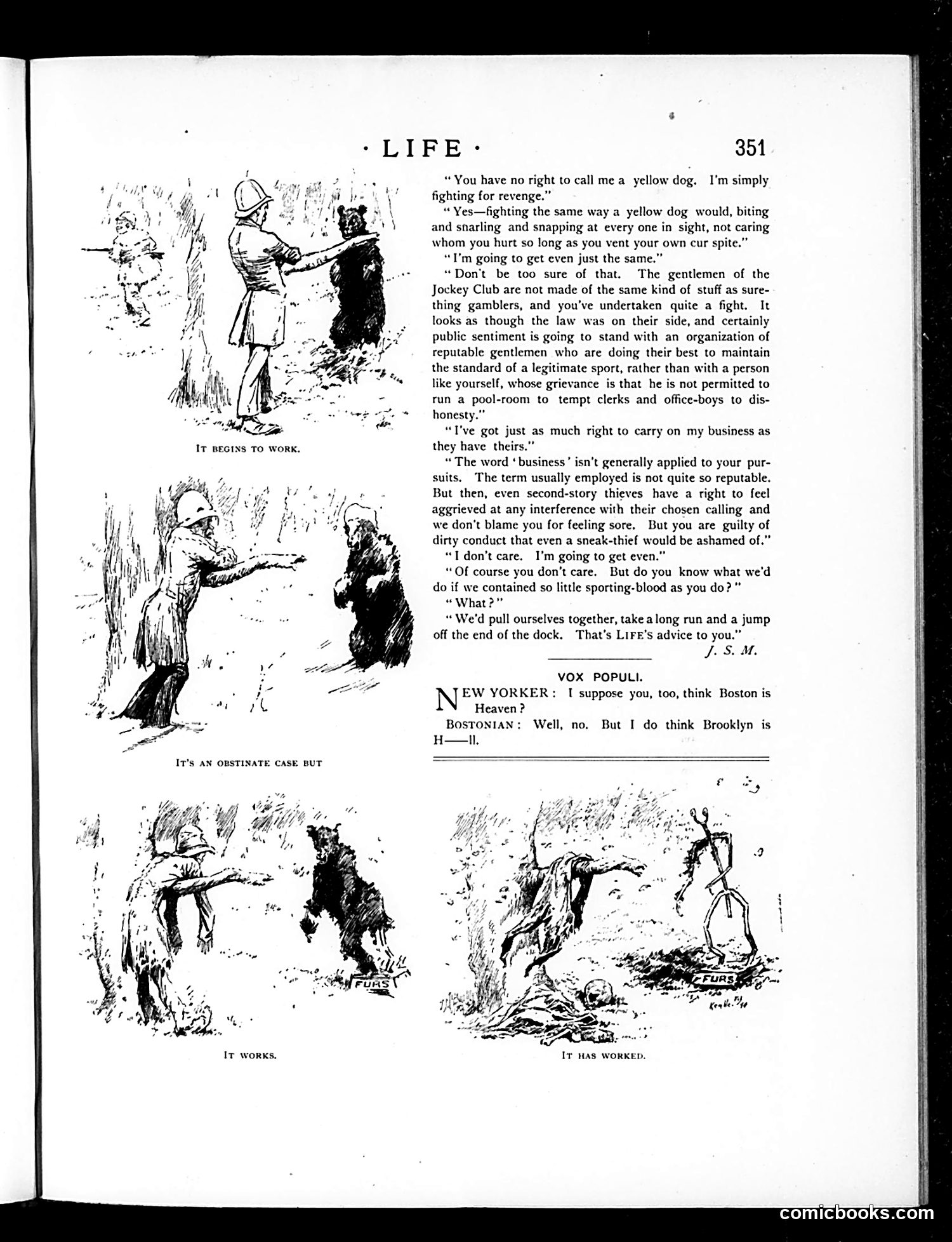
This page satirizes a dispute involving the Jockey Club—an exclusive organization overseeing horse racing. A man (appears to be someone running an illegal gambling operation or pool room) confronts a uniformed official, claiming he has "as much right" to conduct his business as they do theirs. The satire mocks the man's hypocrisy: he operates dishonest gambling while accusing the Jockey Club of impropriety. The accompanying comics show a dog being trained through progressive steps—a visual metaphor suggesting even "dirty conduct" can be normalized through repetition. The piece critiques how those engaged in shady enterprises rationalize their actions by attacking established institutions, while the Jockey Club maintains standards of "legitimate sport" versus back-room gambling schemes.
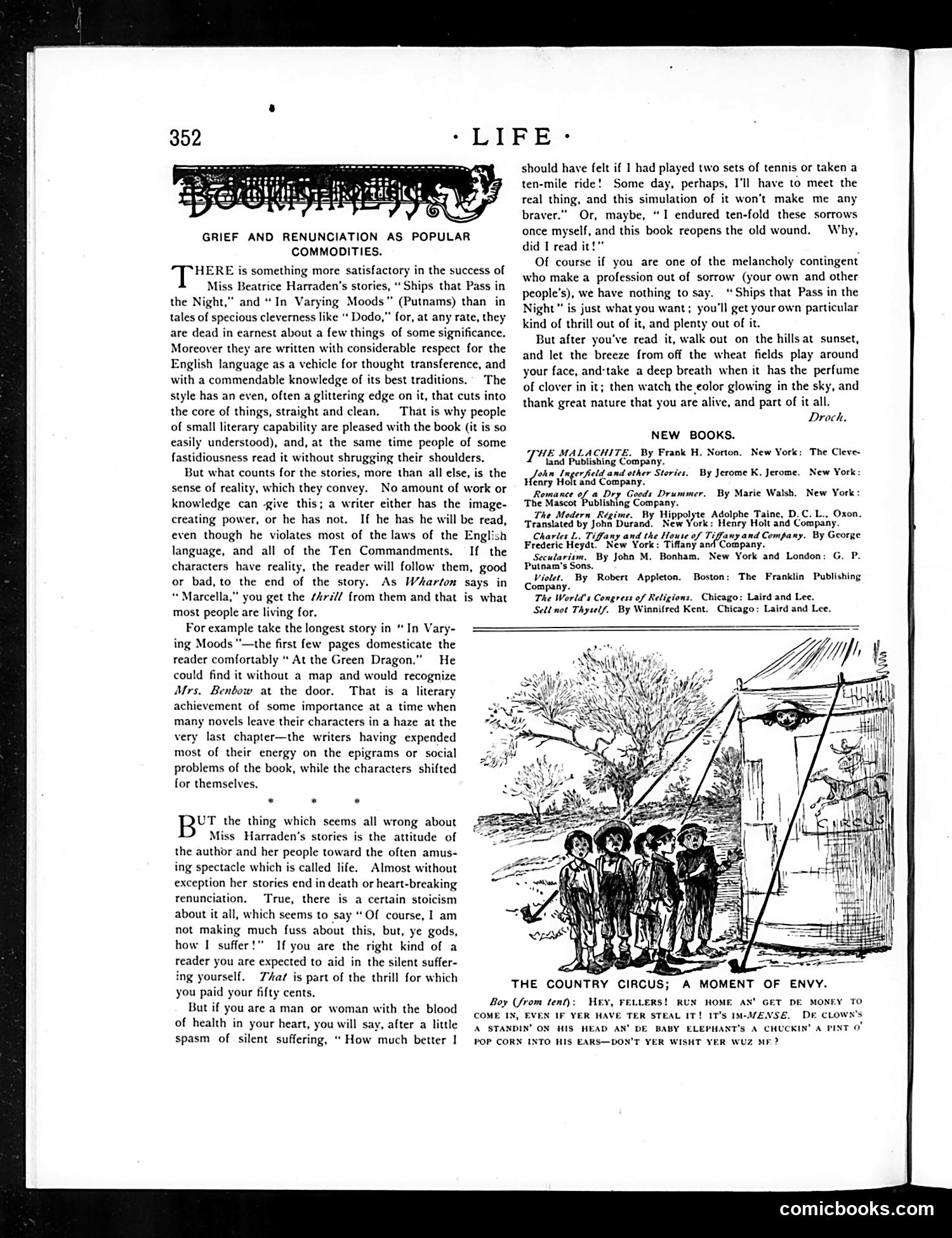
This cartoon depicts four children standing outside a circus tent, looking in with longing. The caption includes dialect dialogue from a boy expressing envy of the circus performers and animals inside—he wishes he had money to attend and mentions specific acts like an elephant and clown. The satire comments on economic inequality and childhood desires. Poor children are locked out of entertainment due to lack of funds, while the circus represents accessible spectacle and joy for those who can afford admission. The boy's wistful monologue emphasizes the gap between what working-class children want and what they can actually experience, a common theme in *Life* magazine's social commentary during the early 20th century.
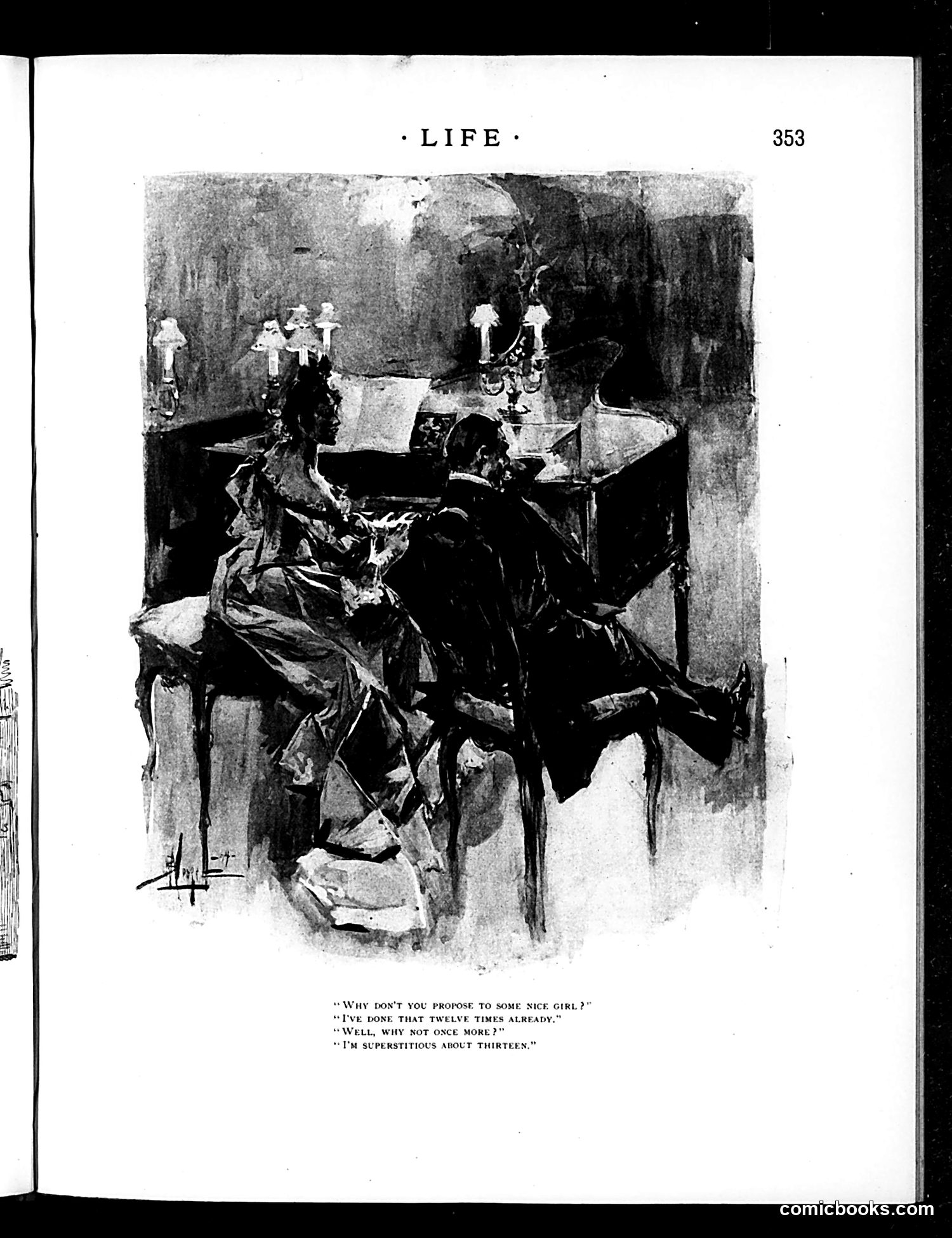
This illustration shows two figures seated at a dining table with candles and place settings, depicting an intimate dinner scene. The dialogue below reveals the satire: **"Why don't you propose to some nice girl?"** **"I've done that twelve times already."** **"Well, why not once more?"** **"I'm superstitious about thirteens."** The joke plays on the superstition surrounding the number thirteen—the man has been rejected twelve times in marriage proposals and refuses to try a thirteenth time, fearing bad luck. The satire mocks male persistence in courtship and the absurdity of attributing repeated romantic failure to superstition rather than addressing actual character flaws or compatibility issues. It's a commentary on both courtship customs of the era and irrational reasoning masking deeper problems.
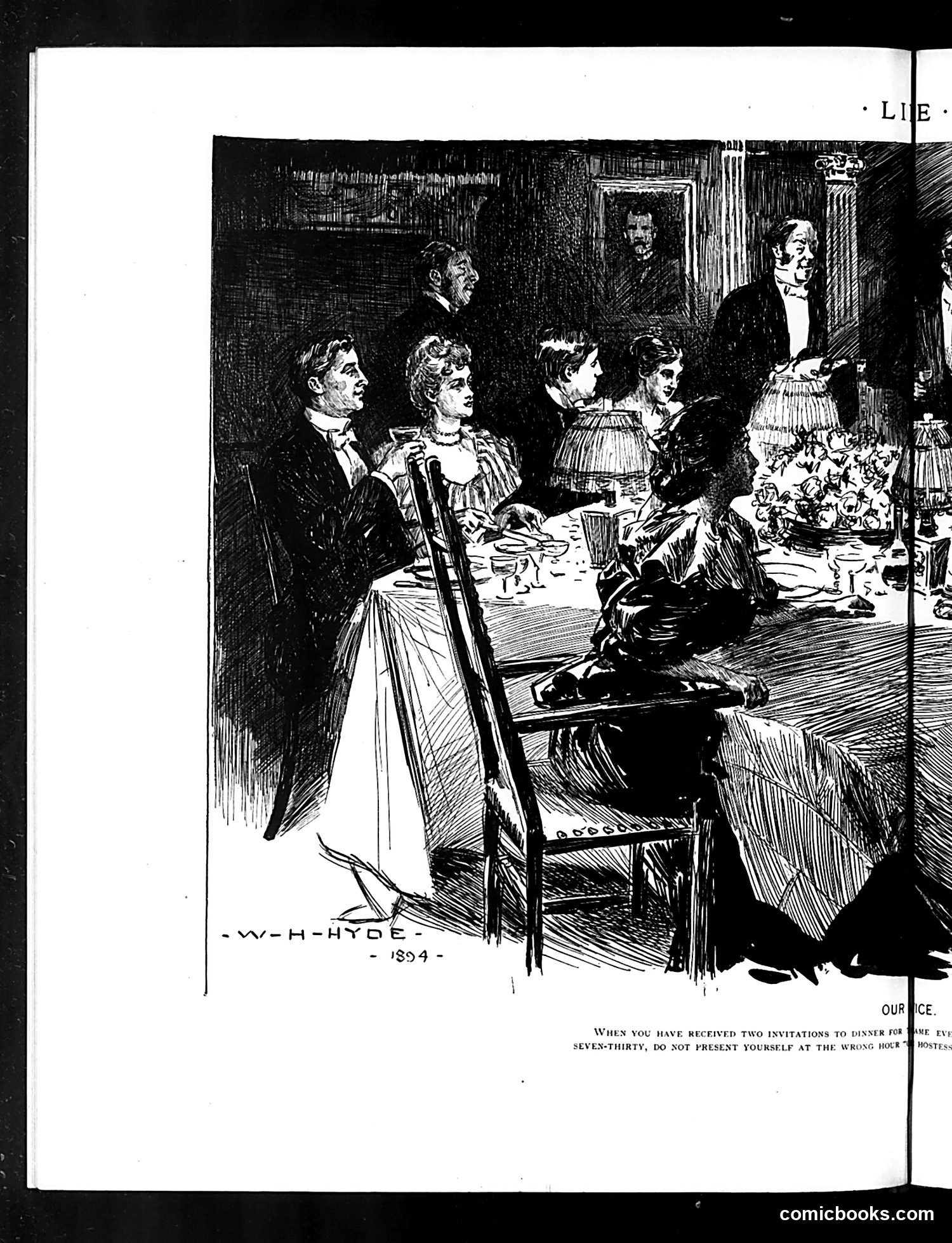
This 1894 W.H. Hyde illustration satirizes upper-class social etiquette, specifically the confusion caused by receiving multiple dinner invitations for the same evening. The caption warns: "When you have received two invitations to dine for the same evening at seven-thirty, do not present yourself at the wrong house." The sketch depicts a formal dinner party where a gentleman appears to have arrived at an incorrect address—creating an awkward social situation. The satire mocks how seriously Victorian high society took such breaches of proper conduct. What seems a minor mistake to modern sensibilities was treated as a serious social embarrassment in the 1890s. The humor relies on readers' familiarity with rigid etiquette rules governing polite society gatherings.
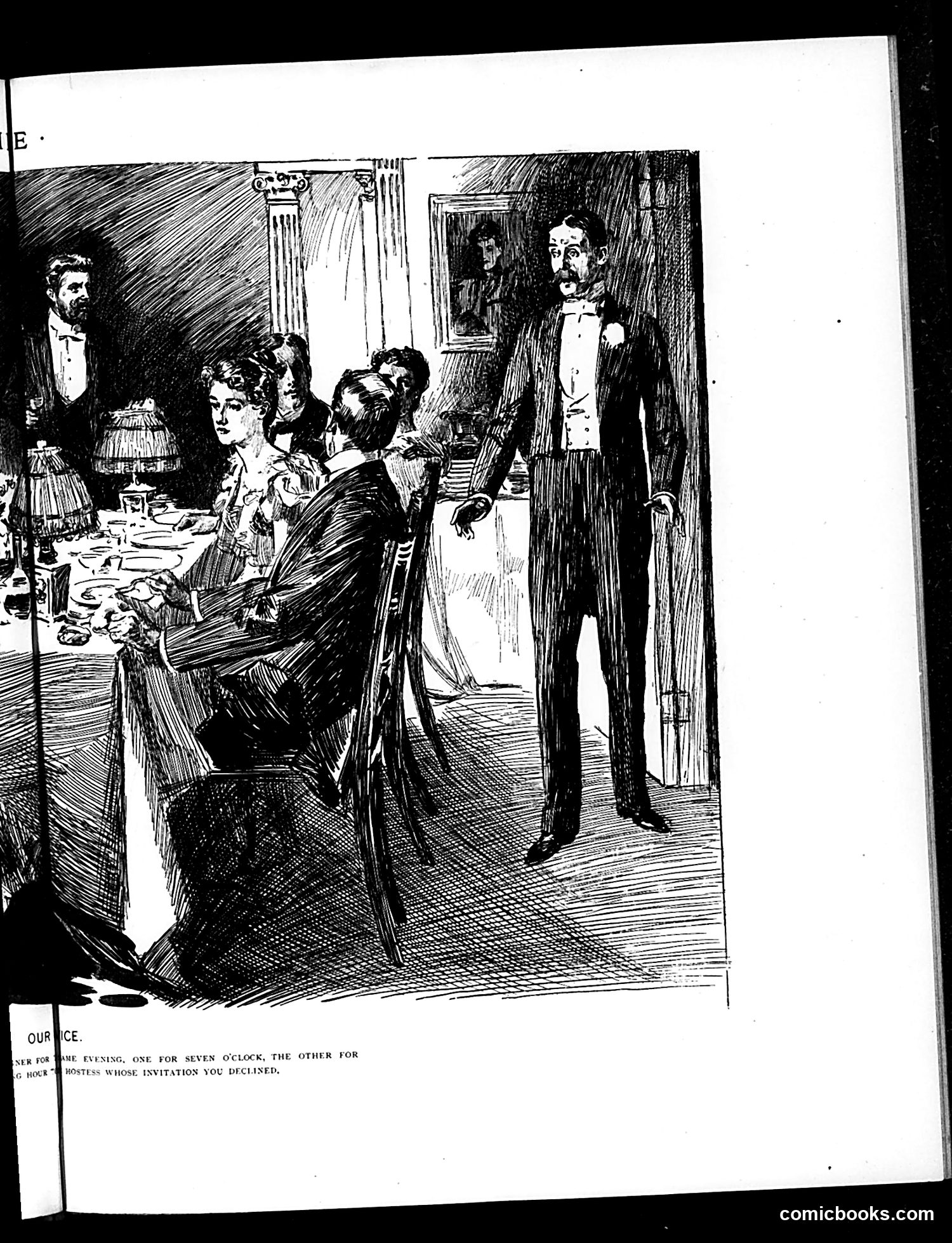
This appears to be a satirical illustration of high society etiquette from *Life* magazine. The scene depicts a formal dinner party where a well-dressed gentleman (right) stands confronting or addressing the assembled guests. The OCR'd text references "two invitations" for the same evening—one at seven o'clock, another from "a hostess whose invitation you declined." The satire targets the social awkwardness and hypocrisy of upper-class society: the gentleman has apparently accepted a dinner invitation while already committed elsewhere, creating an uncomfortable situation. The illustration mocks both his dilemma and the rigid social conventions governing such situations. The formal dress and elegant setting emphasize that this is about maintaining appearances and social standing among the wealthy elite.
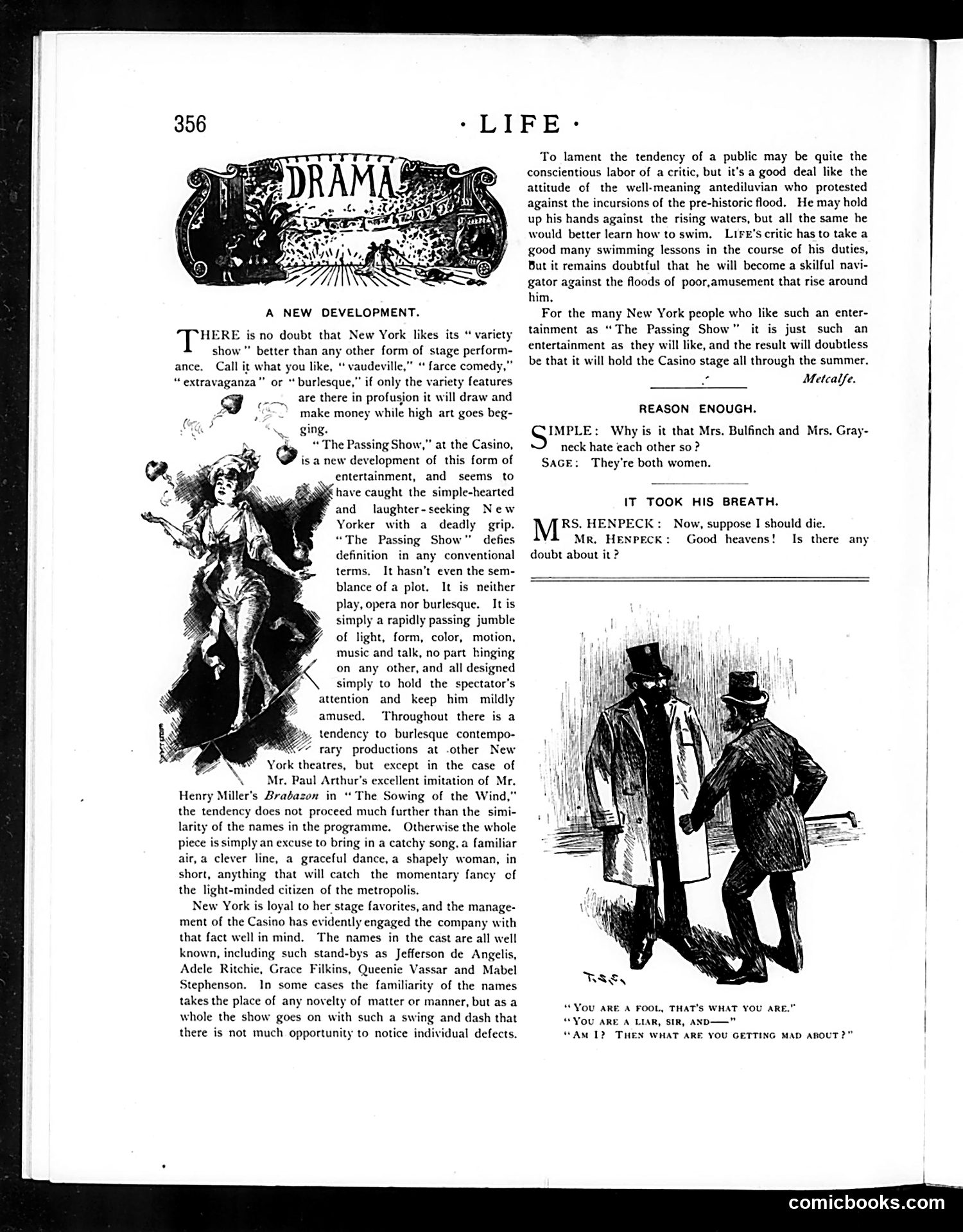
This page contains two distinct satirical pieces from Life magazine. The main article reviews "The Passing Show" at the Casino theater—a vaudeville-style variety entertainment. Life's critic acknowledges New York audiences prefer spectacle over serious drama, comparing those who object to such "low" entertainment to someone uselessly protesting against natural floods. The review is relatively accepting, noting the show's appeal despite lacking plot or artistic merit. The three brief comic dialogues at bottom mock domestic life and masculine weakness: 1. **"Reason Enough"** jokes that two women hate each other simply for being women—a jab at female cattiness. 2. **"It Took His Breath"** depicts a henpecked husband so relieved at the prospect of his wife's death that he's momentarily speechless—satirizing overbearing wives and emasculated husbands. 3. The final exchange shows a man's hypocrisy exposed when accused of being a liar. The cartoons employ period stereotypes about gender dynamics common to early 20th-century American humor.
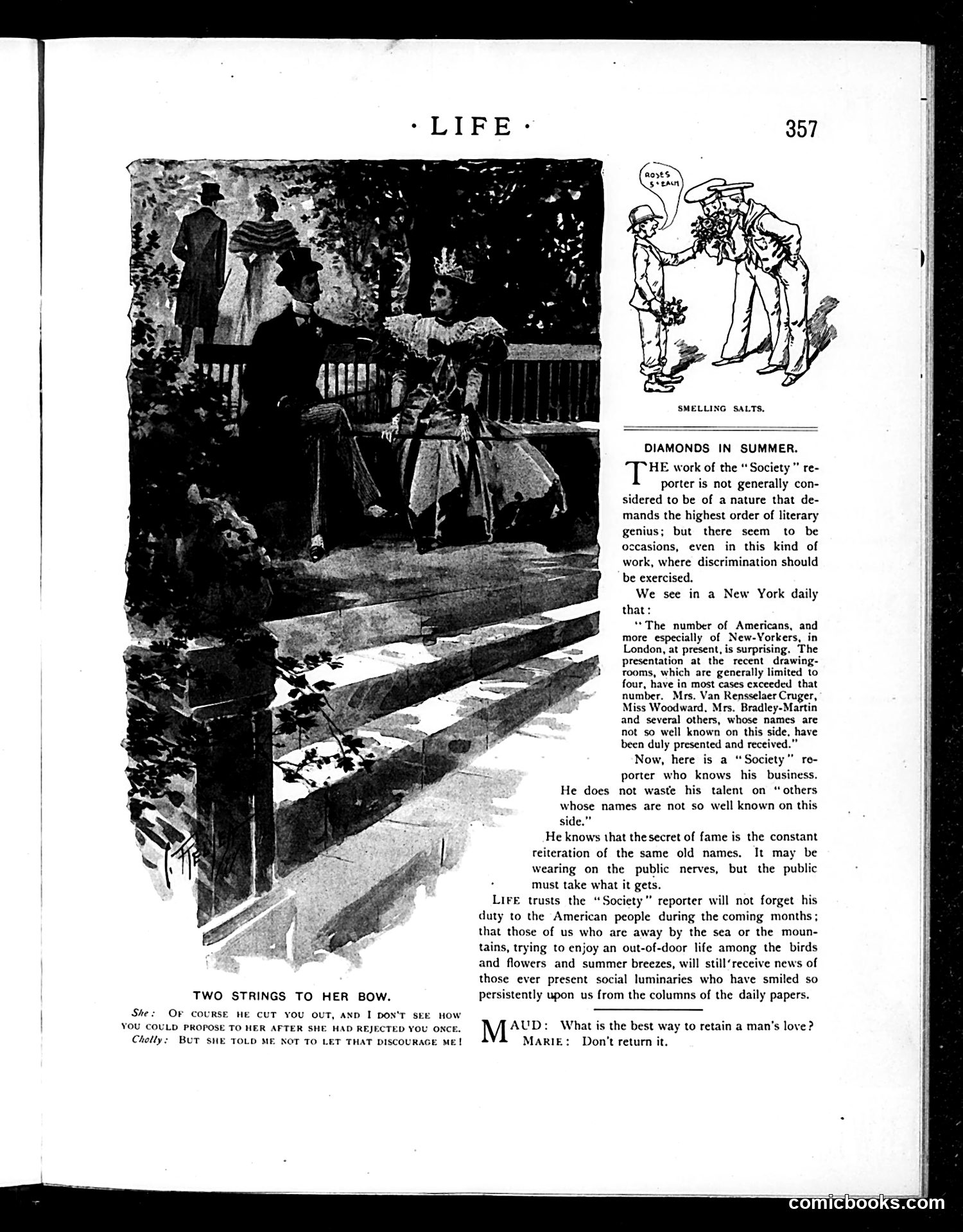
This page contains two satirical pieces mocking high society and romance conventions of the era. **"Diamonds in Summer"** criticizes gossip columnists who obsessively cover the same wealthy New York families (Van Rensselaer Cruger, Woodward, Bradley-Martin) repeatedly in London society pages. The satire argues these reporters know their job is simply to endlessly repeat famous names for public consumption, regardless of newsworthiness—wearing "on the public nerves" but treated as inevitable. Life appeals to summer readers that they'll still receive this tedious social coverage even while escaping to nature. **"Two Strings to Her Bow"** depicts a romantic scenario where a rejected suitor proposes again after rejection. The woman's dismissal ("cut you out") should discourage him, yet he persists after she tells him not to be discouraged. The accompanying joke exchange mocks romantic relationships: "Don't return" a man's love as advice for keeping it—a cynical quip suggesting emotional distance maintains attraction. Both pieces satirize artifice: society's obsession with status and romantic games lacking genuine feeling.
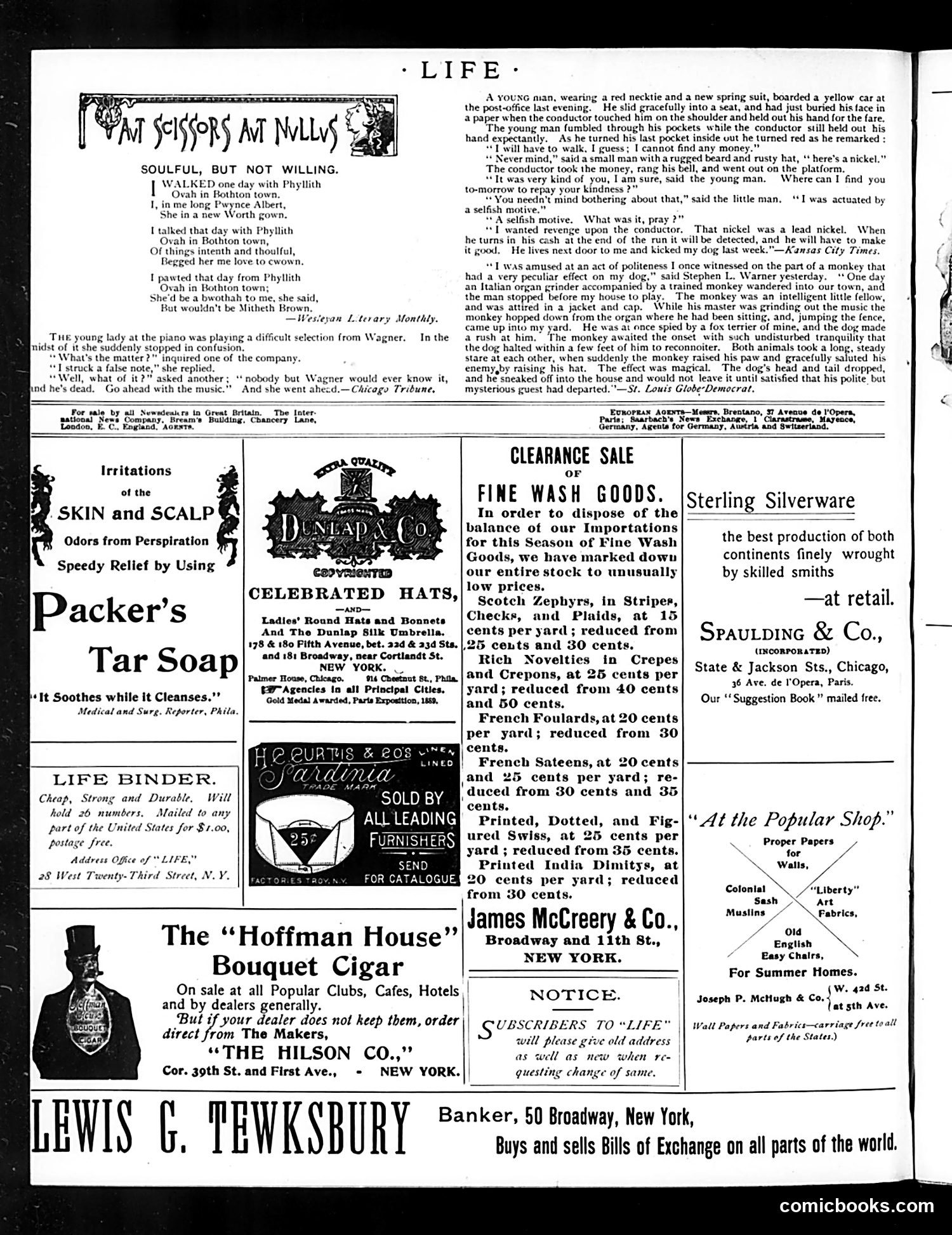
This page contains three humorous short stories typical of Life magazine's satirical humor: 1. **"Soulful, But Not Willing"**: A poem mocking affected speech patterns (exaggerated Boston accent: "Pwynce Albert," "thoulful") about a man's romantic rejection in Boston society. 2. **Wagner Piano Story**: A joke about a woman playing Wagner badly. When she stops after hitting a wrong note, a man reassures her that only Wagner would notice—implying Wagner's music is so complex/bad that errors are undetectable. 3. **Three Interconnected Stories**: Tales of unexpected kindness with ironic motives—a stranger pays a young man's fare (to trick the conductor with a lead nickel), and a monkey's polite hat-tipping defeatsaggressive dog. The page is primarily **advertising and editorial content**. The satire targets pretension, social affectation, and the gap between appearances and true motivations—typical of Life's genteel humor aimed at educated, middle-class readers of this era (appears early 1900s based on typography and products advertised).
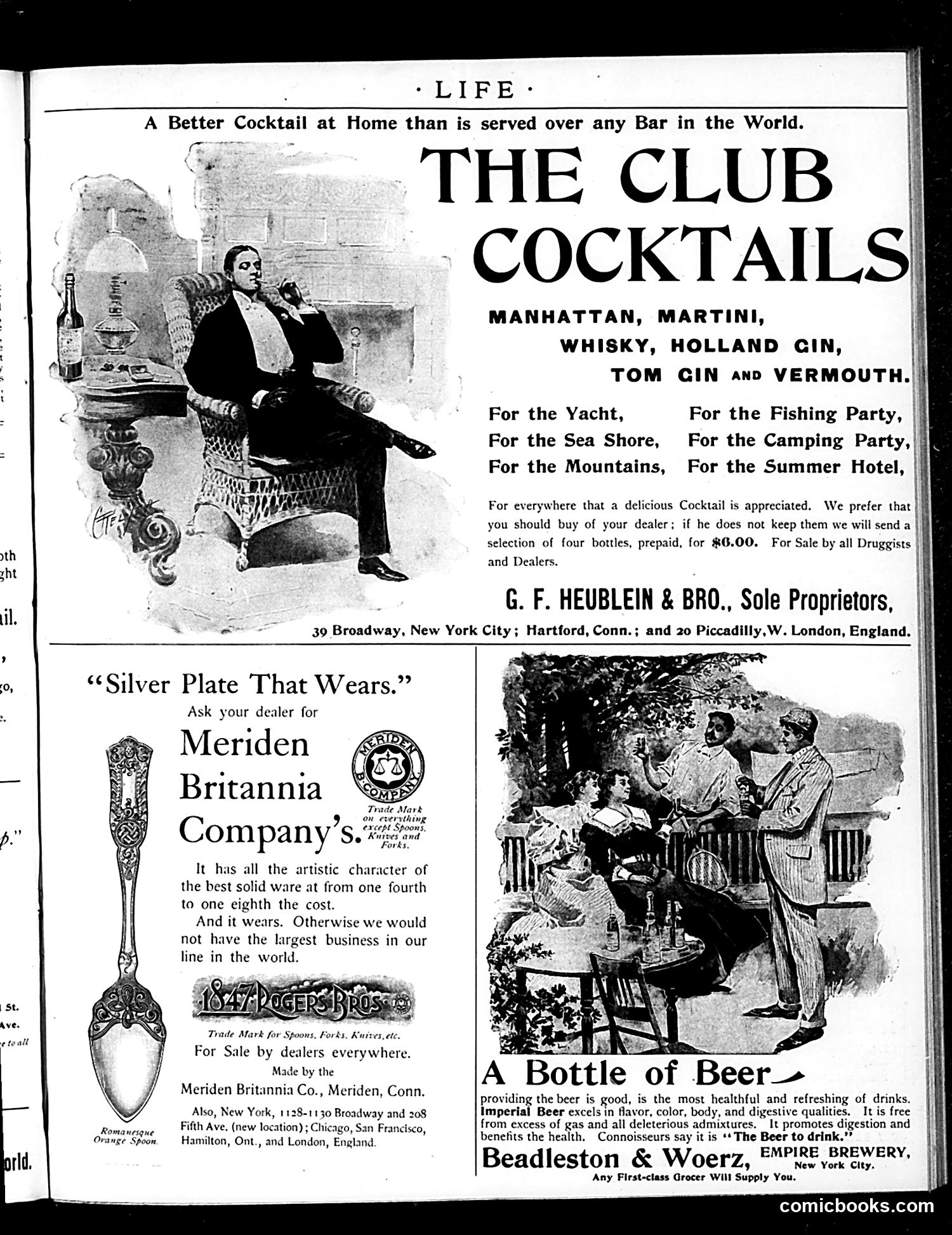
This page is primarily **advertising, not satire or political commentary**. It contains three product advertisements typical of early 20th-century magazines: 1. **The Club Cocktails** (top): Markets pre-made cocktail bottles for home consumption, emphasizing convenience for social occasions (yachting, camping, hotels). The illustration shows a well-dressed gentleman enjoying a cocktail at leisure. 2. **Meriden Britannia Company** (bottom left): Advertises affordable silverplate as a substitute for solid silver—positioning it as quality goods at lower cost. 3. **Beadleston & Woerz Beer** (bottom right): Markets Imperial Beer as a "healthful" digestive aid, with an illustration of people socializing outdoors. These ads reflect the pre-Prohibition era (before 1920) when alcohol was openly marketed with health claims. The page targets affluent leisure consumers, emphasizing elegance and social status rather than offering satirical commentary.
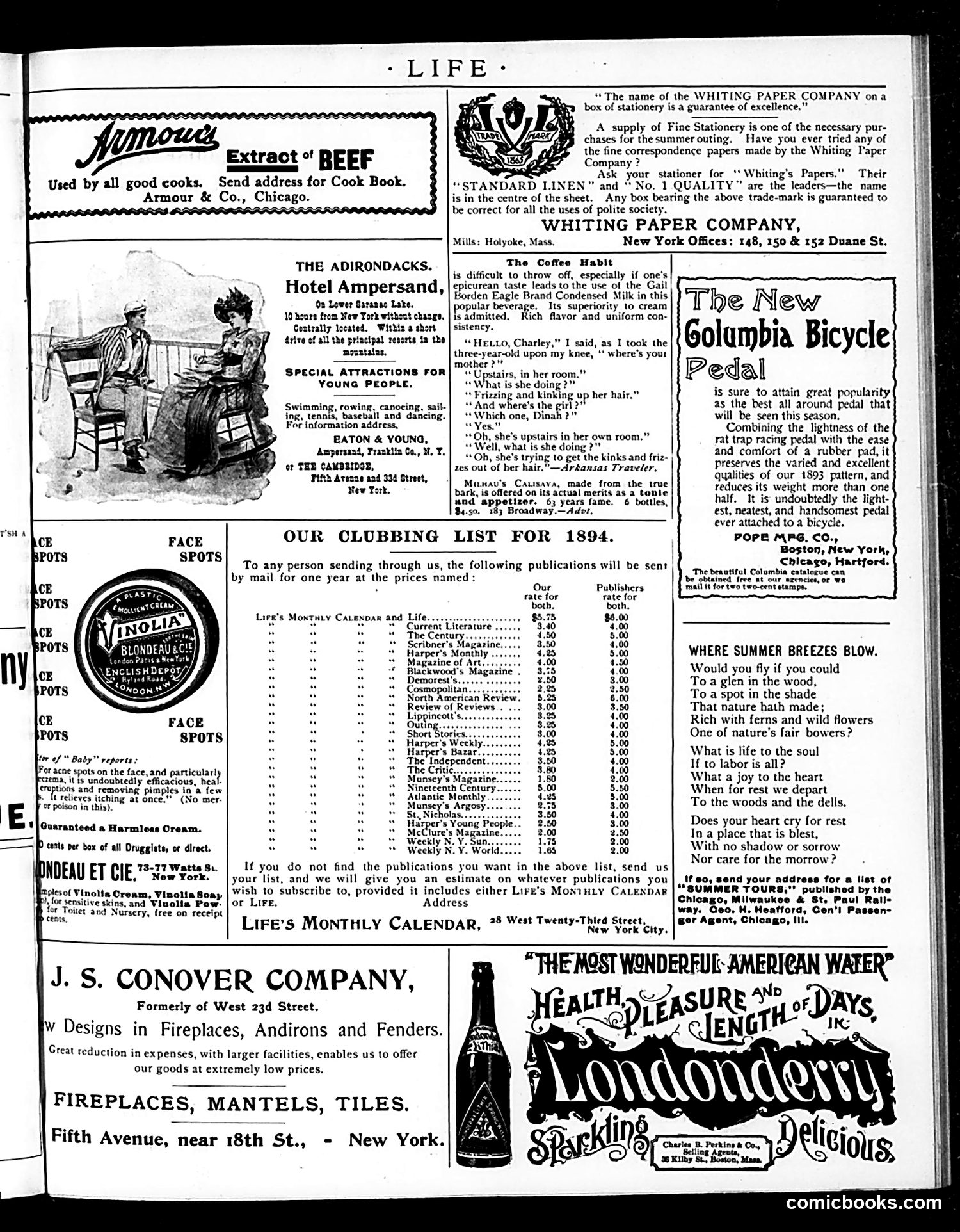
This page is primarily **advertising, not political satire**. It contains various product advertisements from 1894, including: - **Beef extract** and hotel accommodations in the Adirondacks - **Writing paper** and stationary supplies - **Coffee and condensed milk** - **Bicycle pedals** - **Face cream** (Vinolia brand for acne) - **Fireplaces and mantels** The only humorous content is a brief anecdote titled "The Coffee Habit" featuring dialogue about children's hairstyling activities—likely a joke about the widespread, compulsive nature of coffee drinking in the era. Otherwise, this is a typical magazine back page showcasing consumer goods and services. The "Clubbing List" offers bundled magazine subscriptions at reduced rates—common promotional strategies in 1894. There is no significant political commentary or satirical message on this page.
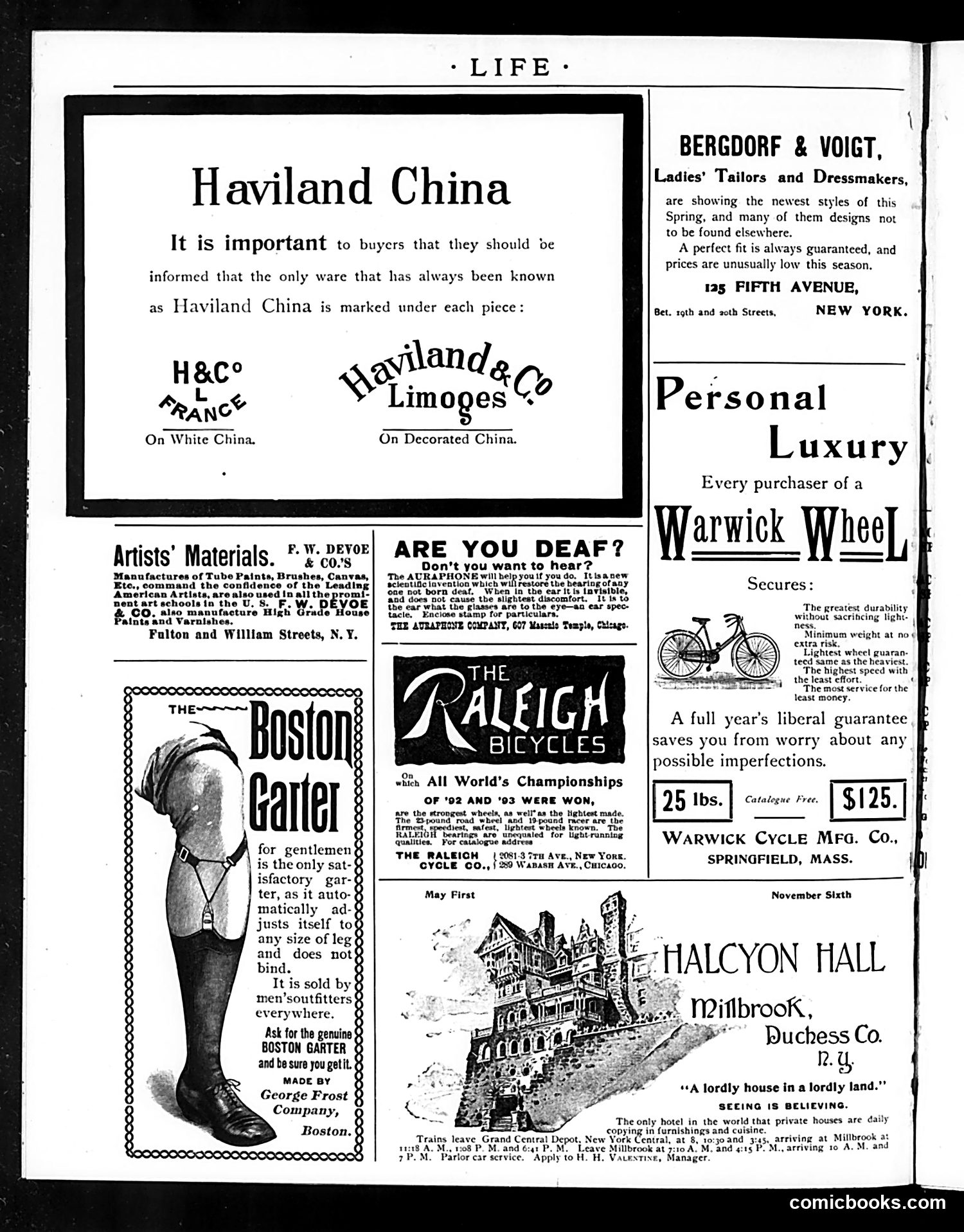
This appears to be primarily an **advertising page** rather than satirical content. The page contains various commercial advertisements from circa early 1900s, including: **Notable ads:** - **Haviland China**: Emphasizes authentic marks (H&C and "Haviland & Co Limoges") to distinguish genuine from counterfeit porcelain - **Boston Garter**: A men's garter that "automatically adjusts itself"—highlighting convenience - **Auraphone Company**: A hearing aid, addressing deafness—a significant medical concern of the era - **Raleigh and Warwick Bicycles**: Competing bicycle manufacturers promoting durability and championships - **Bergdorf & Voigt**: High-end ladies' tailoring on Fifth Avenue - **Halcyon Hall**: A luxury hotel in Millbrook, NY The page reflects **Gilded Age consumer culture**: mass-marketed luxury goods, technological innovations (hearing aids, bicycles), and emphasis on authenticity/brand identity. No clear political satire is evident—this is commercial messaging aimed at affluent readers.
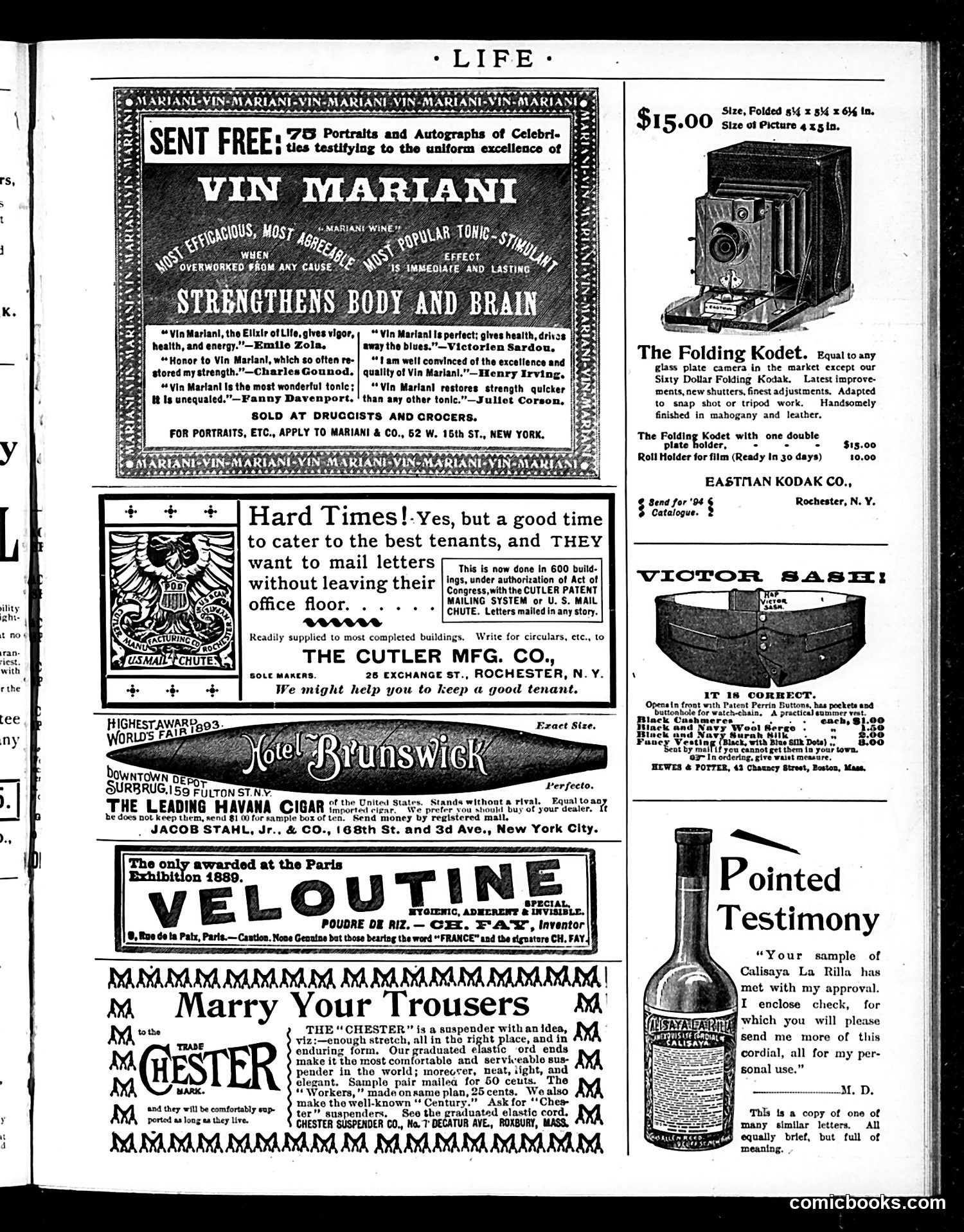
This page is primarily **advertisements**, not political cartoons. It showcases products marketed to early 1900s consumers: **Vin Mariani** dominates the top—a wine tonic claiming to strengthen "body and brain." The ad quotes celebrities (Emile Zola, Henry Irving, etc.) endorsing it, a common marketing tactic of the era. Coca wine products were popular "patent medicines" before regulation. **Other notable ads include:** - A mail-chute system for office buildings - Hotel Brunswick cigars - Veloutine powder (cosmetic) - Chester brand suspenders - Folding Kodak camera - Victor sash product - Calisaya cordial The **implicit satire** lies in Life magazine's role: it was satirical, yet its pages were filled with dubious health claims and celebrity testimonials. The juxtaposition of sophisticated humor elsewhere in the magazine with these credulous product endorsements likely amused readers—these "medicines" often contained alcohol or cocaine, yet doctors and famous artists publicly praised them. The page reflects the **pre-FDA era** when such advertising was unregulated and consumers had no protection against false claims.
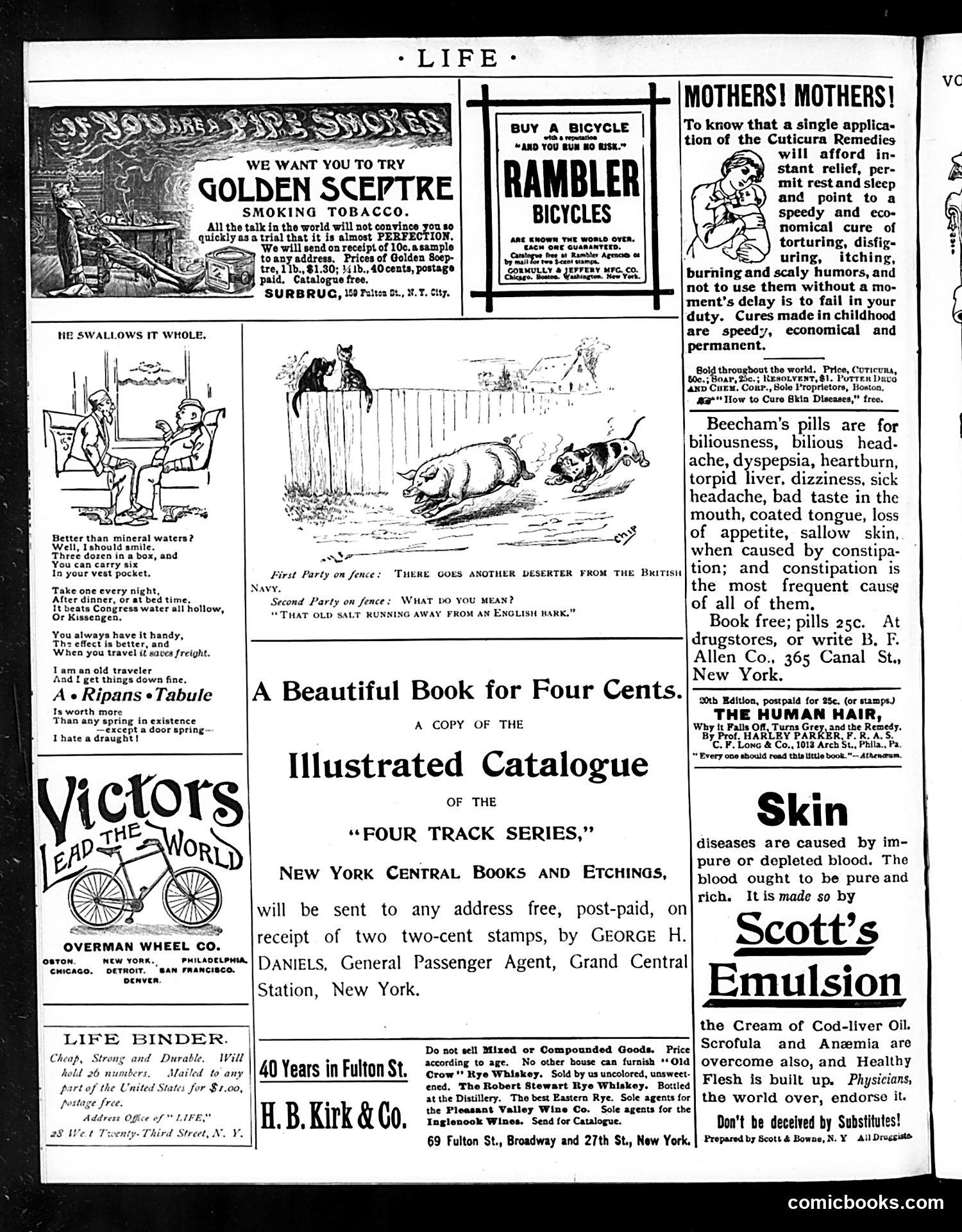
This page is primarily **advertising**, with one satirical cartoon embedded among product promotions. ## The Cartoon The single comic depicts two figures on a fence watching dogs run away. The first remarks that "another deserter from the British Navy" is fleeing; the second responds, "That old salt running away from an English bark." The joke is a **pun**: "bark" refers both to a sailing ship (a "barque") and the sound dogs make. The humor plays on the double meaning—the audience expects a naval reference but gets animal wordplay instead. ## Historical Context This likely reflects late-19th-century Anglo-American tensions or broader skepticism about military service, though the cartoon's mild tone suggests it's primarily comedic rather than sharply political. ## Surrounding Advertisements The page is dominated by patent medicines (Cuticura, Beecham's Pills, Scott's Emulsion) and consumer goods (bicycles, tobacco, whiskey) typical of the era—many making dubious health claims.