
Life, 1894-05-31 · page 8 of 20
Life — May 31, 1894 — page 8: what you’re looking at
What you’re looking at
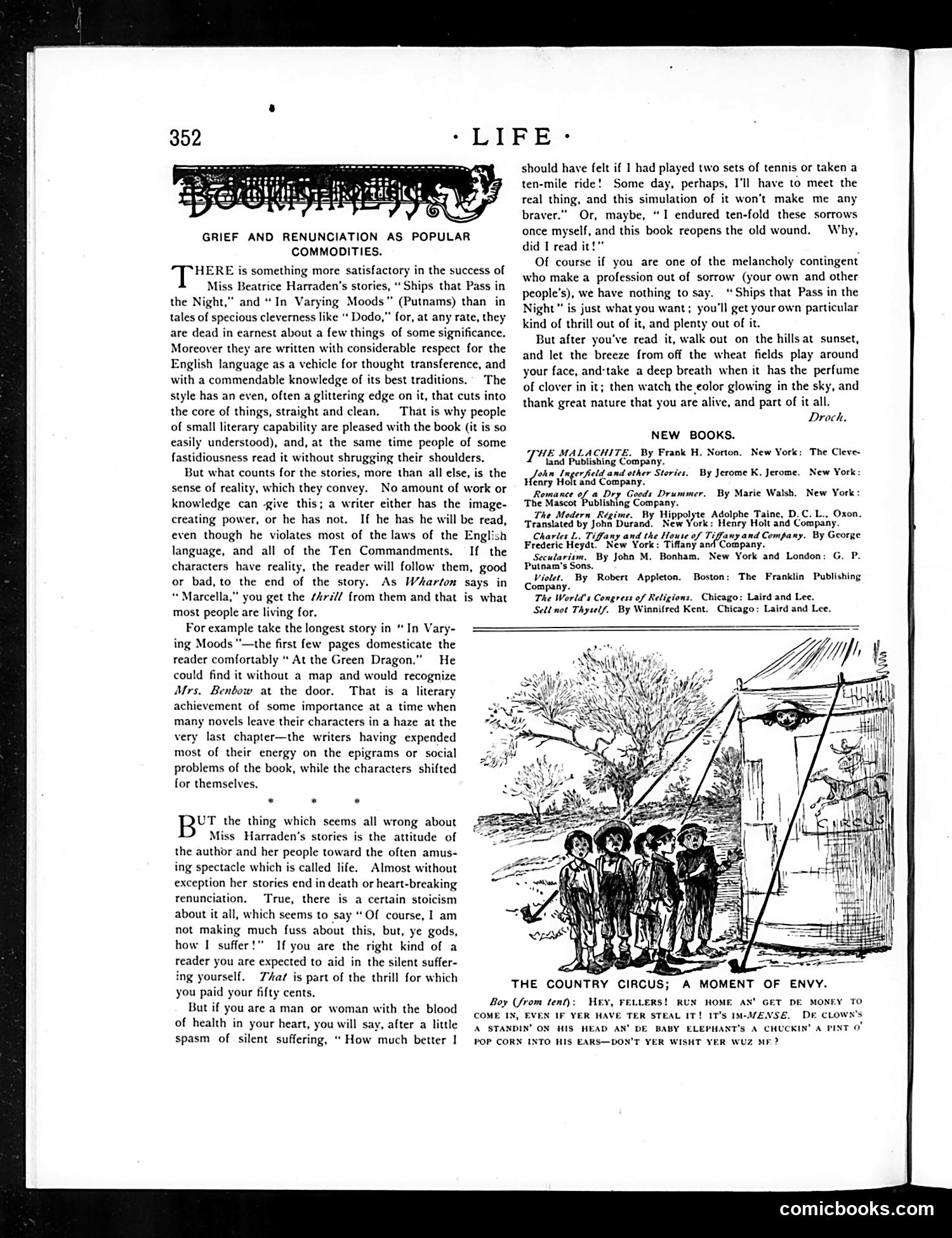
This cartoon depicts four children standing outside a circus tent, looking in with longing. The caption includes dialect dialogue from a boy expressing envy of the circus performers and animals inside—he wishes he had money to attend and mentions specific acts like an elephant and clown. The satire comments on economic inequality and childhood desires. Poor children are locked out of entertainment due to lack of funds, while the circus represents accessible spectacle and joy for those who can afford admission. The boy's wistful monologue emphasizes the gap between what working-class children want and what they can actually experience, a common theme in *Life* magazine's social commentary during the early 20th century.
📄 Transcribed text from this page (OCR, searchable)
Machine-transcribed from the original scan — historical spelling and the odd misread are preserved.
-LI GRIEF AND RENUNCIATION AS POPULAR COMMODITIES. HERE is something more satisfactory in the success of Miss Beatrice Harraden’s stories, “Ships that Pass in the Night,” and “In Varying Moods" (Putnams) than in tales of specious cleverness like ‘* Dodo,” for, at any rate, they are dead in earnest about a few things of some significance. Moreover they are written with considerable respect for the English language as a vehicle for thought transference, and with a commendable knowledge of its best traditions. The style has an even, often a glittering edge on it, that cuts into the core of things, straight and clean, That is why people of small literary capability are pleased with the book (it is so easily understood), and, at the same time people of some fastidiousness read it without shrugging their shoulders. But what counts for the stories, more than all else, is the sense of reality, which they convey. No amount of work or knowledge can -give this; a writer either has the image- creating power, or he has not. If he has he will be read, even though he violates most of the laws of the English language, and all of the Ten Commandments. If the characters have reality, the reader will follow them, good or bad, to the end of the story, As Wharton says in “ Marcella,” you get the ¢/rz// from them and that is what most people are living for. FE: should have felt if I had played two sets of tennis or taken a ten-mile ride! Some day, perhaps, I'll have to meet the real thing, and this simulation of it won't make me any braver.” Or, maybe, “1 endured ten-fold these sorrows once myself, and this book reopens the old wound. Why, did I read it!” Of course if you are one of the melancholy contingent who make a profession out of sorrow (your own and other people’s), we have nothing to say. “Ships that Pass in the Night” is just what you want; you'll get your own particular kind of thrill out of it, and plenty out of it. But after you've read it, walk out on the hills at sunset, and let the breeze from off the wheat fields play around your face, and-take a deep breath when it has the perfume of clover in it; then watch the eolor glowing in the sky, and thank great nature that you are alive, and part of it all. Droch, NEW BOOKS. THE MALACHITE. By Frank H, Norton. land Publishing Company. ohm Inger field and other Stories. Henry Holt and Company. Romance of a Dry Goods Drummer. The Mascot Publishing Company. The Medern Regime. By Hippolyte Adolphe Taine, D.C. L., Oxon, ‘Translated by John Durand. New York: Henry Holt and Company. Charles L. Tiffany and the House of Tiffany and Company. By George Frederic Heydt.. New York: Tiffany and Company. Secularism, By John M. Bonham. New York and London: G. P. Pataam’s Sons. Violet. By Robert Appleton. Boston: The Franklin Publishing Company. The World's Congress of Religions. Chicago: Laird and Lee. Sett not Thyself. By Winnifred Kent. Chicago: Laird and Lee. New York: The Cleve- By Jerome K. Jerome. New York: By Marie Walsh. New York: For example take the longest story in “In Vary- ing Moods ""—the first few pages domesticate the reader comfortably “ At the Green Dragon.” He could find it without a map and would recognize. Mrs. Benbow at the door. That is a literary achievement of some importance at a time when many novels leave their characters in a haze at the very last chapter—the writers having expended most of their energy on the epigrams or social problems of the book, while the characters shifted for themselves. * * T the thing which seems all wrong about Miss Harraden's stori the attitude of the author and her people toward the often amus- ing spectacle which is called life. Almost without exception her stories end in death or heart-breaking renunciation. True, there is a certain stoicism about it all, which seems to say “ Of course, I am not making much fuss about this, but, ye gods, how I suffer!” If you are the right kind of a reader you are expected to aid in the silent suffer- ing yourself. hat is part of the thrill for which you paid your fifty cents. But if you are a man or woman with the blood of health in your heart, you will say, after a little spasm of silent suffering, “ How much better I Boy A STAN! COME IN, EV! THE COUNTRY CIRCUS; (U/rom tent): HEY, FELLERS! RUN HOME < IF YER HAVE TER STEAL IT! 17's IDIN' ON HIS HEAD AN’ DE BABY ELI A MOMENT OF ENVY. AN’ GET DE MONEY TO MENSE. Dr CLown’s POP CORN INTO HIS EARS—DON'T YER WISHT YER WUZ MF? comicbooks.com