
Life, 1894-05-31 · page 4 of 20
Life — May 31, 1894 — page 4: what you’re looking at
What you’re looking at
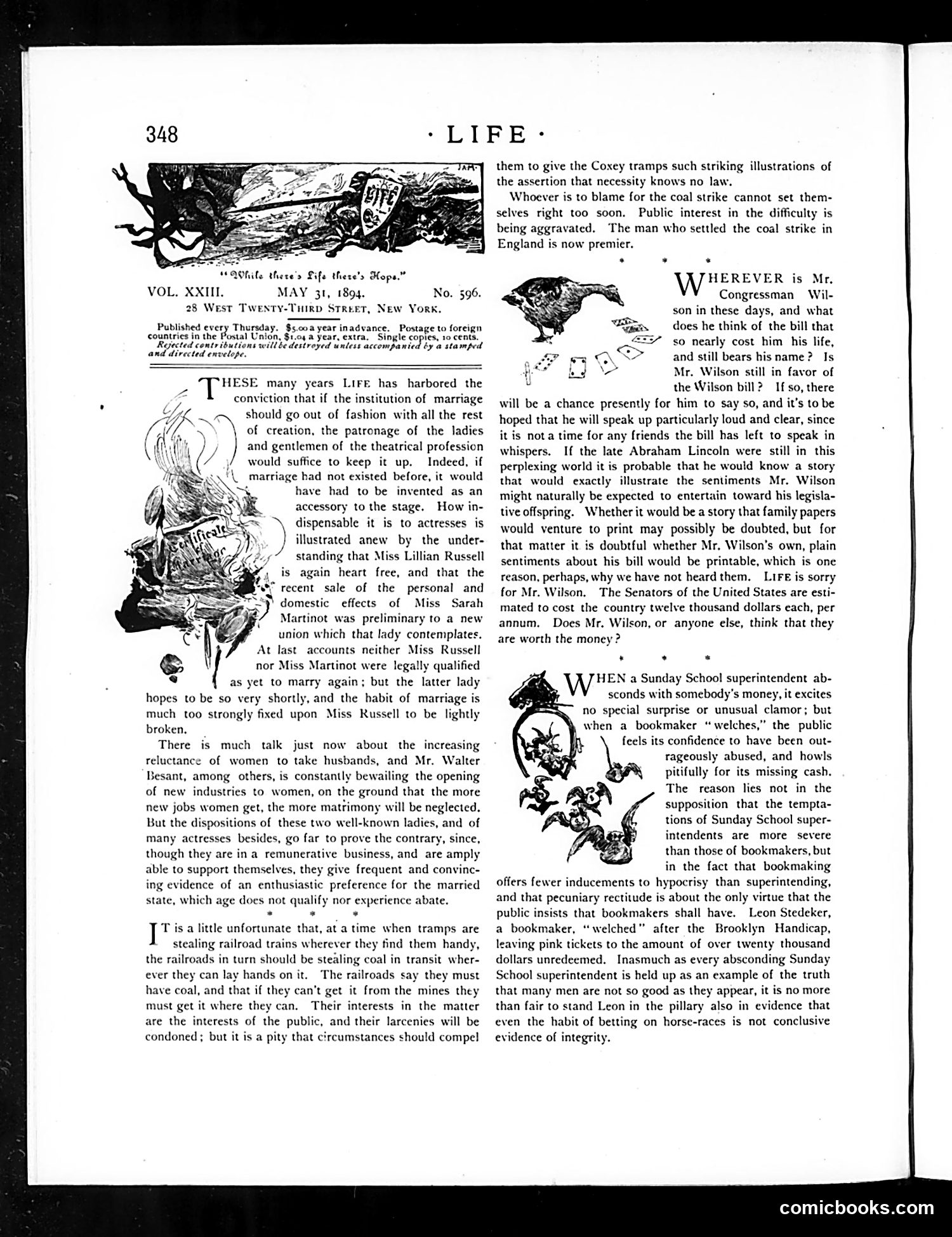
The page contains three satirical commentaries on contemporary issues: 1. **Marriage and the Stage** (main left article): Discusses whether stage actresses should marry, prompted by Miss Sarah Martinot's recent sale of "personal and domestic effects" preceding a rumored remarriage. The text argues actresses prove capable of self-support, contrary to assumptions about women needing husbands. 2. **The Wilson Bill** (right section, marked "WHEREVER"): References Congressman Wilson's nearly-fatal involvement with legislation (unclear which specific bill), questioning whether he still supports it—implying the near-death experience should have changed his position. 3. **Sunday School Superintendent vs. Bookmaker** (bottom right): Compares integrity levels, noting a bookmaker ("welched" on Brooklyn Handicap bets) proves no worse than a superintendent held accountable for embezzled funds—satirizing hypocrisy about morality.
📄 Transcribed text from this page (OCR, searchable)
Machine-transcribed from the original scan — historical spelling and the odd misread are preserved.
> LIFE: While there's Life there’s Hops.” MAY 31, 1894. No. 596. HIRD STREET, New York, VOL. XXIII. 28 West Twent Published every Thursday. $s.coa year inadvance. Postage to foreign countries in the Postal Union, $1.04 a year, extra. Single copies, 10 cents. Rejected contributions willbe destroyed untess accompanied by a stamped and directed envelope. ESE many years Lire has harbored the conviction that if the institution of marriage Kx should go out of fashion with all the rest of creation, the patronage of the ladies and gentlemen of the theatrical profession would suffice to keep it up. Indeed, if marriage had not existed before, it would have had to be invented as an accessory to the stage. How in- > dispensable it is to actresses is ) illustrated anew by the under- standing that Miss Lillian Russell is again heart free, and that the recent sale of the personal and domestic effects of Miss Sarah Martinot was preliminary to a new union which that lady contemplates. At last accounts neither Miss Russell nor Miss Martinot were legally qualified e as yet to marry again; but the latter lady hopes to be so very shortly, and the habit of marriage is much too strongly fixed upon Miss Russell to be lightly broken, There is much talk just now about the increasing reluctance of women to take husbands, and Mr. Walter Besant, among others, is constantly bewailing the opening of new industries to women, on the ground that the more new jobs women get, the more matrimony will be neglected, But the dispositions of these two well-known ladies, and of many actresses besides, go far to prove the contrary, since, though they are ina remunerative business, and are amply able to support themselves, they give frequent and convinc- ing evidence of an enthusiastic preference for the married state, which age does not qualify nor experience abate. * * . i is a little unfortunate that, at a time when tramps are ‘ealing railroad trains wherever they find them handy, the railroads in turn should be stealing coal in transit wher- ever they can lay hands on it. The railroads say they must have coal, and that if they can’t get it from the mines they must get it where they can. Their interests in the matter are the interests of the public, and their larcenies will be condoned ; but it is a pity that circumstances should compel them to give the Coxey tramps such striking illustrations of the assertion that necessity knows no law. Whoever is to blame for the coal strike cannot set them- selves right too soon. Public interest in the difficulty is being aggravated. The man who settled the coal strike in England is now premier. . HEREVER is Mr. Congressman Wil- son in these days, and what does he think of the bill that so nearly cost him his life, and still bears his name? Is Mr. Wilson still in favor of the Wilson bill? If so, there will be a chance presently for him to say so, and it’s to be hoped that he will speak up particularly loud and clear, since itis nota time for any friends the bill has left to speak in whispers. If the late Abraham Lincoln were still in this perplexing world it is probable that he would know a story that would exactly illustrate the sentiments Mr. Wilson might naturally be expected to entertain toward his legisla- tive offspring. Whether it would be a story that family papers would venture to print may possibly be doubted, but for that matter it is doubtful whether Mr. Wilson’s own, plain sentiments about his bill would be printable, which is one reason, perhaps, why we have not heard them. LIFE is sorry for Mr. Wilson, The Senators of the United States are esti- mated to cost the country twelve thousand dollars each, per annum. Does Mr. Wilson, or anyone else, think that they are worth the money ? . . * HEN a Sunday School superintendent ab- sconds with somebody's money, it excites no special surprise or unusual clamor; but when a bookmaker “ welches,” the public feels its confidence to have been out- rageously abused, and howls pitifully for its missing cash. The reason lies not in the supposition that the tempta- tions of Sunday School super- intendents are more severe than those of bookmakers, but in the fact that bookmaking offers fewer inducements to hypocrisy than superintending, and that pecuniary rectitude is about the only virtue that the public insists that bookmakers shall have. Leon Stedeker, a bookmaker, “welched” after the Brooklyn Handicap, leaving pink tickets to the amount of over twenty thousand dollars unredeemed. Inasmuch as every absconding Sunday School superintendent is held up as an example of the truth that many men are not so good as they appear, it is no more than fair to stand Leon in the pillary also in evidence that even the habit of betting on horse-races is not conclusive evidence of integrity. comicbooks.com