
A complete issue · 18 pages · 1894
Life — May 17, 1894
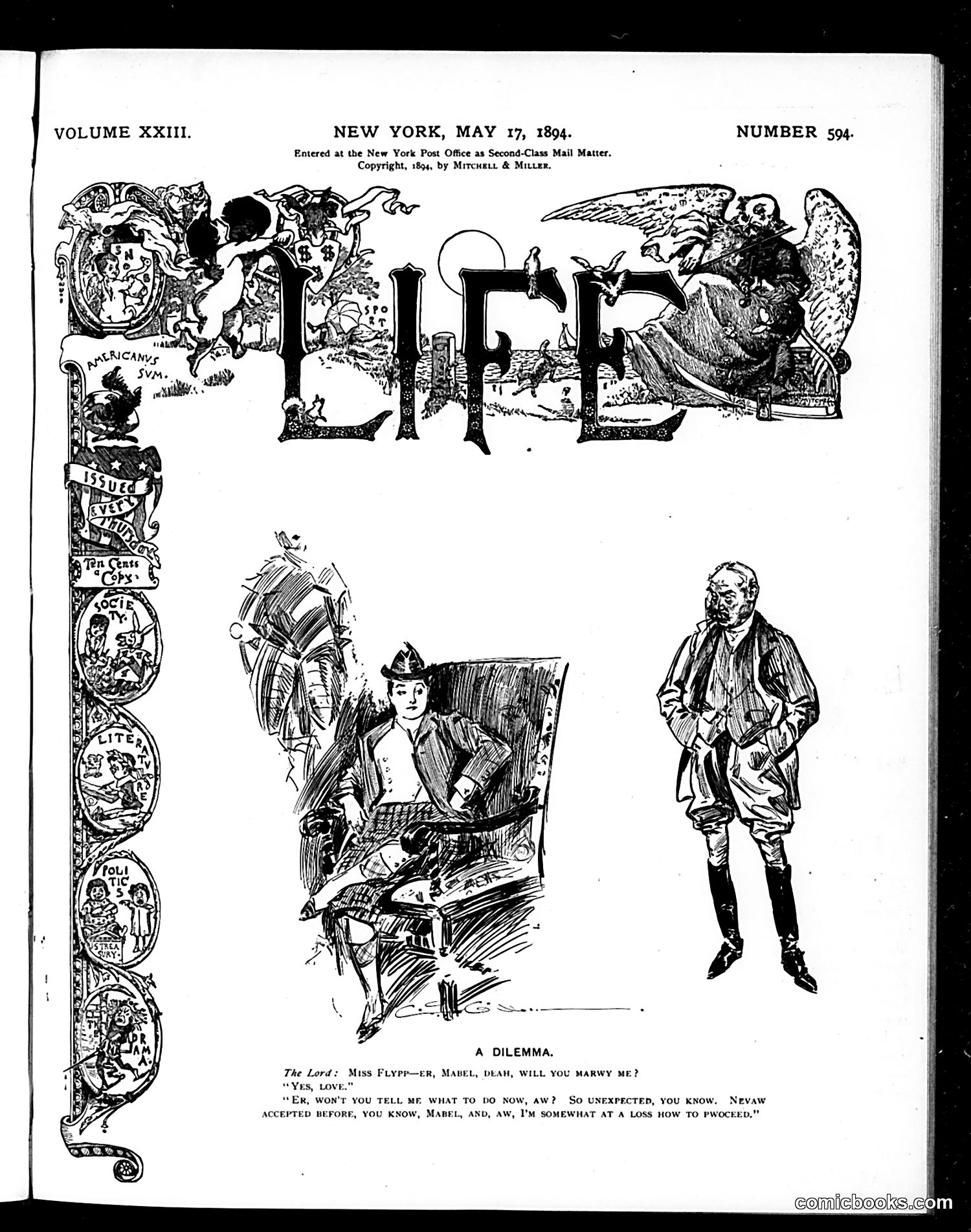
This satirical cartoon depicts a comedic romantic predicament. A young man in military dress (seated, left) has apparently proposed to a woman named Mabel. The caption shows his dialogue: he's asking "Will you marry me?" She responds affirmatively but then throws him into confusion by asking what he should do next, since he's "somewhat at a loss how to proceed." The humor lies in the reversal of expectations—the man successfully proposed but is now comically befuddled about the next steps in courtship or marriage preparation. A second figure (right) observes the scene, possibly representing the woman's father or a chaperone concerned about propriety. The joke plays on Victorian-era social conventions and male uncertainty about romantic procedures.
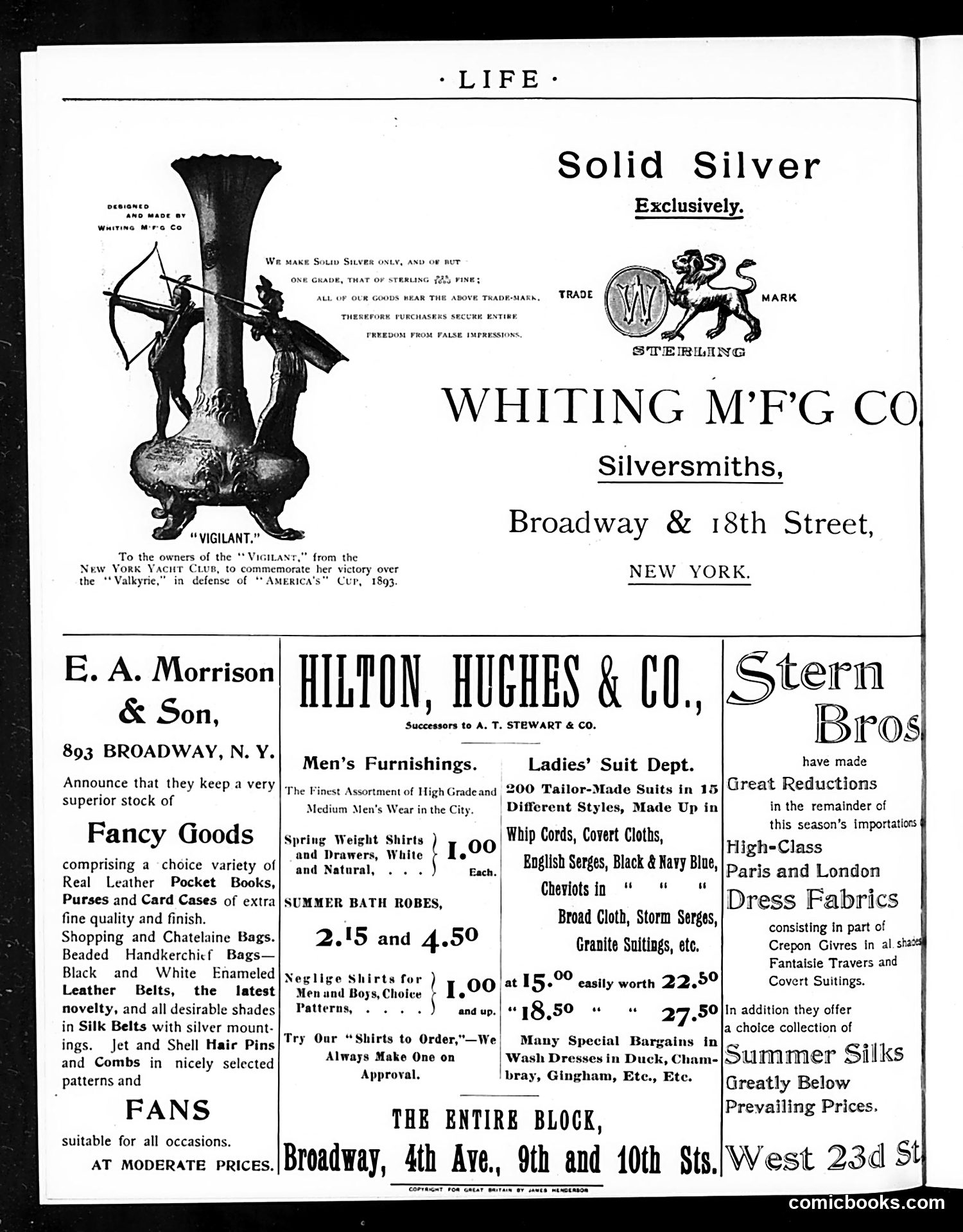
This page is primarily **advertising**, not editorial content or satire. The main illustration shows a silver trophy or decorative vessel labeled "Vigilant," commissioned by the New York Yacht Club to commemorate a victory over the "Valkyrie" in defense of "America's Cup, 1893." The image supports the accompanying text from Whiting M'fg Co, silversmiths advertising their "Solid Silver Exclusively" craftsmanship. The trophy depicts classical allegorical figures (likely representing victory or maritime themes) appropriate to yacht-racing commemoration. The remaining page consists of retail advertisements for E.A. Morrison & Son (fancy goods), Hilton Hughes & Co (men's furnishings), and Stern Bros (dress fabrics)—typical late-19th-century commercial promotion with no satirical content.
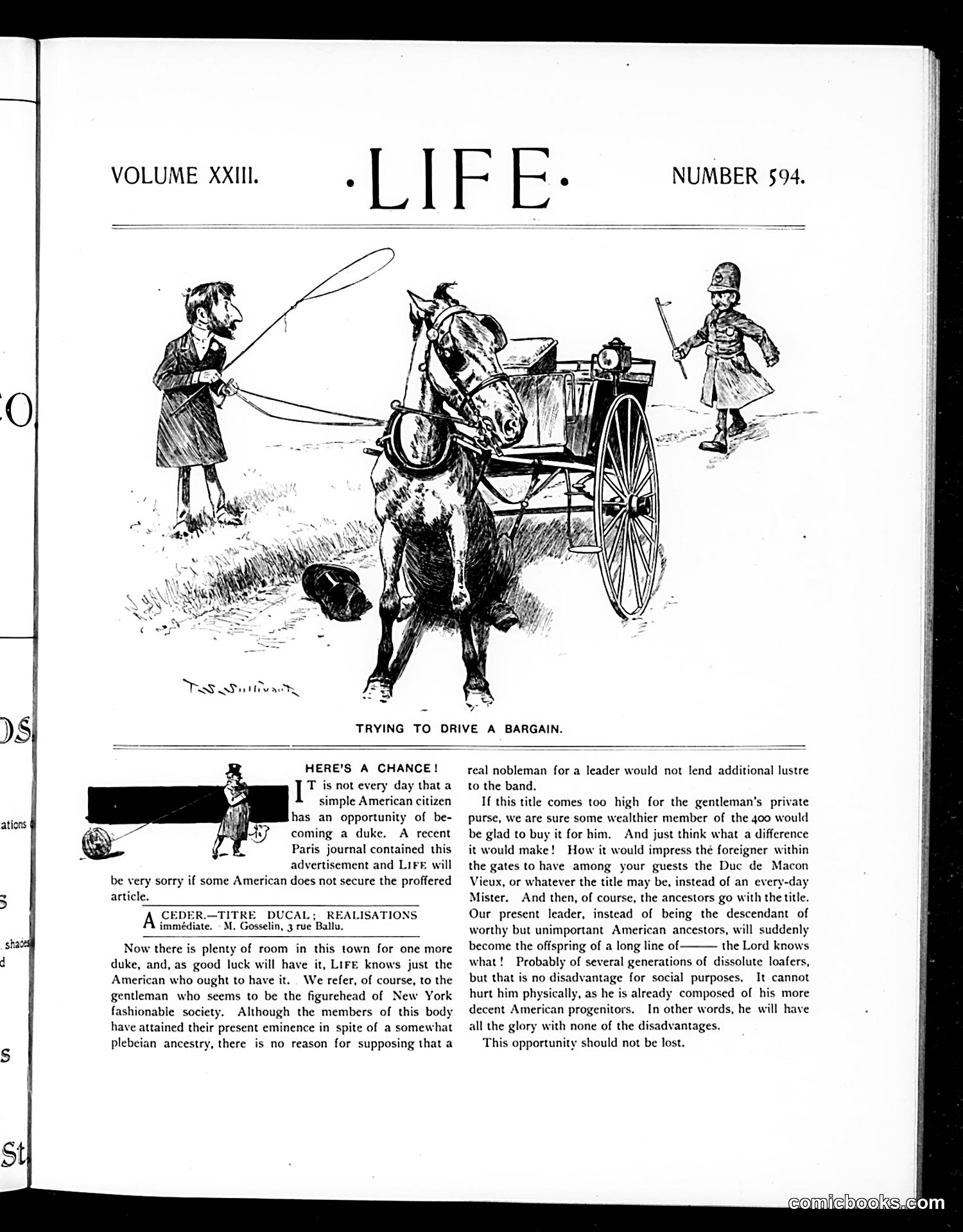
The cartoon satirizes the American aspiration to acquire European nobility titles. The illustration shows a man struggling to manage a horse-drawn cart while children playfully crack a whip and wave a flag—depicting the chaos of attempting to "drive a bargain" for a ducal title. The accompanying article mocks wealthy Americans who purchase or marry into European aristocratic titles. It specifically references a Paris journal advertisement offering a dukedom for sale. The satire targets the absurdity of this practice: these titles provide no practical benefit, yet wealthy Americans eagerly pursue them to impress society and guests. The piece argues such titles are meaningless for "American progenitors" and represents empty social climbing rather than genuine achievement or distinction.
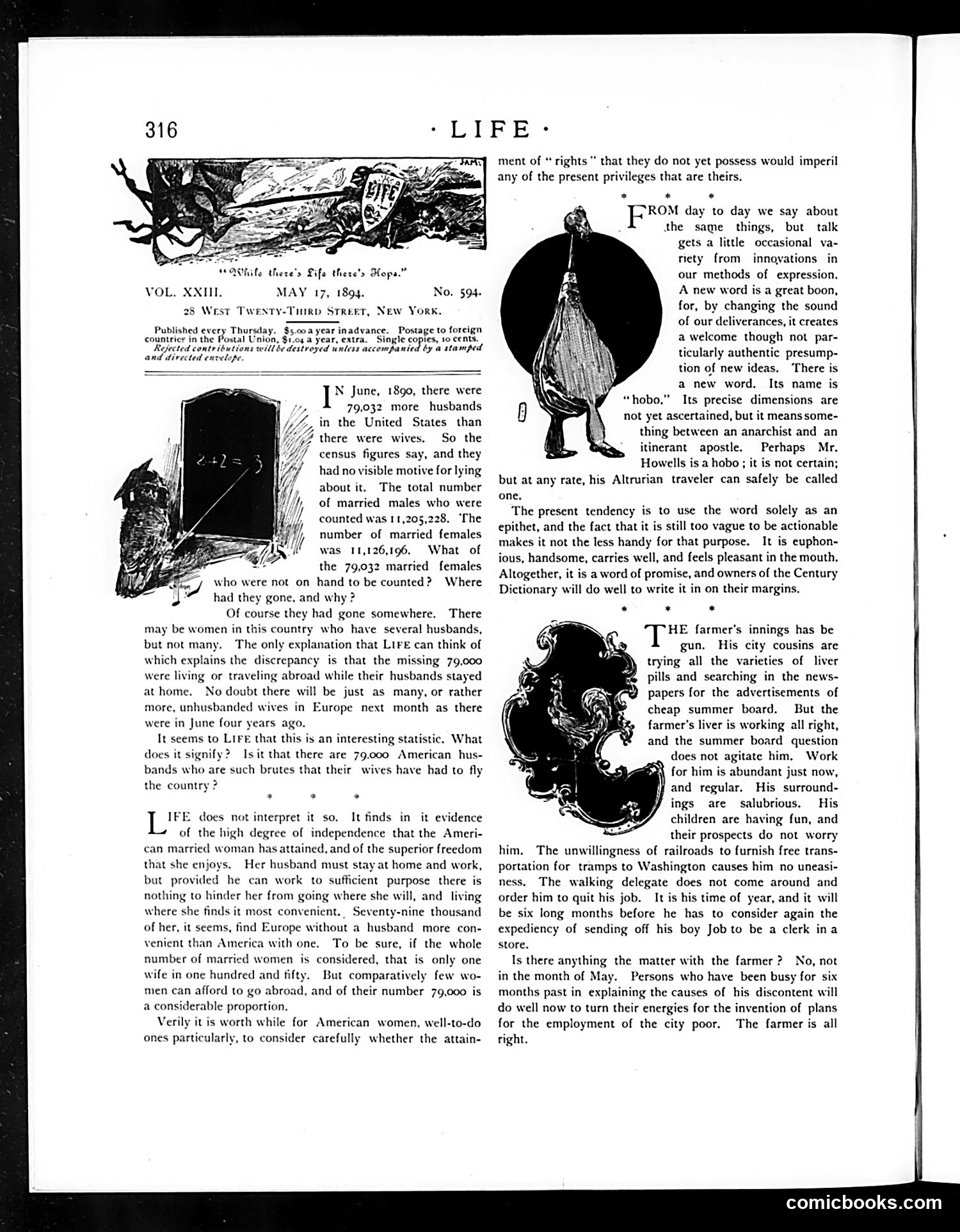
The page contains three distinct illustrations with satirical commentary. The left cartoons appear to mock census statistics about missing husbands—showing a man hiding behind a door with a math equation, suggesting marital discord or desertion. The central figure depicts a "hobo," with accompanying text introducing this as a new slang term for vagrant travelers, positioned between "anarchist" and "itinerant apostle" in meaning. The right column features a bearded man's head, introducing discussion of a farmer's contentment despite economic hardship. The text celebrates the farmer's resilience during difficult times, noting he resists distraction from labor reform movements and remains focused on work. The overall theme addresses American social tensions of the 1890s: marriage instability, emerging vagrant culture, and rural-urban economic divides.
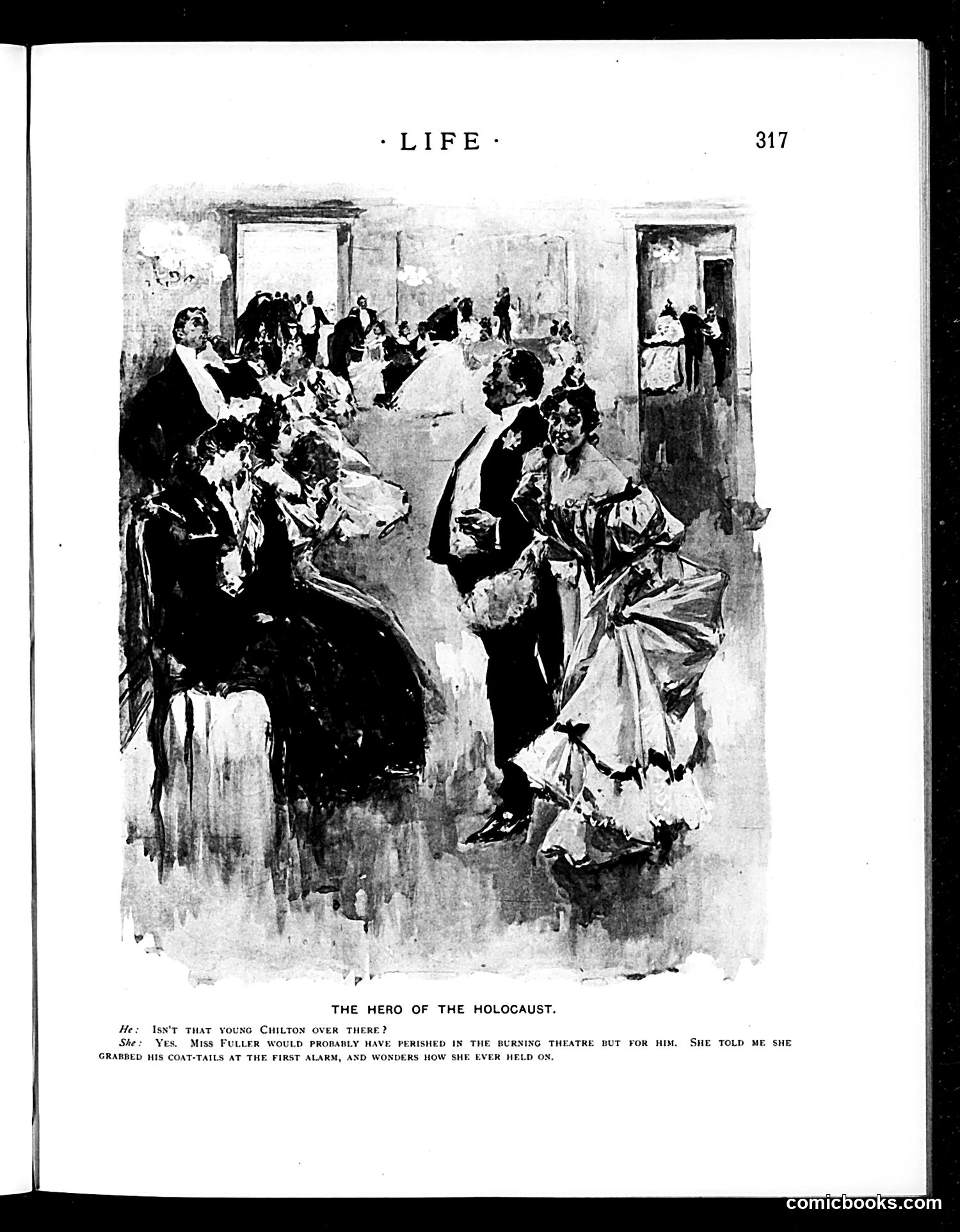
This page references a theatrical fire disaster. The illustration depicts an elegant social gathering where two figures in formal dress converse in the foreground while others mingle in background rooms. The caption indicates a young man named Chilton is being praised as a hero. According to the dialogue, Miss Fuller would have perished in a burning theater, but Chilton saved her by grabbing her coat-tails at the first alarm. She survived because of his quick action. The satire appears to mock the trivial basis for heroism—Chilton is celebrated not for brave rescue tactics, but for an accidental grab of clothing that happened to save someone. The "holocaust" (fire) becomes merely the backdrop for commenting on how society constructs and celebrates heroes based on fortunate circumstance rather than genuine courage or action.
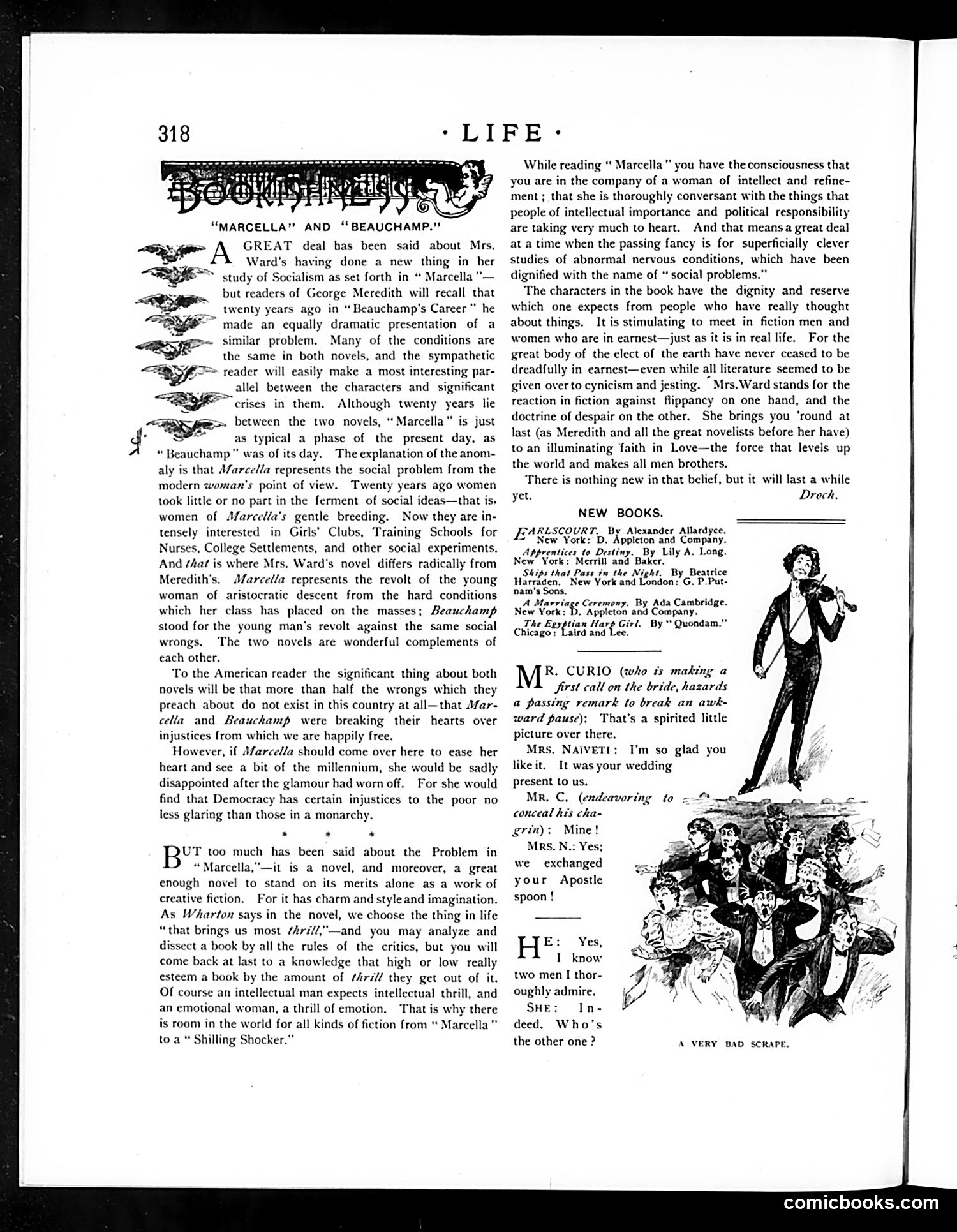
This page from *Life* magazine primarily contains a **book review** of two novels by Mrs. Ward: *Marcella* and *Beauchamp*. The left column discusses these works' treatment of socialism and social problems affecting women. The right side features a **small cartoon titled "A Very Bad Scrape,"** showing what appears to be a social embarrassment involving well-dressed figures—likely satirizing Victorian-era etiquette violations or awkward social situations among the upper classes. Below the cartoon is a brief humorous dialogue between Mr. Curio, Mrs. Naiveti, and Mr. C., joking about an Apostle spoon given as a wedding gift and mistaken identity of admirers. The page is primarily **literary criticism and light social satire** rather than political commentary, reflecting *Life*'s focus on cultural and social humor.
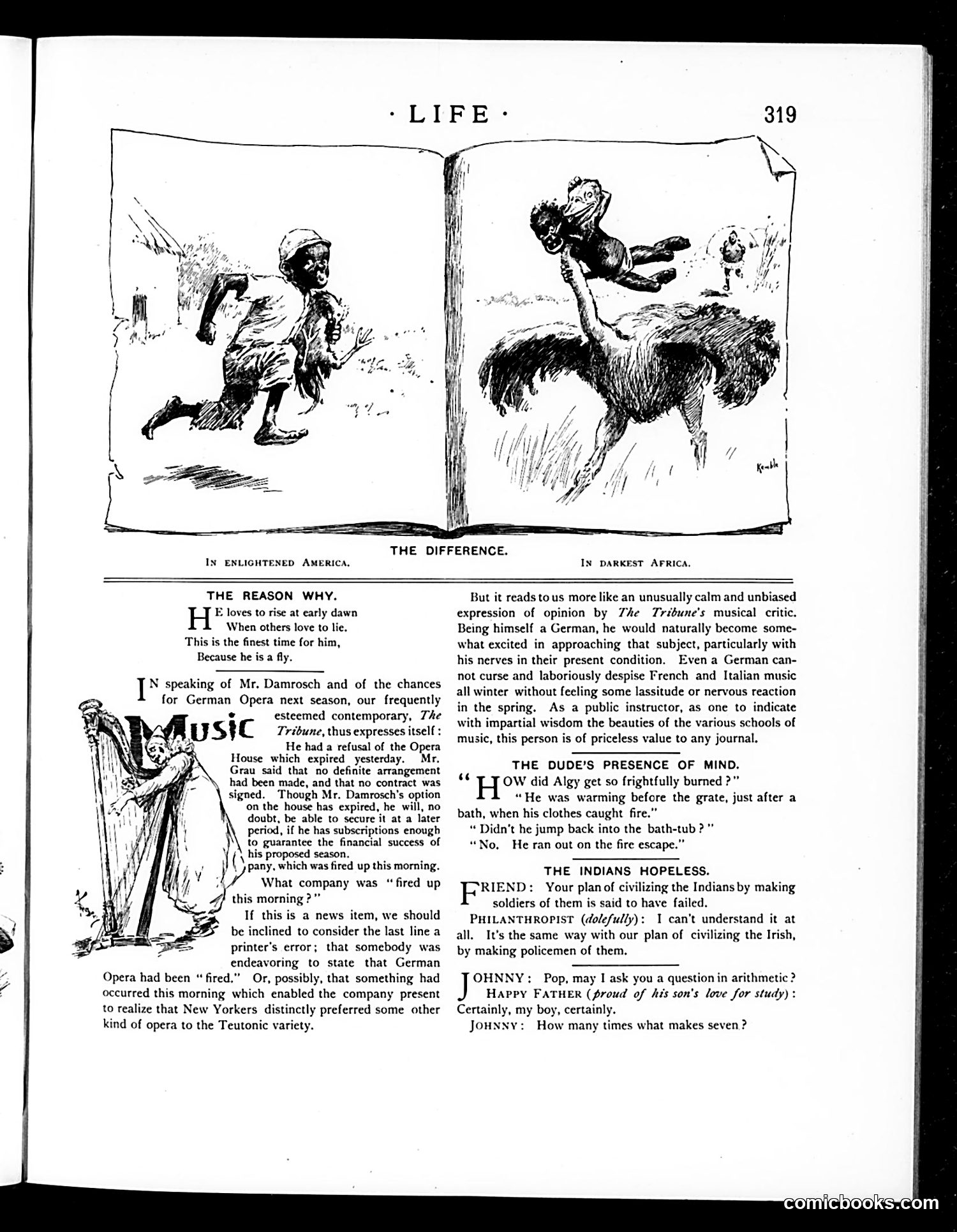
The top cartoon titled "The Difference" contrasts child-rearing practices: on the left, "In Enlightened America," a child is disciplined; on the right, "In Darkest Africa," an ostrich appears to kick a child. The satire suggests American civilization's superiority through child discipline versus supposed African chaos. Below are several brief satirical pieces: "The Reason Why" mocks dishonesty; "Music" discusses German Opera House management; "The Dude's Presence of Mind" is a humorous anecdote about bathing; and "The Indians Hopeless" presents cynical commentary comparing failed efforts to "civilize" Native Americans with similar attempts to discipline Irish immigrants. The overall tone reflects early 20th-century American attitudes regarding racial and ethnic hierarchies.
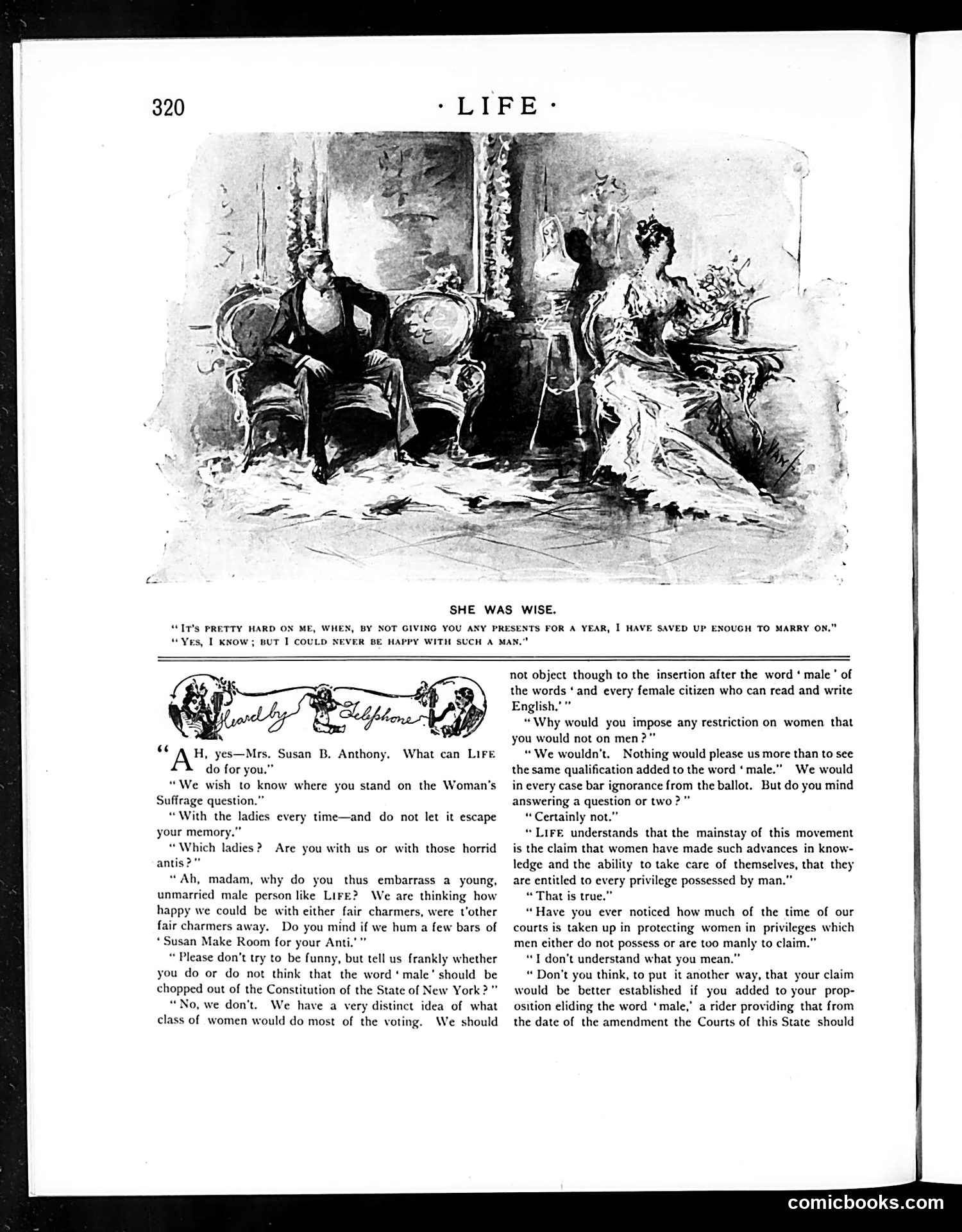
This Life magazine page satirizes the women's suffrage debate through a fictional dialogue with "Mrs. Susan B. Anthony" (the famous suffragist). The cartoon depicts a woman rejecting marriage to accumulate savings, prompting a discussion about voting rights. The text exchanges mock suffragists' arguments: a male interlocutor challenges whether women deserve political equality, suggesting they lack the capacity. He sarcastically proposes adding a disclaimer to constitutional amendments excluding the word "male"—implying that granting women voting rights is absurd. The satire ridicules both suffragists and anti-suffrage opponents, using humor to delegitimize women's equality claims. The "wise" woman's financial independence through refusing marriage is positioned as foolish rather than rational self-determination.
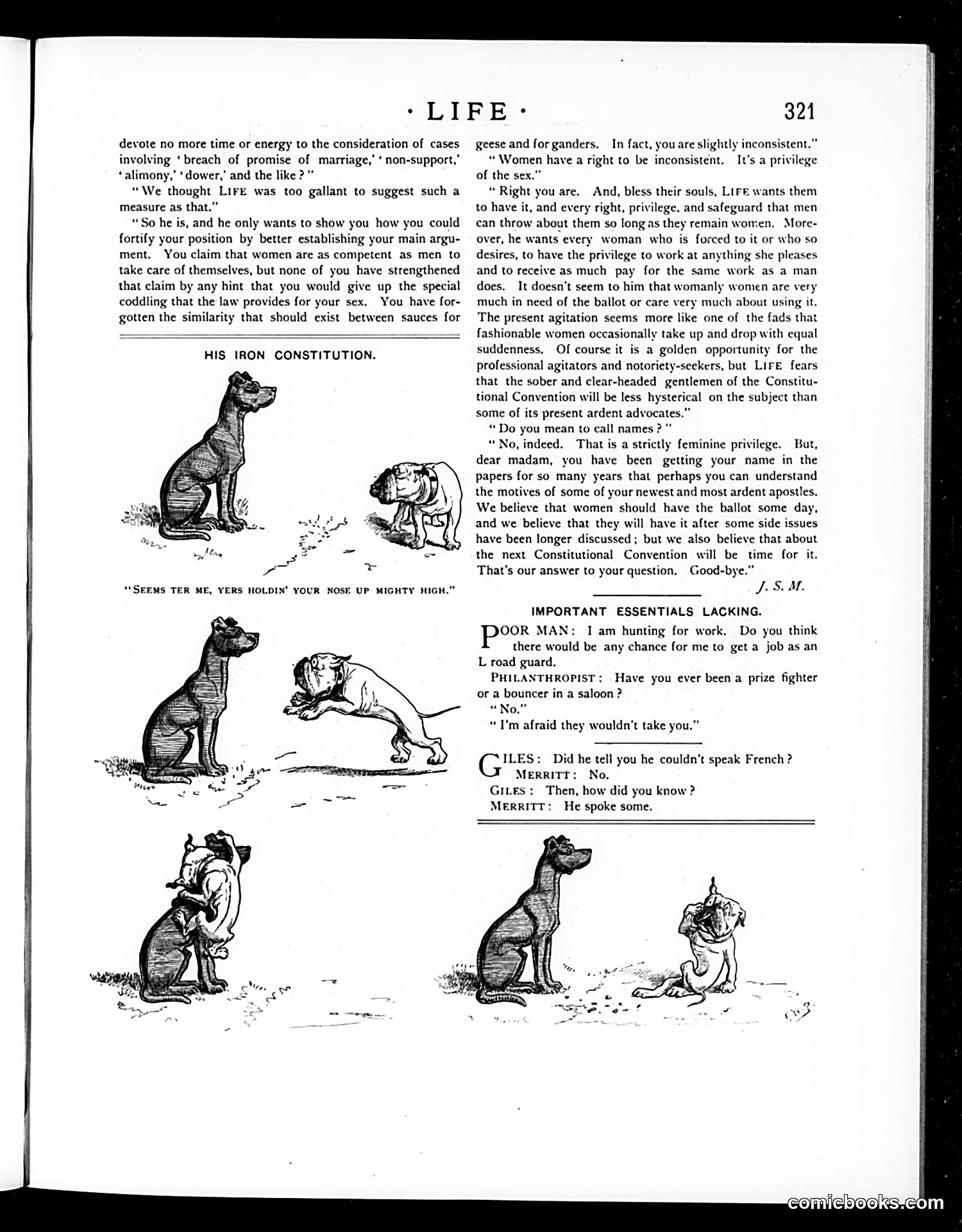
**Top Section ("His Iron Constitution"):** The illustrated dialogue satirizes women's suffrage activism. A man defends denying women voting rights by claiming women are inconsistent and emotional—they shouldn't have the "ballot" because they're prone to taking up causes then dropping them. The female respondent argues women deserve equal rights and that the suffrage question should be addressed at the next Constitutional Convention. **Bottom Section ("Important Essentials Lacking"):** A series of dog illustrations accompanies brief comedic dialogues about employment and language ability, appearing unrelated to the suffrage debate above. The humor relies on misunderstandings and unexpected answers in job-seeking scenarios. The page reflects early 20th-century anti-suffrage arguments characterizing women as fickle, while simultaneously presenting their counter-argument for equality.
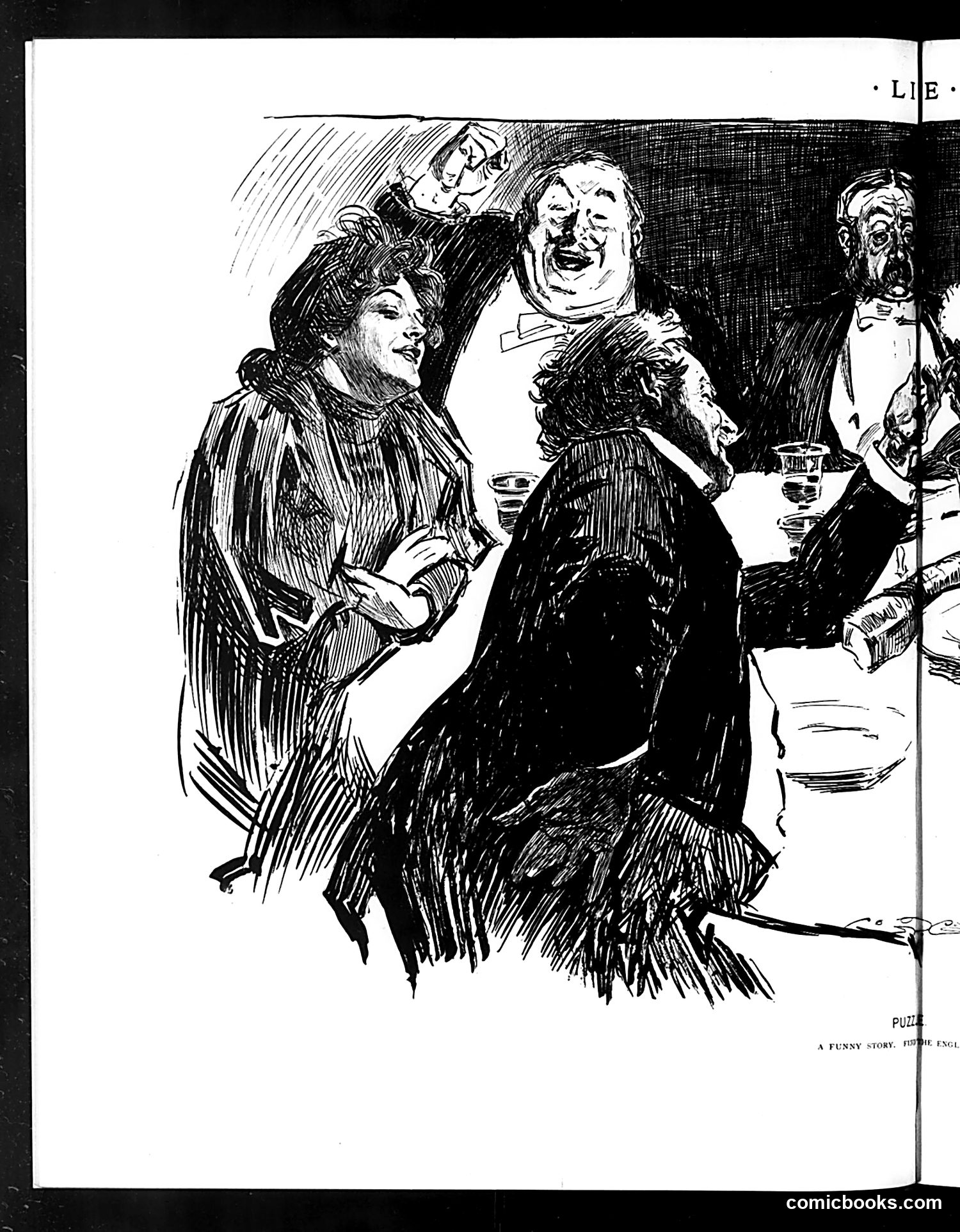
This appears to be a social satire illustration from *Life* magazine depicting a formal dinner scene. The cartoon shows well-dressed figures at what seems to be an elegant gathering, with glasses and table settings visible. The title indicates "A FUNNY STORY" related to "THE ENGLISHMAN" (partially visible text), suggesting the humor involves English social customs or stereotypes. The central jovial man appears to be recounting an anecdote while others react with amusement or shock—a common *Life* magazine format mocking upper-class dinner conversation and pretension. Without clearer text or identifying context, the specific satirical target remains unclear, though it likely comments on either English social affectation or a particular contemporary scandal discussed in such circles. The exaggerated facial expressions emphasize the humor of polite society's reactions.
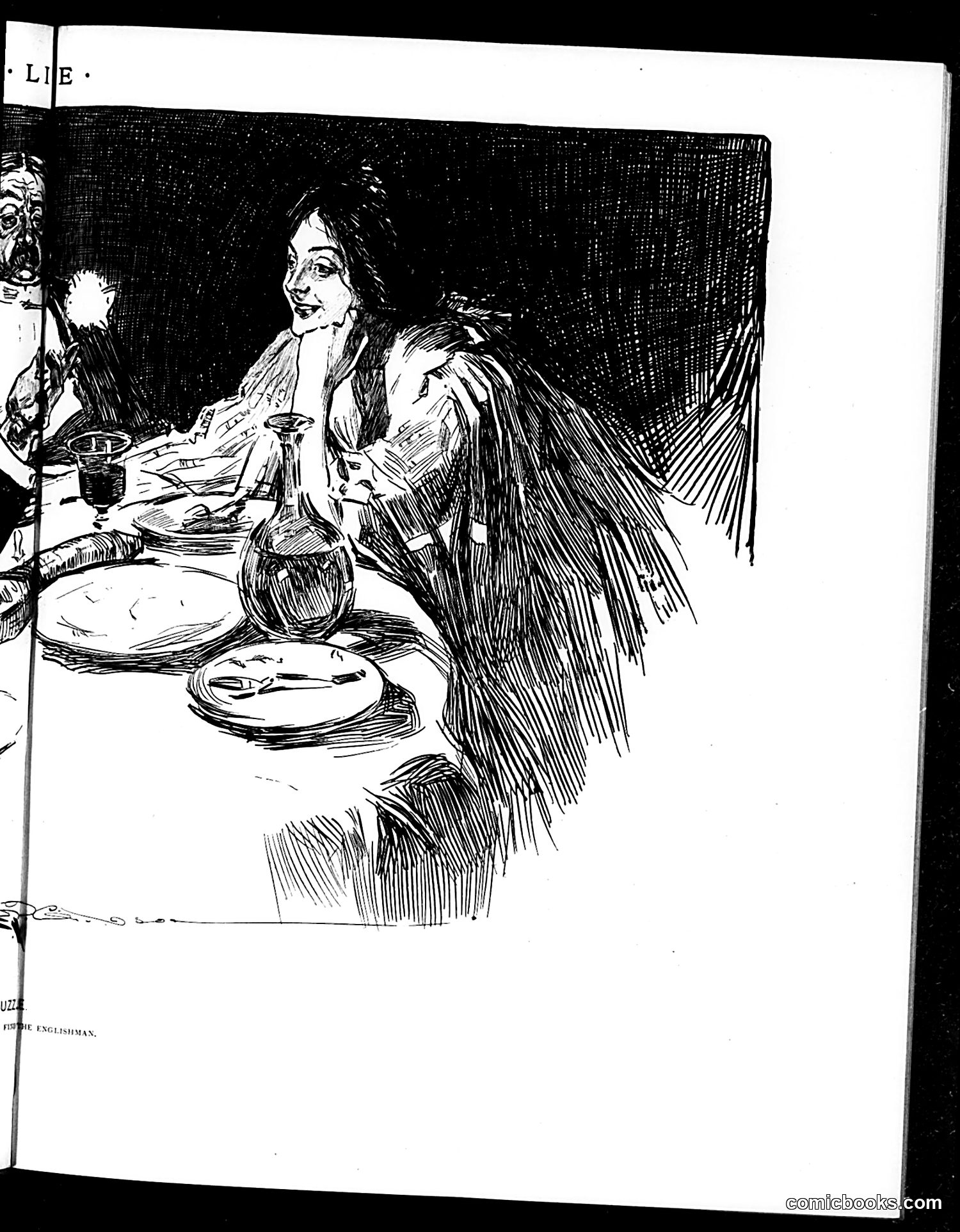
This appears to be an illustration from *Life* magazine showing a dinner scene with two figures at a table. The image shows a woman and man in what appears to be an intimate or flirtatious dining moment, with wine bottles and place settings visible. However, without clearer OCR text or visible captions on the page, I cannot definitively identify which specific political figures or social commentary this cartoon references. The artistic style and composition suggest social satire typical of *Life* magazine's content—likely commenting on romance, courtship, or social behavior of the era—but the precise satirical point and any specific identities remain unclear from this reproduction. To accurately explain the cartoon's meaning to a modern reader, I would need legible text or captions identifying the subjects or satirical target.
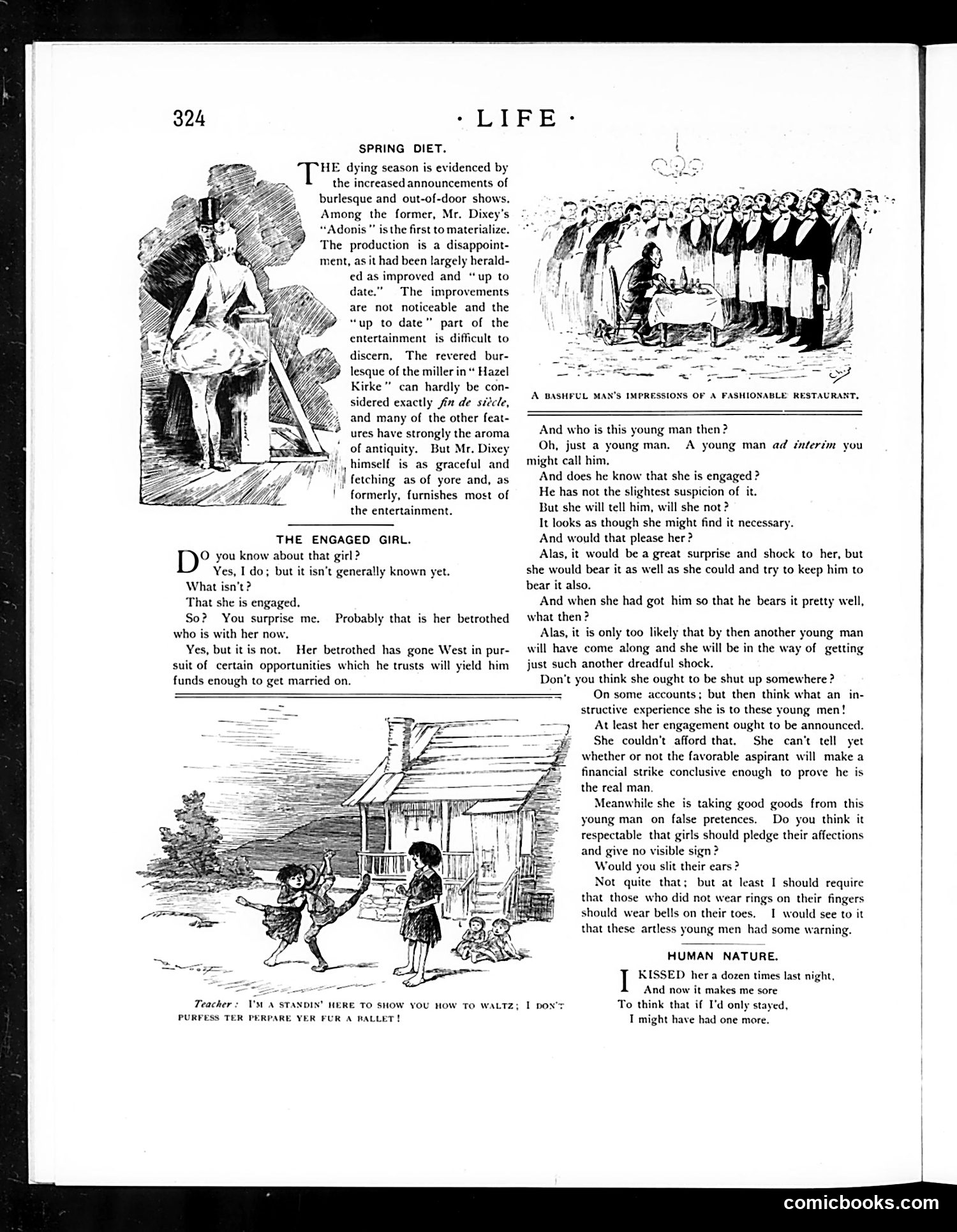
This page satirizes **courtship deception and social hypocrisy** among the wealthy classes. The main dialogue, "The Engaged Girl," mocks a young woman who is secretly engaged while actively courting another man ("ad interim")—a temporary placeholder. The satire targets her dishonesty: she accepts gifts and affection under false pretenses while waiting to see if her actual fiancé (away pursuing wealth) will succeed financially enough to marry her. The dialogue humorously proposes absurd solutions—suggesting she wear "bells on their toes" like livestock to warn unsuspecting suitors of her deception. The lower cartoon shows a dance instructor with children, captioned with his folksy denial that he's preparing them for ballet—a lighter comedic aside. The overall message critiques the mercenary nature of upper-class engagement, where marriage calculations depend entirely on the man's financial success, while women maintain multiple romantic interests as backup plans. The satire exposes how "respectable" society masks duplicity behind etiquette.
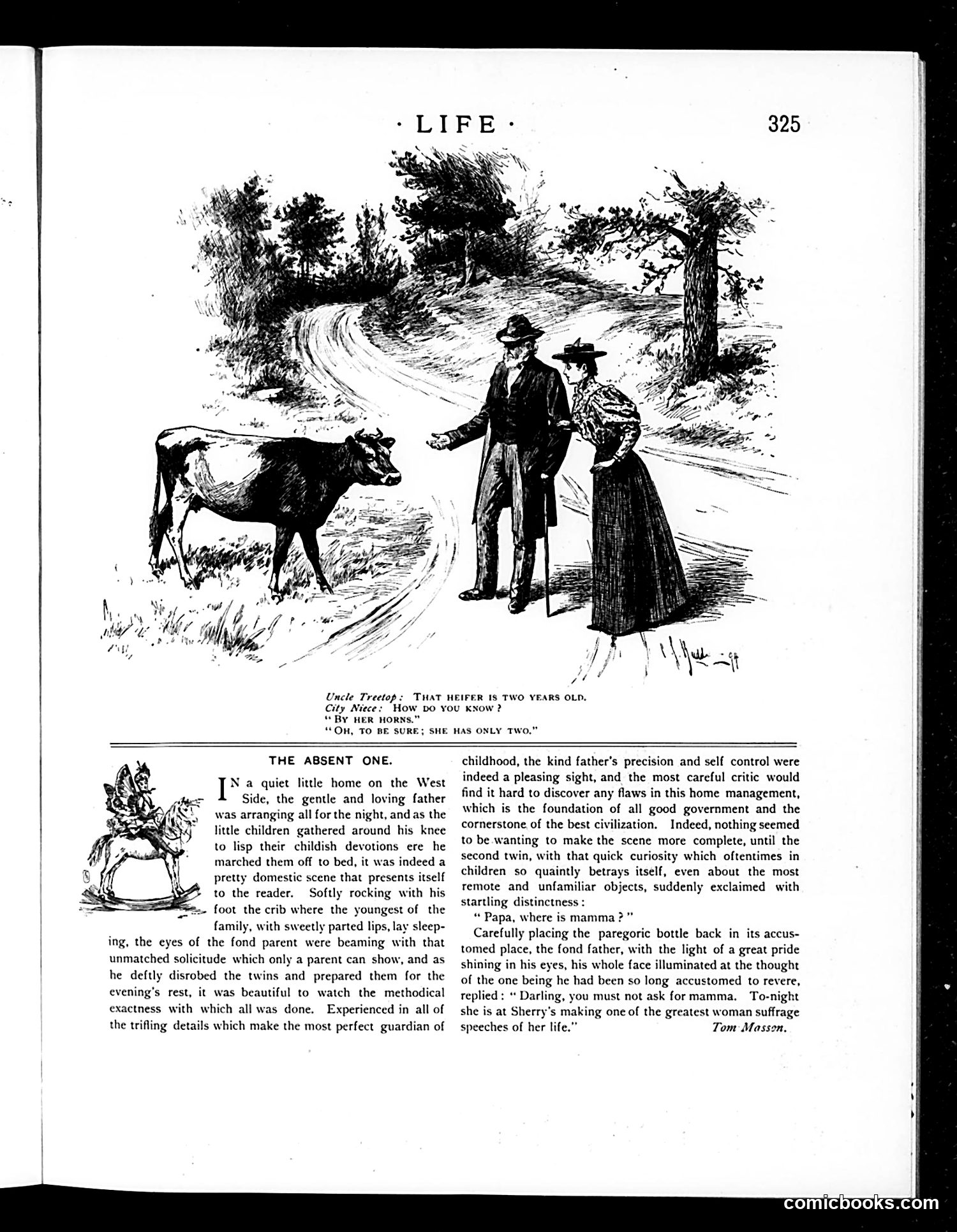
**The Cartoon (top):** A dated joke about estimating a cow's age. A city visitor asks an uncle how he knows the cow is two years old. His response—"she has only two [horns]"—is a rustic non-sequitur that plays on the visitor's gullibility, suggesting country folk have nonsensical logic. **The Story "The Absent One":** This is gentle satire about gender roles and women's suffrage. A devoted father handles all domestic duties—tucking in children, preparing them for bed—with perfect precision. The twist: his wife is absent because she's giving a women's suffrage speech at Sherry's (likely a restaurant or venue). The satire lies in the contrast: the story presents the father's domestic management as admirable and civilized, yet his wife's political activism (speaking for voting rights) is presented as unusual enough that the child must ask "where is mamma?" The piece gently mocks both the notion that a man managing the home is remarkable *and* the idea that a woman abandoning domestic duties for political speech is noteworthy—reflecting early-1900s anxieties about women's roles.
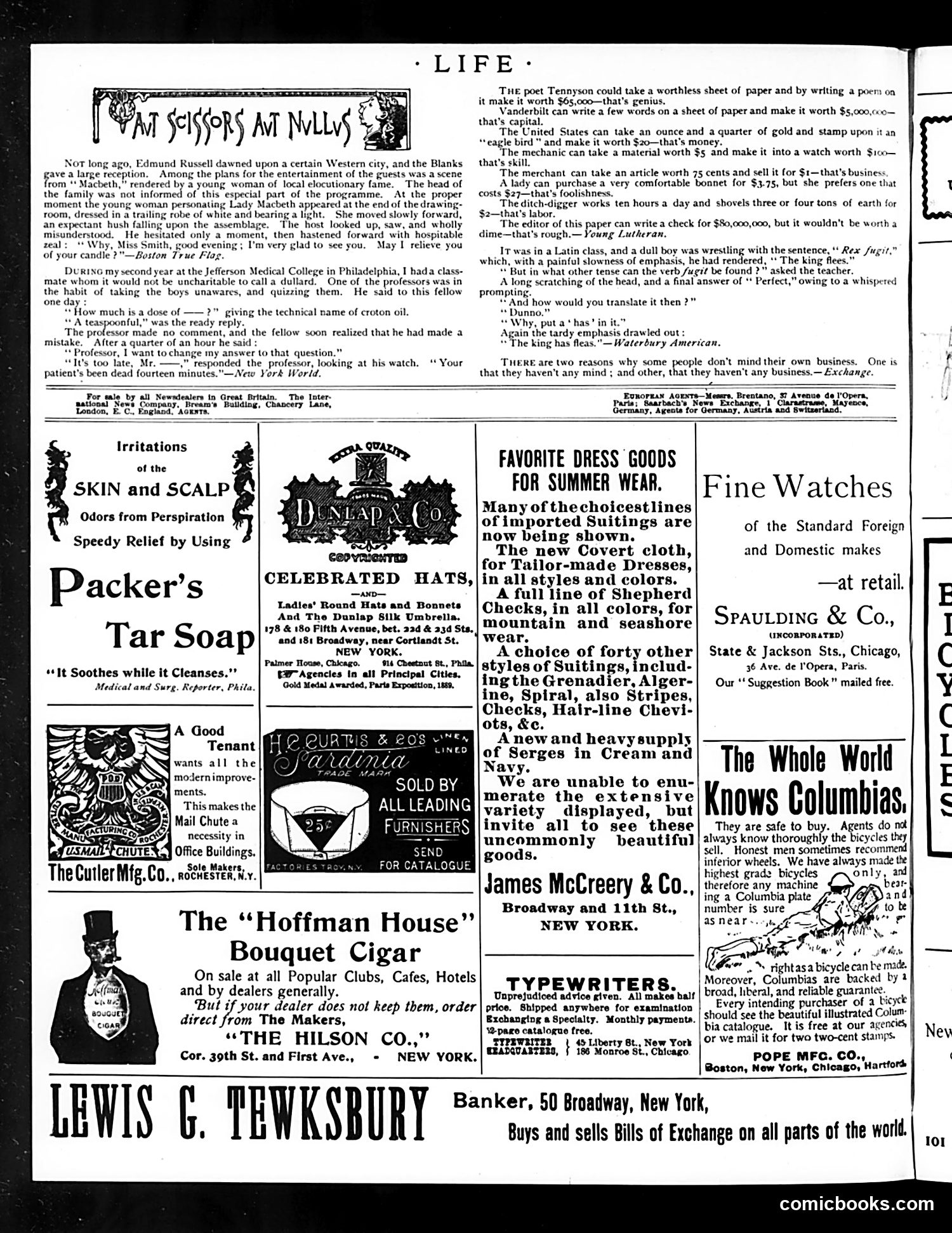
This page from *Life* magazine contains three brief humorous anecdotes rather than political cartoons: 1. **The Macbeth Misunderstanding**: A host mistakes a woman performing Lady Macbeth (in costume with a candle) for a guest, offering to take her coat. The joke relies on the host's obliviousness to the planned theatrical performance. 2. **The Medical Student**: A dull student answers a professor's question about croton oil dosage incorrectly, then tries to correct himself—but the professor says the patient has been dead for fourteen minutes, implying the wrong answer was fatal. This satirizes poor medical education or careless students. 3. **The Latin Translation**: A student struggles with the Latin verb "fugit" (flees), eventually mistranslating it as "has fleas" instead of "has fled." This mocks student incompetence. The page is primarily **advertising**—watches, cigars, soap, and dress goods dominate the layout. The humor targets common social foibles: absent-minded hosts, incompetent professionals, and dull students.
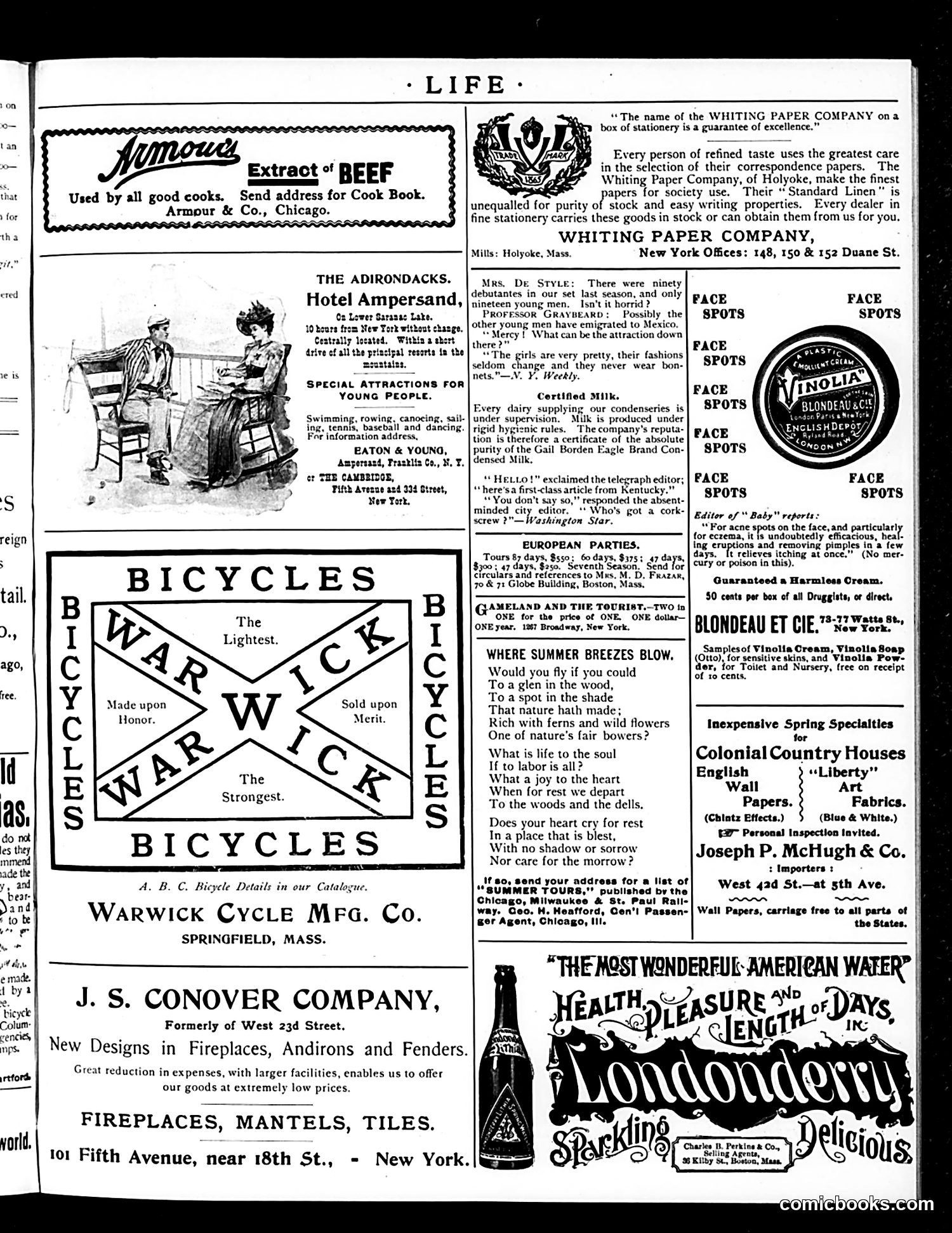
This page is **primarily advertisements** with minimal editorial cartoon content. The notable text-based humor includes: **"Where Summer Breezes Blow"** — A sentimental poem advertising vacation tours, offering escapism from labor ("What a joy to the heart / When for rest we depart"). **Two brief jokes:** 1. A brief exchange about the Adirondacks' Hotel Ampersand noting ninety women guests but only nineteen young men—the humor suggests young men have emigrated to Mexico, where girls are prettier and fashion-conscious (implying American women are overly concerned with fashions like bonnets). 2. A telegraph/city editor exchange where an editor asks for a "corkscrew" upon hearing of a Kentucky article—the joke is unclear without more context but appears to mock absent-minded journalism. The page otherwise consists of **product advertisements** for bicycles (Warwick Cycle), beef extract (Armour), stationery (Whiting Paper), milk products, fireplace fixtures, and skin creams—typical of late-19th/early-20th century magazine content. No significant political satire is evident.
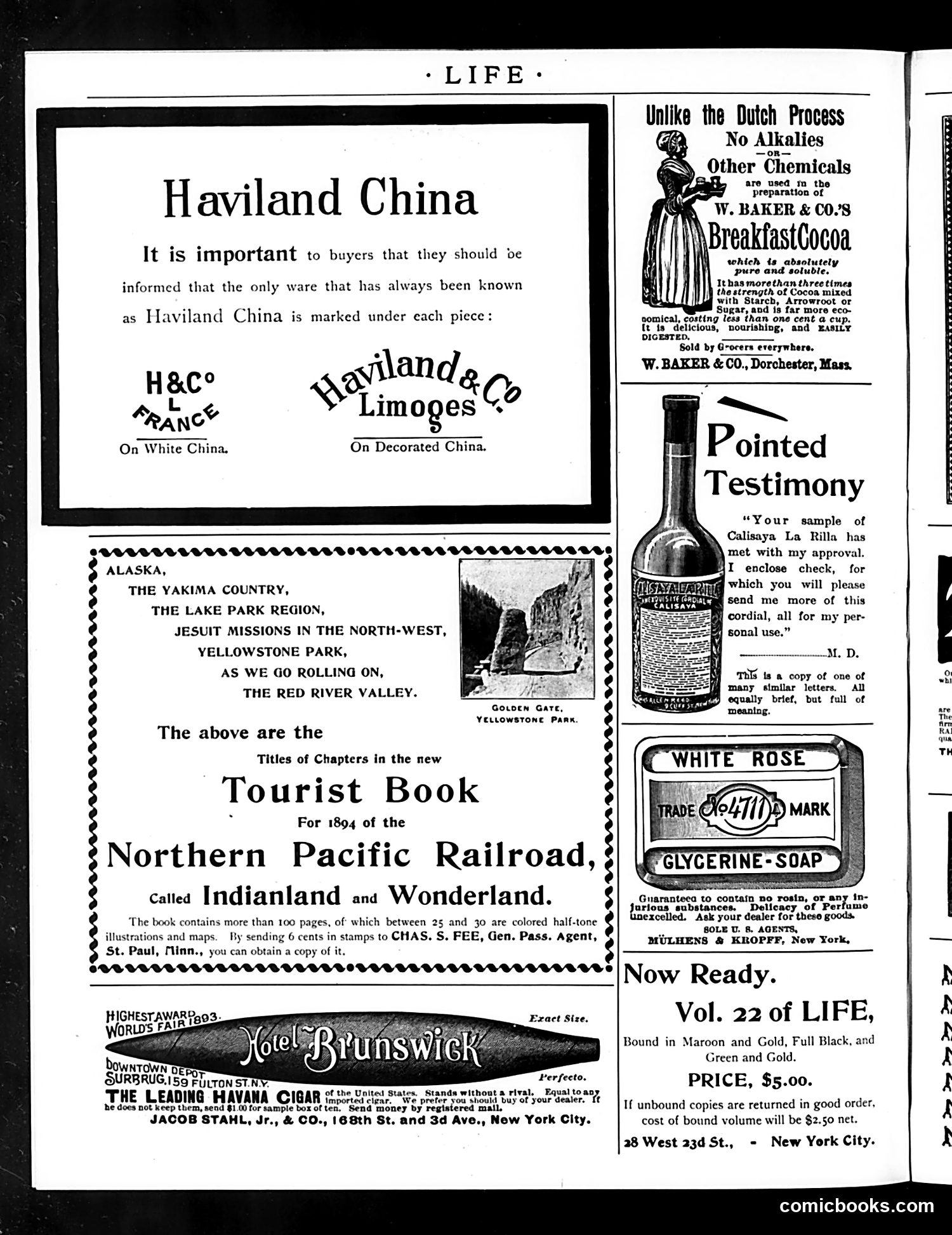
This page is primarily **advertising**, not satirical content. It contains multiple commercial advertisements typical of the 1890s: **Key advertisements include:** - **Haviland China**: Emphasizes brand authentication through manufacturer's marks - **Northern Pacific Railroad**: Promotes a tourist guidebook featuring western destinations (Yellowstone, Red River Valley) - **Hotel Brunswick**: A Havana cigar brand claiming highest award at the 1893 World's Fair - **W. Baker & Co. Cocoa**: Highlights superiority over Dutch-process competitors - **White Rose Glycerine Soap**: Claims purity and perfume quality - **Calisaya La Rilla**: Likely a medicinal cordial with testimonial endorsement - **Life Magazine Vol. 22**: Announcing the new volume's availability The page reflects late-Victorian consumer culture, emphasizing product quality, international goods, tourism, and testimonial advertising—common strategies of the 1890s before modern advertising regulation.
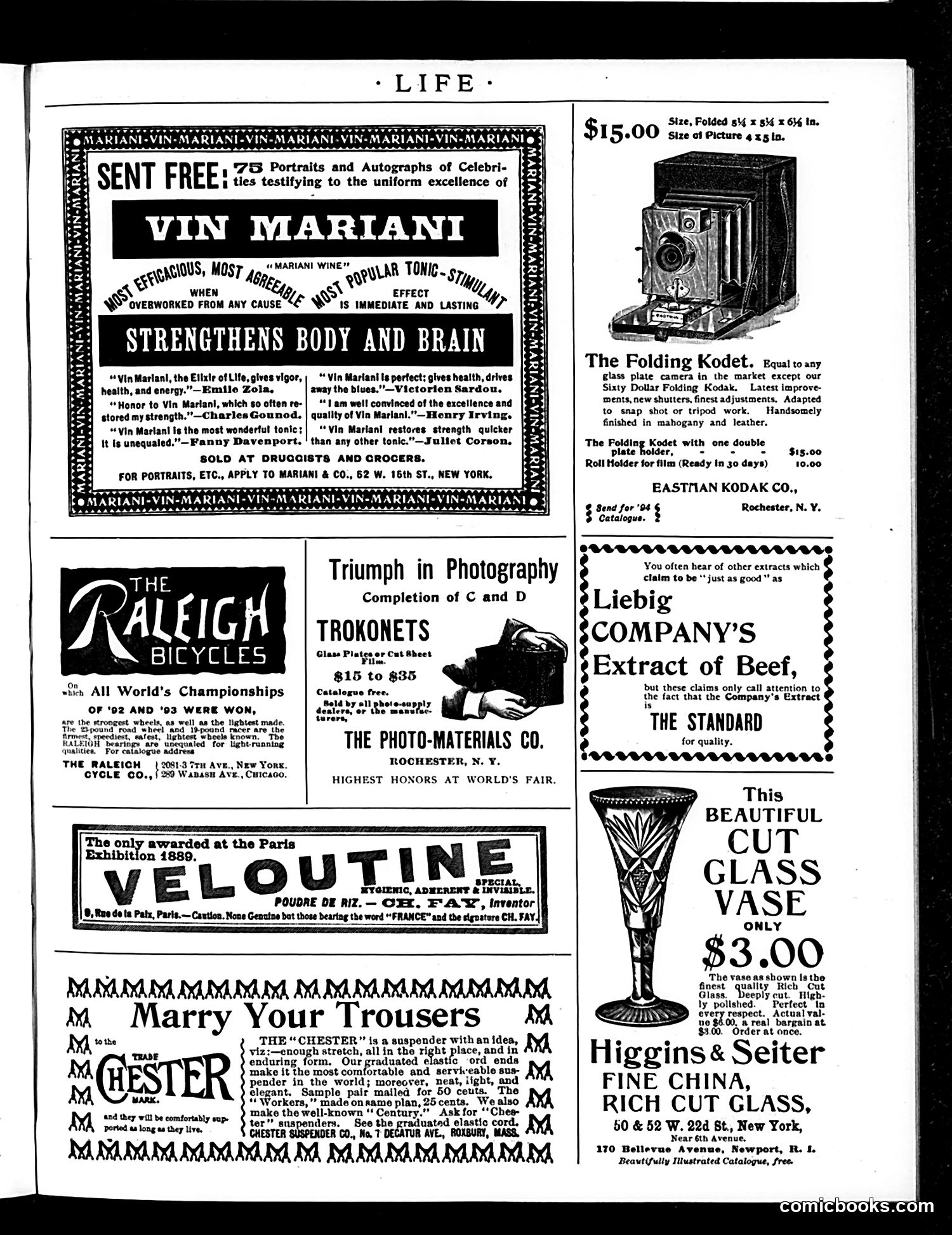
This is primarily an **advertising page** rather than a satirical cartoon page. It showcases luxury goods and patent medicines aimed at affluent readers circa the 1890s-early 1900s. The main items advertised include: - **Vin Mariani wine tonic**: A medicinal wine claiming to strengthen "body and brain," endorsed by famous celebrities (Émile Zola, Henry Irving, Fanny Davenport). This appears to be an early cocaine-containing patent medicine, marketed as a health elixir. - **Raleigh bicycles**: Promoted as champions at world's fairs. - **Photography equipment**: Trokonets glass plates and a Folding Kodak camera. - **Chester suspenders**: Advertised as the most comfortable. - **Liebig Extract of Beef**: A meat extract product claiming superior quality. - **Cut glass vase**: A luxury decorative item priced at $3.00. The page reflects late-Victorian consumer culture and the era's patent medicine marketing—before FDA regulation restricted such claims.
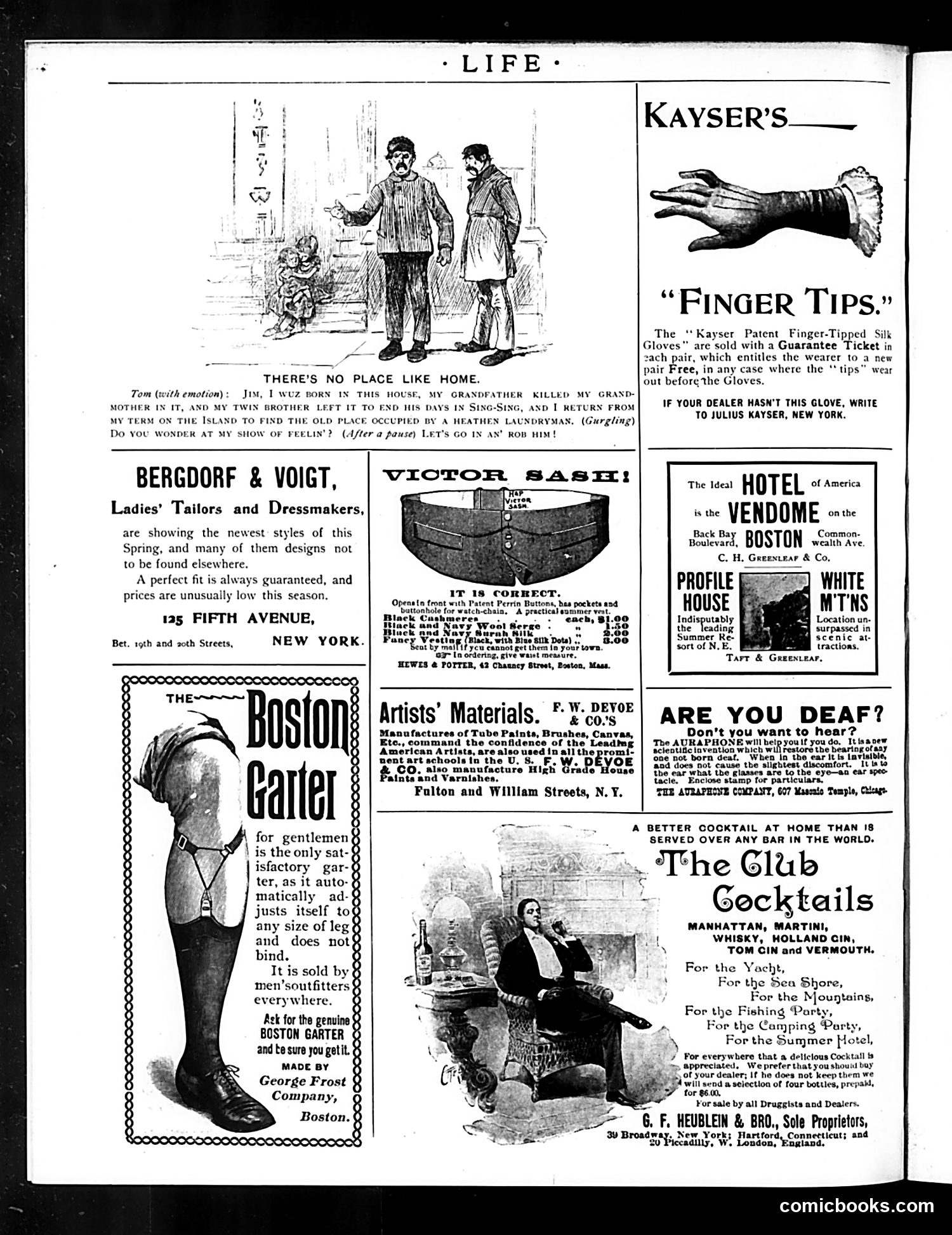
This cartoon depicts two men—Tom and Jim—returning to Tom's childhood home, now occupied by a Chinese laundry operator (referred to as a "heathen laundryman"). Tom emotionally recounts his family's violent history in the house (his grandfather killed his mother there; his twin brother died there), then concludes by proposing they rob the current occupant. The satire targets **nativist sentiment and anti-Chinese prejudice** common in early 20th-century America. The joke relies on stereotyping: the Chinese immigrant is presented as an interloper who has desecrated an American family home. The cartoon mocks both Tom's melodramatic nostalgia and the casual suggestion of robbery—implying that nativists viewed immigrants as threats warranting illegal action. The "heathen" label reflects period xenophobia toward non-Christian immigrants. This reflects Life magazine's often-satirical treatment of immigration controversies of the era.