
Life, 1894-05-17 · page 4 of 18
Life — May 17, 1894 — page 4: what you’re looking at
What you’re looking at
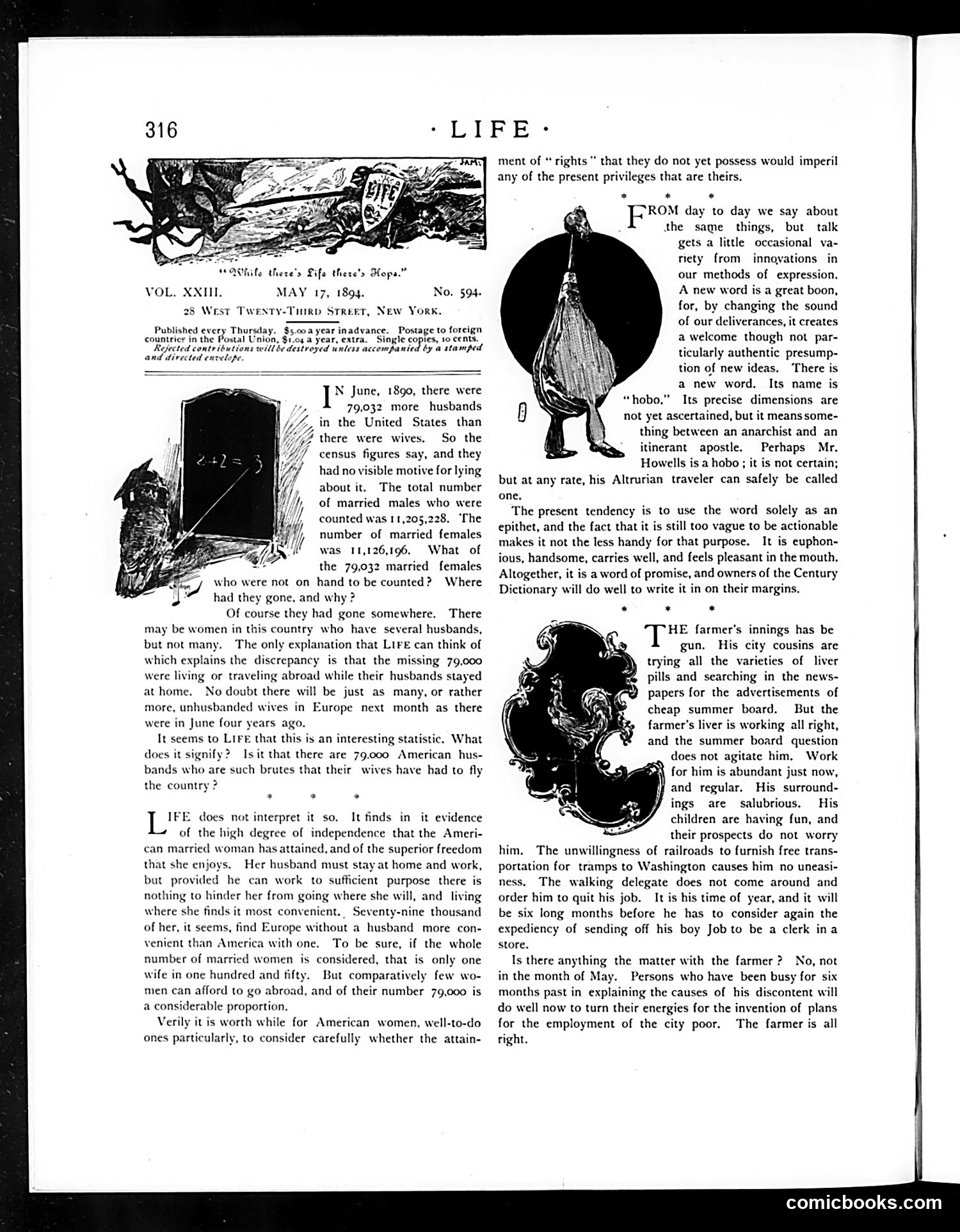
The page contains three distinct illustrations with satirical commentary. The left cartoons appear to mock census statistics about missing husbands—showing a man hiding behind a door with a math equation, suggesting marital discord or desertion. The central figure depicts a "hobo," with accompanying text introducing this as a new slang term for vagrant travelers, positioned between "anarchist" and "itinerant apostle" in meaning. The right column features a bearded man's head, introducing discussion of a farmer's contentment despite economic hardship. The text celebrates the farmer's resilience during difficult times, noting he resists distraction from labor reform movements and remains focused on work. The overall theme addresses American social tensions of the 1890s: marriage instability, emerging vagrant culture, and rural-urban economic divides.
📄 Transcribed text from this page (OCR, searchable)
Machine-transcribed from the original scan — historical spelling and the odd misread are preserved.
> LIFE > Wh “s Life there's Hops.” MAY 17, 1894. THikp STREE VOL. XXIII. 28 West Twest No. 594. + New York, Published every Thursday. $5.00a year inadvance. Postage to foreign countricr in the Postal Union, $1.c¢ a year, extra. Single copies, 10 cents Rejected contributions will be destroyed unless accompanied by @ stamped and directed envelope. yy June, 1890, there were [tp 79,032 more husbands in the United States than Vip there were wives, So the 4, census figures say, and they / had no visible motive for lying i about it. The total number //f, of married males who were My) counted was 11,205,228, ‘The i) number of married females 7S Wf was 11,126,196. What of + the 79,032 married females who were not on hand to be counted? Where had they gone, and why ? Of course they had gone somewhere. There may be women in this country who have several husbands, but not many. The only explanation that Lire can think of which explains the discrepancy is that the missing 79,000 were living or traveling abroad while their husbands stayed at home. No doubt there will be just as many, or rather more, unhusbanded wives in Europe next month as there were in June four years ago. It seems to LiFe that this is an interesting statistic. What does it signify? Is it that there are 79.000 American hus- bands who are such brutes that their wives have had to fly the country ? * * * IFE does not interpret it so. It finds in it evidence of the high degree of independence that the Ameri- can married woman has attained, and of the superior freedom that she enjoys. Her husband must stay at home and work, but provided he can work to sufficient purpose there is nothing to hinder her from going where she will, and living Seventy-nine thousand of her, it seems, find Europe without a husband more con- venient than America with one. To be sure, if the whole number of married women is considered, that is only one wife in one hundred and fifty, But comparatively few wo- men can afford to go abroad, and of their number 79,000 is a considerable proportion. Verily it is worth while for American women, well-to-do ones particularly, to consider carefully whether the attain- where she finds it most convenient. ment of “ rights” that they do not yet possess would imperil any of the present privileges that are theirs. . * . ROM day to day we say about the same things, but talk gets a little occasional va- nety from innovations in our methods of expression. A new word is a great boon, for, by changing the sound of our deliverances, it creates a welcome though not par- ticularly authentic presump- tion of new ideas. ‘There is a new word, Its name is “hobo.” Its precise dimensions are not yet ascertained, but it meanssome- thing between an anarchist and an itinerant apostle. Perhaps Mr. Howells is a hobo ; it is not certain; but at any rate, his Altrurian traveler can safely be called one. he present tendency is to use the word solely as an epithet, and the fact that it is still too vague to be actionable makes it not the less handy for that purpose. It is euphon- ious, handsome, carries well, and feels pleasant in the mouth. Altogether, it is a word of promise, and owners of the Century Dictionary will do well to write it in on their margins, . * HE farmer's innings has be gun. His city cousins are trying all the varieties of liver pills and searching in the news- papers for the advertisements of cheap summer board. But the farmer's liver is working all right, and the summer board question does not agitate him. Work for him is abundant just now, and regular. His surround- ings are salubrious. His children are having fun, and their prospects do not worry him. The unwillingness of railroads to furnish free trans- portation for tramps to Washington causes him no uneasi- ness, The walking delegate does not come around and order him to quit his job. It is his time of year, and it will be six long months before he has to consider again the expediency of sending off his boy Job to be a clerk ina store. Is there anything the matter with the farmer ? No, not in the month of May. Persons who have been busy for six months past in explaining the causes of his discontent will do well now to turn their energies for the invention of plans for the employment of the city poor. The farmer is all right. comicbooks.com