
Life, 1894-05-17 · page 6 of 18
Life — May 17, 1894 — page 6: what you’re looking at
What you’re looking at
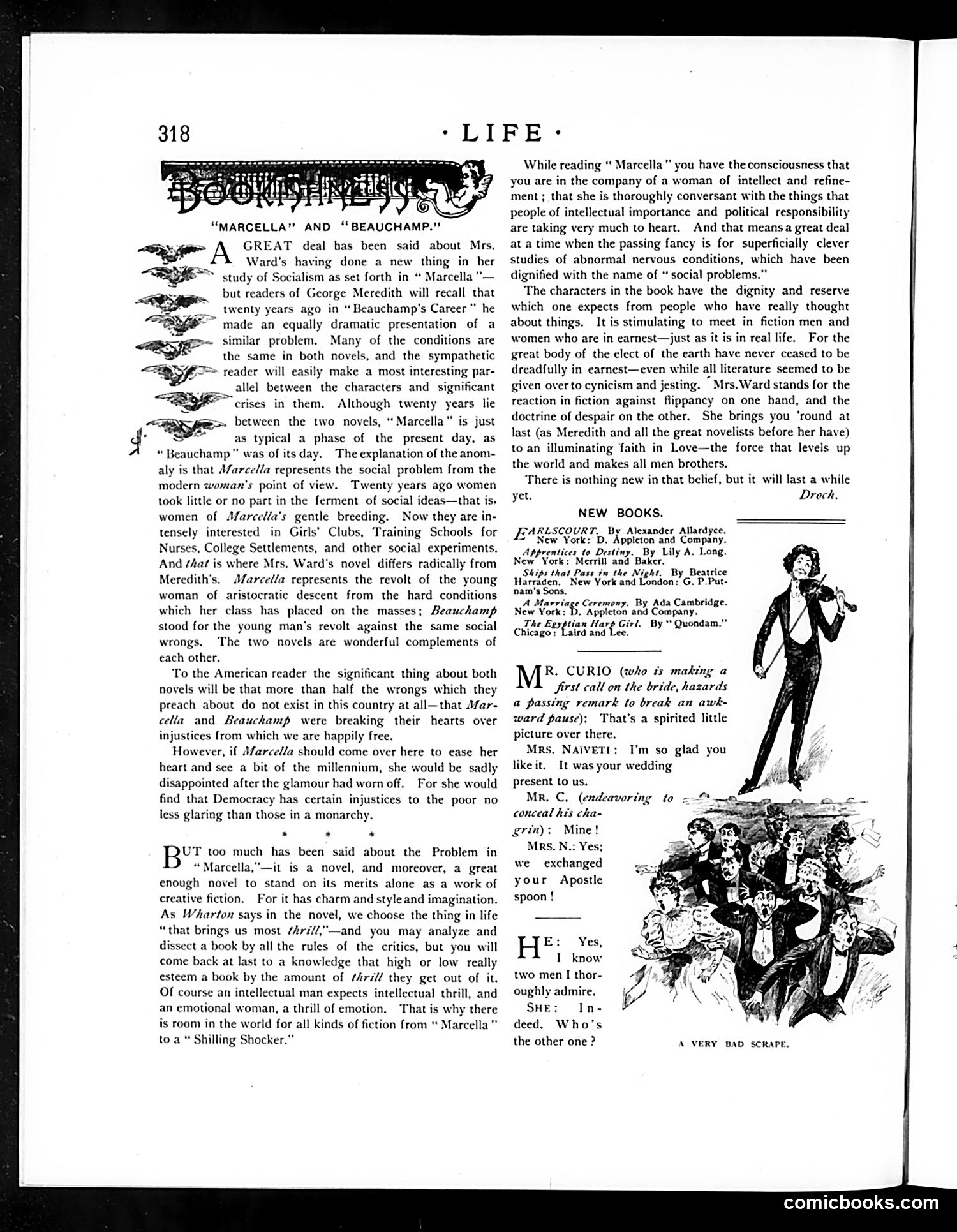
This page from *Life* magazine primarily contains a **book review** of two novels by Mrs. Ward: *Marcella* and *Beauchamp*. The left column discusses these works' treatment of socialism and social problems affecting women. The right side features a **small cartoon titled "A Very Bad Scrape,"** showing what appears to be a social embarrassment involving well-dressed figures—likely satirizing Victorian-era etiquette violations or awkward social situations among the upper classes. Below the cartoon is a brief humorous dialogue between Mr. Curio, Mrs. Naiveti, and Mr. C., joking about an Apostle spoon given as a wedding gift and mistaken identity of admirers. The page is primarily **literary criticism and light social satire** rather than political commentary, reflecting *Life*'s focus on cultural and social humor.
📄 Transcribed text from this page (OCR, searchable)
Machine-transcribed from the original scan — historical spelling and the odd misread are preserved.
ac eel between the two novels, “ Marcella” ¢ en as typical a phase of the present day, as ‘LIFE: “MARCELLA” AND ‘BEAUCHAMP. GREAT deal bas been said about Mrs. Ward's having done a new thing in her study of Socialism as set forth in “ Marcella "— but readers of George Meredith will recall that twenty years ago in “ Beauchamp's Career” he made an equally dramatic presentation of a similar problem. Many of the conditions are the same in both novels, and the sympathetic reader will easily make a most interesting par- allel between the characters and significant crises in them, Although twenty years lie is just “ Beauchamp" was of its day. The explanation of the anom- aly is that AZarce//a represents the social problem from the modern woman's point of view. Twenty years ago women took little or no part in the ferment of social ideas—that is. women of Afarcella's gentle breeding. Now they are in- tensely interested in Girls’ Clubs, Training Schools for Nurses, College Settlements, and other social experiments. And ¢hat is where Mrs, Ward's novel differs radically from Meredith's. Afarcella represents the revolt of the young woman of aristocratic descent from the hard conditions which her class has placed on the masses; Beauchamp stood for the young man’s revolt against the same social wrongs. The two novels are wonderful complements of each other, To the American reader the significant thing about both novels will be that more than half the wrongs which they preach about do not exist in this country at all—that Mar- cella and Beauchamp were breaking their hearts over injustices from which we are happily free. However, if M/arce/la should come over here to ease her heart and sce a bit of the millennium, she would be sadly disappointed after the glamour had worn off. For she would find that Democracy has certain injustices to the poor no less glaring than those in a monarchy. . * . UT too much has been said about the Problem in “Marcella,"—it is a novel, and moreover, a great enough novel to stand on its merits alone as a work of creative fiction. For it has charm and styleand imagination. As Wharton says in the novel, we choose the thing in life “that brings us most ¢hr#//,"—and you may analyze and dissect a book by all the rules of the critics, but you will come back at last to a knowledge that high or low really esteem a book by the amount of ¢/rd// they get out of it. Of course an intellectual man expects intellectual thrill, and an emotional woman, a thrill of emotion. That is why there is room in the world for all kinds of fiction from * Marcella” to a * Shilling Shocker.” While reading “ Marcella” you have the consciousness that you are in the company of a woman of intellect and refine- ment ; that she is thoroughly conversant with the things that people of intellectual importance and political responsibility are taking very much to heart. And that meansa great deal at a time when the passing fancy is for superficially clever studies of abnormal nervous conditions, which have been dignified with the name of “ social problems.” The characters in the book have the dignity and reserve which one expects from people who have really thought about things. It is stimulating to meet in fiction men and women who are in earnest—just as it is in real life. For the great body of the elect of the earth have never ceased to be dreadfully in earnest—even while all literature seemed to be given over to cynicism and jesting. Mrs.Ward stands for the reaction in fiction against flippancy on one hand, and the doctrine of despair on the other. She brings you ‘round at last (as Meredith and all the great novelists before her have) to an illuminating faith in Love—the force that levels up the world and makes all men brothers. There is nothing new in that belief, but it will last a while et. Droch. NEW BOOKS. EARLSCOURT. By Alexander Allardyce. “New York: D. Appleton and Company. Apprentices to Destiny. By Lily A. Long. New’ Works Merrill and’ Baker. Ships that Pass in the Night. By Beatrice Harraden, New York and London: G. P.Put- nam's Sons. A Marriage Ceremony. By Ada Cambridge. New York: D. Appleton and Company. The Egyptian Harp Girl. By‘ Quondam.”” Chicago: Laird and Lee. R. CURIO (who is making a Sirst call on the bride, hazards a passing remark to break an awk- ward pause): That's a spirited little picture over there. Mrs. Naiveti: I'm so glad you likeit. It was your wedding present to us. Mr. C. (endeavoring to = conceal his cha- grin): Mine! Mrs. N.: Yes; we exchanged your Apostle spoon ! Yes, H 1 know two men I thor- oughly admire. SHE: In- deed. Who's the other one ? A VERY BAD SCRAPE, comicbooks.com