
A complete issue · 14 pages · 1894
Life — April 12, 1894
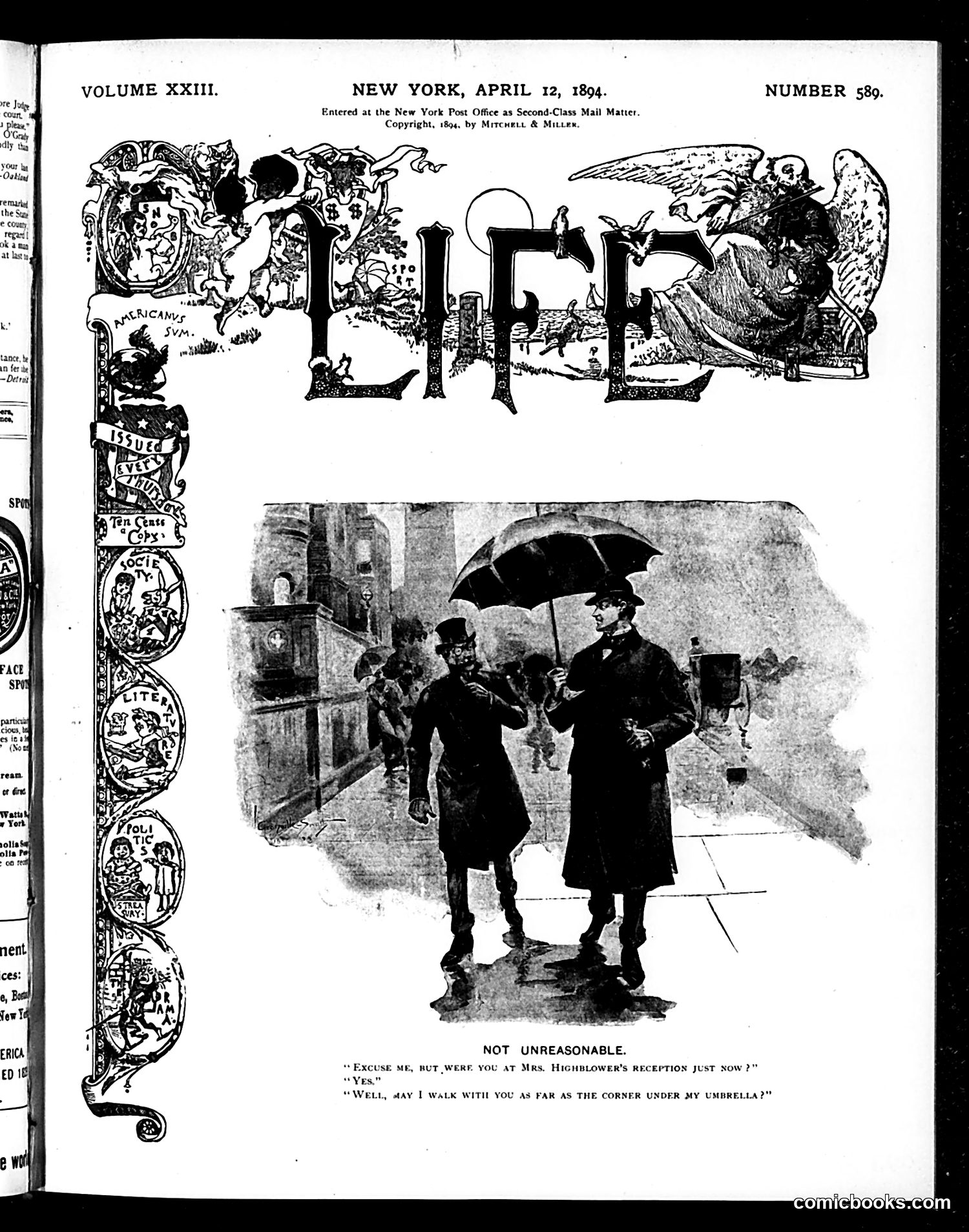
This cartoon satirizes social etiquette among the upper class. Two well-dressed men with umbrellas encounter a woman on a rainy street. The caption reads: "Excuse me, but were you at Mrs. Highblower's reception just now?" "Yes." "Well, say I walk with you as far as the corner under my umbrella?" The humor lies in the absurdity of their politeness. Despite apparently meeting by chance in poor weather, the man asks permission to share his umbrella for a brief walk—treating a practical gesture as requiring formal social permission. This mocks the excessive formality and awkward etiquette conventions of wealthy Victorian society, where even offering shelter required elaborate courtesy.
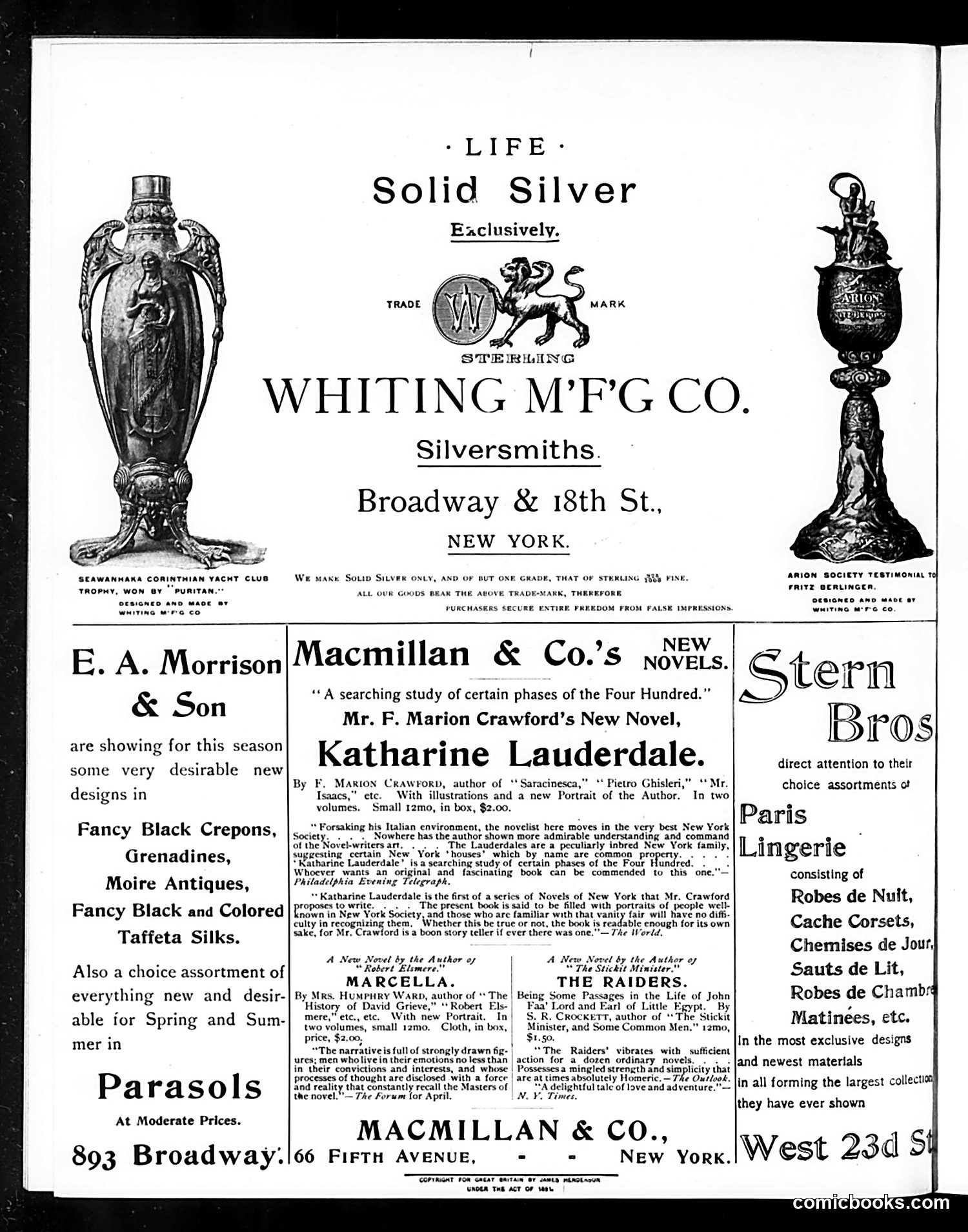
This page is **primarily advertising**, not satirical content. It features: **Top section:** Whiting M'FG Co., silversmiths on Broadway & 18th St., New York, advertising solid silver goods exclusively. Two ornate silver vessels are displayed—a trophy and a decorative urn with classical designs. **Middle/lower sections:** Book advertisements from Macmillan & Co. promoting new novels, including F. Marion Crawford's *Katharine Lauderdale* and S. R. Crockett's *The Raiders*. **Left side:** E.A. Morrison & Son advertising fancy fabrics—black crepes, grenadines, and silk parasols at moderate prices (893 Broadway). **Right side:** Stern Bros. advertising Paris lingerie and women's clothing. No political satire or caricature is present on this page—it's a standard turn-of-century commercial advertising section.
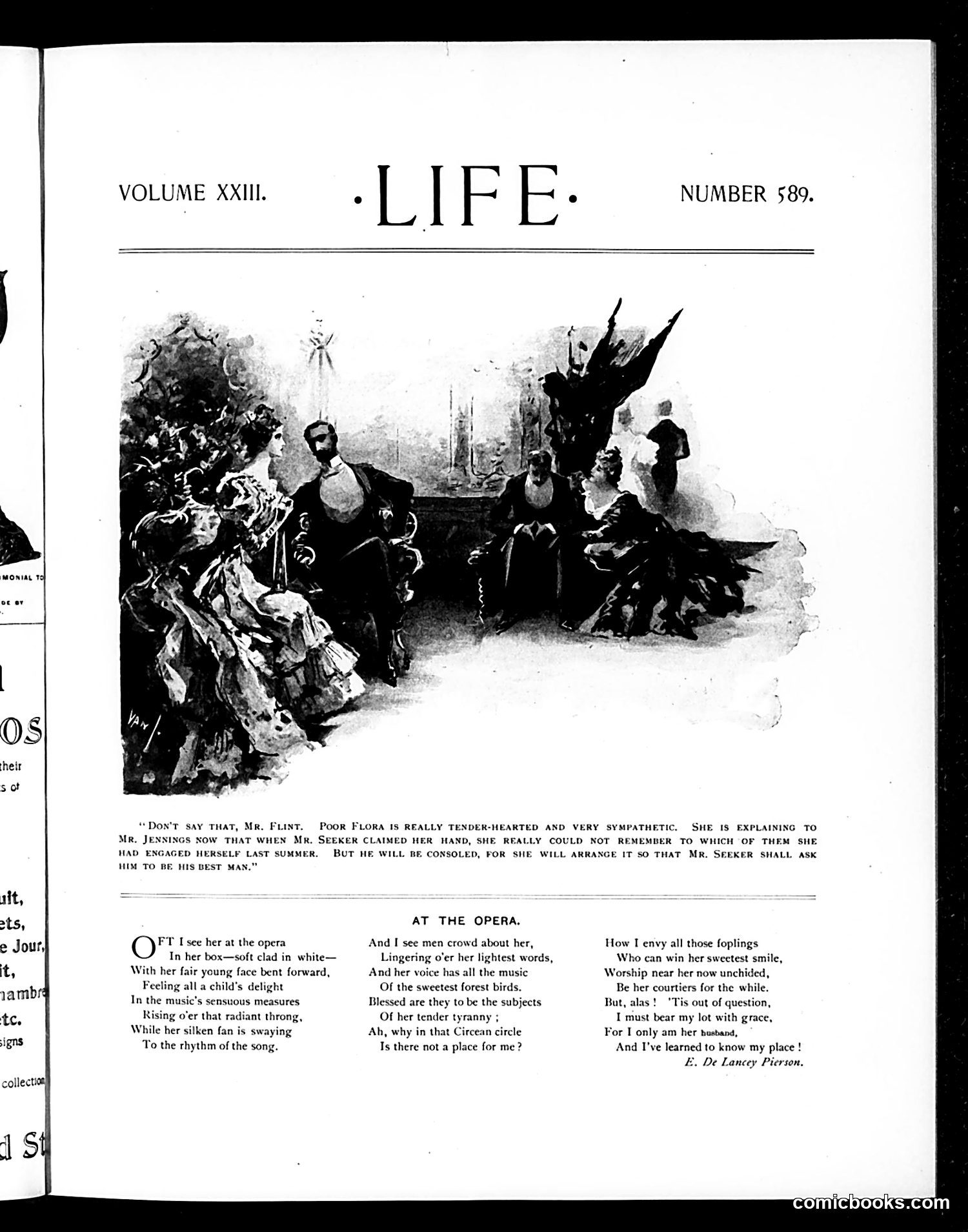
This page from *Life* magazine (Volume XXIII, Number 589) contains a satirical illustration and poem titled "At the Opera." The cartoon depicts a social scene at an opera house, showing elegantly dressed Victorian-era figures. The caption references characters named Mr. Flint, Poor Flora, Mr. Jennings, and Mr. Seeker, describing a romantic entanglement where Flora claims she cannot remember which suitor she previously engaged herself to. The accompanying poem by E. De Lancey Pierson uses the opera setting to explore themes of romantic rivalry and social aspiration—a man watching from the audience envies the wealthy suitors in the box seats who can court the attractive woman on stage. The satire targets upper-class romantic pretensions and social climbing, common *Life* magazine themes mocking Victorian society's affectations around wealth, courtship, and culture.
The page contains political commentary rather than a cartoon. The main text criticizes the election of poor-quality legislators and governors, arguing that citizens who vote for "crank" politicians must accept harmful consequences like increased taxes. A secondary piece discusses **filial devotion**, concerning a young Mr. Astor's plan to build his mother a stable on Madison Avenue in New York. The satire mocks this as an absurd expression of filial piety—building a stable in a residential neighborhood ostensibly to comfort his mother, while actually inconveniencing neighbors. This appears to reference a real Astor family member and New York society controversy. The final section debates English language contractions ("don't" vs. "do not"), a minor but typical Victorian-era linguistic debate.
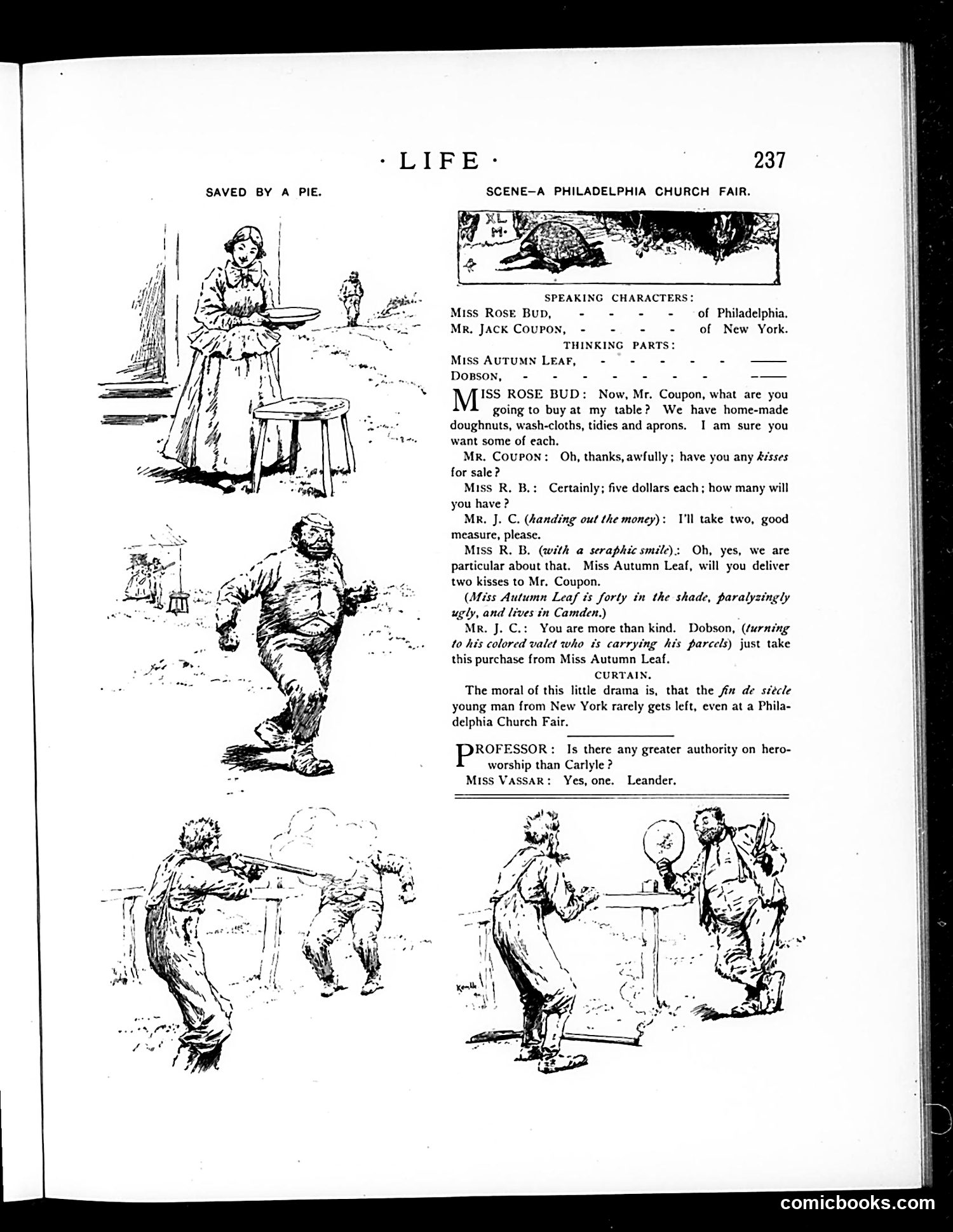
This is a humorous sketch set at a Philadelphia Church Fair. Miss Rose Bud (a vendor) sells homemade goods to Mr. Jack Coupon from New York. The joke hinges on a transaction: Coupon purchases "kisses" for $5 each from Miss Autumn Leaf, who is described as "forty in the shade, paralyzingly ugly, and lives in Camden." The satire targets young men from New York who frequently attend Philadelphia social events, suggesting they rarely escape such awkward situations. The moral explicitly states this is commentary on the vulnerability of out-of-town visitors to local schemes. The lower illustrations show slapstick consequences—apparently the pie somehow "saves" Coupon from an embarrassing encounter, though the exact mechanism remains unclear from the text alone. This reflects early 20th-century satirical humor about regional stereotypes and social commerce.
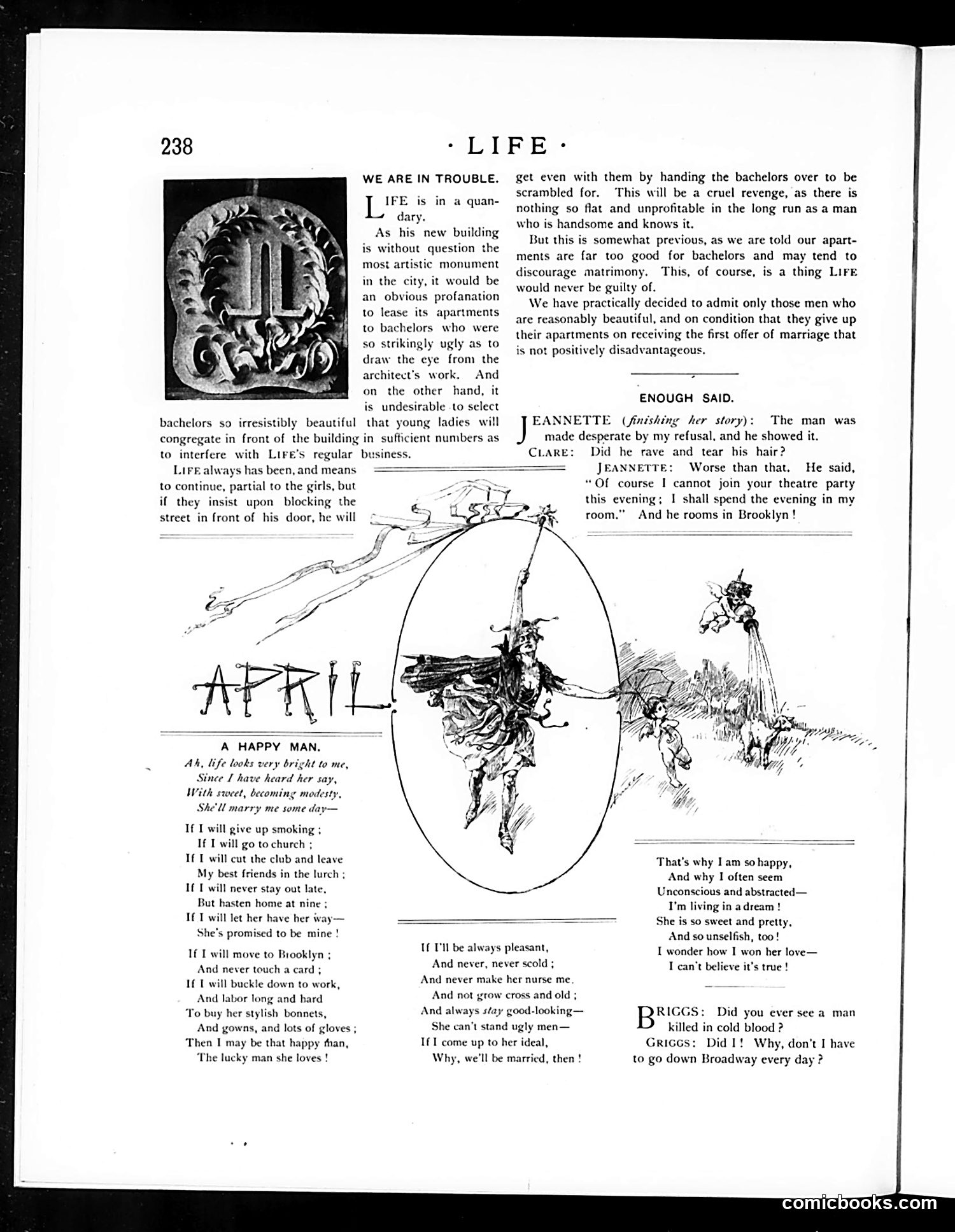
This page satirizes New York City bachelor apartments and their social impact. The main article "WE ARE IN TROUBLE" discusses a new building with units so attractive that they're discouraging marriage—young women congregate there, interfering with normal business. The building's architect is criticized for creating such desirable bachelor spaces. The central cartoon "A HAPPY MAN" depicts a man juggling multiple romantic interests, illustrating the consequences: bachelor apartments enable men to remain unmarried and socially active rather than settle down. The dialogue snippets ("ENOUGH SAID") mock the excuses men use to avoid commitment—claiming they must stay in Brooklyn rather than attend social events. The satire critiques how urban design and living arrangements facilitate bachelor lifestyles, undermining traditional marriage expectations of the era.
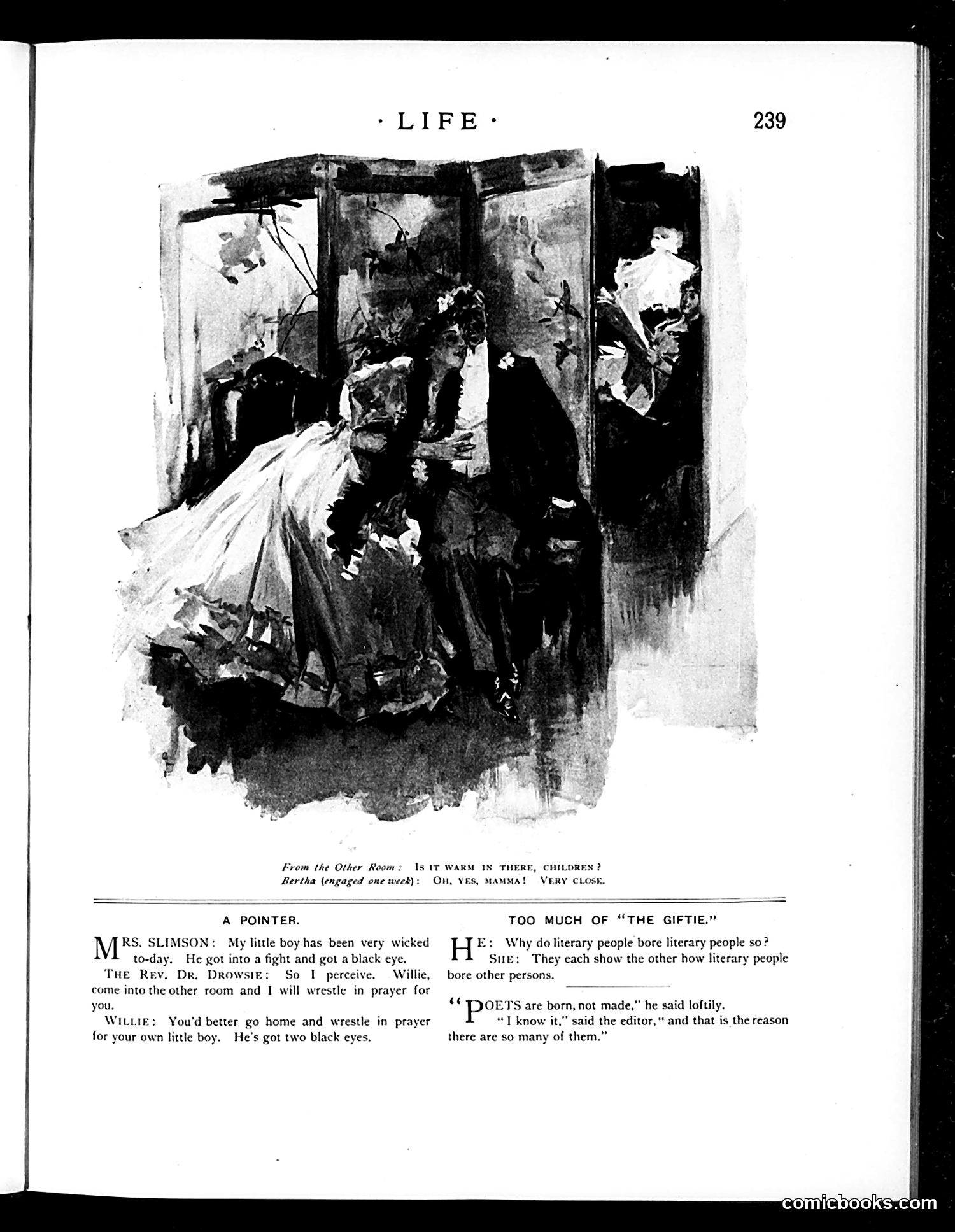
This page contains two separate satirical pieces from *Life* magazine. **"A Pointer"** (lower left) depicts a domestic scene where Mrs. Slimson complains to Reverend Dr. Dismukes that her son fought and got a black eye. Willie responds sarcastically that the reverend should go home and "wrestle in prayer for your own little boy. He's got two black eyes"—a comeback implying the reverend's own child misbehaves worse. **"Too Much of 'The Giftie'"** (lower right) is a literary joke. When asked why literary people bore other literary people, the response explains they mutually demonstrate "how literary people bore other persons." The editor then quips that "Poets are born, not made," explaining why there are so many boring ones—a jab at pretentious literary circles and mediocre poets. The upper illustration appears to relate to one of these pieces but its specific connection is unclear from the visible text.
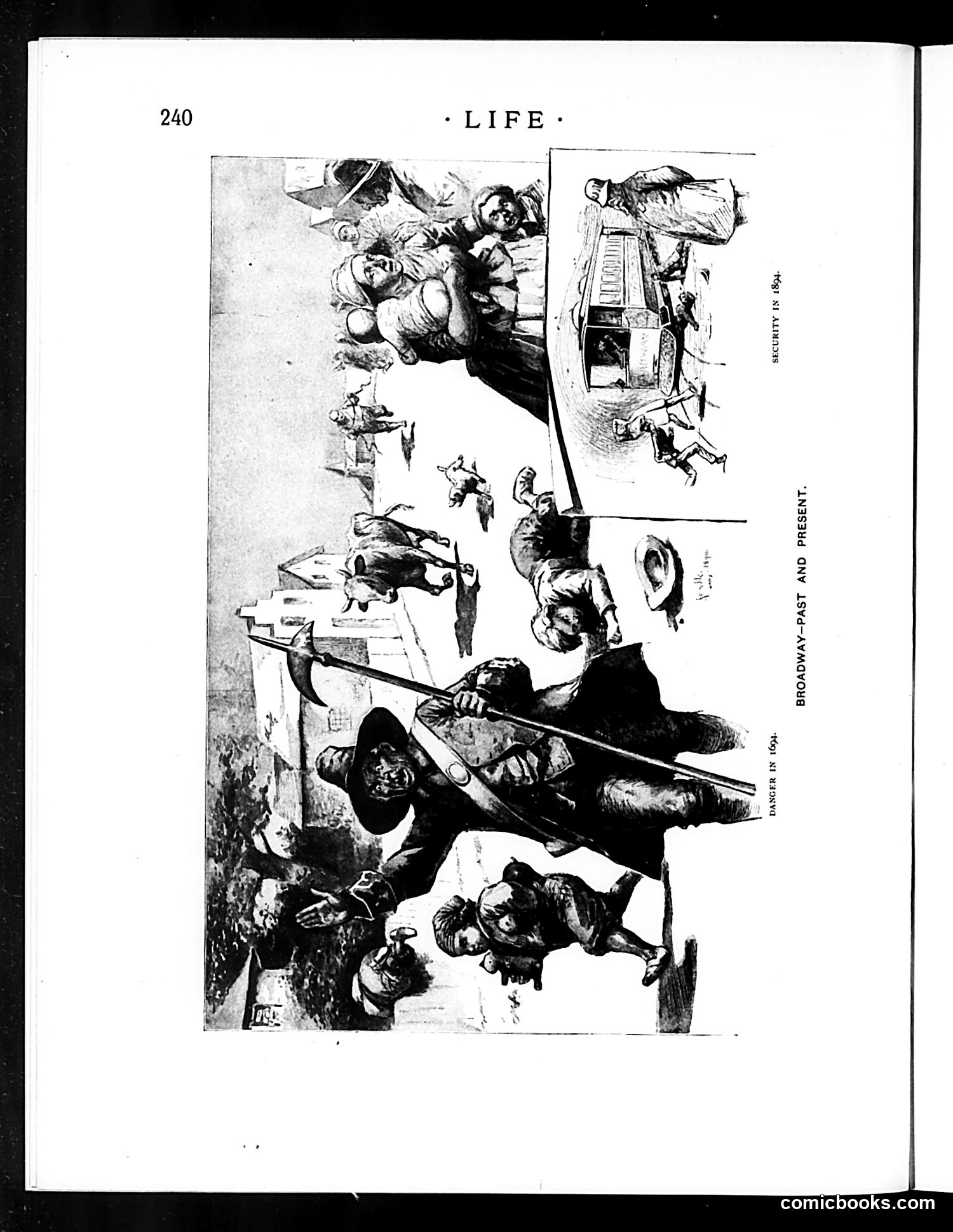
This page contains a single illustration titled "Broadway—Past and Present" (visible on the right margin). The image is rotated 90 degrees, depicting a street scene that contrasts two time periods of Broadway. The cartoon shows a figure in period clothing (appearing to be from an earlier era) holding a long pole or staff, observing the modern Broadway street below. The scene includes various figures, buildings, and street activity that likely represent the transformation of Broadway from its historical character to its contemporary commercialized state around the magazine's publication period. The satire critiques how Broadway has changed—suggesting nostalgia for an older, perhaps more authentic version while satirizing its modern commercialization and development. However, without clearer visibility of specific figures or dated references, the exact social commentary remains somewhat general about urban change and modernization.
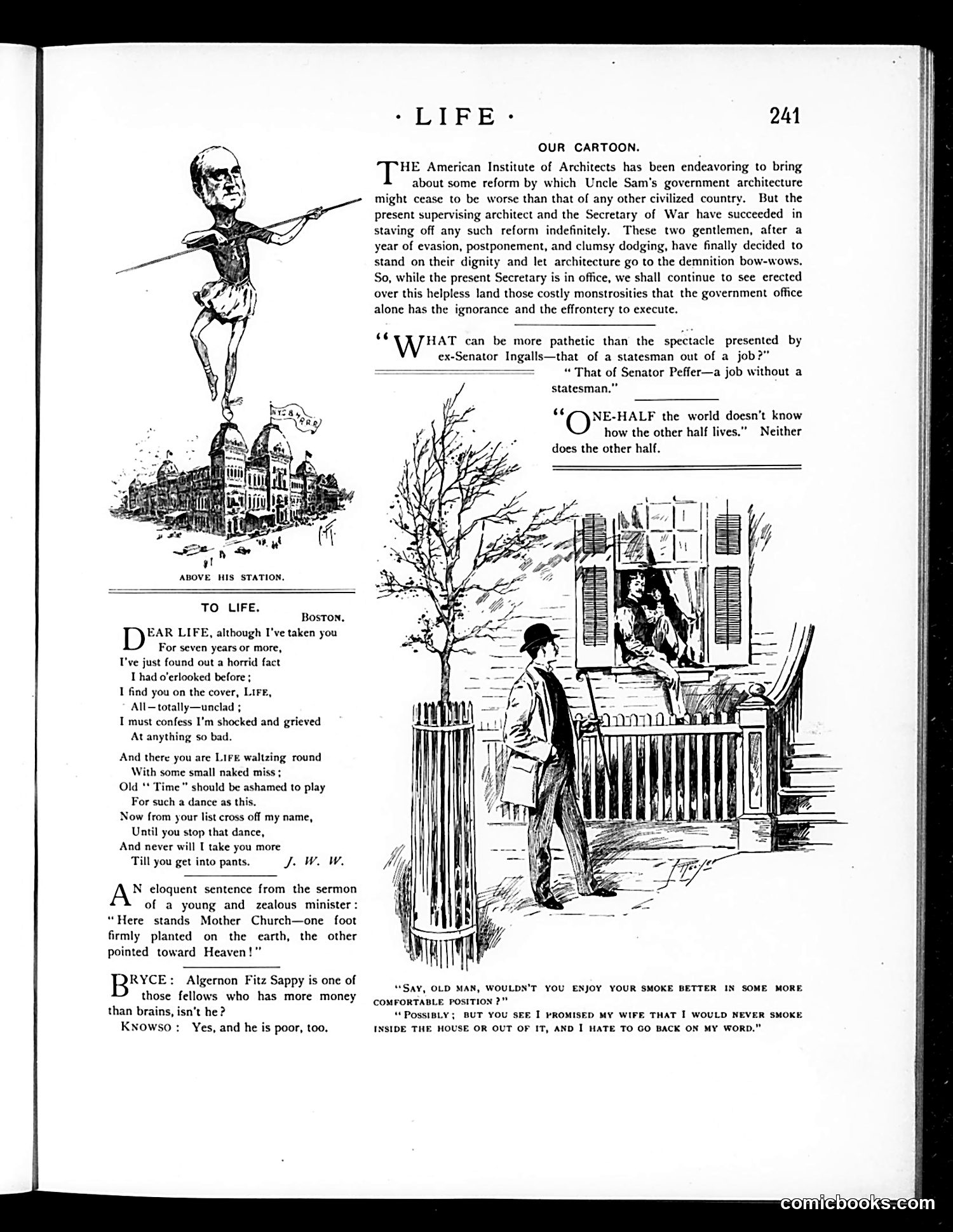
The top cartoon depicts a skeletal Uncle Sam figure balanced precariously atop an ornate government building, illustrating the satire's central complaint: the American Institute of Architects has failed to reform Uncle Sam's government architecture, which remains as wastefully extravagant as ever. The text criticizes the current Secretary of War and supervising architect for abandoning architectural reform efforts, allowing the government to continue erecting "costly monstrosities." The piece mocks ex-Senator Ingalls as a "statesman out of a job" and references Senator Peffer in similar terms. The bottom cartoon depicts a man outside a modest house, humorously illustrating class divisions ("one-half the world doesn't know how the other half lives") through his refusal to smoke indoors due to a promise to his wife.
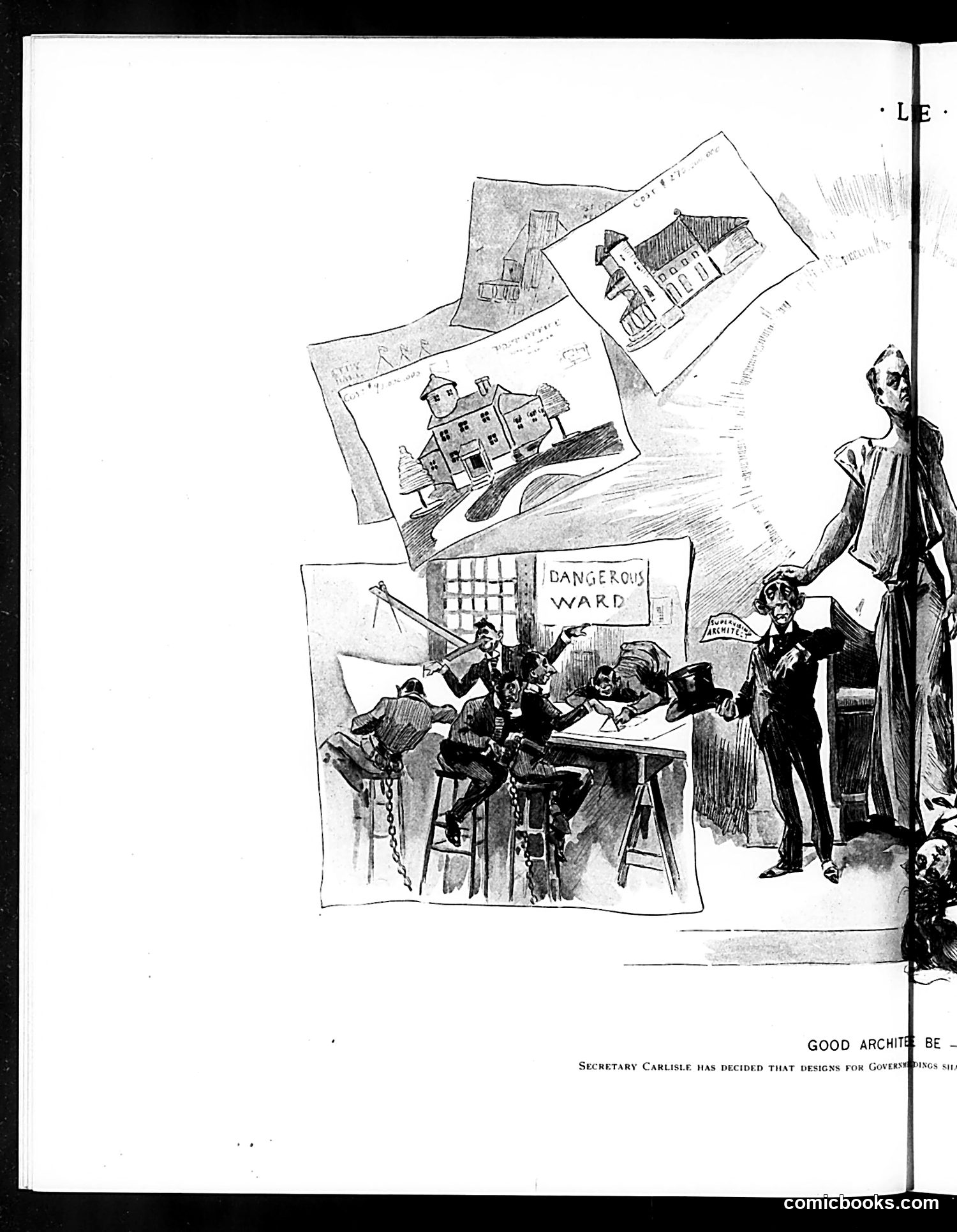
This political cartoon satirizes Secretary Carlisle's decision regarding government building designs. The image shows stacked architectural drawings of different buildings labeled "DANGEROUS WARD," depicting what appears to be a chaotic scene with multiple figures in formal dress examining or debating plans. The satire suggests that Carlisle's architectural choices for government buildings are problematic or ill-conceived—hence the "dangerous" designation. The overlapping, tumbled arrangement of the building designs visually communicates confusion or poor judgment in the selection process. Without additional context about Secretary Carlisle's specific architectural decisions, the exact nature of the criticism remains unclear, but the cartoon mocks what Life's editors viewed as a flawed or questionable approach to designing important public structures.
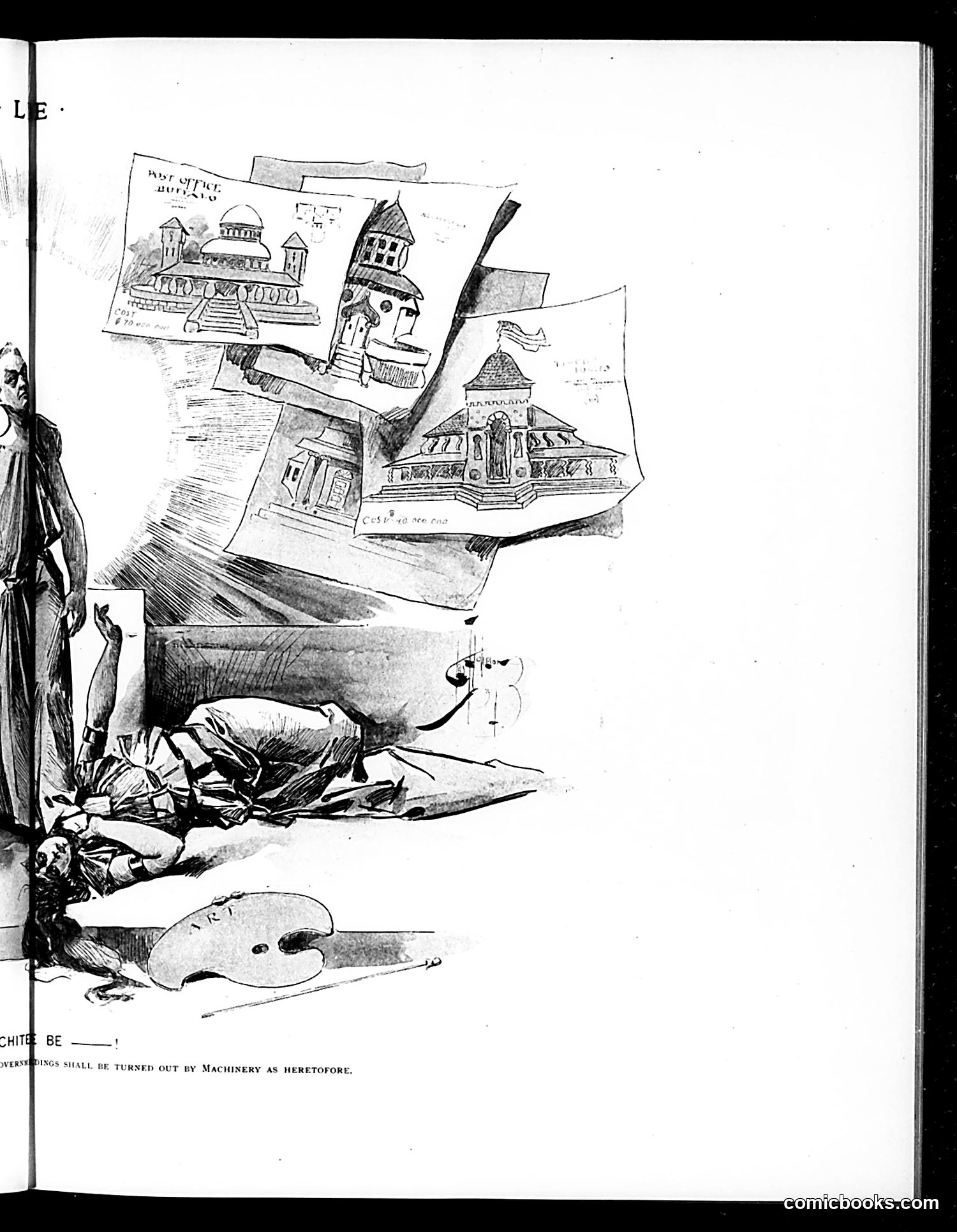
This satirical cartoon depicts a figure lying prone on the ground, appearing injured or defeated, while architectural drawings of buildings float above in an exaggerated, chaotic manner. The visible text references "MACHINERY AS HERETOFORE," suggesting criticism of industrial or mechanical systems. The composition suggests commentary on urban development or architectural planning gone awry—the scattered building blueprints above the fallen figure imply that grand construction schemes have literally collapsed upon or overwhelmed someone, likely representing a politician, city planner, or businessman. Without clearer identification of the specific figure or visible publication date, the precise political target remains unclear, but the satire appears to critique ambitious architectural/industrial projects that have failed or caused harm to the public or a particular leader.
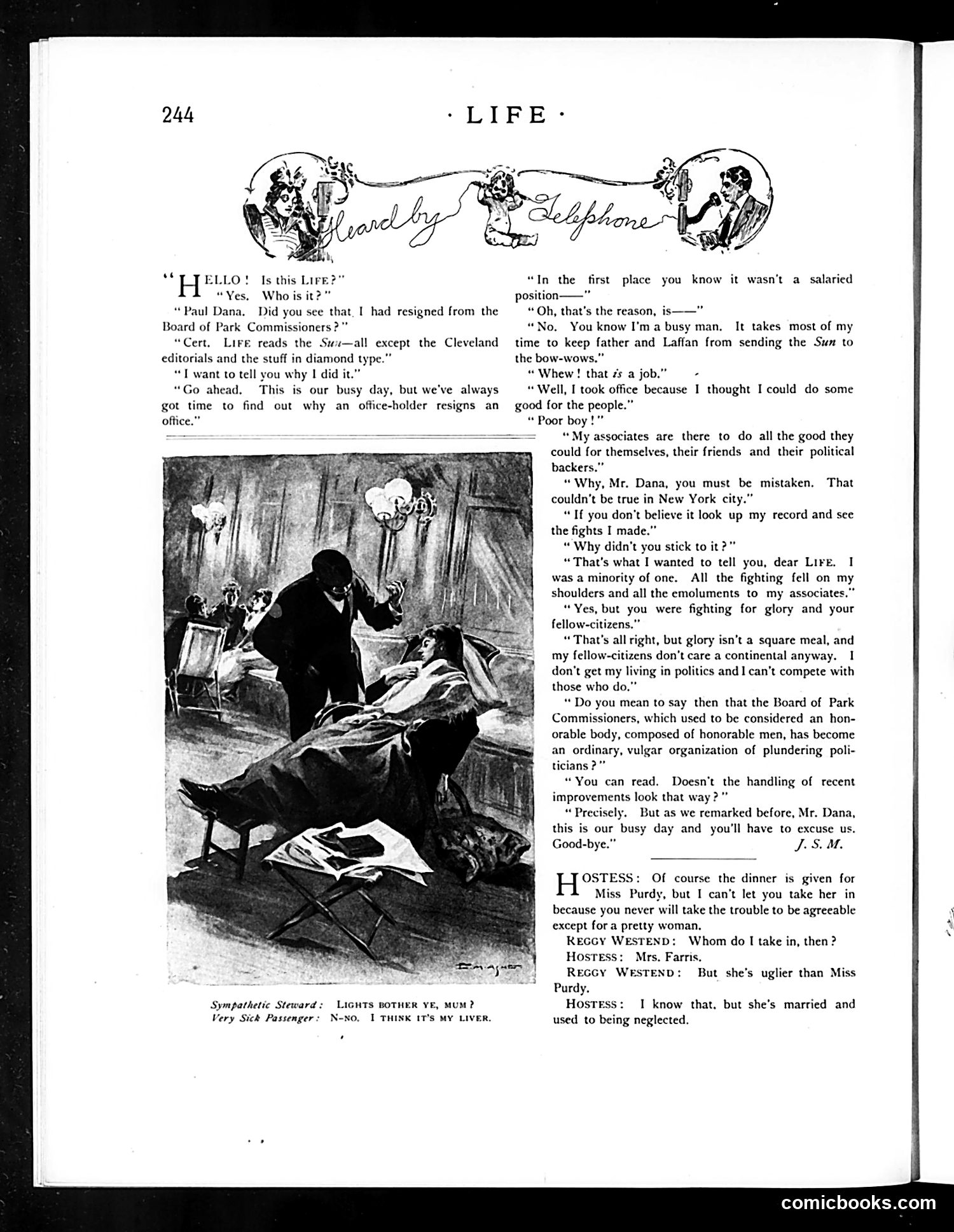
This page contains two separate satirical pieces: **Top cartoon/dialogue**: Paul Dana, apparently a New York Park Commissioner, explains his resignation to *Life* magazine. The satire targets political corruption: Dana claims he was "a minority of one" fighting against associates who used office for personal gain and their backers' benefit rather than public good. When *Life* expresses shock that such corruption exists in New York, Dana sarcastically suggests they read recent park improvement scandals. The joke is that idealistic public service is impossible when surrounded by self-interested politicians—Dana couldn't compete because he didn't profit from the position. **Bottom cartoon/dialogue**: A social satire about dinner etiquette. A gentleman (Reggy Westend) is told he must escort the unattractive Mrs. Farris rather than the prettier Miss Purdy, because married women "are used to being neglected." The humor lies in the brutal honesty: marriage = acceptance of indifference, making Mrs. Farris a safer, more resigned companion than an unmarried woman who might expect attention.
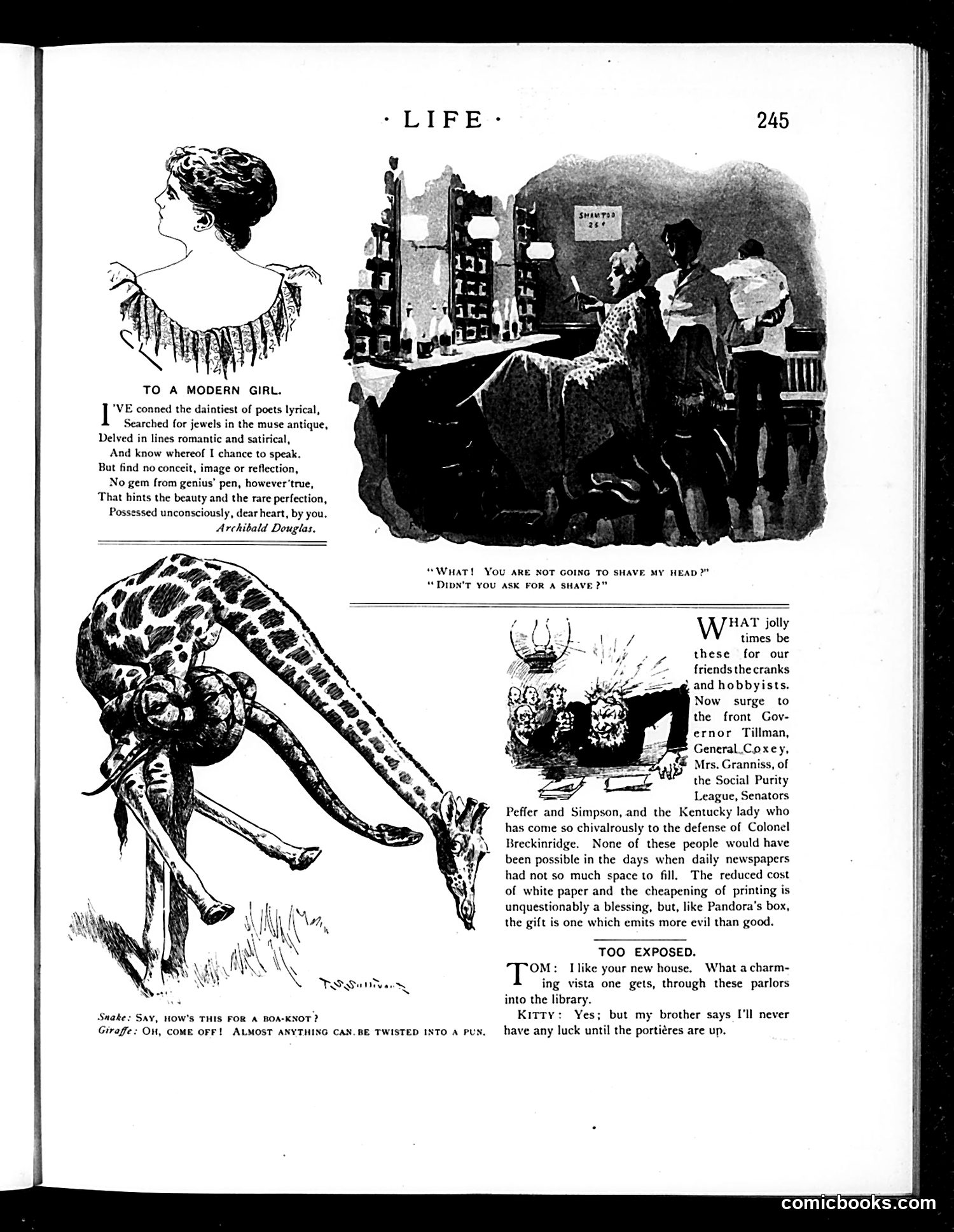
This *Life* magazine page satirizes late 19th-century social and political figures who gained prominence through increased newspaper coverage. The main text criticizes how cheap printing costs enabled minor "cranks and hobbyists"—including Governor Tillman, General Coxey, and Senator Peffer—to dominate public discourse. The author argues this democratization of media attention produces "more evil than good," echoing anxieties about sensationalism. The bottom dialogue joke plays on "exposed"—a woman's new house lacks curtains (portieres), leaving rooms visible from the street, which superstition held brought bad luck. This is a mild pun mocking Victorian propriety concerns. The animal cartoons (snake and giraffe) are unrelated wordplay jokes. The top illustration references a barbershop dispute. The page's overall tone reflects elite frustration with populist politicians and media-driven celebrity in the Gilded Age.
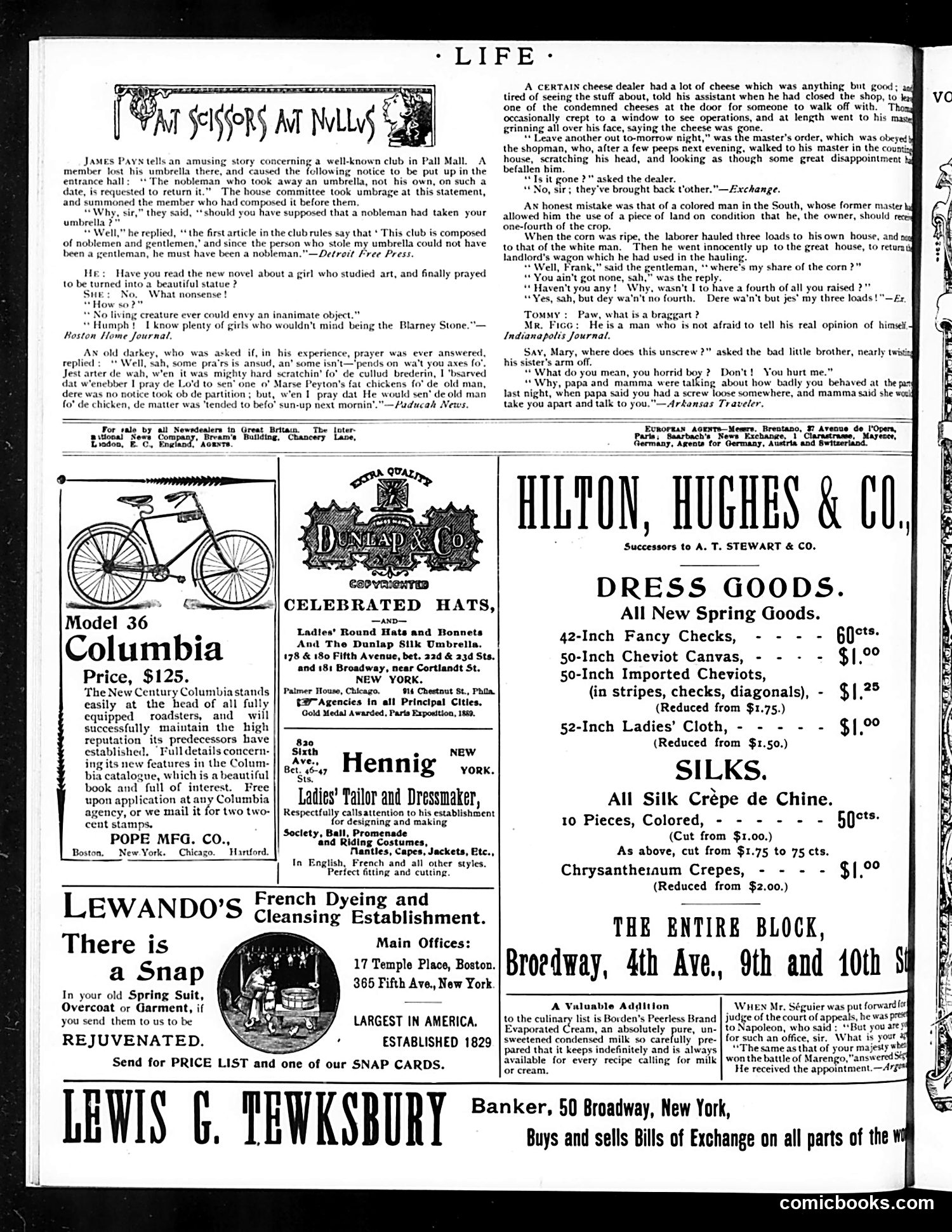
This page is primarily **advertising with interspersed humorous anecdotes**—typical of Life magazine's format. The cartoons/satirical content consists of brief jokes rather than visual political cartoons. The humor relies on **social class commentary and racial stereotypes common to the 1880s-90s**: 1. **The Pall Mall Club story**: Satire on aristocratic pretense—a nobleman's theft is excused by claiming no gentleman would steal, so the thief must be nobility. 2. **The "old darkey" prayer anecdote**: Uses racist dialect to tell a story where a formerly enslaved person's prayer is "answered" when his former master comes to reclaim stolen chickens—treating theft as divine justice. 3. **The sharecropper story**: Similar racial humor about a Black farmer's deliberate miscount of corn shares with his white landlord. 4. **Child behavior jokes**: Innocent observations about children's honesty and curiosity. The advertisements (Columbia bicycles, Dunlap hats, Hilton Hughes dress goods) occupy substantial space, indicating this was a revenue-driven publication mixing editorial content with commercial messaging.