
Life, 1894-04-12 · page 4 of 14
Life — April 12, 1894 — page 4: what you’re looking at
What you’re looking at
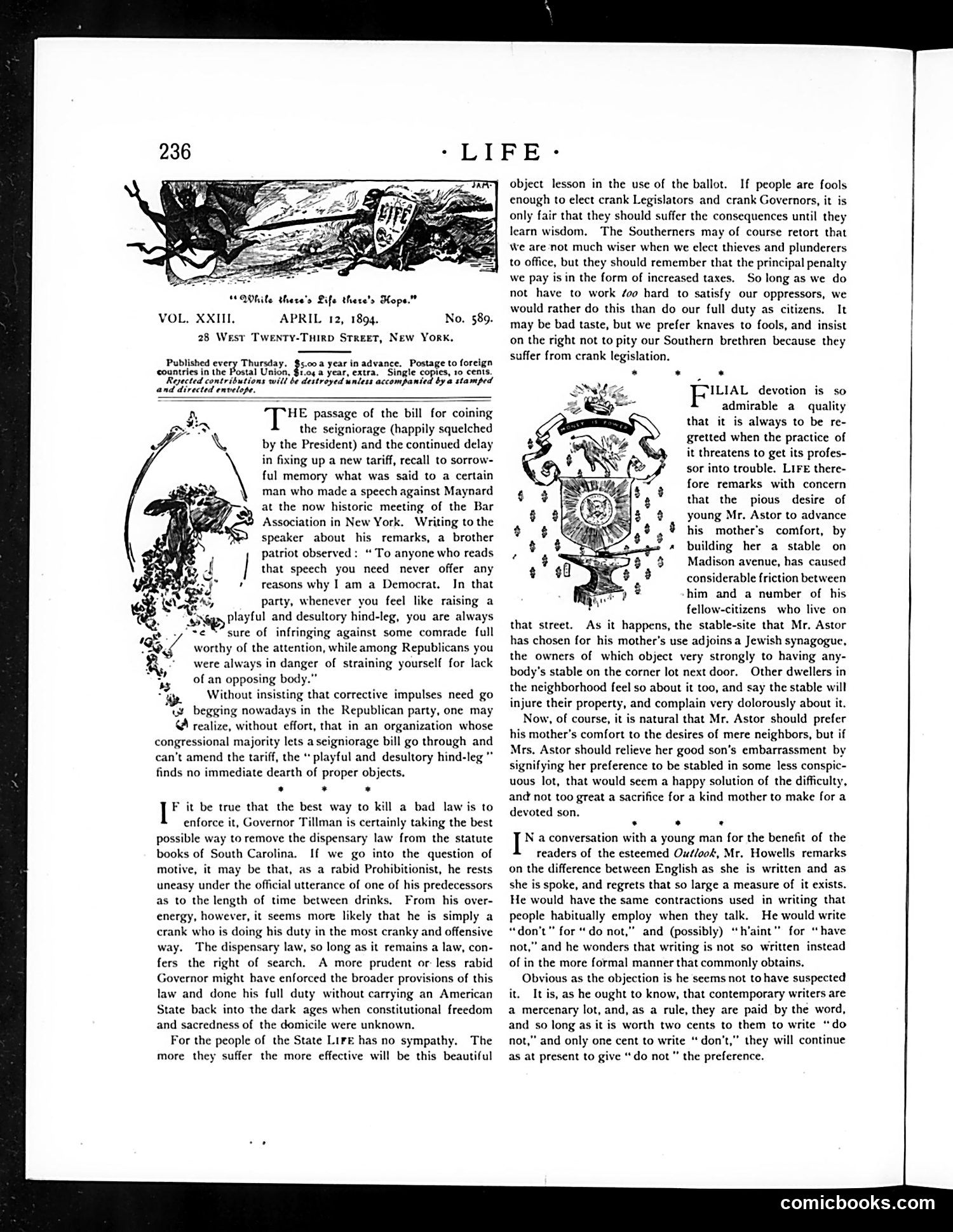
The page contains political commentary rather than a cartoon. The main text criticizes the election of poor-quality legislators and governors, arguing that citizens who vote for "crank" politicians must accept harmful consequences like increased taxes. A secondary piece discusses **filial devotion**, concerning a young Mr. Astor's plan to build his mother a stable on Madison Avenue in New York. The satire mocks this as an absurd expression of filial piety—building a stable in a residential neighborhood ostensibly to comfort his mother, while actually inconveniencing neighbors. This appears to reference a real Astor family member and New York society controversy. The final section debates English language contractions ("don't" vs. "do not"), a minor but typical Victorian-era linguistic debate.
📄 Transcribed text from this page (OCR, searchable)
Machine-transcribed from the original scan — historical spelling and the odd misread are preserved.
“OMhile there's Life there's Hope.” VOL. XXIII. APRIL 12, 1894. No. 589. 28 West Twenty-Tuirp Street, New York. Published every Thursday. $s.coa year in advance. Postage to foreign countries in the Postal Union, $1.04 a year, extra, Single copies, 10 cents. Reyected contributions will be destroyed unless accompanied bya stamped and directed envelope. HE passage of the bill for coining the seigniorage (happily squelched by the President) and the continued delay in fixing up a new tariff, recall to sorrow- ful memory what was said to a certain man who made a speech against Maynard at the now historic meeting of the Bar Association in New York. Writing to the ~) speaker about his remarks, a brother patriot observed: “To anyone who reads | that speech you need never offer any reasons why I am a Democrat, In that party, whenever you feel like raising a NED playful and desultory hind-leg, you are always e * sure of infringing against some comrade full worthy of the attention, while among Republicans you were always in danger of straining yourself for lack of an opposing body.” “Jy Without insisting that corrective impulses need go wt begging nowadays in the Republican party, one may A realize, without effort, that in an organization whose congressional majority lets a seigniorage bill go through and can't amend the tariff, the * playful and desultory hind-leg " finds no immediate dearth of proper objects. . * . F it be true that the best way to kill a bad law is to enforce it, Governor Tillman is certainly taking the best possible way to remove the dispensary law from the statute books of South Carolina. If we go into the question of motive, it may be that, as a rabid Prohibitionist, he rests uneasy under the official utterance of one of his predecessors as to the length of time between drinks, From his over- energy, however, it seems more likely that he is simply a crank who is doing his duty in the most cranky and offensive way. The dispensary law, so long as it remains a law, con- fers the right of search. A more prudent or less rabid Governor might have enforced the broader provisions of this law and done his full duty without carrying an American State back into the dark ages when constitutional freedom and sacredness of the domicile were unknown, For the people of the State Lire has no sympathy. The more they suffer the more effective will be this beautiful -LIFE-: object lesson in the use of the ballot. If people are fools enough to elect crank Legislators and crank Governors, it is only fair that they should suffer the consequences until they learn wisdom. The Southerners may of course retort that We are not much wiser when we elect thieves and plunderers to office, but they should remember that the principal penalty we pay is in the form of increased taxes. So long as we do not have to work foo hard to satisfy our oppressors, we would rather do this than do our full duty as citizens. It may be bad taste, but we prefer knaves to fools, and insist on the right not to pity our Southern brethren because they suffer from crank legislation. * ILIAL devotion is so admirable a quality that it is always to be re- gretted when the practice of it threatens to get its profes- sor into trouble. LIFE there- fore remarks with concern that the pious desire of young Mr, Astor to advance his mother’s comfort, by building her a stable on Madison avenue, has caused considerable friction between him and a number of his fellow-citizens who live on As it happens, the stable-site that Mr. Astor has chosen for his mother’s use adjoins a Jewish synagogue, the owners of which object very strongly to having any- body's stable on the corner lot next door. Other dwellers in the neighborhood feel so about it too, and say the stable will injure their property, and complain very dolorously about it. Now, of course, it is natural that Mr. Astor should prefer his mother’s comfort to the desires of mere neighbors, but if Mrs. Astor should relieve her good son’s embarrassment by signifying her preference to be stabled in some less conspic- uous lot, that would seem a happy solution of the difficulty, and not too great a sacrifice for a kind mother to make for a devoted son. that street. . . . I N a conversation with a young man for the benefit of the readers of the esteemed Ous/ook, Mr. Howells remarks on the difference between English as she is written and as she is spoke, and regrets that so large a measure of it exists. He would have the same contractions used in writing that people habitually employ when they talk. He would write “don't” for “do not,” and (possibly) “h’aint" for “have not,” and he wonders that writing is not so written instead of in the more formal manner that commonly obtains. Obvious as the objection is he seems not to have suspected it. It is, as he ought to know, that contemporary writers are a mercenary lot, and, as a rule, they are paid by the word, and so long as i worth two cents to them to write “do not,” and only one cent to write “don’t,” they will continue as at present to give “do not" the preference. comicbooks.com