
A complete issue · 16 pages · 1894
Life — February 22, 1894
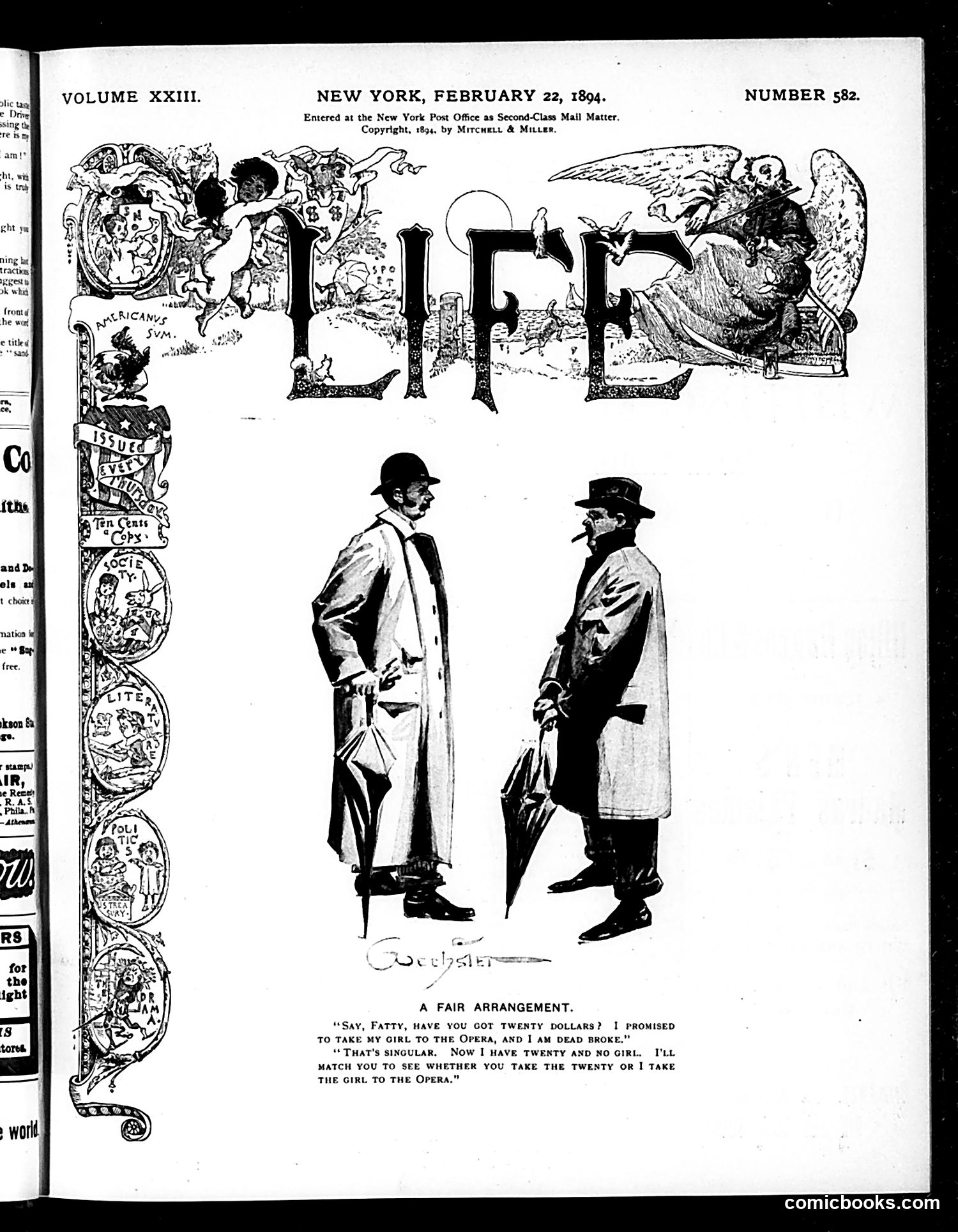
This cartoon depicts two men in conversation, with the caption presenting a humorous negotiation about money and romance. One man claims he promised to take his girlfriend to the opera but is broke ("dead broke"). The other proposes a wager: if the first man has twenty dollars, they'll bet on whether he takes the girl to the opera or keeps the money. The satire mocks the financial struggles of working-class men in the 1890s and the tension between romantic obligations and economic necessity. It's a lighthearted commentary on how poverty forces men to choose between courtship expenses and personal finances—a relatable dilemma for Life's middle-class readership during this economically uncertain period.
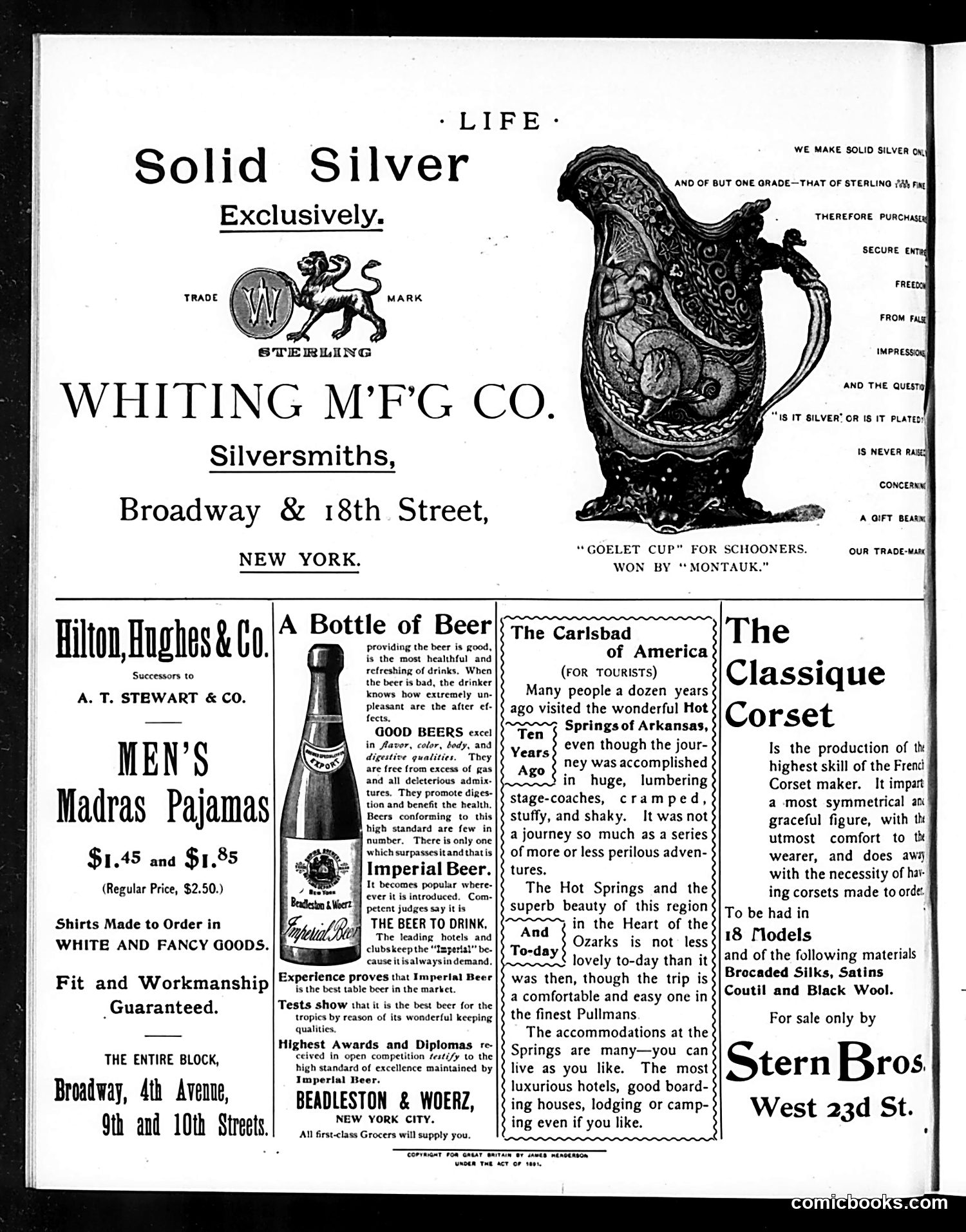
This page is **primarily advertising** rather than satirical content. It features four distinct advertisements: 1. **Whiting M'FG Co.** – A silversmith advertising solid sterling silver goods, with an ornate "Goblet Cup for Schooners" won by "Montauk" 2. **Hilton, Hughes & Co.** – Men's clothing (pajamas and shirts) at discount prices 3. **Beadleston & Woerz** – An Imperial Beer advertisement emphasizing quality and awards 4. **Stern Bros.** – A corset company advertising "The Classique Corset," claiming French craftsmanship The page header reads "LIFE," confirming this is from Life magazine. No political cartoons or satirical commentary are present—this is a standard commercial advertising page typical of early 20th-century magazines.
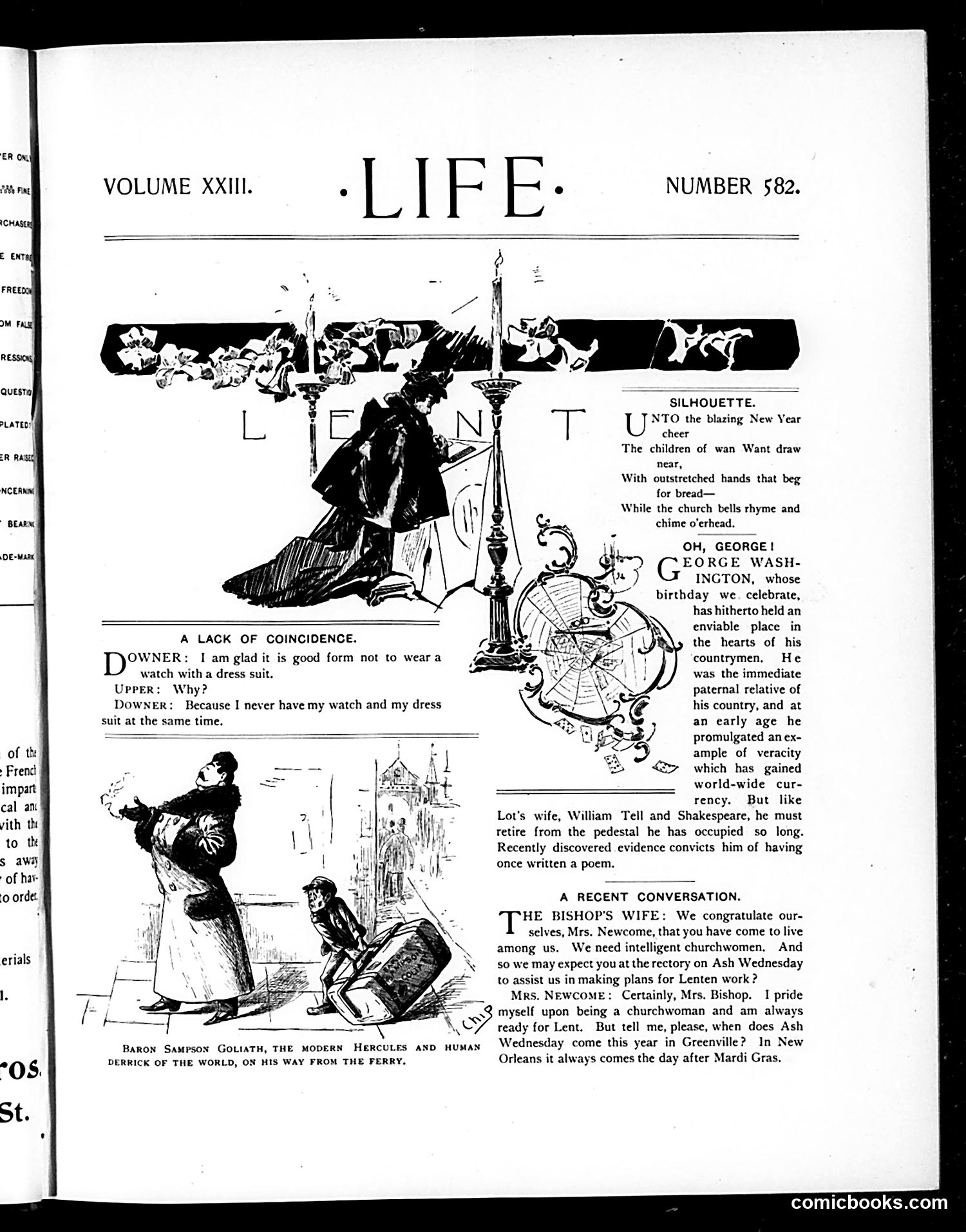
This page contains three separate humor items: 1. **"A Lack of Coincidence"** — A brief joke about a man who never wears his watch and dress suit simultaneously, so they're never damaged together. 2. **"Silhouette"** — A poem about New Year's Eve and children begging for bread, contrasted with George Washington's birthday celebration. The text notes Washington's exemplary character and mentions Lot's wife, William Tell, and Shakespeare as historical figures, while sarcastically suggesting Washington must "retire from the pedestal" since someone recently discovered he once wrote a poem. 3. **"A Recent Conversation"** — A dialogue between a Bishop's wife and Mrs. Newcome about Ash Wednesday and Lenten plans, with a joke about when Ash Wednesday falls in New Orleans (always after Mardi Gras). The page uses satirical humor typical of early 20th-century Life magazine.
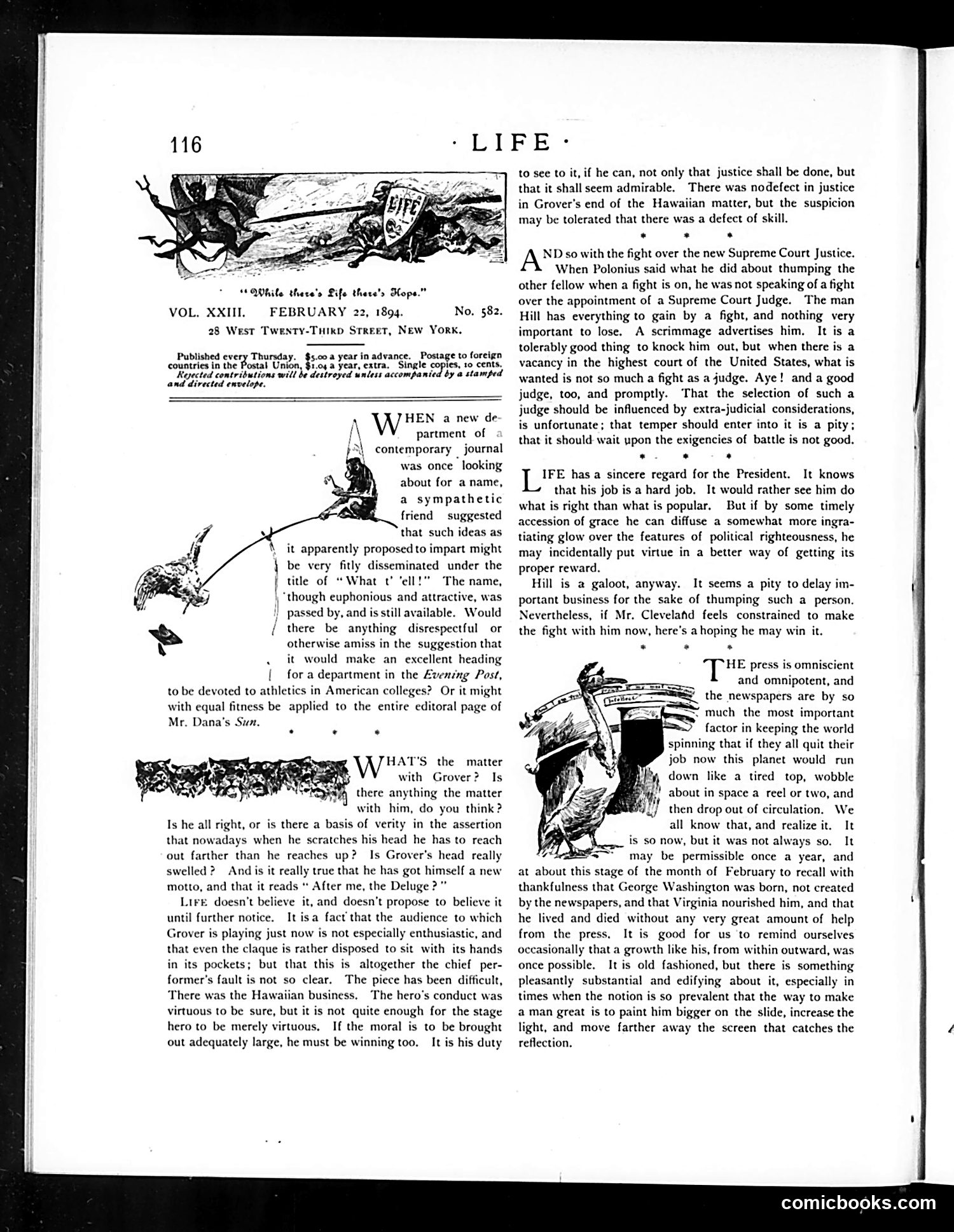
The page contains editorial commentary on two contemporary issues: **Supreme Court Justice Fight**: The text discusses controversy over appointing a new Supreme Court Justice, referencing "Hill" (likely Senator David B. Hill) as a contentious candidate. The satire criticizes that important judicial positions are being decided by political "fighting" rather than merit. **Grover Cleveland Commentary**: The editorial praises President Cleveland's character while criticizing newspaper coverage of him. It argues the press should focus on substantive accomplishments rather than sensationalizing political figures. The decorative illustrations show fighting figures (likely representing political conflict), but lack clear identifying labels. The overall thrust criticizes how American politics and media handled judicial appointments and presidential reputation during the 1890s.
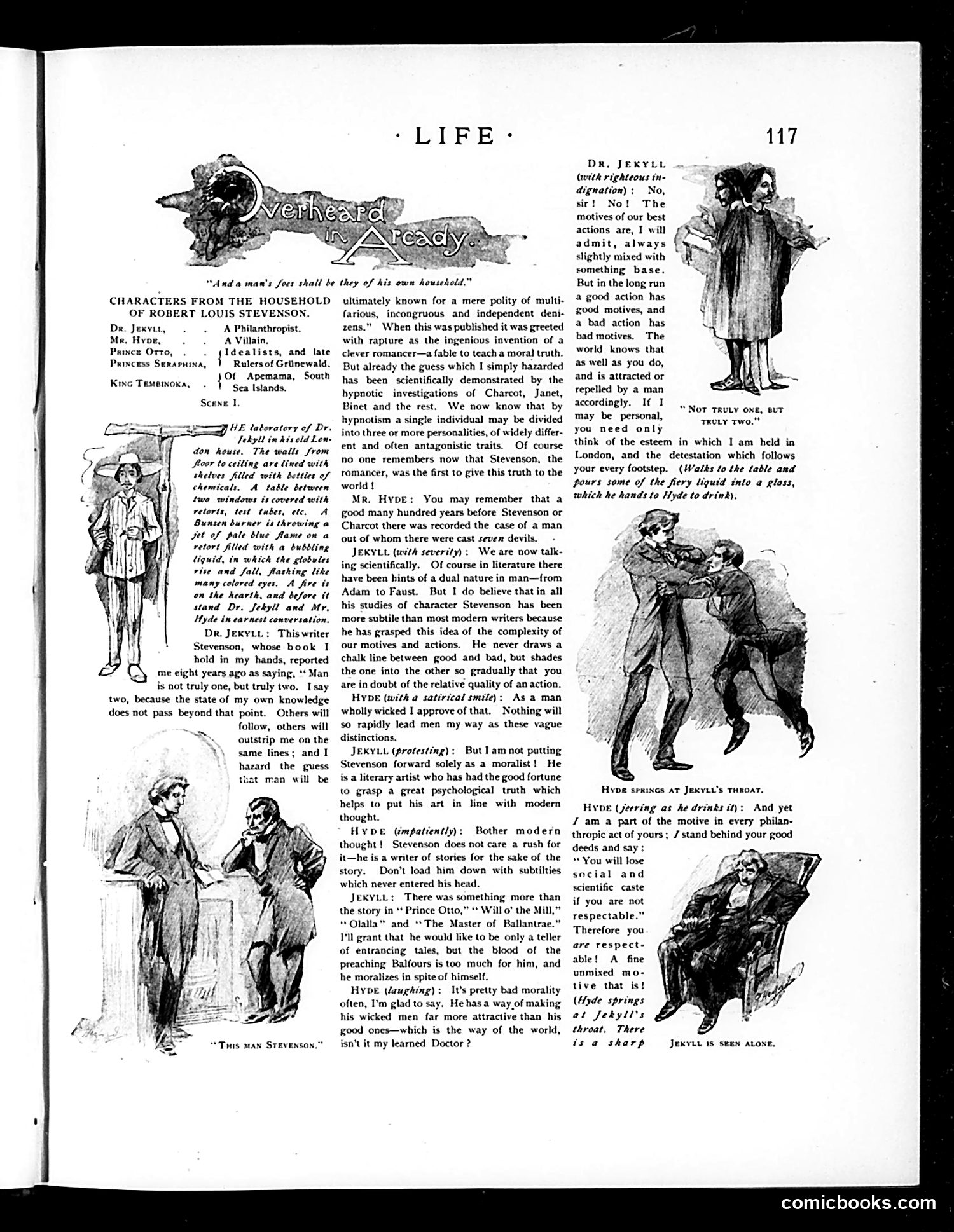
This page discusses Stevenson's famous novel through a dramatic dialogue between characters including Dr. Jekyll and Mr. Hyde. The satirical point appears to be about the novel's exploration of dual human nature—the capacity for both good and evil within one person. The debate centers on whether Stevenson is being a "moralist" by presenting this duality. One character argues the novel simply shows psychological complexity without preaching morality. Another defends it as literature that grasps "the complexity of our motives and actions." The accompanying illustrations show various character scenes. This is primarily literary criticism presented as dramatic dialogue rather than political satire—examining how the novel treats moral questions through its portrayal of Jekyll's split personality.
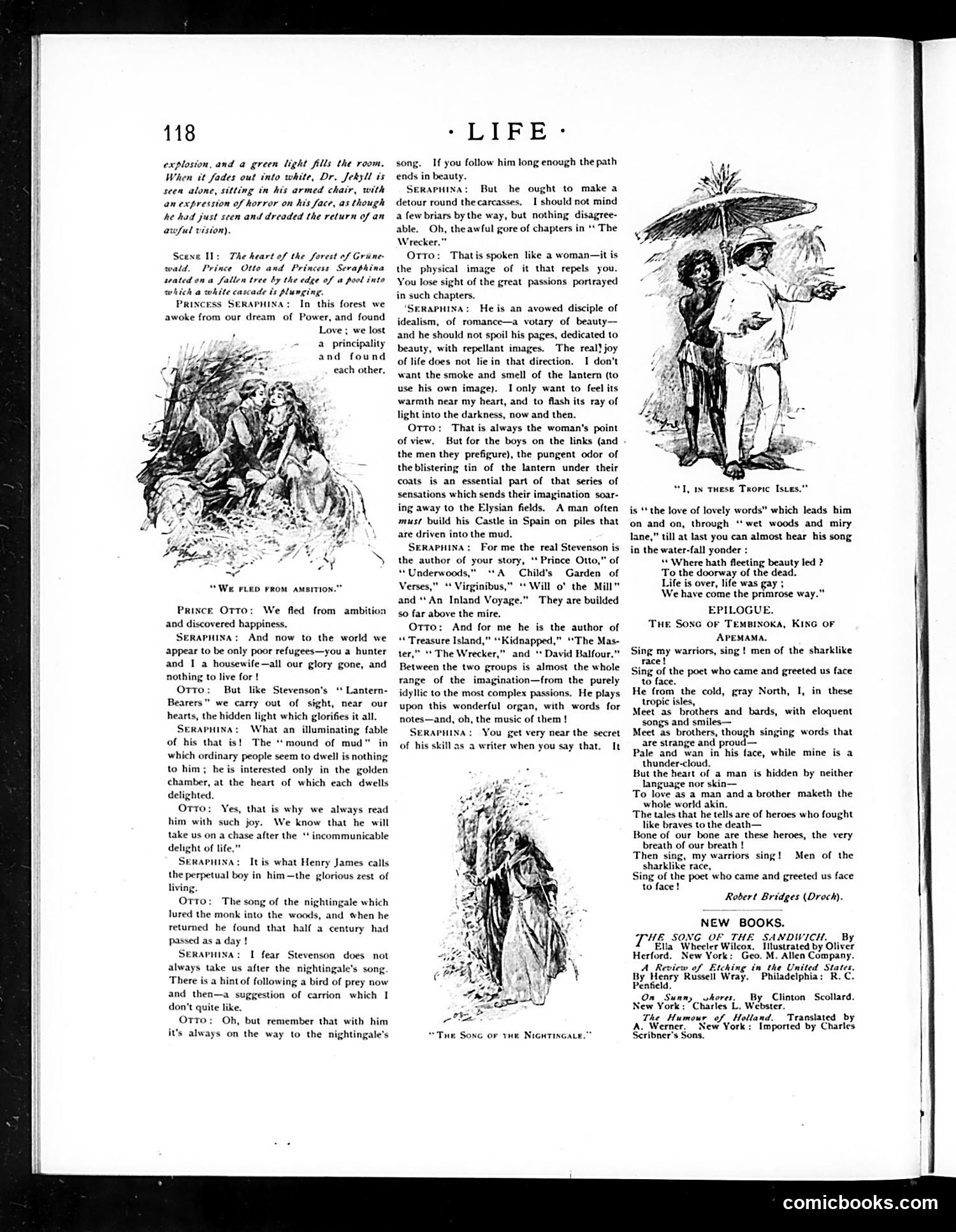
This page contains a literary dialogue between characters named Otto and Seraphina, discussing Robert Louis Stevenson's works and writing style. The text praises Stevenson's imagination and skill, particularly regarding his ability to convey beauty and passion through descriptive language. The three illustrations on the page appear to be artistic engravings related to Stevenson's literary works, possibly depicting romantic or adventurous scenes. One is captioned "I, in these Tropic Isles" and another shows "The Song of the Nightingale." Rather than political satire, this page represents Life magazine's literary criticism function—evaluating and promoting contemporary authors. The content celebrates Stevenson's craftsmanship and emotional resonance, typical of late-19th-century literary journalism.
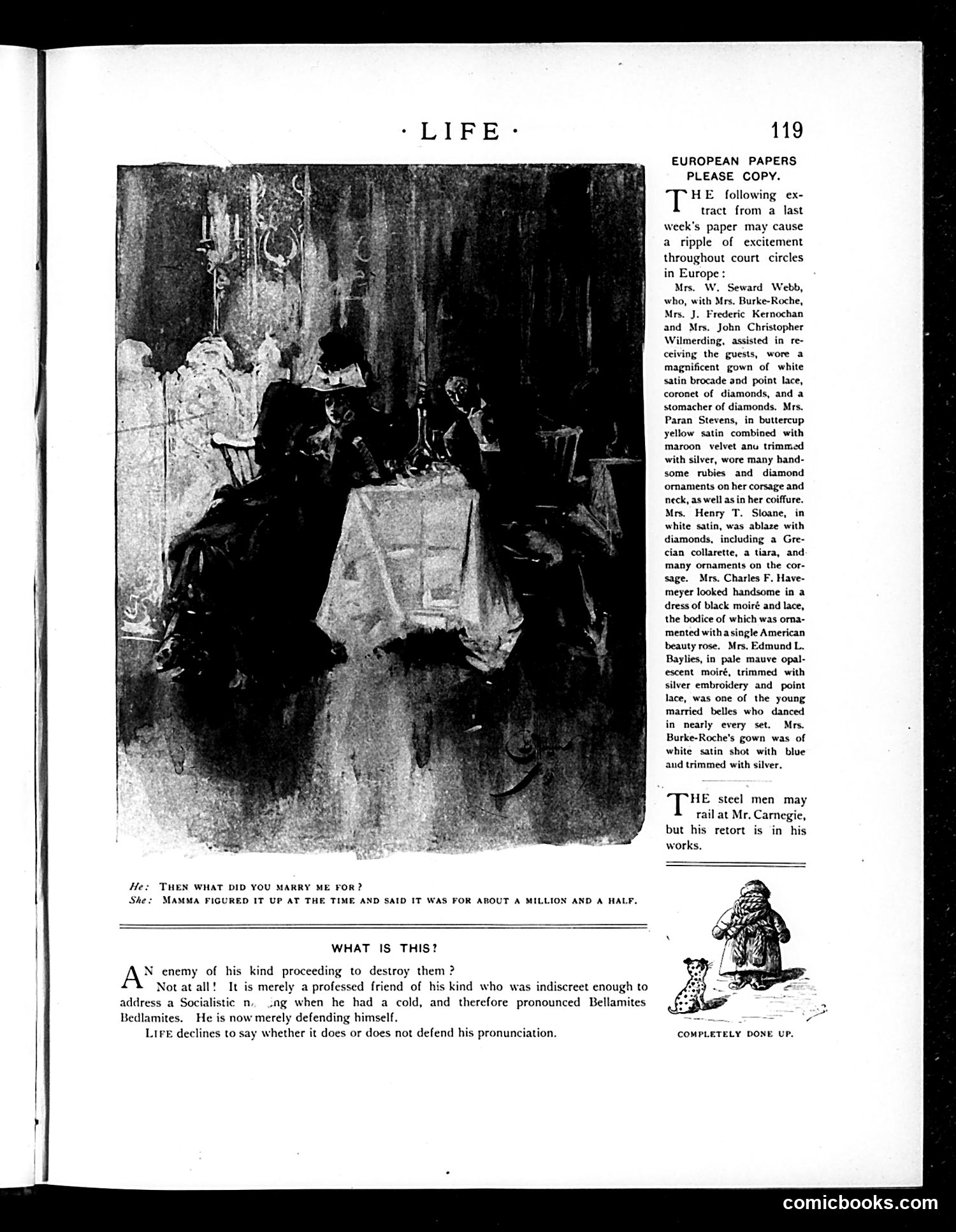
**Main Content:** A society gossip column describing a high-society reception hosted by Mrs. W. Seward Webb and others, detailing the elaborate gowns and jewelry worn by attendees—white satin, diamonds, Grecian collars, and formal attire. **"What Is This?" Section:** A brief satirical commentary mocking someone's defensive pronunciation of "Bellamites" or "Belllamites." The joke suggests this person was defending their pronunciation after catching a cold affected their speech, and LIFE sardonically notes it "merely" defends the individual rather than attacking an enemy. **Cartoon:** A small illustration labeled "Completely Done Up" showing what appears to be an exhausted figure, likely commenting on social fatigue from such formal events. The page satirizes upper-class pretension through detailed fashion coverage combined with sharp wit about pronunciation and social anxieties.
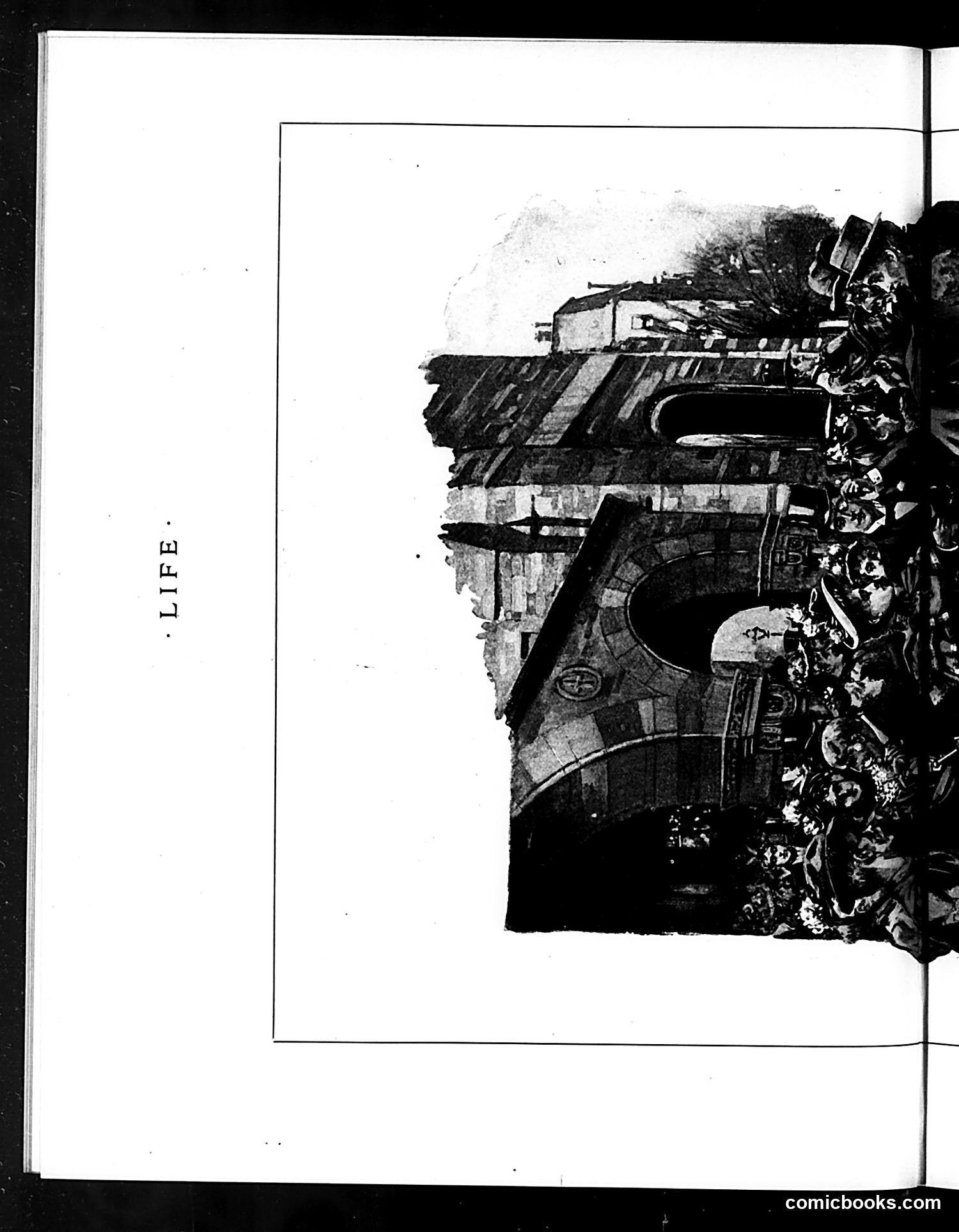
This appears to be a title page or section divider from *Life* magazine, featuring the word "LIFE" printed vertically on the left margin. The right side contains a black and white photograph or illustration that is rotated 90 degrees (sideways). The image shows what appears to be an architectural or industrial structure—possibly a building facade or factory—with ornamental ivy or flowering vines growing up its right side. The contrast between the stark industrial geometry and the delicate natural growth creates visual interest. Without additional context or caption text visible, I cannot determine if this image carries specific satirical or political meaning. It may be purely decorative artwork or an illustrative element typical of *Life* magazine's design aesthetic from its satirical era.
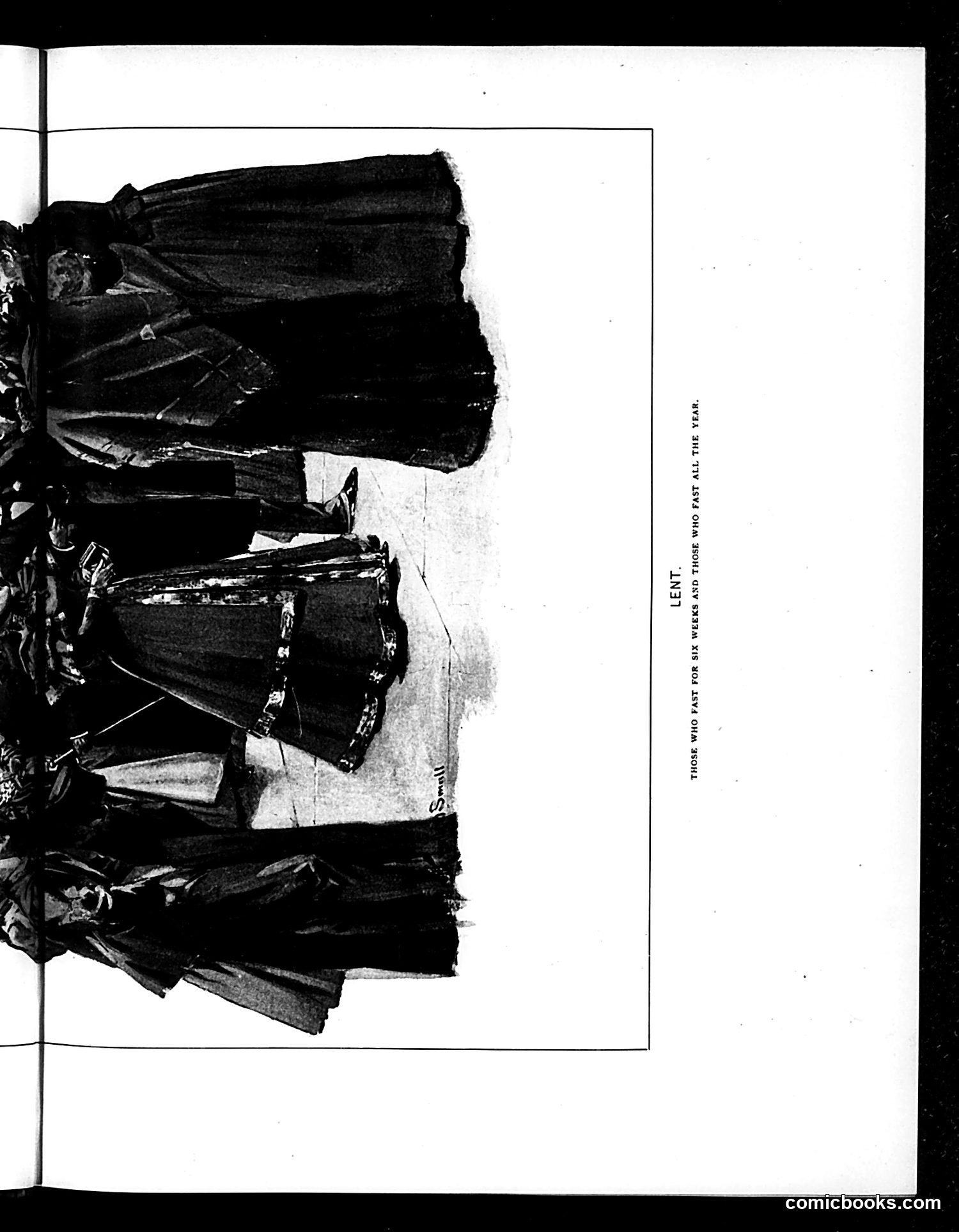
This appears to be a satirical illustration about the Christian observance of Lent, the 40-day period of fasting and self-denial before Easter. The image shows what appears to be discarded or abandoned clothing and personal items in dark, shadowy tones. The caption "Those who part for 'is weeks and three days" suggests the satire targets people who make grand gestures of self-sacrifice during Lent but may not sustain genuine religious commitment. The joke likely critiques hollow or performative piety—people who dramatically give things up for Lent's duration but treat it as a superficial religious obligation rather than meaningful spiritual practice. The visual composition emphasizes the discarding of material goods, reinforcing this commentary on Lenten observance customs.
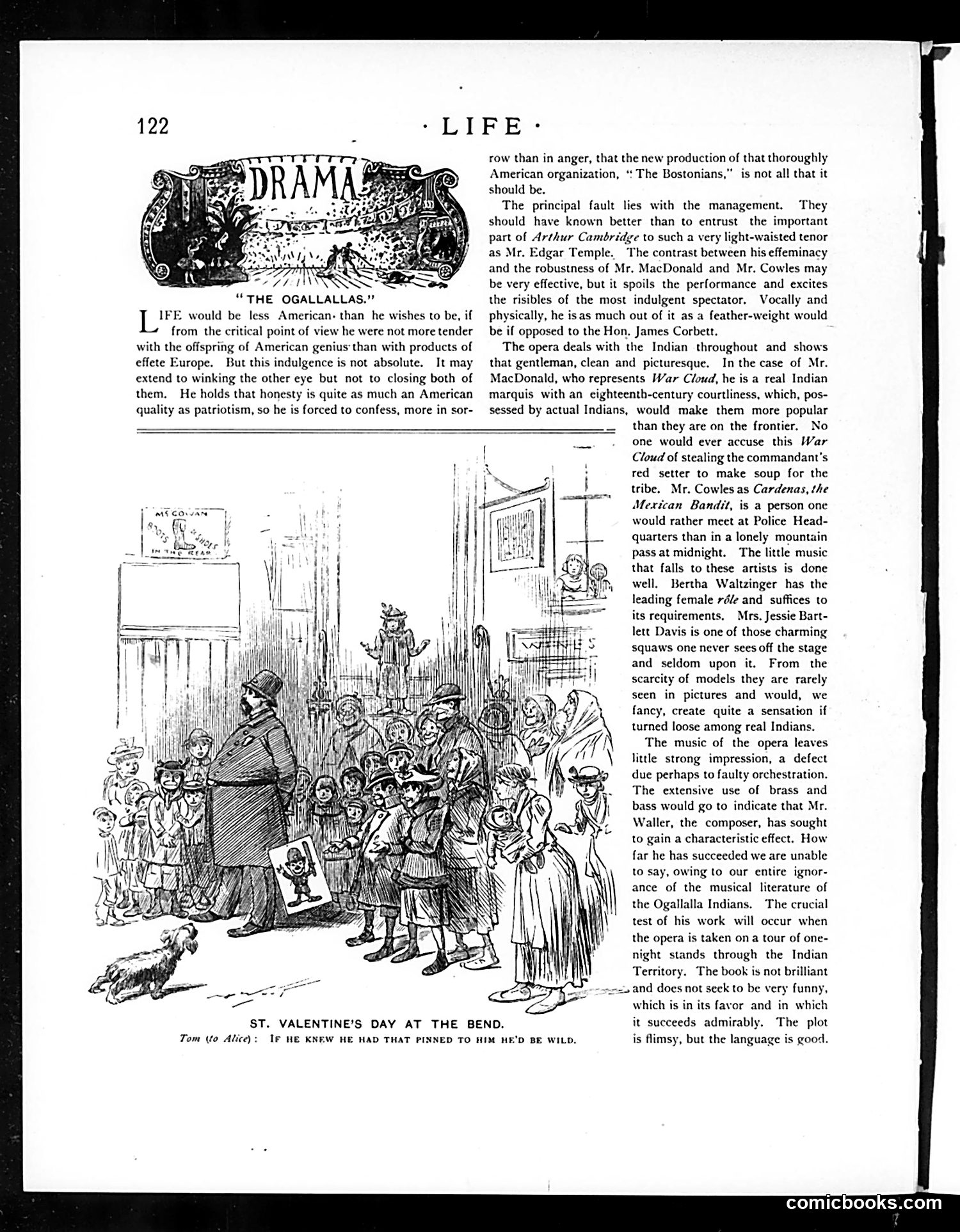
This cartoon satirizes a theatrical production called "The OSallalla" (an opera about Native Americans). The caption reads: "Tom (to Alice): If he knew he had that pinned to him he'd be wild." The joke appears to target the opera's management and artistic choices. The text criticizes the production for poor casting and staging decisions—particularly that actual Native Americans would find the portrayal offensive if they saw it. The crowded, chaotic street scene illustrated suggests the opera's attempt at authentic "Indian" representation falls comically short. The broader satire questions whether American theater should rely on European operatic conventions when depicting American subjects, implying that unexamined artistic pretension creates unintentional comedy rather than genuine drama.
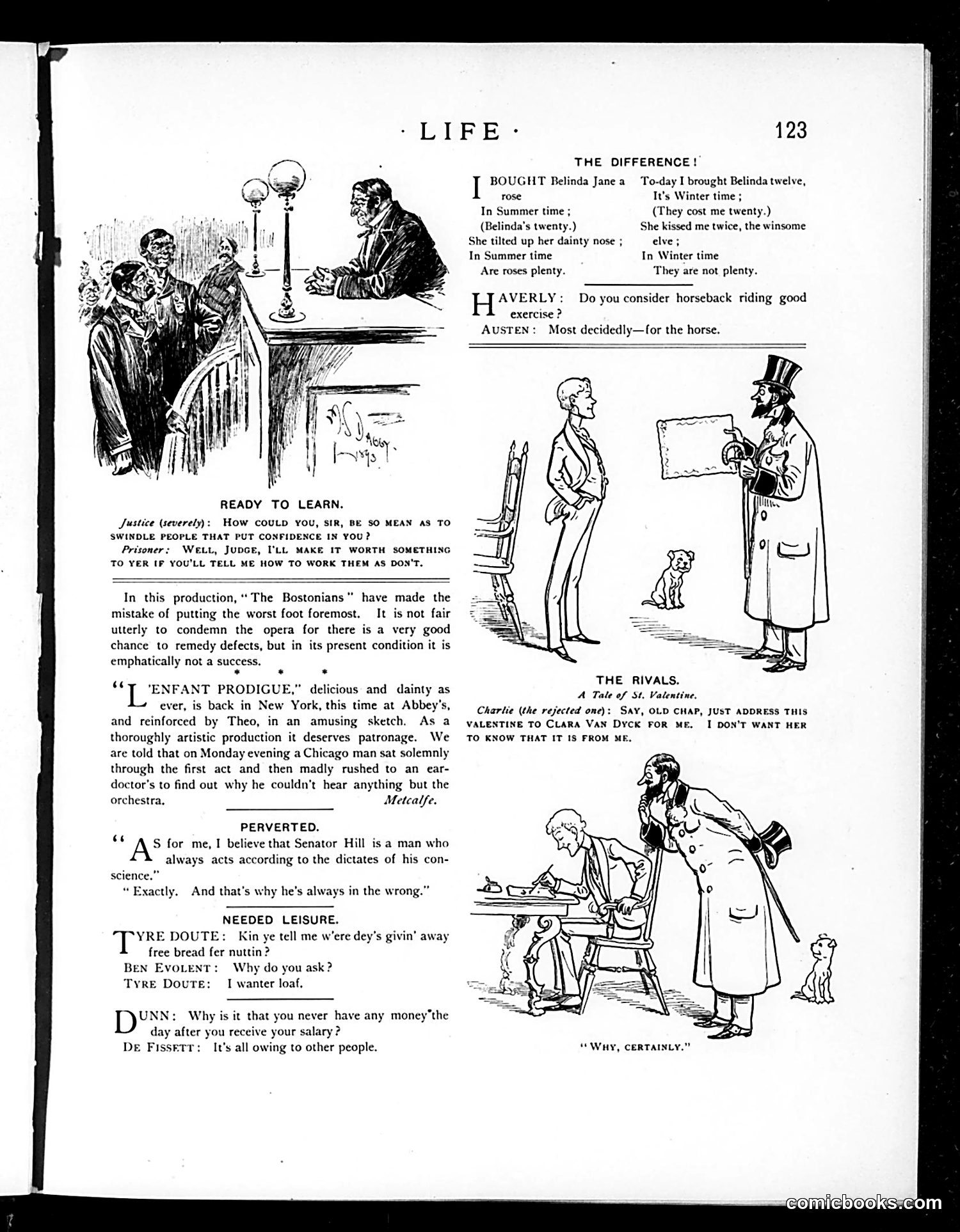
This page contains several short humorous sketches satirizing American social life: **"The Difference"** mocks romantic gestures—buying roses in summer versus winter reveals disparate effort and meaning. **"Ready to Learn"** shows a con artist teaching swindling techniques, satirizing how confidence men exploit the naive. **"The Rivals"** depicts a rejected suitor enlisting a messenger to win back his love, poking fun at romantic persistence. **"Needed Leisure"** features working-class characters discussing poverty and financial desperation through dialect humor. The sketches use exaggerated illustrations and dialogue to mock contemporary class differences, romantic folly, and economic struggle. The overall tone reflects Life's early satirical mission: exposing human pretension and social absurdities through humor accessible to educated readers.
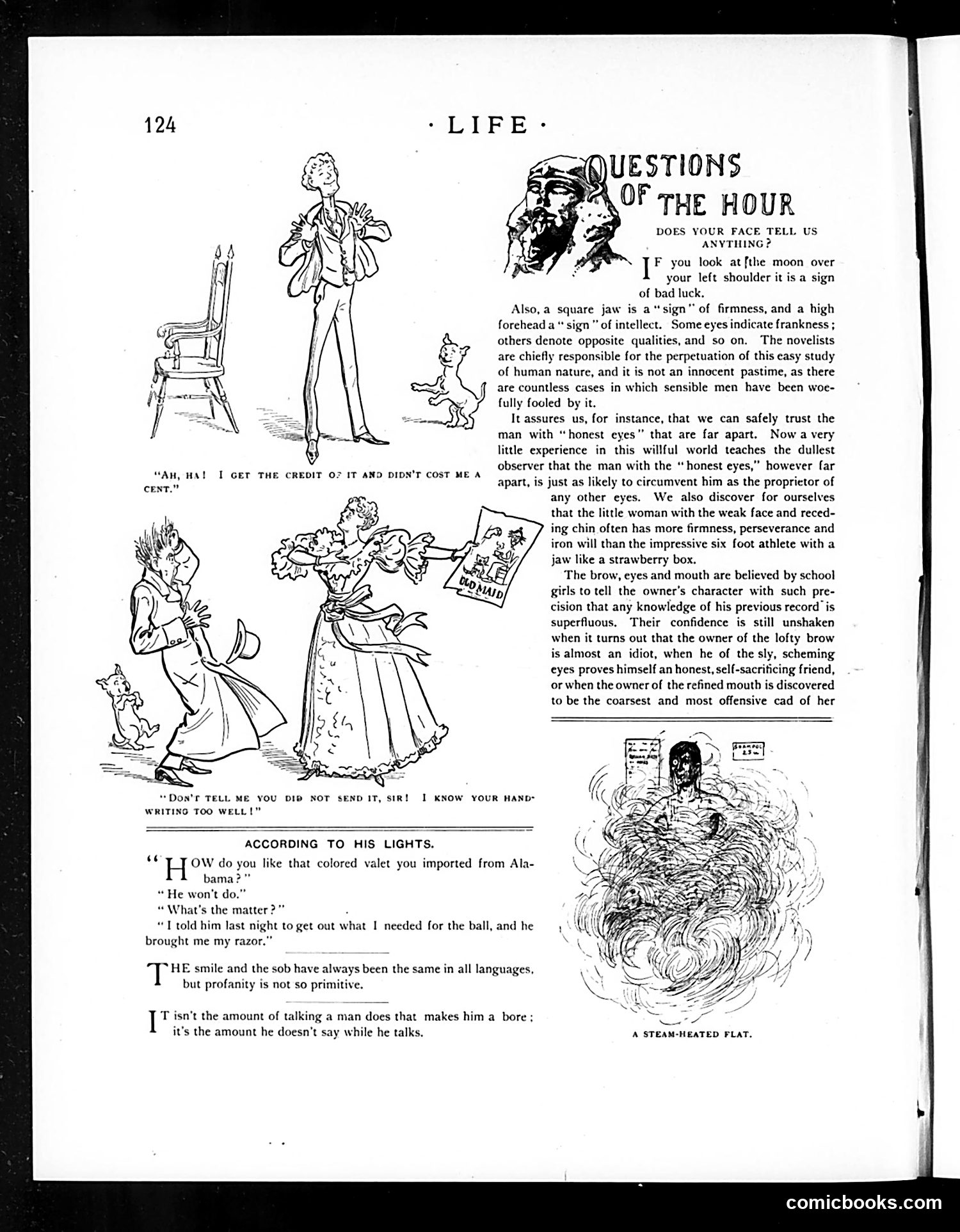
This page contains three distinct satirical pieces: **"Questions of the Hour"** mocks the popular pseudoscience of physiognomy—judging character by facial features. The article ridicules the notion that facial traits (square jaws, forehead shape, eye placement) reliably indicate moral character, noting that novelists popularized this false belief. The satire points out that "honest eyes" don't guarantee honesty, and refined appearance often masks crude behavior. **"According to His Lights"** is a brief joke about a Black servant misunderstanding instructions—the master asked him to fetch ball attire but received a razor instead, playing on racist stereotypes about Black workers' intelligence. **The cartoon vignettes** at left show domestic comedy: a man claiming credit for a gift he didn't buy, and a woman confronting someone about recognizing their handwriting on a letter. The page reflects early 20th-century Life magazine's mix of social commentary and casual racial humor typical of that era.
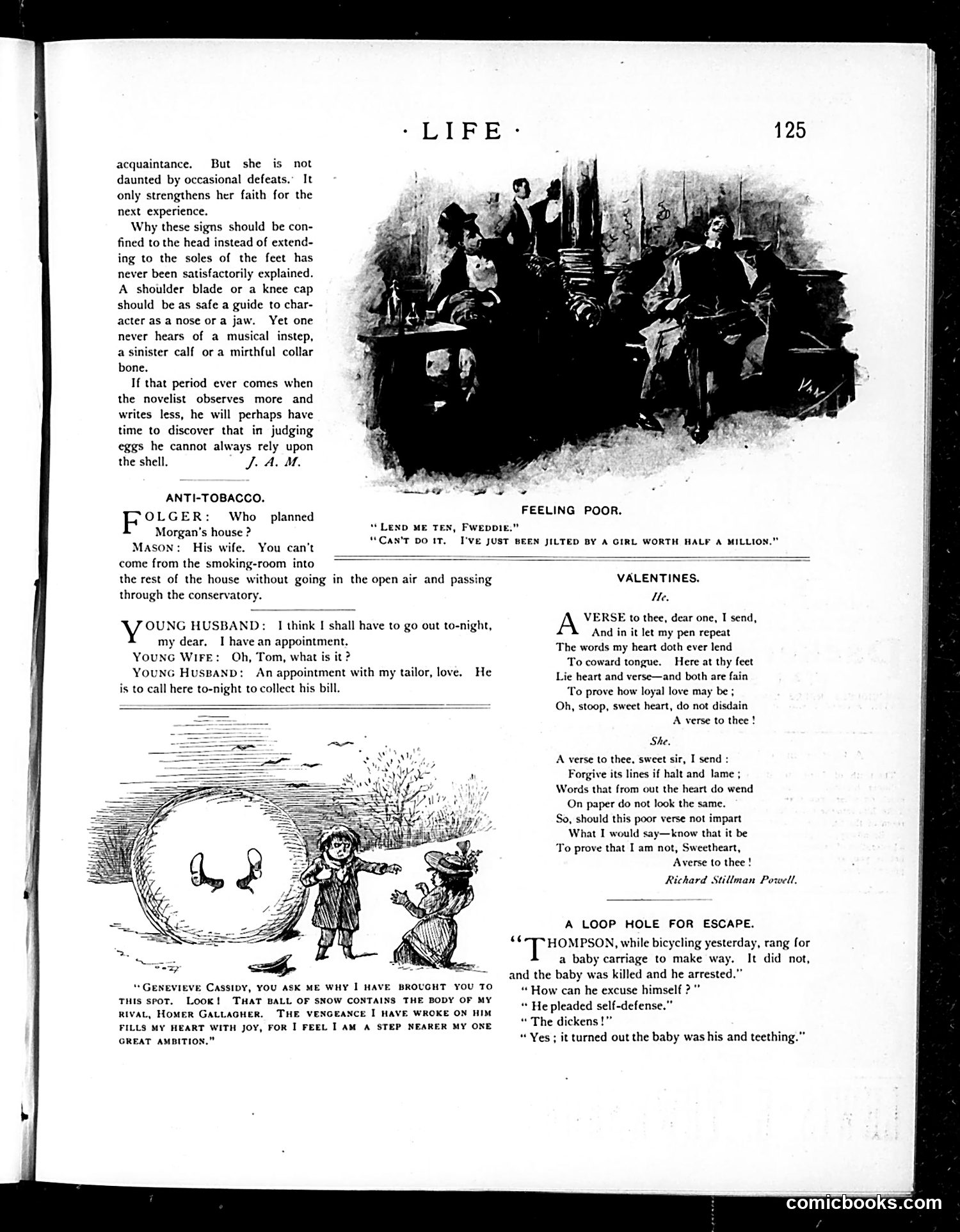
This page contains several unrelated satirical pieces typical of Life magazine's format: **"Anti-Tobacco"** presents a dialogue joke: a man asks who designed Morgan's house, and the wife responds you can't enter from the smoking room without going outside through the conservatory—implying the husband smokes so much the house was designed around avoiding him. **"Feeling Poor"** mocks wealth disparity: a man asks to borrow ten dollars, explaining he was "jilted by a girl worth half a million"—the humor being his casual attitude toward romantic rejection by the wealthy. **The main illustration** (untitled) depicts what appears to be a melodramatic scene with a man revealing a corpse in a snowball to justify murdering his rival—dark Victorian satire on extreme jealousy and violent revenge. **"Valentines"** prints sentimental verse exchanges between lovers. **"A Loop Hole for Escape"** presents absurdist humor: a cyclist kills a baby in a carriage and escapes arrest by claiming "self-defense" because the baby was his *own* and "teething." The page exemplifies Life's mix of social observation, domestic humor, and dark comedy.
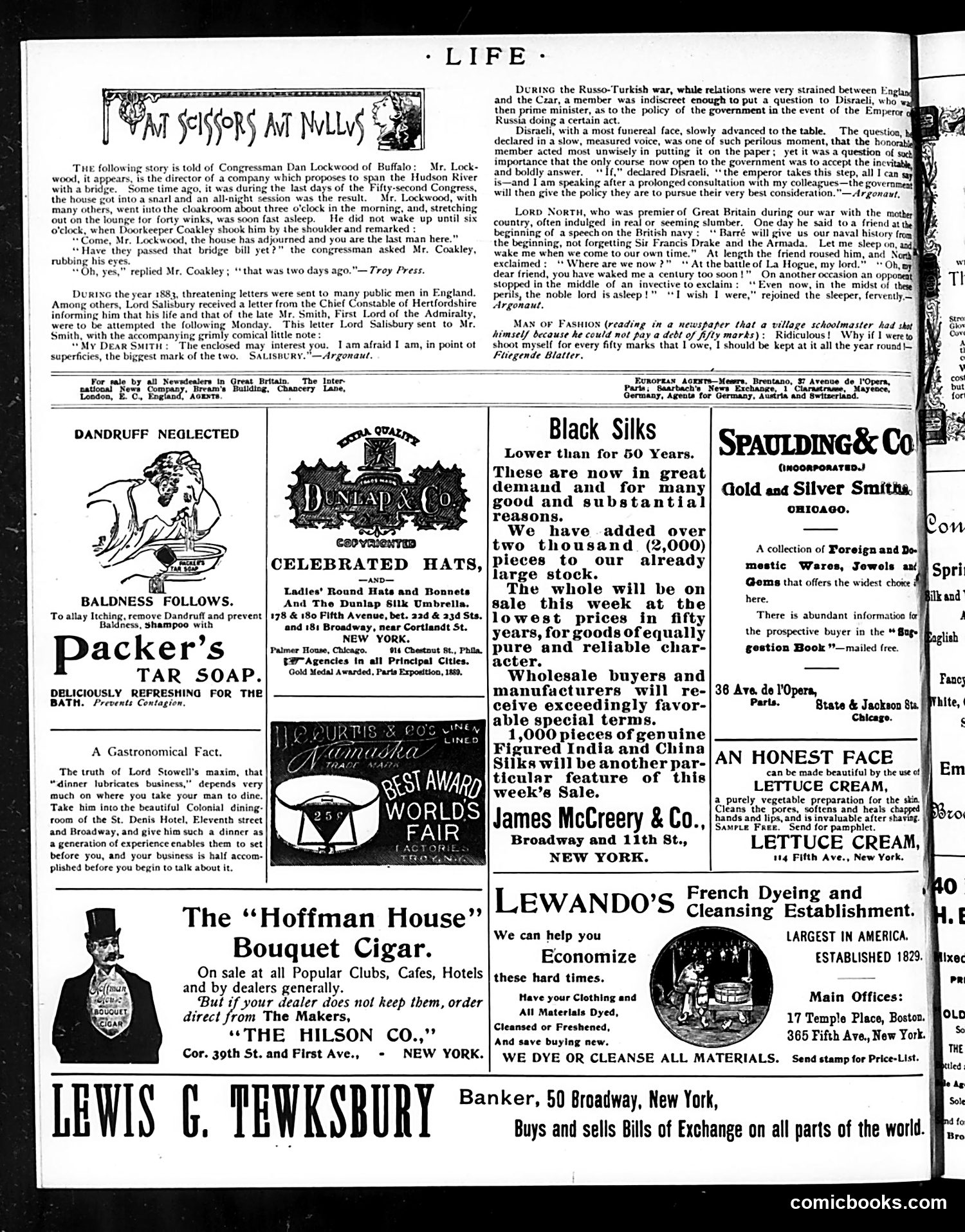
This page from *Life* magazine is primarily **advertisements and short anecdotes** rather than political cartoons. The content includes: **Humorous Stories:** - A congressman so absorbed in his bridge bill that he sleeps through Congressional sessions - Lord Salisbury's darkly witty response to assassination threats (self-deprecating joke about being an easier target) - Disraeli's evasive political non-answer during the Russo-Turkish War tensions with Russia - Lord North's legendary sleeping habits during Parliamentary speeches **The Satire:** These anecdotes mock politicians' obsessions, evasiveness, and incompetence—a standard *Life* magazine theme. The humor relies on readers recognizing these historical figures' reputations. **Rest of Page:** Mostly advertisements for products (soap, hats, silk, cigars, cream) typical of the era. Without clear cartoon imagery visible here, the page's "satire" is purely textual—witty stories about political figures rather than visual caricature.
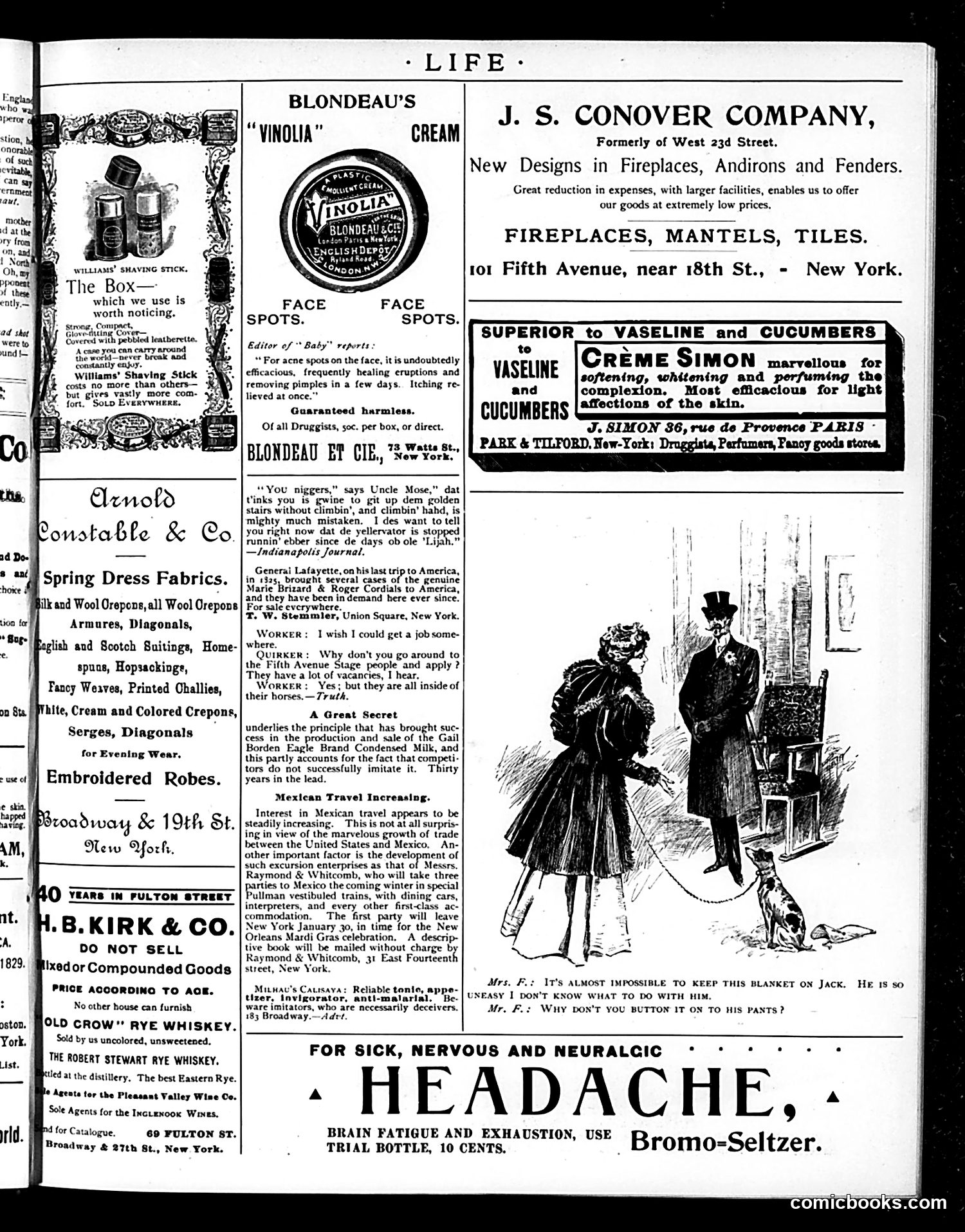
This page is primarily **advertisements and brief humorous items**, typical of Life magazine's format. The main cartoon shows **two well-dressed figures** (likely a man and woman) in winter clothing. The caption jokes about keeping a blanket on a dog named Jack, with the man asking why the woman won't button his pants. This is mild domestic humor about the inconvenience of winter dress. Below are several **short joke items**: - "Uncle Mose" makes a dialect joke about African Americans ("You niggers") claiming they can't reach heaven without effort—reflecting the racist humor common in period publications. - A workplace joke about stage workers and horses. The page is dominated by **period product advertisements**: Williams' Shaving Stick, spring fabrics, whiskey, face cream for acne, cordials, condensed milk, and home fixtures. These ads illustrate consumer goods and marketing appeals of the era. The satirical content is minimal; this is primarily a commercial magazine page using light humor to frame product pitches.
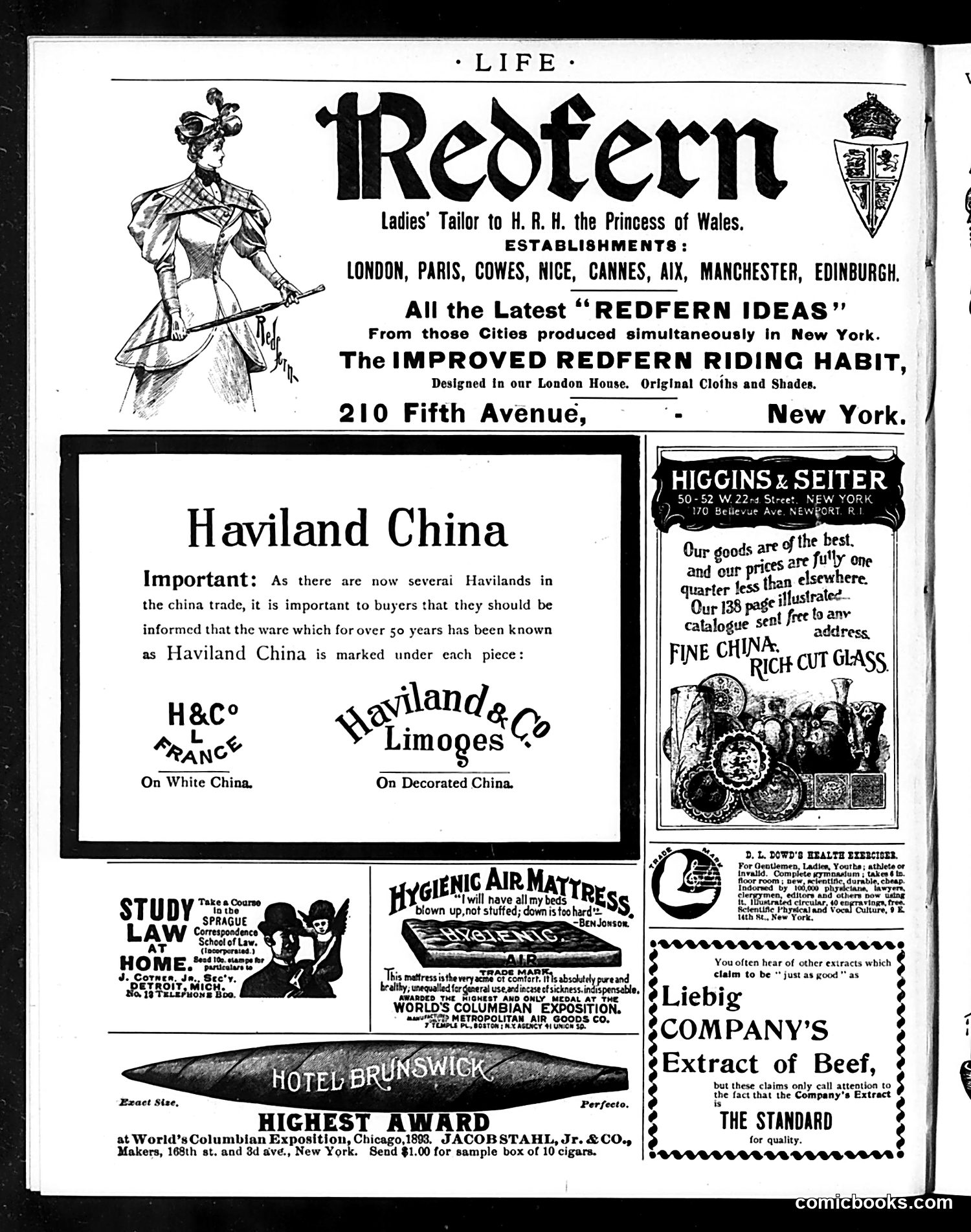
This is primarily a **commercial advertising page** from Life magazine, not a satirical cartoon page. The dominant content is product advertisements rather than editorial humor. The page features ads for luxury goods and services targeting affluent readers: Redfern (high-end ladies' tailoring serving royalty), Haviland China (fine porcelain), Higgins & Seiter (fine china and glassware), and Liebig Company's Extract of Beef (a premium food product). There are minor illustrated ads for correspondence law school, a health exercise institute, a hotel, and cigars—typical of period magazine advertising. The only visually prominent illustration is the fashionable woman in riding habit at the top, advertising Redfern's tailoring services to wealthy clientele. This reflects the magazine's audience: educated, prosperous readers interested in luxury imports and fashionable goods rather than political satire. This appears to be a **regular advertising section** rather than editorial content.