
Life, 1894-02-22 · page 5 of 16
Life — February 22, 1894 — page 5: what you’re looking at
What you’re looking at
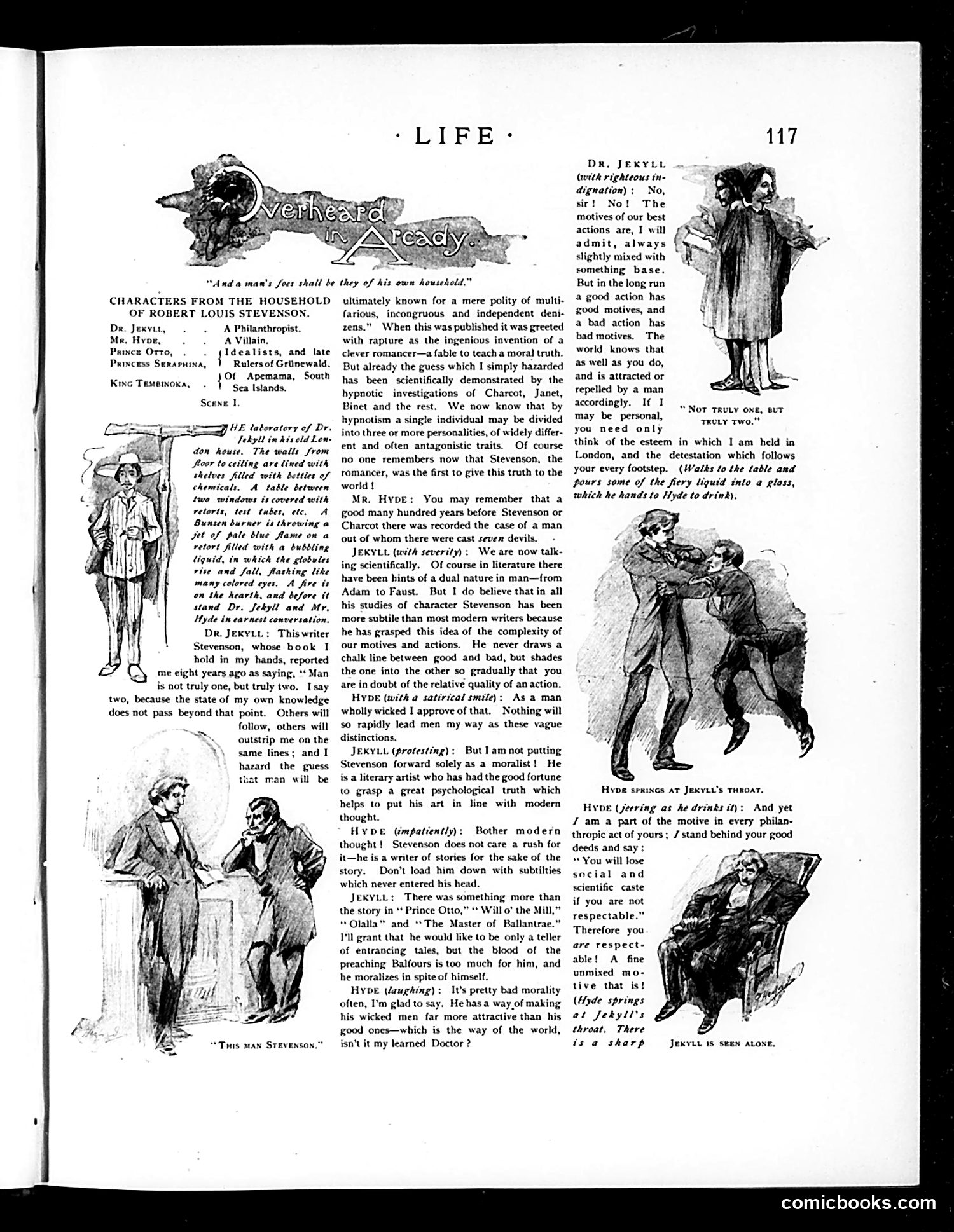
This page discusses Stevenson's famous novel through a dramatic dialogue between characters including Dr. Jekyll and Mr. Hyde. The satirical point appears to be about the novel's exploration of dual human nature—the capacity for both good and evil within one person. The debate centers on whether Stevenson is being a "moralist" by presenting this duality. One character argues the novel simply shows psychological complexity without preaching morality. Another defends it as literature that grasps "the complexity of our motives and actions." The accompanying illustrations show various character scenes. This is primarily literary criticism presented as dramatic dialogue rather than political satire—examining how the novel treats moral questions through its portrayal of Jekyll's split personality.
📄 Transcribed text from this page (OCR, searchable)
Machine-transcribed from the original scan — historical spelling and the odd misread are preserved.
“Anda man's foes shall be they of hit own household.” CHARACTERS FROM THE HOUSEHOLD OF ROBERT LOUIS STEVENSON. Dr. Jexvur, A Philanthropist. Mr. Hyoe, A Villain, Prince Oro, Idealists, and late Princess Sexarnixa, } Rulersof Grunewald, Of Apemama, South Sea Islands. Scene 1. Kinc Temprnoxa, HE latoratery of Dr. Jekyll inhiseld Len- don house. The walls from Aor to ceiting are lined with shelves filled with bettles of chemicals, A table between two windows is covered with retorts, test tubes, ete. A Bunsen burner is throwing a det of pale blue flame on a retort filled with a bubbling liquid, in which the globules rise and fall, flashing like many colored eyes. A fire is on the hearth, and before it stand Dr. Jekyll and Mr. Hyde in earnest conversation. Dr. Jexyii: Thiswriter Stevenson, whose book I hold in my hands, reported me eight years ago as saying, * Man is not truly one, but truly two. Tsay two, because the state of my own knowledge does not pass beyond that point. Others will follow, others will outstrip me on the same lines; and I hazard the guess that man will be ultimately known for a mere polity of multi- farious, incongruous and independent deni- zens,” When this was published it was greeted with rapture as the ingenious invention of a clever romancer—a fable to teach a moral truth. But already the guess which I simply hazarded has been scientifically demonstrated by the hypnotic investigations of Charcot, Janet, Binet and the rest. We now know that by hypnotism a single individual may be divided into three or more personalities, of widely differ- ent and often antagonistic traits, Of course no one remembers now that Stevenson, the romancer, was the first to give this truth to the world ! Mr. Hype: You may remember that a good many hundred years before Stevenson or Charcot there was recorded the case of a man out of whom there were cast seven devils. JEKYLL (with severity): We are now talk- ing scientifically. Of course in literature there have been hints of a dual nature in man—from Adam to Faust. But I do believe that in all his studies of character Stevenson has been more subtile than most modern writers because he has grasped this idea of the complexity of our motives and actions. He never draws a chalk line between good and bad, but shades the one into the other so gradually that you are in doubt of the relative quality of an action, Hype (with @ satirical smile): As a man wholly wicked I approve of that. Nothing will so rapidly lead men my way as these vague distinctions. JEKYLL (protesting): But I am not putting Stevenson forward solely as a moralist! He is a literary artist who has had the good fortune to grasp a great psychological truth which helps to put his art in line with modern thought. Hy DE (impatiently): Bother modern thought ! Stevenson does not care a rush for it—he is a writer of stories for the sake of the story. Don’t load him down with subtilties which never entered his head. JexyLt: There was something more than the story in“ Prince Otto,” * Will o' the Mill,”” ‘Olalla” and The Master of Ballantrae. T'll grant that he would like to be only a teller of entrancing tales, but the blood of the preaching Balfours is too much for him, and he moralizes in spite of himself. HybE (laughing): It's pretty bad morality often, I'm glad to say. He has a way of making his wicked men far more attractive than his ood ones—which is the way of the world, isn't it my learned Doctor ? Dr. JEKYLL (with righteous in- dignation) : No, sir! No! The motives of our best actions are, I will admit, always slightly mixed with something base. But in the long run ‘a good action has good motives, and a bad action has bad motives. The world knows that as well as you do, and is attracted or repelled by a man accordingly. If I may be personal, you need only think of the esteem in which I am held in London, and the detestation which follows your every footstep. (Walks to the table and pours some of the fiery liquid into a glass, which he hands to Hyde to drink), “Not TRULY ONE, BUT TRULY Two.” Hype srrixcs at JexyLt’s THROAT. Hype (jeering as he drinks it): And yet 7 am a part of the motive in every philan- thropic act of yours ; / stand behind your good deeds and say : “You will lose social and scientific caste if you are not respectable.” Therefore you are respect- able! A fine unmixed mo- tive that is! (Hyde springs at Jekyll's throat. There fsa sharp — Jexvitis seen atone, comicbooks.com