
Life, 1894-02-22 · page 4 of 16
Life — February 22, 1894 — page 4: what you’re looking at
What you’re looking at
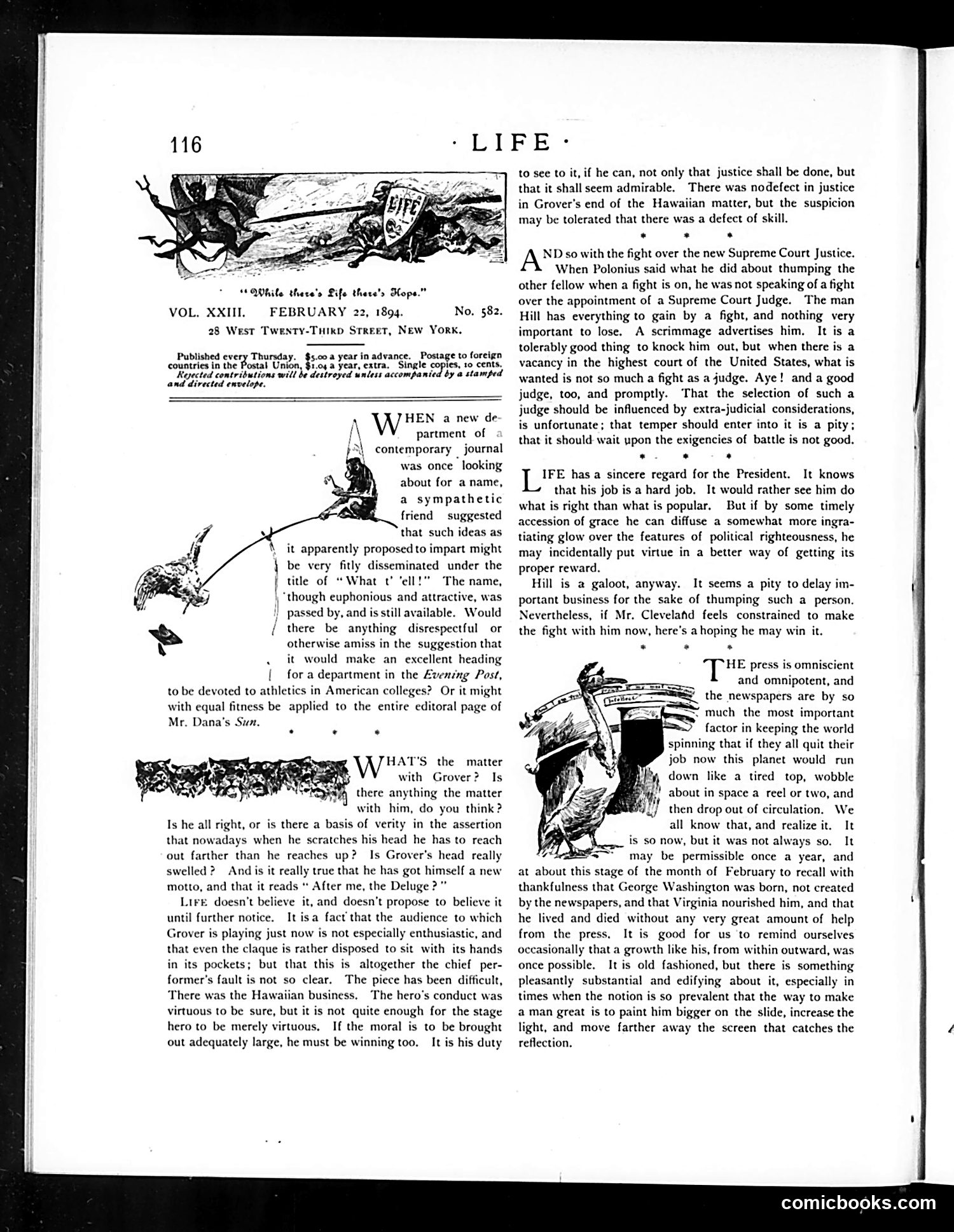
The page contains editorial commentary on two contemporary issues: **Supreme Court Justice Fight**: The text discusses controversy over appointing a new Supreme Court Justice, referencing "Hill" (likely Senator David B. Hill) as a contentious candidate. The satire criticizes that important judicial positions are being decided by political "fighting" rather than merit. **Grover Cleveland Commentary**: The editorial praises President Cleveland's character while criticizing newspaper coverage of him. It argues the press should focus on substantive accomplishments rather than sensationalizing political figures. The decorative illustrations show fighting figures (likely representing political conflict), but lack clear identifying labels. The overall thrust criticizes how American politics and media handled judicial appointments and presidential reputation during the 1890s.
📄 Transcribed text from this page (OCR, searchable)
Machine-transcribed from the original scan — historical spelling and the odd misread are preserved.
‘LIFE: “While there's Life there's Hope.” VOL. XXIII. FEBRUARY 22, 1894. No, 582. 28 West Twenty-Tuikp Street, New York. Thursday. $5.00 a year in advance. Published eve: c countries in the Fostal Union, $1.04 year, extra. Single copies, ro cents, Keyected contributions will be destroyed untess accompanied by a stamped and directed envelope. Ponage to foreign HEN a new de partment of contemporary journal was once looking about for a name, a sympathetic friend suggested that such ideas as it apparently proposed to impart might be very fitly disseminated under the title of “What t’ ‘ell! The name, , ‘though euphonious and attractive, was | passed by, and is still available. Would there be anything disrespectful or otherwise amiss in the suggestion that «it would make an excellent heading | fora department in the Evening Post, to be devoted to athletics in American colleges? Or it might with equal fitness be applied to the entire editoral page of Mr. Dana’s Sus. * HAT’S the matter with Grover? Is there anything the matter with him, do you think? Is he all right, or is there a basis of verity in the assertion that nowadays when he scratches his head he has to reach out farther than he reaches up? Is Grover's head really swelled ? And is it really true that he has got himself a new motto, and that it reads * After me, the Deluge?” Lire doesn’t believe it, and doesn't propose to believe it until further notice. It isa fact that the audience to which Grover is playing just now is not especially enthusiastic, and that even the claque is rather disposed to sit with its hands in its pockets; but that this is altogether the chief per- former's fault is not so clear. The piece has been difficult, There was the Hawaiian business. The hero's conduct was virtuous to be sure, but it is not quite enough for the stage hero to be merely virtuous, If the moral is to be brought out adequately large, he must be winning too. It is his duty to see to it, if he can, not only that justice shall be done, but that it shall seem admirable. There was nodefect in justice in Grover's end of the Hawaiian matter, but the suspicion may be tolerated that there was a defect of skill. * * * ANP so with the fight over the new Supreme Court Justice. When Polonius said what he did about thumping the other fellow when a fight is on, he was not speaking of a fight over the appointment of a Supreme Court Judge. The man Hill has everything to gain by a fight, and nothing very important to lose. A scrimmage advertises him. It is a tolerably good thing to knock him out, but when there is a vacancy in the highest court of the United States, what is wanted is not so much a fight as a judge. Aye! and a good judge, too, and promptly. That the selection of such a judge should be influenced by extra-judicial considerations, is unfortunate; that temper should enter into it is a pity; that it should wait ypon the exigencies of battle is not good. . . * IFE has a sincere regard for the President. It knows that his job is a hard job, It would rather see him do what is right than what is popular. But if by some timely accession of grace he can diffuse a somewhat more ingra- tiating glow over the features of political righteousness, he may incidentally put virtue in a better way of getting its proper reward. Hill is a galoot, anyway. It seems a pity to delay im- portant business for the sake of thumping such a person. Nevertheless, if Mr. Clevelafd feels constrained to make the fight with him now, here's a hoping he may win it. . . HE press is omniscient and omnipotent, and = the newspapers are by so =. much the most important factor in keeping the world spinning that if they all quit their job now this planet would run Pi down like a tired top, wobble ¢:| about in space a reel or two, and then drop out of circulation. We all know that, and realize it. It is so now, but it was not always so. It may be permissible once a year, and at about this stage of the month of February to recall with thankfulness that George Washington was born, not created by the newspapers, and that Virginia nourished him, and that he lived and died without any very great amount of help from the press, It is good for us to remind ourselves occasionally that a growth like his, from within outward, was once possible. It is old fashioned, but there is something pleasantly substantial and edifying about it, especially in times when the notion is so prevalent that the way to make a man great is to paint him bigger on the slide, increase the light, and move farther away the screen that catches the reflection, comicbooks.com