A complete issue · 16 pages · 1894
Life — February 8, 1894
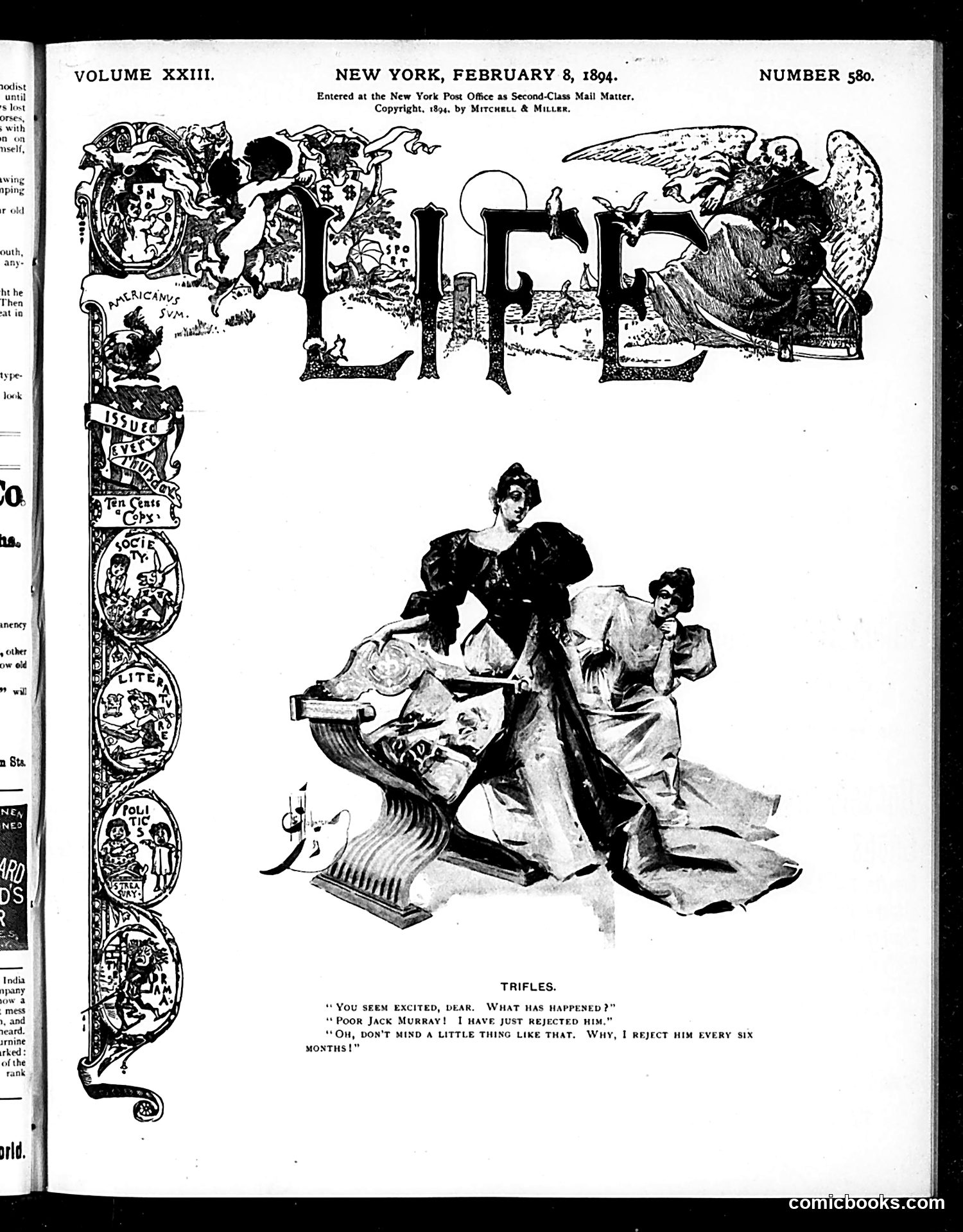
This cartoon illustrates a domestic scene captioned "Trifles," depicting a woman confronting her husband about infidelity. The dialogue reveals she's rejected him "every six months" because she discovered he's been unfaithful ("Poor Jack Murray! I have just rejected him"). The satire targets Victorian-era marriage dynamics and female agency. The woman's composed, almost dismissive response—treating his betrayal as a minor recurring irritation rather than grounds for serious consequence—suggests ironic commentary on how women of that era were expected to tolerate male infidelity while maintaining social propriety. The elaborate decorative border on the left appears typical of Life's design aesthetic from this period. The cartoon reflects broader social anxieties about marriage, fidelity, and gender relations in the 1890s.
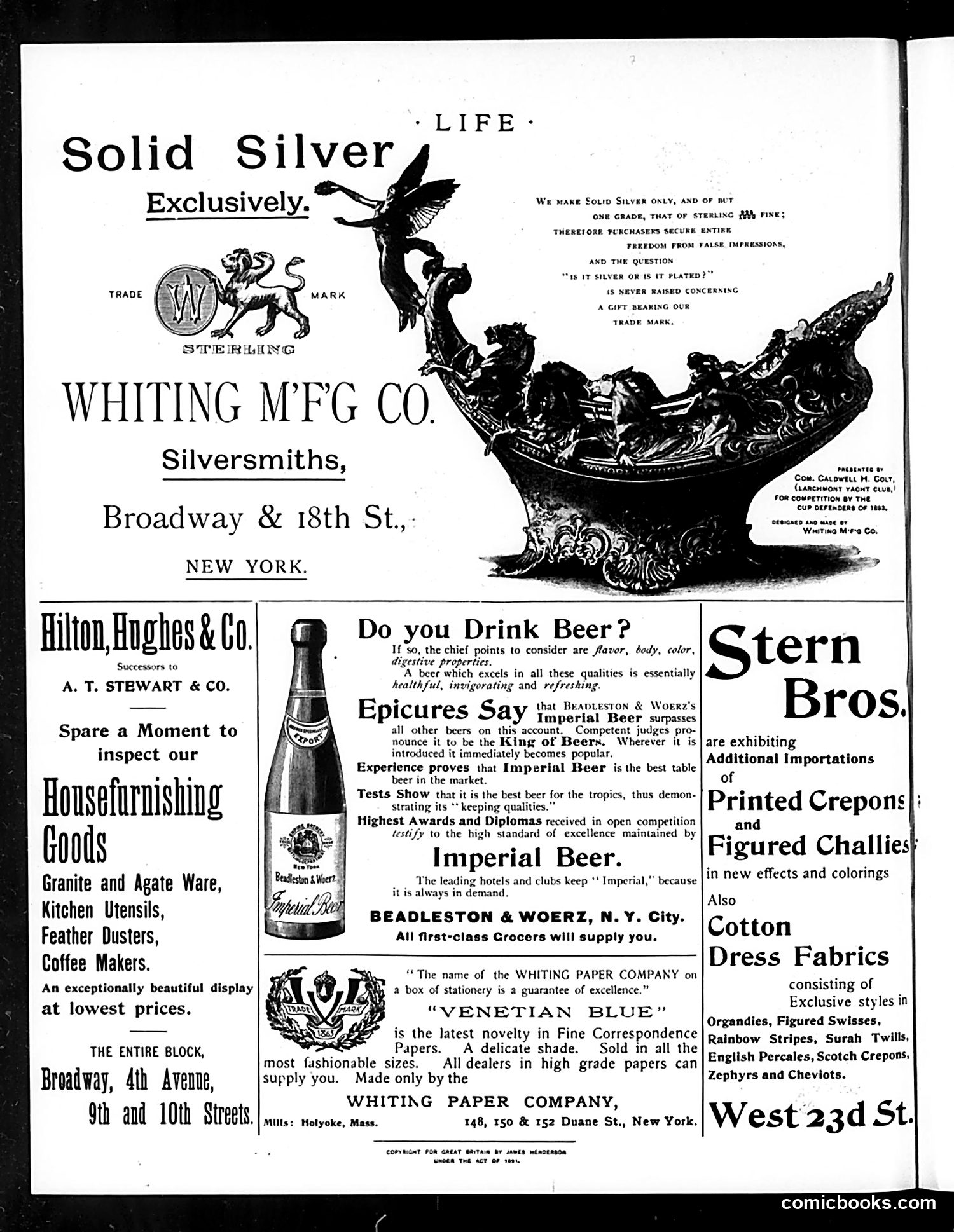
This page is primarily **advertising**, not satirical content. It features multiple commercial notices from late 19th or early 20th-century New York businesses: The largest advertisement promotes **Whiting Manufacturing Company**, silversmiths on Broadway & 18th Street, emphasizing their solid silver goods bearing a sterling mark. Other ads include housefurnishings, beer (Imperial Beer by Beadleston & Woerz), paper products, and fabric imports. The Stern Bros. advertisement promotes imported crepe and figured challies fabrics on West 23rd Street. There is **no political cartoon or satire** visible on this page. The decorative silver vessel illustration is purely commercial imagery. This appears to be a standard advertising page from *Life* magazine's commercial section.
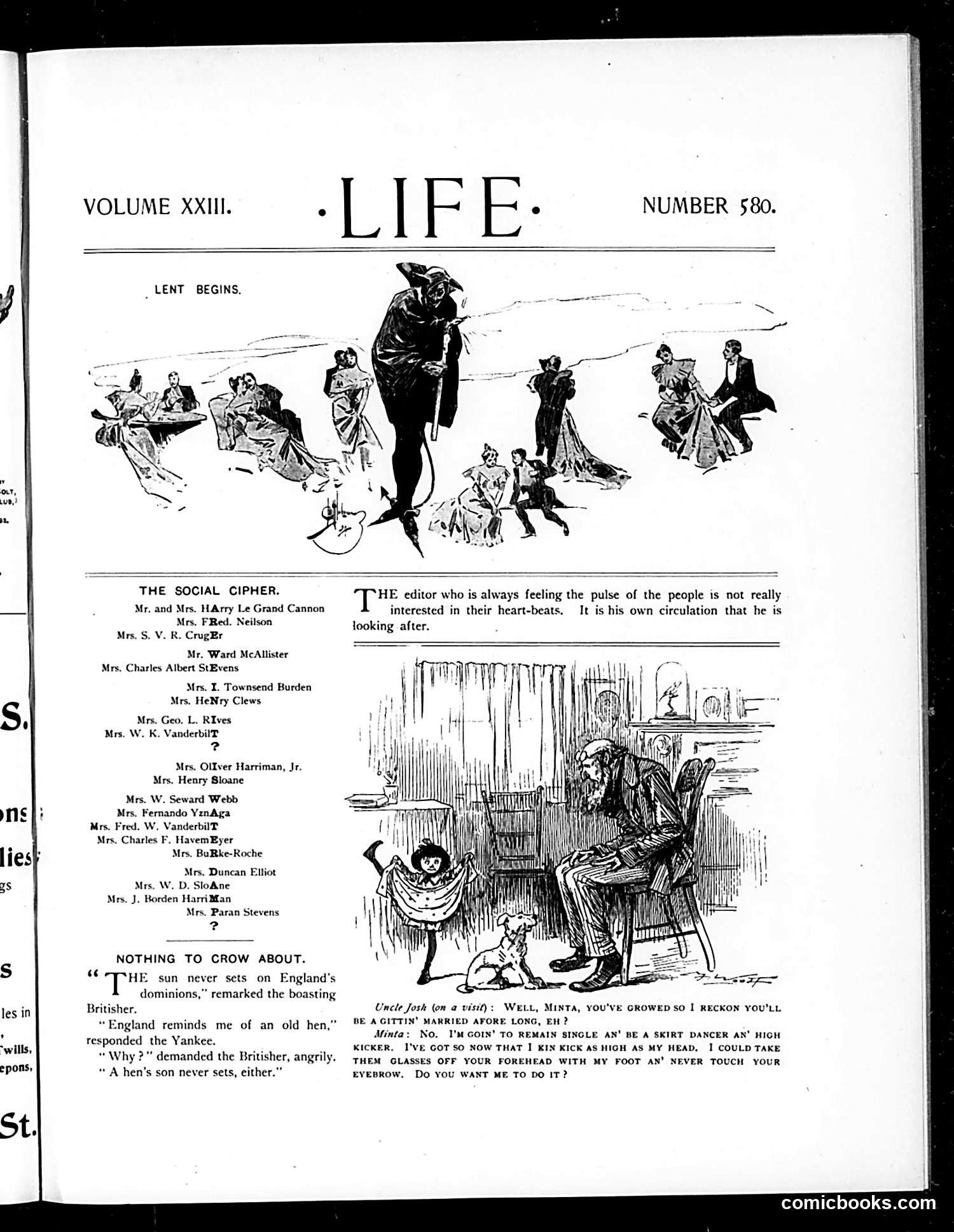
This page contains two satirical pieces: **"The Social Cipher"** lists names of society figures, likely mocking high-society pretension through the mundane roster presentation. **"Nothing to Crow About"** is a dialogue cartoon satirizing Anglo-American relations. A Britisher boasts that "the sun never sets on England's dominions," to which a Yankee responds that England "reminds me of an old hen." The Britisher demands "Why?" and the Yankee concludes: "A hen's son never sets either." The joke plays on "sets"—conflating the sun's perpetual presence with the biological impossibility of a hen's offspring never being born. It's dated humor mocking British imperial pride through a deliberately crude, rural American rejoinder.
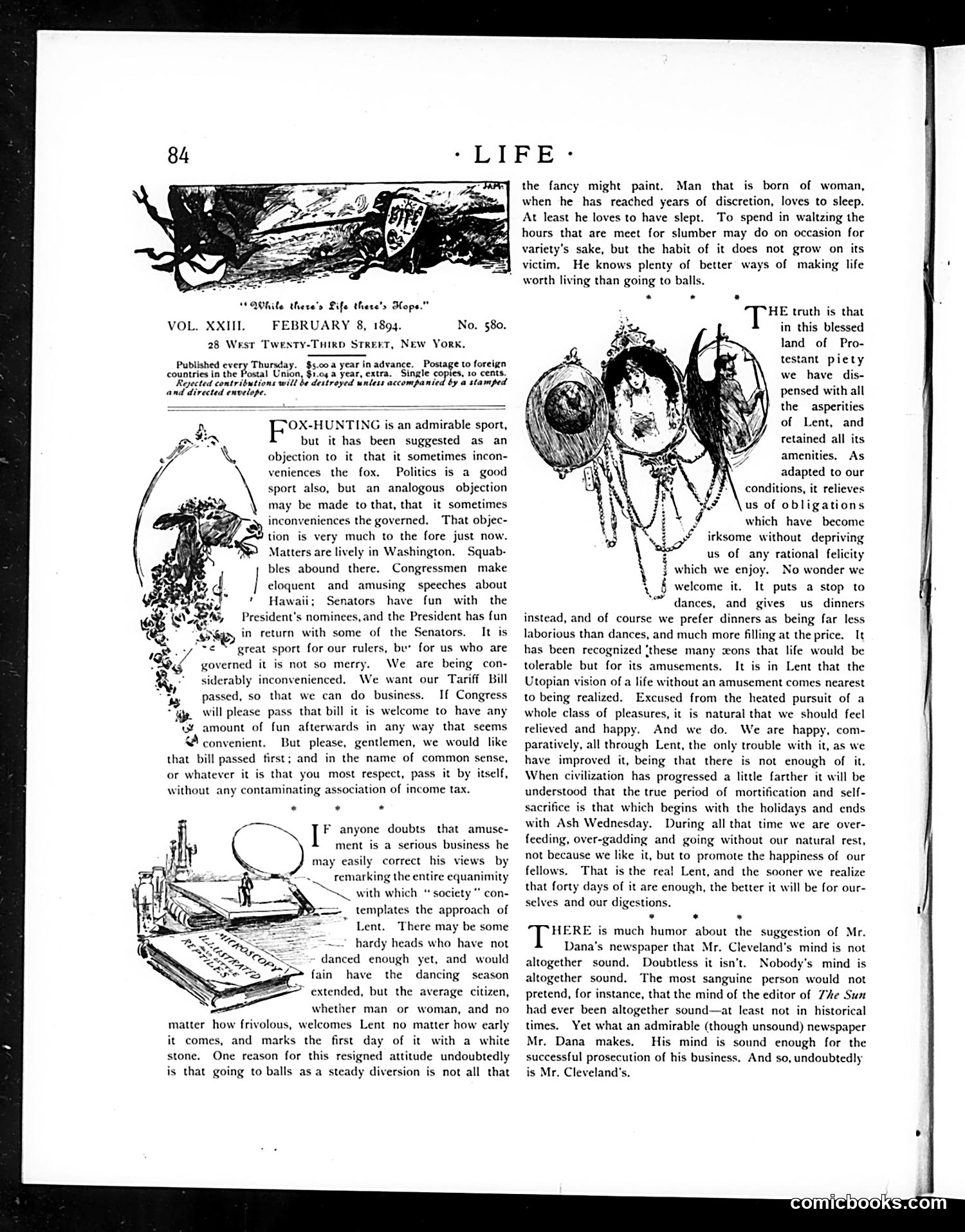
This page contains two editorial pieces about leisure and amusement during Lent. The text discusses fox-hunting as sport and debates whether amusements should be permitted during the Lenten season—a period of religious self-denial in Christian tradition. The illustrations include decorative vignettes: one appears to show a hunted fox or animal in period engraving style, and another depicts what looks like a skating or recreational scene. The satire targets the hypocrisy of wealthy Americans who claim religious piety during Lent while seeking loopholes to enjoy entertainments like balls and dancing. The author argues that moderate amusements (dinners, fox-hunting) are preferable to complete deprivation, mocking the tension between Protestant morality and desire for pleasure among the elite.
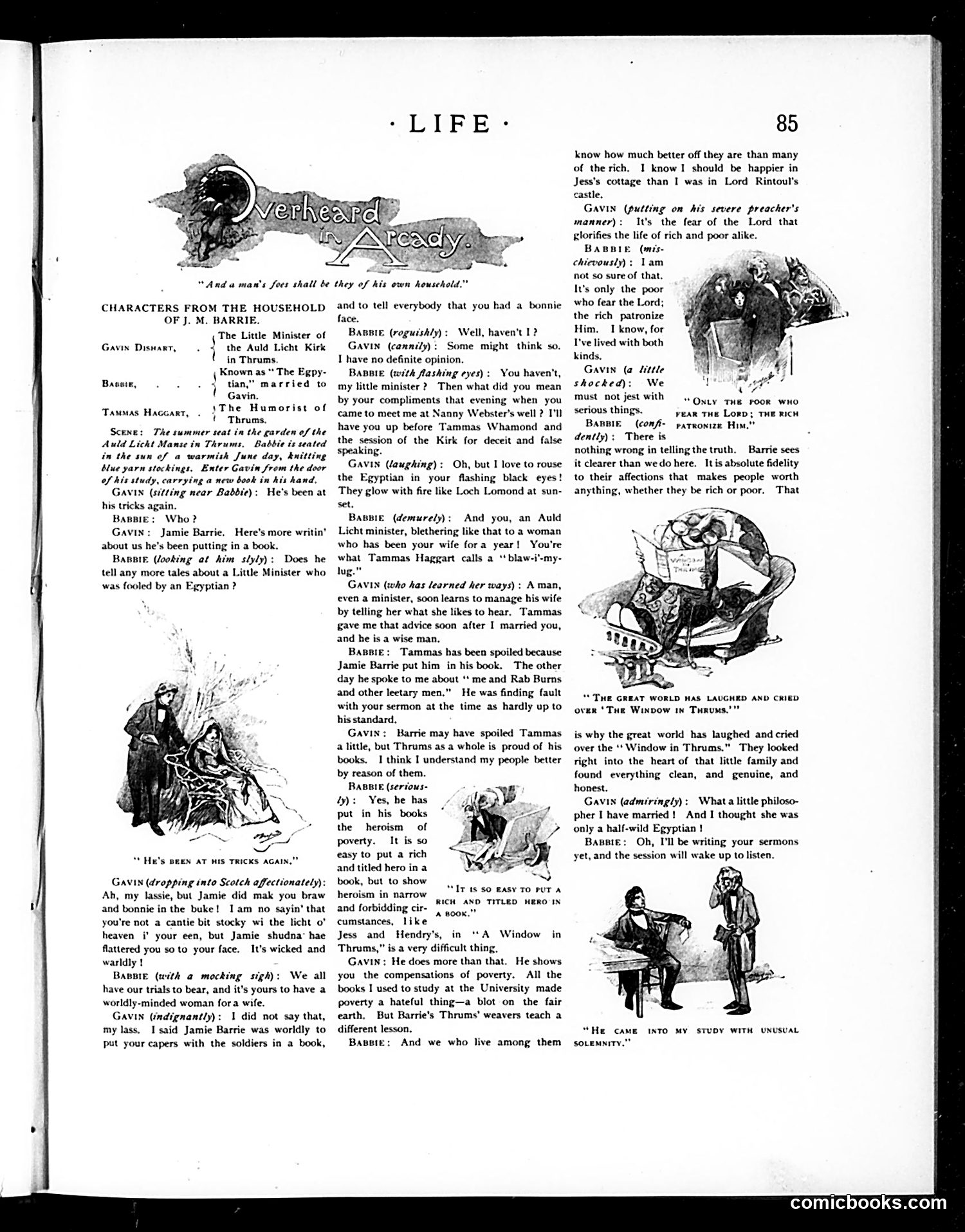
This page from *Life* magazine presents a dramatic scene from what appears to be a stage production or serialized story titled "Characters from the Household Off 'A Harim.'" The dialogue satirizes class attitudes and social pretension of the era. The scene mocks wealthy, titled characters (references to "Auld Licht minister" and "Egyptian") who patronize the poor while claiming moral superiority. One character boasts of understanding poverty through literature rather than lived experience—a jab at upper-class sentimentality. The humor targets Victorian hypocrisy: the wealthy reading books *about* poverty as substitute for actual compassion. The multiple illustrations show dramatic reactions, emphasizing the satire's theatrical nature and the absurdity of the characters' self-satisfied moralizing.
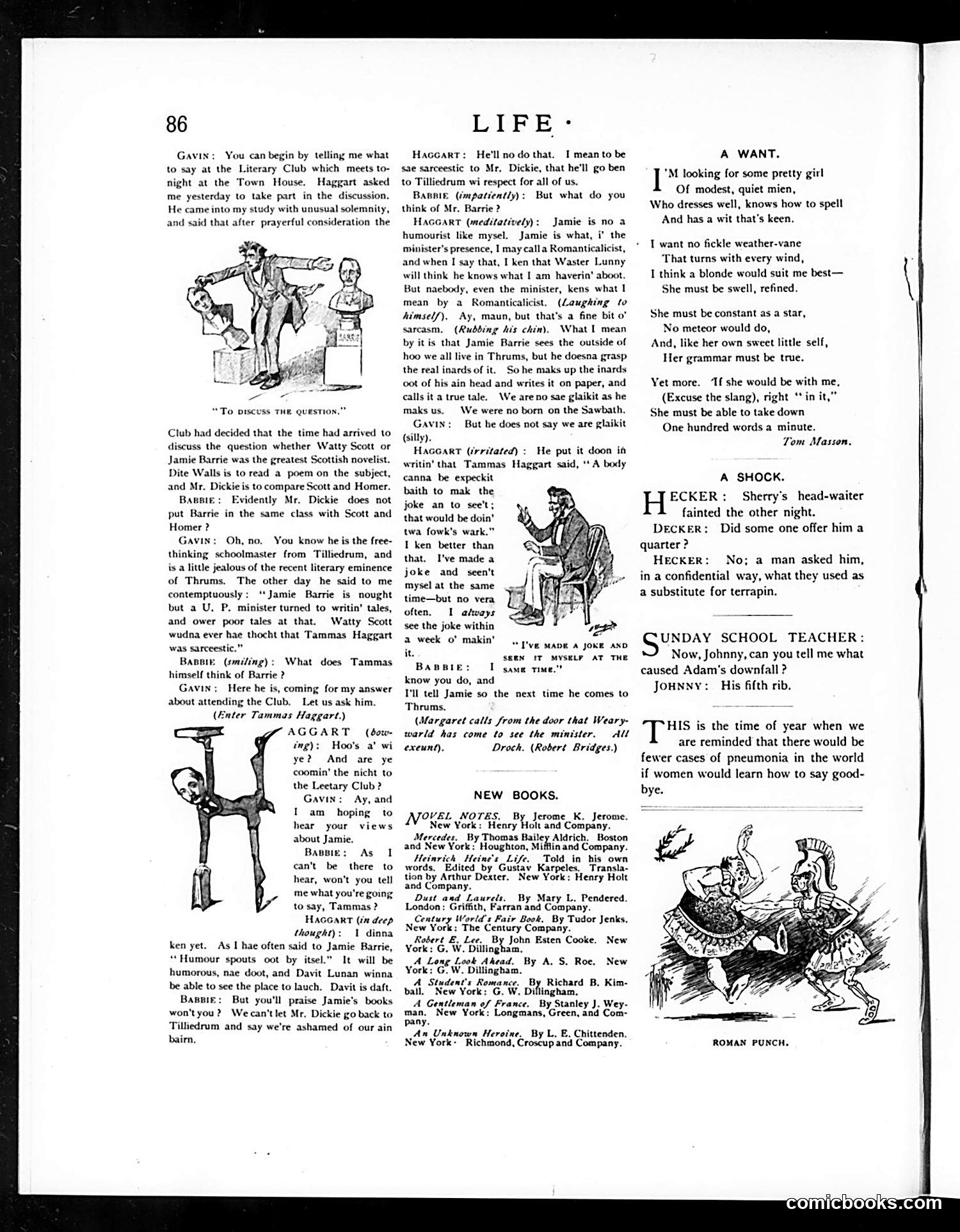
This page features a Literary Club discussion debate about whether Scottish novelist **Watty Scott** or **Jamie Barrie** was the greatest Scottish novelist. The debate references contemporary literary criticism and romanticism. The illustrated cartoons show figures in exaggerated poses—one doing a handstand—accompanying the satirical dialogue about literary merit and artistic intent. The figures appear to represent club members engaged in heated debate. A separate section includes book reviews and advertisements, plus small illustrations including what's labeled "Roman Punch" at bottom. The satire targets pretentious literary criticism and academic debates about authorial merit, mocking how literary enthusiasts overanalyze and assign grand importance to questions of artistic ranking. The physical comedy of the illustrations undercuts the pompous tone of the discussion.
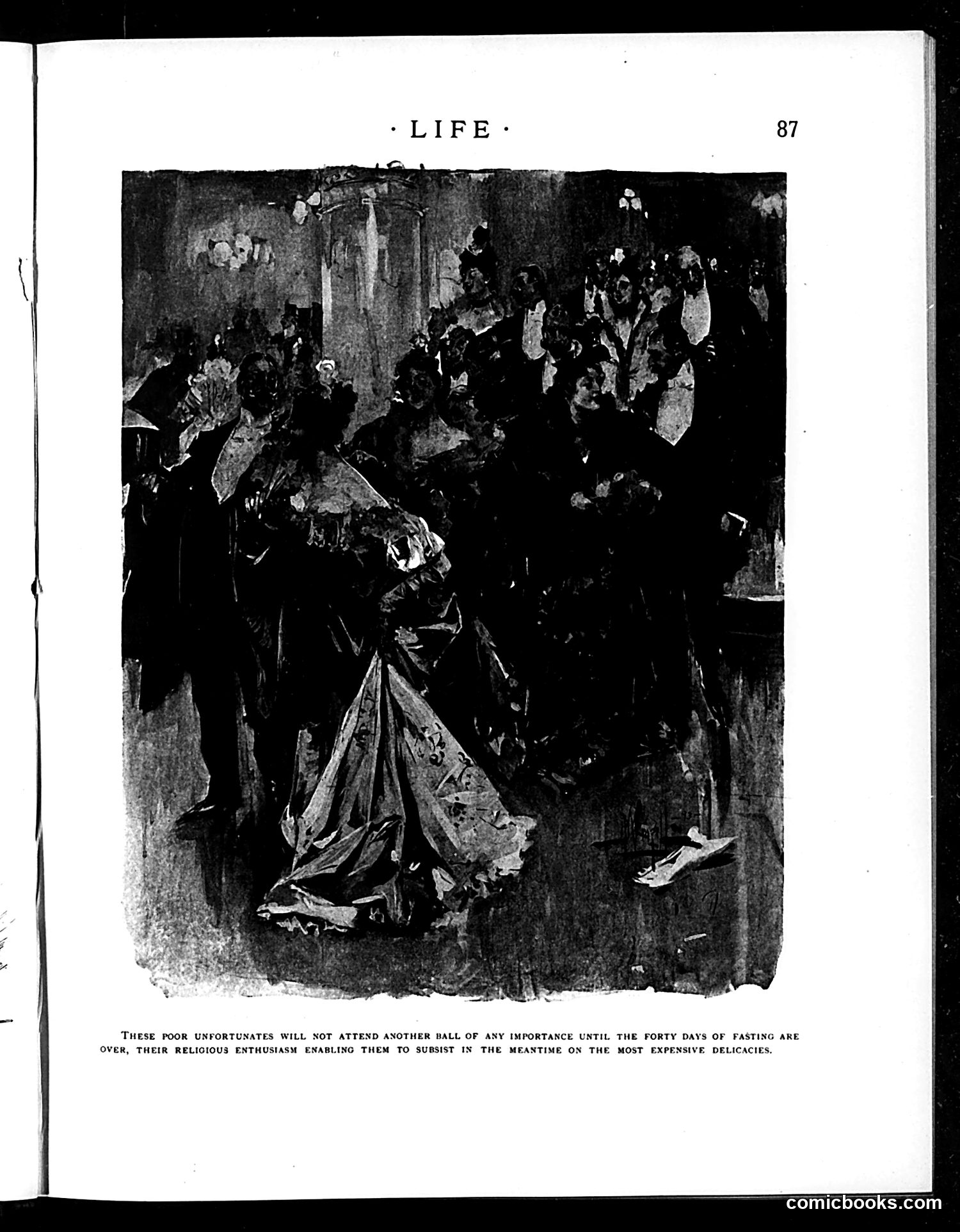
This appears to be a satirical illustration from *Life* magazine depicting a high-society ball or social gathering. The image shows well-dressed figures in formal attire at what appears to be an exclusive event, rendered in dramatic black and white. The caption criticizes attendees as "poor unfortunates" who cannot attend important balls until completing "forty days of fasting" due to their "religious enthusiasm," which supposedly enables them to "subsist in the meantime on the most expensive delicacies." The satire targets wealthy social elites who practice religious fasting while paradoxically maintaining expensive lifestyles and social obligations. The joke suggests hypocrisy: their religious devotion appears performative, masking continued indulgence in luxury. The illustration mocks both their pretension and the contradiction between ascetic religious practice and lavish consumption.
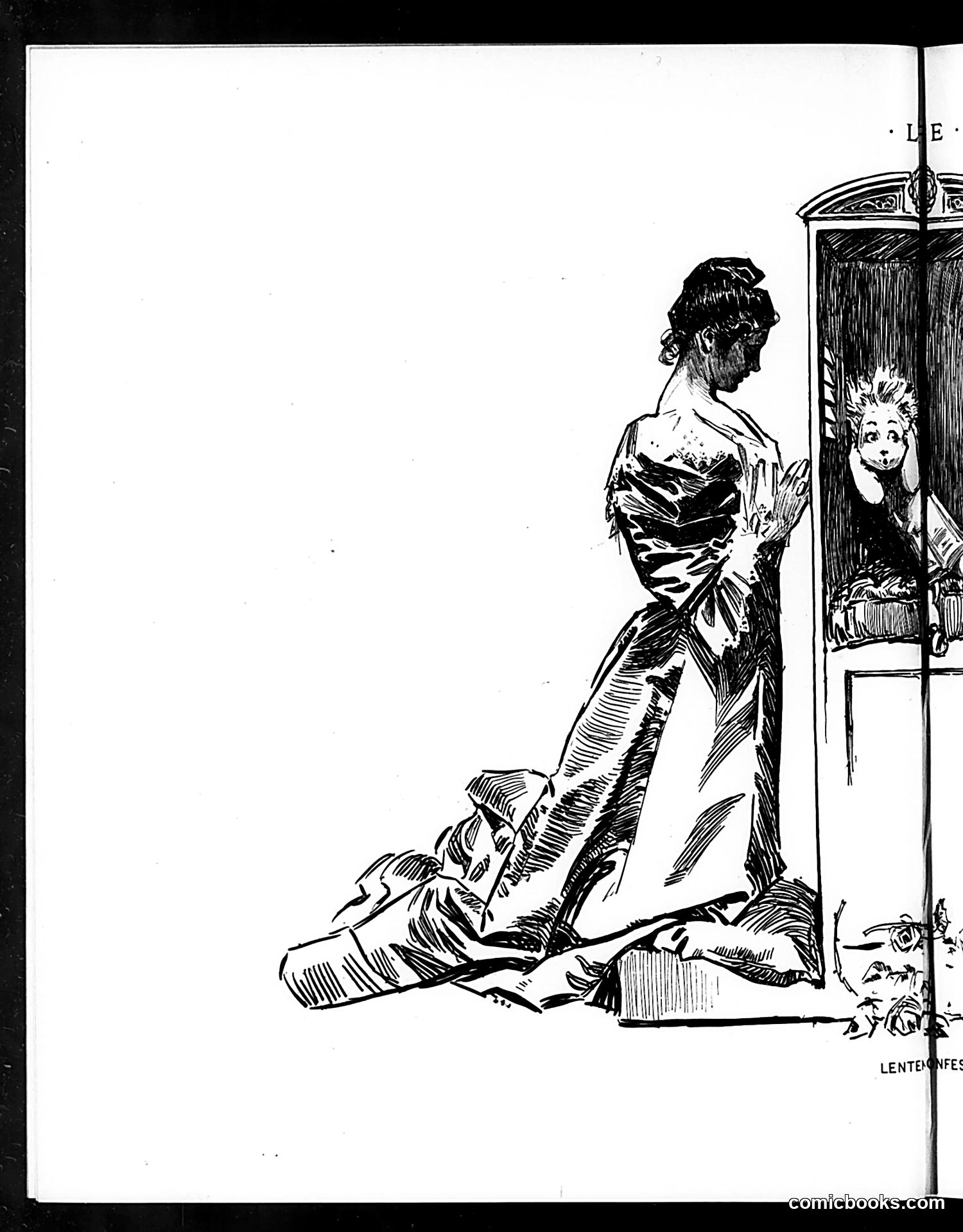
This is a single-panel illustration signed by Lentendres showing a woman in an elegant dress with a long train, viewed from behind, standing at a doorway. She appears to be greeting or observing someone inside a mirror or room beyond the door—another figure with an exaggerated, somewhat grotesque expression is visible. The satire likely comments on **vanity, appearance, or self-perception**—a common theme in early 20th-century Life magazine. The contrast between the woman's fashionable exterior and the distorted or unflattering reflection/figure suggests mockery of either feminine preoccupation with beauty, deceptive appearances, or perhaps marital/romantic disillusionment. Without additional context or captions visible, the specific target remains somewhat unclear, though the illustration exemplifies Life's typical satirical approach to society and human nature.
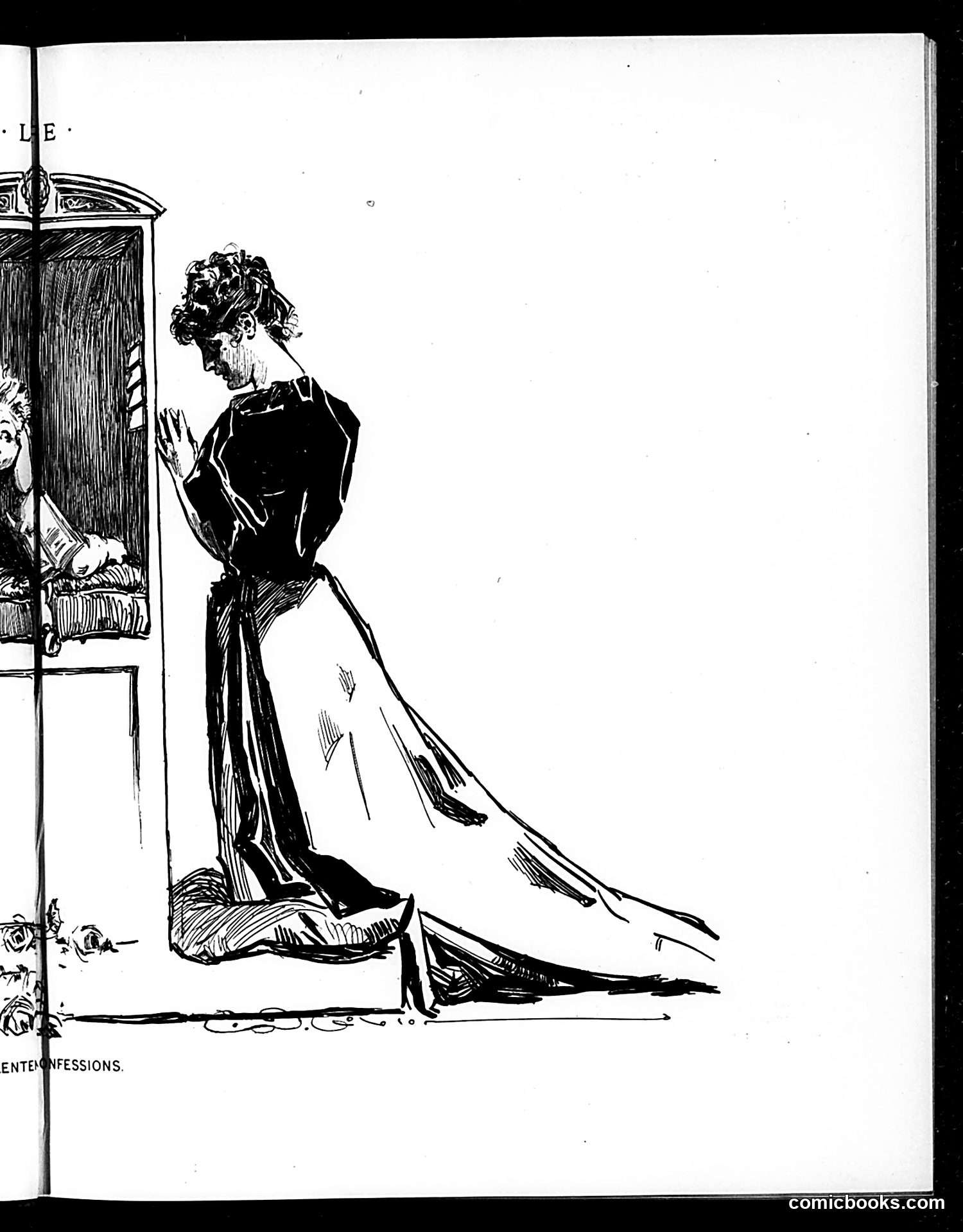
This appears to be an illustration from *Life* magazine titled "Ente[r]confessions" (partially visible at bottom). The image shows a elegantly dressed woman in profile, wearing a dark jacket and a long, flowing light-colored skirt with a dramatic train. She is positioned before what seems to be a mirror or doorway on the left side. The satirical point likely concerns high society fashion and social pretension—the woman's elaborate, trailing gown suggests either excessive vanity or the absurdities of formal wear. The "confessions" title implies this is commentary on wealthy women's admitted vanities or secrets about their appearance and social positioning. Without additional context or visible text, the specific social commentary remains somewhat unclear, but it appears to mock upper-class women's obsession with fashionable dress and presentation.
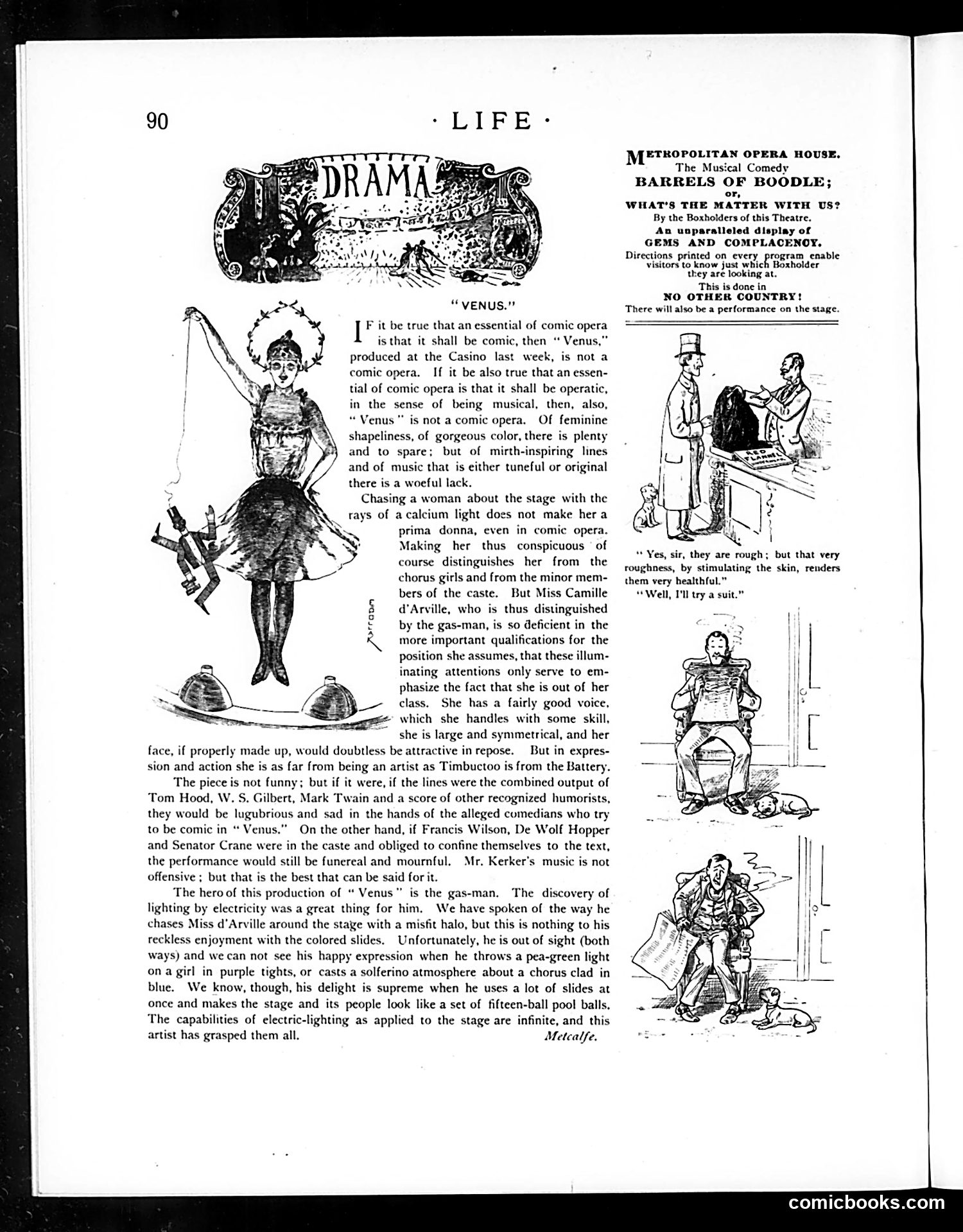
This page contains a theater review titled "Venus" critiquing a comic opera production at the Casino theater. The left illustration depicts the character Venus in an exaggerated pose, likely mocking the lead actress Miss Camille d'Arville's performance and physical appearance. The reviewer's tone is sharply critical: the opera lacks genuine humor and musicality, and the lead actress lacks the artistic qualifications for her role. The right-side illustrations and accompanying text (discussing "roughness" stimulating skin health) appear to be satirical advertisements or sidebar commentary, possibly mocking beauty treatments or theatrical convention. The satire targets both the production's mediocrity and the performer's inadequacy, while celebrating the innovative electric lighting effects—the production's only genuine achievement.
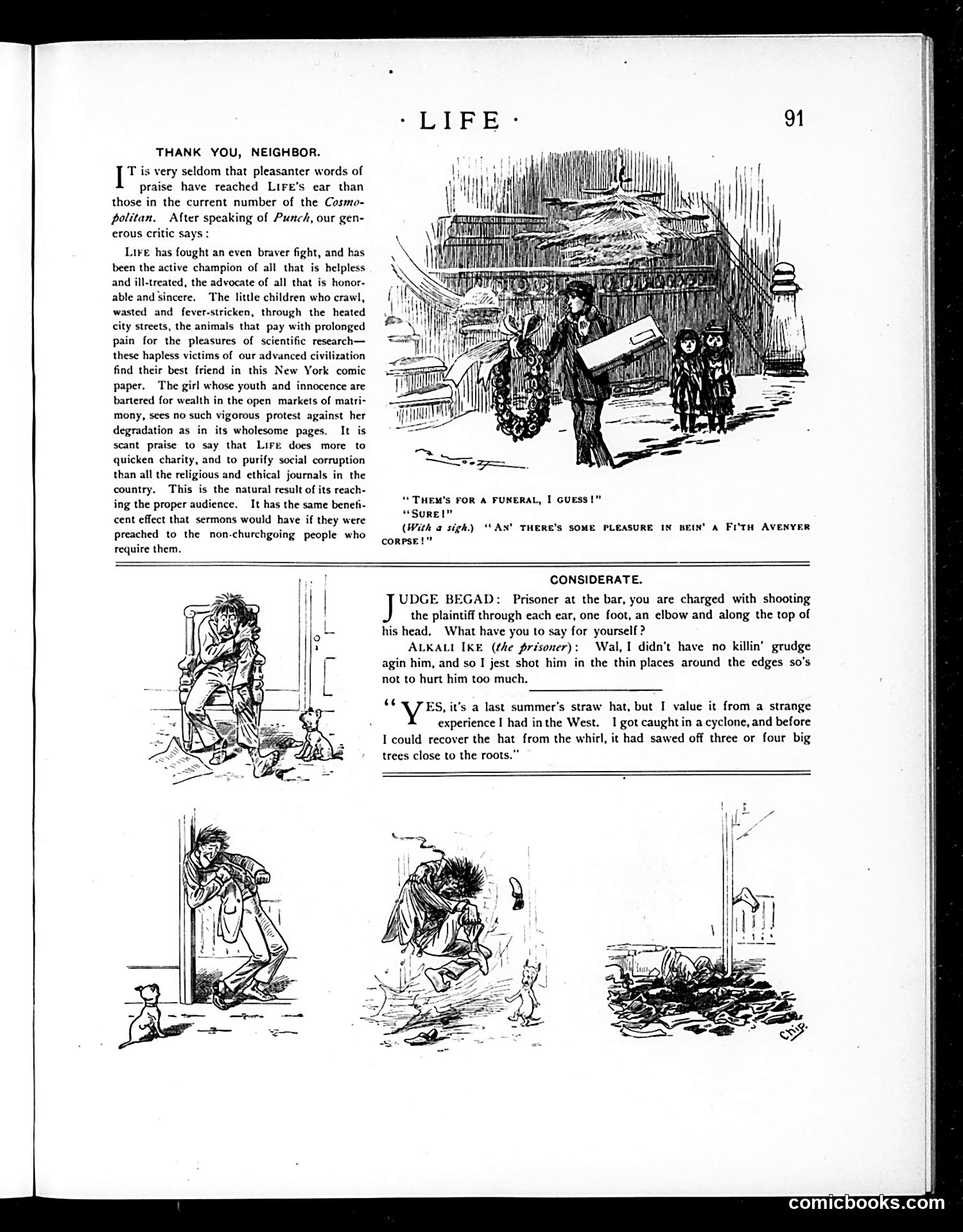
This page contains satirical content criticizing social issues of the era. The top section "Thank You, Neighbor" praises *Life* magazine's advocacy for animal welfare and children's protection against scientific experimentation and child labor—positioning it as morally superior to religious publications. Below, a courtroom sketch titled "Considerate" depicts a humorous exchange where a prisoner named "Alkali Ike" is charged with shooting a man through both ears. His absurd defense—that he shot only the "thin places" to minimize harm—satirizes backwards frontier logic and reckless violence treated casually. The lower cartoons appear to illustrate various comedic mishaps, though specific details are unclear from the image alone. The overall tone mocks both rural ignorance and social indifference to harm.
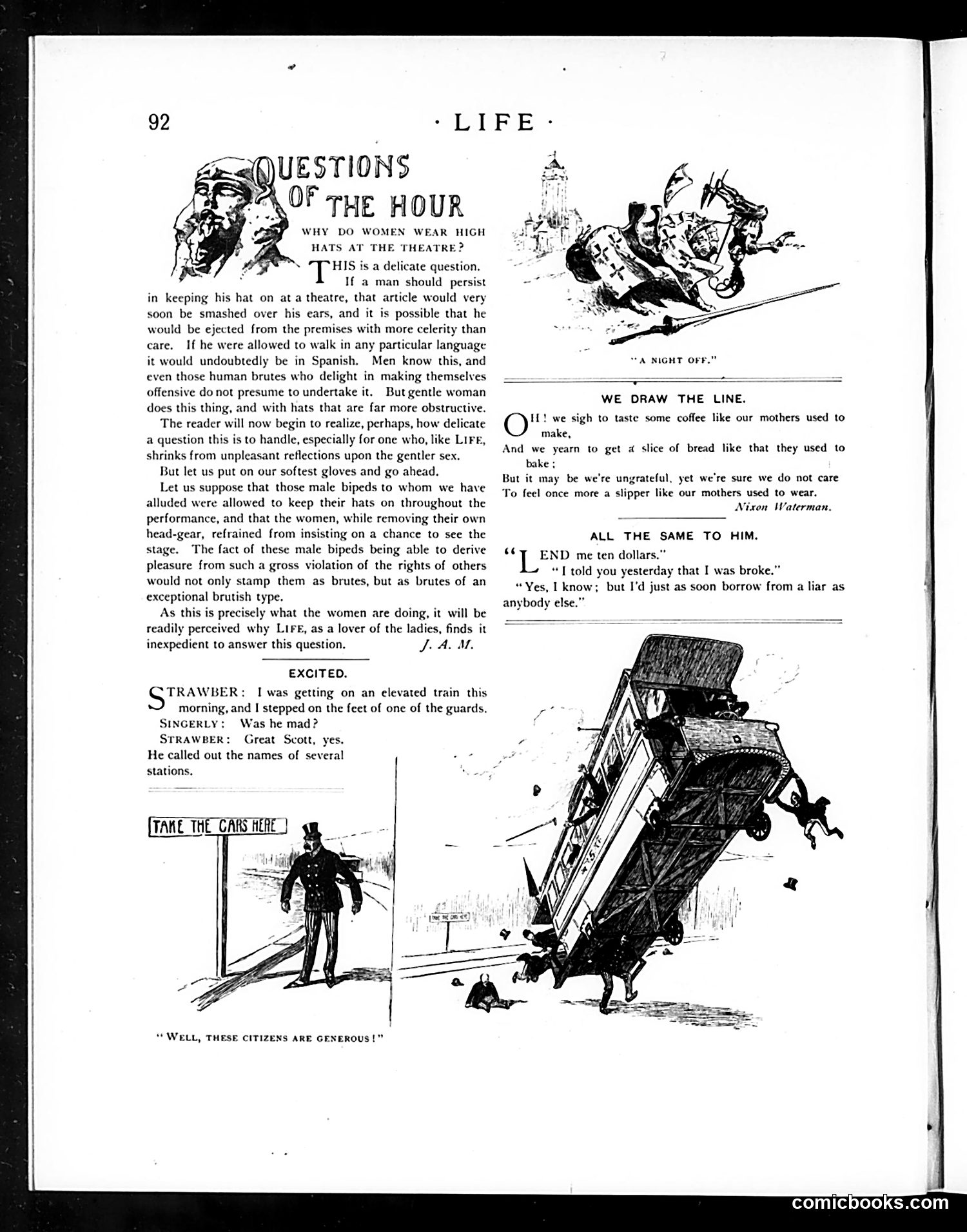
This page contains several distinct satirical pieces: **"Hats at the Theatre"** (main article): Life critiques women who wear large, obstructive hats to theater performances, blocking other patrons' views. The author notes men who kept hats on would be violently ejected, yet women face no such consequences despite wearing even larger hats. The satire exposes a double standard in social enforcement—society tolerates women's inconsiderate behavior while brutally punishing identical conduct from men. **"Excited" (brief dialogue)**: A joke about a train guard so angry at being stepped on that he angrily calls out station names—implying he's so furious he can only express himself through his job duties. **"A Night Off"**: A cartoon showing horses rearing wildly, titled as if they're enjoying leisure time away from work. **"We Draw the Line"** (poem): Nostalgic verse about missing mothers' homemade coffee and bread, but explicitly *not* missing her old slippers—a humorous rejection of certain domestic traditions. **"All the Same to Him"**: A joke about someone so morally flexible they borrow money equally from broke people or liars. The page exemplifies *Life*'s style: social criticism wrapped in humor and illustration.
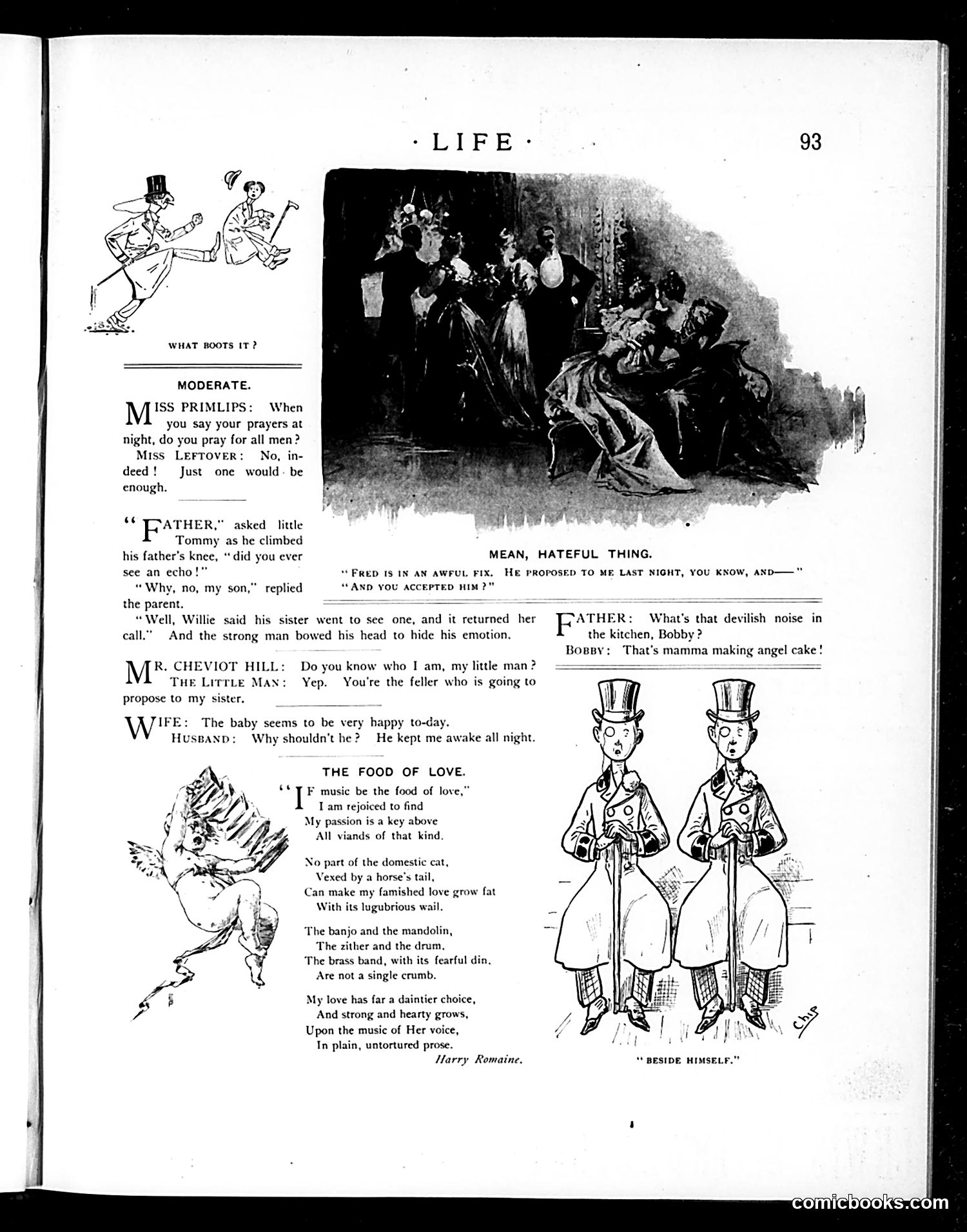
This page collects brief satirical jokes and humorous sketches typical of early 20th-century Life magazine's style. **Key content:** - **"What Boots It?"** - A cartoon mocking courtship rituals; two young women discuss prayer, with one admitting she only prays for one specific man (implying romantic fixation rather than religious devotion). - **Echo joke** - A child misunderstands his father's explanation of echoes, suggesting a girl who "saw" one was actually meeting a suitor. - **"Mean, Hateful Thing"** - A domestic scene where a woman rejects a marriage proposal, shown through overheard conversation. - **"Beside Himself"** - Two identical cartoon figures illustrating the phrase's literal meaning. - **"The Food of Love"** - A poem by Harry Romaine celebrating a lover's voice over musical instruments, satirizing Romantic-era sentimentality about love and music. The humor relies on courtship anxieties, domestic situations, and wordplay typical of the era's middle-class audience.
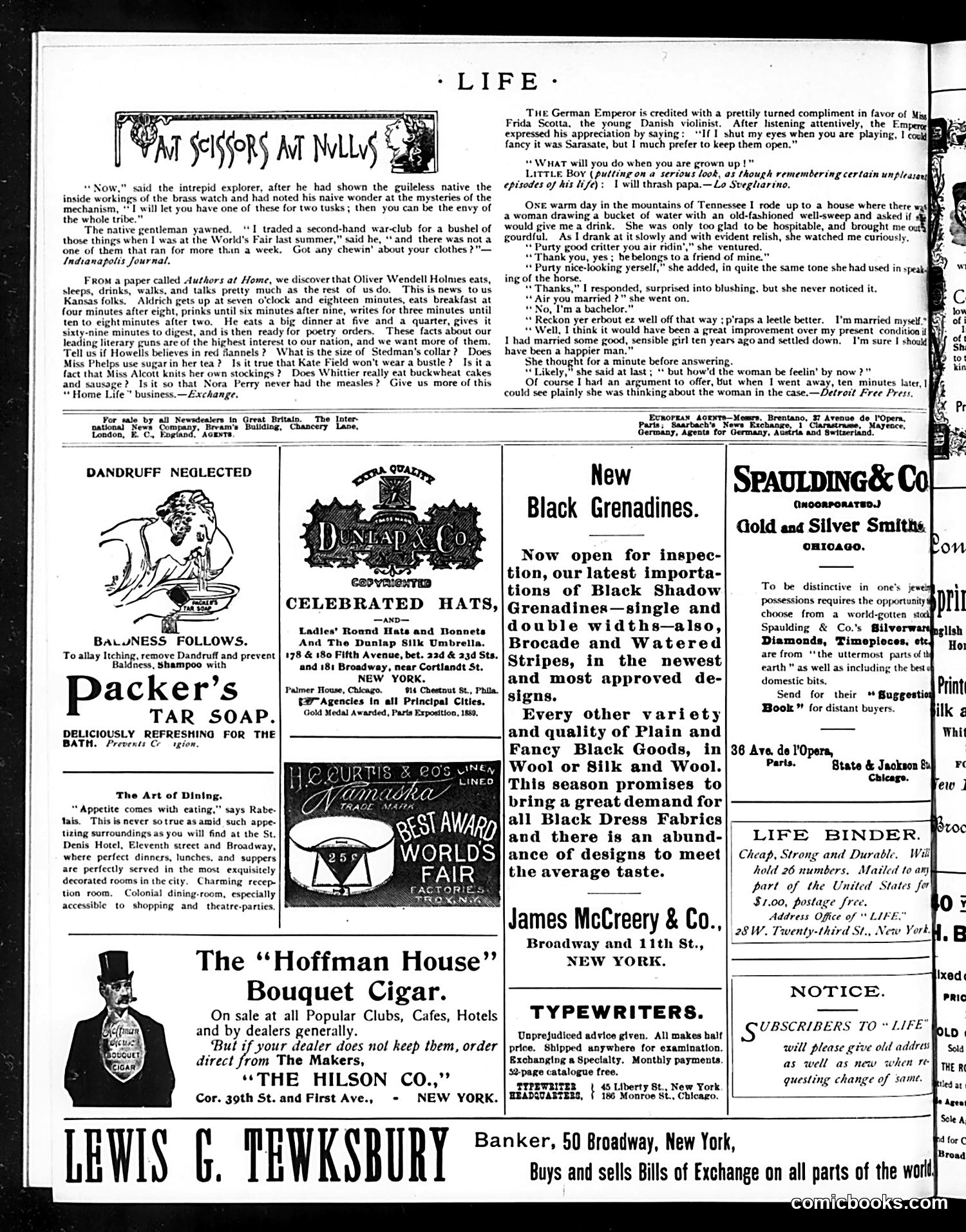
This page contains **satirical stories and anecdotes** rather than political cartoons. The main pieces mock social pretensions and gender dynamics: 1. **"I Am Scissors at Mills"**: An explorer tries impressing a "guileless native" with a brass watch, only to learn the man already obtained such trinkets at the World's Fair. The satire targets colonial-era assumptions about "primitive" peoples and Western superiority. 2. **"What Will You Do When Grown Up?"**: A child threatens to thrash his father—dark humor about parental discipline. 3. **Tennessee Water Scene**: A bachelor encounters a married woman at a well. When he regrets remaining single, she pointedly asks how the woman he'd have married would feel by now—sharp social commentary on male selfishness in marriage. 4. **"Authors at Home"**: Mock-serious cataloging of famous writers' daily routines (Holmes, Aldrich, etc.), satirizing Victorian-era obsession with celebrity minutiae and invasion of privacy. The page is primarily **text-based satire** addressing late-19th-century social attitudes: colonialism, class assumptions, gender relations, and celebrity culture.
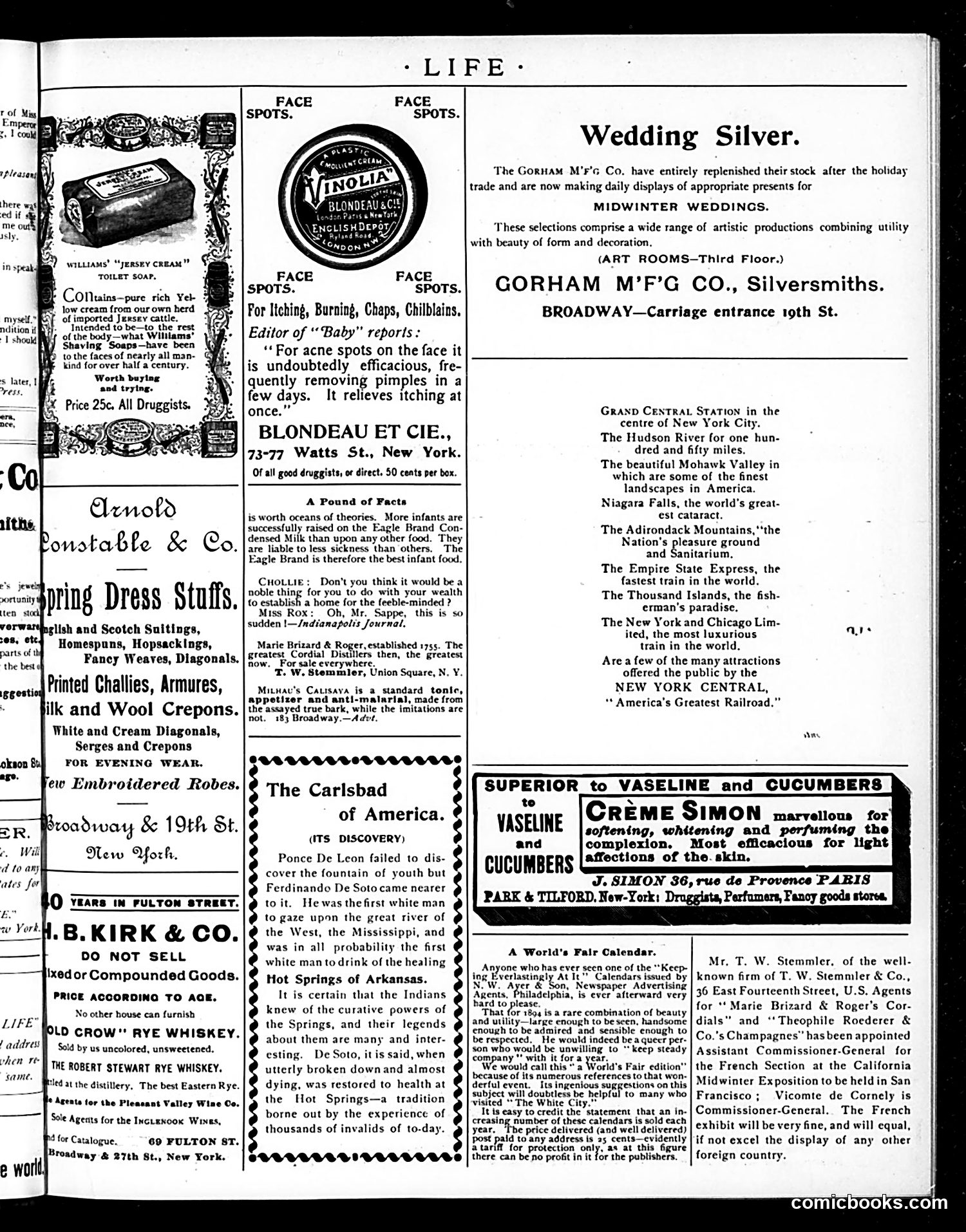
This is primarily a **commercial advertisement page** from *Life* magazine, not a political cartoon. The page consists almost entirely of period product ads and commercial notices. The small humor piece ("Chollie") is a mild romantic joke: a man asks a wealthy woman if she'd establish a home for the mentally disabled. She misinterprets his phrasing as a marriage proposal, responding "this is so sudden!" — the humor being her feigned shock at what she treats as an unexpected engagement. The rest of the page advertises wedding silver, toiletries (acne cream), fabric, whiskey, condensed milk, and medicinal products. One notable ad touts Arkansas's Hot Springs as "the Carlsbad of America," claiming curative powers based on legend about Spanish explorer De Soto being healed there. **For modern readers:** This reflects late 19th/early 20th-century marketing that freely made health claims (now illegal), and shows how *Life* magazine's revenue came from advertising rather than editorial content alone.