
Life, 1894-02-08 · page 6 of 16
Life — February 8, 1894 — page 6: what you’re looking at
What you’re looking at
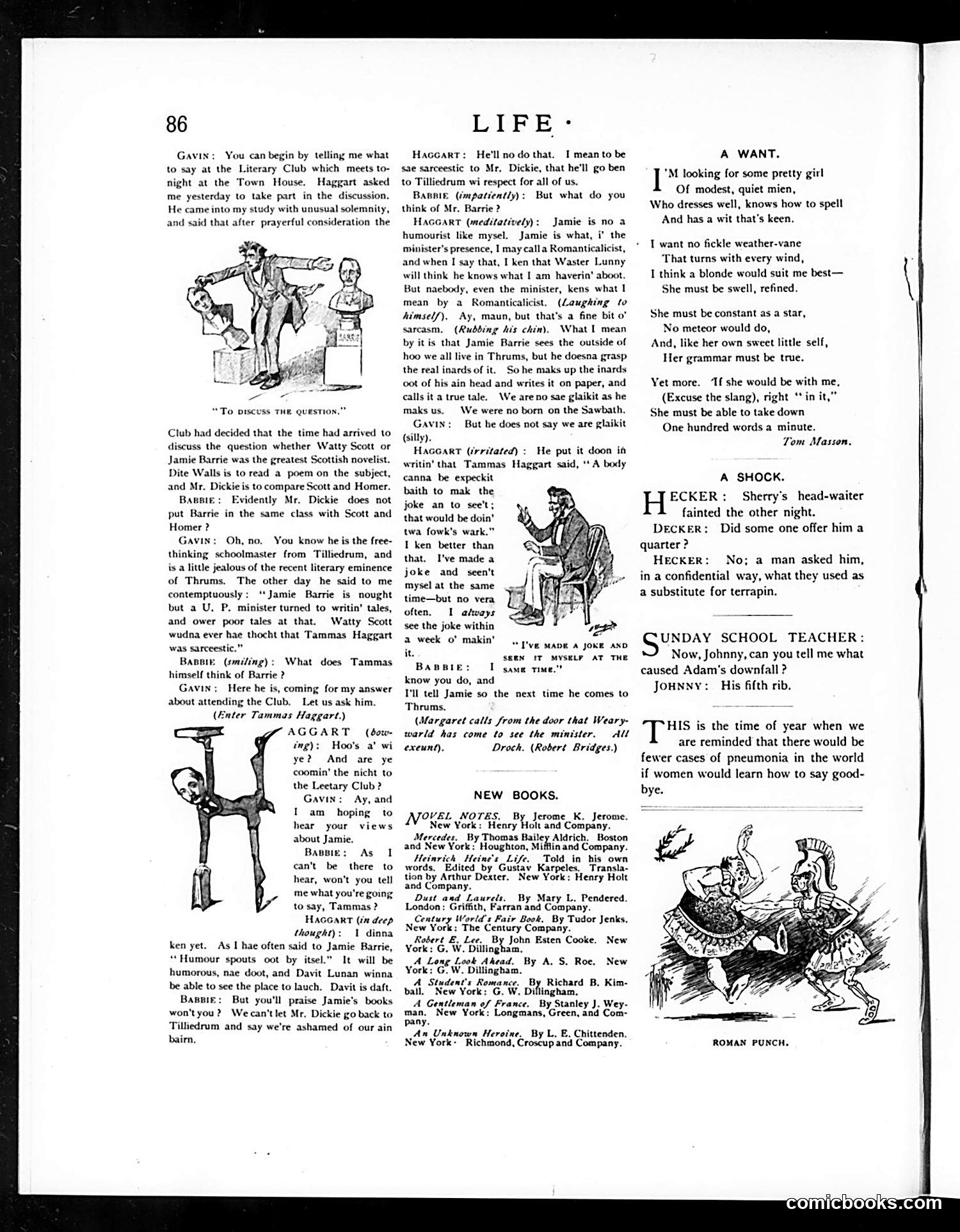
This page features a Literary Club discussion debate about whether Scottish novelist **Watty Scott** or **Jamie Barrie** was the greatest Scottish novelist. The debate references contemporary literary criticism and romanticism. The illustrated cartoons show figures in exaggerated poses—one doing a handstand—accompanying the satirical dialogue about literary merit and artistic intent. The figures appear to represent club members engaged in heated debate. A separate section includes book reviews and advertisements, plus small illustrations including what's labeled "Roman Punch" at bottom. The satire targets pretentious literary criticism and academic debates about authorial merit, mocking how literary enthusiasts overanalyze and assign grand importance to questions of artistic ranking. The physical comedy of the illustrations undercuts the pompous tone of the discussion.
📄 Transcribed text from this page (OCR, searchable)
Machine-transcribed from the original scan — historical spelling and the odd misread are preserved.
86 Gavin: You can begin by telling me what to say at the Literary Club which meets to- night at the Town House. Haggart asked me yesterday to take part in the discussion. He came into my study with unusual solemnity, and said that after prayerful consideration the “To ptscuss THE QUESTION.” Club had decided that the time had arrived to discuss the question whether Watty Scott or Jamie Barrie was the greatest Scottish novelist. Dite Walls is to read a poem on the subject, and Mr. Dickie is to compare Scott and Homer. Basie: Evidently Mr. Dickie does not put Barrie in the same class with Scott and Homer ? Gavin: Oh, no, You know he is the free- thinking schoolmaster from Tilliedrum, and is a little jealous of the recent literary eminence of Thrums. The other day he said to me contemptuously: Jamie Barrie is nought but a U. P, minister turned to writin’ tales, and ower poor tales at that. Watty Scott wudna ever hae thocht that Tammas Haggart was sarceestic.” Basak (smiling) : himself think of Barrie ? Gavin: Here he is, coming for my answer about attending the Club. Let us ask him. (Enter Tammas Haggart.) AGGART ing): Hoo's a’ wi ye? And are ye coomin’ the nicht to the Leetary Club ? Gavin: Ay, and 1 am hoping to hear your about Jami Bavoie: As I can't be there to hear, won't you tell me what you're going to say, Tammas ? HaAGGart (in deep thought): 1 dinna ken yet. As I hae often said to Jamie Barrie, “Humour spouts oot by itsel.” It will be humorous, nae doot, and Davit Lunan winna be able to see the place to lauch. Davit is daft. Banpir: But you'll praise Jamie's books won'tyou? Wecan'tlet Mr. Dickie go back to Tilliedrum and say we're ashamed of our ain bairn, What does Tammas (dow- views LIFE: Haccart: He'll nodo that. I mean to be sae sarceestic to Mr. Dickie, that he'll go ben to Tilliedrum wi respect for all of us. Bapnig (‘mpatiently): But what do you think of Mr. Barrie? HAGGART (meditatively): Jamie is no a humourist like mysel. Jamie is what, i’ the minister's presence, I may calla Romanticalicist, and when I say that, I ken that Waster Lunny will think he knows what | am haverin' aboot. But naebody, even the minister, kens what I mean by a Romanticalicist. (Laughing to himself). Ay, maun, but that's a fine bit o° sarcasm. (Rubbing his chin). What I mean by it is that Jamie Barrie sees the outside of hoo we all live in Thrums, but he doesna grasp the real inards of it. So he maks up the inards cot of his ain head and writes it on paper, and calls it a true tale. We areno sae glaikit as he maks us. We were no born on the Sawbath. Gavin: But he does not say we are glaikit (silly). HaGGart (irritated) : He put it doon if writin’ that Tammas Haggart said, ‘A body canna be expeckit baith to mak the joke an to see't; that would be doin’ twa fowk's wark.” I ken better than that, I've made a joke and seen't mysel at the same time—but no vera often, 1 atways see the joke within a week o° makin’ it. BABBIE: I know you do, and T'll tell Jamie so the next time he comes to Thrums. (Margaret calls from the door that Weary- warld has come to see the minister. All exeunt), Droch. (Robert Bridges.) “I've MADE A JOKE AXD SEEN IT MYSELY AT THE sani tiate, NEW BOOKS. NOKEL NOTES. By, Jerome K. Jerome. New York: Henry Holt and Company. Mercedes. By Thomas Bailey Aldrich, Boston and New York: Houghton, Mifflin and Company. Heinrich Heine's Life, Told in his own words, Edited by Gustav Karpeles. Transla- tion by Arthur Dexter. New York: Henry Holt and Company. Dust and Laurels, By Mary L, Pendered. London: Griffith, Farran and Company. Century World's Fair Book, By Tudor Jenks, New York: The Century Company. Robert E. Lee. By John Esten Cooke. York: G. W. Dillingham. A Long Look Ahead. York: G, W. Dillingham. A Student's Romance, By Richard B, ball. New York: G. W. Dillingham, A Gentleman of France. By Stanley J. Wey- man. New York: Longmans, Green, and Com- pany. An Unknown Heroine. By L. E. Chittenden. New York Richmond, Croscup and Company. New By A, S, Roe, New Kim- A WANT. I™ looking for some pretty girl Of modest, quiet mien, Who dresses well, knows how to spell And has a wit that’s keen, T want no fickle weather-vane ‘That turns with every wind, I think a blonde would suit me best— She must be swell, refined. She must be constant as a star, No meteor would do, And, like her own sweet little self, Her grammar must be true. Yet more. ‘If she would be with me, (Excuse the slang), right ** in it,” She must be able to take down One hundred words a minute. Tom Masson. A SHOCK. ECKER: Sherry’s head-waiter fainted the other night. DECKER: Did some one offer him a quarter ? HECKER: No; a man asked him, in a confidential way, what they used as a substitute for terrapin. UNDAY SCHOOL TEACHER: Now, Johnny, can you tell me what caused Adam's downfall ? JOHNNY: His fifth rib. HIS is the time of year when we are reminded that there would be fewer cases of pneumonia in the world if women would learn how to say good- ROMAN PUNCH,