
Life, 1894-02-08 · page 4 of 16
Life — February 8, 1894 — page 4: what you’re looking at
What you’re looking at
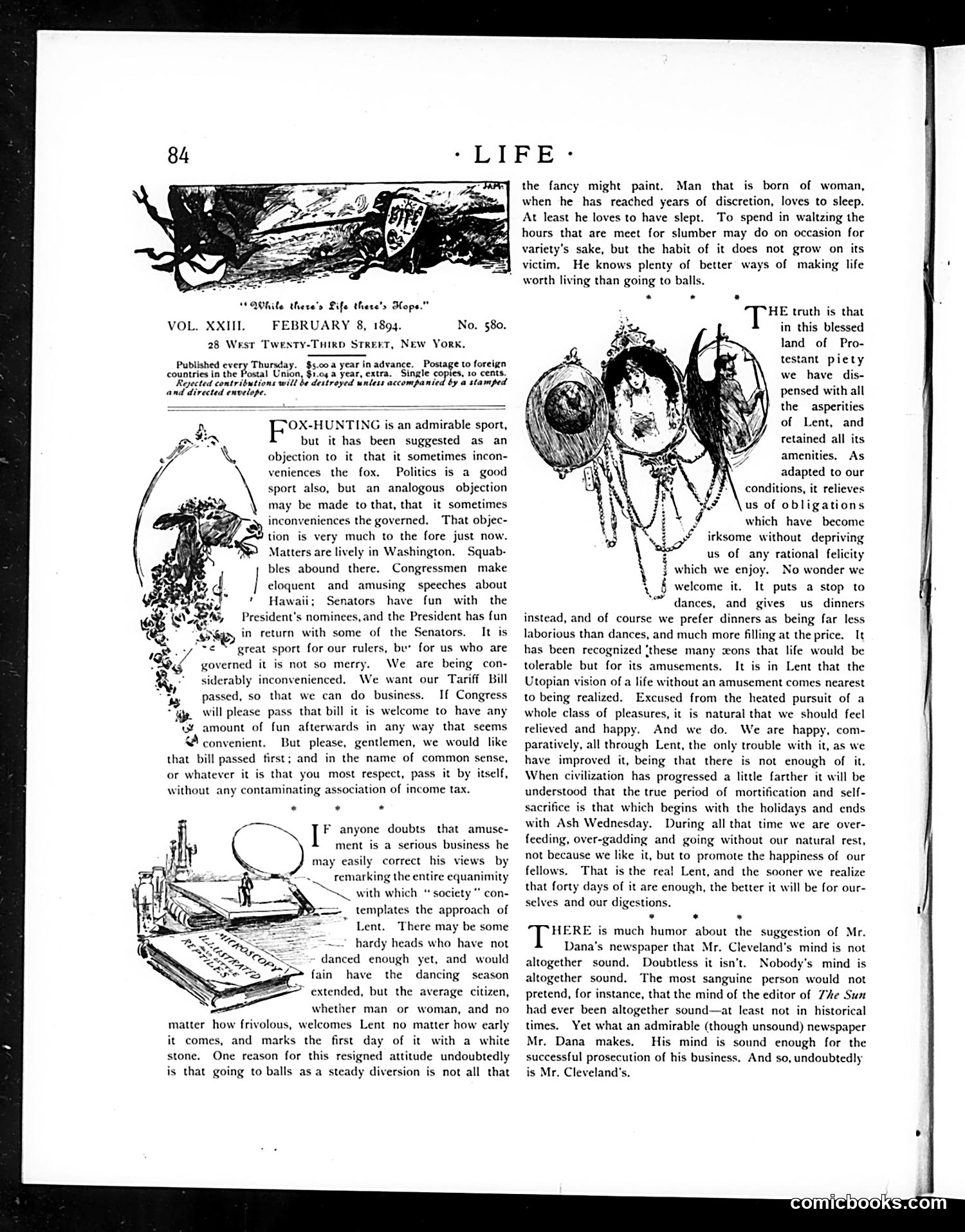
This page contains two editorial pieces about leisure and amusement during Lent. The text discusses fox-hunting as sport and debates whether amusements should be permitted during the Lenten season—a period of religious self-denial in Christian tradition. The illustrations include decorative vignettes: one appears to show a hunted fox or animal in period engraving style, and another depicts what looks like a skating or recreational scene. The satire targets the hypocrisy of wealthy Americans who claim religious piety during Lent while seeking loopholes to enjoy entertainments like balls and dancing. The author argues that moderate amusements (dinners, fox-hunting) are preferable to complete deprivation, mocking the tension between Protestant morality and desire for pleasure among the elite.
📄 Transcribed text from this page (OCR, searchable)
Machine-transcribed from the original scan — historical spelling and the odd misread are preserved.
‘LIFE: “QVhile there's Life there's Hope.” VOL, XXIII. FEBRUARY 8, 1894. No. 580. 28 West Twesty-THirp Street, New York. countries ia ths Bosal Caton, ghaga year entra "Single capt to cn Reyected contributions will be destroyed untess accompanied by a stamped and directed envelope. OX-HUNTING is an admirable sport, but it has been suggested as an objection to it that it sometimes incon- veniences the fox. Politics is a good sport also, but an analogous objection may be made to that, that it sometimes inconveniences the governed. That objec- tion is very much to the fore just now. Matters are lively in Washington. Squab- bles abound there. Congressmen make eloquent and amusing speeches about Hawaii; Senators have fun with the President's nominees, and the President has fun in return with some of the Senators. It is great sport for our rulers, bu’ for us who are governed it is not so merry. We are being con- siderably inconvenienced. We want our Tariff Bill passed, so that we can do busin: If Congress will please pass that bill it is welcome to have any «wf amount of fun afterwards in any way that seems convenient. But please, gentlemen, we would like that bill passed first; and in the name of common sense, or whatever it is that you most respect, pass it by itself, without any contaminating association of income tax. —S\ -, * . I* anyone doubts that amuse- ment is a serious business he may easily correct his views by ms remarking the entire equanimity with which “ society" con- >—— templates the approach of ” Lent. There may be some hardy heads who have not danced enough yet, and would fain the dancing extended, but the average citizen, have season whether man or woman, and no matter how frivolous, welcomes Lent no matter how early it comes, and marks the first day of it with a white stone. One reason for this resigned attitude undoubtedly is that going to balls asa steady diversion is not all that the fancy might paint. Man that is born of woman, when he has reached years of discretion, loves to sleep. At least he loves to have slept. To spend in waltzing the hours that are meet for slumber may do on occasion for variety’s sake, but the habit of it does not grow on its victim. He knows plenty of better ways of making life worth living than going to balls. HE truth is that in this blessed land of Pro- testant piety we have dis- pensed with all the asperities of Lent, and retained all its amenities. As adapted to our conditions, it relieves us of obligations which have become irksome without depriving us of any rational felicity 3 which we enjoy. No wonder we | é welcome it. It puts a stop to “*" dances, and gives us dinners instead, and of course we prefer dinners as being far less laborious than dances, and much more filling at the price. It has been recognized ‘these many zxons that life would be tolerable but for its amusements. It is in Lent that the Utopian vision of a life without an amusement comes nearest to being realized. Excused from the heated pursuit of a whole class of pleasures, it is natural that we should feel relieved and happy. And we do. We are happy, com- paratively, all through Lent, the only trouble with it, as we have improved it, being that there is not enough of it. When civilization has progressed a little farther it will be understood that the true period of mortification and self- acrifice is that which begins with the holidays and ends with Ash Wednesday. During all that time we are over- feeding, over-gadding and going without our natural rest, not because we like it, but to promote the happiness of our fellows. That is the real Lent, and the sooner we realize that forty days of it are enough, the better it will be for our- selves and our digestions. . . . HERE is much humor about the suggestion of Mr. Dana's newspaper that Mr. Cleveland's mind is not altogether sound. Doubtless it isn't. Nobody's mind is altogether sound, The most sanguine person would not pretend, for instance, that the mind of the editor of 7he Sun had ever been altogether sound—at least not in historical times. Yet what an admirable (though unsound) newspaper Mr. Dana makes. His mind is sound enough for the successful prosecution of his business. And so, undoubtedly is Mr. Cleveland's.