
A complete issue · 14 pages · 1894
Life — January 11, 1894
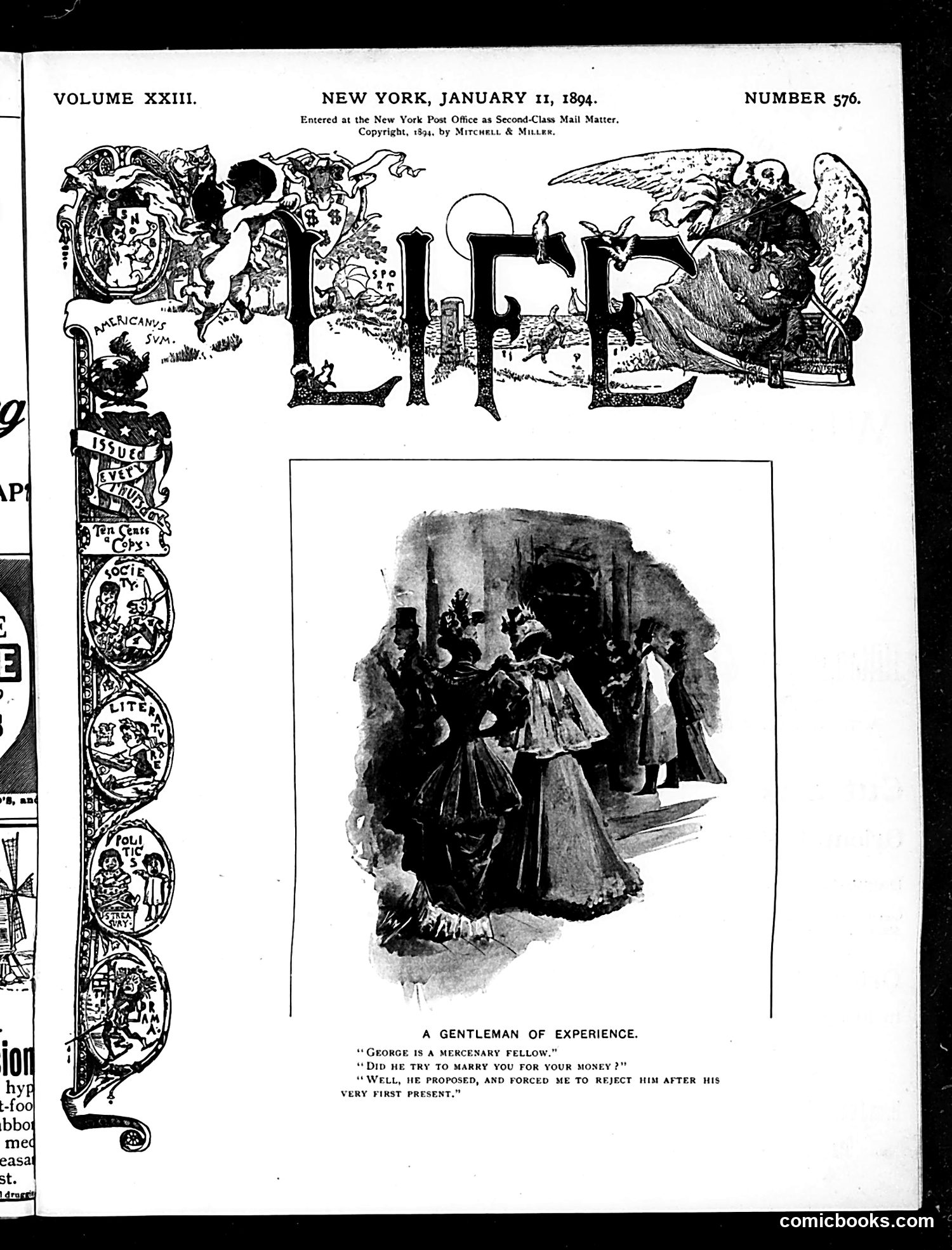
This cartoon satirizes a mercenary romantic scoundrel. The caption reads: "George is a mercenary fellow. Did he try to marry you for your honey?" "Well, he proposed, and forced me to reject him after his very first present." The joke plays on the phrase "for your honey" (meaning money, an old slang term). The female figure rejected George's proposal despite—or perhaps because of—his initial gift-giving, suggesting his courtship was transparently mercenary and awkwardly transactional. The satire mocks men who court women primarily for financial gain, presenting such behavior as obvious and off-putting. The illustration shows a woman in Victorian dress rejecting a suitor in what appears to be a formal social setting, capturing the genteel pretense masking purely selfish romantic motives.
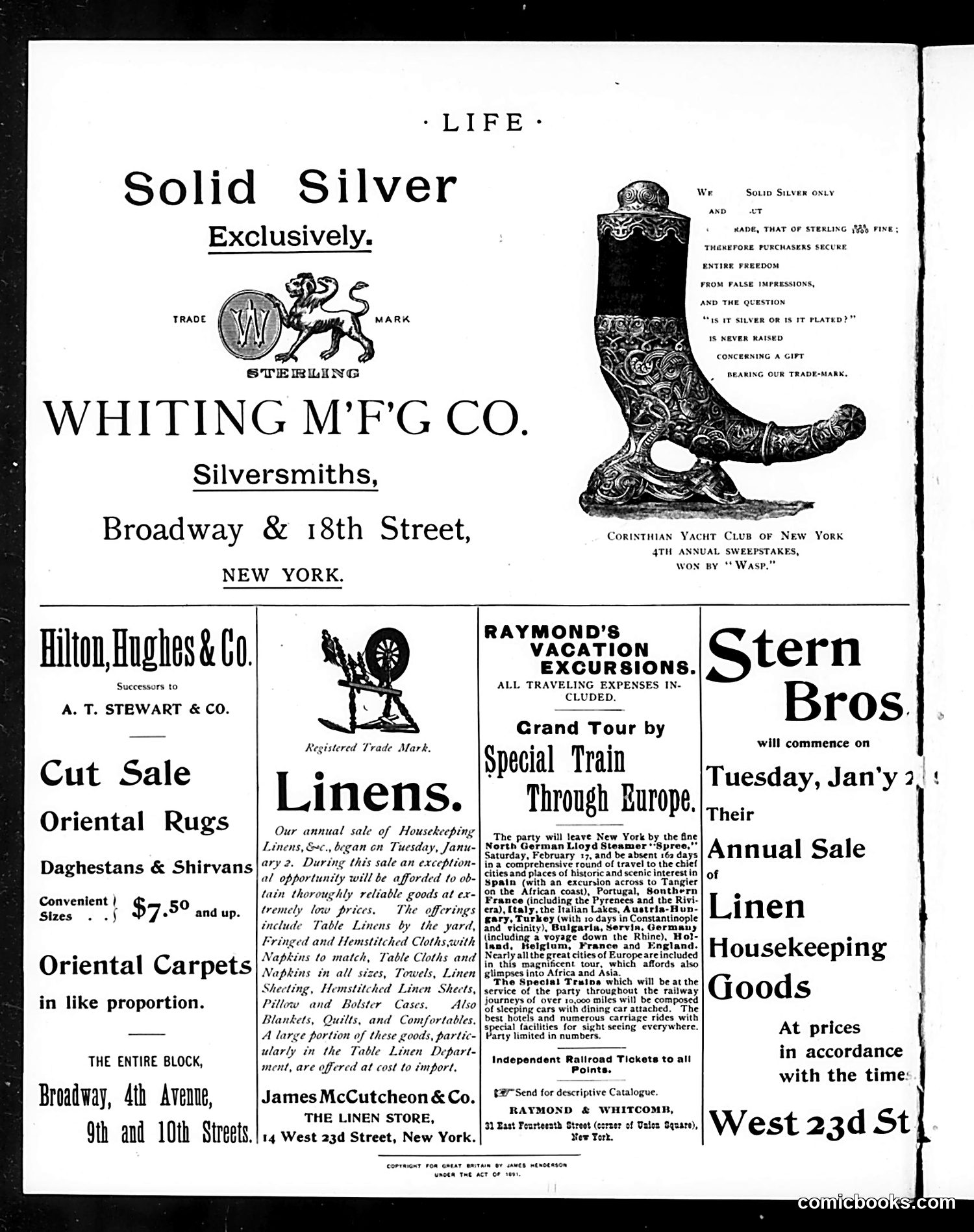
This page is **primarily advertising**, not satirical content. It contains multiple commercial advertisements from late 19th-century New York businesses: Whiting M'fg Co. (sterling silver), Hilton Hughes & Co. (rugs and carpets), James McCutcheon & Co. (linens), Raymond's Vacation Excursions (European tour packages), and Stern Bros. (linen sale). The only illustrative content is a decorative ornamental spoon (top right) labeled as a Corinthian Yacht Club trophy won by a boat named "Wasp," and a linen company's registered trademark (a spinning wheel symbol). There is no political satire or social commentary visible. The page represents typical *Life* magazine advertising revenue, not editorial content.
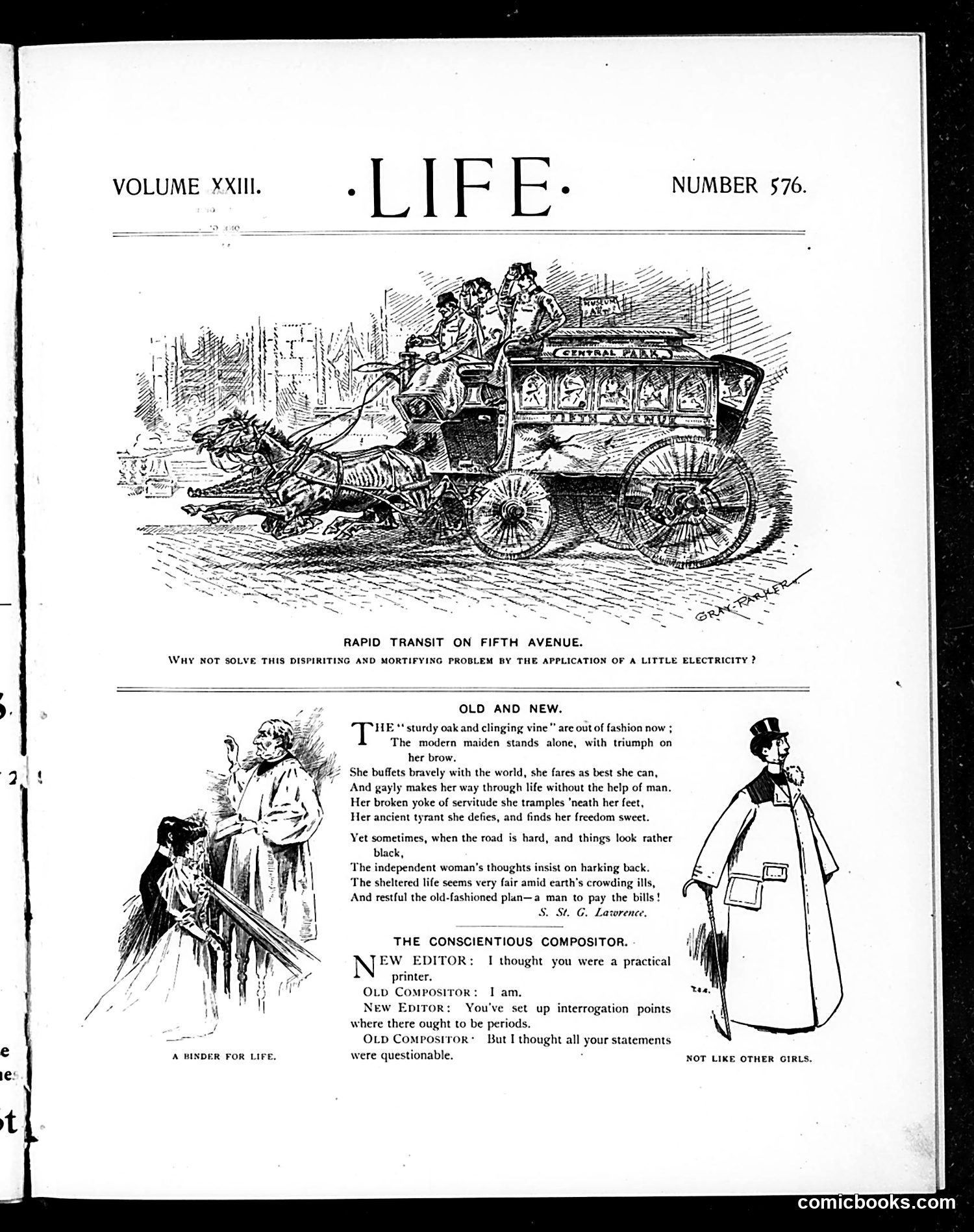
The main cartoon satirizes New York City transit on Fifth Avenue. The illustration shows a horse-drawn carriage labeled "Central Park" with passengers aboard, suggesting the outdated transportation system. The caption questions why the city doesn't solve traffic problems "by the application of a little electricity"—a reference to the emerging electric streetcar technology of the early 1900s. Below, two separate sketches accompany poems about women's changing social roles. "Old and New" contrasts traditional and modern women, while "Not Like Other Girls" appears to address women's growing independence. "The Conscientious Compositor" is a brief humorous dialogue about editorial punctuation standards. The overall theme reflects turn-of-the-century debates about modernization and women's evolving place in society.
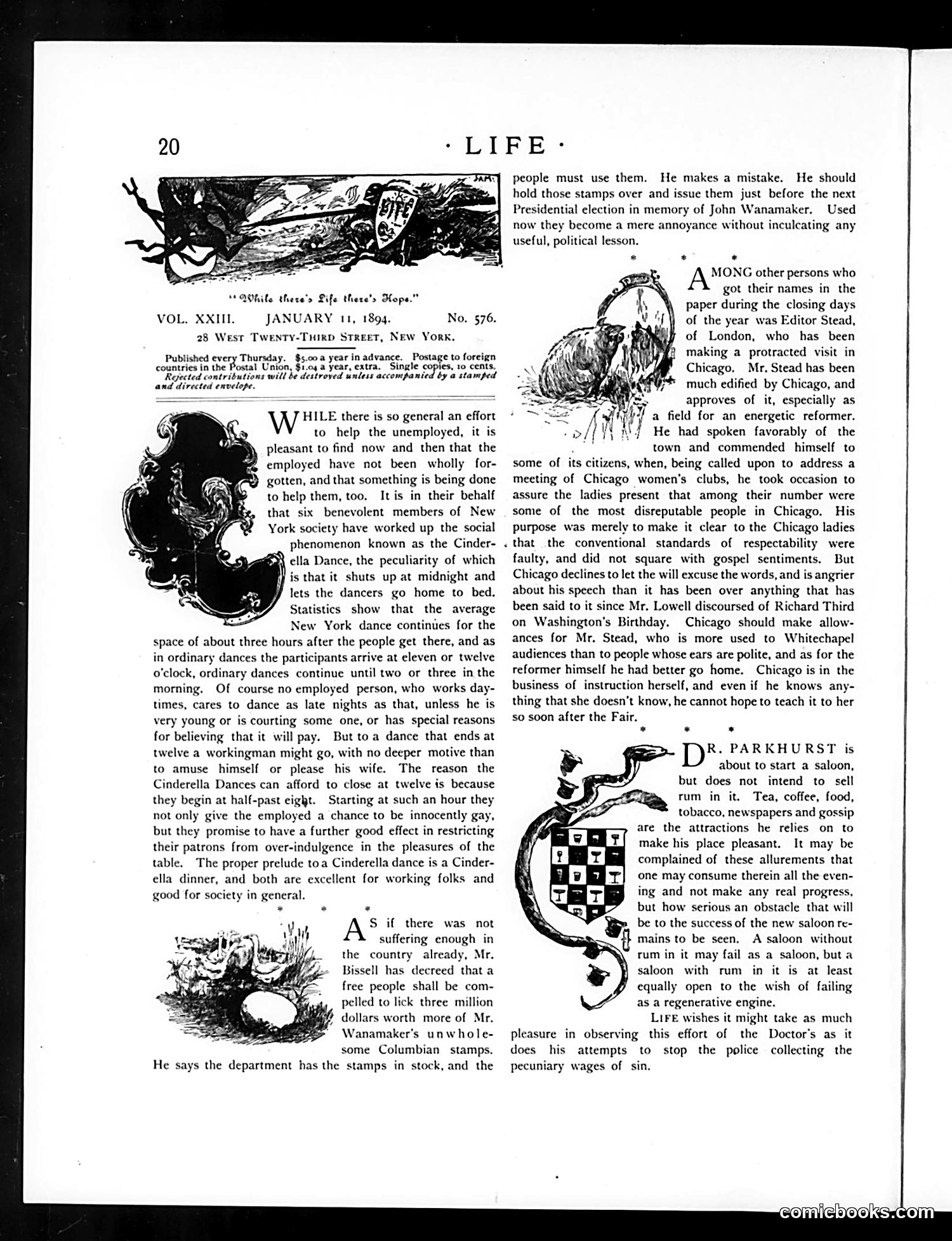
This page contains three separate satirical pieces: **1. The Cinderella Dance:** Life criticizes a New York charitable event where wealthy society members hosted midnight dances for the unemployed. The satire suggests the wealthy are congratulating themselves for minimal charity while the working poor must leave at midnight like Cinderella—the "special reasons" for early closures actually protect the wealthy from genuine social responsibility. **2. Editor Stead's Chicago Visit:** A British editor visiting Chicago claimed the city's moral standards were deficient. Life mocks his sanctimoniousness, suggesting he lacks standing to lecture Americans and should focus on his own business. **3. Dr. Parkhurst's Saloon:** A doctor plans opening a saloon serving tea and coffee instead of alcohol to combat vice. Life sarcastically questions whether a business without profit motive can truly succeed or reform society.
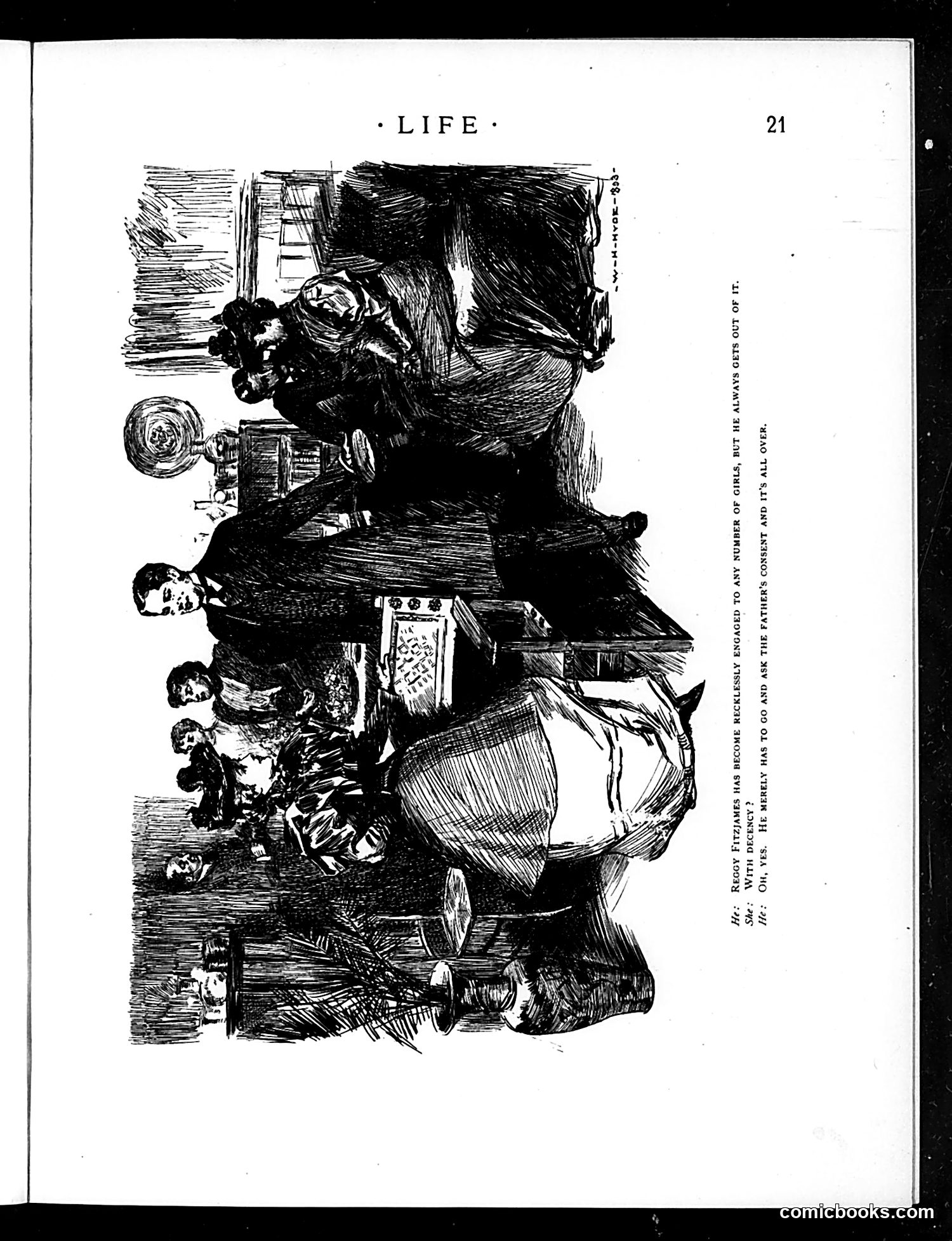
This page from *Life* magazine (page 21) contains a satirical illustration about domestic life, shown rotated 90 degrees. The sketch depicts a household scene with multiple figures and a baby carriage, rendered in bold black ink. The caption references "Rocky Flannery" and mentions someone who "is always giving out it" and concerns about "a former consist and to oner." The text is partially illegible in the OCR, making the specific satirical target unclear. The cartoon appears to mock domestic situations or family life, typical of *Life's* humor content from this era. Without clearer caption text, I cannot definitively identify which specific social trend, family stereotype, or public figure this caricatures. The sketch style suggests commentary on ordinary household affairs rather than high-profile political figures.
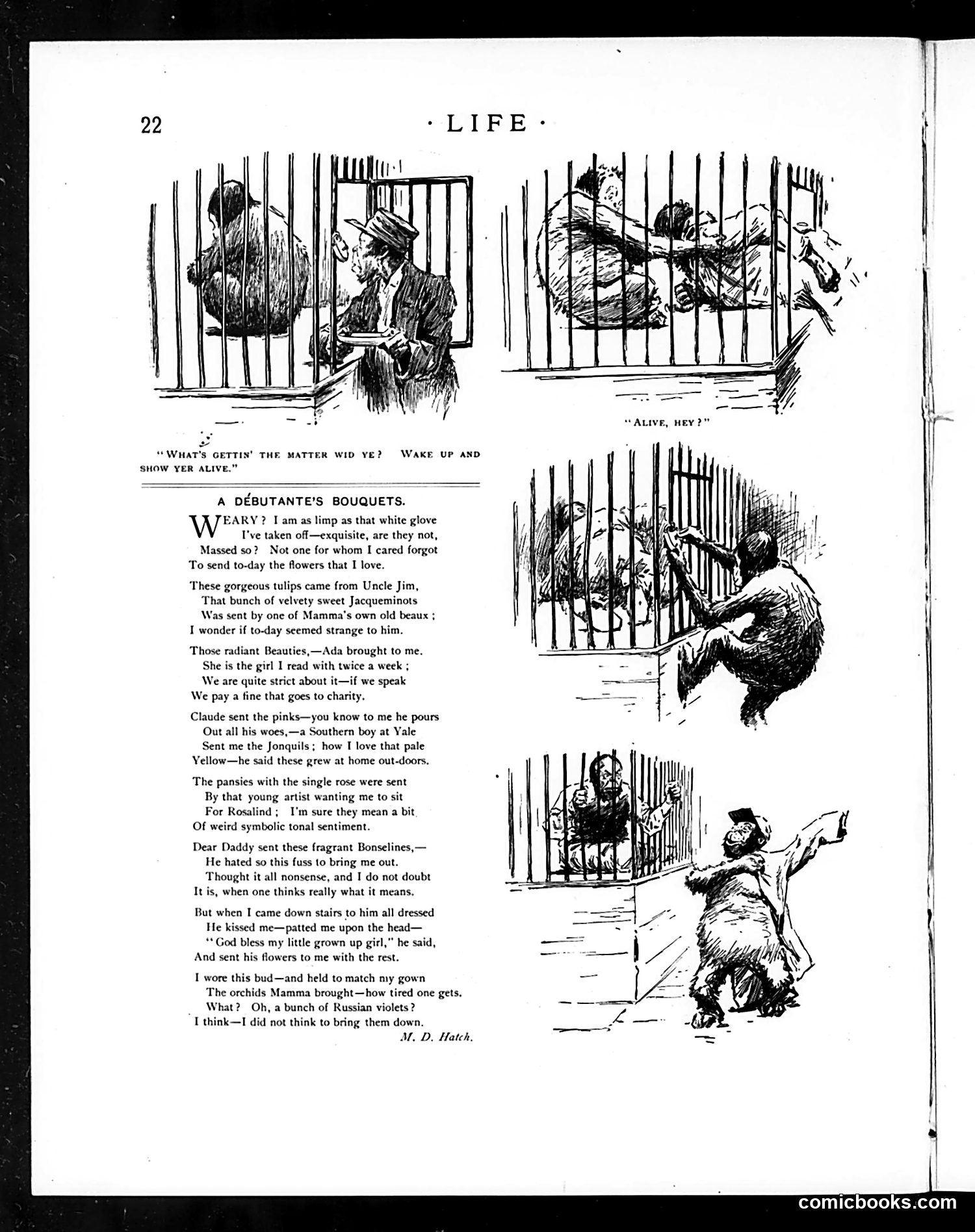
This page contains a humorous poem titled "A Debutante's Bouquets" by M.D. Hatch, accompanied by four cartoon illustrations showing a woman receiving flowers while confined to what appears to be a sickbed or recovery situation. The satire mocks the social conventions of upper-class courtship rituals. The poem catalogs various floral gifts received from suitors—tulips, jacinths, pinks, jonquils, pansies, and roses—each supposedly sent by different admirers with romantic intentions. The humor lies in the debutante's bedridden predicament making her an ironic object of romantic pursuit, and the excessive formality of flower-sending as a courtship custom among the wealthy. The cartoons illustrate the poem's narrative with exaggerated character reactions, emphasizing the absurdity of the social performance.
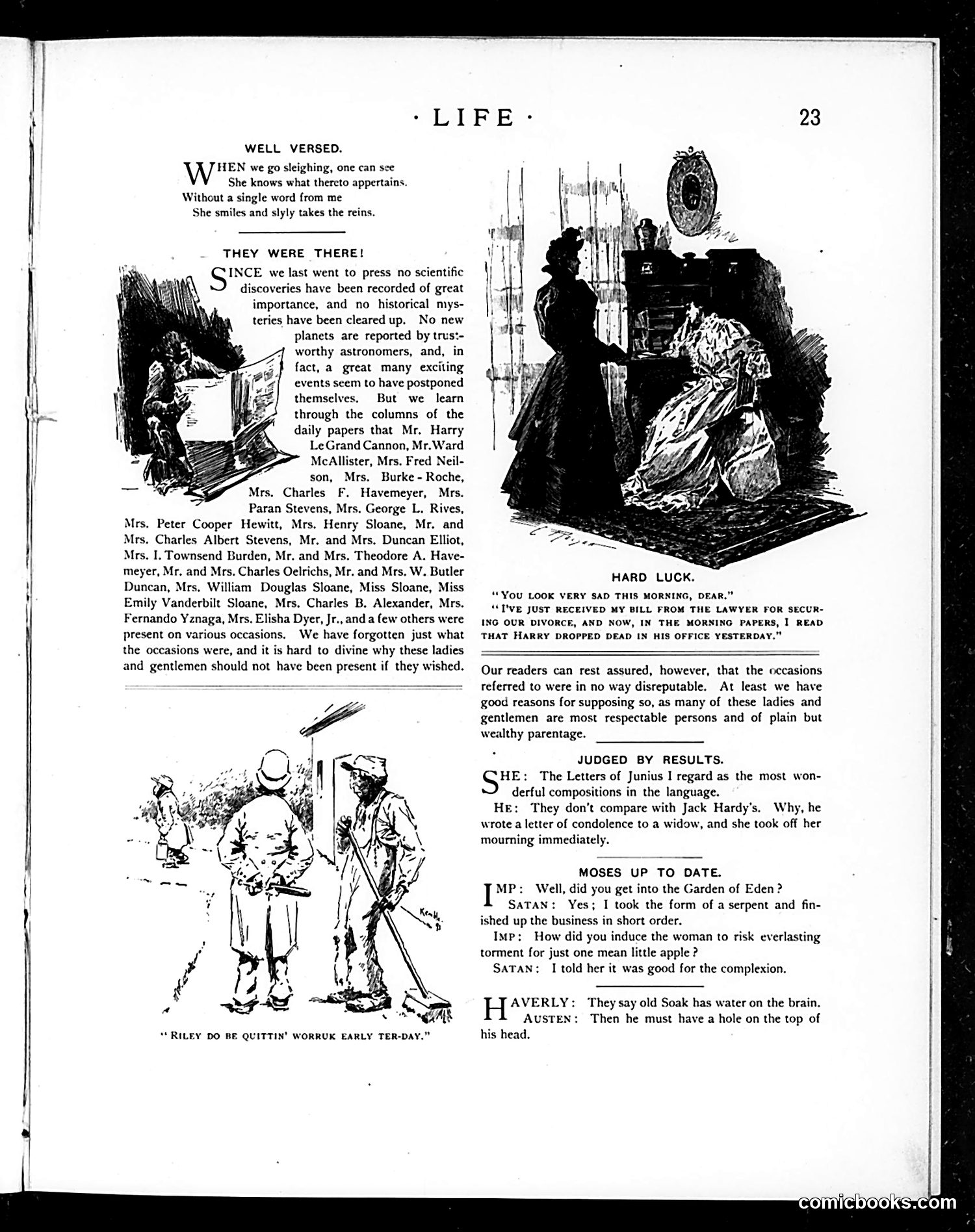
This page contains several unrelated satirical pieces typical of Life's format: **"Well Versed"** and **"They Were There!"** discuss a social gathering, listing numerous attendees (names of what appear to be society figures from the era). The text humorously notes it's difficult to remember who should have been present. **"Hard Luck"** depicts a woman receiving divorce papers, with the caption about her husband being found dead in his office—dark satire on marital misfortune. The remaining sections are short joke exchanges: - **"Judged by Results"** mocks Junius's letter-writing - **"Moses Up to Date"** presents satirical dialogue between Moses and Satan about temptation - **"Laverly/Austen"** is a one-liner about someone having "water on the brain" The bottom illustration shows three working men with the caption **"Riley do be quittin' worruck early ter-day,"** likely satirizing working-class dialect and labor habits.
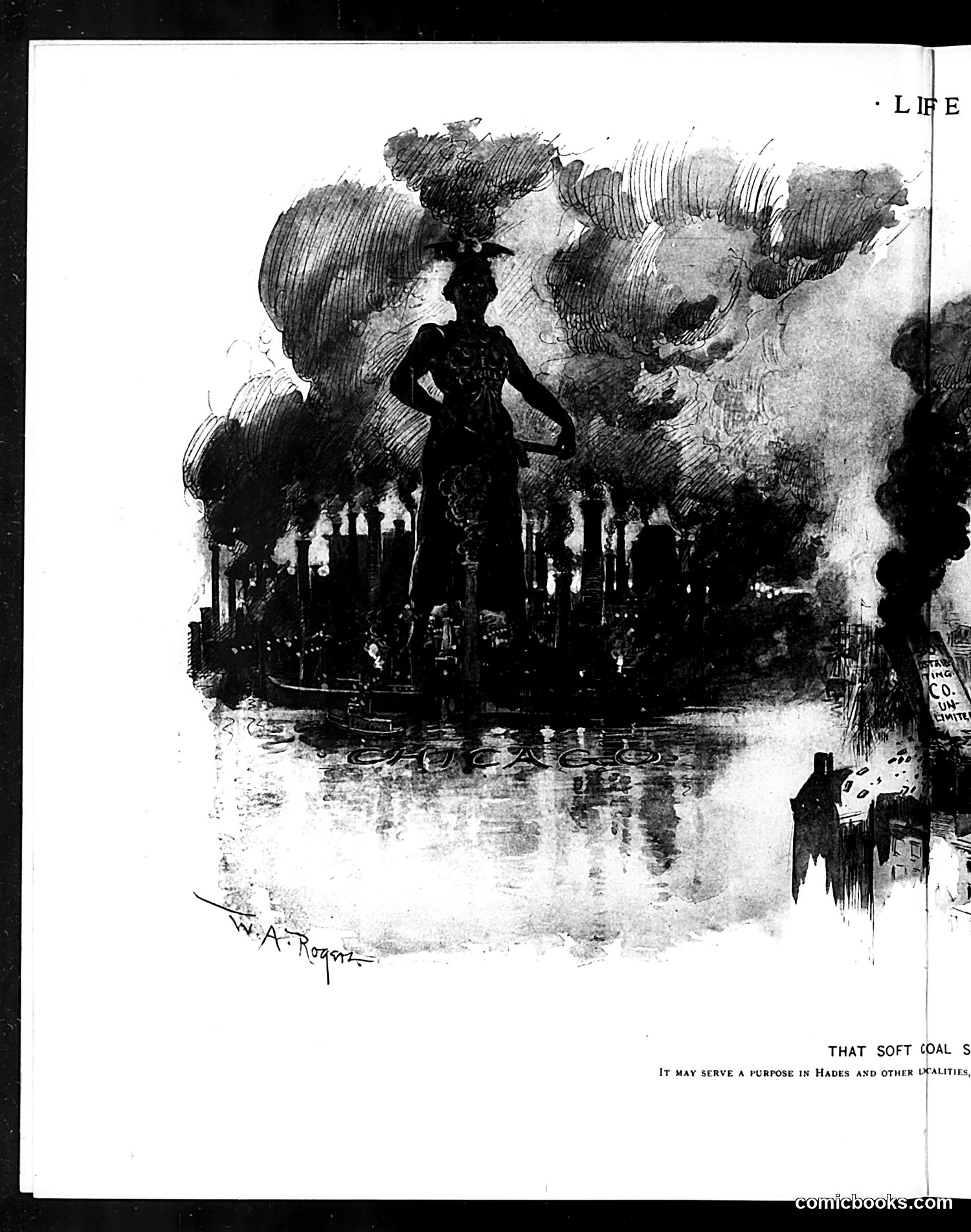
This appears to be a political cartoon signed by W.A. Rogers, depicting a silhouetted female figure standing prominently among what looks like industrial smokestacks or factory buildings shrouded in smoke and steam. The visible text mentions "THAT SOFT COAL S" and references to "Hades and other localities," suggesting commentary on soft coal pollution and its environmental/health impacts. The composition—a woman confronting industrial infrastructure—likely critiques coal industry practices or the government's failure to regulate pollution. The reference to "Hades" sarcastically compares industrial cities to hell due to their polluted conditions. Without the complete caption and date, I cannot identify the specific woman depicted or the exact political moment referenced, but this appears to be early-20th-century criticism of industrial pollution's social costs.
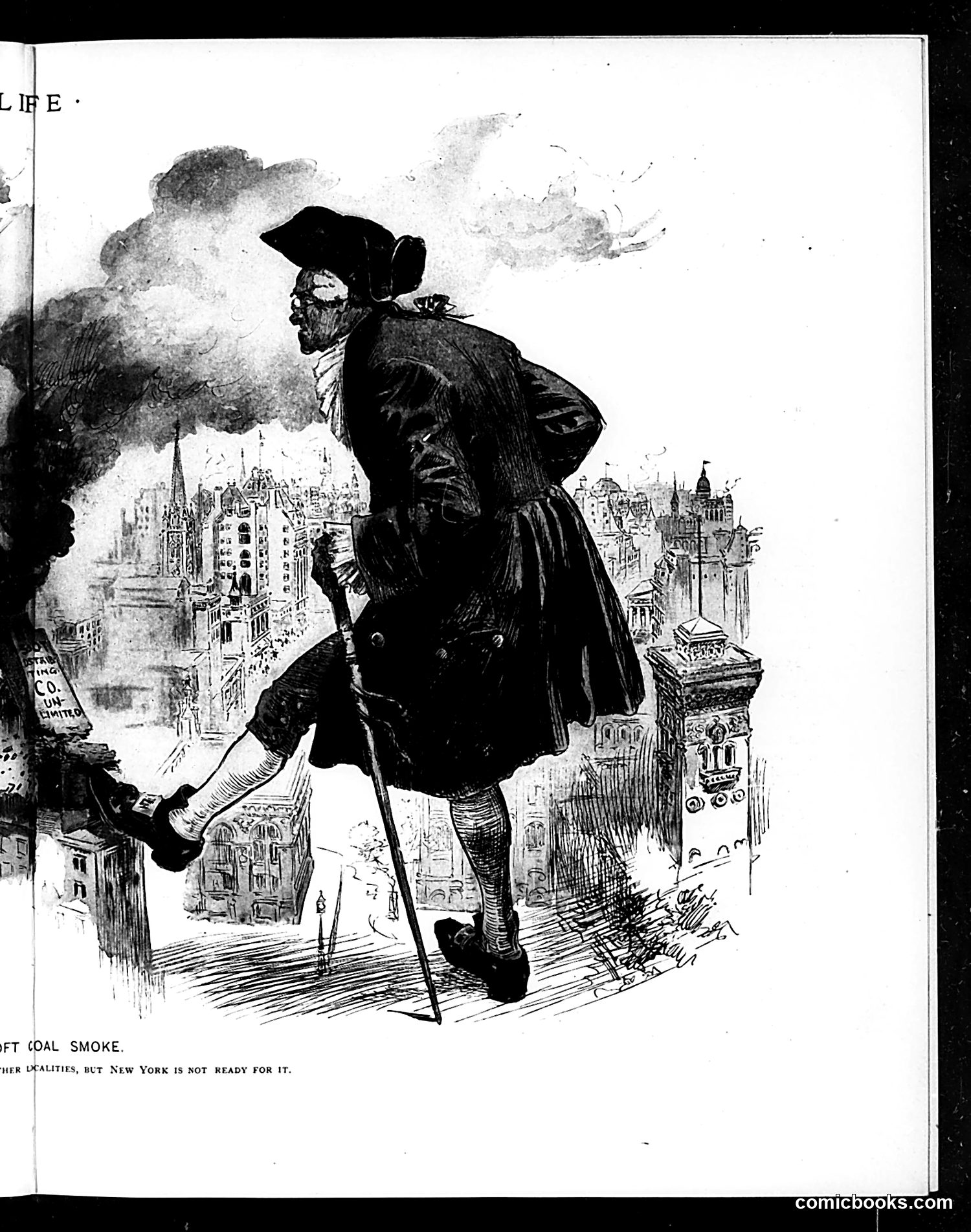
This satirical illustration depicts a figure in 18th-century dress (tricorn hat, period coat, cane) striding confidently over a cityscape. The caption references "coal smoke" and states that while other cities may have it, "New York is not ready for it." The cartoon appears to criticize New York's resistance to industrial progress or urban modernization. The figure—likely representing advocates of development or industry—strides forward despite smoke and fire in the background, suggesting inevitable industrial change. The historical costume may reference founding-era ideals now being challenged by modern industry. The satire suggests New Yorkers believed themselves too refined or unprepared for industrial transformation, while progress marches forward regardless. This reflects late 19th/early 20th-century debates over urbanization and pollution.
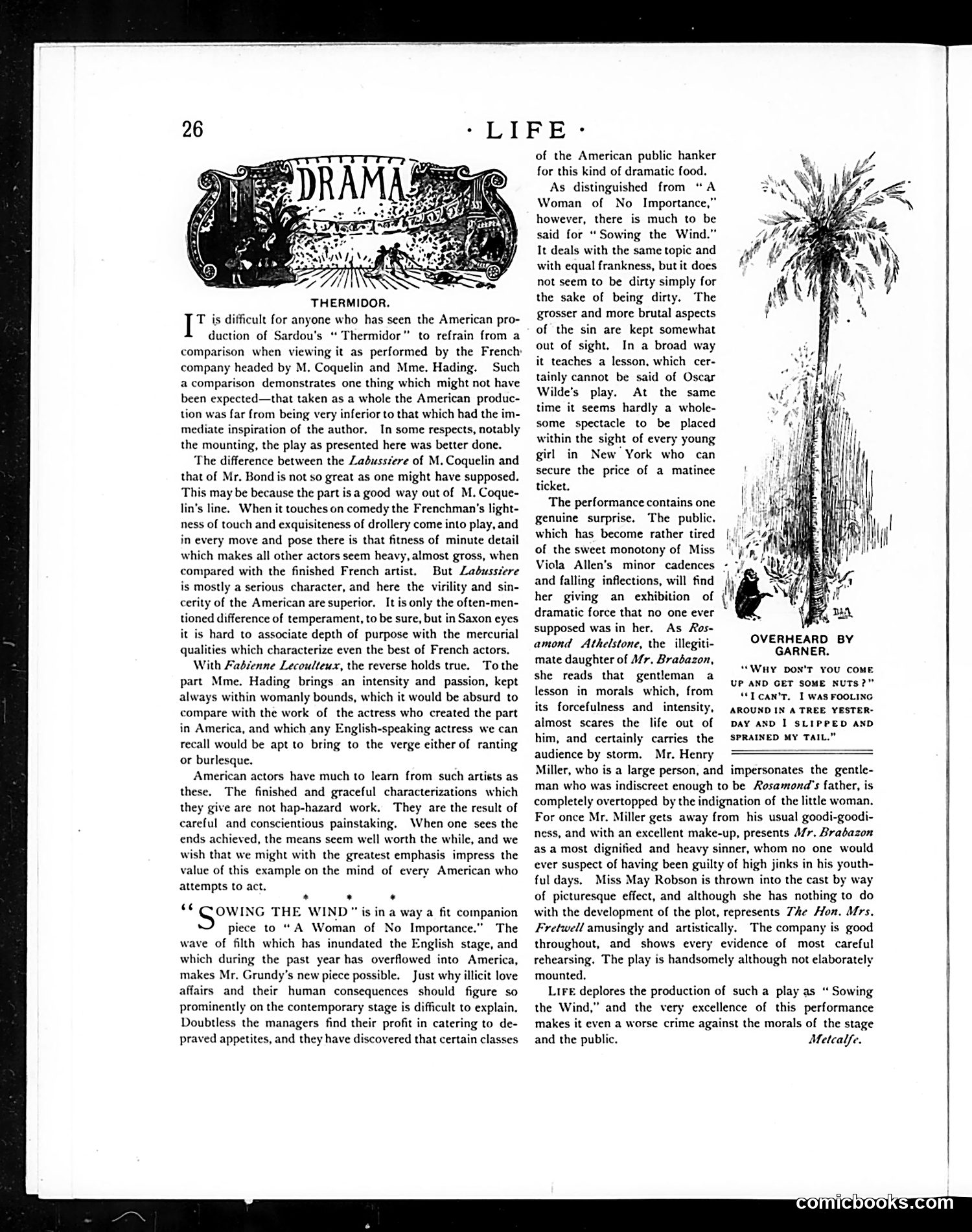
This page reviews theatrical productions, specifically discussing Sardou's "Thermidor" and a play called "Sowing the Wind." The text criticizes "Sowing the Wind" as morally objectionable dramatization of illicit affairs, deploring that such scandalous content attracts American audiences. The small illustration labeled "OVERHEARD BY GARNER" shows a figure at a palm tree saying "WHY DON'T YOU GIVE UP AND GET SOME NUTS?" with a response about "I HAVE BEEN AROUND IN A TREE YESTERDAY AND I SCATTERED MY TAIL." This appears to be a humorous non-sequitur cartoon unrelated to the theater reviews—typical of Life's satirical format mixing serious cultural criticism with absurdist humor.
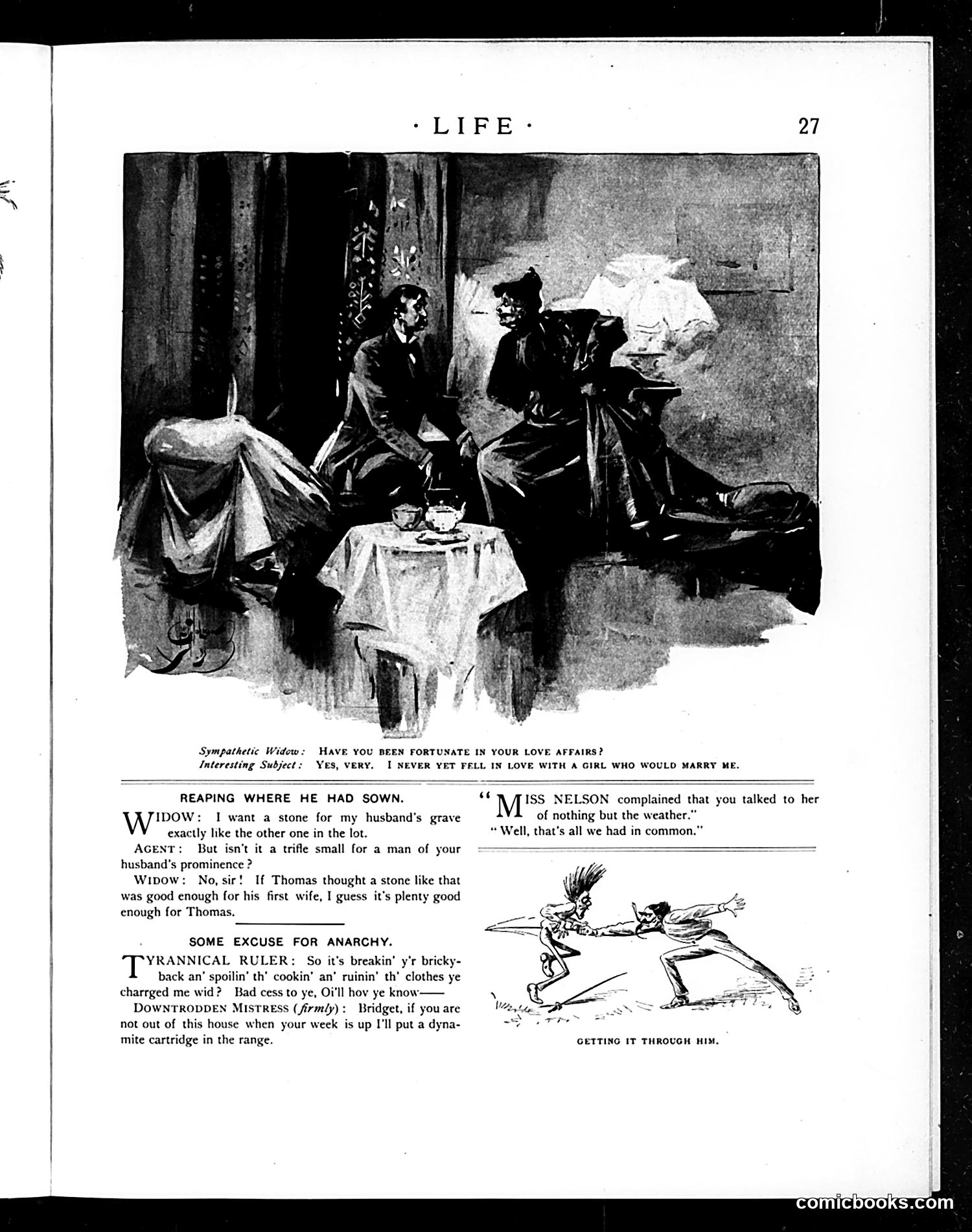
This page contains three separate satirical sketches typical of Life's humor format: 1. **Top illustration**: Shows a "Sympathetic Widow" consulting an agent about a gravestone. The widow wants an identical stone to her first husband's, but the agent objects it's too grand for a man of her husband's "prominence." Her reply—that if Thomas's first wife got one, Thomas deserves one too—satirizes remarriage and social pretension around memorial displays. 2. **"Reaping Where He Had Sown"**: Mocks tyrannical rulers and domestic discord, with a mistress threatening to use "dynamite cartridges" on a misbehaving servant. The title suggests consequences for harsh treatment. 3. **"Getting It Through Him"**: A cartoon showing physical comedy of someone struggling with another person, illustrating the caption's metaphorical meaning about forcing understanding through difficulty. All employ vintage early 20th-century humor conventions.
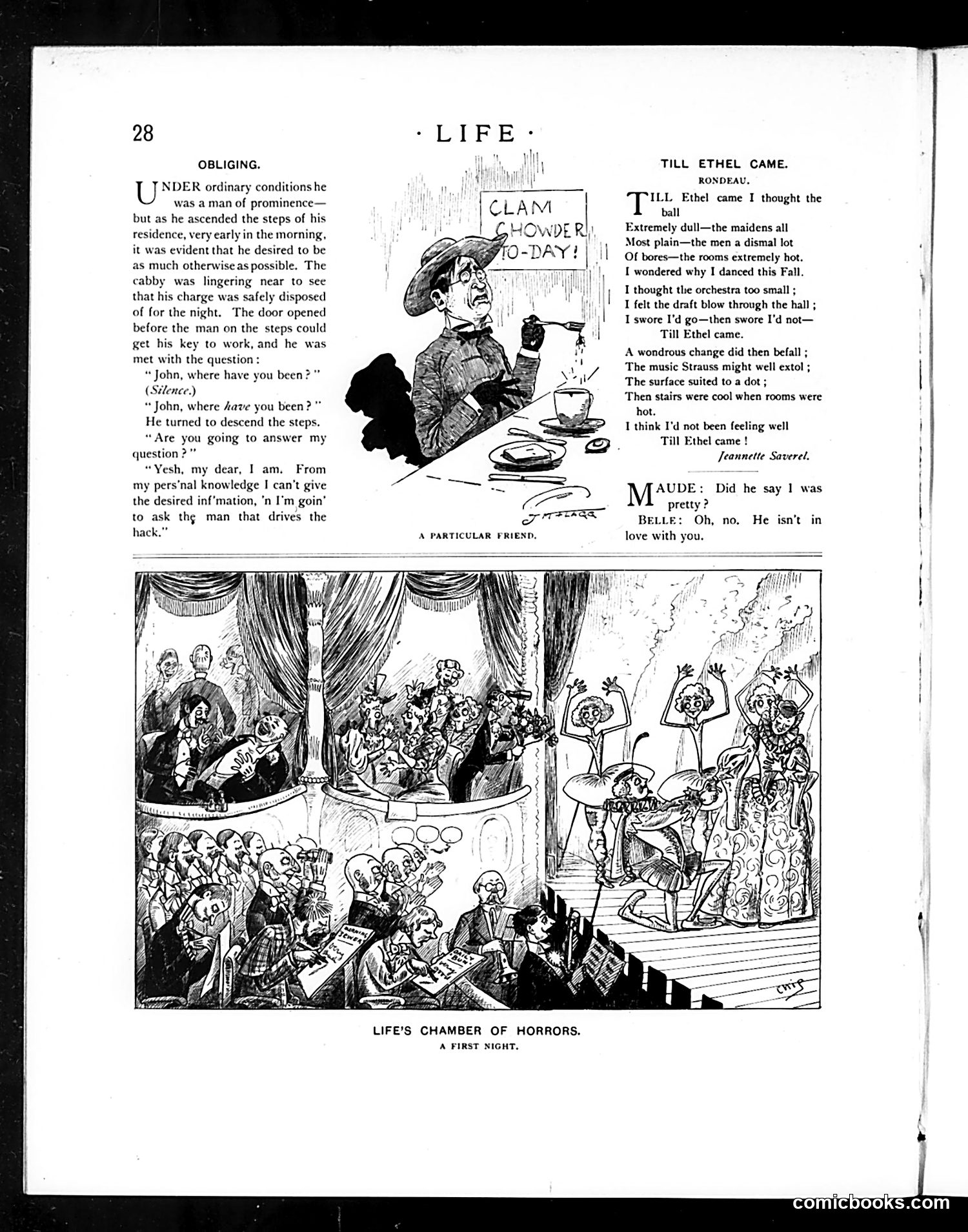
**"Obliging"** (top left): A drunk, well-dressed man arrives home late, stumbling up his front steps. When his wife demands to know where he's been, he deflects by claiming he'll ask the taxi driver—a humorous deflection of marital accountability. The satire targets husbands avoiding difficult conversations with wives, particularly regarding late-night absences. **"Till Ethel Came"** (right): A light poem mocking how a young man's entire perception of a ball changes when an attractive woman (Ethel) arrives. Everything previously tedious becomes wonderful. The satire gently ridicules how infatuation blinds judgment. **"Life's Chamber of Horrors: A First Night"** (bottom): A chaotic theater scene depicting opening night—the audience appears excited and animated while performers on stage appear distressed or overwhelmed. This likely satirizes the chaos and anxiety of theatrical premieres, or audiences' indifference to performers' struggles. These are domestic and social humor pieces typical of early 20th-century Life magazine, targeting courtship, marriage dynamics, and entertainment culture.
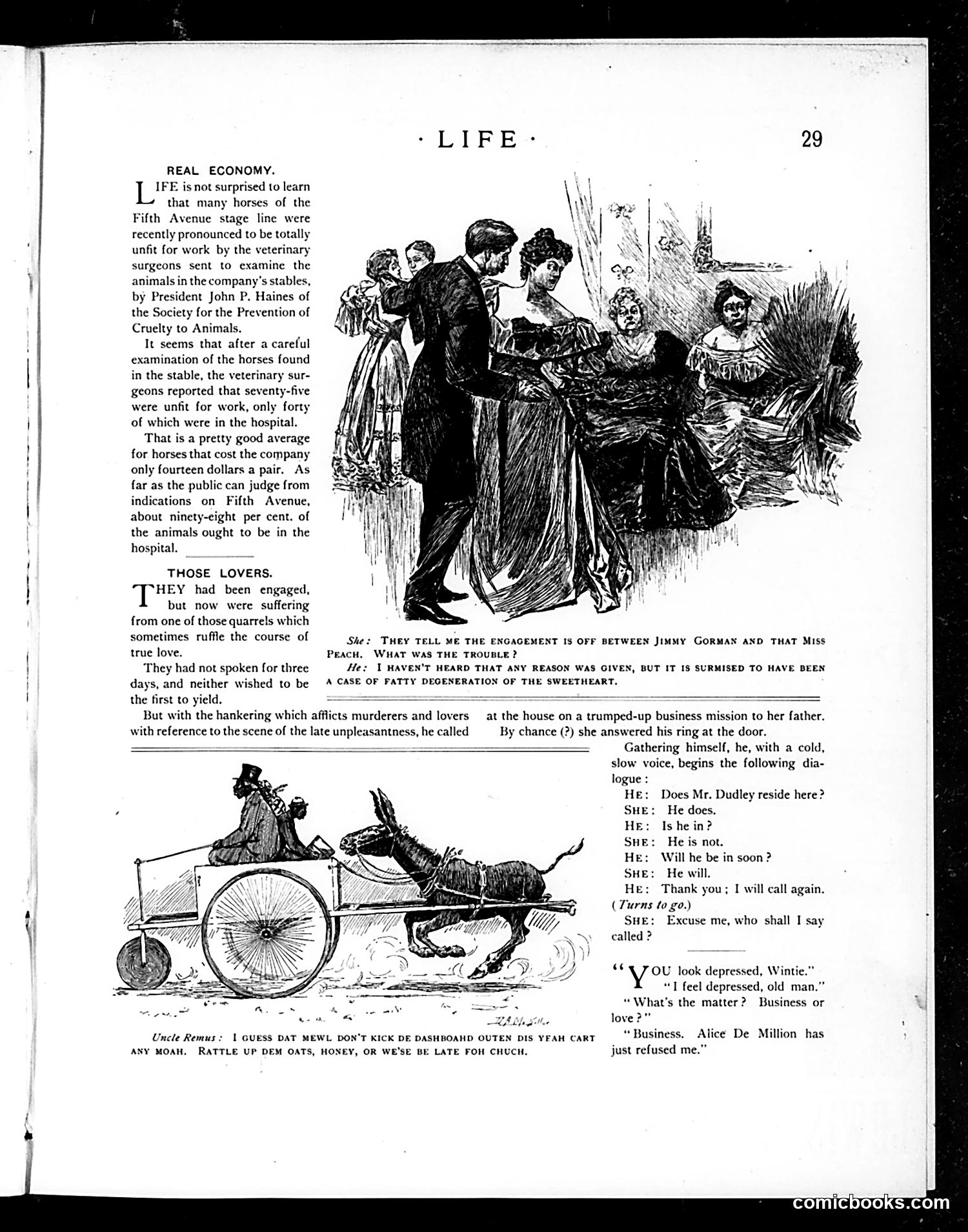
This page contains three satirical pieces typical of early 20th-century American humor: **"Real Economy"** mocks the Fifth Avenue stage line's cost-cutting. The Society for the Prevention of Cruelty to Animals found 75 of their horses unfit for work, yet the company only spent $14 per pair—so cheap many should be hospitalized. The satire criticizes both animal cruelty and corporate penny-pinching at animals' expense. **"Those Lovers"** features a couple in a quarrel. When the man visits the woman's house, he hears gossip that their engagement is off due to "fatty degeneration of the sweetheart"—a medical-sounding insult suggesting she's become unattractive. The humor relies on the couple's pride and their willingness to believe insulting rumors. **The bottom cartoon** (caption unclear in OCR) shows Uncle Remus with a donkey cart, using period dialect humor common to the era, though the exact joke is difficult to parse from the damaged text. All three pieces employ satire about social pretense, animal welfare, and romantic vanity.
This page contains three distinct humorous pieces: **"AM SCISSORS AT NULLUS"**: A classical anecdote about Napoleon demanding provisions from a French convent. When monks refuse in Latin, Napoleon—lacking classical education—has his secretary write a deliberately mangled mock-Latin response threatening to burn their monastery and hang them. The joke mocks both Napoleon's educational pretensions and the pomposity of Latin as a language of authority. **The English/American Coaching Trip**: Two travelers—an American and Englishman—engage in friendly national rivalry. The American finds a sign directing people to a blacksmith for reading help, calling it ridiculous. The Englishman, after sleeping on it, realizes the sign is actually practical for illiterate travelers, gently satirizing American arrogance and assumption of superiority. **"The Justice"**: A brief courtroom joke where a man arrested for "profane language and disorderly conduct" explains he was hit by swinging storm doors while exiting a store with his wife's shopping packages. The judge discharges him, implying the store—not the man—is at fault. All three pieces employ mild satire targeting pretension, cultural smugness, and absurdity.