
Life, 1894-01-11 · page 10 of 14
Life — January 11, 1894 — page 10: what you’re looking at
What you’re looking at
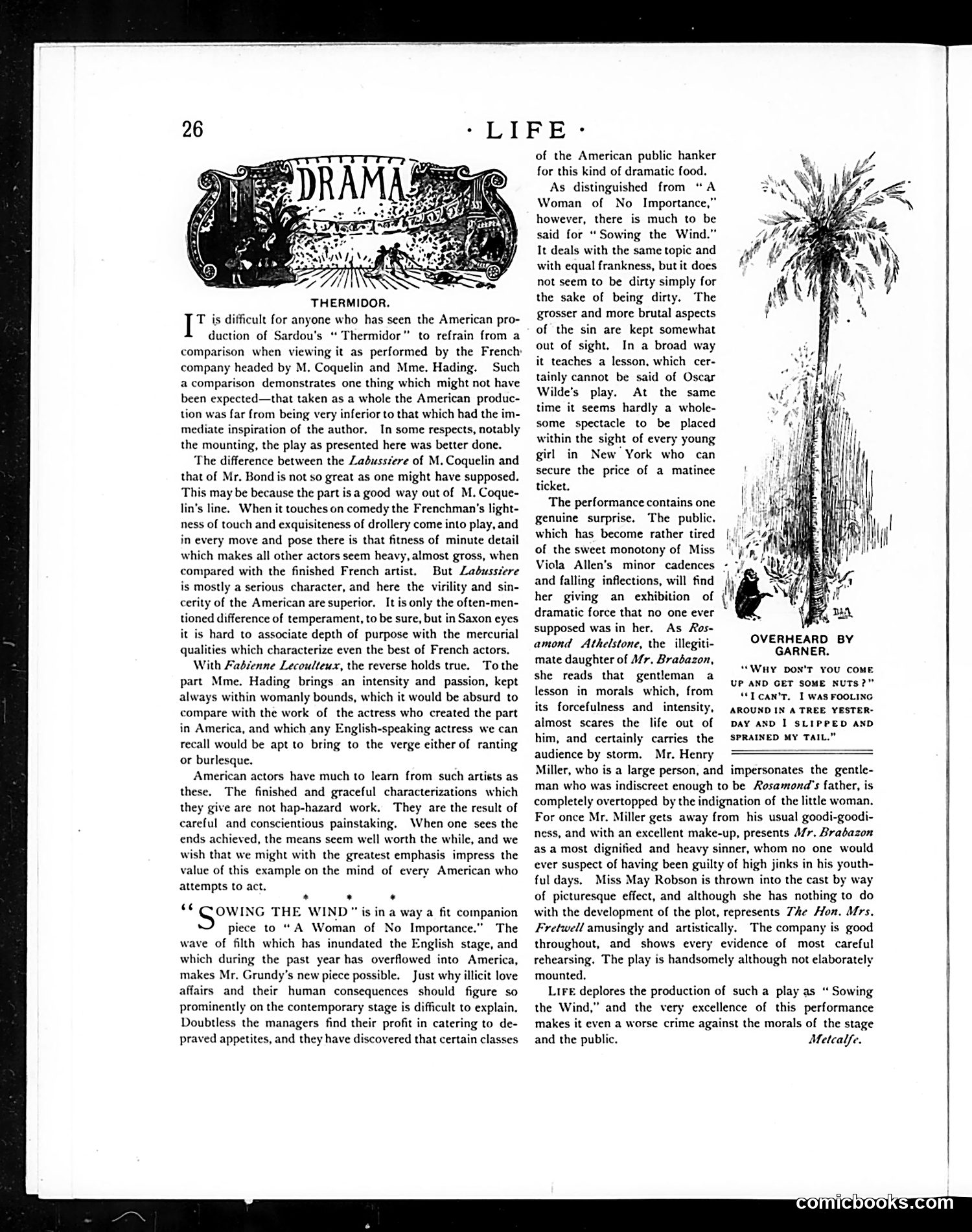
This page reviews theatrical productions, specifically discussing Sardou's "Thermidor" and a play called "Sowing the Wind." The text criticizes "Sowing the Wind" as morally objectionable dramatization of illicit affairs, deploring that such scandalous content attracts American audiences. The small illustration labeled "OVERHEARD BY GARNER" shows a figure at a palm tree saying "WHY DON'T YOU GIVE UP AND GET SOME NUTS?" with a response about "I HAVE BEEN AROUND IN A TREE YESTERDAY AND I SCATTERED MY TAIL." This appears to be a humorous non-sequitur cartoon unrelated to the theater reviews—typical of Life's satirical format mixing serious cultural criticism with absurdist humor.
📄 Transcribed text from this page (OCR, searchable)
Machine-transcribed from the original scan — historical spelling and the odd misread are preserved.
THERMIDOR. T is difficult for anyone who has seen the American pro- duction of Sardou's “ Thermidor” to refrain from a comparison when viewing it as performed by the French company headed by M. Coquelin and Mme. Hading. Such acomparison demonstrates one thing which might not have been expected—that taken as a whole the American produc- tion was far from being very inferior to that which had the im- mediate inspiration of the author. In some respects, notably the mounting, the play as presented here was better done. The difference between the Ladusséere of M. Coquelin and that of Mr. Bond is not so great as one might have supposed. This may be because the part isa good way out of M. Coque- lin’s line. When it touches on comedy the Frenchman's light- ness of touch and exquisiteness of drollery come into play, and in every move and pose there is that fitness of minute detail which makes all other actors seem heavy, almost gross, when compared with the finished French artist. But Labussiere is mostly a serious character, and here the virility and sin- cerity of the American are superior, It is only the often-men- tioned difference of temperament, to be sure, but in Saxon eyes it is hard to associate depth of purpose with the mercurial qualities which characterize even the best of French actors. With Fabsenne Lecoulteux, the reverse holds true. To the part Mme. Hading brings an intensity and passion, kept always within womanly bounds, which it would be absurd to compare with the work of the actress who created the part in America, and which any English-speaking actress we can recall would be apt to bring to the verge either of ranting or burlesque. American actors have much to learn from such artists as these, The finished and graceful characterizations which they give are not hap-hazard work. They are the result of careful and conscientious painstaking. When one sees the ends achieved, the means seem well worth the while, and we wish that we might with the greatest emphasis impress the value of this example on the mind of every American who attempts to act. * * . £€ OWING THE WIND "is in a way a fit companion piece to “A Woman of No Importance." The wave of filth which has inundated the English stage, and which during the past year has overflowed into America, makes Mr. Grundy’s new piece possible, Just why illicit love affairs and their human consequences should figure so prominently on the contemporary stage is difficult to explain, Doubtless the managers find their profit in catering to de- praved appetites, and they have discovered that certain classes - LIFE: of the American public hanker for this kind of dramatic food. As distinguished from “A Woman of No Importance,” however, there is much to be said for “Sowing the Wind.” It deals with the same topic and with equal frankness, but it does not seem to be dirty simply for the sake of being dirty. The grosser and more brutal aspects of the sin are kept somewhat out of sight. In a broad way it teaches a lesson, which cer- tainly cannot be said of Oscar Wilde's play. At the same time it seems hardly a whole- some spectacle to be placed within the sight of every young girl in| New York who can secure the price of a matinee ticket. The performance contains one genuine surprise. The public, which has become rather tired of the sweet monotony of Miss Viola Allen's minor cadences and falling inflections, will find her giving an exhibition of dramatic force that no one ever supposed was in her. As Ros- amond Athelstone, the illegiti- mate daughter of Mr. Brabazon, she reads that gentleman a lesson in morals which, from its forcefulness and intensity, almost scares the life out of him, and certainly carries the audience by storm, Mr, Henry Miller, who is a large person, and impersonates the gentle- man who was indiscreet enough to be Rosamond’s father, is completely overtopped by the indignation of the little woman, For once Mr. Miller gets away from his usual goodi-goodi- ness, and with an excellent make-up, presents Afr. Brabazon as a most dignitied and heavy sinner, whom no one would ever suspect of having been guilty of high jinks in his youth- ful days. Miss May Robson is thrown into the cast by way of picturesque effect, and although she has nothing to do with the development of the plot, represents The Hon. Mrs. Fretwell amusingly and artistically. The company is good throughout, and shows every evidence of most careful rehearsing. The play is handsomely although not elaborately mounted. Lire deplores the production of such a play as “ Sowing the Wind,” and the very excellence of this performance makes it even a worse crime against the morals of the stage and the public. Metcalfe. OVERHEARD BY GARNER. “WHY DON'T YoU Come UP AND GET SOME NUTS?” “Tcan’r, I was FOOLING AROUND IN A TREE YESTER- Day AND I SLIPPED AND SPRAINED MY TAIL.”