
Life, 1894-01-11 · page 4 of 14
Life — January 11, 1894 — page 4: what you’re looking at
What you’re looking at
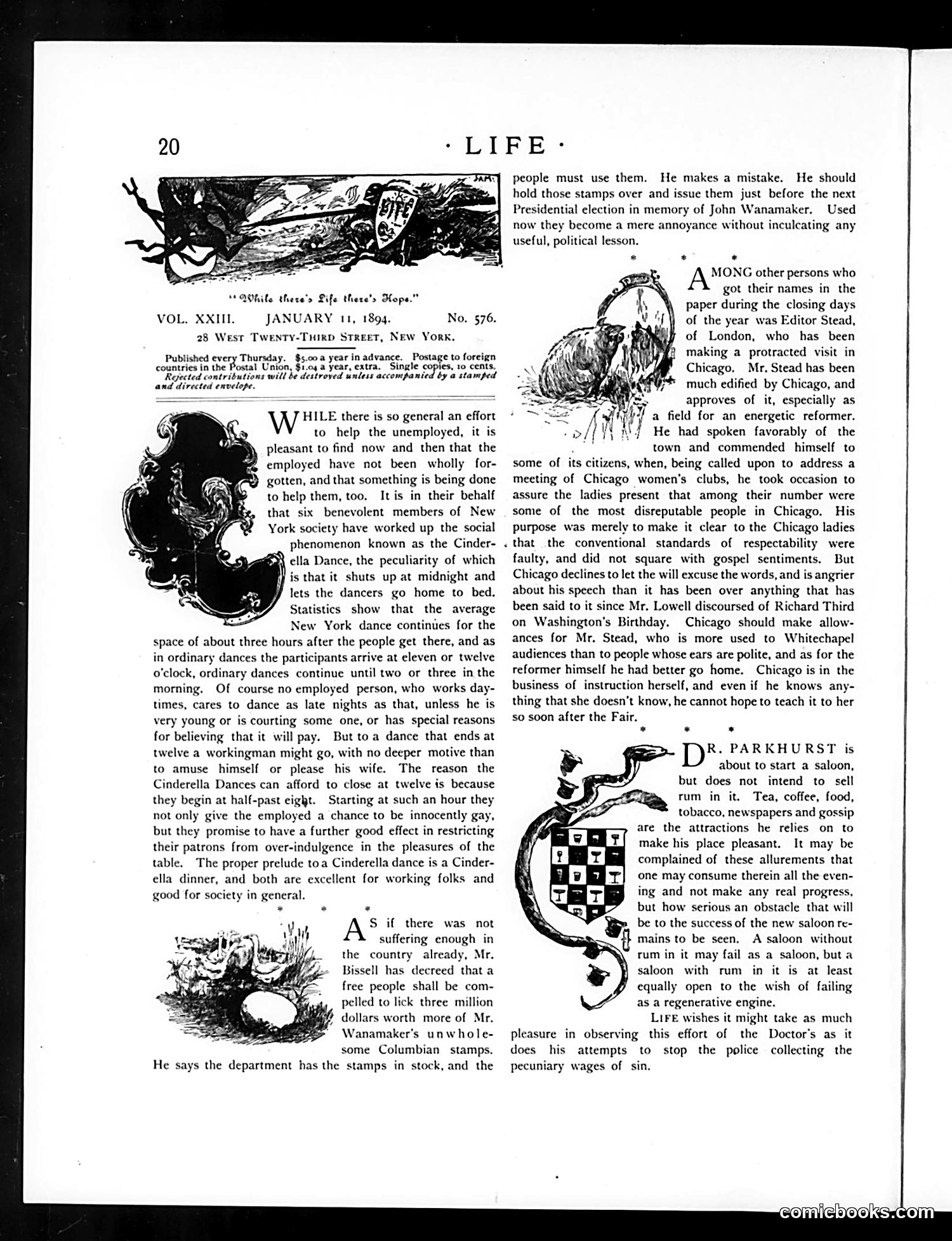
This page contains three separate satirical pieces: **1. The Cinderella Dance:** Life criticizes a New York charitable event where wealthy society members hosted midnight dances for the unemployed. The satire suggests the wealthy are congratulating themselves for minimal charity while the working poor must leave at midnight like Cinderella—the "special reasons" for early closures actually protect the wealthy from genuine social responsibility. **2. Editor Stead's Chicago Visit:** A British editor visiting Chicago claimed the city's moral standards were deficient. Life mocks his sanctimoniousness, suggesting he lacks standing to lecture Americans and should focus on his own business. **3. Dr. Parkhurst's Saloon:** A doctor plans opening a saloon serving tea and coffee instead of alcohol to combat vice. Life sarcastically questions whether a business without profit motive can truly succeed or reform society.
📄 Transcribed text from this page (OCR, searchable)
Machine-transcribed from the original scan — historical spelling and the odd misread are preserved.
- LI “While there's Life there's Hope.” VOL. XXIII. JANUARY 11, 1894. No. 576. 28 West Twenty-THirp Street, NEW York. Published every Thursday. $5.00 a year in advance. Postage to foreign countries in the Postal Univa, $1.cg a year, extra, Single copies, 10 cents, Rejected contributions will be destroyed unless accompanied by a stamped and directed envelope. HILE there is so general an effort to help the unemployed, it is pleasant to find now and then that the employed have not been wholly for- gotten, and that something is being done to help them, too. Itis in their behalf that six benevolent members of New York society have worked up the social phenomenon known as the Cinder- ES clia Dance, the peculiarity of which } is that it shuts up at midnight and lets the dancers go home to bed. Statistics show that the average New York dance continues for the space of about three hours after the people get there, and as in ordinary dances the participants arrive at eleven or twelve o'clock, ordinary dances continue until two or three in the morning. Of course no employed person, who works day- times, cares to dance as late nights as that, unless he is very young or is courting some one, or has special reasons for believing that it will pay. But to a dance that ends at twelve a workingman might go, with no deeper motive than to amuse himself or please his wife. The reason the Cinderella Dances can afford to close at twelve is because they begin at half-past eigyt. Starting at such an hour they not only give the employed a chance to be innocently gay, but they promise to have a further good effect in restricting their patrons from over-indulgence in the pleasures of the table. The proper prelude toa Cinderella dance is a Cinder- ella dinner, and both are excellent for working folks and good for society in general. . . AS if there was not suffering enough in the country already, Mr. Bissell has decreed that a free people shall be com- pelled to lick three million dollars worth more of Mr. Wanamaker'’s unwhole- some Columbian stamps. s the department has the stamps in stock, and the FE: people must use them. He makes a mistake. He should hold those stamps over and issue them just before the next Presidential election in memory of John Wanamaker. Used now they become a mere annoyance without inculcating any useful, political lesson. * * Ammons other persons who got their names in the paper during the closing days of the year was Editor Stead, of London, who has been making a protracted tin Chicago. Mr. Stead has been much edified by Chicago, and > approves of it, especially as a field for an energetic reformer. He had spoken favorably of the town and commended himself to some of its citizens, when, being called upon to address a meeting of Chicago women's clubs, he took occasion to assure the ladies present that among their number were some of the most disreputable people in Chicago. His purpose was merely to make it clear to the Chicago ladies «that the conventional standards of respectability were faulty, and did not square with gospel sentiments. But Chicago declines to let the will excuse the words, and is angrier about his speech than it has been over anything that has been said to it since Mr. Lowell discoursed of Richard Third on Washington's Birthday. Chicago should make allow- ances for Mr. Stead, who is more used to Whitechapel audiences than to people whose ears are polite, and as for the reformer himself he had better go home. Chicago is in the business of instruction herself, and even if he knows any- thing that she doesn’t know, he cannot hope to teach it to her so soon after the Fair. . * . => D*: PARKHURST is about to start a saloon, but does not intend to sell rum in it. Tea, coffee, food, tobacco, newspapers and gossip are the attractions he relies on to make his place pleasant. It may be complained of these allurements that one may consume therein all the even- ing and not make any real progress, but how serious an obstacle that will be to the success of the new saloon re- mains to be seen, A saloon without rum in it may fail as a saloon, but a saloon with rum in it is at least equally open to the wish of failing as a regenerative engine. LiFE wishes it might take as much pleasure in observing this effort of the Doctor's as it does his attempts to stop the police collecting the pecuniary wages of sin.