
A complete issue · 16 pages · 1893
Life — December 7, 1893
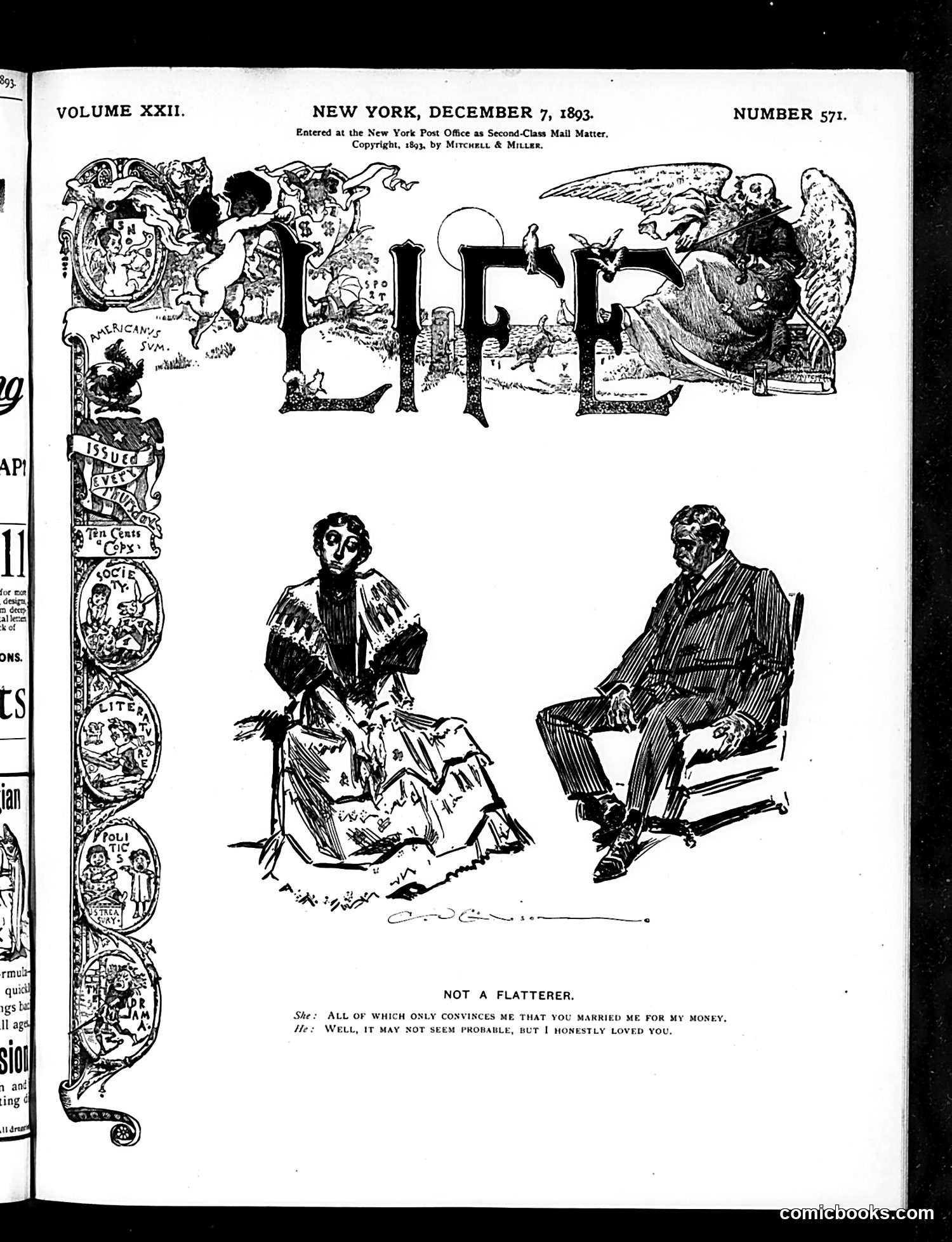
This cartoon satirizes a marriage of convenience. The title and dialogue reveal the satire's target: a woman married a man purely for money, not love. She admits ("all of which only convinces me that you married me for my money"), while he protests his genuine affection, claiming "I honestly loved you." The visual contrast emphasizes the satire—the woman sits elaborately dressed in finery (bought with wealth), while the man sits in plain business attire. The cartoon mocks both parties: the woman's mercenary motivations and the man's transparent lie about his feelings. The "flatterer" of the title refers to his unconvincing protestations of love, which no one—including his wife—believes.
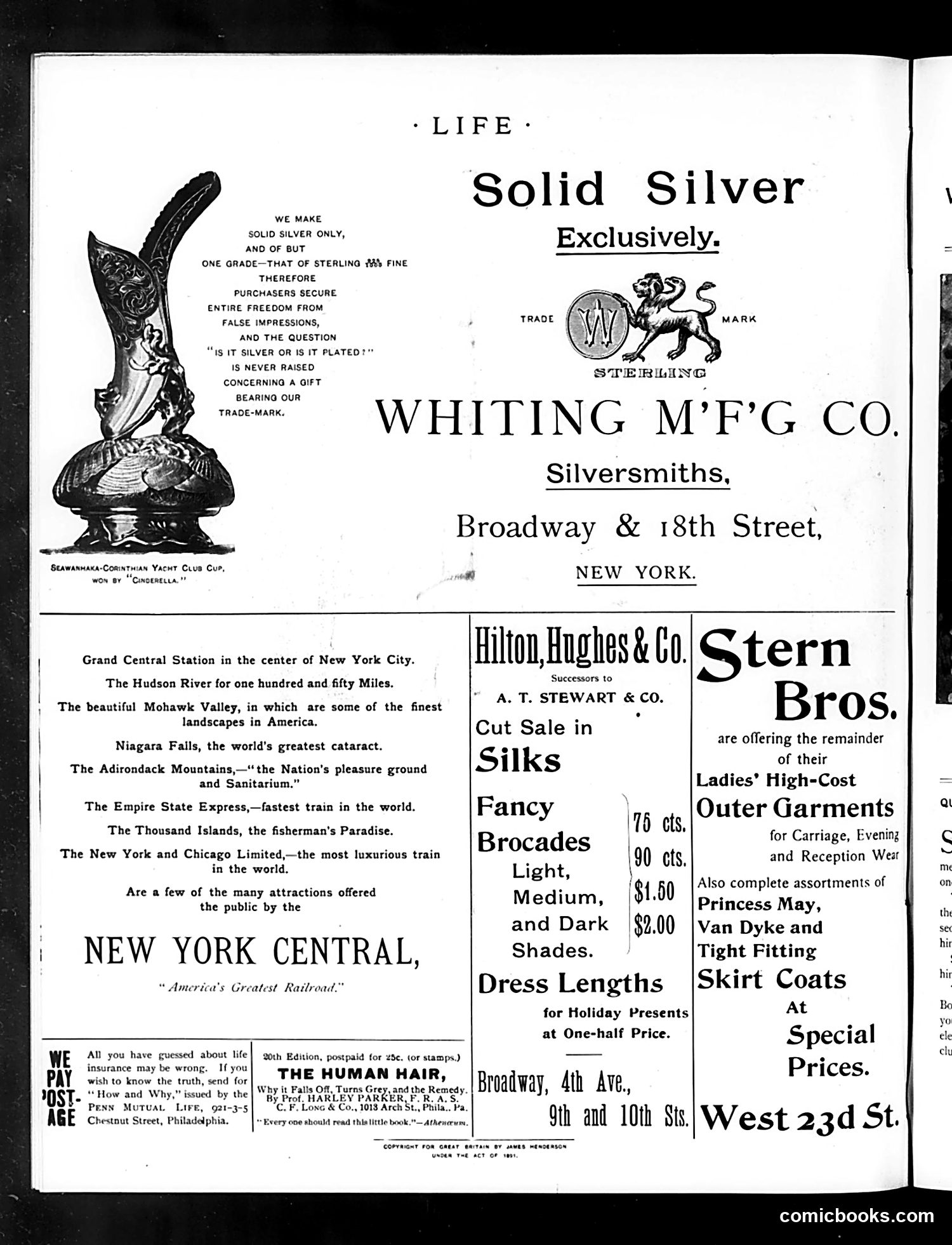
This page is primarily **advertising**, not satire or political commentary. The dominant advertisement features **Whiting M'FG Co.**, silversmiths located at Broadway & 18th Street in New York City. They emphasize making "solid silver only" and never plated items, addressing consumer concerns about authenticity—a common fraud worry in the era. The ornate trophy image (labeled as a Seawanhaka-Corinthian Yacht Club Cup) serves as quality demonstration. Below are additional advertisements: **New York Central Railroad** highlighting tourist attractions (Niagara Falls, Adirondacks), **Hilton, Hughes & Co.** selling discounted silks and brocades, and **Stern Bros.** advertising women's garments. A small book advertisement about human hair appears at bottom left. The page reflects early-20th-century consumer culture and commercial messaging rather than political satire.
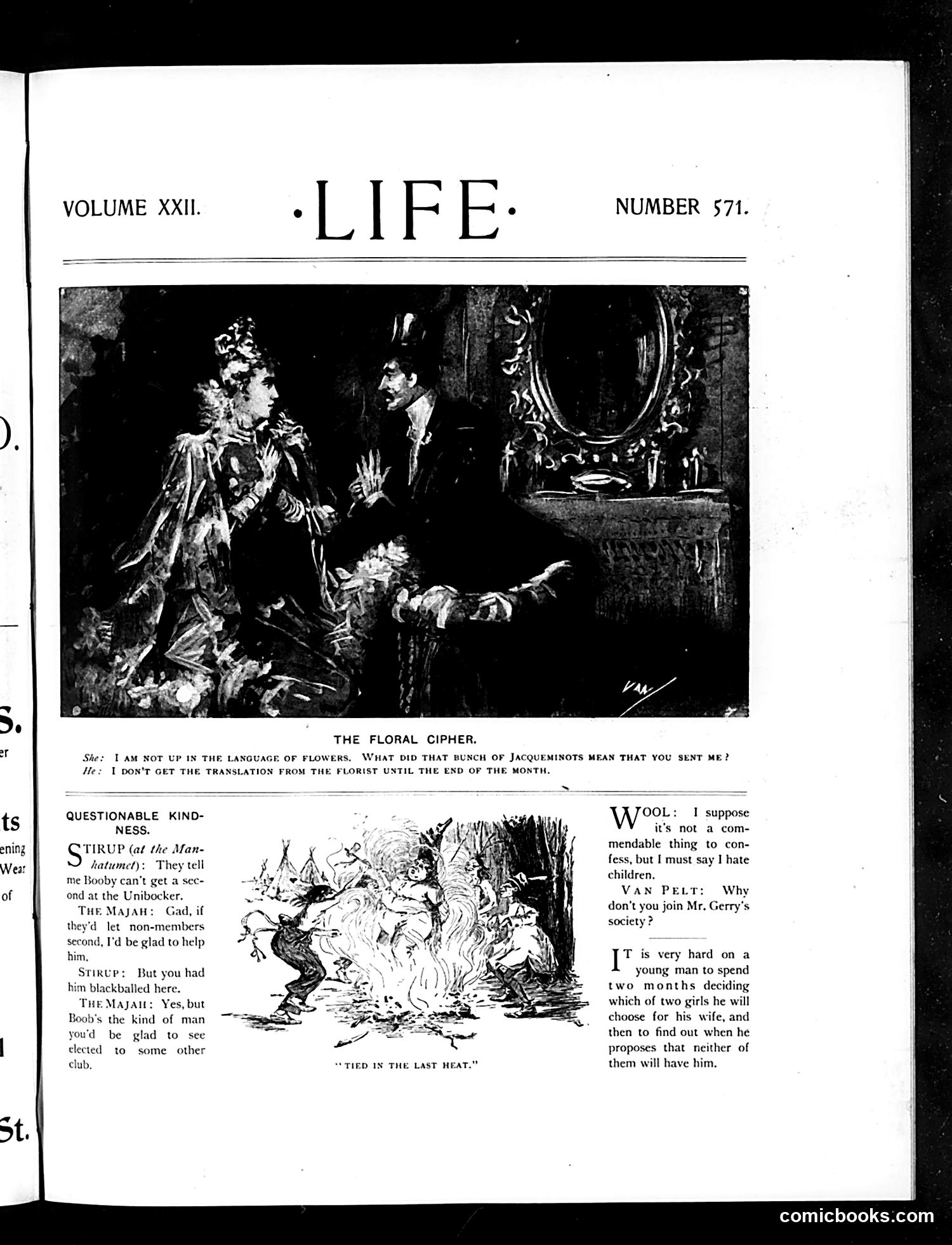
This page contains two satirical pieces: **"The Floral Cipher"** (top): A woman sends her male companion flowers with a coded message. The joke plays on the Victorian-era language of flowers—different blooms supposedly conveyed hidden meanings. The humor lies in the woman's frustration that the florist cannot translate the romantic or meaningful message embedded in her floral arrangement, so her suitor remains confused about her intent. **"Questionable Kindness"** (bottom): Features dialogue between characters named Stirup, The Major, and others discussing a man's social standing. The cartoon satirizes how exclusionary clubs operate—that blackballing someone from membership is actually doing them a favor by sparing them association with the club's undesirable members. Both pieces mock social pretension and miscommunication in upper-class society.
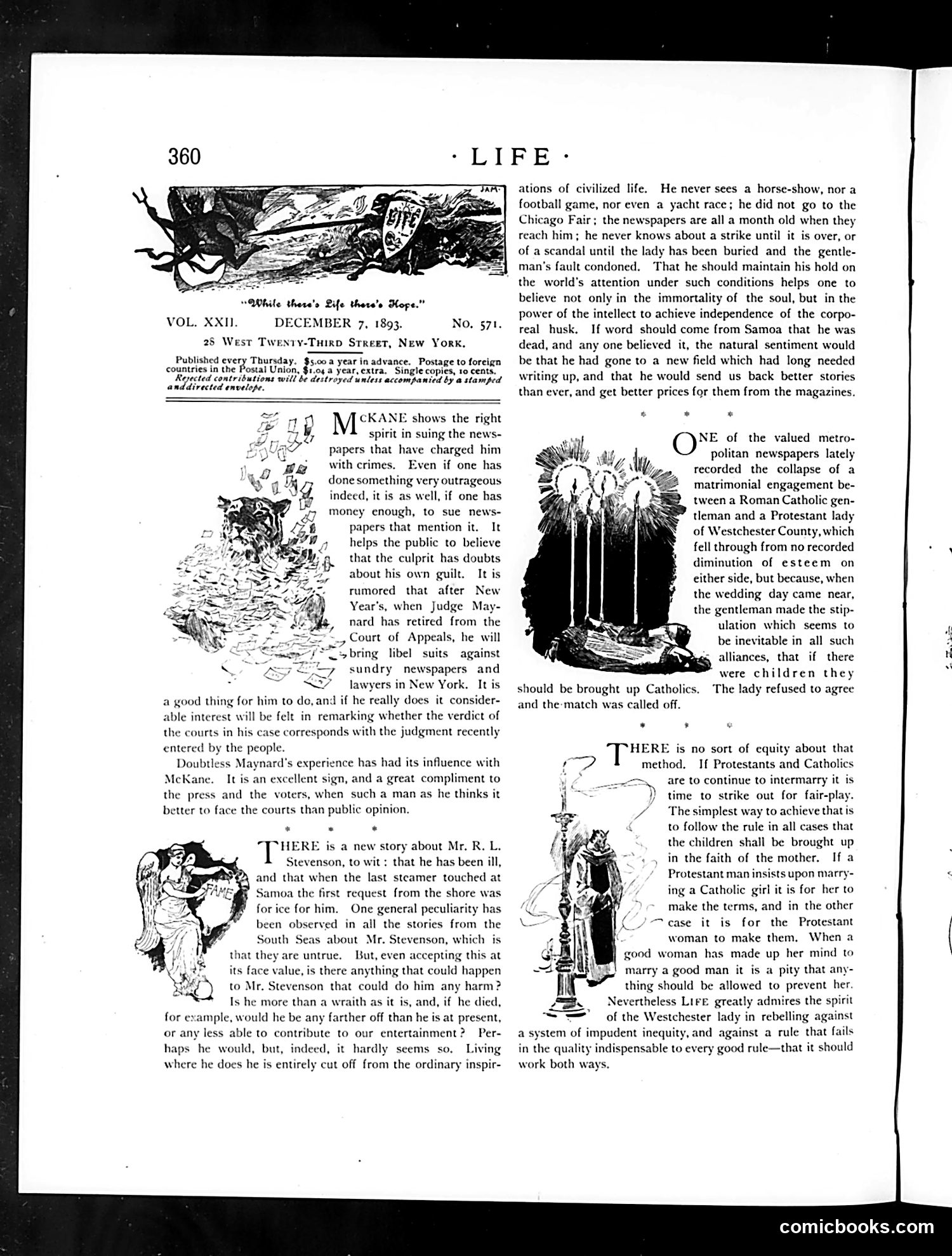
This page contains three separate satirical pieces: 1. **McKane cartoon (left)**: References Judge Maynard McKane, apparently recently involved in libel suits. The text suggests McKane prefers suing newspapers rather than facing public opinion or court verdicts—satirizing his litigious nature as cowardly. 2. **R.L. Stevenson piece (center-bottom)**: Discusses the author's isolation in Samoa. The satire questions whether Stevenson, cut off from ordinary life and entertainment, can truly contribute meaningfully to society or public amusement from such remote exile. 3. **Westchester engagement story (right)**: Mocks interfaith marriage disputes. A Protestant-Catholic couple's broken engagement highlights rigid social rules about children's religious upbringing, satirizing such "equity" as absurd and impractical. All three pieces critique institutional rigidity and hypocrisy.
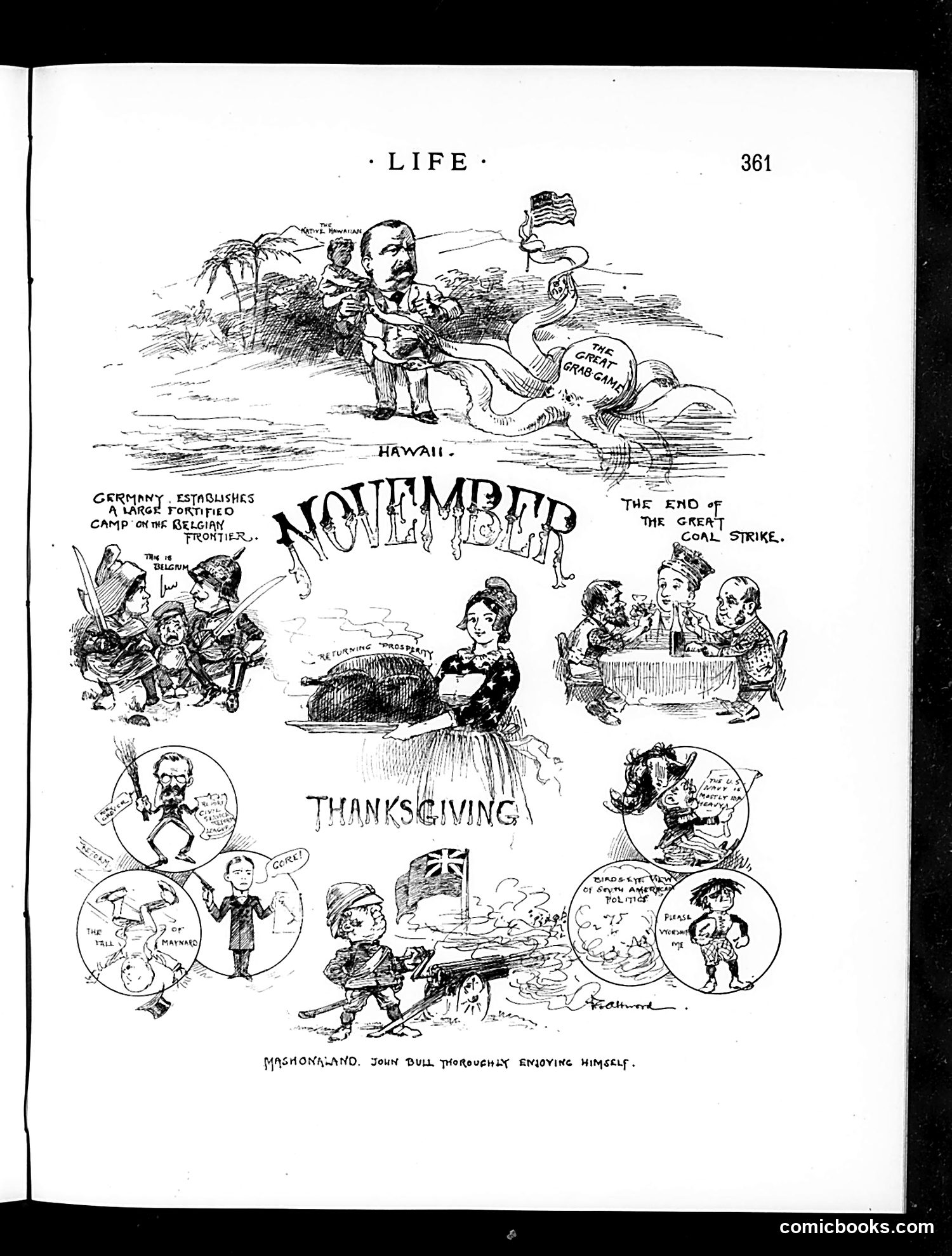
This satirical page depicts multiple November 1902 events. The top section shows Hawaii with an American figure asserting control, referencing American imperialism. "Germany Establishes a Large Fortified Camp on the Algerian Frontier" alludes to colonial tensions in North Africa. "The End of the Great Coal Strike" references the recent settlement of the 1902 anthracite coal strike that had paralyzed the nation. The Thanksgiving scene with various political figures appears to mock political leadership's self-congratulation over resolving the strike. The bottom scene with "Mashonaland" and "John Bull Thoroughly Enjoying Himself" likely references British colonial activities in Southern Africa. The circular vignettes appear to satirize various politicians' reactions to current events, though specific identifications require additional context.
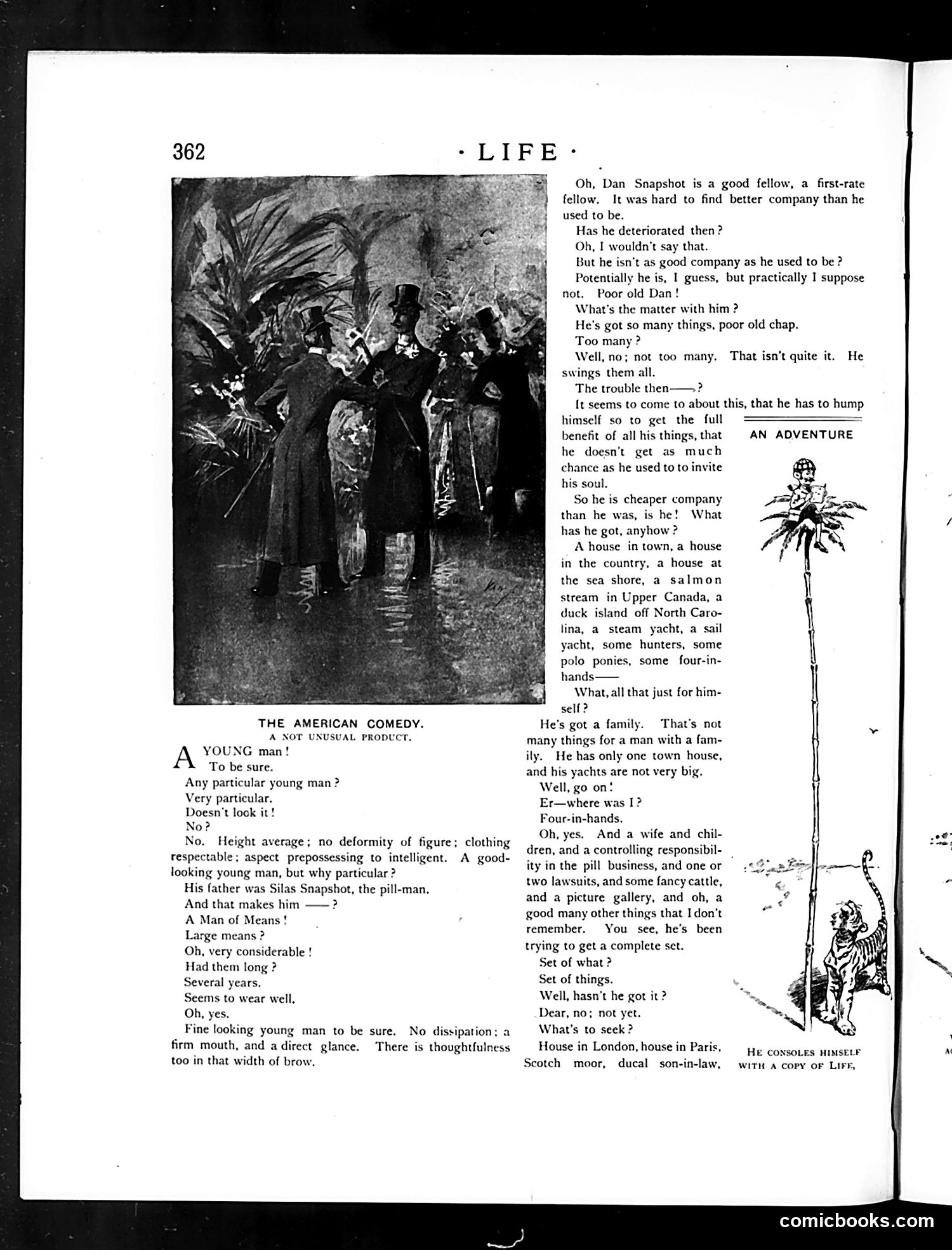
This page presents a satirical dialogue about a "young man" character—apparently someone of average appearance and modest means who pretends to greater wealth and importance than he possesses. The conversation mocks his pretensions: he claims to own multiple properties (London house, Paris house, Scottish moor, Canadian estates, yachts, polo ponies) and various luxuries, yet the speakers suggest these acquisitions are hollow attempts to appear successful. The satire targets wealthy Americans who accumulate status symbols while remaining essentially unchanged—still the same unremarkable person underneath. The illustration shows what appears to be a theatrical or social scene, reinforcing the "comedy" of performance and false appearances. The overall message critiques American materialism and the illusion that possessions can manufacture character or status.
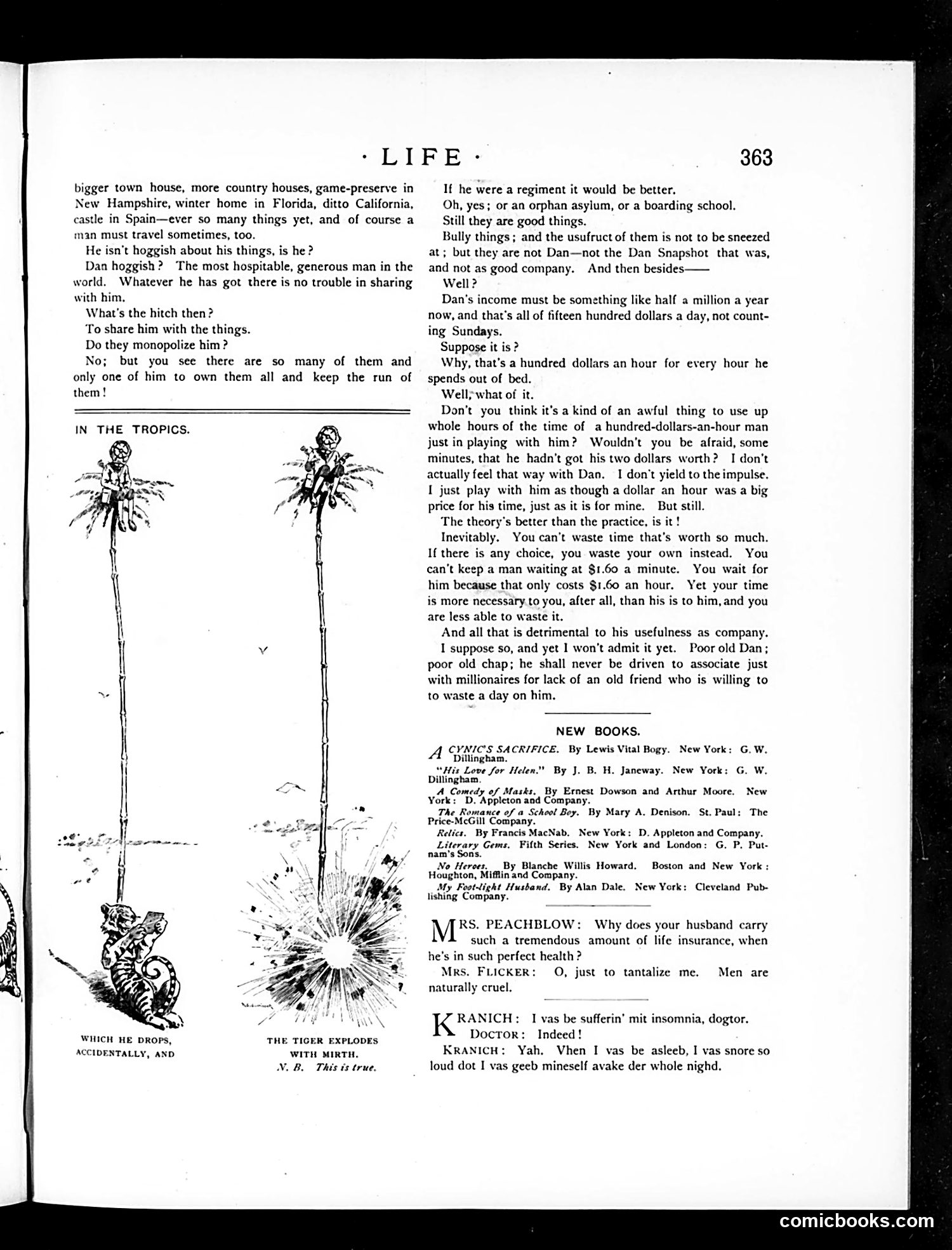
The page contains two illustrations labeled "IN THE TROPICS." The left image shows a figure dropping accidentally while climbing a palm tree, labeled "WHICH HE DROPS, ACCIDENTALLY, AND." The right image depicts "THE TIGER EXPLODES WITH MIRTH" with what appears to be a tiger laughing at the accident. This is a simple slapstick humor cartoon playing on physical comedy—a classic trope of the era. The joke relies on the incongruity of a dangerous animal finding amusement in human misfortune, anthropomorphizing the tiger's reaction for comedic effect. The caption notes "N.B. This is true," suggesting it purports to document an actual incident, adding absurdist humor through false authenticity. The remainder of the page contains text about wealthy individuals and includes book advertisements.
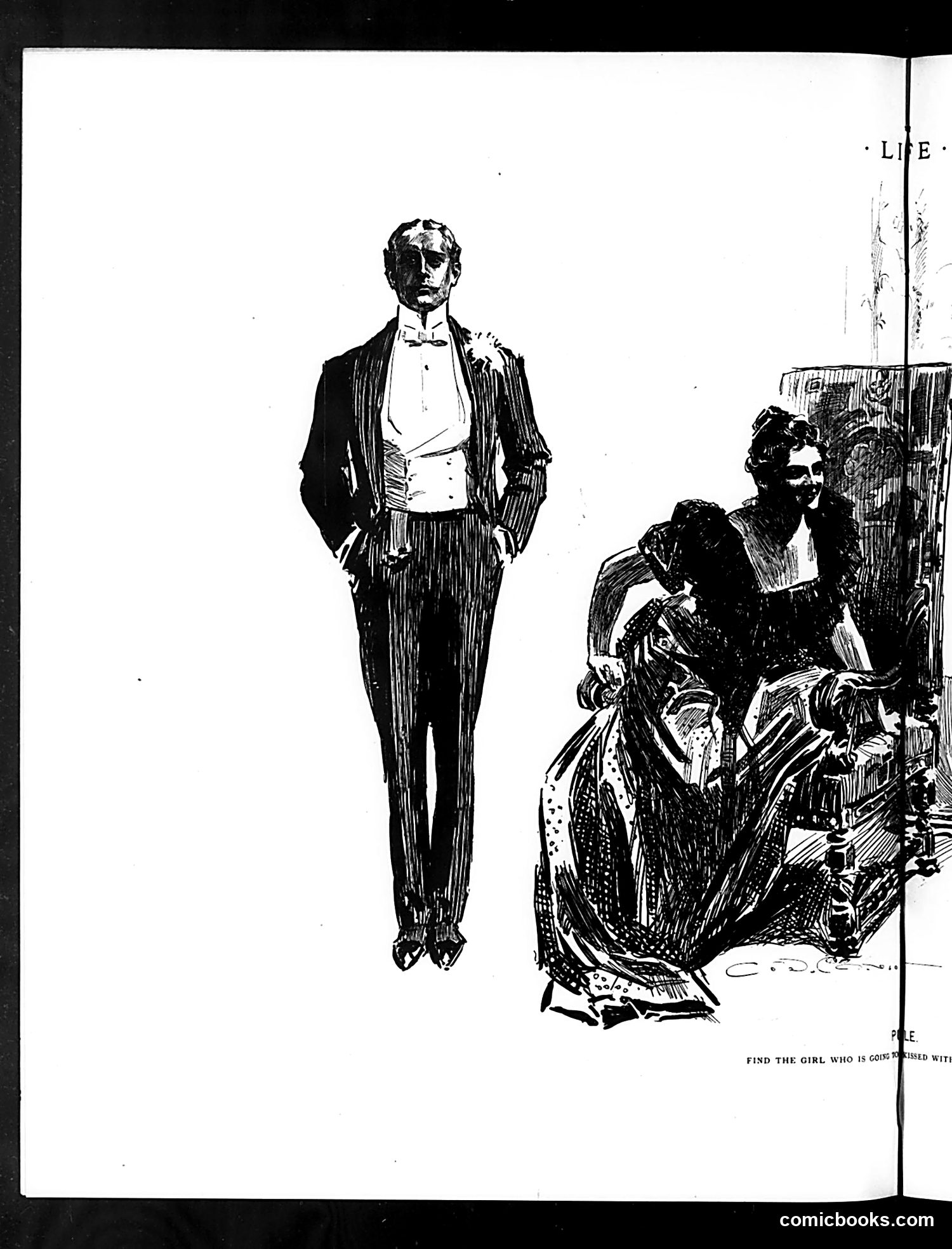
This page from *Life* magazine features a satirical illustration about romantic relationships and courtship. On the left stands a man in formal evening wear (tuxedo with tails), drawn in an idealized, almost statuesque manner. On the right, two women are seated together, apparently gossiping or discussing the man. The partially visible caption at bottom reads "FIND THE GIRL WHO IS GOING [to be] MARRIED WITH" (text cut off). The satire appears to mock the social dynamics of courtship—presenting the formally dressed man as a prize or object of matrimonial interest, while the women evaluate or discuss him. This reflects early 20th-century social commentary on marriage markets and the commodification of eligible bachelors, a recurring theme in *Life*'s satirical commentary on upper-class society and gender relations.
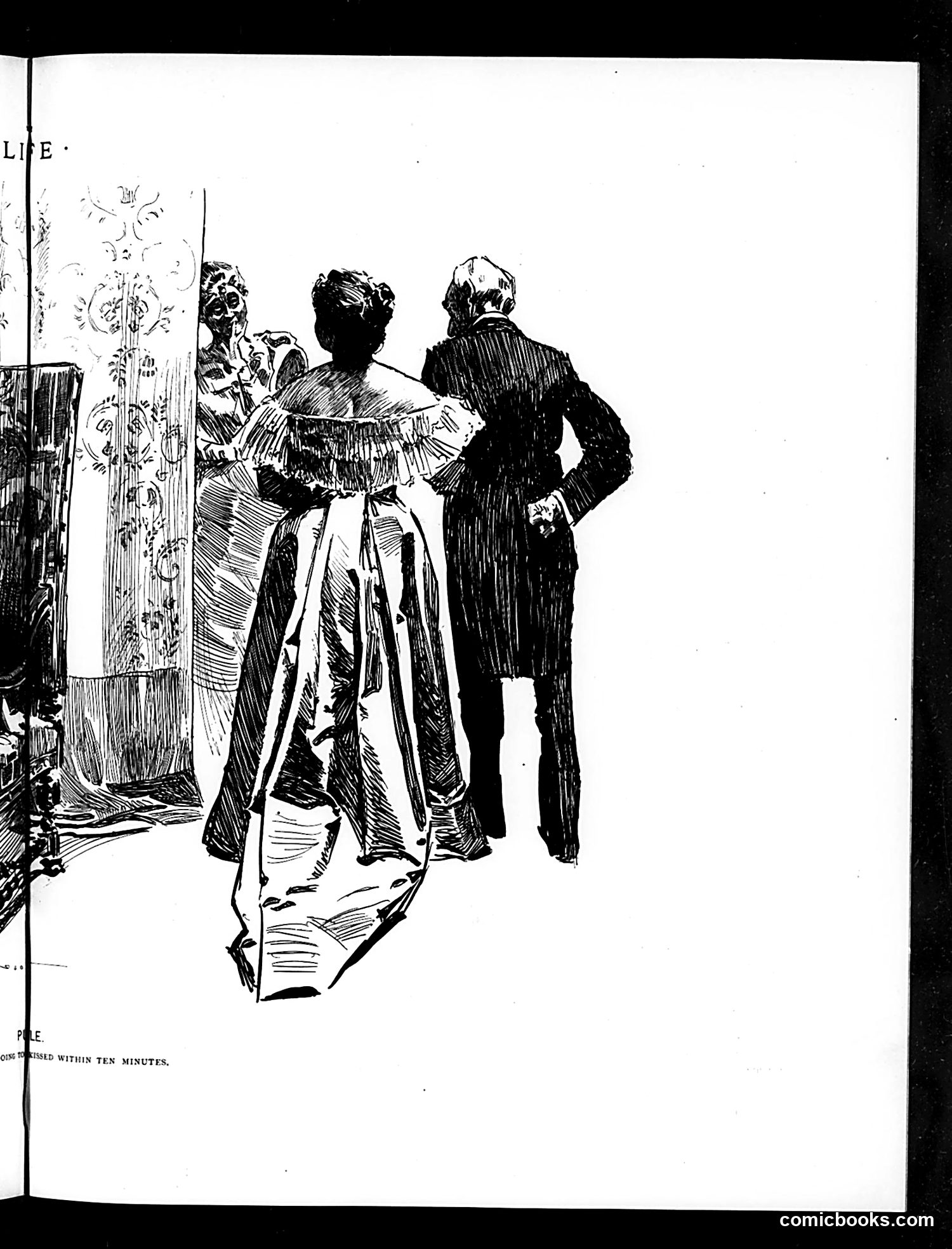
This page from *Life* magazine shows a sketch of three figures in formal evening wear examining what appears to be a large decorative item or garment with an elaborate train. The partially visible caption mentions "ORGANISED WITHIN TEN MINUTES," though the full context is unclear from this excerpt. The illustration appears to be satirical commentary on high society or fashion, depicting well-dressed individuals with the exaggerated linework typical of early 20th-century *Life* magazine's satirical style. However, without the complete caption or title, I cannot definitively identify the specific figures, event, or social commentary being lampooned. The sketch style and formal dress suggest commentary on wealthy society customs or fashion pretension, but the precise satirical target remains unclear from the visible image alone.
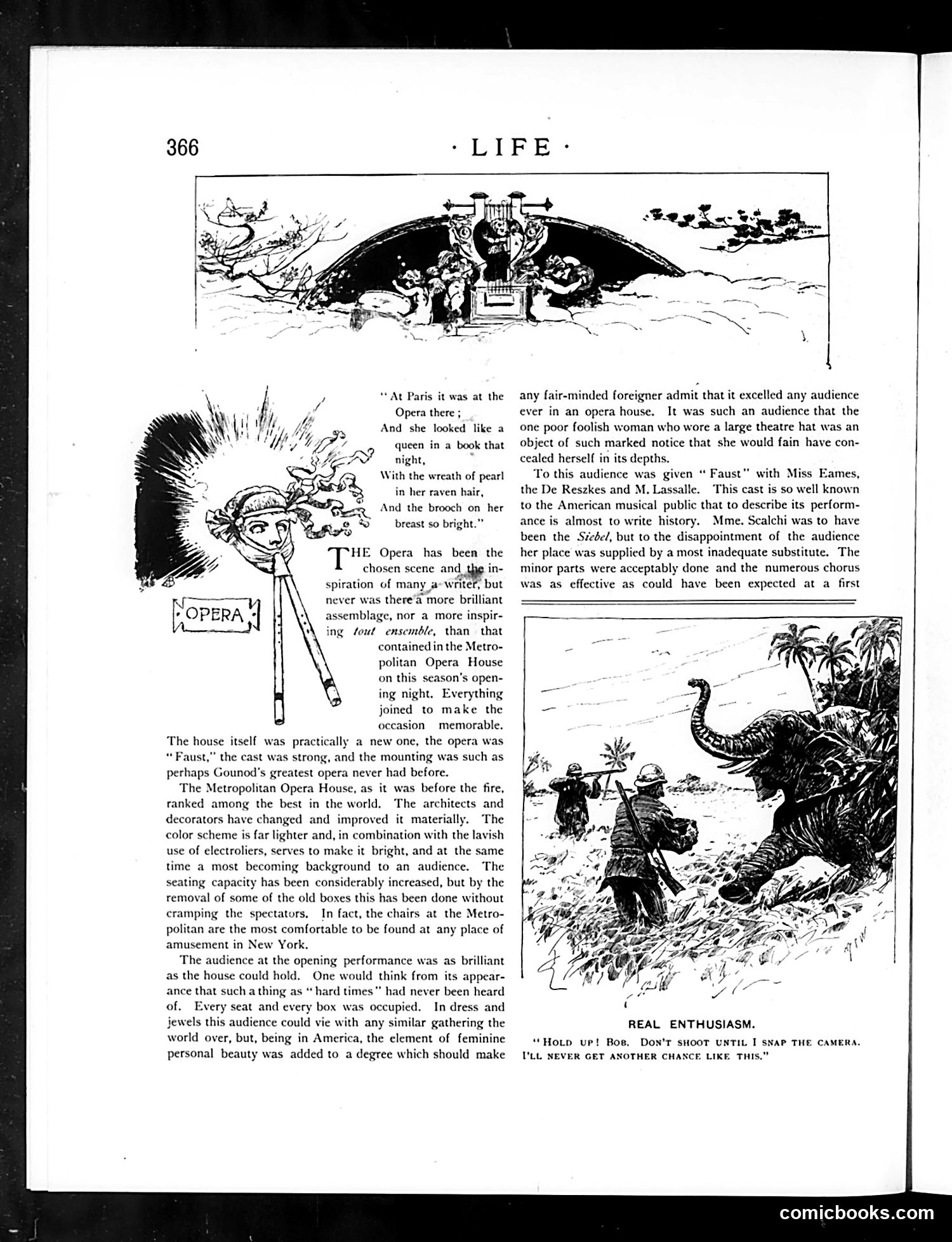
This page reviews the Metropolitan Opera House's production of "Faust," featuring Miss Eames, De Reszkes, and M. Lassalle. The text praises the performance as exceptional—"hard times" had never brought such a brilliant audience to the opera house. The illustration labeled "REAL ENTHUSIASM" depicts hunters with rifles attempting to photograph a large bird (possibly an ostrich or similar creature) in a desert landscape with palm trees. The hunter says: "HOLD UP! BOB. DON'T SHOOT UNTIL I SNAP THE CAMERA. I'LL NEVER GET ANOTHER CHANCE LIKE THIS." The joke satirizes the audience's fervent enthusiasm for the opera—comparing their excitement to hunters so eager to capture a rare moment they nearly miss the actual event. It's social commentary on American audiences' competitive desire to document and display cultural experiences.
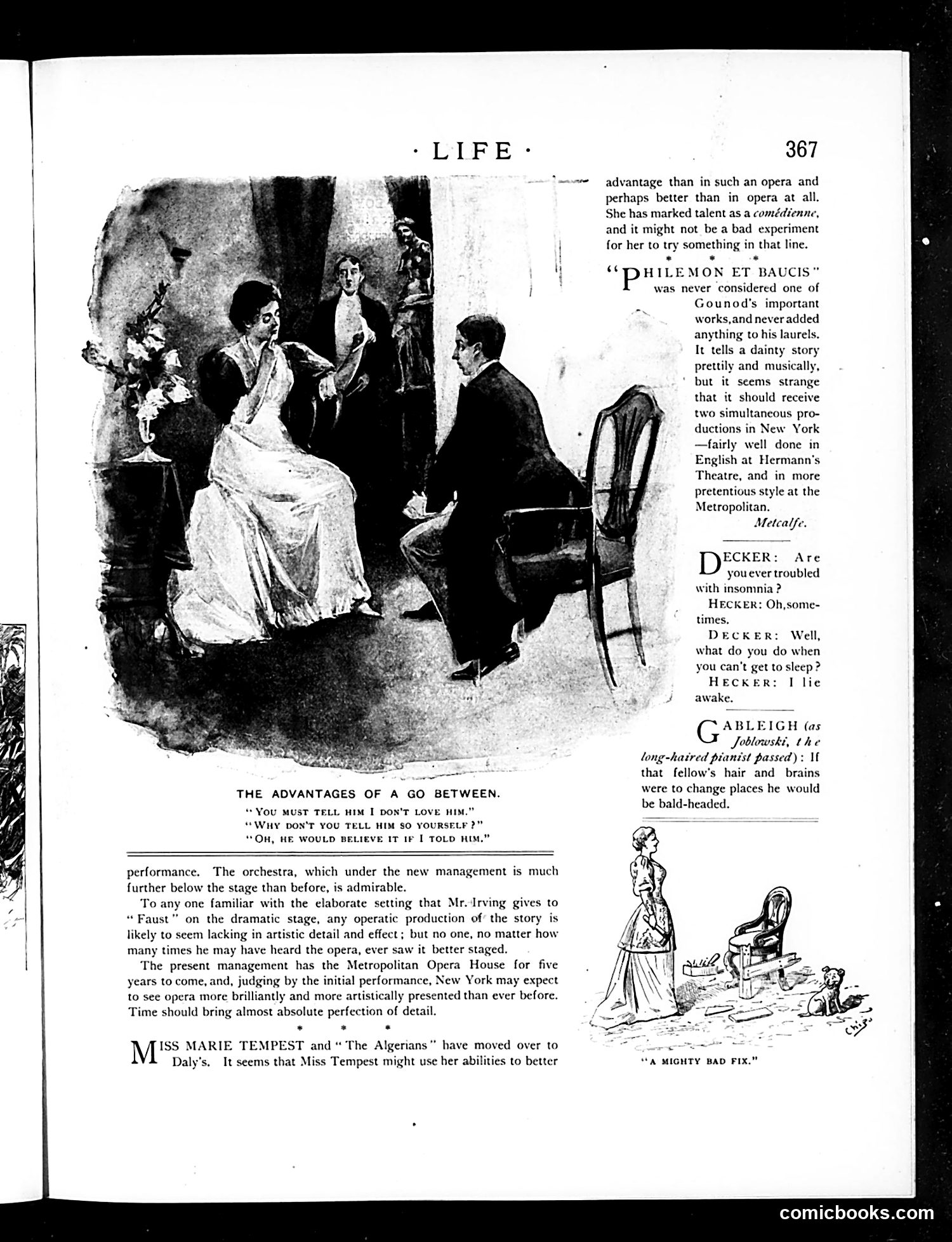
This page from *Life* magazine contains theatrical criticism rather than political cartoons. The main illustration depicts "The Advantages of a Go Between," showing a social scene where a woman tells a man she doesn't love him, but would believe it if told by an intermediary—satirizing indirect communication in relationships. The text discusses opera productions, particularly "Philemon et Baucis" by Gounod, and mentions Marie Tempest's move to Daly's Theatre. The secondary cartoon, "A Mighty Bad Fix," shows a woman and child with what appears to be a plumbing or domestic problem. These are society/theater satires targeting upper-class social conventions and theatrical performances rather than political issues.
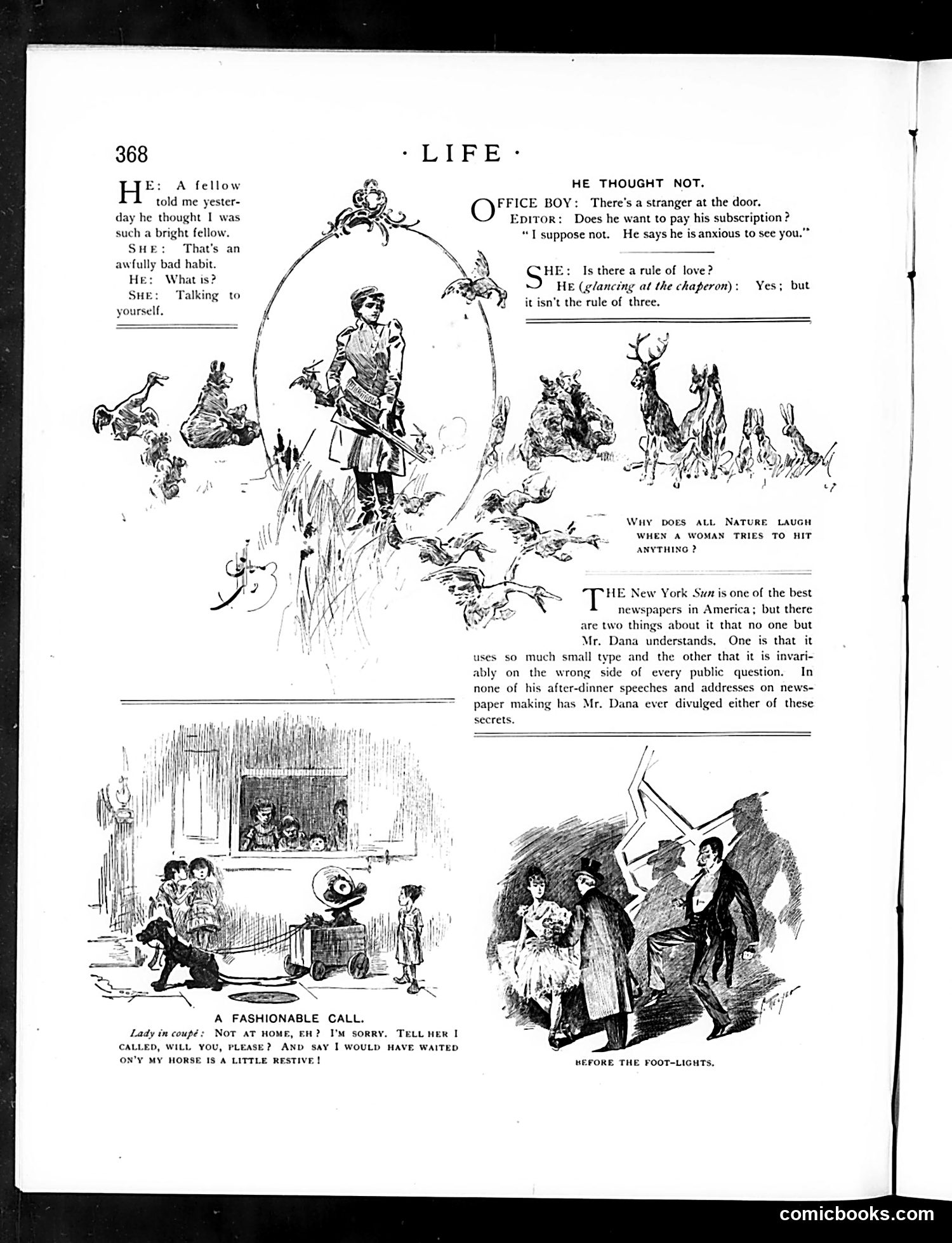
This page from Life magazine contains several short satirical pieces mocking social conventions and contemporary figures: **Top dialogue**: A couple's exchange where the man makes a math pun ("rule of three" rather than "rule of love"), with a chaperon present—mocking courtship formality. **Office Boy scene**: Satirizes newspaper subscription troubles, a common complaint. **Nature/Women joke**: A crude gender stereotype suggesting women are inherently clumsy or poor at physical tasks. **New York Sun critique**: A direct jab at the newspaper and its publisher (likely Charles Dana), mocking its small typeface and contrarian editorial positions on public issues. **Fashionable Call**: Satirizes upper-class calling customs—a woman leaving a false "called" card while claiming her restless horse prevented her from actually waiting, exposing the performative nature of social etiquette among the wealthy. The page reflects Life's style: punching at pretension, gender norms, and media figures through illustrated humor and wordplay.
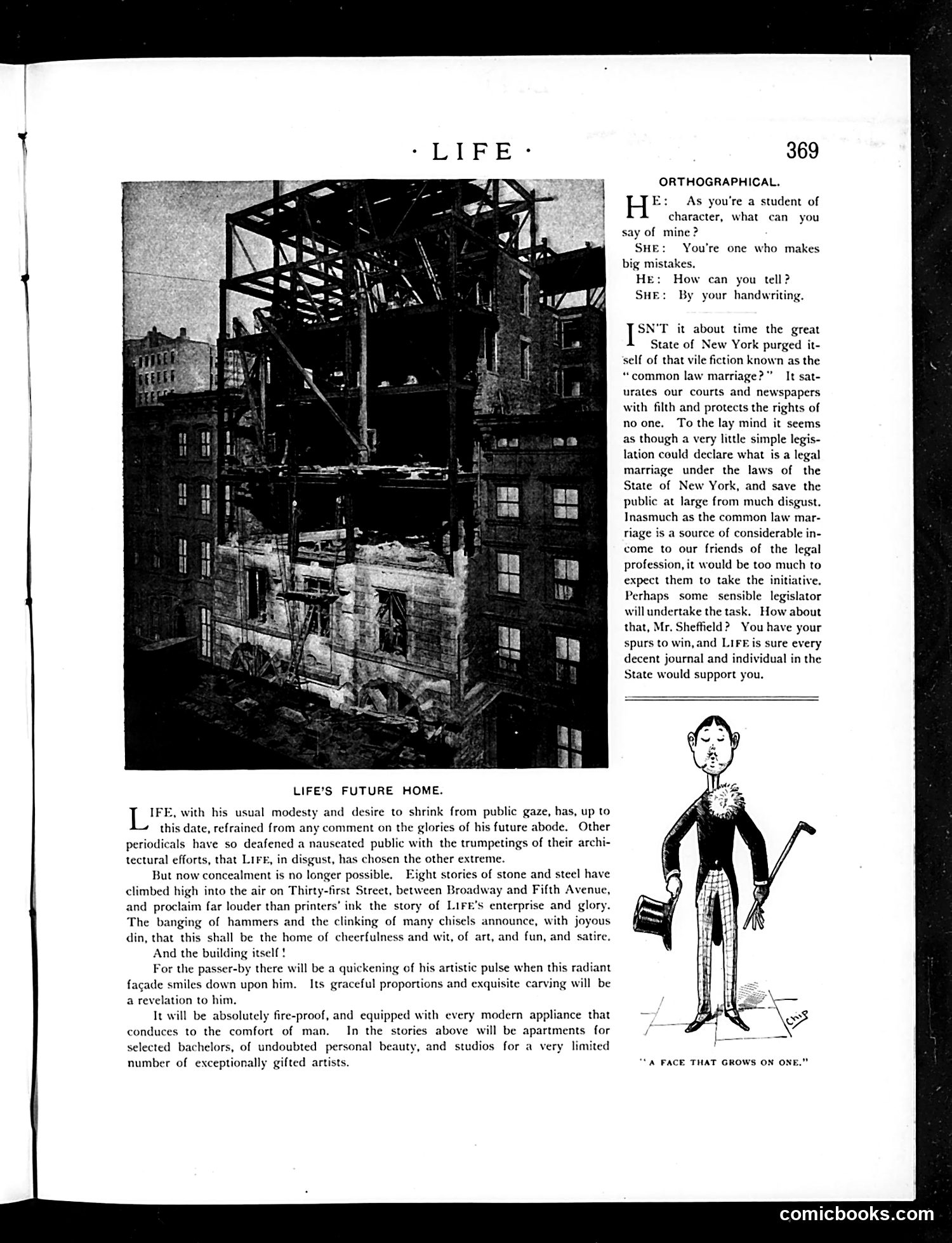
**The Cartoons/Content:** This page contains two distinct items: 1. **"Orthographical" joke** (top): A brief comic dialogue where a man asks a woman to assess his character based on his handwriting. She responds that he "makes big mistakes," revealing the joke relies on handwriting analysis (graphology) being unreliable—his poor penmanship doesn't actually indicate character flaws. 2. **"Life's Future Home"** (main article): An announcement about Life magazine's new building on 31st Street between Broadway and Fifth Avenue in New York City. The accompanying photograph shows the steel-frame construction. The text humorously celebrates the building's grandeur while mock-modestly claiming Life has been too dignified to brag about it (unlike competitor magazines). The small cartoon labeled "A Face That Grows On One" depicts a thin man, likely satirizing the magazine's editorial staff or approach. **Context:** This appears to be early 20th-century institutional self-promotion disguised as satirical commentary on New York's legal and architectural developments.
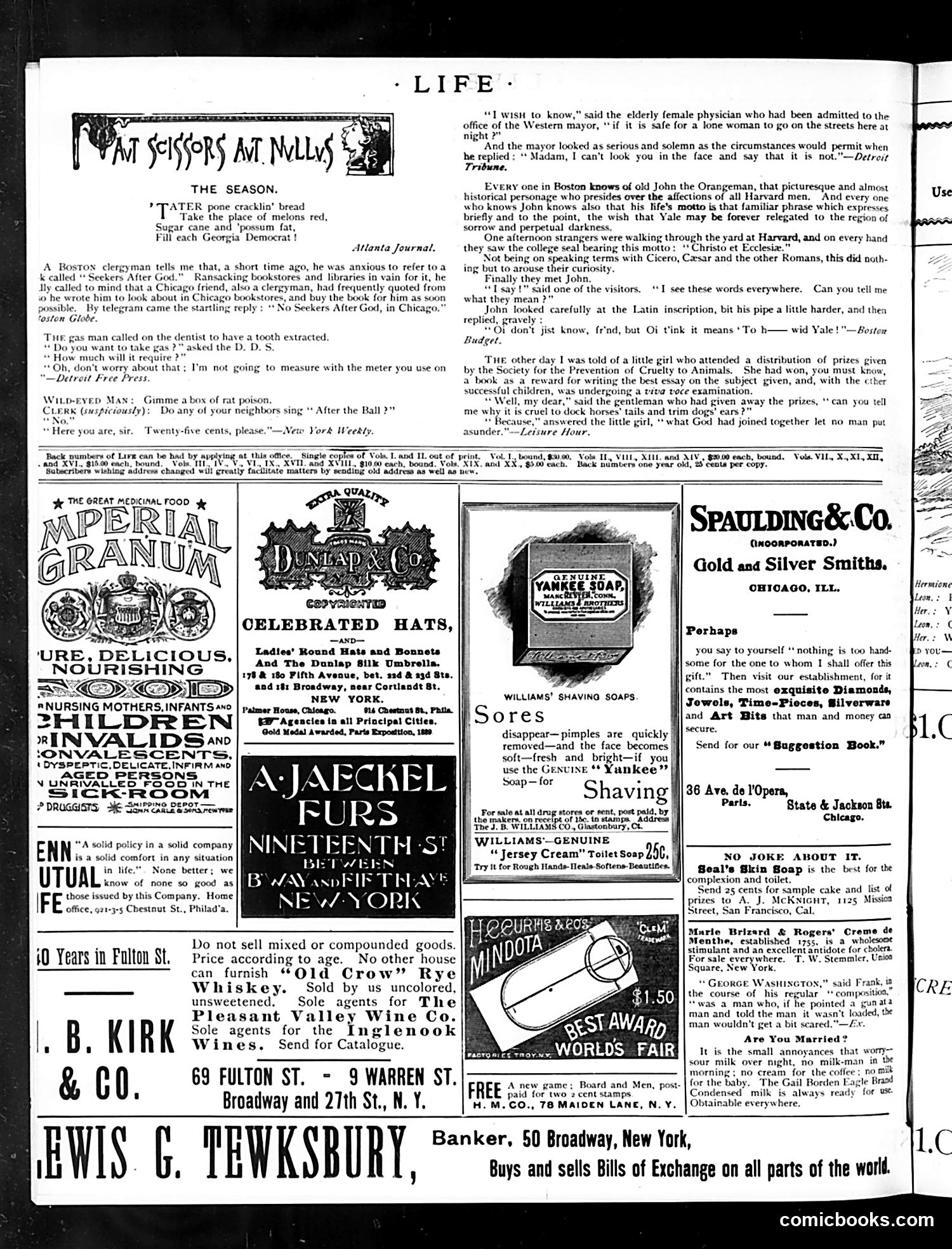
This page contains several short humorous anecdotes typical of Life magazine's satirical content, rather than political cartoons. The jokes target various American social types and situations: **"Seekers After God"**: A Boston clergyman's ironic search for a book reveals Chicago's supposed cultural barrenness. **Harvard's Latin Motto**: An Irish groundskeeper ("old John the Orangeman") at Harvard misinterprets the college seal's Latin phrase "Christo et Ecclesia" as meaning "To h— wid Yale!"—expressing the intense Yale-Harvard rivalry through working-class dialect humor. **The Girl's Essay Prize**: A child's answer about animal cruelty—that docking horses' tails violates God's design—satirizes both sentimental Victorian animal-welfare attitudes and religious literalism. **Minor jokes** mock dentists, gas bills, and neighbors' singing. The page is otherwise filled with period advertisements for medicines, hats, soaps, and financial services. The humor reflects late-19th-century American preoccupations: regional differences, class distinctions, and sentimental Victorian values.
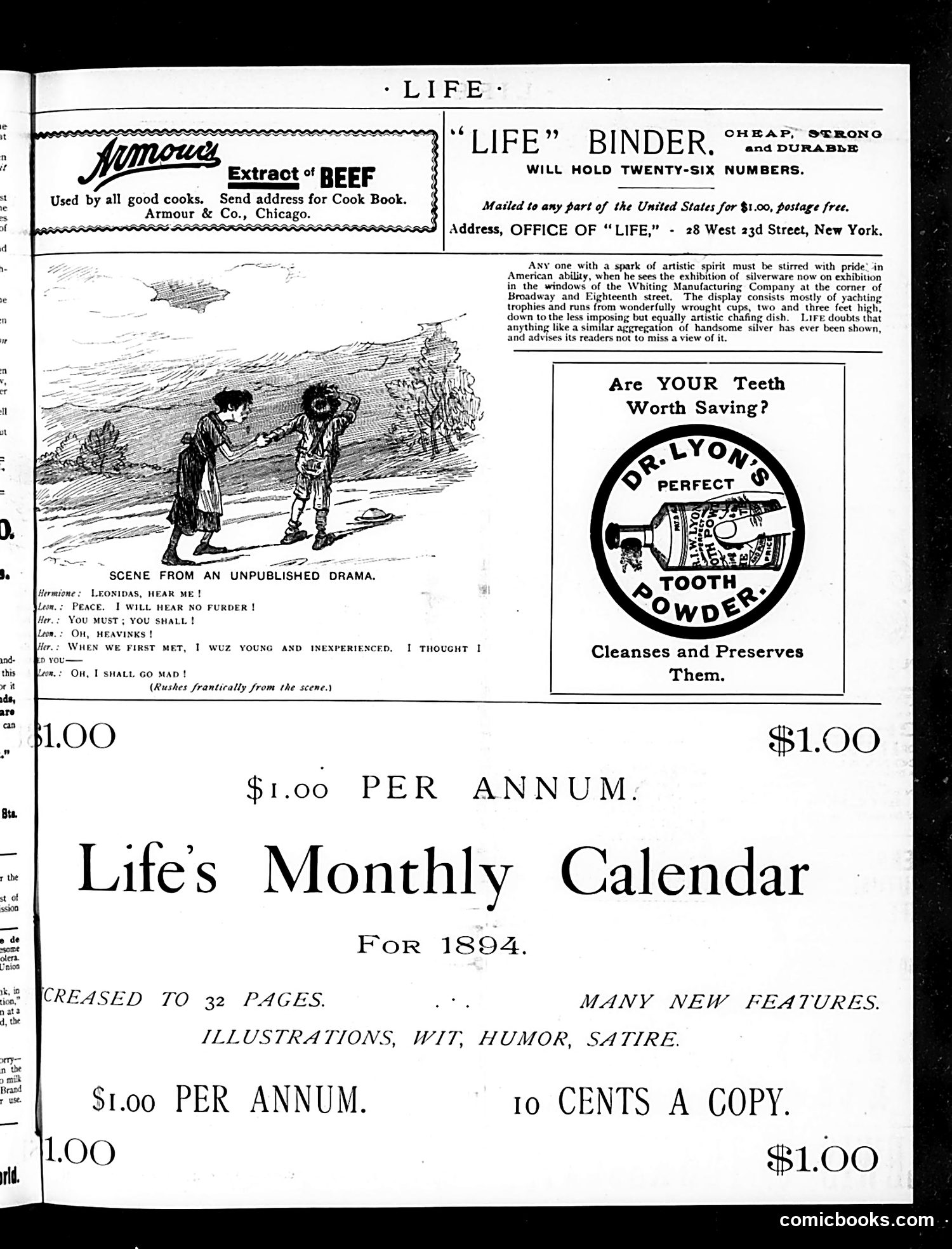
This is primarily a **title/contents page** from Life magazine, not a political cartoon. The page advertises Life's 1894 Monthly Calendar and various products. The only narrative content is a brief dramatic scene labeled "from an unpublished drama," showing two figures (Hermione and Leonidas) in what appears to be a melodramatic romantic conflict. The dialogue—"When we first met, I wuz young and inexperienced"—uses deliberate misspelling ("wuz") for comedic effect, likely mocking overwrought Victorian theatrical conventions and sentimental drama. The page is otherwise filled with **advertisements** for Armour beef extract, a Life magazine binder, and Dr. Lyon's tooth powder. The satirical magazine used such ads to fund publication. No specific political references or notable caricatures appear on this page—it's primarily a commercial and promotional document from 1894.
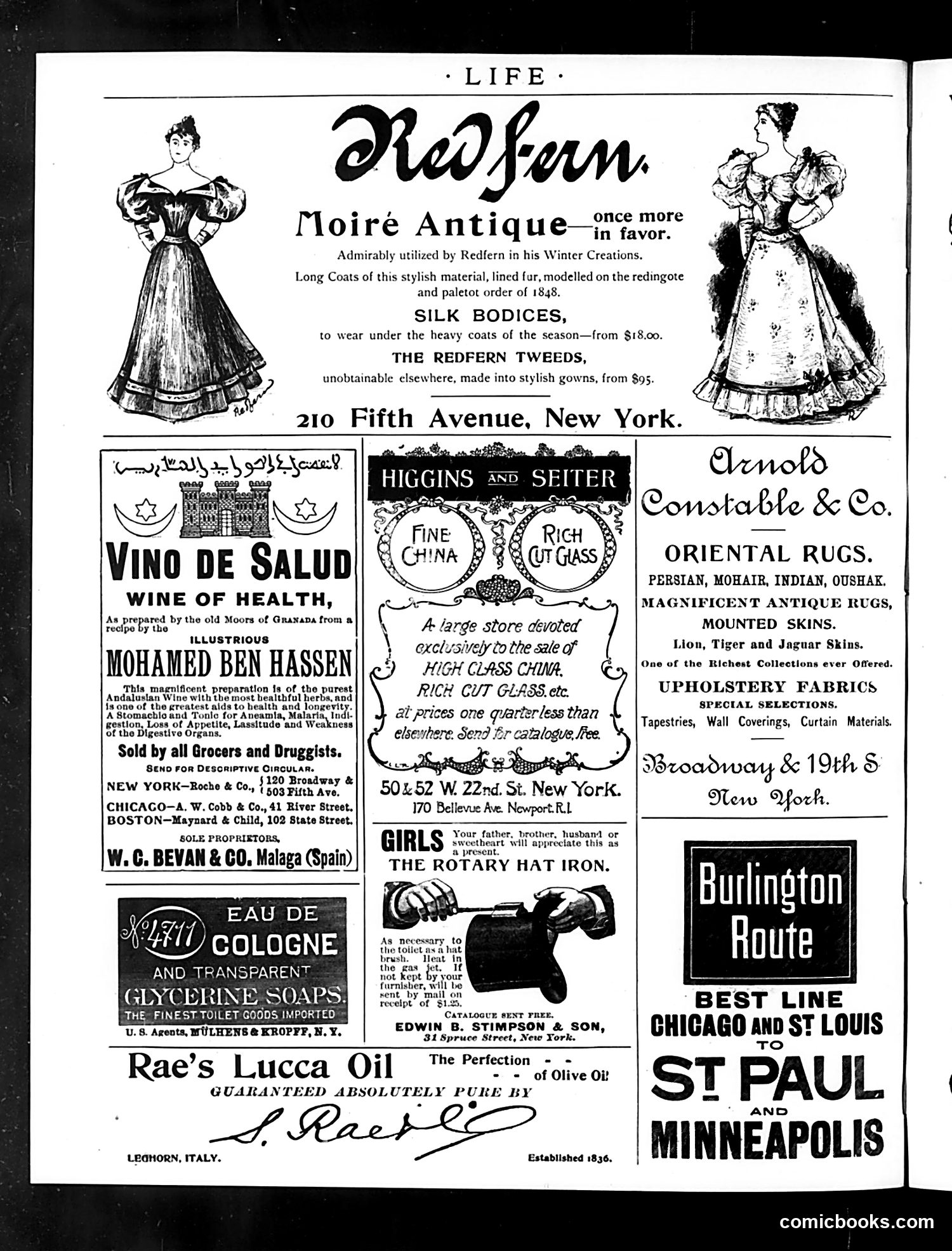
This is primarily an **advertisement page**, not a satirical cartoon page. It showcases luxury goods and services aimed at wealthy American consumers, circa 1890s-1900s. **Key advertisers include:** - **Redfern** (top): High-end fashion house selling expensive silk bodices and tweeds - **Vino de Salud**: A "health wine" marketed with orientalist imagery (Moorish origins), reflecting period fascination with exotic remedies - **Higgins and Seiter**: Fine china and cut glass retailer - **Arnold Constable & Co.**: Oriental rugs, mounted animal skins, upholstery fabrics - **Rae's Lucca Oil**: Italian olive oil marketed as pure and superior - **Burlington Route**: Railroad advertising Chicago-St. Paul service **Social context**: The page reflects Gilded Age consumer culture—expensive imported goods, orientalism as luxury, and emphasis on "authenticity" and European provenance. Products target affluent urban dwellers willing to pay premium prices for quality and exclusivity.