
Life, 1893-12-07 · page 4 of 16
Life — December 7, 1893 — page 4: what you’re looking at
What you’re looking at
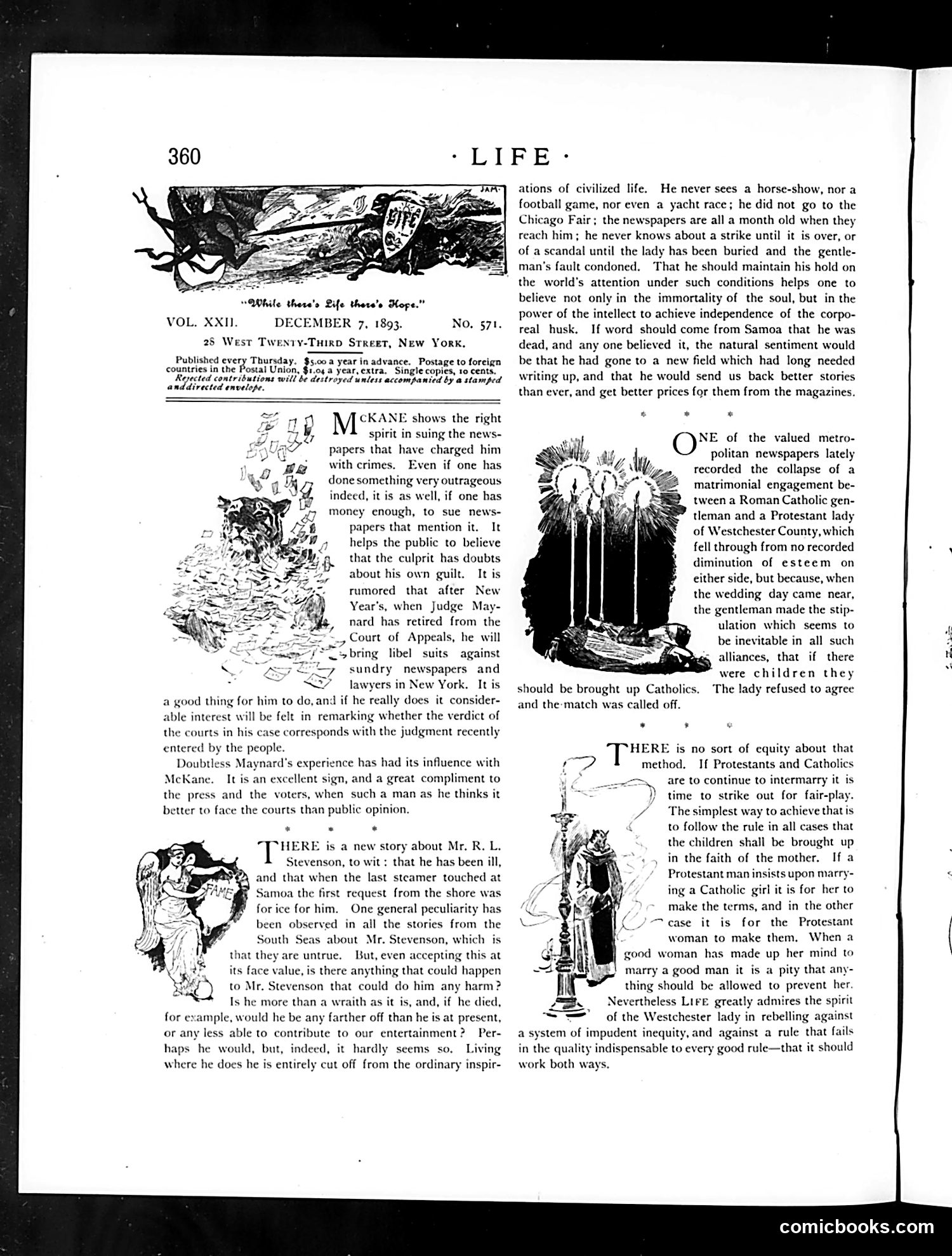
This page contains three separate satirical pieces: 1. **McKane cartoon (left)**: References Judge Maynard McKane, apparently recently involved in libel suits. The text suggests McKane prefers suing newspapers rather than facing public opinion or court verdicts—satirizing his litigious nature as cowardly. 2. **R.L. Stevenson piece (center-bottom)**: Discusses the author's isolation in Samoa. The satire questions whether Stevenson, cut off from ordinary life and entertainment, can truly contribute meaningfully to society or public amusement from such remote exile. 3. **Westchester engagement story (right)**: Mocks interfaith marriage disputes. A Protestant-Catholic couple's broken engagement highlights rigid social rules about children's religious upbringing, satirizing such "equity" as absurd and impractical. All three pieces critique institutional rigidity and hypocrisy.
📄 Transcribed text from this page (OCR, searchable)
Machine-transcribed from the original scan — historical spelling and the odd misread are preserved.
- LIFE: While there's Life there's Hope.” VOL. XXII. DECEMBER 7, 1893. No, 571. 28 West Twenty-Tuirp Street, New York. Published every Thursday. $s.00a year in advance. Postage to foreign countries in the Postal Union, $1.04 a year, extra, Single copies, 10 cents. Rejected contributions will be destroyed unless accompanied by a stamped and directed envelope. shows the right it in suing the news- papers that have charged him with crimes. Even if one has done something very outrageous. indeed, it is as well, if one has money enough, to sue news- papers that mention it. It helps the public to believe that the culprit has doubts about his own guilt. It is rumored that after New Year's, when Judge May- ,, hard has retired from the “Court of Appeals, he will ~bring libel suits against 7 sundry newspapers and lawyers in New York. It is a good thing for him to do, and if he really does it consider- able interest will be felt in remarking whether the verdict of the courts in his case corresponds with the judgment recently entered by the people. Doubtless Maynard's experi McKane. It is an excellent sign, and a great compliment to the press and the voters, when such a man as he thinks it better to face the courts than public opinion. nce has had its influence with . . * HERE is a new story about Mr. R. L. Stevenson, to wit: that he has been ill, and that when the last steamer touched at Samoa the first request from the shore was for ice for him. One general peculiarity has been observed in all the stories from the South Seas about Mr. Stevenson, which is are untrue. But, even accepting this at its face value, is there anything that could happen to Mr. Stevenson that could do him any harm? Is he more than a wraith as it is, and, if he died, ample, would he be any farther off than he is at present, or any less able to contribute to our entertainment? Per- haps he would, but, indeed, it hardly seems so. Living where he does he is entirely cut off from the ordinary inspir- ations of civilized life. He never sees a horse-show, nor a football game, nor even a yacht race; he did not go to the Chicago Fair; the newspapers are all a month old when they ach him; he never knows about a strike until it is over, or of a scandal until the lady has been buried and the gentle- man’s fault condoned. That he should maintain his hold on the world’s attention under such conditions helps one to believe not only in the immortality of the soul, but in the power of the intellect to achieve independence of the corpo- real husk. If word should come from Samoa that he was dead, and any one believed it, the natural sentiment would be that he had gone to a new field which had long needed writing up, and that he would send us back better stories than ever, and get better prices for them from the magazines. * * NE of the valued metro- politan newspapers lately recorded the collapse of a matrimonial engagement be- tween a Roman Catholic gen- tleman and a Protestant lady of Westchester County, which fell through from no recorded diminution of esteem on either side, but because, when the wedding day came near, the gentleman made the stip- ulation which seems to be inevitable in all such alliances, that if there were children they should be brought up Catholi The lady refused to agr and the match was called off. . * ¢ HERE is no sort of cquity about that method. If Protestants and Catholics are to continue to intermarry it is time to strike out for fair-play, The simplest way to achieve that is to follow the rule in all cases that the children shall be brought up in the faith of the mother. If a Protestant man insists upon marry- ing a Catholic girl it is for her to make the terms, and in the other case it is for the Protestant woman to make them, When a good woman has made up her mind to )! marry a good man it is a pity that any- ‘© thing should be allowed to prevent her. Nevertheless Lire greatly admires the spirit of the Westchester lady in rebelling against a system of impudent inequity, and against a rule that fails in the quality indispensable to every good rule—that it should work both ways. fl —— comicbooks.com