
A complete issue · 14 pages · 1893
Life — November 2, 1893
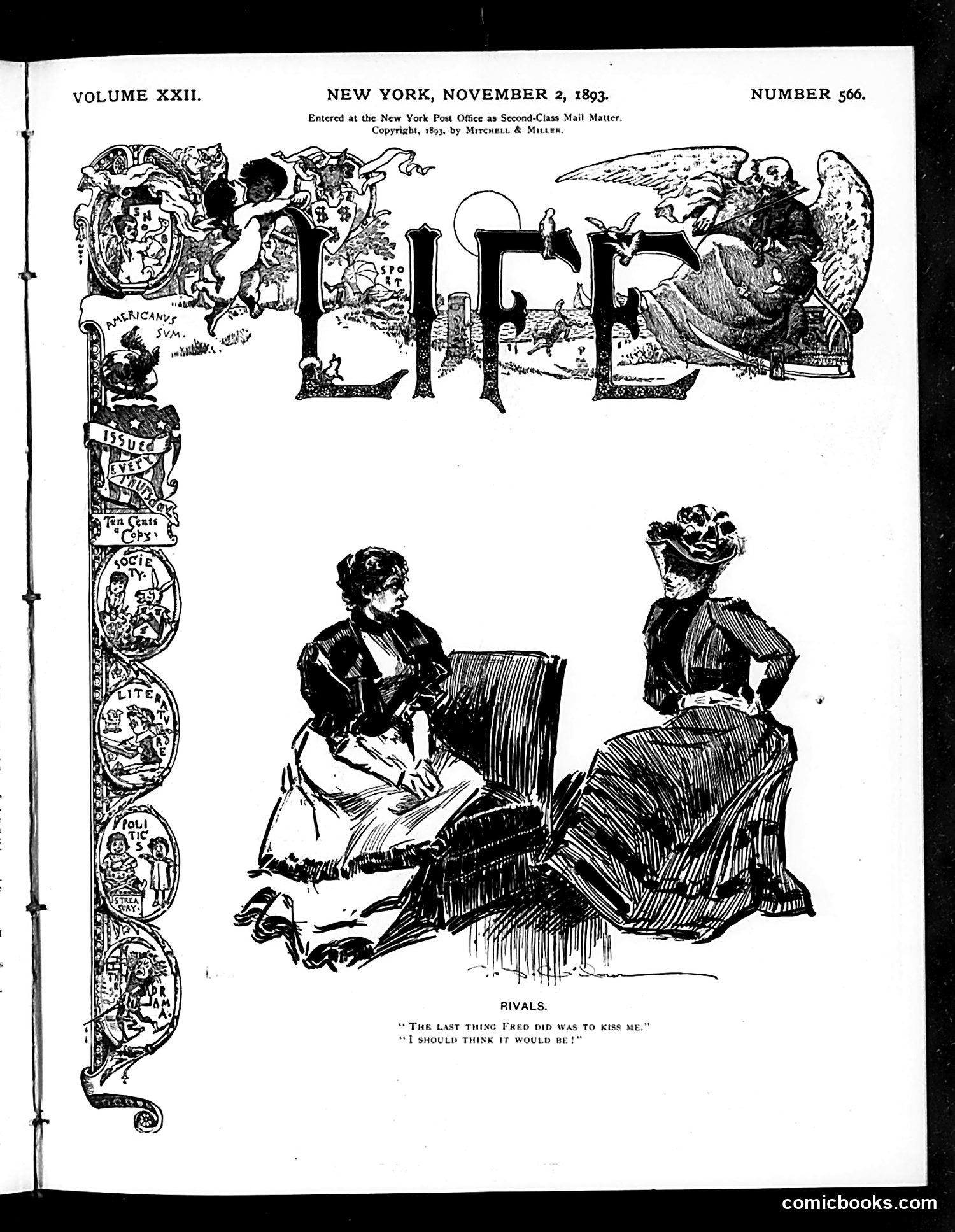
This is the cover of *Life* magazine's issue featuring a cartoon titled "RIVALS." The illustration depicts two fashionably dressed women in 1890s attire engaged in what appears to be a competitive or confrontational moment. One woman sits while the other stands, both wearing elaborate clothing typical of the period. The caption reads: "The last thing Fred did was to kiss me." / "I should think it would be!" The satire appears to mock romantic rivalry between women over a man named Fred, poking fun at courtship customs and female competition for male attention. The women's expressions and body language suggest disapproval or jealousy. This represents typical *Life* magazine humor of the era—lighthearted social satire about romance and Victorian-era relationships.
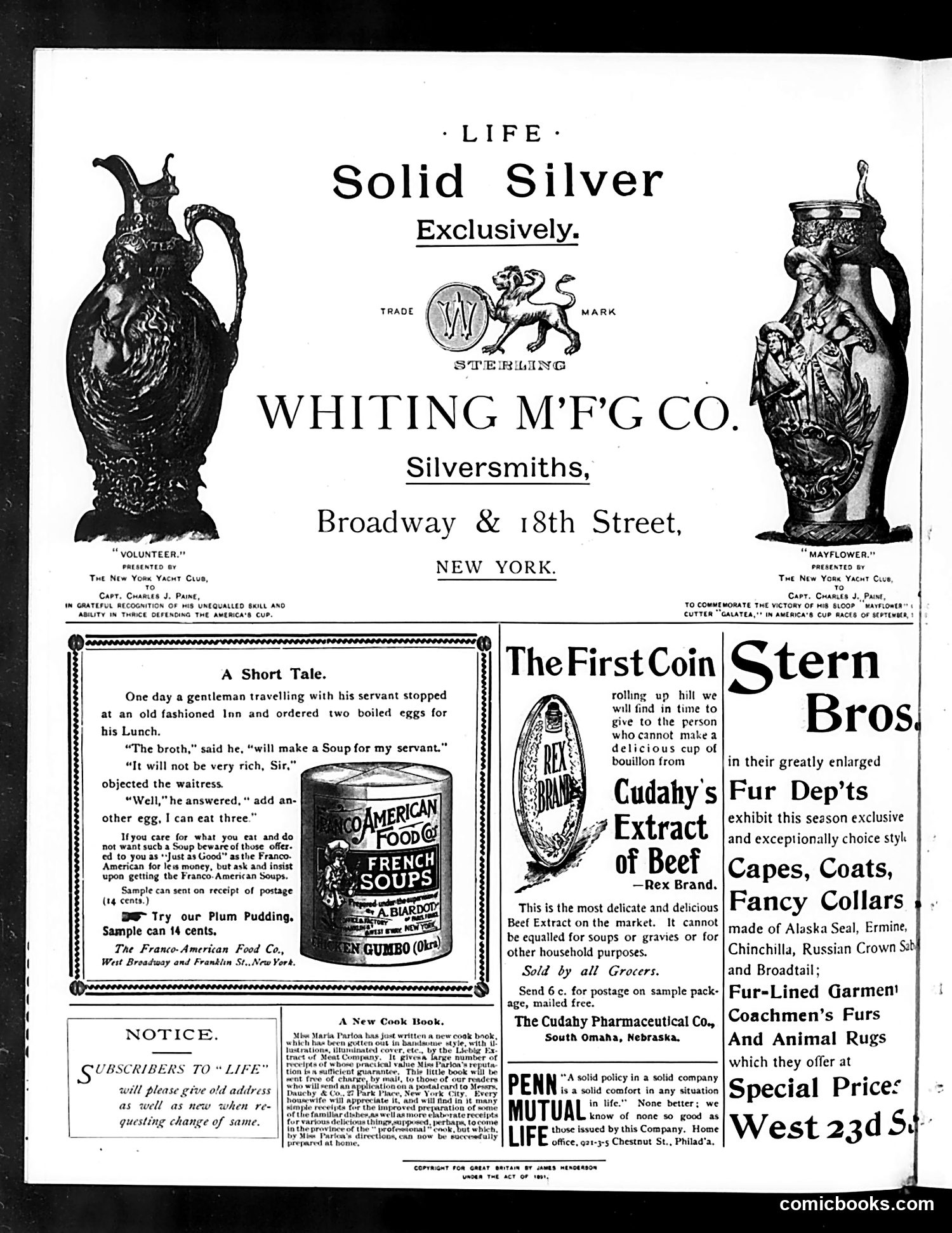
This page is **primarily advertising**, not political satire. The dominant content features two ornate silver pitchers from **Whiting Manufacturing Company** (a New York silversmith). These appear to be trophies: the left pitcher labeled "Volunteer" was presented by the New York Yacht Club to Captain Charles J. Paine, and the right "Mayflower" pitcher commemorates a yacht-racing victory in America's Cup races of September. The remaining space contains miscellaneous period advertisements: Franco-American soups, Cudahy's Extract of Beef, a cookbook, Penn Mutual Life Insurance, and Stern Brothers' fur department store. There is **no discernible political cartoon or satirical content** on this page—it represents standard magazine advertising of the early 20th century mixed with product announcements.
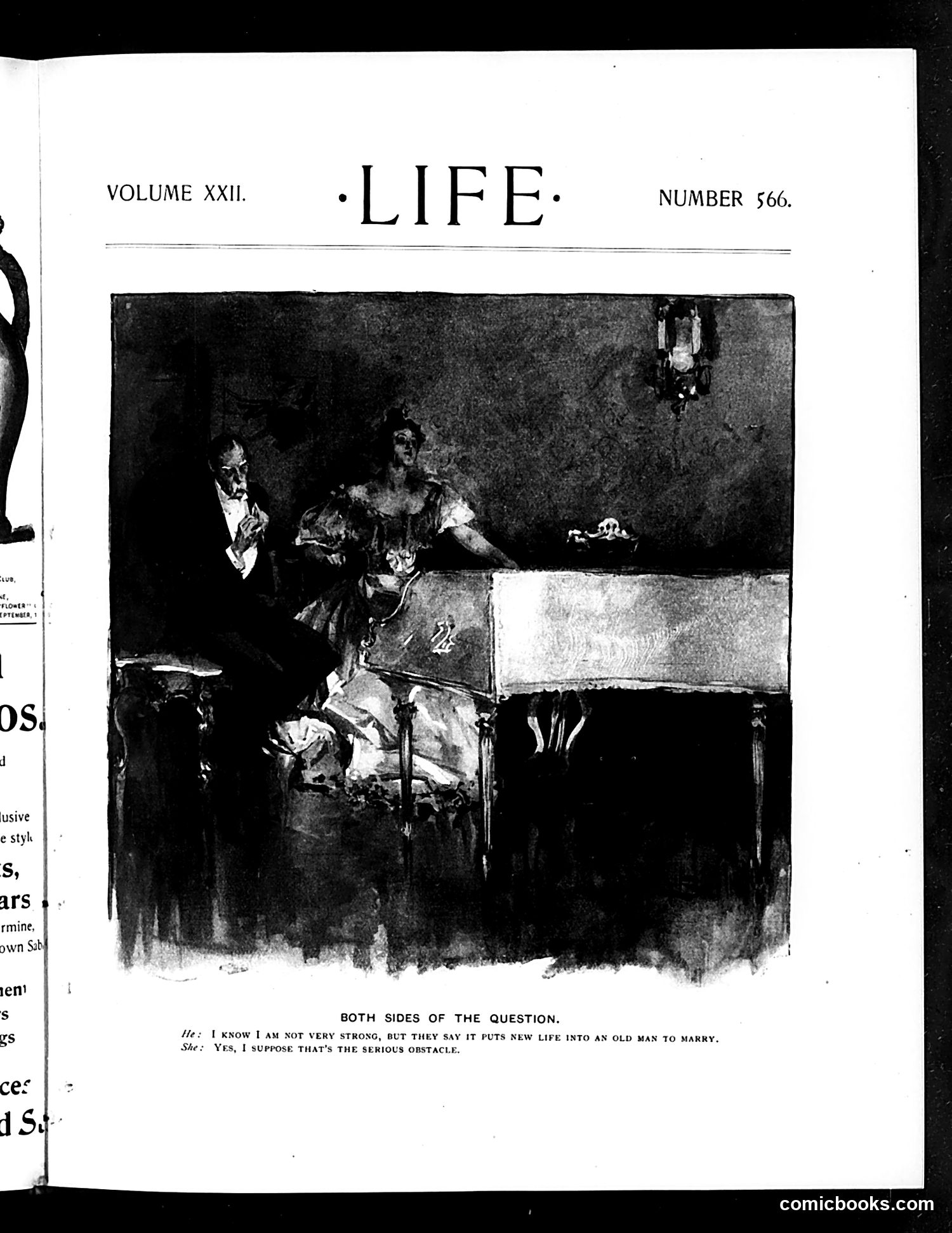
This Life magazine page presents a cartoon titled "Both Sides of the Question" depicting what appears to be a domestic scene with a couple discussing marriage. The dialogue reads: **Him:** "I know I am not very strong, but they say it puts new life into an old man to marry." **She:** "Yes, I suppose that's the serious obstacle." The satire targets contemporary anxieties about marriage and aging. The joke hinges on the woman's skepticism about marriage revitalizing an elderly husband—she considers his weakness the "serious obstacle" to matrimony. This reflects early 20th-century social commentary on marriage motivations and gender dynamics, where women's practical concerns about marrying older, less vigorous men are presented ironically. The cartoon mocks both romantic idealism and matrimonial practicality of the era.
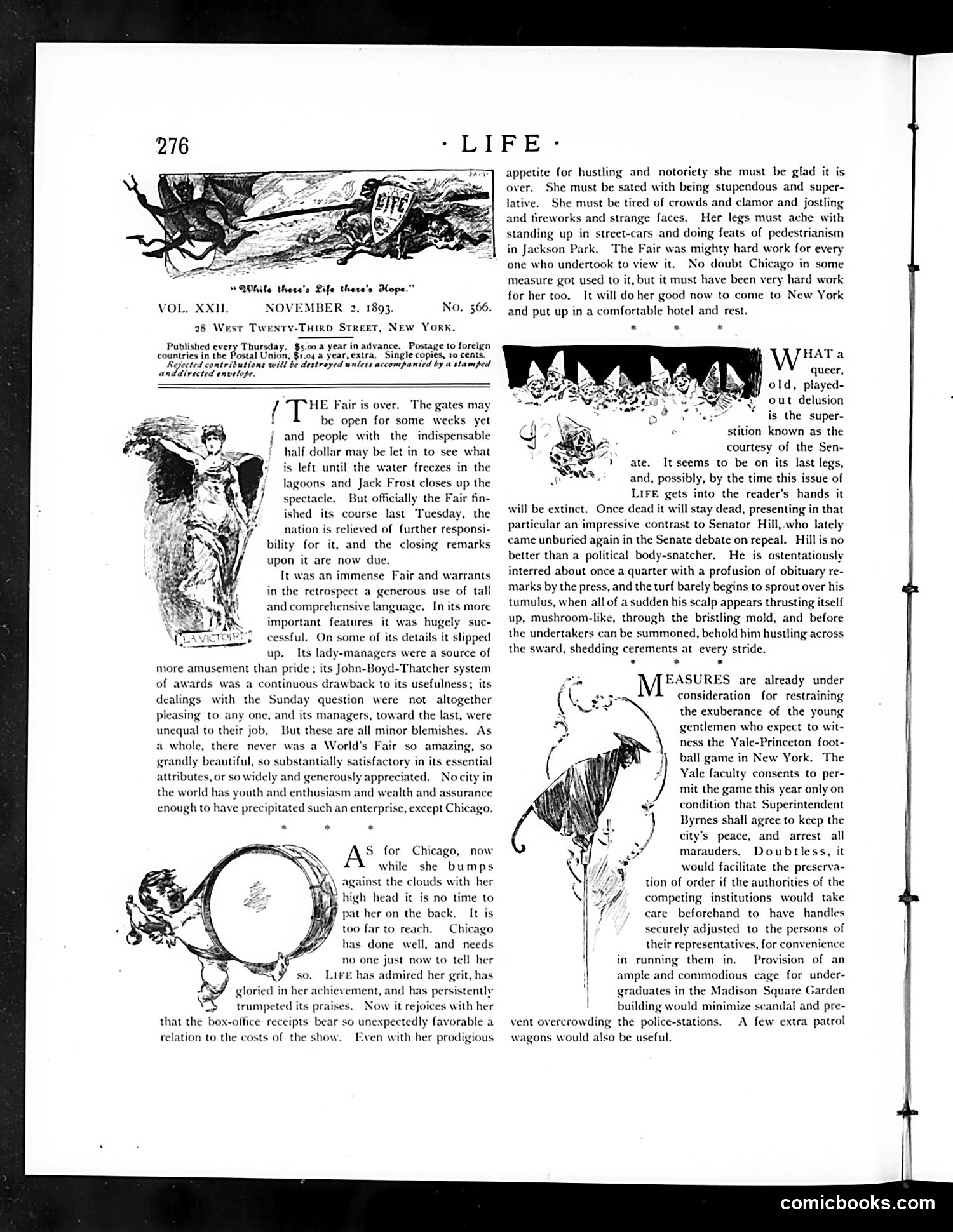
This page discusses the recently-closed World's Columbian Exposition ("the Fair") in Chicago. The satirical commentary praises the fair's success while gently mocking Chicago's enthusiastic self-promotion and the city's need for validation. The cartoons feature allegorical figures—likely representing Chicago or American progress—depicted in classical style. The text criticizes how Chicago "bumps against the clouds with her high head" and "has admired her grit," suggesting satirical commentary on the city's boastfulness. The page also addresses Yale-Princeton football game security concerns in New York, proposing "cages for undergraduates" in Madison Square Garden to prevent rowdy behavior—a humorous exaggeration of youth conduct anxieties of the era.
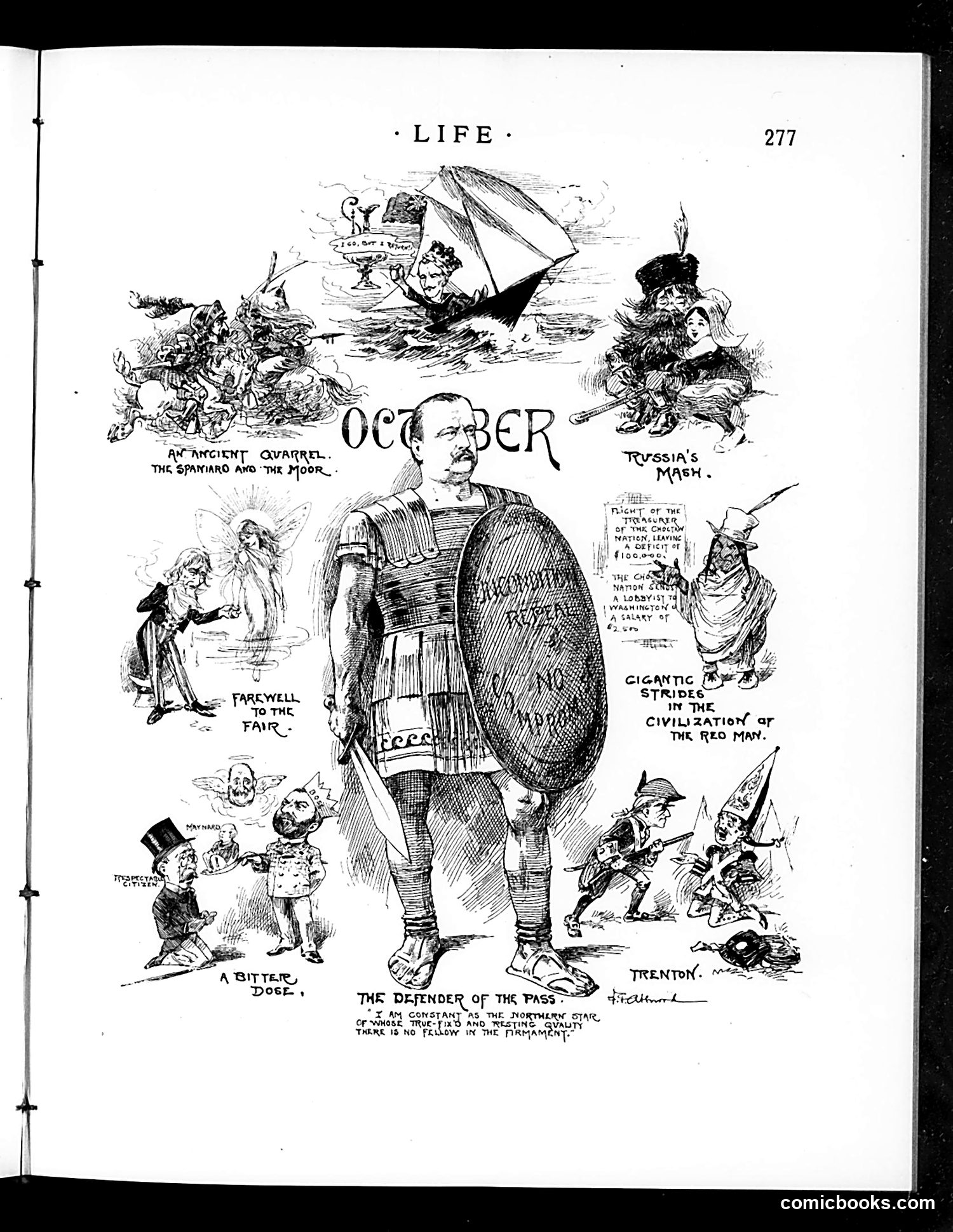
This is a political cartoon titled "The Defender of the Pass," centered on a large military figure in Roman-style armor. The surrounding vignettes reference Russian (Tsarist) military and political themes, labeled "Tsussia's Marsh," "Flight of the Turbulent Nobles," and "Gigantic Strides in the Civilization of the Red Man." The cartoon appears to satirize Russian military leadership during conflict, possibly relating to the Russo-Japanese War or internal Russian political instability. The "pass" likely represents a strategic military position. Smaller scenes mock Russian nobility, military incompetence, and broader geopolitical struggles. The "Ancient Quarters," "Spaniard and the Moor," and "Bitter Dose" references suggest this compares Russia's contemporary struggles to historical conflicts, implying Russia faces perpetual chaos and military challenges.
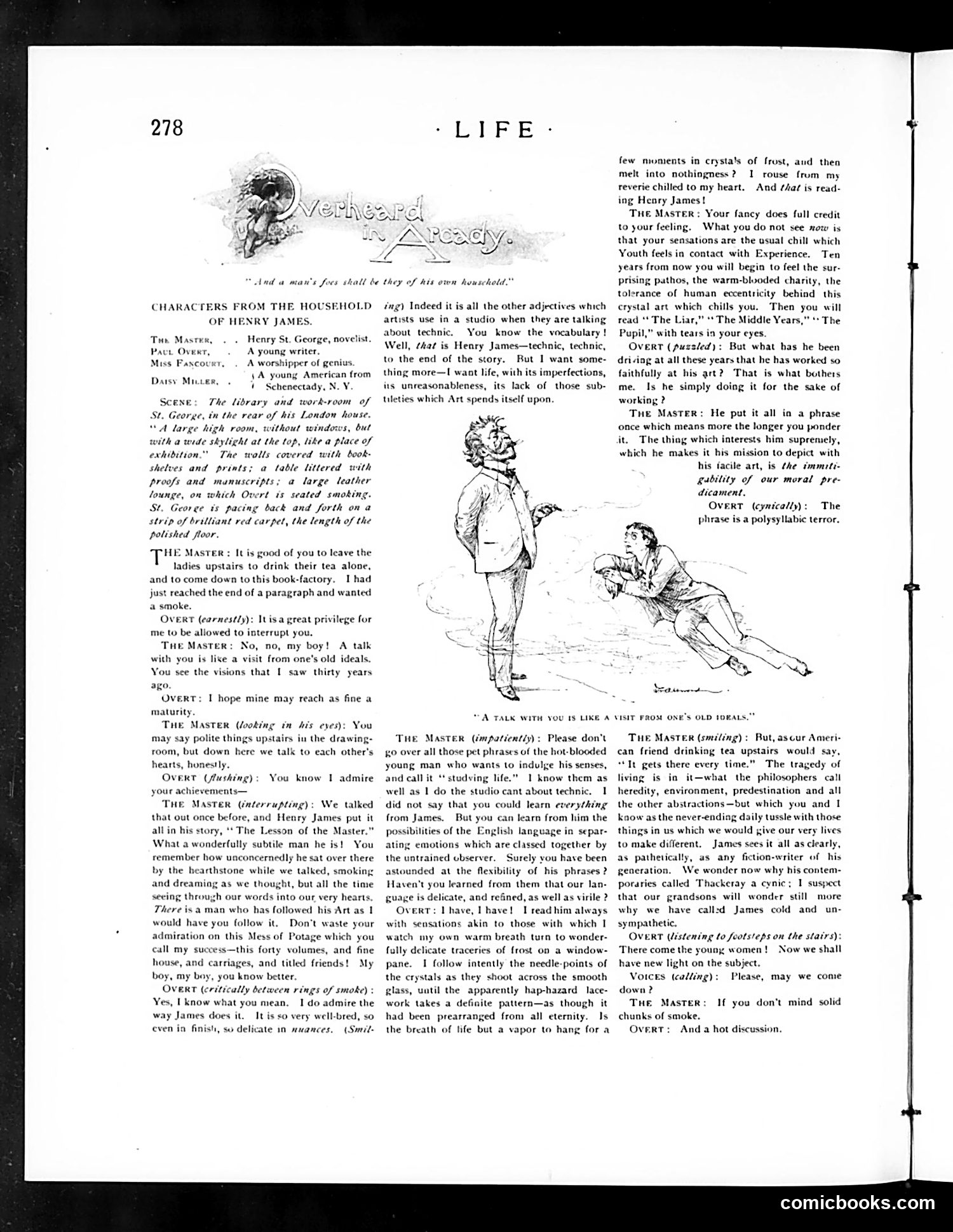
This page presents a dramatic dialogue scene titled "Overheard Already," featuring two illustrated figures in conversation. The taller man appears to be lecturing a younger, smaller figure who is bent over or cowering. The text discusses Henry James's writing style—specifically his use of complex language and artistic technique. The Master (the taller figure) defends James's elaborate prose as expressing subtle emotional truths, while Overt (the younger figure) questions whether such density of language truly captures "life." The satire targets literary pretension: James's ornate style versus genuine human experience. The physical comedy—the small figure literally diminished before the pontificating "Master"—mocks how avant-garde artistic theory can overwhelm and intimidate those seeking authentic artistic expression.
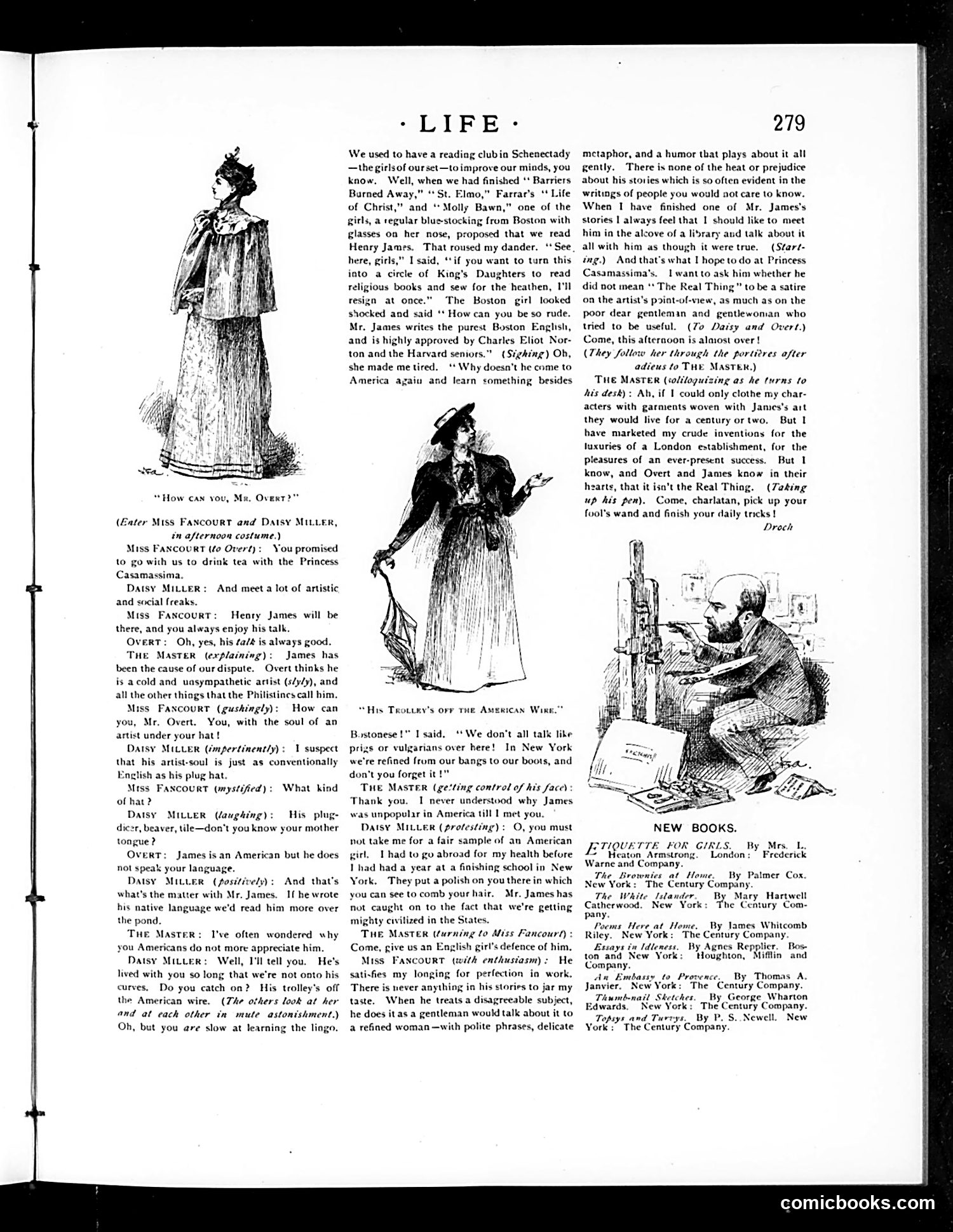
This page contains a satirical dialogue between literary characters discussing Henry James, the American novelist. The conversation mocks James's notoriously complex, dense prose style and his unpopularity in America. Characters debate whether James is a true artist or merely writes in an affectedly "cold and unsympathetic" manner. One speaker defends him as misunderstood; another jokes that James's language is incomprehensibly difficult ("Does he speak your language?"). The satire targets James's reputation for ornate, challenging writing that alienated American readers, despite his popularity among literary elites and Harvard professors. The cartoon illustrates the cultural divide between James's refined artistic ambitions and mainstream American taste—a recurring critique of his work during this period.
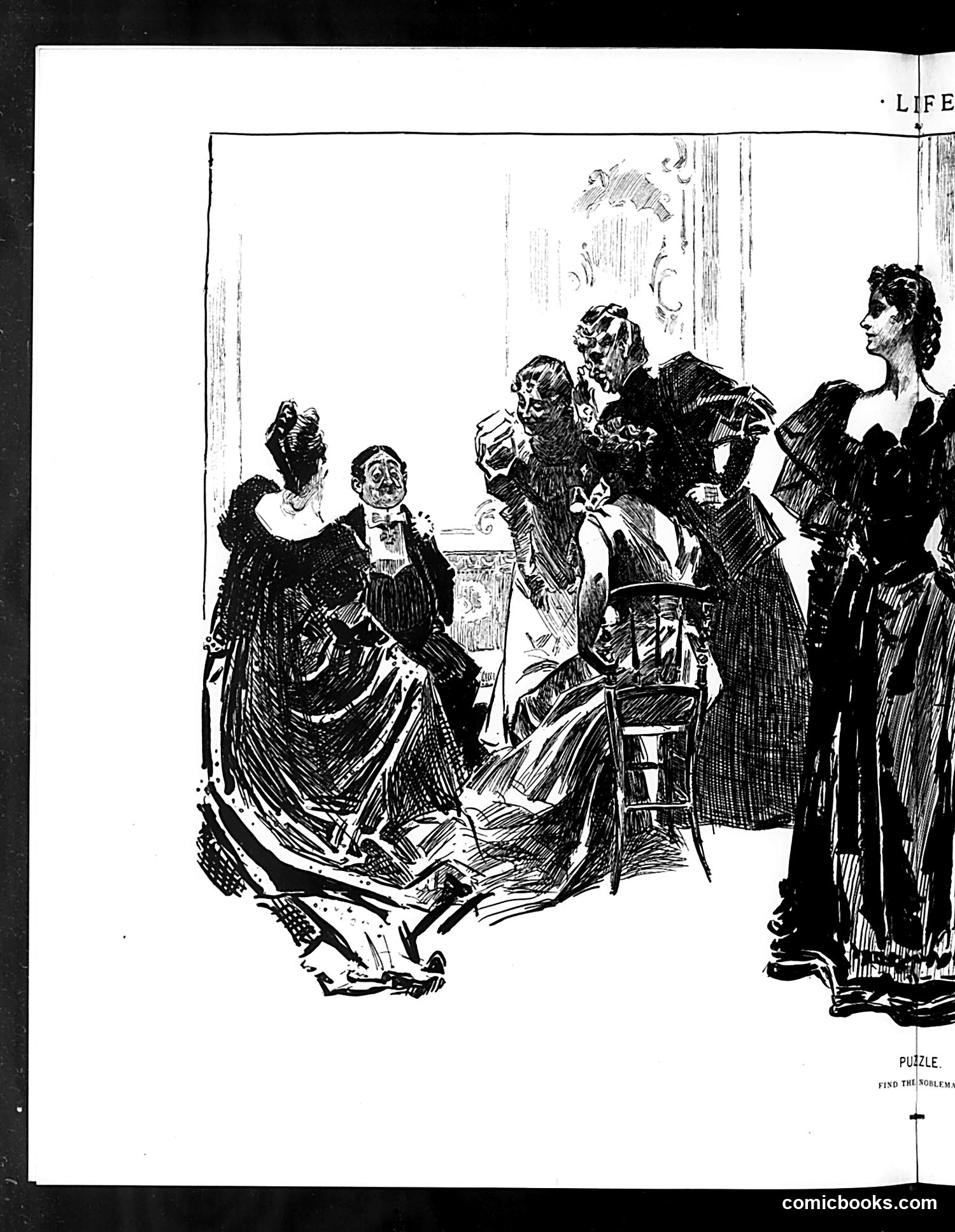
This is a satirical illustration titled "Puzzle: Find the Problem" from *Life* magazine. The sketch depicts an elegant social gathering of well-dressed men and women in what appears to be a formal drawing room or salon setting. The figures are rendered in a detailed ink-sketch style typical of early 20th-century magazine illustration. The satire likely critiques social pretension or the artificiality of high society. The "puzzle" invites readers to identify what is wrong or absurd about the scene—possibly that one figure doesn't belong, or that the entire gathering represents some form of social hypocrisy. Without additional context about the specific historical moment or accompanying text, the exact target of the satire remains unclear, though it appears to mock upper-class social conventions or gatherings of the era.
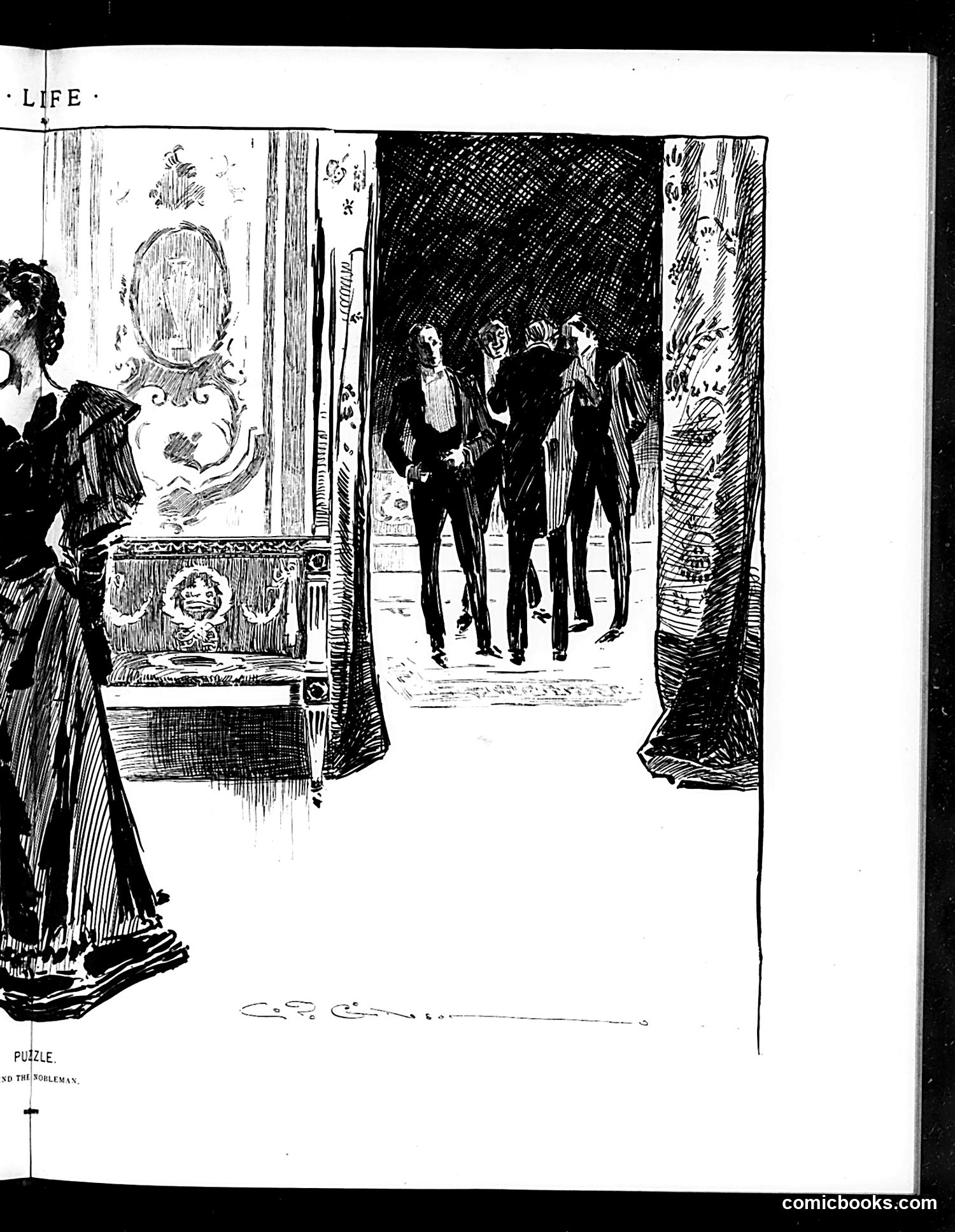
This page from *Life* magazine contains a cartoon titled "Puzzle to the Nobleman." The illustration depicts a domestic interior scene where a woman in dark clothing stands at left, observing three men in formal attire gathered outside through an open doorway. The scene appears to satirize upper-class social interactions or etiquette. The "puzzle" likely refers to the woman's bewilderment at the men's behavior or conversation visible through the doorway. Without additional context about the specific historical moment, the exact satirical point remains unclear—though it appears to mock aristocratic social conventions or the incomprehensibility of gentlemen's conduct to observers. The artist's signature is visible but not fully legible.
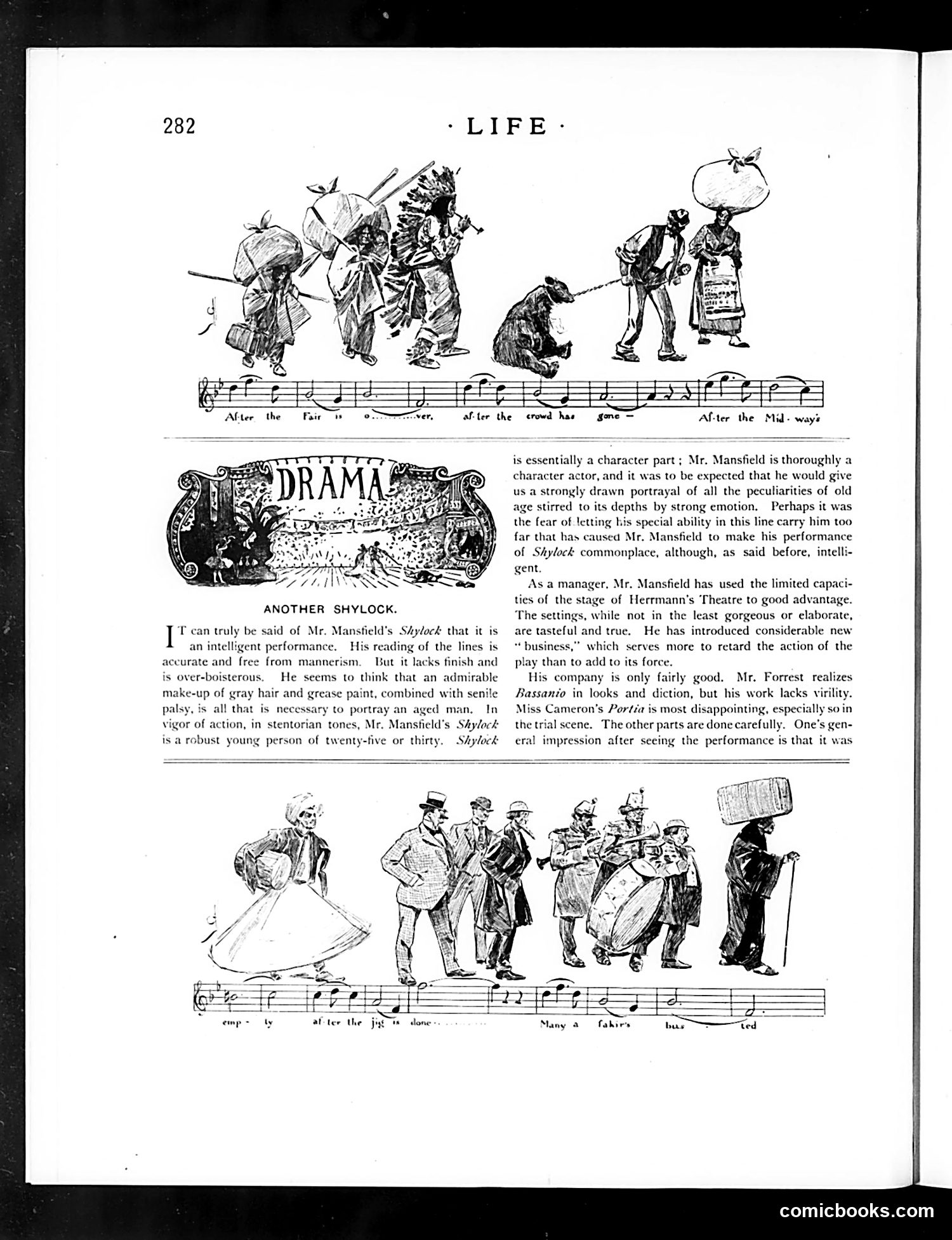
This page reviews a theatrical production of *Shylock*, featuring actor Mr. Mansfield in the title role. The illustrated vignettes show scenes from the play with musical notation beneath. The review critiques Mansfield's performance as intelligent but overly cautious—afraid to fully explore the character's emotional depths. The critic praises his makeup and costuming as appropriately aged, but notes the performance remains "commonplace." The supporting cast receives mixed reviews: Mr. Forrest's *Bassanio* lacks vitality, and Miss Cameron's *Portia* disappoints, especially in trial scenes. Overall, the production benefits from tasteful settings but lacks theatrical force. The musical notation likely indicates songs or instrumental accompaniment accompanying the staged scenes depicted above.
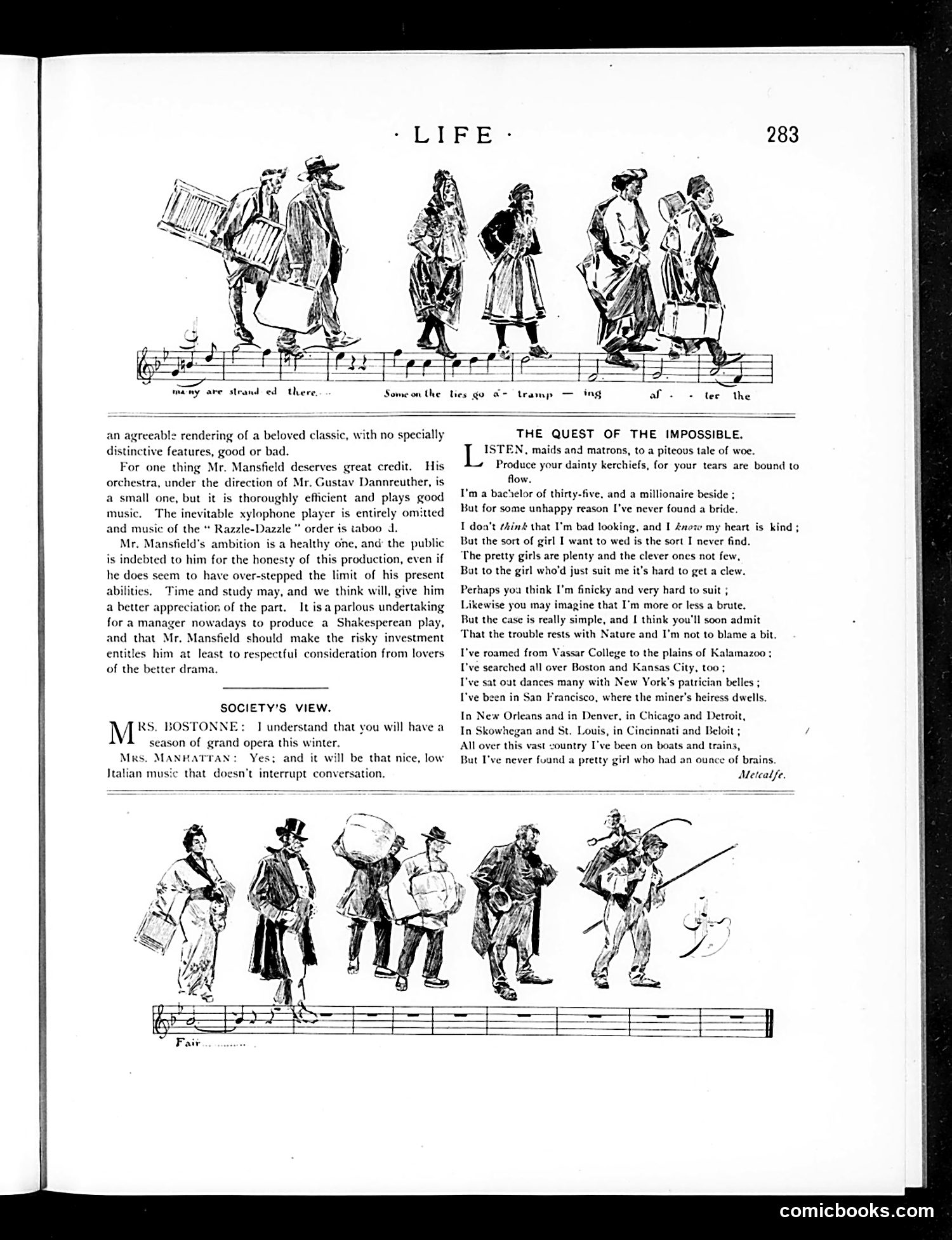
This page contains theatrical/operatic satire with musical accompaniment. The top illustration depicts characters struggling with luggage, accompanying lyrics about being "stranded there" with "tramp-ing af...tee the." The middle section titled "SOCIETY'S VIEW" features a brief dialogue between Mrs. Bostonne and Mrs. Manhattan discussing an upcoming opera season—a gentle mockery of high society's musical pretensions. "THE QUEST OF THE IMPOSSIBLE" presents a monologue from a bachelor describing his futile search for an intelligent bride across America—from Boston to Denver to New Orleans. The joke satirizes both the bachelor's impossibly high standards and contemporary American women. The bottom illustration shows six figures in period dress with musical notation, captioned "Fair." The overall satire targets upper-class affectation regarding arts and romance.
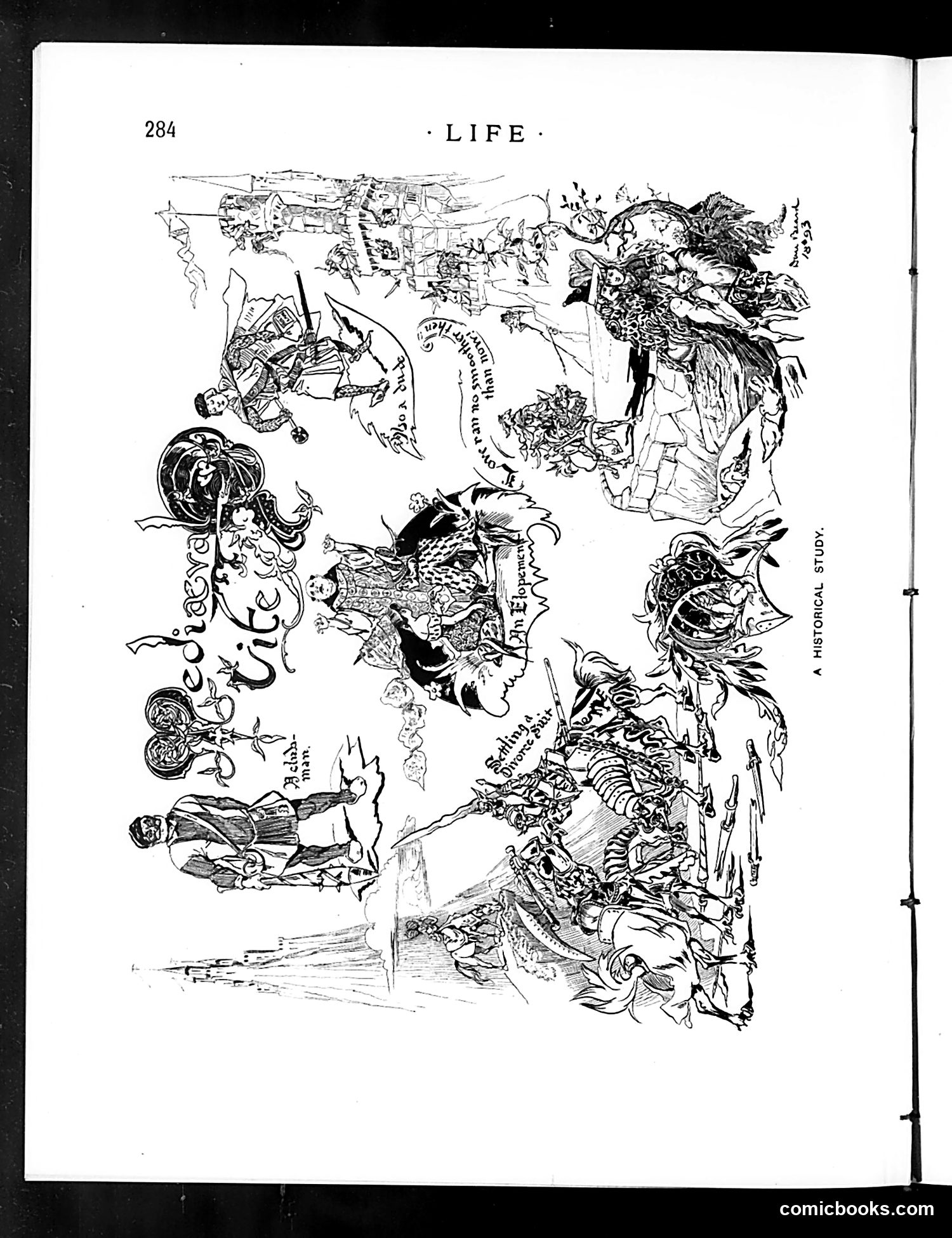
This page from *Life* magazine presents "A Hierarchical Study" — a satirical illustration organizing various figures in a hierarchical arrangement, likely social or political commentary. The page is rotated and contains multiple grotesque caricatures rendered in detailed pen-and-ink style. Without clearer OCR text or visible labels identifying specific individuals, I cannot confidently name the particular figures or explain the precise satirical targets. The hierarchical composition suggests commentary on social stratification or power structures, a common *Life* magazine theme. The elaborate, somewhat grotesque character designs indicate mockery of the subjects' pretensions or characteristics. To accurately explain this cartoon's meaning, clearer identification of the labeled figures would be necessary.
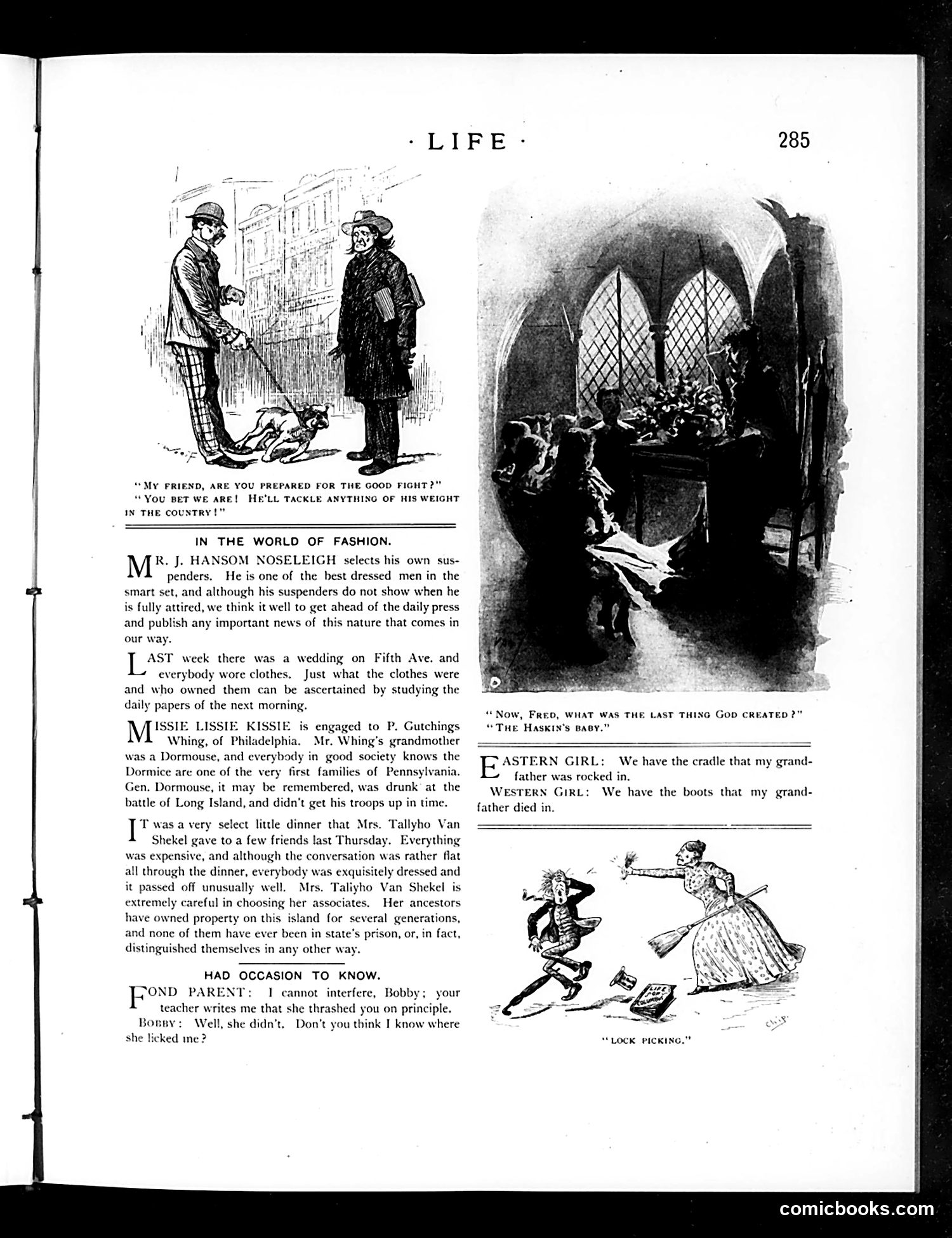
This page satirizes American high society and pretension through multiple sketches: **Top cartoon**: Two men discuss boxing; the humor likely involves one man's confident boasting about fighting opponents "of his weight." **Fashion section**: Mocks wealthy New York society by highlighting absurd details. "Mr. J. Hansom Noseleigh" is a caricatured socialite whose *invisible* suspenders supposedly merit press coverage—satirizing how society pages report trivial details about the well-dressed elite. The section ridicules Fifth Avenue weddings, genealogical obsession (Missie Kissie's engagement to "P. Gutchings Whing" whose grandmother was a "Dormouse"), and the Van Shekel family's anxiety about maintaining respectability while lacking actual distinction. **Humorous anecdotes**: Include a child's crude misunderstanding of corporal punishment and a joke about God's final creation being "the Haskin's baby." **Bottom cartoon ("Lock Picking")**: Depicts children engaged in mischief. Overall, the page ridicules upper-class pretension, genealogical snobbery, and the emptiness behind society's polished exterior.
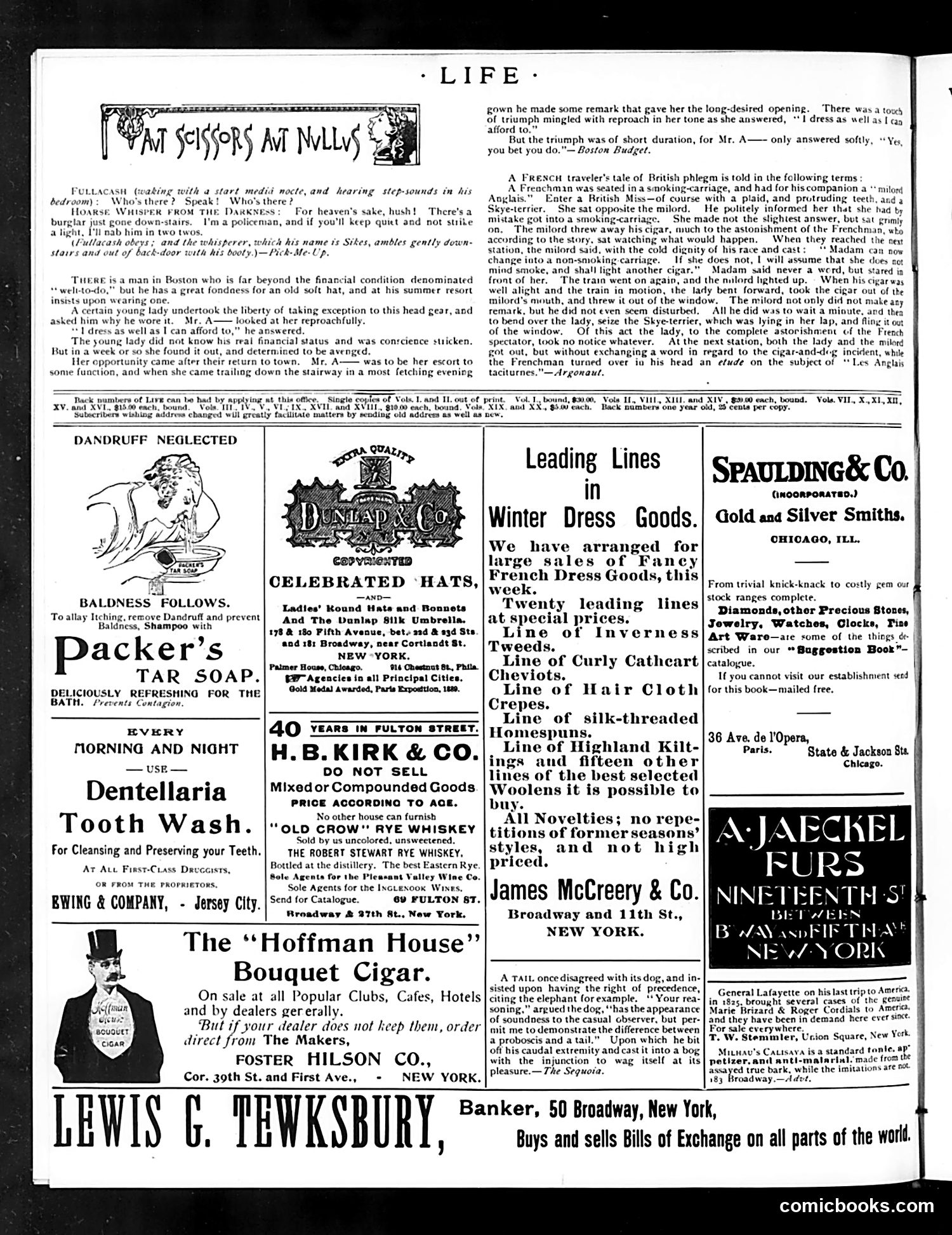
This page contains two humorous anecdotes rather than political cartoons: **"Fullacash" Story**: A man is awakened by noises; a "hoarse whisper from the darkness" claims to be a policeman warning of a burglar downstairs. Fullacash obeys and goes down, whereupon the "policeman" (actually the burglar) flees with his boots. The joke is a simple con—the burglar poses as law enforcement to ensure the homeowner won't interfere. **The "Old Hat" Anecdote**: A wealthy Boston man refuses to discard a shabby old hat despite his financial means. A young lady he knows questions this, and he responds he "dresses as well as I can afford to." Later, she retorts with the same line, implying he's poor—but he responds "Yes, you bet you do," suggesting she dresses too well for her actual means. The satire mocks superficial social judgment and class pretense. **The French Traveler Story**: A lengthy anecdote contrasting British stoicism with French dramatics—a milord and Frenchman in a train carriage engage in an escalating cigar dispute with understated British dignity versus emotional French reaction.