
Life, 1893-11-02 · page 6 of 14
Life — November 2, 1893 — page 6: what you’re looking at
What you’re looking at
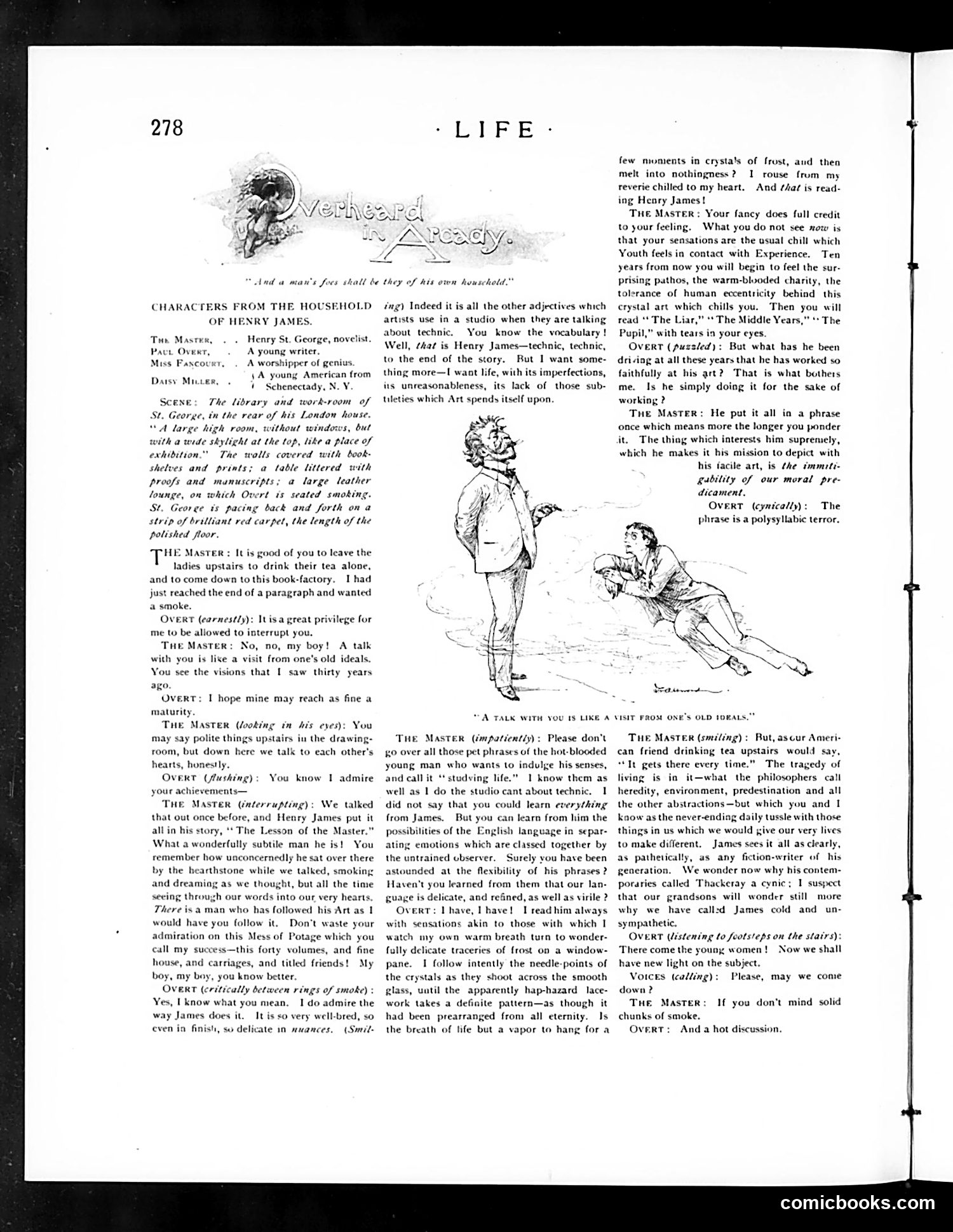
This page presents a dramatic dialogue scene titled "Overheard Already," featuring two illustrated figures in conversation. The taller man appears to be lecturing a younger, smaller figure who is bent over or cowering. The text discusses Henry James's writing style—specifically his use of complex language and artistic technique. The Master (the taller figure) defends James's elaborate prose as expressing subtle emotional truths, while Overt (the younger figure) questions whether such density of language truly captures "life." The satire targets literary pretension: James's ornate style versus genuine human experience. The physical comedy—the small figure literally diminished before the pontificating "Master"—mocks how avant-garde artistic theory can overwhelm and intimidate those seeking authentic artistic expression.
📄 Transcribed text from this page (OCR, searchable)
Machine-transcribed from the original scan — historical spelling and the odd misread are preserved.
"And a man's foes shall be they of his own houscheld.” CHARACTERS FROM THE HOUSEHOLD RY JAM Tun Masten, Pact. Overr, Miss Faxcoe Henry St. George, novelist. A young writer. A worshipper of genius. A ung American from Dale Mets, ‘ schenectady, N y. Scene: The library and work-room of St. George, in the rear of his London house. “A large high room, without windows, but with a wide skylight at the top, like a place of The walls covered with book- @ table littered with proofs and manuscripts; a@ large leather lounge, on which Overt is seated smoking. St. George is pacing back and forth on a strip of brilliant red carpet, the length of the polished floor. exhibition.” shelves and prints; HE Master : It is good of you to leave the ladies upstairs to drink their tea alone, and to come down to this book-factory. I had just reached the end of a paragraph and wanted a smoke. OVERT (earnestly): Iisa great privilege for me to be allowed to interrupt you. THe Master: No, no, my boy! A talk with you is like a visit from one's old ideals. You sce the visions that [1 saw thirty years ago. OveRT: I hope mine may reach as fine a maturity. THE Master (looking in his eyes): You may say polite things upstairs in the drawing- room, but down here we talk to each other's hearts, honestly, Overt (flushing) your achievements— THE MASTER (interrupting): We talked that out once before, and Henry James put it all in his story, The Lesson of the Master.” What a wonderfully subtile man he is! You remember how uaconcernedly he sat over there by the b and dream You know I admire «thstone while we talked, smoking ing as we thought, but all the time seeing through our words into our very hearts. There is a man who has followed his Art as 1 would have you follow it, admiration on this Mess of Potage which you call my success—this forty volumes, and fine house, and carriages, and titled friends! My boy, my boy, you know better, Overt (critically between rings of smoke) : Yes, [know what you mean, I do admire the way James does it, It is so very well-bred, so Don’t waste your even in finish, so delicate in nuances. ing) Indeed it is all the other adjectives which artists use in a studio when they are talking about technic. You know the vocabulary | Well, ¢hat is Henry James—technic, technic, to the end of the story. But I want some- thing more—I want life, with its imperfections, its _unreasonableness, its lack of those sub- Uleties which Art spends itself upon. “A TALK WITH YoU IS LIKE A THE MASTER (’mpatientiy): Please don't Ko over all those pet phrases of the hot-blooded young man who wants to indulge his senses, and call it * studving life.” 1 know them as well as 1 do the studio cant about technic. 1 did not say that you could learn everything from James. But you can learn from him the possibilities of the English language in separ- ating emotions which are classed together by the untrained observer. Surely you have been astounded at the flexibility of his phrases ? Haven't you learned from them that our lan- guage is delicate, and refined, as well as virile ? Overt: Thave, Thave! [read him always with sensations akin to those with which I watch my own warm breath turn to wonder- fully delicate traceries of frost on a window- pane. I follow intently the needle-points of the crystals as they shoot across the smooth glass, until the apparently hap-hazard_lace- work takes a definite pattern—as though it had been prearranged from all eternity. Is the breath of life but a vapor to hang for a few moments in crysta's of frost, aud then melt into nothingness? 1 reverie chilled to my heart, ing Henry James! THe Master: Your fancy does full credit to your feeling. What you do not see now is that your sensations are the usual chill which Youth feels in contact with Experience. Ten years from now you will begin to feel the sur- prising pathos, the warm-blooded charity, the tolerance of human eccentricity behind this crystal art which chills you. Then you will read ‘ The Liar,” ** The Middle Years," ** The Pupil,” with tears in your eyes. Overt (puzzled): But what bas he been deising at all these years that he has worked so faithfully at his art? That is what bothers Is he simply doing it for the sake of working ? Tue Master: He put it all in a phrase once which means more the longer you ponder it. The thing which interests him supremely, which he makes it his mission to depict with his facile art, is the tmmiti- gability of our moral pre- dicament. OverT (cynically): The a polysyllabic terror. rouse frum my And that is read- me. VISIT FROSt ONE'S OLD 1ORALS.” The MASTER (smiling): But, ascur Ameri- can friend drinking tea upstairs would say, “It gets there every time.” The tragedy of living is in it—what the philosophers call heredity, environment, predestination and all the other abstractions—but which you and I koow as the never-ending daily tussle with those things in us which we would give our very lives to make different. James sees it all as clearly, as pathetically, as any fiction-writer of his generation. We wonder now why his contem- poraries called ‘Thackeray a cynic; 1 suspect that our grandsons will wonder still why we have call:d James cold and un- sympathetic. OVERT (listening to footsteps on the stairs): There come the young women! Now we shall have new light on the subject. Votces (calling): Please, may we come down? THe Master: chunks of smoke, OveRT: And a hot discussion. more If you don't mind solid comicbooks.com