
A complete issue · 16 pages · 1893
Life — October 26, 1893
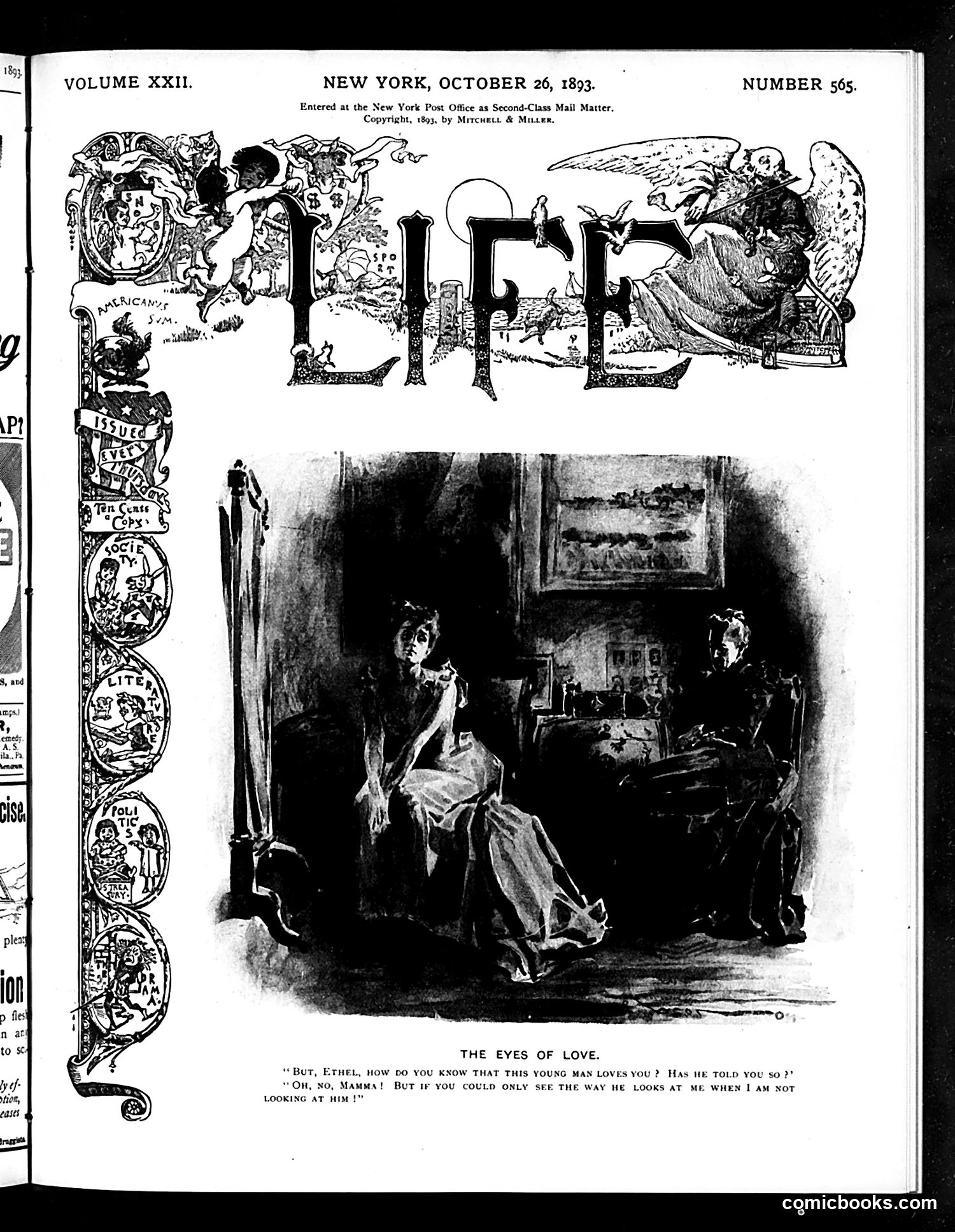
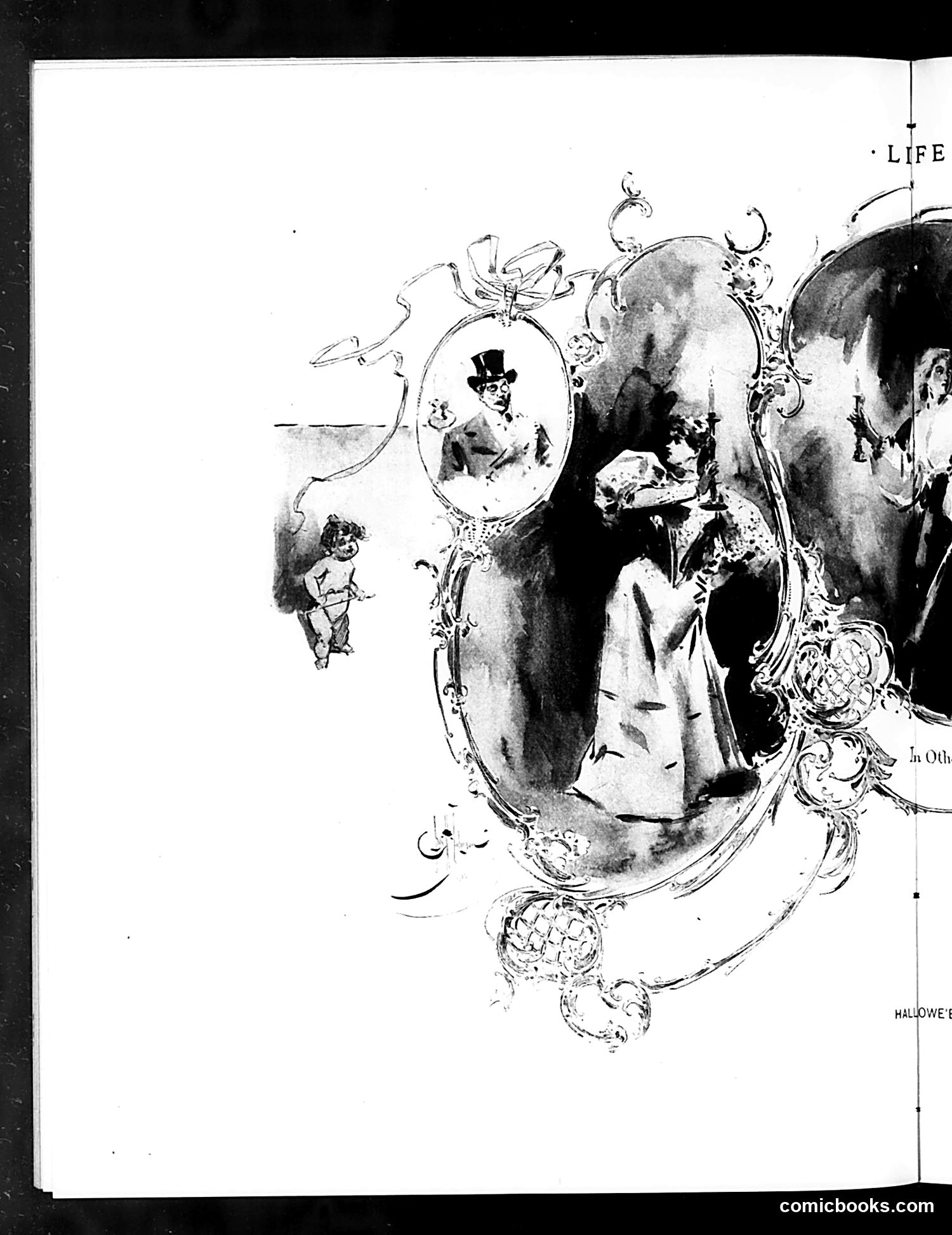
This illustration depicts a domestic scene titled "The Eyes of Love," featuring dialogue between what appears to be a mother (Mamma) and daughter (Ethel) about a young man's romantic feelings. The caption reads: "But, Ethel, how do you know that this young man loves you? Has he told you so?" followed by Ethel's response about observing how he looks at her when unaware. This is a sentimental romantic sketch typical of 1890s Life magazine—satirizing courtship conventions of the era. The humor likely derives from the naive, indirect communication methods of Victorian-era romance, where a young woman must infer love from glances rather than direct declaration. The ornate decorative border on the left is characteristic of the magazine's artistic design from this period.
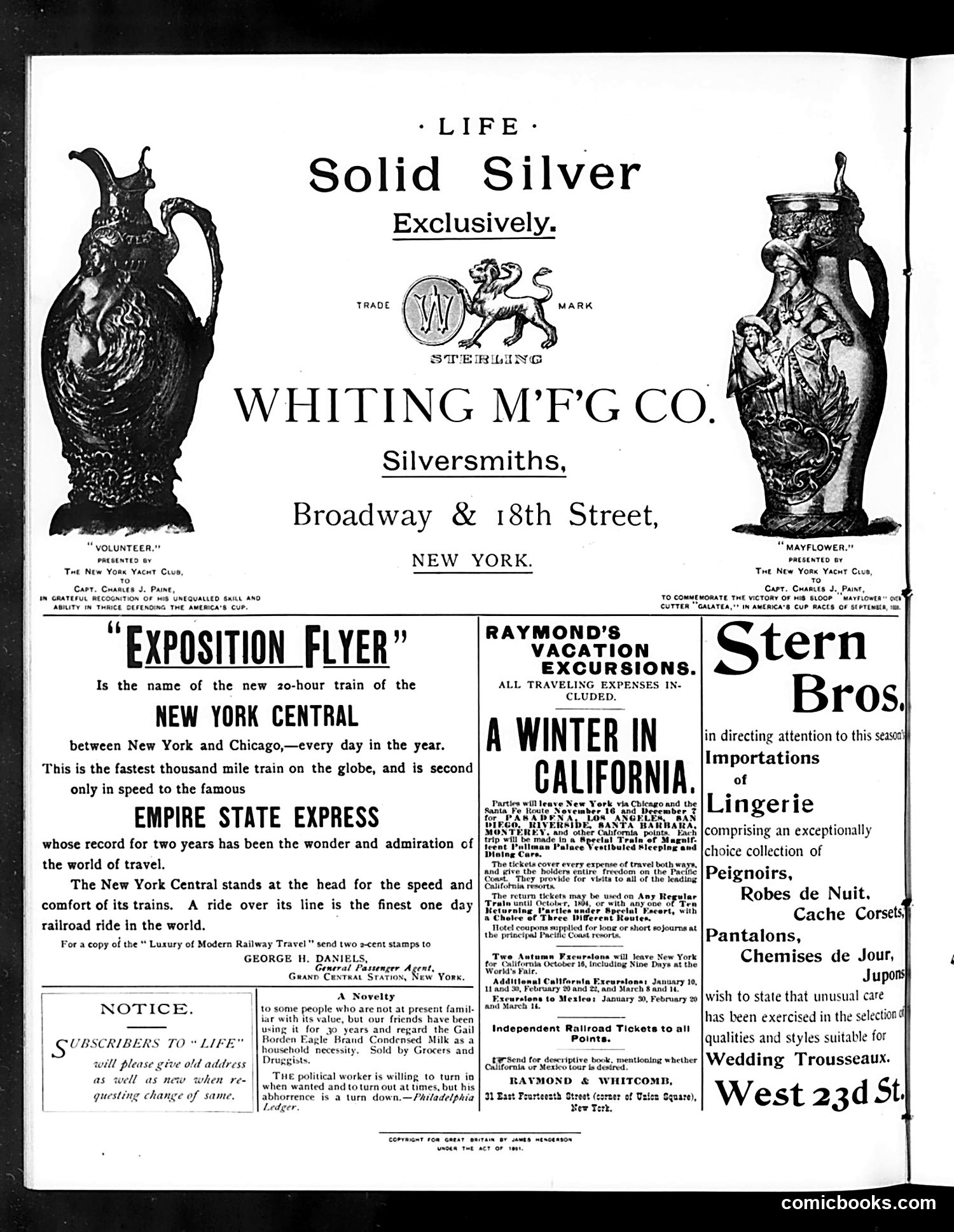
This page is primarily **advertising**, not satirical content. The dominant feature is a Whiting M'F'G Co. advertisement for solid silver serving pieces ("Volunteer" and "Mayflower" pitchers presented to the New York Yacht Club). Below are three separate ads: one for the New York Central's "Exposition Flyer" train service to Chicago; one for Raymond's vacation excursions to California; and one for Stern Bros. department store advertising imported lingerie and wedding trousseaux. A small "Notice" section requests that *Life* subscribers update their addresses. There is **no political cartoon or satirical content** visible on this page—it functions as a standard advertising vehicle for luxury goods and services aimed at wealthy New York readers.
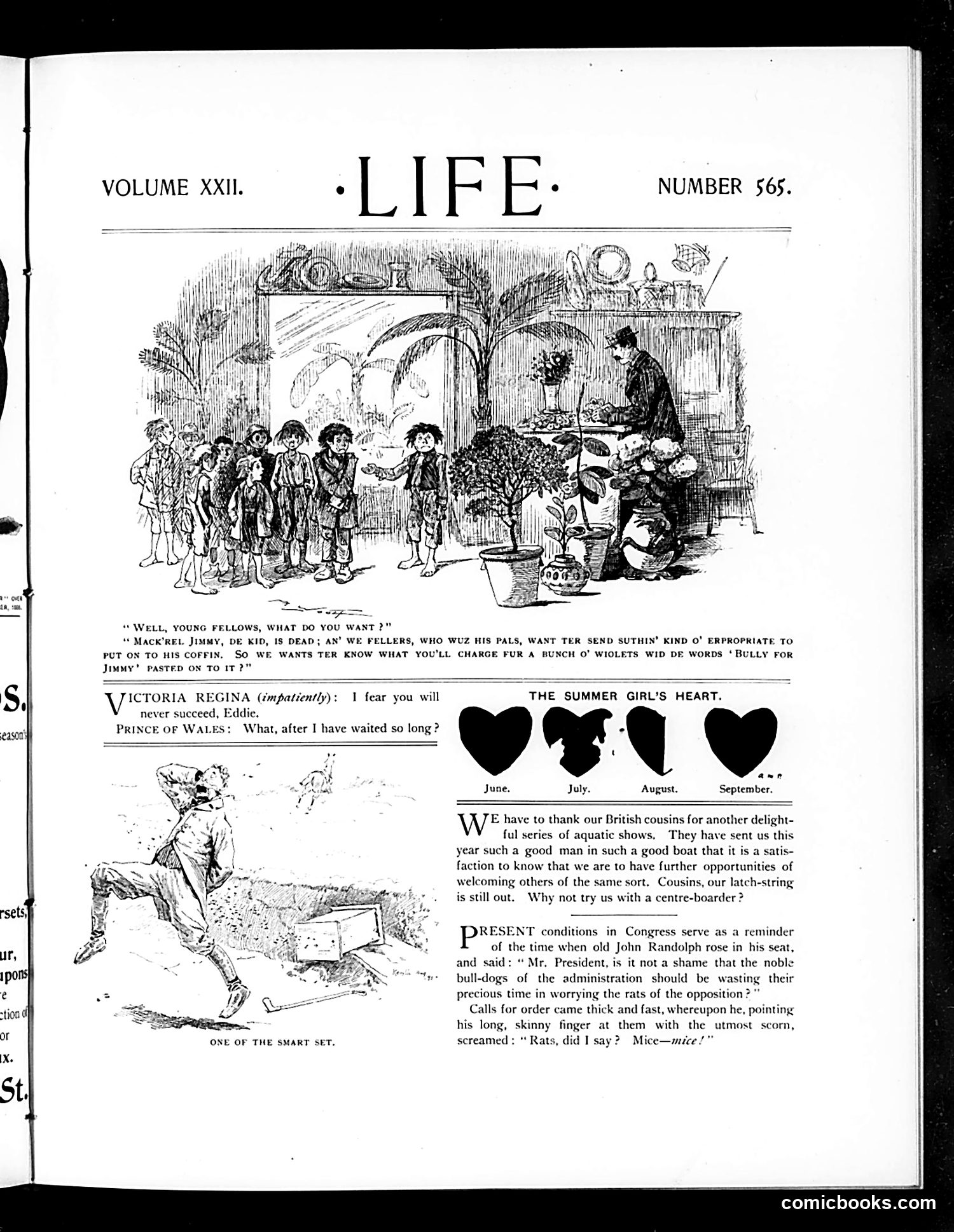
**Top Cartoon:** A florist or nurseryman is solicited by street children asking what he'll charge for flowers to place on a coffin. The dialogue references sending "appropriate" flowers for a funeral and mentions "bully" (slang for excellent). This appears to be satirizing either funeral commerce or children's morbid curiosity about death. **Middle Section:** A brief exchange between "Victoria Regina" and the "Prince of Wales" about waiting, likely a romantic reference. **"Summer Girl's Heart" graphic:** Shows a heart symbol changing across four months (June-September), suggesting romantic inconstancy or fickleness. **Bottom cartoon ("One of the Smart Set"):** Depicts a fashionable woman in an awkward pose, presumably mocking contemporary fashion or social pretension. The page combines social satire with humor about death, romance, and class.
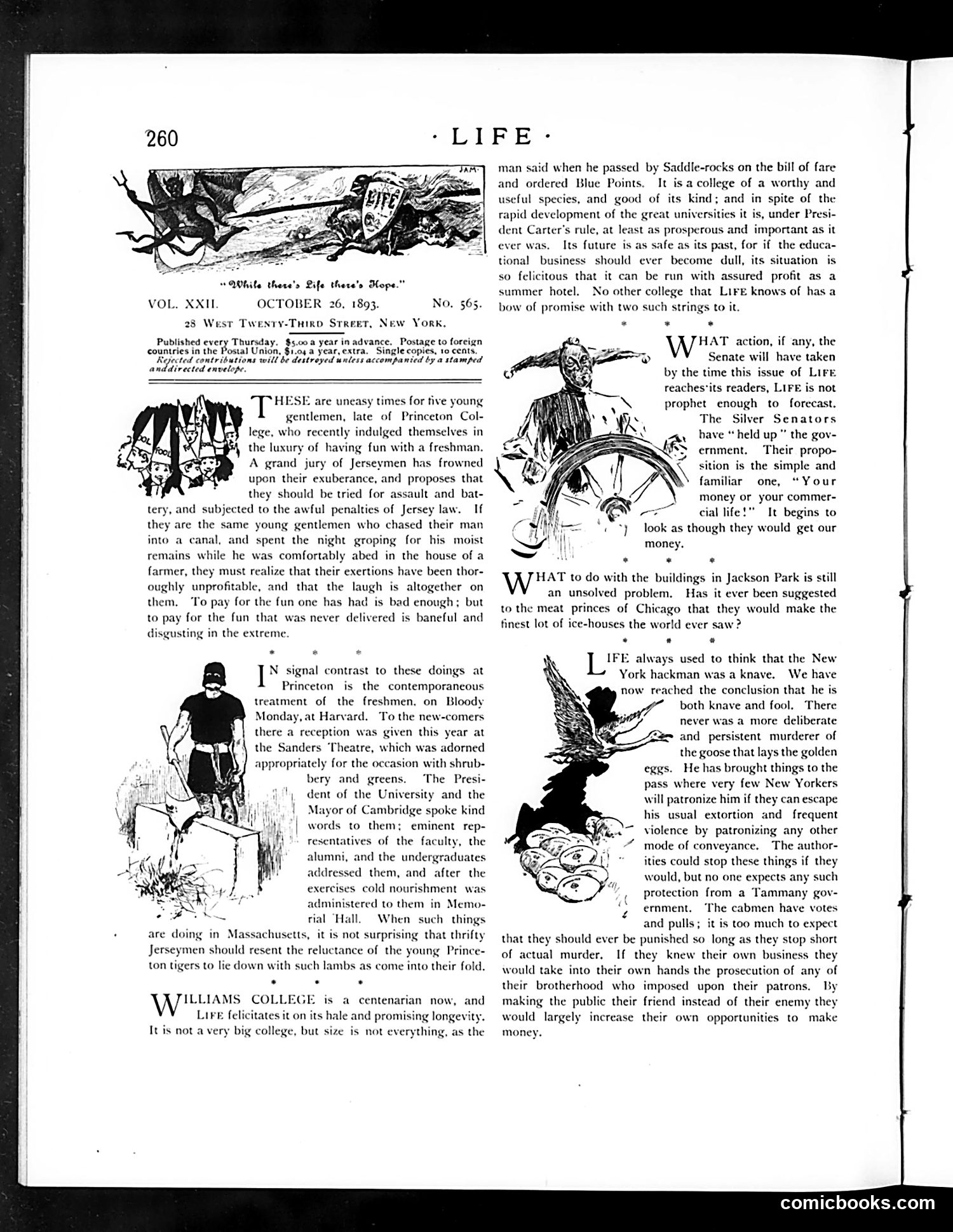
This page contains editorial commentary on contemporary issues rather than cartoons. The illustrations are decorative but the text discusses: 1. **Princeton freshman hazing**: Young gentlemen endured "assault and battery" and canal dunking. The piece sarcastically proposes they face Jersey law consequences, mocking both the perpetrators' and victims' silence. 2. **Harvard's Bloody Monday incident**: Contrasted positively with Princeton's treatment of freshmen, showing administrative competence. 3. **Williams College**: Praised for its "centennarian" status and longevity, though acknowledged as "not a very big college." 4. **New York hackmen (taxi drivers)**: Criticized as deliberate murderers who extort passengers through violence and intimidation, with authorities unwilling to prosecute. The satire targets institutional negligence and urban crime toleration.
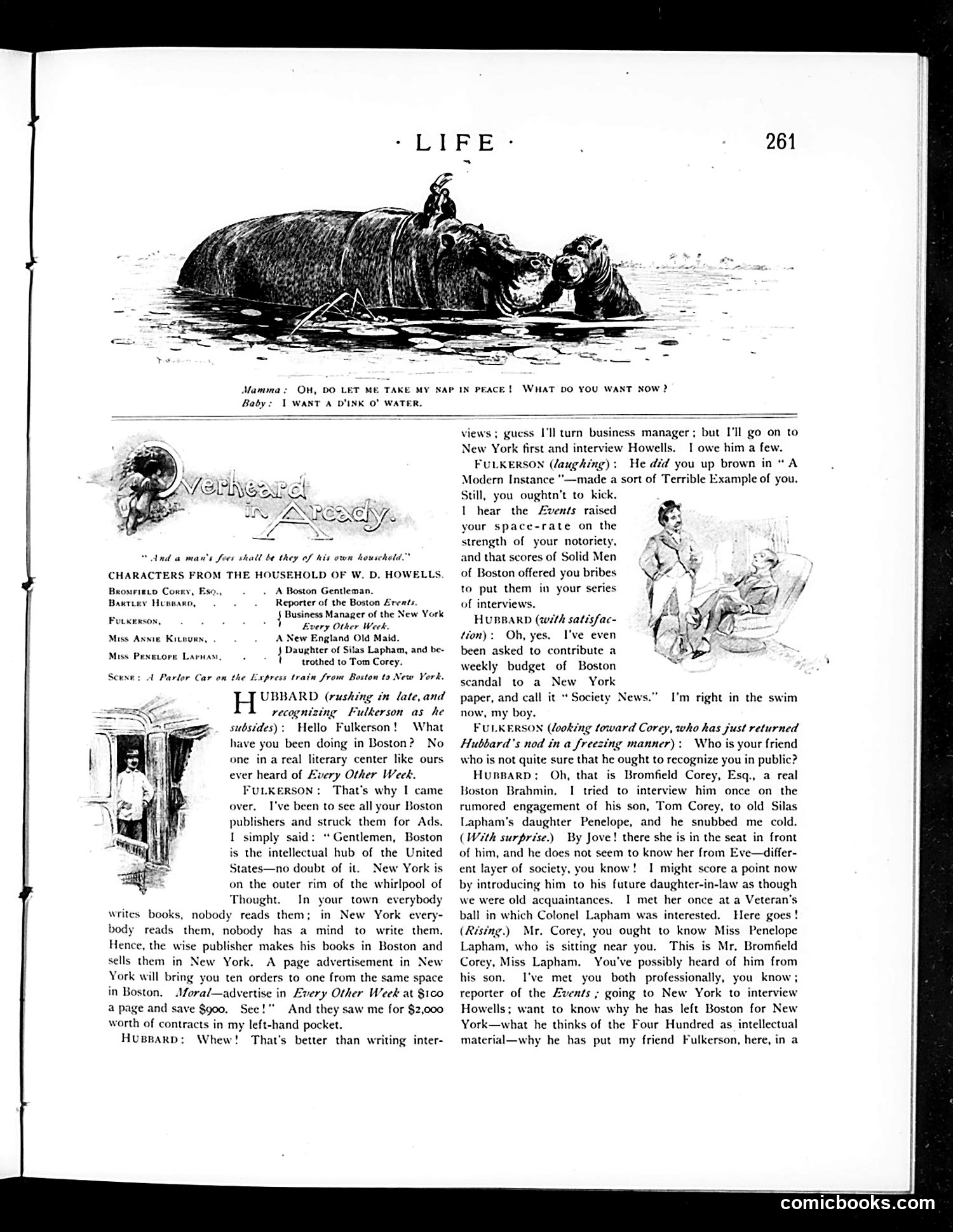
This page presents a satirical dialogue between literary figures, likely from the early 1900s. The conversation mocks the commercialization of literature and New York's publishing industry. Fulkerson, apparently a writer, discusses how Boston's intellectual reputation contrasts with New York's commercial dominance in publishing. The satire targets: - **Publishers' mercenary focus**: Advertisement contracts and page rates matter more than literary merit - **Boston vs. New York rivalry**: Boston claims intellectual prestige; New York has actual market power - **Celebrity culture**: References to securing interviews and society coverage suggest emerging media sensationalism - **Literary commodification**: Books are treated as advertisement vehicles rather than art The hippopotamus illustration at top appears unrelated—typical of Life's visual format. The overall tone ridicules how American letters had become primarily a business enterprise rather than a cultural endeavor.
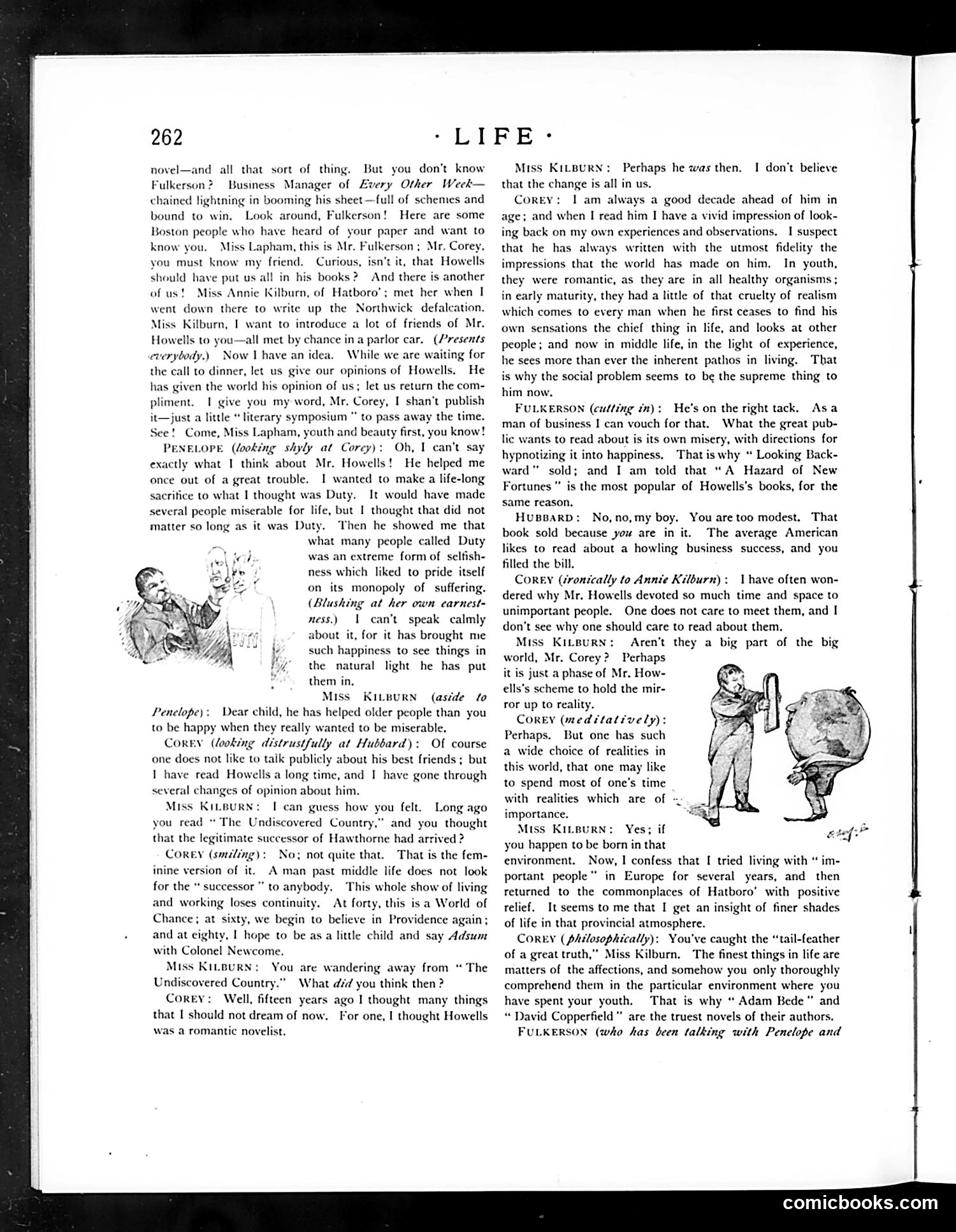
This page contains a literary discussion between characters named Fulkerson, Corey, Miss Kilburn, Penelope, and Hubbard about the novelist William Dean Howells. The conversation debates Howells's literary merit and his focus on ordinary, "unimportant" people rather than dramatic subjects. The two small illustrations appear to be period sketches accompanying this dialogue—likely depicting characters from Howells's works or the conversationalists themselves in animated debate. The satire targets literary pretension: characters discuss whether Howells is a "romantic novelist" or a realist documenting everyday life. One speaker defends writing about common people; another dismisses it as commercially motivated rather than artistically important. The debate reflects late 19th/early 20th-century tensions between romantic and realistic literary schools.
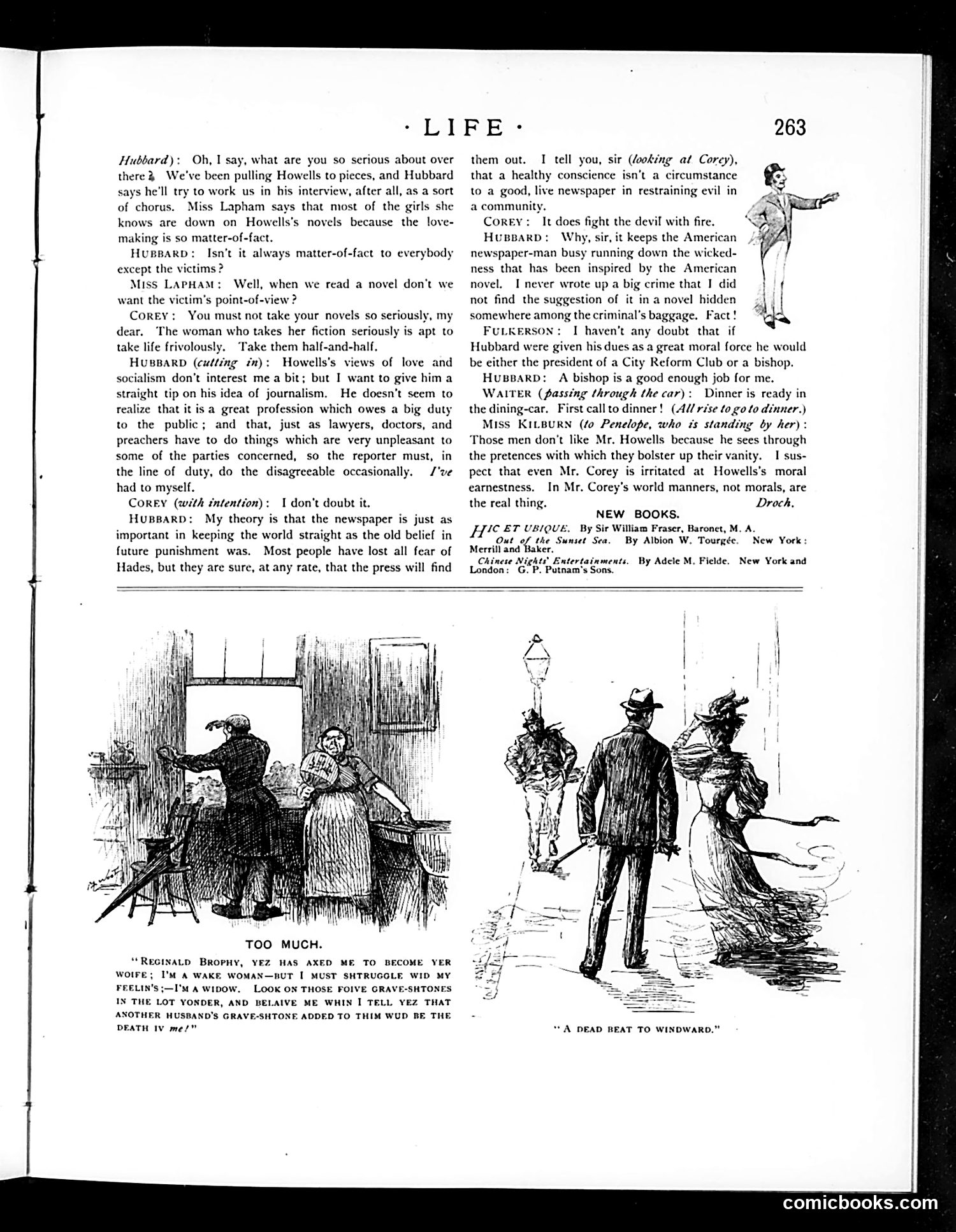
This page contains a literary discussion between characters named Hubbard, Corey, Miss Lapham, Fulkerson, and Walter about the morality of newspaper reporting and novel-writing. The debate centers on whether journalists and novelists have a duty to expose crime and social problems, or risk corrupting their audiences. The two cartoons below illustrate this tension: **"Too Much"** shows a widow overwhelmed by multiple marriage proposals after her husband's death. **"A Dead Beat to Windward"** depicts what appears to be social maneuvering or fortune-hunting among fashionable society figures. Both cartoons satirize how sensational stories—whether in newspapers or novels—can distort reality and encourage unsavory human behavior. The page examines debates about media responsibility that remain relevant today.
This appears to be a decorative illustration rather than a political cartoon. The image shows an ornate, art nouveau-style frame or mirror with elaborate scrollwork and floral motifs. Within the frame are several figures: a woman in Victorian dress wearing a top hat appears in a smaller circular portrait at the top, while below, figures in period clothing are arranged around the composition. A cherub or cupid figure appears on the left side. The word "LIFE" is visible in the top right corner, confirming this is from *Life* magazine. The ornamental style and figures suggest this may be illustrating a story, advertisement, or decorative piece rather than direct social commentary. Without additional context or visible text identifying specific subjects, the exact satirical meaning remains unclear.
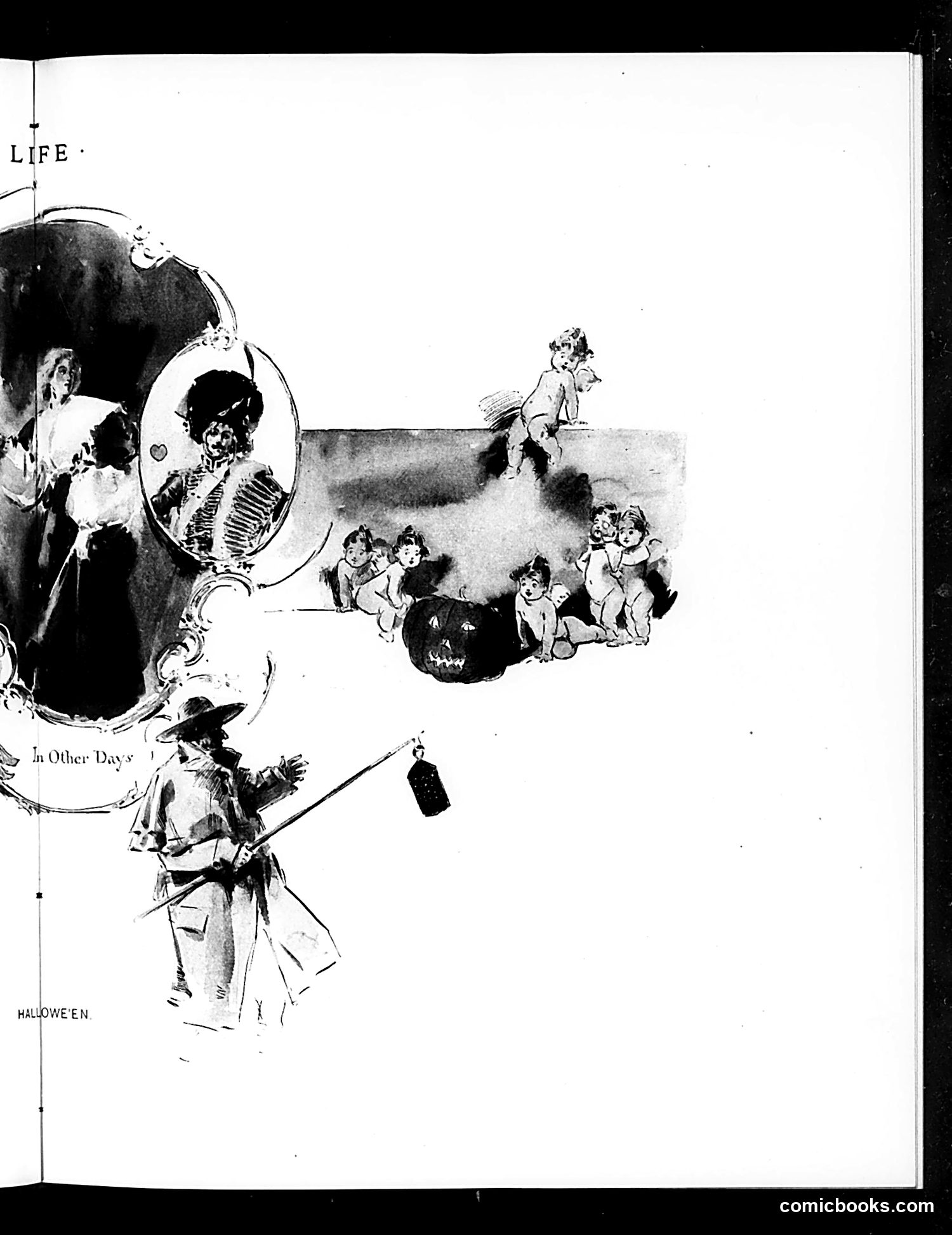
This page presents Halloween-themed illustrations contrasting "Life in Other Days" with contemporary practice. The left side shows a mirror reflecting a woman's face alongside what appears to be a skeletal or death's-head figure—a traditional memento mori or supernatural element common in older Halloween folklore. Below, a figure in period dress (possibly 18th or 19th century) holds what looks like a turnip or root vegetable carved as a jack-o'-lantern. The right side depicts modern children engaged in Halloween activities around a jack-o'-lantern, suggesting how the holiday's practices had evolved by the time this was published. The satire seems to contrast older, superstition-based Halloween customs with contemporary, commercialized children's entertainment—a commentary on how American holidays had been transformed into secular, youth-focused celebrations.
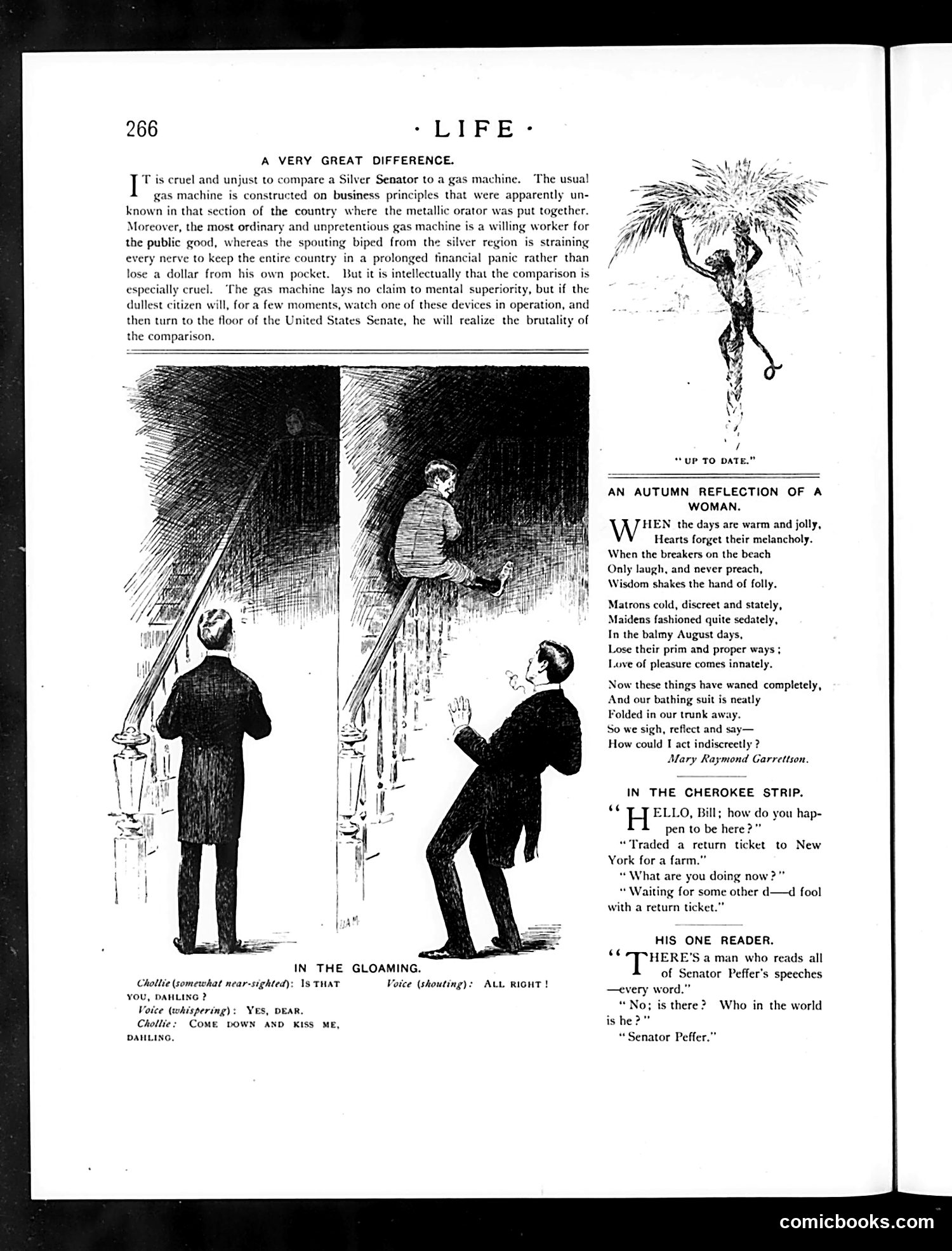
The main article "A Very Great Difference" compares a U.S. Senator (specifically a "Silver Senator") to a gas machine, criticizing the Senator's commitment to financial panic over the nation's wellbeing. The text argues the comparison, while harsh, becomes clear when observing Senate proceedings. The cartoon "In the Gloming" (left) depicts two men in formal dress in what appears to be a building's interior, with dialogue about kissing. This appears to be social/romantic satire unrelated to the Senator critique. The right side contains miscellaneous humor pieces: "An Autumn Reflection of a Woman" (poetry), "In the Cherokee Strip" (dialogue joke), and "His One Reader" (about Senator Peffer's speech-reading). The page mixes political commentary with lighter domestic and social humor typical of Life's satirical format.
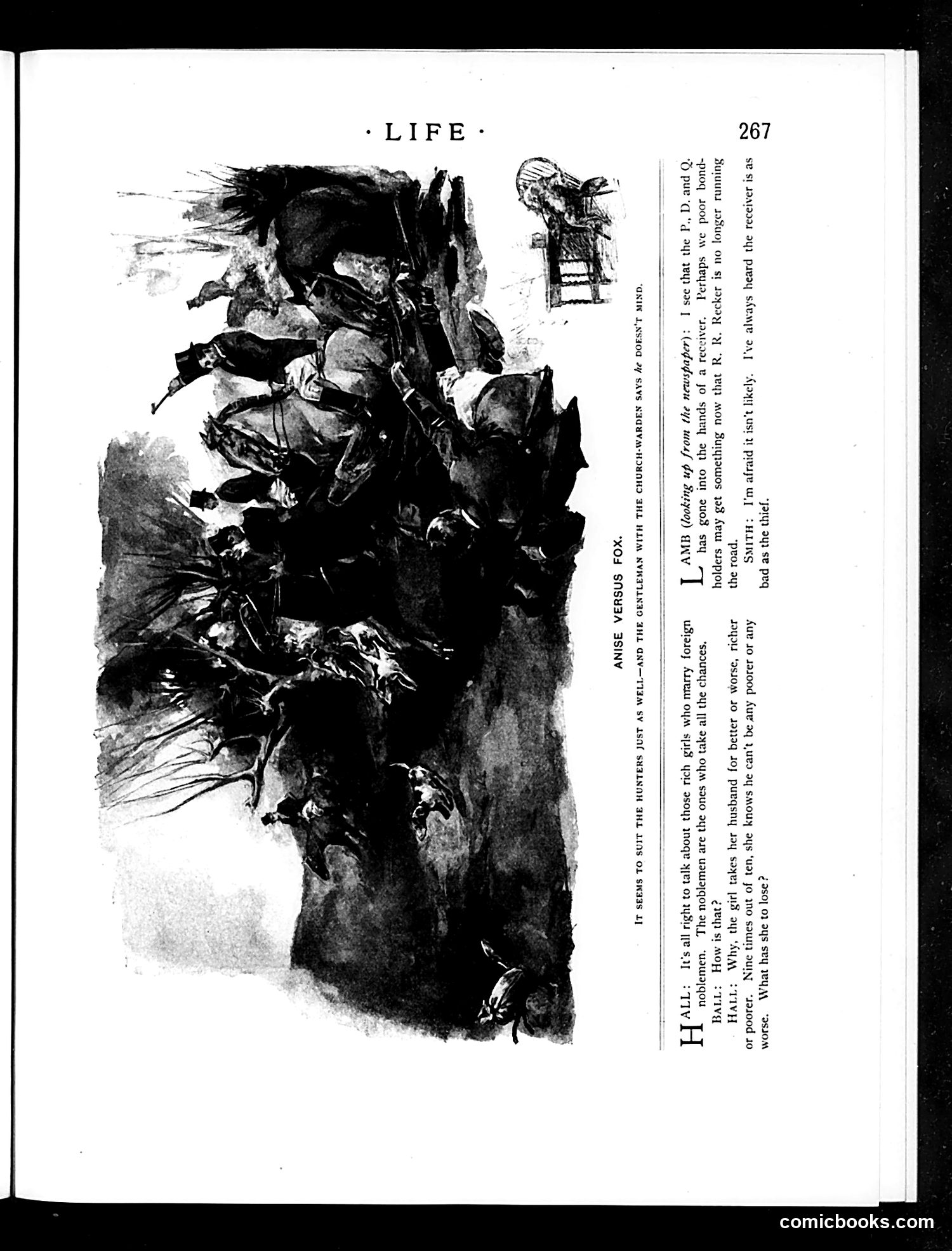
This appears to be a satirical illustration from *Life* magazine titled "Anise Versus Fox." The image shows a grotesque, demonic head or mask with exaggerated features rendered in dark, aggressive strokes. The text's opening line—"It is not to sit on the three benches just a wild-and-hairy creature wars that ever existed"—suggests this depicts some form of conflict or struggle. The cryptic caption mentions concerns about "problems," "foreign" matters, and references to "better or worse, richer or poorer" conditions and blood. Without additional context about the publication date or political moment, the specific identities remain unclear. However, the "anise versus fox" framing suggests an allegory comparing two opposing forces or ideologies, rendered as grotesque caricature typical of early 20th-century American satirical art.
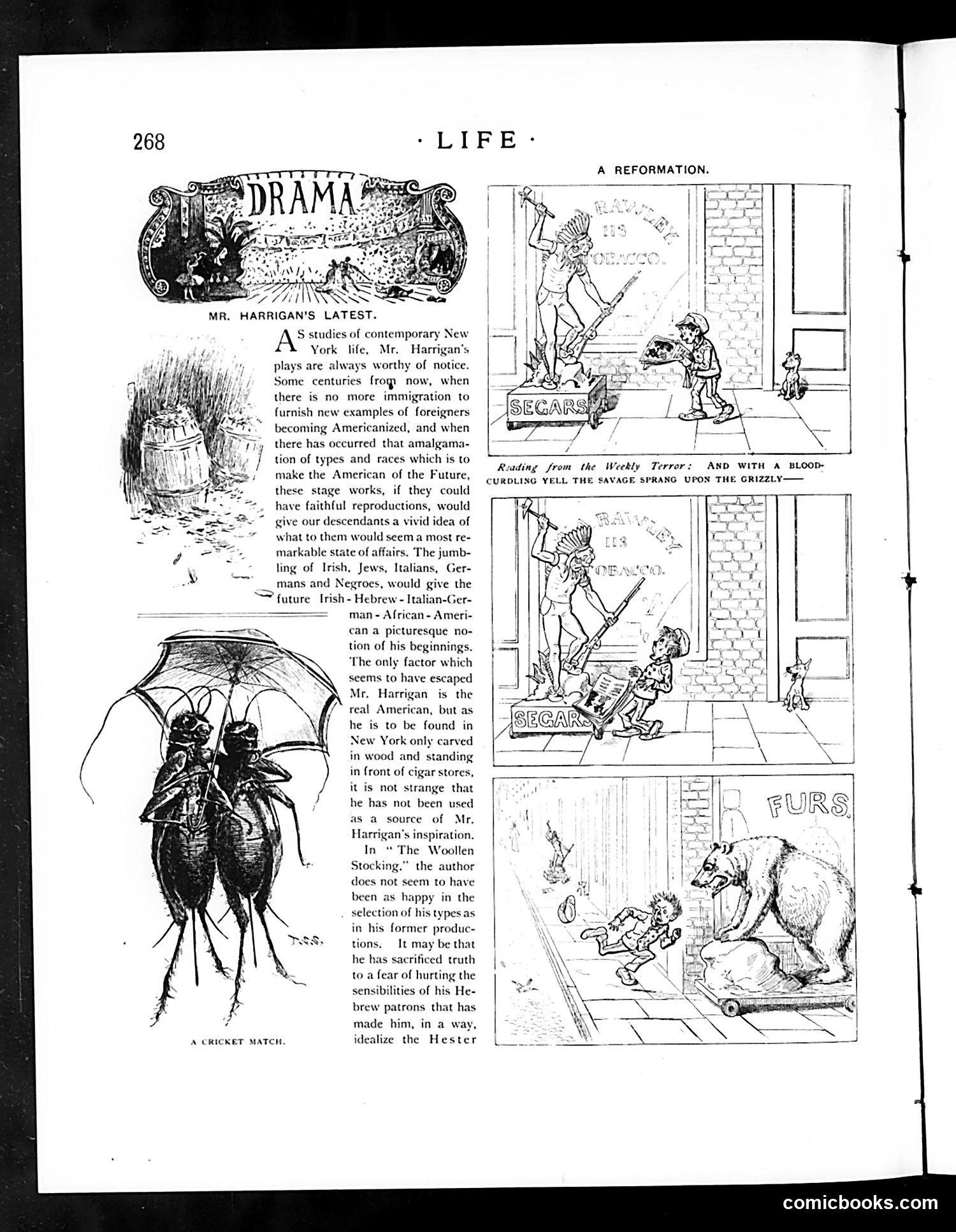
This page reviews playwright Edward Harrigan's plays about contemporary New York life. The critic praises Harrigan's realistic depictions of immigrant communities—Irish, Jews, Italians, Germans, and Black Americans—becoming "Americanized," calling these works valuable historical documents of cultural assimilation. However, the critic makes a backhanded complaint: Harrigan has supposedly *omitted* "the real American," found only as wooden cigar-store Indians in New York. This racist joke mocks Native Americans as non-people or relics. The review also suggests Harrigan compromised artistic truth in his play "The Woollen Stocking" by softening portrayals of Hebrew (Jewish) characters to avoid offending wealthy Jewish patrons—implying Harrigan prioritized Jewish audience sensibilities over authentic representation. The accompanying cartoons and cricket-match illustration appear decorative rather than directly connected to the text's arguments.
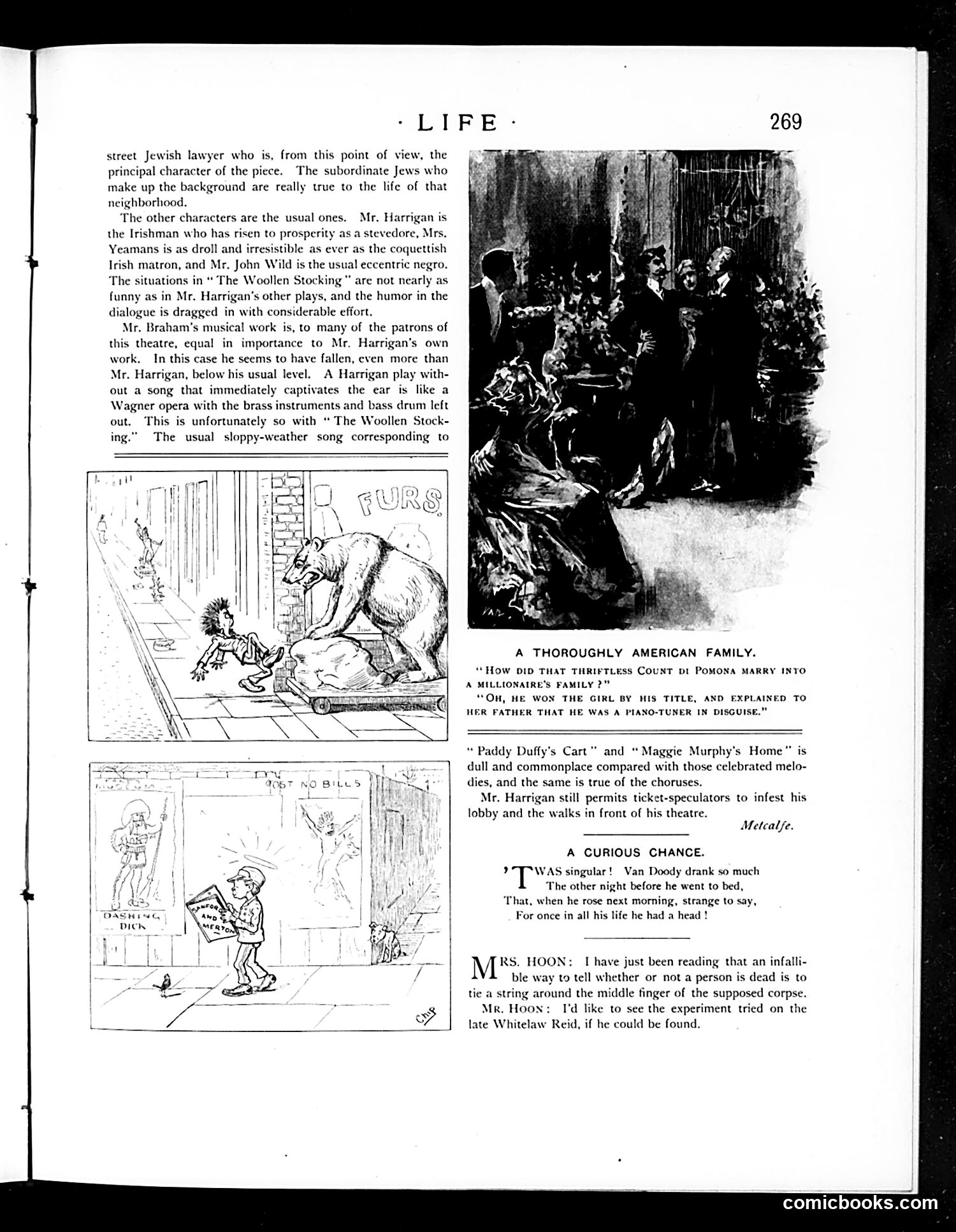
This page contains theater criticism of a Harrigan play ("The Woollen Stocking") alongside period cartoons and brief comedic items. The main review critiques actor Edward Harrigan's musical comedy, praising his portrayal of a Jewish street lawyer while noting the play's weak humor and inferior musical score compared to his earlier works. The critic particularly laments the absence of a memorable "sloppy-weather song"—apparently a Harrigan trademark. The cartoons appear to be unrelated: one depicts domestic chaos (likely illustrating the review's theatrical context), while another shows a figure in distress. The brief comic items mock social pretension (a European count marrying into American wealth by claiming to be a piano-tuner "in disguise") and include a dark joke about the recently deceased Whitelaw Reid, a prominent newspaper publisher. The page reflects turn-of-century American entertainment criticism and casual satirical humor.
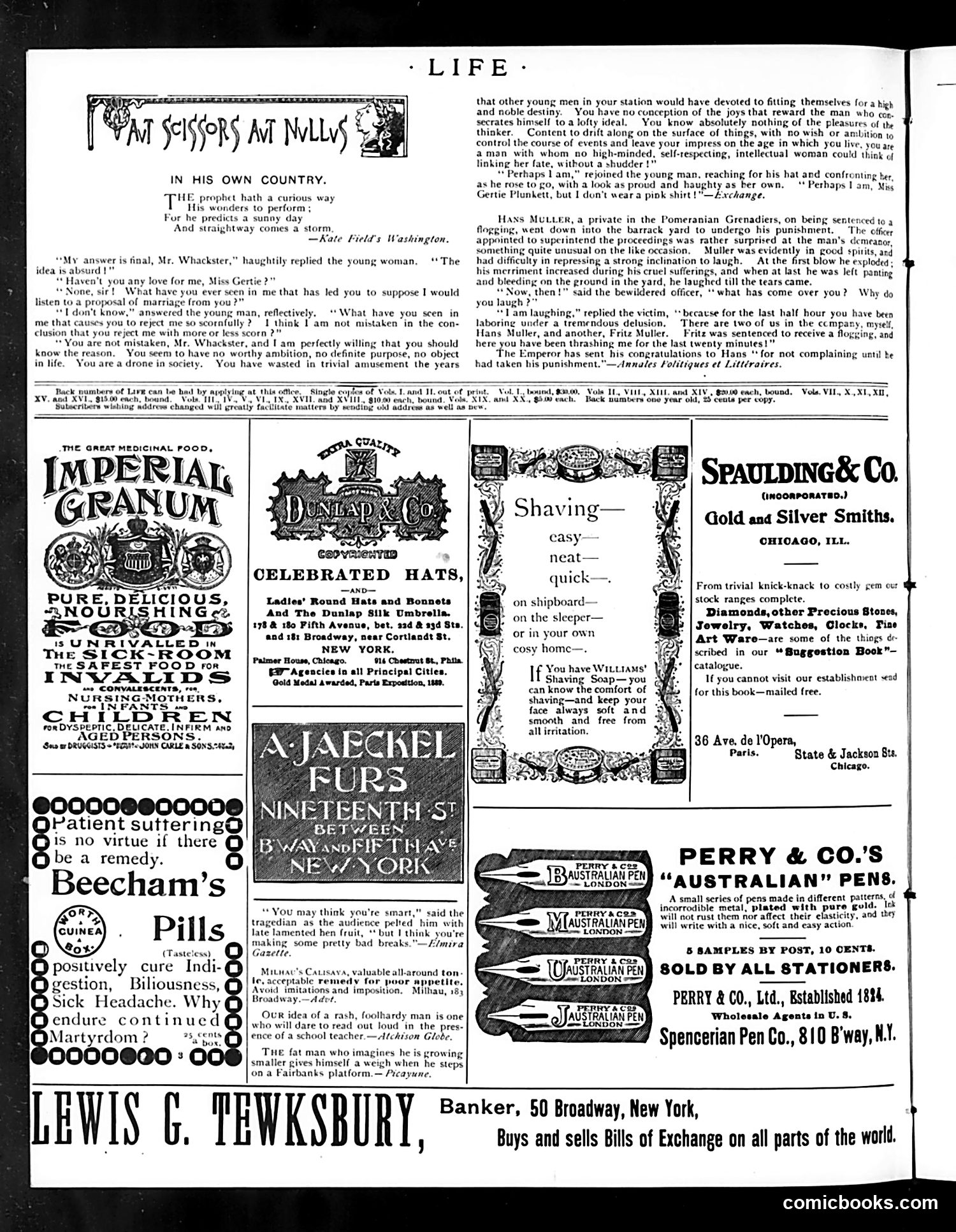
This page contains **two satirical stories** (not political cartoons): 1. **"Am Scissors am Nullus"** (top): A young woman rejects a suitor's marriage proposal, calling him a "drone in society" with no ambition or purpose. He retorts defiantly that at least "I don't wear a pink shirt!"—implying she's criticizing his masculinity while he questions her materialism. 2. **"In His Own Country"** (middle): A darkly comic Prussian military story. Private Hans Müller receives a brutal flogging but laughs throughout—revealing to his shocked officer that he's actually *Fritz* Müller, not Hans. The wrong man was punished. The emperor congratulates "Hans" for not complaining, unknowingly honoring the wrong person. The satire in the second story mocks Prussian military rigidity and bureaucratic incompetence: even under extreme punishment, absurd bureaucratic mix-ups proceed without question. The page is primarily **advertisements** (Imperial Granum food, hats, pens, pills, banking services) with these two humorous filler stories—typical Life magazine format of the era.
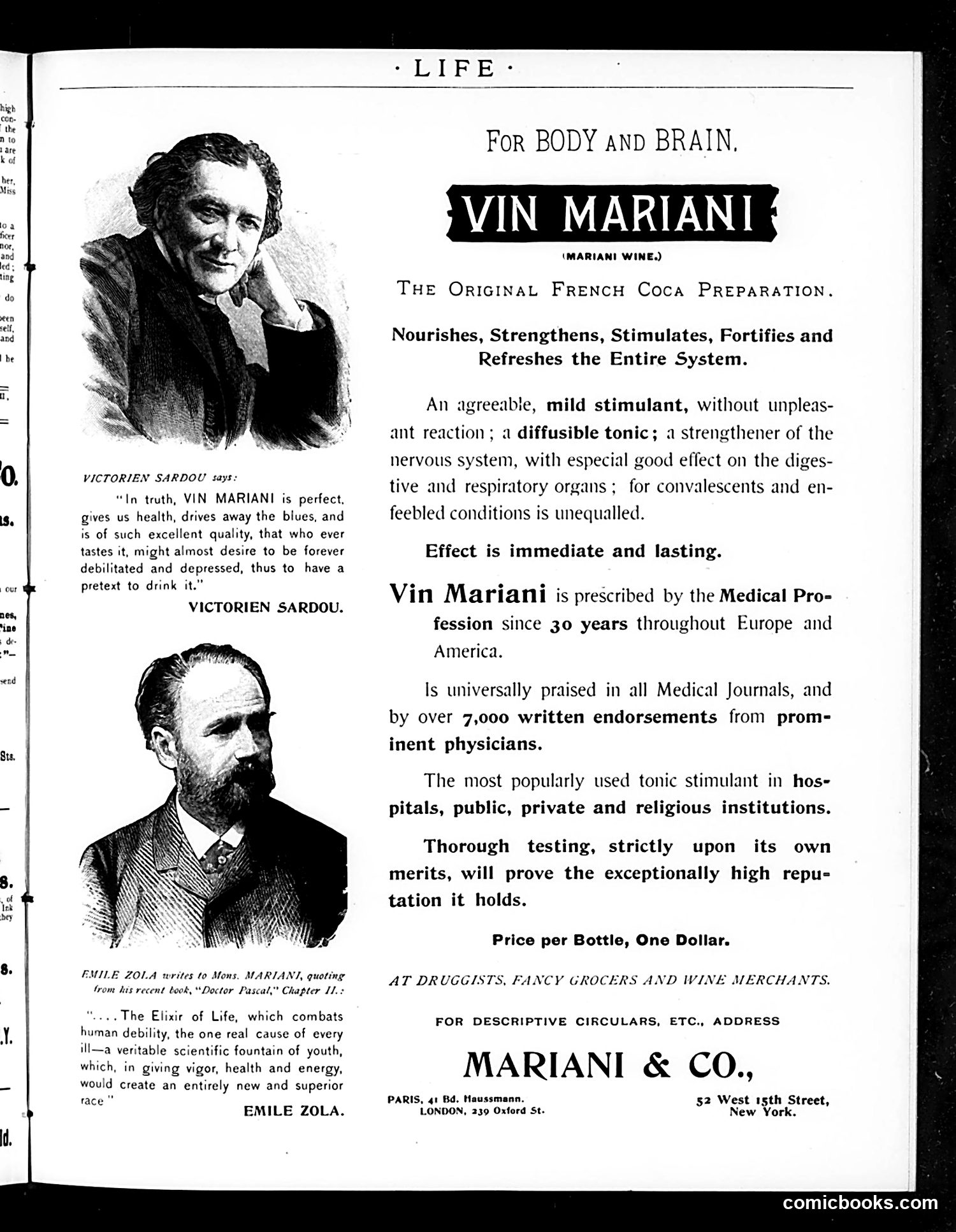
This is a full-page advertisement for Vin Mariani, a patent medicine wine containing coca extract (an early cocaine product). The page uses celebrity endorsements to market the product as a legitimate medical tonic. Two famous 19th-century French figures are quoted: playwright Victorien Sardou praises it for health and mood, while novelist Emile Zola (via his recent book *Doctor Pascal*) describes it as an "Elixir of Life" that combats human weakness and could create a "superior race." The advertisement claims 7,000 physician endorsements and widespread use in hospitals and institutions. It promises to strengthen nerves, aid digestion, and provide immediate, lasting effects—standard patent medicine claims of the era. This reflects pre-regulation America when such products were legally sold without restriction, and celebrity testimonials and medical claims required no substantiation.
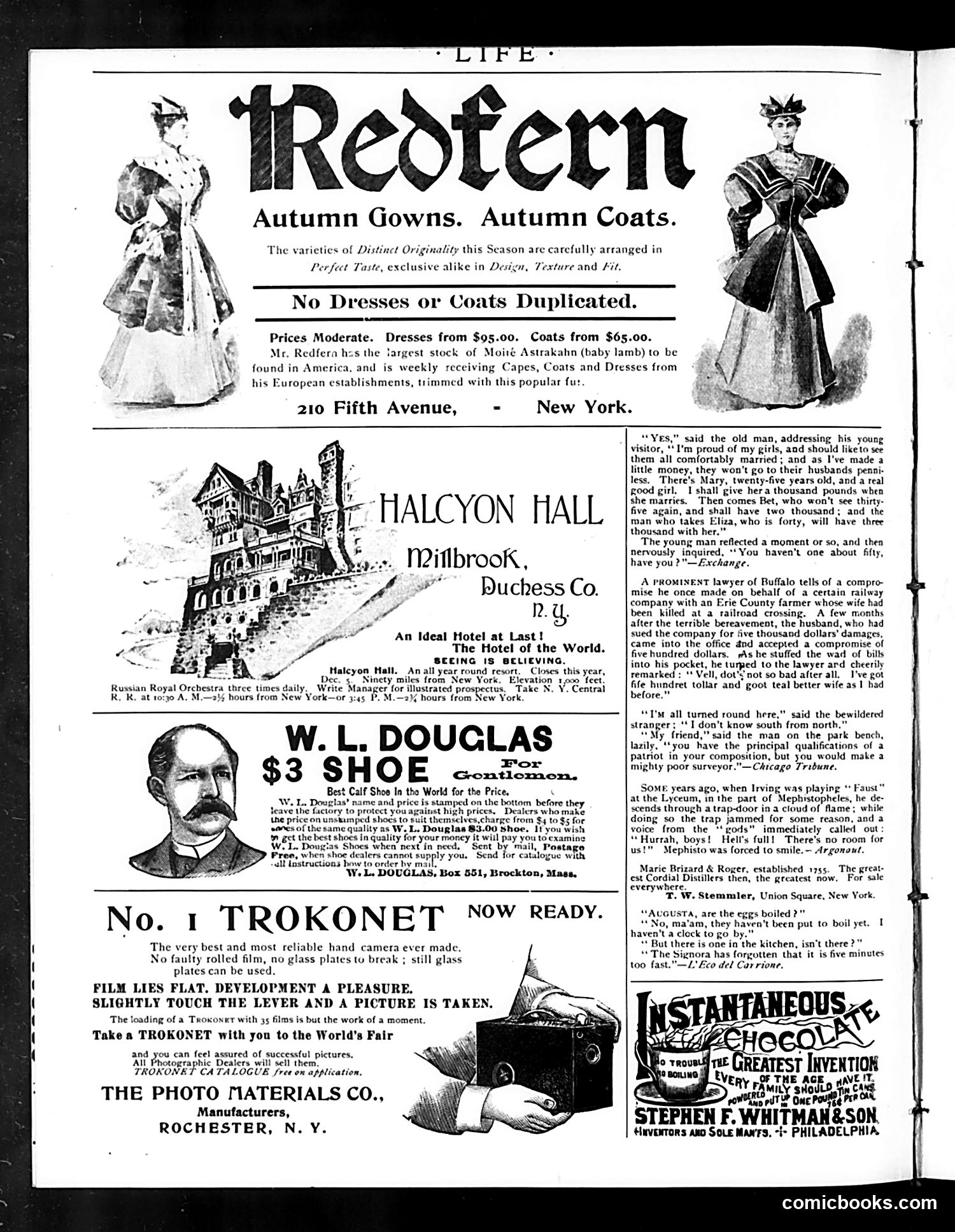
This page is primarily **advertising**, not editorial content or political cartoons. It features luxury fashion (Redfern gowns and coats), a hotel, and consumer products (W.L. Douglas shoes, Trokonet cameras, Instantaneous Chocolate). The few editorial elements are brief **humorous anecdotes** typical of Life magazine's "Funny Stories" section: 1. A joke about a father offering dowries to marry off daughters, with a young man asking about a fifty-year-old woman—satirizing mercenary marriage attitudes. 2. A railroad lawyer story where a bereaved farmer accepts $500 as settlement, then reportedly finds a "better wife"—dark humor about replacement and material compensation. 3. Irving the actor gets stuck mid-performance; someone yells "Hell's full!"—theatrical humor. 4. A domestic exchange about boiling eggs—simple domestic comedy. These sketches mock Victorian-era social conventions: marriage markets, grief/compensation, and household dynamics. No specific political figures or events are referenced.