
Life, 1893-10-26 · page 5 of 16
Life — October 26, 1893 — page 5: what you’re looking at
What you’re looking at
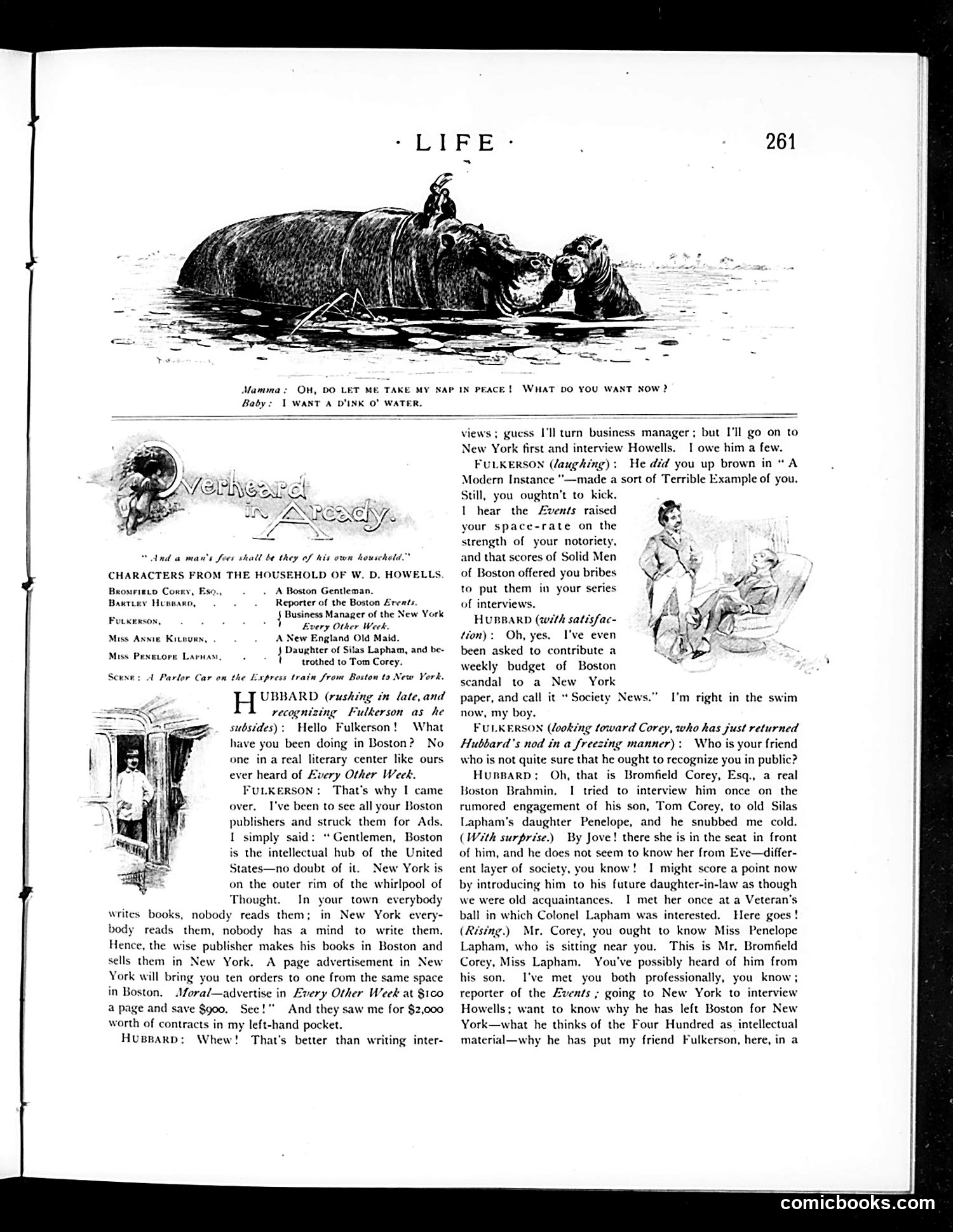
This page presents a satirical dialogue between literary figures, likely from the early 1900s. The conversation mocks the commercialization of literature and New York's publishing industry. Fulkerson, apparently a writer, discusses how Boston's intellectual reputation contrasts with New York's commercial dominance in publishing. The satire targets: - **Publishers' mercenary focus**: Advertisement contracts and page rates matter more than literary merit - **Boston vs. New York rivalry**: Boston claims intellectual prestige; New York has actual market power - **Celebrity culture**: References to securing interviews and society coverage suggest emerging media sensationalism - **Literary commodification**: Books are treated as advertisement vehicles rather than art The hippopotamus illustration at top appears unrelated—typical of Life's visual format. The overall tone ridicules how American letters had become primarily a business enterprise rather than a cultural endeavor.
📄 Transcribed text from this page (OCR, searchable)
Machine-transcribed from the original scan — historical spelling and the odd misread are preserved.
Mamma: OW, DO LET ME TAKE MY NAP IN PEACE! WHAT DO YOU WANT NOW ? Baby: 1 WANT A D'INK O° WATER. And a man's foes shall be they of his own houschold.” CHARACTERS FROM THE HOUSEHOLD OF W. D. HOWELLS. A Boston Gentleman. Reporter of the Boston Events { Business Manager of the New York Every Other Week. A New England Old Maid. Daughter of Silas Lapham, and be- Miss Pexetore Larwas, } othied to Toa Cony 1 Parlor Car on the Express train from Boston ta New York. UBBARD (rushing in late,and recognizing Fulkerson as he subsides): Hello Fulkerson! What have you been doing in Boston? No one ina real literary center like ours ever heard of Every Other Week, E RSON: That's why I came over. I've been to see all your Boston publishers and struck them for Ads. I simply said: entlemen, Boston is the intellectual hub of the United States—no doubt of it. New York is on the outer rim of the whirlpool of Thought. In your town everybody writes books, nobody reads them; in New York every- body reads them, nobody has a mind to write them. Brosrieto Conny, Eso., Baxtiey Henaano, Furxexson, Miss Annie Kitnury, Scusn: Hence, the wise publisher makes his books in Boston and sells them in New York. A page advertisement in New York will bring you ten orders to one from the same space in Boston, Mfora/—advertise in Every Other Week at $1c0 a page and save $900. See!" And they saw me for $2,000 worth of contracts in my left-hand pocket. HupBarp: Whew! That's better than writing inter- views ; guess I'll turn business manager ; but I'll go on to New York first and interview Howells. I owe him a fe FULKERSON (laughing): He déd you up brown in “ A Modern Instance "—made a sort of Terrible Example of you. e Still, you oughtn’t to kick. I hear the vents raised your space-rate on the strength of your notoriety, and that scores of Solid Men of Boston offered you bribes to put them in your series of interviews. HUBBARD (wth satisfac- tion): Oh, yes. I’ve even been asked to contribute a weekly budget of Boston scandal to a New York paper, and call it “* Society News.” now, my boy. FULKERSON (looking foward Corey, who has just returned Hubbard's nod in a freezing manner): Who is your friend who is not quite sure that he ought to recognize you in public? Hunparp: Oh, that is Bromfield Corey, Esq., a real Boston Brahmin. I tried to interview him once on the rumored engagement of his son, Tom Corey, to old Silas Lapham’s daughter Penelope, and he snubbed me cold. (With surprise.) By Jove! there she is in the seat in front of him, and he does not seem to know her from Eve—differ- ent layer of society, you know! I might score a point now by introducing him to his future daughter-in-law as though we were old acquaintances. I met her once at a Veteran's ball in which Colonel Lapham was interested. Here goes! (Rising.) Mr. Corey, you ought to know Miss Penelope Lapham, who is sitting near you. This is Mr. Bromfield Corey, Miss Lapham, You've possibly heard of him from his son. I've met you both professionally, you know reporter of the Events ; going to New York to interview Howells; want to know why he has left Boston for New what he thinks of the Four Hundred as intellectual al—why he has put my friend Fulkerson, here, in a I'm right in the swim