
Life, 1893-10-26 · page 6 of 16
Life — October 26, 1893 — page 6: what you’re looking at
What you’re looking at
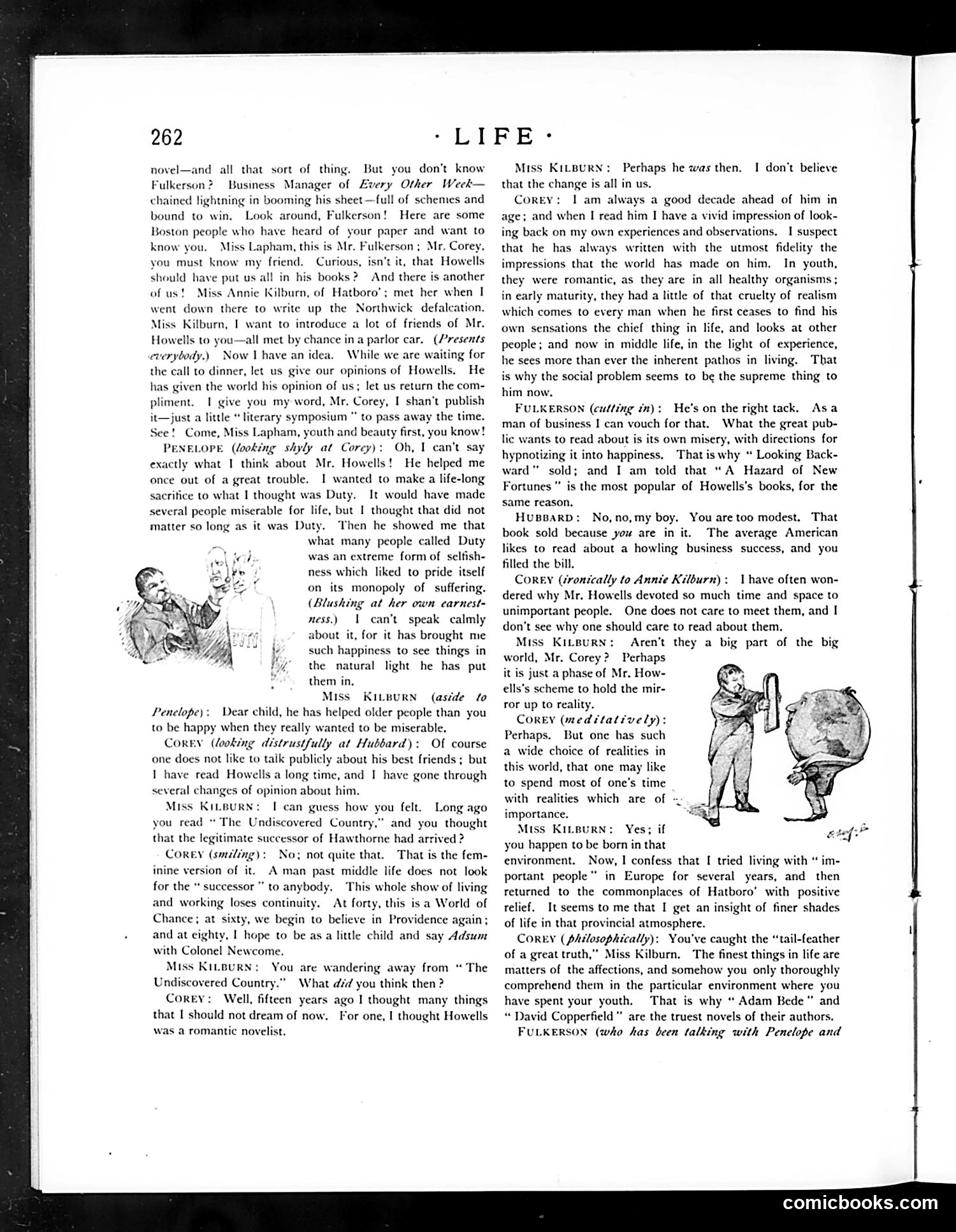
This page contains a literary discussion between characters named Fulkerson, Corey, Miss Kilburn, Penelope, and Hubbard about the novelist William Dean Howells. The conversation debates Howells's literary merit and his focus on ordinary, "unimportant" people rather than dramatic subjects. The two small illustrations appear to be period sketches accompanying this dialogue—likely depicting characters from Howells's works or the conversationalists themselves in animated debate. The satire targets literary pretension: characters discuss whether Howells is a "romantic novelist" or a realist documenting everyday life. One speaker defends writing about common people; another dismisses it as commercially motivated rather than artistically important. The debate reflects late 19th/early 20th-century tensions between romantic and realistic literary schools.
📄 Transcribed text from this page (OCR, searchable)
Machine-transcribed from the original scan — historical spelling and the odd misread are preserved.
262 novel—and all that sort of thing. Fulkerson? Business Manager of But you don't know ry Other Week— chained lightning in booming his sheet—full of schemes and bound to win, Look around, Fulkerson! Here are some Boston people who have heard of your paper and want to Miss Lapham, this is Mr. Fulkerson ; Mr. Corey, Curious, isn’t it, that Howells. And there is another Miss Annie Kilburn, of Hatboro’; met her when I went down there to write up the Northwick defalcation, Miss Kilburn, | want to introduce a lot of friends of Mr. Howells to you—all met by chance in a parlor car. (Presents everybody.) Now have an idea. While we are waiting for the call to dinner, let us give our opinions of Howells, He has given the world his opinion of us; let us return the com- pliment. I give you my-word, Mr. Corey, I shan’t publish it—just a little “ literary symposium ” to pass away the time. See! Come, Miss Lapham, youth and beauty first, you know! PENELOPE (looking shyly at Corey): Oh, I can't say exactly what I think about Mr. Howells! He helped me once out of a great trouble. I wanted to make a life-long sacrifice to what I thought was Duty. It would have made several people miserable for life, but 1 thought that did not matter so long as it was Duty. ‘Then he showed me that know you. you must know my friend. should have put us all in his books ? of us! what many people called Duty was an extreme form of selfish- ness which liked to pride itself on its monopoly of suffering. (Blushing at her own earnest- ness.) 1 can’t speak calmly about it, for it has brought me such happiness to see things in the natural light he has put them in, Miss KILBURN (aside to Penelope): Dear child, he has helped older people than you to be happy when they really wanted to be miserable. Corey (looking distrustfully at Hubbard): Of course one does not like to taik publicly about his best friends ; but I have read Howells a long time, and I have gone through several changes of opinion about him. Miss KiILBURN: I can guess how you read “ The Undisco ‘ou felt. Long ago ered Country, id you thought that the legitimate successor of Hawthorne had arrived ? Corey (smiling): That is the fem- inine version of it. A man past middle life does not look for the“ y This whole show of living and working loses continuity. At forty, this is a World of Chance; at sixty, we begin to believe in Providence again ; and at eighty, | hope to be asa little child and say Adsum with Colonel Newcome. Miss KILBURN: You are wandering away from Undiscovered Country.” What d/d you think then ? Corey: Well, fifteen years ago I thought many things that I should not dream of now. For one, | thought Howells. was a romantic noveli No; not quite that. The - LIFE: Miss KILBURN: Perhaps he was then. I don’t believe that the change is all in us. Cor 1 am always a good decade ahead of him in age; and when I read him I have a vivid impression of look- ing back on my own experiences and observations. I suspect that he has alw written with the utmost fidelity the impressions that the world has made on him. In youth, they were romantic, as they are in all healthy organisms in early maturity, they had a little of that cruelty of realism which comes to every man when he first ceases to find his own sensations the chief thing in life, and looks at other people; and now in middle life, in the light of experience, he sees more than ever the inherent pathos in living. That is why the social problem seems to be the supreme thing to him now, FULKERSON (cutting en): He's on the right tack, Asa man of business I can vouch for that. What the great pub- lic wants to read about is its own misery, with directions for hypnotizing it into happiness, That is why “ Looking Back- ward" sold; and I am told that “A Hazard of New Fortunes” is the most popular of Howells’s books, for the same reason. Hussarv: No,no,my boy. You are too modest. That book sold because you are in it. The average American likes to read about a howling business success, and you filled the bill. Corey (¢rontcally to Annie Kilburn): (have often won- dered why Mr. Howells devoted so much time and space to unimportant people. One does not care to meet them, and I don’t see why one should care to read about them. Miss KILBURN: Aren't they a big part of the big world, Mr. Corey? Perhaps it is just a phase of Mr. How- ells’s scheme to hold the mir- ror up to reality. Corey (med itatively): Perhaps. But one has such a wide choice of realities in this world, that one may like to spend most of one’s time with realities which are of ~ importance, Miss KILBURN: Yes; if you happen to be born in that environment, Now, 1 confess that [ tried living with “ im- portant people” in Europe for several years, and then returned to the commonplaces of Hatboro’ with positive relief. It seems to me that I get an insight of finer shades of life in that provincial atmosphere. Corey (philosophically): You've caught the “tail-feather of a great truth,” Miss Kilburn. The finest things in life are matters of the affections, and somehow you only thoroughly comprehend them in the particular environment where you have spent your youth, That is why “ Adam Bede” and “ David Copperfield” are the truest novels of their authors. FULKERSON (who has been talking with Penelope and comicbooks.com