
A complete issue · 18 pages · 1893
Life — October 12, 1893
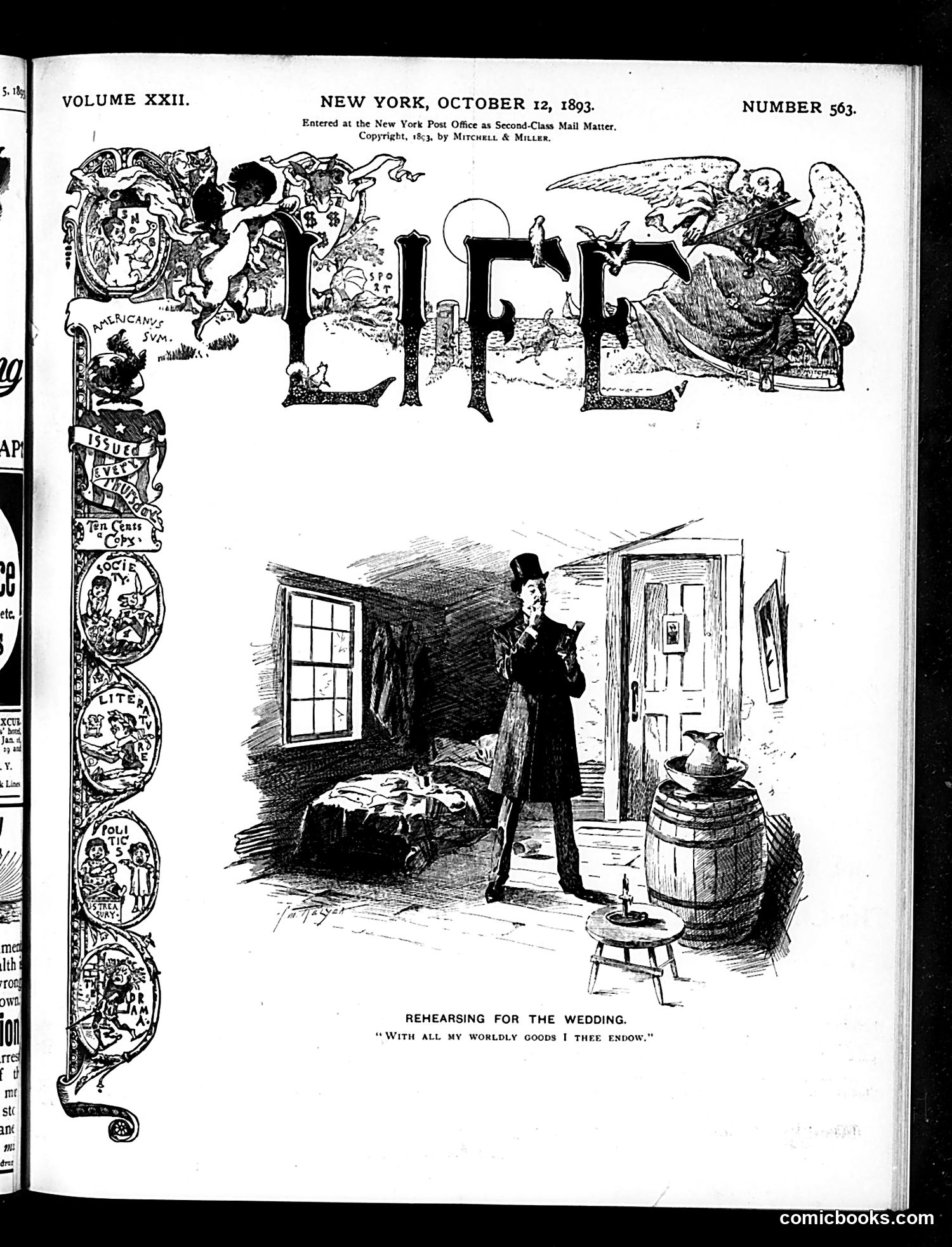
This page contains two illustrations. The top features the magazine's ornate masthead with decorative figures. The main cartoon below, titled "Rehearsing for the Wedding" with the caption "With all my worldly goods I thee endow," depicts a man in formal dress (top hat and coat) standing in a sparse, modest room amid basic furnishings—a bed, barrel, stool, and simple window. The satire mocks the contrast between the idealistic marriage vow promising to share "worldly goods" and the groom's apparent poverty or lack of material possessions. The sparse setting emphasizes the irony: he's rehearsing to pledge wealth he clearly doesn't possess. This satirizes either social pretension among the poor or the hollowness of marriage vows regardless of economic circumstances.
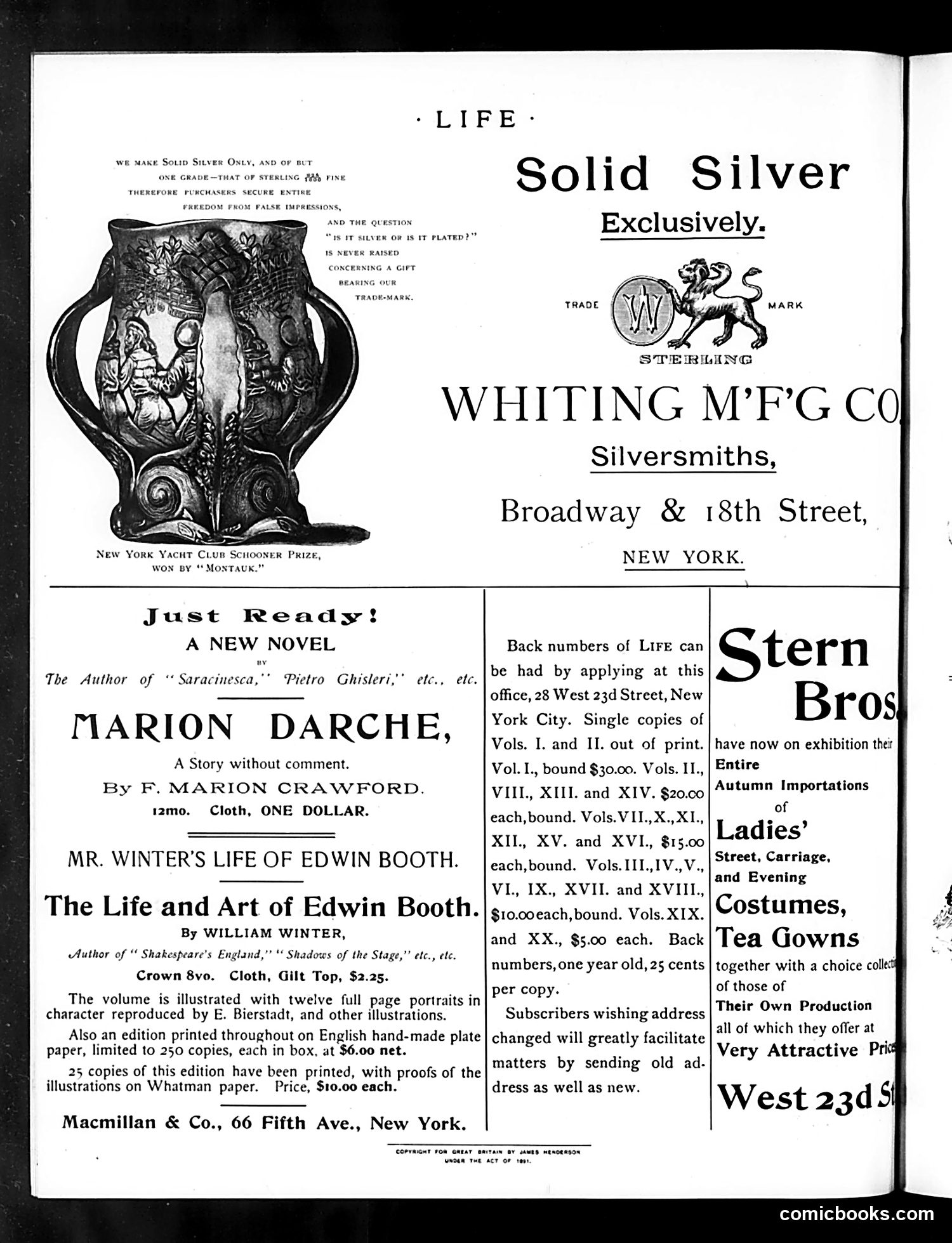
This page is primarily **advertising and book announcements** rather than political satire or editorial cartoon content. The main visual element is a decorative silver trophy—the "New York Yacht Club Schooner Prize, won by 'Montauk'"—illustrating an advertisement for Whiting M'fg Co, silversmiths. Below are book advertisements: - *Marion Darche* by F. Marion Crawford (a novel) - *The Life and Art of Edwin Booth* by William Winter (biography of the famous actor) The right column contains notices about back issues of *Life* magazine and an advertisement for Stern Bros department store's autumn importations of ladies' clothing. The page reflects the era's integration of editorial content with commercial advertising typical of late 19th-century American magazines.
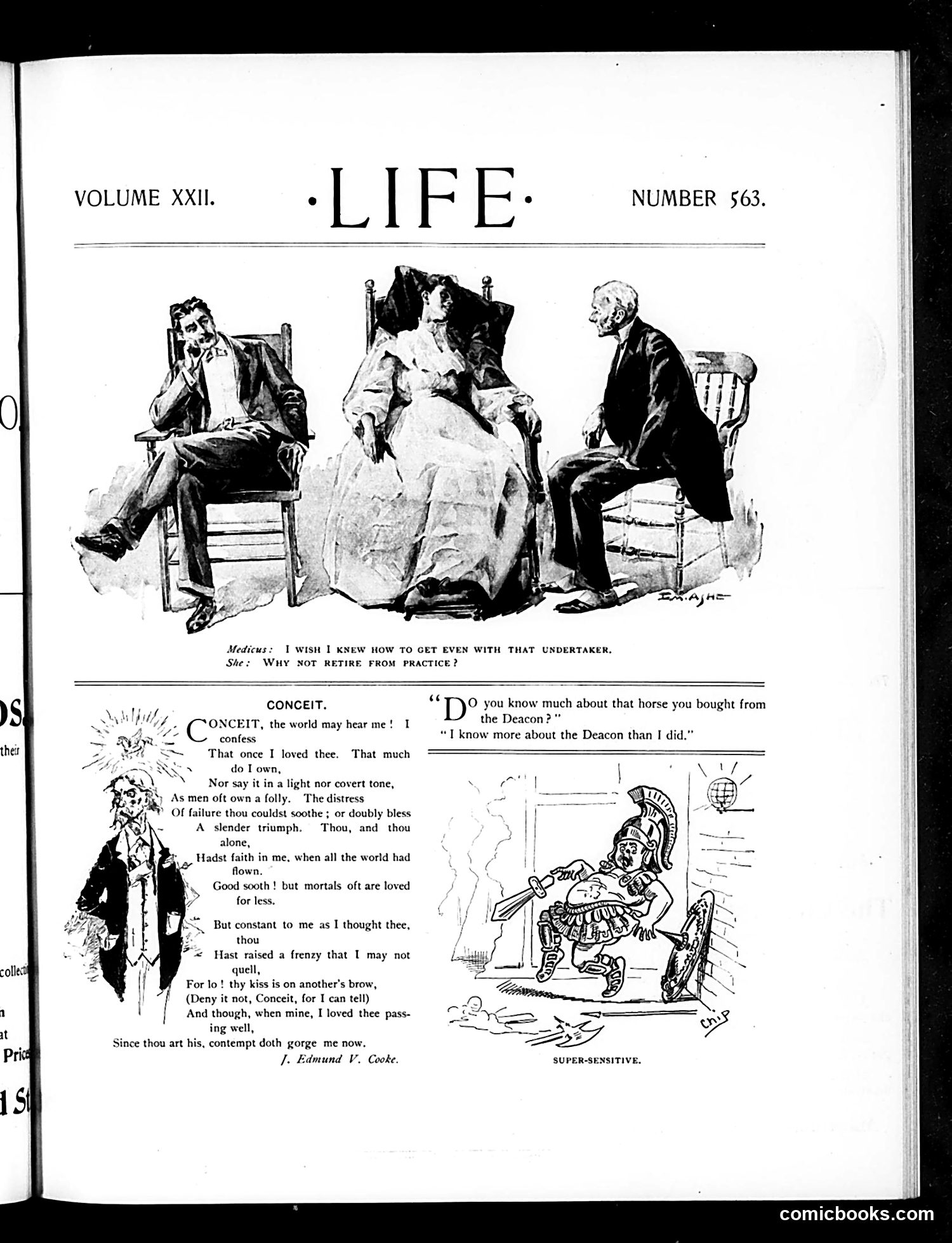
**Top Cartoon:** Three figures in conversation—a woman seated between two men. The caption reads: "Medicus: I wish I knew how to get even with that undertaker. She: Why not retire from practice?" This appears to be a joke about a doctor's rivalry with an undertaker, with the woman suggesting he stop practicing medicine (implying his patients die anyway, enriching the undertaker). **"Conceit" Poem:** A romantic verse by Edmund V. Cooke about lost love, presented with an illustration of a distressed figure. **"Super-Sensitive" Cartoon:** A humorous sketch showing a figure in Roman armor reacting dramatically to something minor, captioned with dialogue: "Do you know much about that horse you bought from the Deacon?" / "I know more about the Deacon than I did." The page combines satirical commentary with light humor typical of early 20th-century Life magazine.
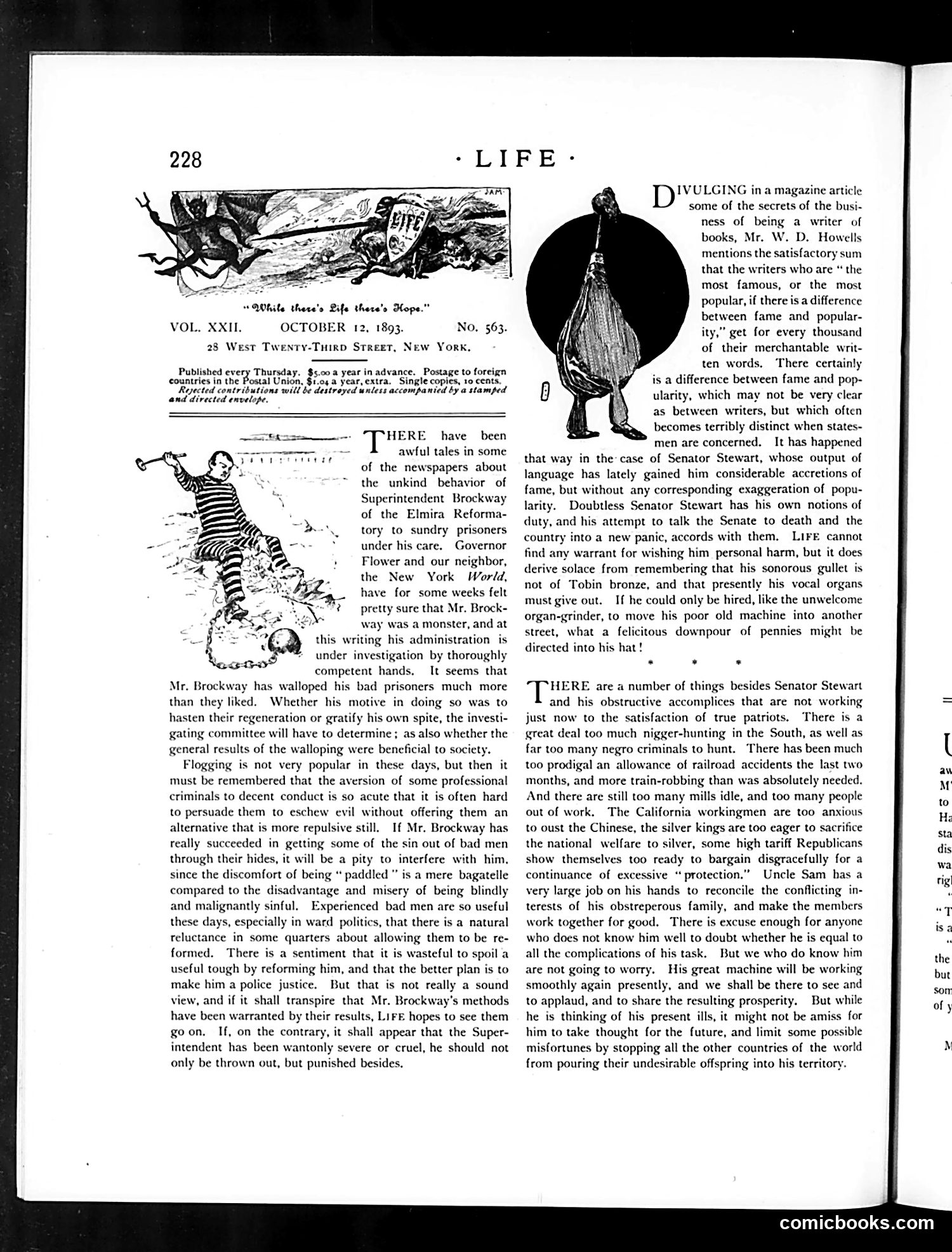
The page contains two editorial pieces criticizing political figures and social conditions of the 1890s. **Left cartoon** ("Where there's Life there's Hope"): Depicts Superintendent Brockway of the Elmira Reformatory as a figure walloping prisoners. The satire attacks his harsh treatment of inmates and questions whether his administration truly benefits society or merely satisfies his own inclinations toward cruelty. **Right article**: Primarily criticizes Senator Stewart for generating public alarm through inflammatory rhetoric about economic threats, attempting to panic the nation rather than addressing genuine issues. The text also discusses broader national problems—excessive "nigger-hunting" in the South, railroad accidents, unemployment, and immigration—satirizing political leaders' failure to solve real problems while creating unnecessary panic. The overall tone condemns both institutional cruelty and irresponsible political fearmongering.
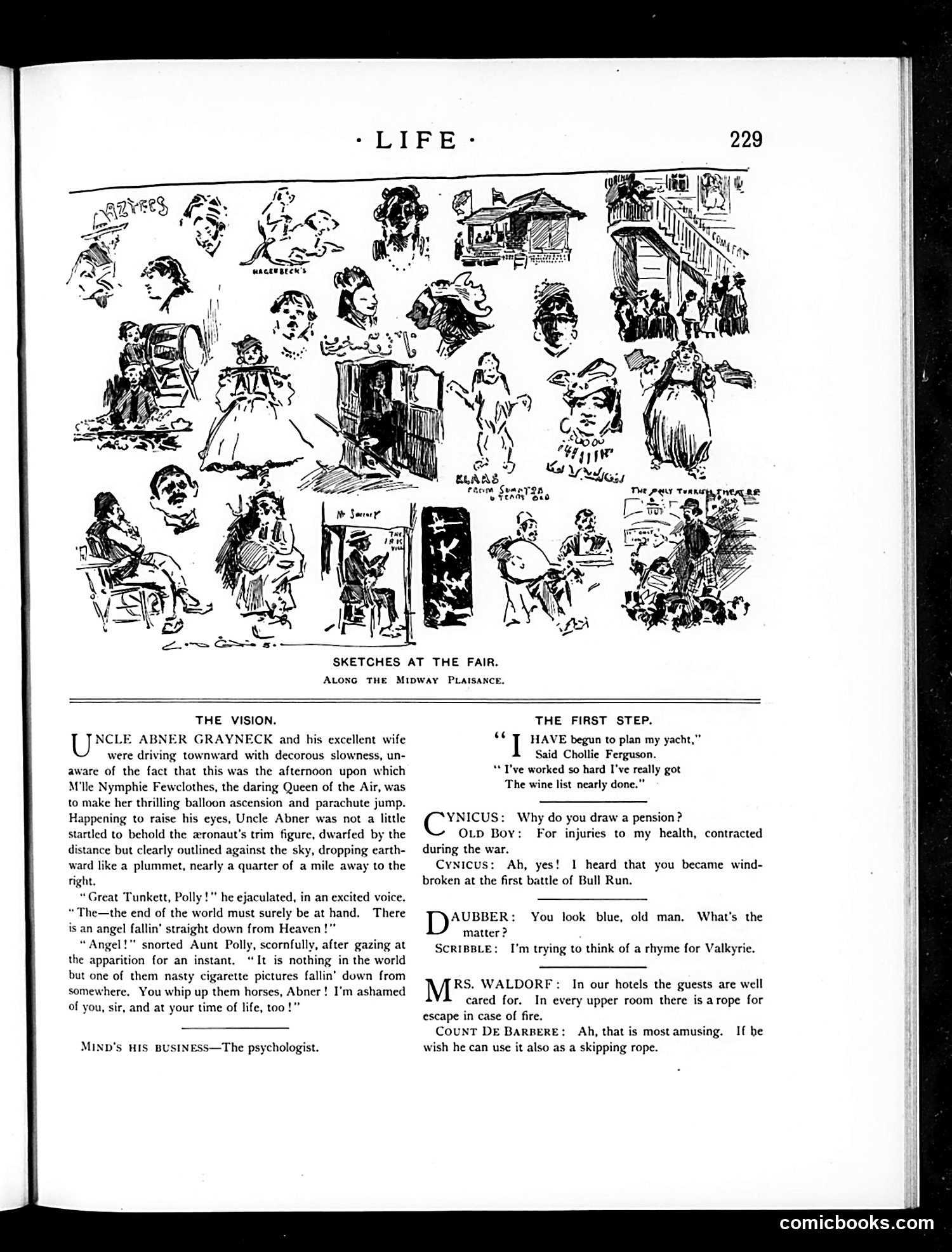
This page features "Sketches at the Fair: Along the Midway Plaisance"—cartoon vignettes from what appears to be a world's fair (likely the 1893 World's Columbian Exposition in Chicago, given the "Midway Plaisance" reference). The sketches depict fair-goers and attractions in humorous situations. Below are dialogue vignettes featuring characters like Uncle Abner Grayneck witnessing a balloon ascent, and various exchanges about fair experiences. One sketch mocks a psychologist ("Mind's his business"), while others contain light social humor about war injuries, hotel safety ropes, and rhyming challenges. The satire targets fair crowds, eccentric visitors, and contemporary social foibles rather than specific political figures. It's primarily entertainment-focused rather than political commentary.
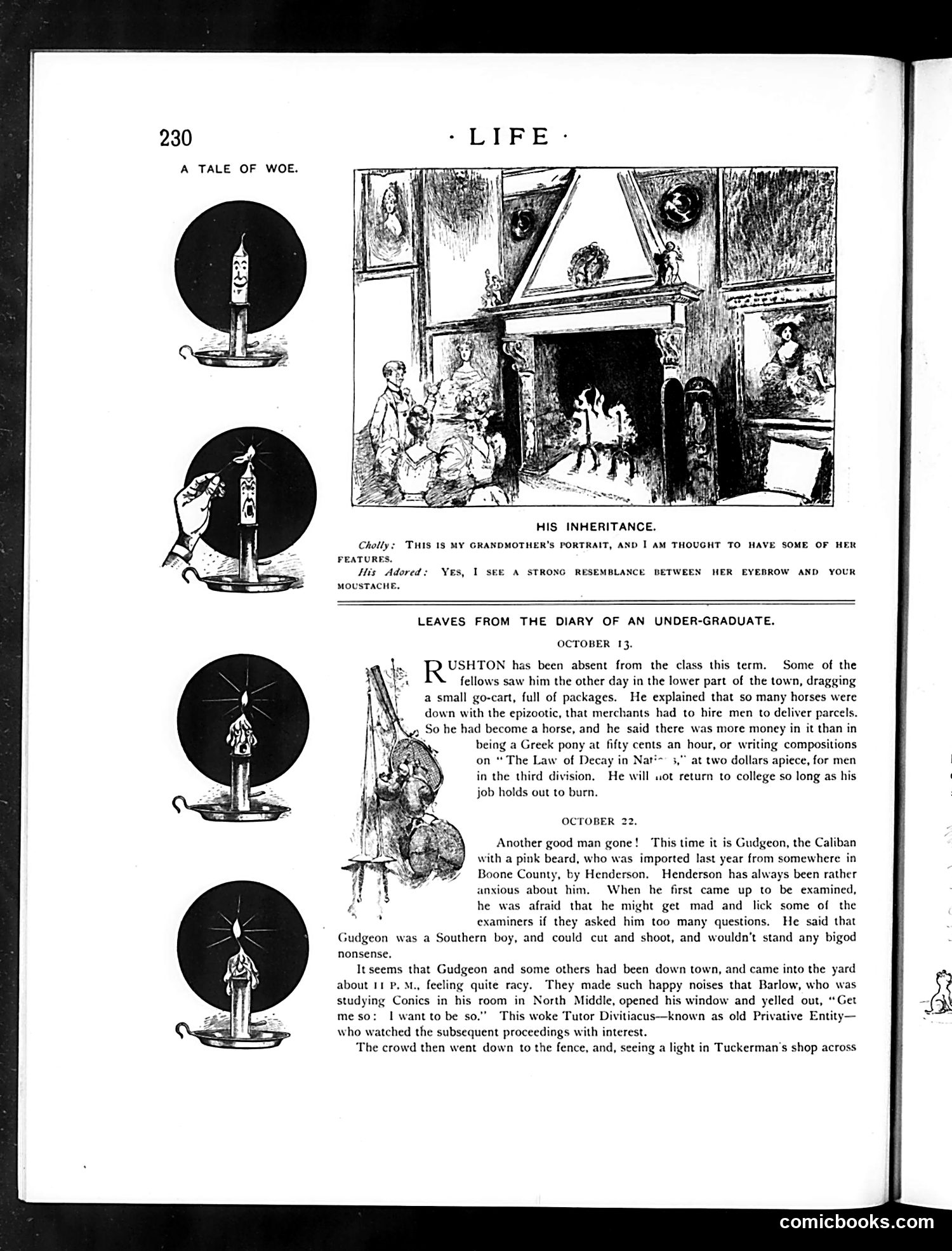
The page contains two distinct pieces: **Left side:** Four small cartoons titled "A Tale of Woe" showing a candle in progressively lower states—lit, being held, shortened, and nearly gone. This appears to be a visual metaphor for decline or deterioration, though the specific reference is unclear without additional context. **Right side:** An illustrated scene titled "His Inheritance" depicting a domestic interior. The dialogue suggests a humorous observation about family resemblance between a grandmother's portrait and a grandson's distinctive facial features (eyebrow and moustache). Below this is "Leaves from the Diary of an Under-Graduate," a satirical narrative about college student misbehavior, describing absent students, a character named Gudgeon engaging in rowdy behavior, and various undergraduate pranks during October.
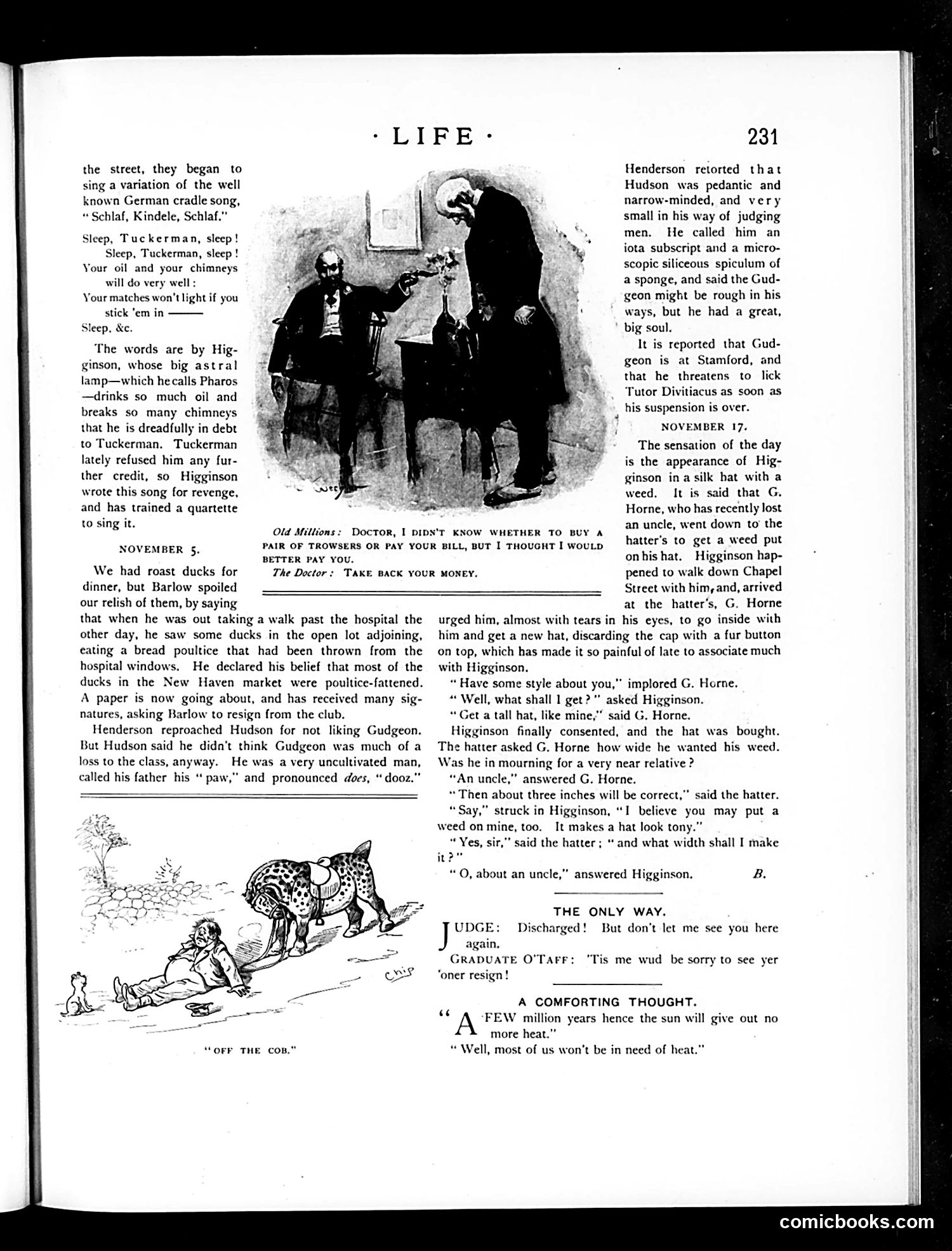
This page contains several distinct satirical pieces: **The Higginson Song (November 5):** A revenge song by Higginson mocking Tuckerman, a wealthy man whose "astral lamp" (Pharos) consumes so much oil that he's in debt. Higginson trained musicians to sing it as satire. **The Ducks Anecdote:** Harlow's joke about hospital ducks—suggesting they're "poultice-attended"—mocks both Hudson's gullibility and contemporary medical practices. **The Hatter Story (November 17):** Higginson visits a hatter (hat-maker) with G. Horne. The humor lies in Higginson's awkward attempt to buy a mourning hat for a deceased uncle, with the hatter's deadpan responses about measurements. **The Cartoon "Off the Cob":** An illustration showing a figure and animals, likely depicting rural/pastoral humor. The page's humor relies on character comedy and social observation typical of 1870s-80s American satire.
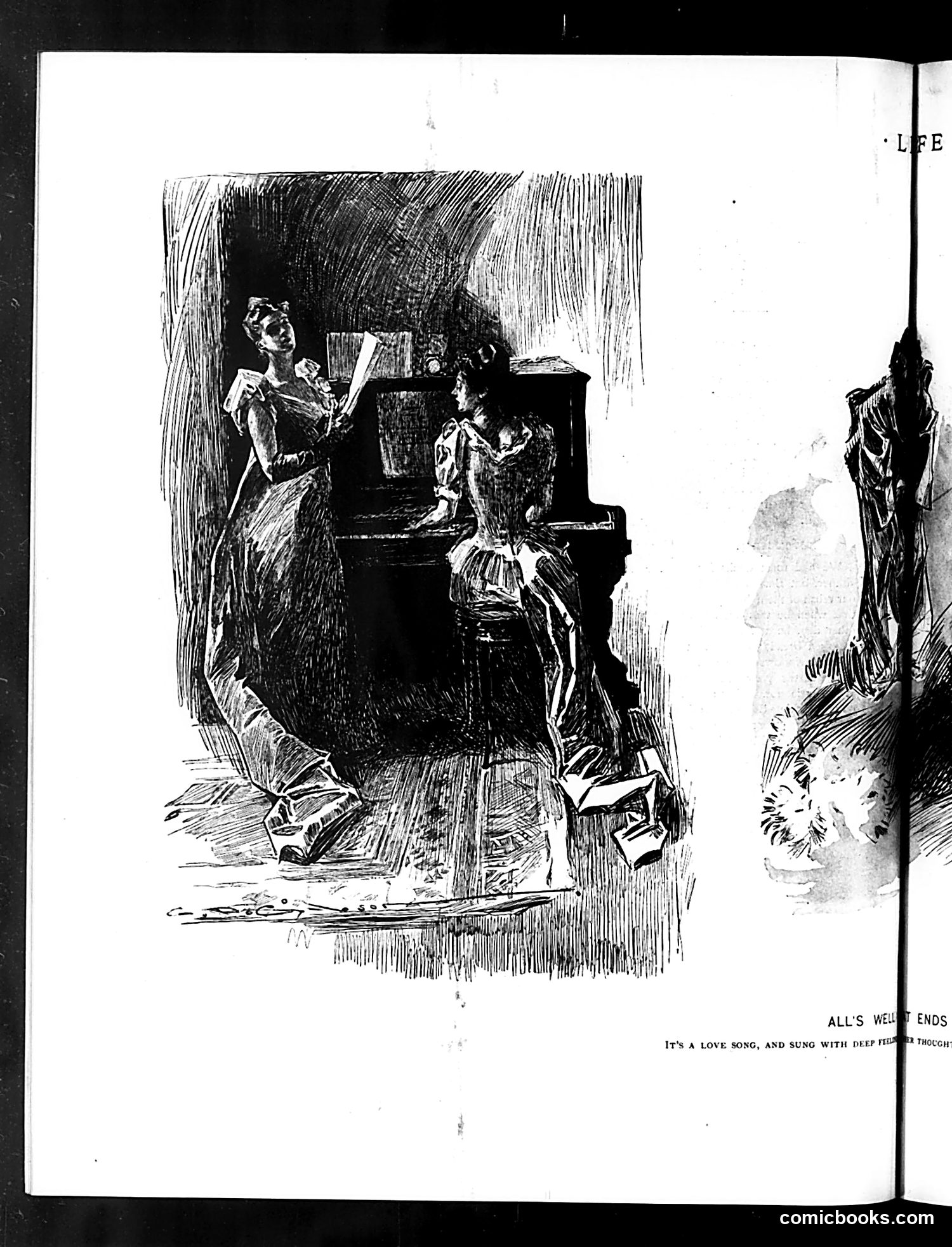
This illustration appears from a section titled "ALL'S WELL ENDS" with text referencing "IT'S A LOVE SONG, AND SUNG WITH DEEP FEELING THROUGHOUT." The sketch shows a Victorian-era domestic scene: a woman at a piano while a man stands beside her looking upward emotionally. A child sits nearby. The dramatic crosshatching and composition suggest this depicts a sentimental musical moment—likely illustrating a popular song or theatrical performance from the period. Without additional context from the magazine issue, the specific satire remains unclear. It could be mocking overwrought sentimentality in popular music, domestic melodrama, or Victorian emotional expression. The exaggerated poses and the ironic caption title suggest Life's editors found something ridiculous worth lampooning in this earnest musical scene, though the precise target of the satire isn't definitively evident from the image alone.
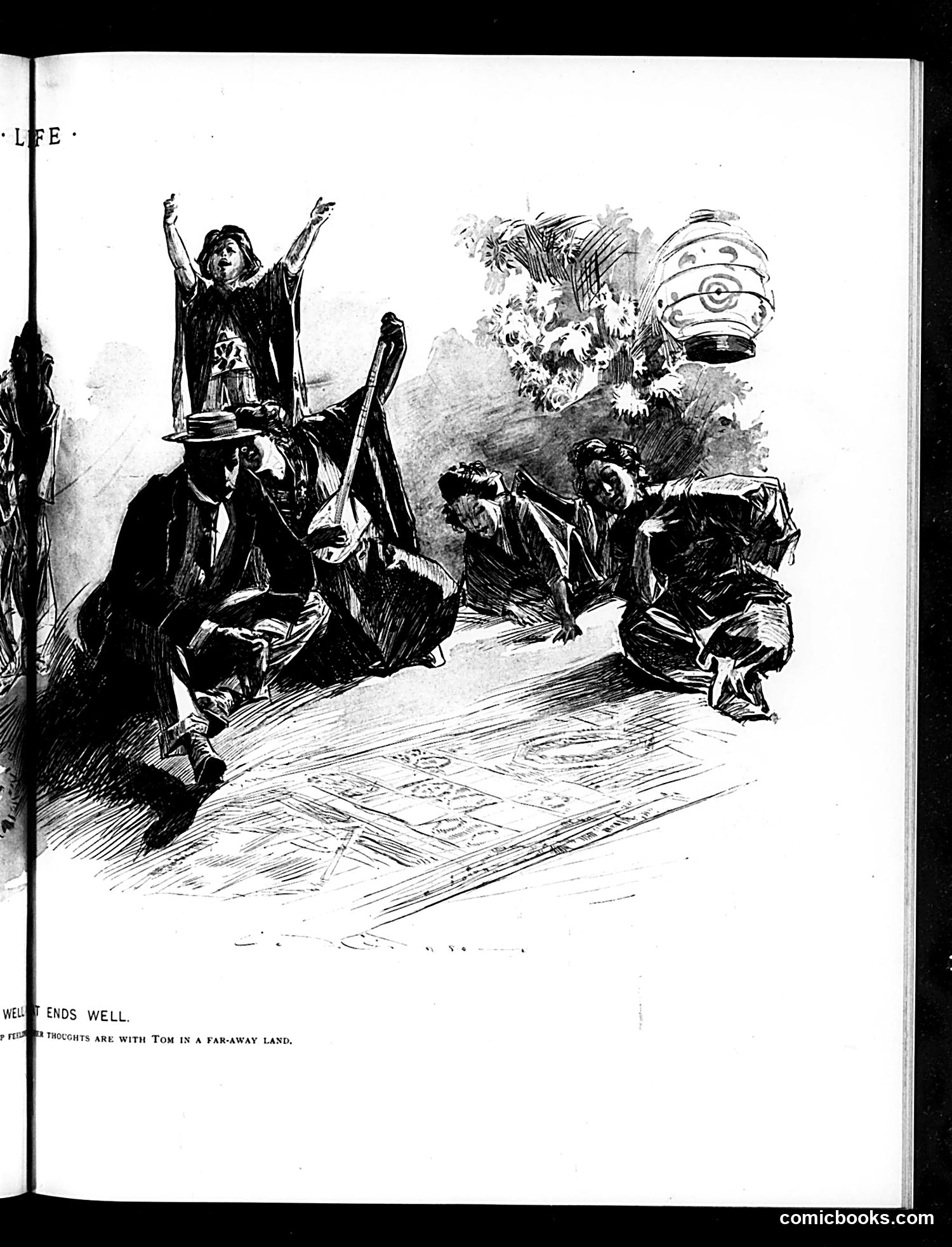
This appears to be an illustration concluding a serialized story, titled "ALL ENDS WELL" with the caption "HIS THOUGHTS ARE WITH TOM IN A FAR-AWAY LAND." The scene depicts a theatrical or domestic setting where figures gather around what seems to be a map or document on the floor. A character with raised arms stands elevated (possibly on furniture), suggesting triumph or celebration. The artistic style and formal dress suggest late 19th or early 20th century. Without the full story context, the specific narrative remains unclear. However, the "far-away land" reference and map suggest this may involve colonial adventure, military conflict, or imperial themes common to *Life* magazine's satirical content during that era. The celebratory pose contrasts with the referenced separation, possibly ironizing patriotic sentiment or imperial ventures.
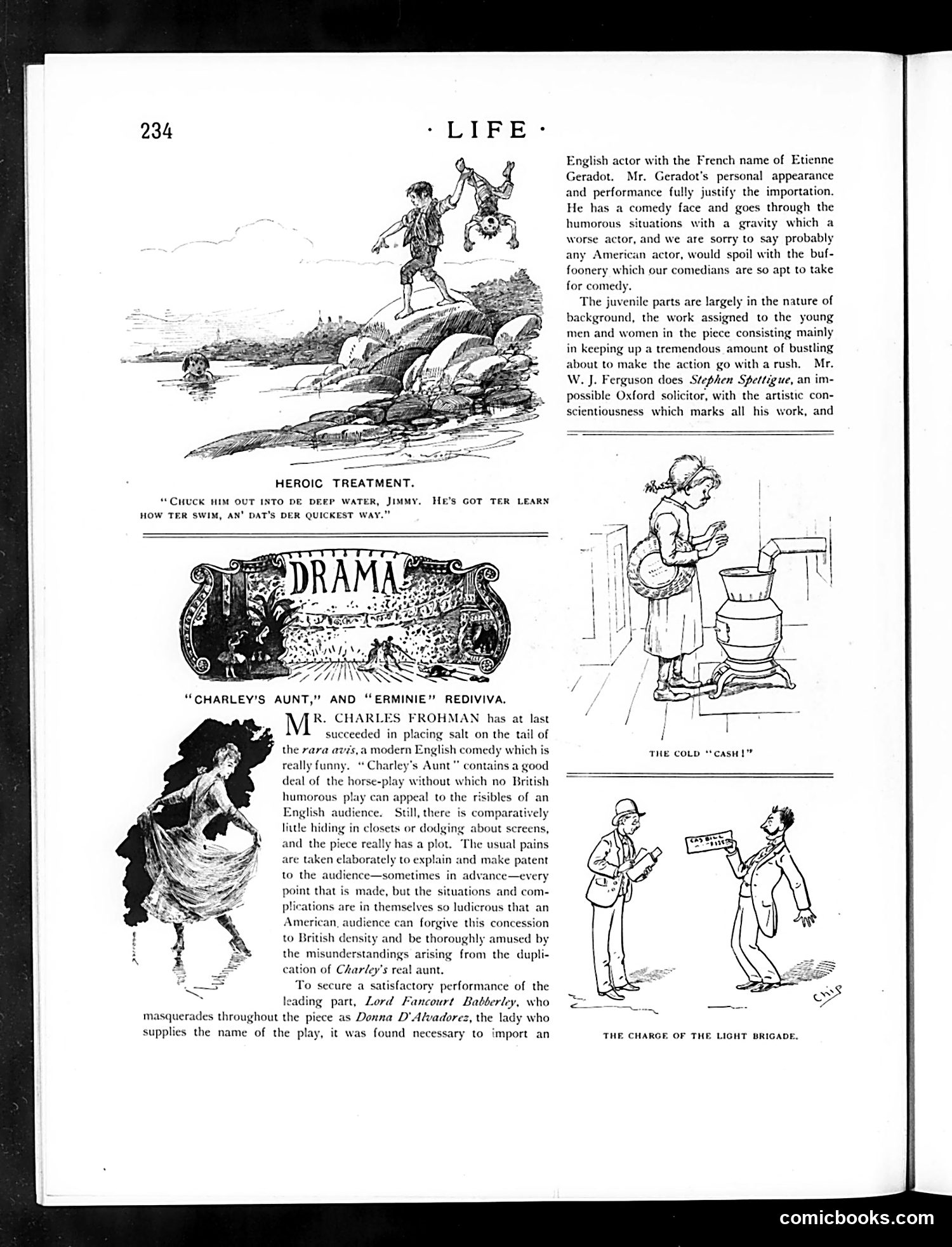
This page reviews British theatrical productions. The main focus is "Charley's Aunt" and "Erminie," praised for their comedic horse-play and humor. The text notes that English audiences appreciate such physical comedy in ways American audiences might not. The illustrations show theatrical scenes: one depicts a woman in elaborate dress (likely from the play's plot), while others illustrate comedic situations like "The Cold 'Cash!'" and "The Charge of the Light Brigade"—the latter appears to be a satirical sketch playing on the famous Crimean War cavalry charge by treating it as a comedic theatrical bit. The page essentially explains why these British plays succeed with English audiences through their blend of slapstick humor and plot-driven comedy.
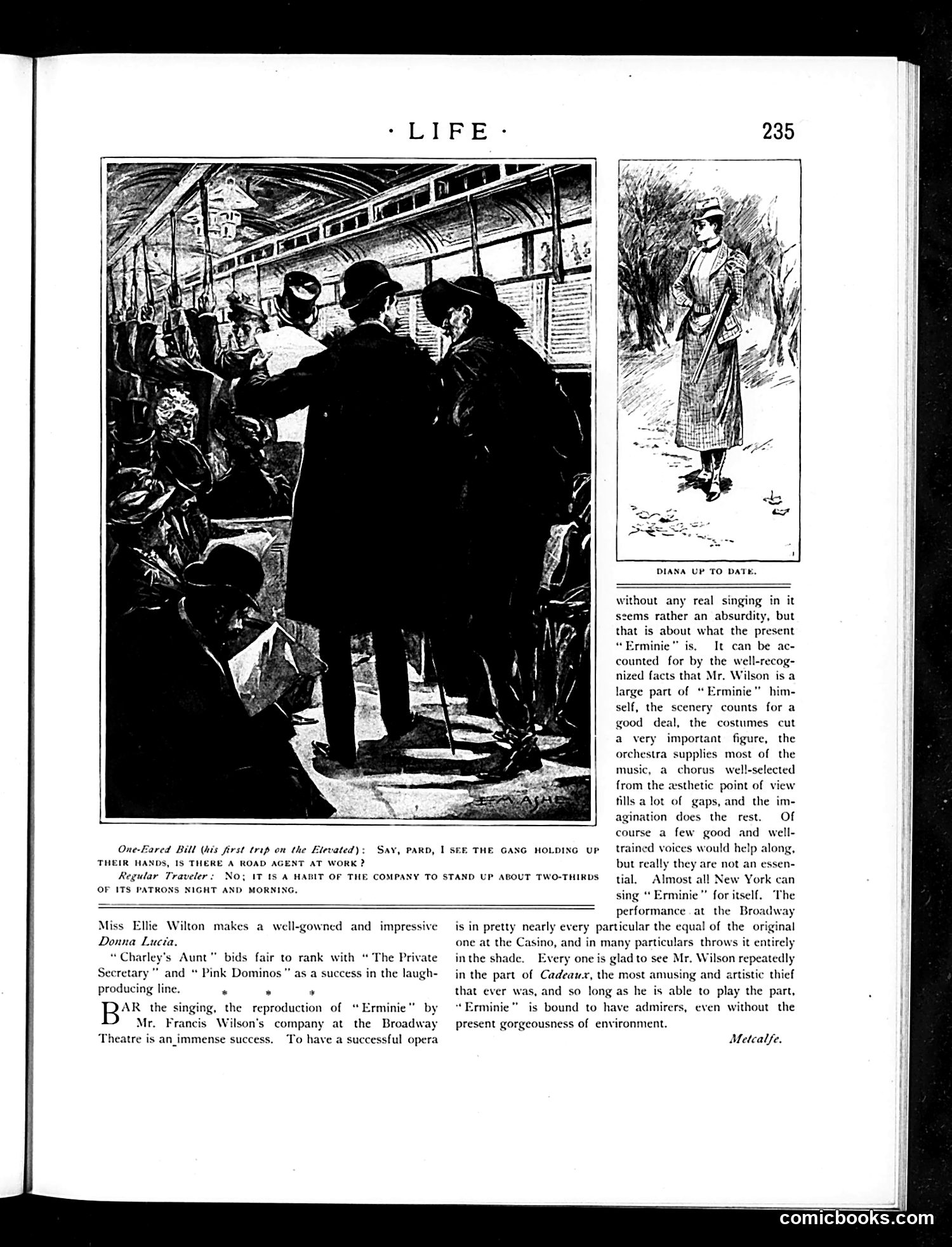
This page reviews Francis Wilson's Broadway production of "Erminie," an opera. The large left illustration shows a crowded elevated train car—likely satirizing the working-class audience packed into public transit to see the show, contrasting with the elite opera tradition. The right illustration labeled "Diana Up to Date" depicts a fashionably dressed woman outdoors, appearing to reference modern femininity or the "new woman" of the era. The text praises Wilson's performance and production values while acknowledging the opera lacks genuine singing quality. It notes that Wilson's acting, scenery, costumes, and orchestra compensate for vocal limitations. The reviewer suggests almost anyone in New York could sing the role competently, emphasizing that Wilson's star power and theatrical skill—rather than musical merit—drive the production's success.
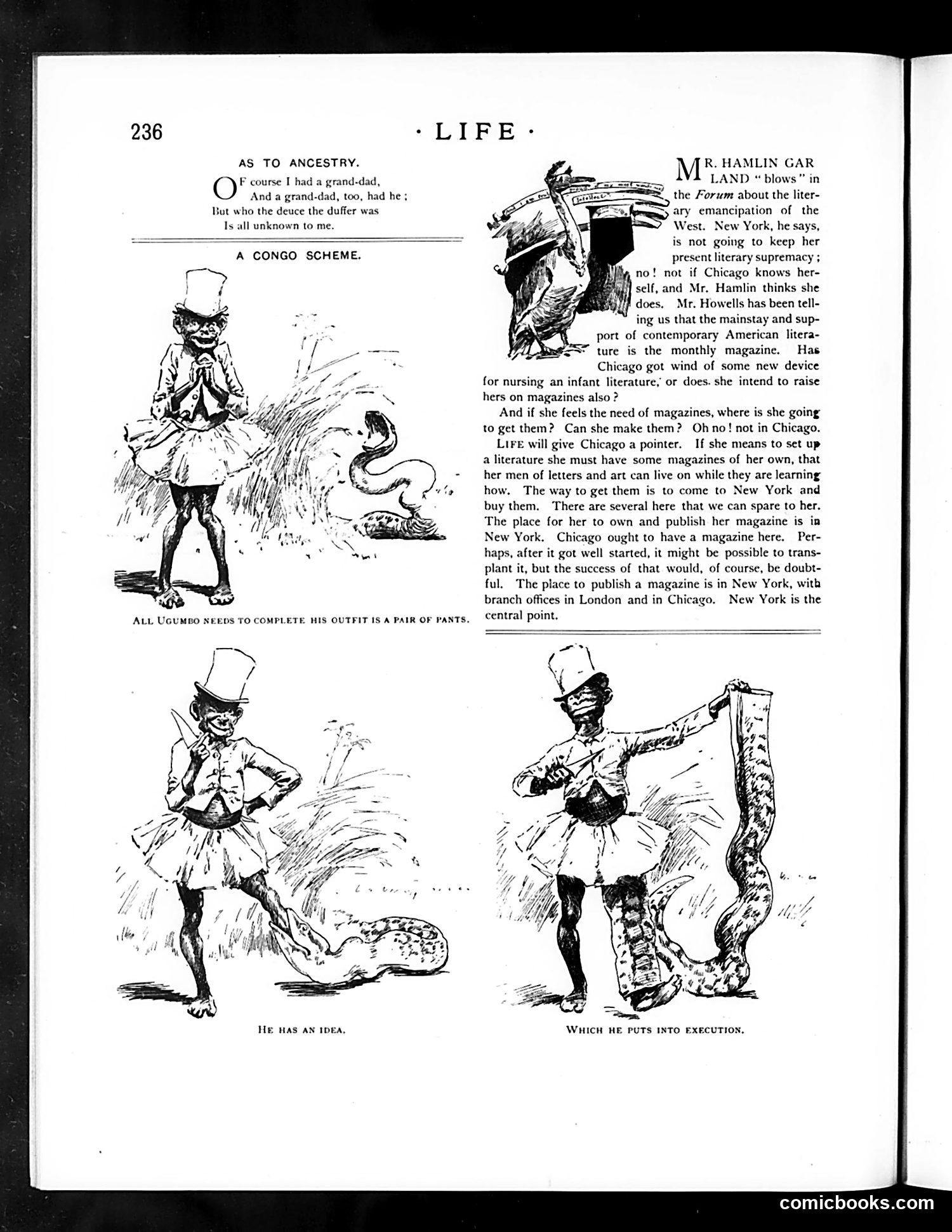
This page satirizes competing claims about American literary leadership between New York and Chicago. The text mocks Chicago's ambitions to become a literary center, arguing it must buy existing magazines from New York rather than create its own—New York being the essential "central point." The "Congo Scheme" cartoons use racist caricature (depicting Black Africans in exaggerated, dehumanizing style common to the era) to mock this rivalry through analogy: just as the figure needs pants to complete his outfit, Chicago needs New York's magazines to establish literary credibility. The crude visual humor equates Chicago's literary aspirations with primitive nonsense. The poem snippet dismisses questions of ancestry/legitimacy—a metaphorical dig at Chicago's cultural pedigree compared to established Eastern institutions. This reflects early 1900s East Coast intellectual snobbery toward Chicago's growing cultural ambitions.
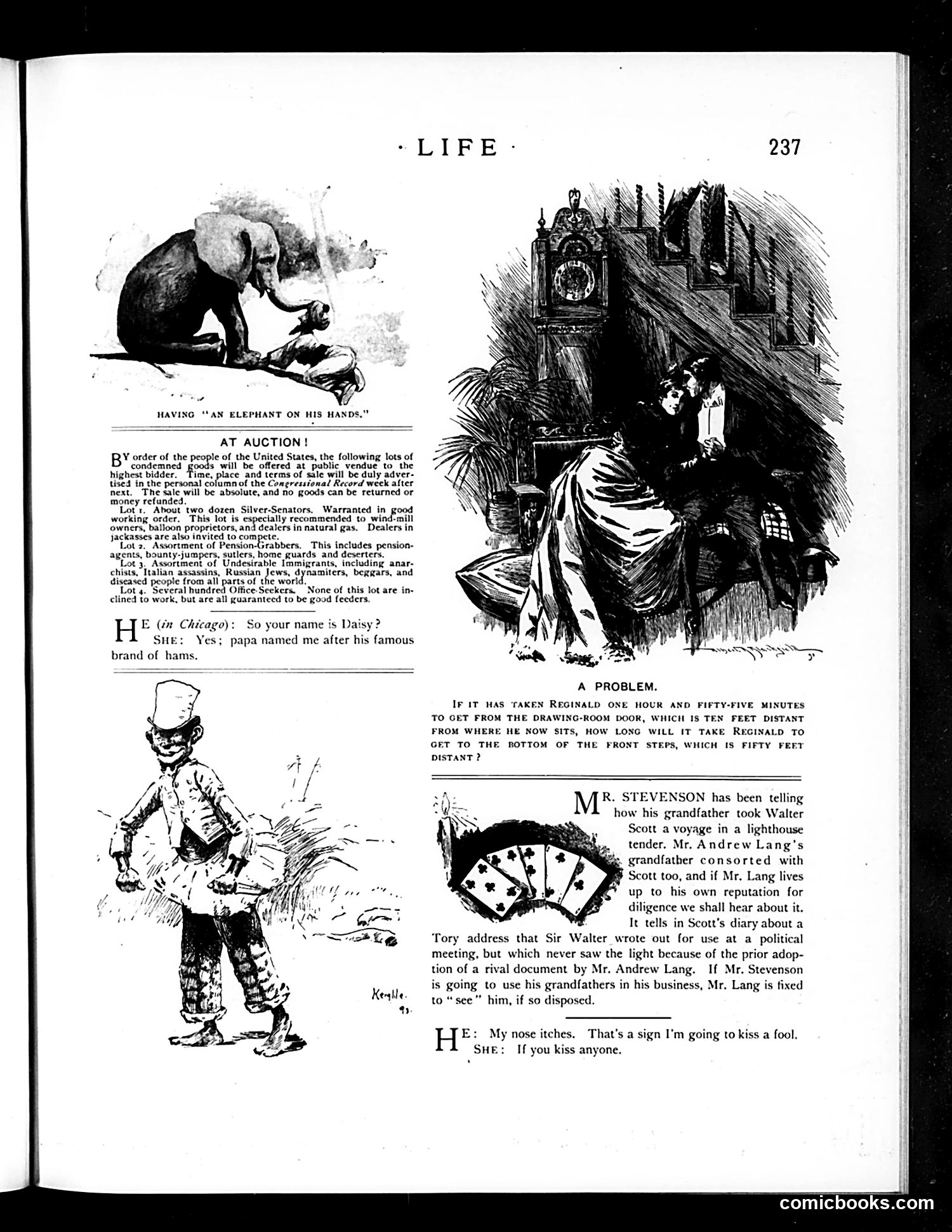
This page contains multiple satirical pieces: **Top cartoon**: "Having an Elephant on His Hands" depicts a congressman or politician struggling with an actual elephant—a visual pun on the phrase meaning an unwanted burden. This likely references Republican Party politics (the elephant being the GOP symbol) or a specific legislative problem. **"At Auction"**: A mock government auction listing "condemned goods" for sale, sarcastically offering "Silver-Senators" (corrupt politicians), "Pension-Grabbers" (fraud), and "Undesirable Immigrants"—attacking political corruption and contemporary anti-immigrant sentiment through absurdist humor. **Lower sketches**: Brief comedic vignettes, including wordplay about a girl named "Daisy" after her father's ham brand, and a math problem about courtship delays. **Bottom section**: Gossip about Scottish literary figures Walter Scott and Andrew Lang, using genealogical name-dropping as satire of intellectual pretension. The page exemplifies *Life*'s satirical approach: attacking political corruption, immigration policy debates, and social hypocrisy through cartoon, mock-serious listing, and witty dialogue.
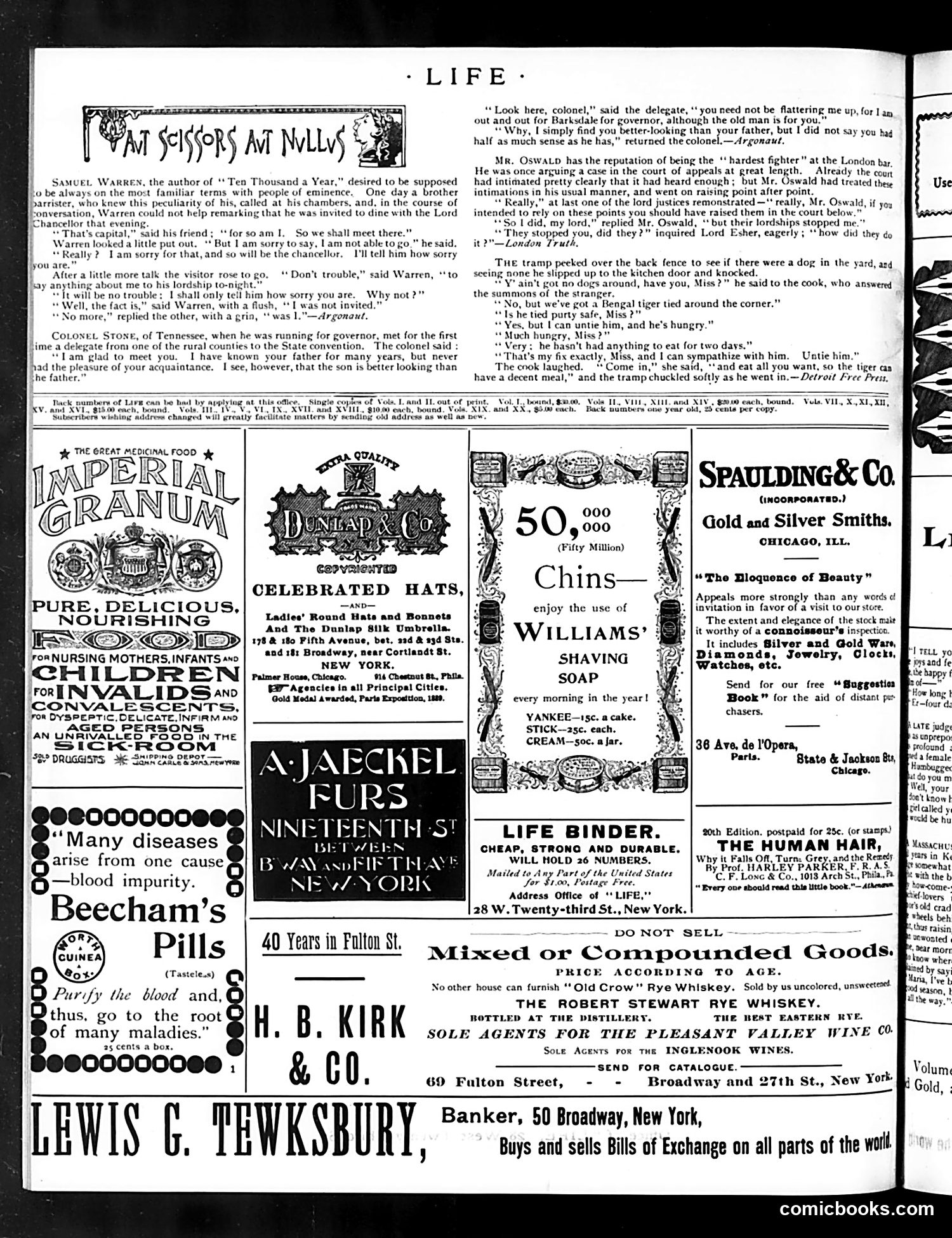
This page contains **four separate humorous anecdotes** rather than political cartoons. Each depicts social awkwardness or absurdity: 1. **Warren's Dinner Invitation**: A man invites author Samuel Warren to dine with a lord, but Warren admits he wasn't actually invited—a joke about social pretension and honesty. 2. **The Tennessee Colonel**: A delegate tells a politician he's voting for a rival (Barksdale) for governor, then claims the politician "looks better" than his own father but isn't smarter—satirizing empty political flattery. 3. **Mr. Oswald's Legal Arguments**: A barrister argues so long in court that judges interrupt him. When asked if he'll continue, he notes they "stopped" him anyway—mocking verbose lawyers. 4. **The Tramp and the Tiger**: A hungry vagrant asks a cook if she has dogs, then learns she has a Bengal tiger tied nearby. She feeds him anyway, and he's "sympathize[s]" with the tiger's hunger—dark humor about desperation. The page is primarily **advertising** below these stories, including products like Imperial Granum cereal and Beecham's Pills.
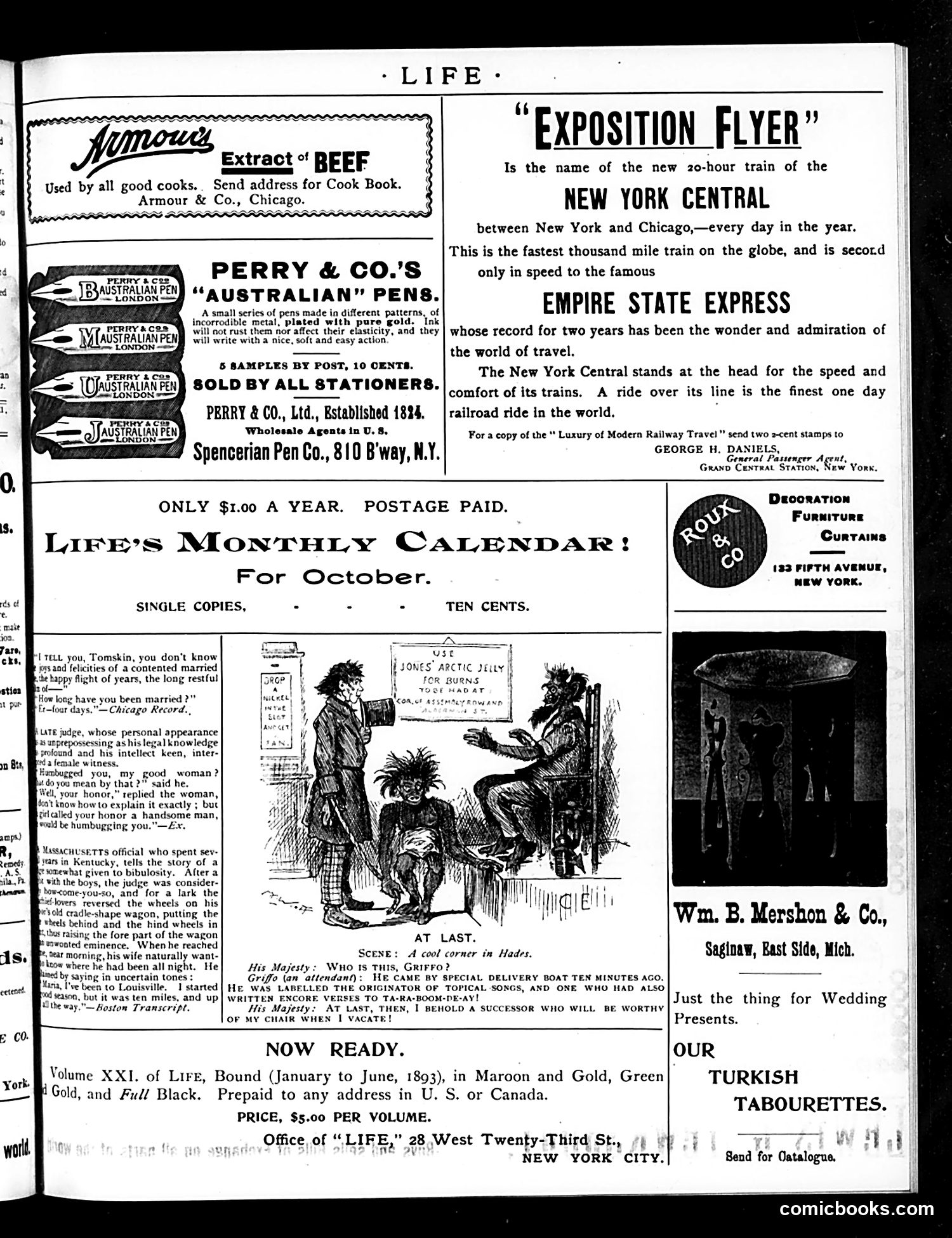
This page is primarily **advertisements and filler content**, with one cartoon of historical interest. The main cartoon titled "AT LAST" depicts a dialogue in Hades (hell) between His Majesty (likely Satan) and a new arrival named Griffo, described as "the originator of topical songs" who wrote encores to "Ta-Ra-Boom-De-Ay." This is satire directed at a specific songwriter or entertainer (Griffo is likely a character based on a real performer), mocking him as so mediocre that even Satan wants him as a successor when vacating his throne. The joke relies on "Ta-Ra-Boom-De-Ay" being recognizable to contemporary readers as either extremely popular or ridiculously banal music. The rest of the page contains prose humor pieces (marital comedy, a judge's anecdote) and period advertising for beef extract, fountain pens, trains, and furniture. These represent typical Life magazine content circa 1893.
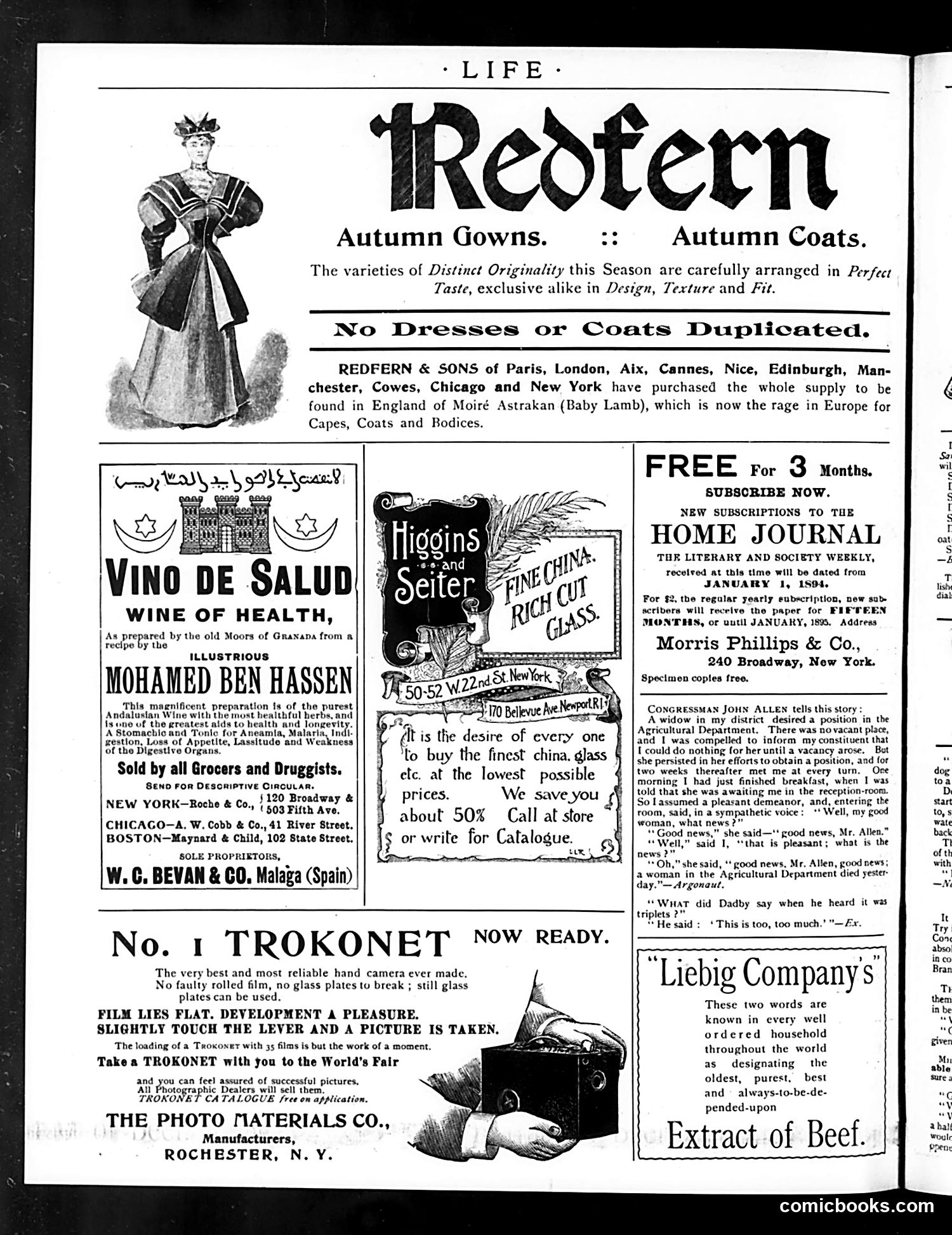
This is primarily an **advertising page** with minimal satirical content. The main items are commercial advertisements for luxury goods and patent products typical of the 1890s era. Notable ads include: - **Redfern fashion house**: High-end clothing retailer advertising exclusive autumn gowns and coats made from expensive moiré astrakan (baby lamb fur) - **Vino de Salud**: A dubious "health wine" allegedly based on a Moorish recipe, claiming medicinal benefits—typical of patent medicine snake oil common in this period - **Trokonet camera**: An early hand camera marketed for the upcoming World's Fair The only satirical content is a brief **anecdote** attributed to "Congressman John Allen" about a widow persistently seeking a government job, which only ends when she reports a departmental woman's death. This appears to mock both political patronage and persistent job-seekers—common targets of Period satire. The page reflects turn-of-the-century consumer culture and reveals attitudes toward women's employment and questionable medical products.
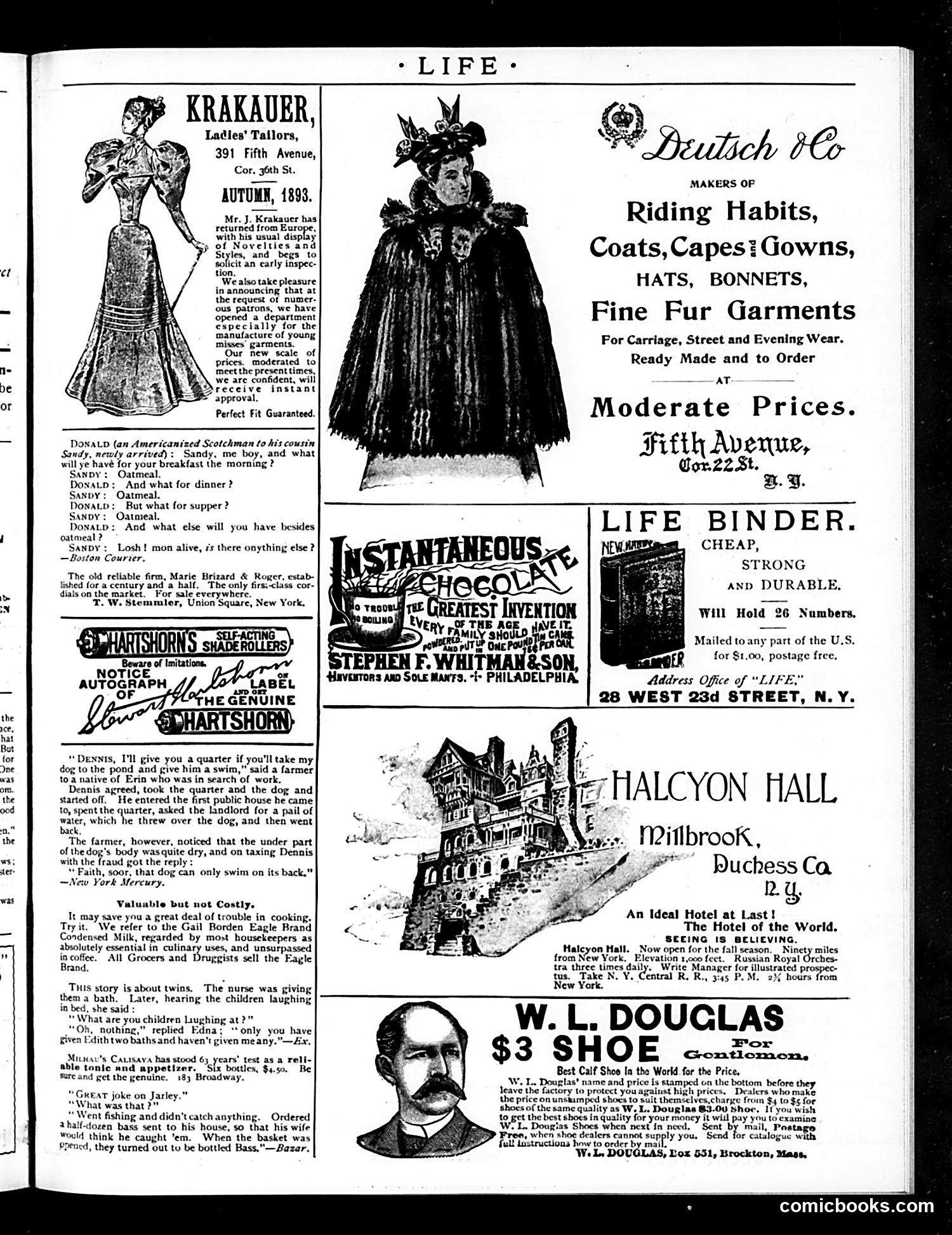
This page is primarily advertising with embedded humorous stories—typical of Life magazine's format in 1898. The main visual cartoon features a Scottish immigrant ("Donald") asking his newly-arrived cousin what he wants for breakfast, lunch, and dinner. The cousin repeatedly answers "Oatmeal," prompting Donald's exasperated question: "And what else will you have besides oatmeal?" The joke satirizes Scottish stereotypes about frugality and limited diet, a common ethnic humor trope of the era. Another brief story mocks Irish immigrants: a farmer pays an Irishman to bathe his dog; the worker spends the money at a pub, throws water on the dog once, then claims the dog "can only swim on its back"—poking fun at perceived Irish dishonesty and cunning. A third joke about twins and baths plays on children's bathroom innocence. The rest of the page contains advertisements for ladies' tailoring, chocolates, shoe polish, cordials, condensed milk, and hotels—with no satirical content. The page reflects period attitudes toward immigrant communities through ethnic stereotyping presented as harmless humor.
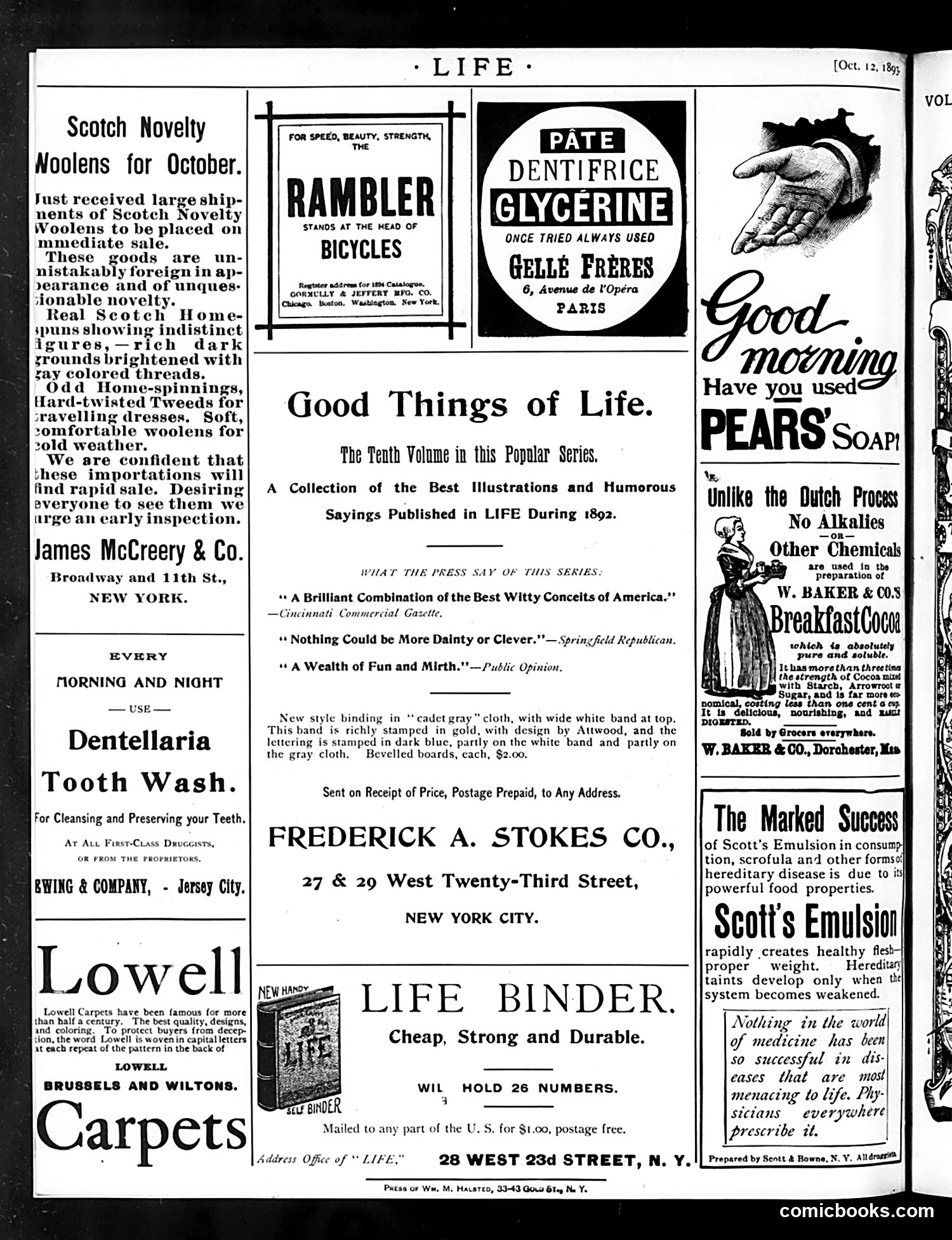
This is primarily an **advertising and promotional page** rather than a satirical cartoon page. It advertises the tenth volume of Life's "Good Things of Life" collection—a compilation of illustrations and humorous sayings published throughout 1892. The page features: - **Product advertisements** typical of the 1890s: Scotch woolens, bicycles (Rambler brand), toothpaste, carpets, soap, cocoa, and patent medicines (Scott's Emulsion for consumption/tuberculosis) - **Press quotes** praising the book as offering "witty conceits" and "fun and mirth" - **Book details**: cadet gray cloth binding with gold stamping, $2.00, available from Frederick A. Stokes Co. - **A Life Binder advertisement**: holds 26 magazine issues for $1.00 The satirical content referenced would be *inside* the collection itself. This page serves mainly as a catalog/sales tool showcasing Life's merchandise and back catalog, with no visible political cartoon or social satire on this particular page.