
A complete issue · 16 pages · 1893
Life — September 28, 1893
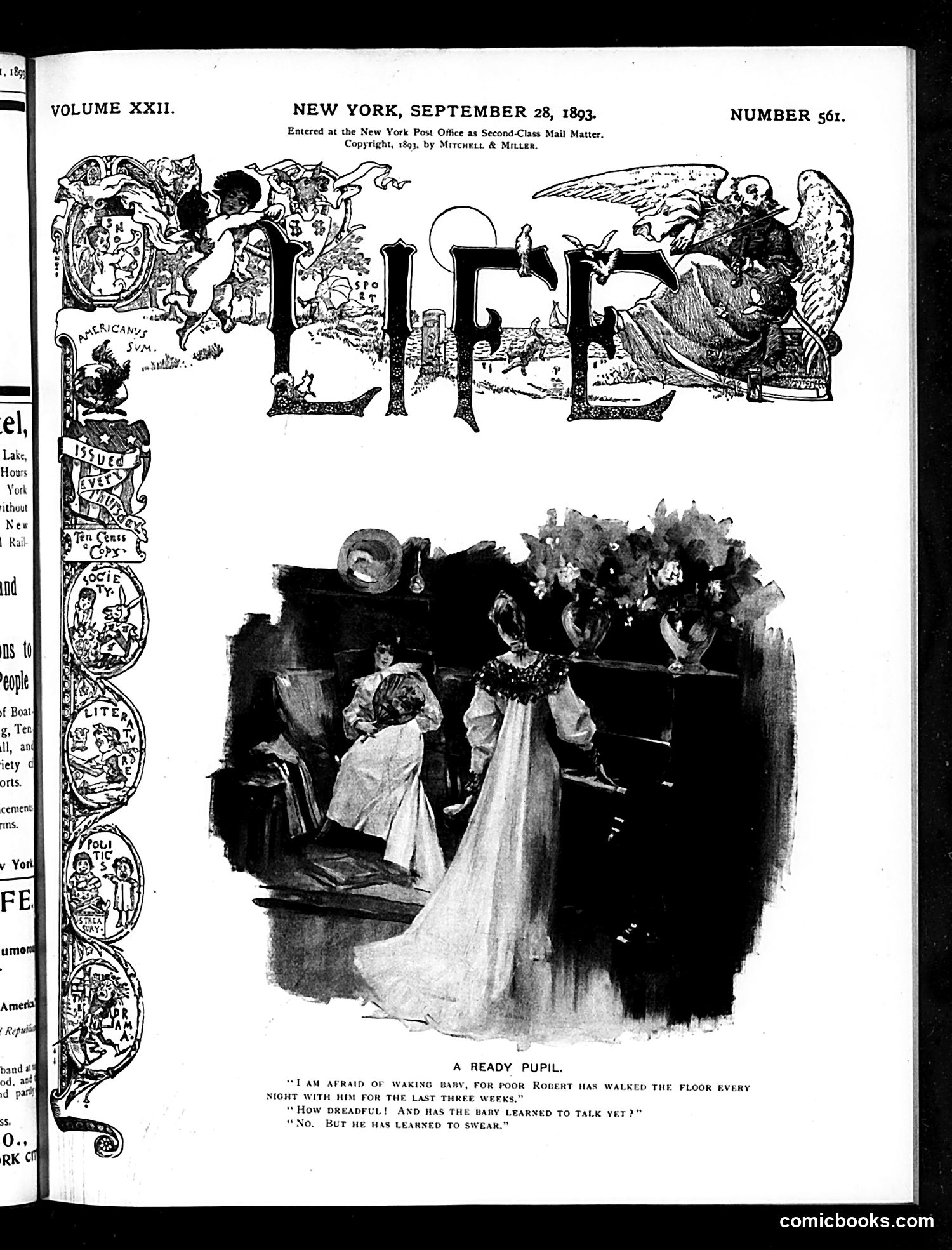
This page contains a single illustrated joke titled "A Ready Pupil." The image shows a woman at a piano with a baby, while a man (presumably the father) stands nearby looking concerned. The caption reads: "I am afraid of waking baby, for poor Robert has walked the floor every night with him for the last three weeks." When asked "How dreadful! And has the baby learned to talk yet?" the response is "No. But he has learned to swear." The humor relies on a common domestic scenario of 1890s life: sleepless nights with an infant. The joke suggests the frustrated father has been swearing so much during nighttime baby-walking that the child has picked up curse words rather than learning proper speech—a commentary on parental exhaustion and loss of composure.
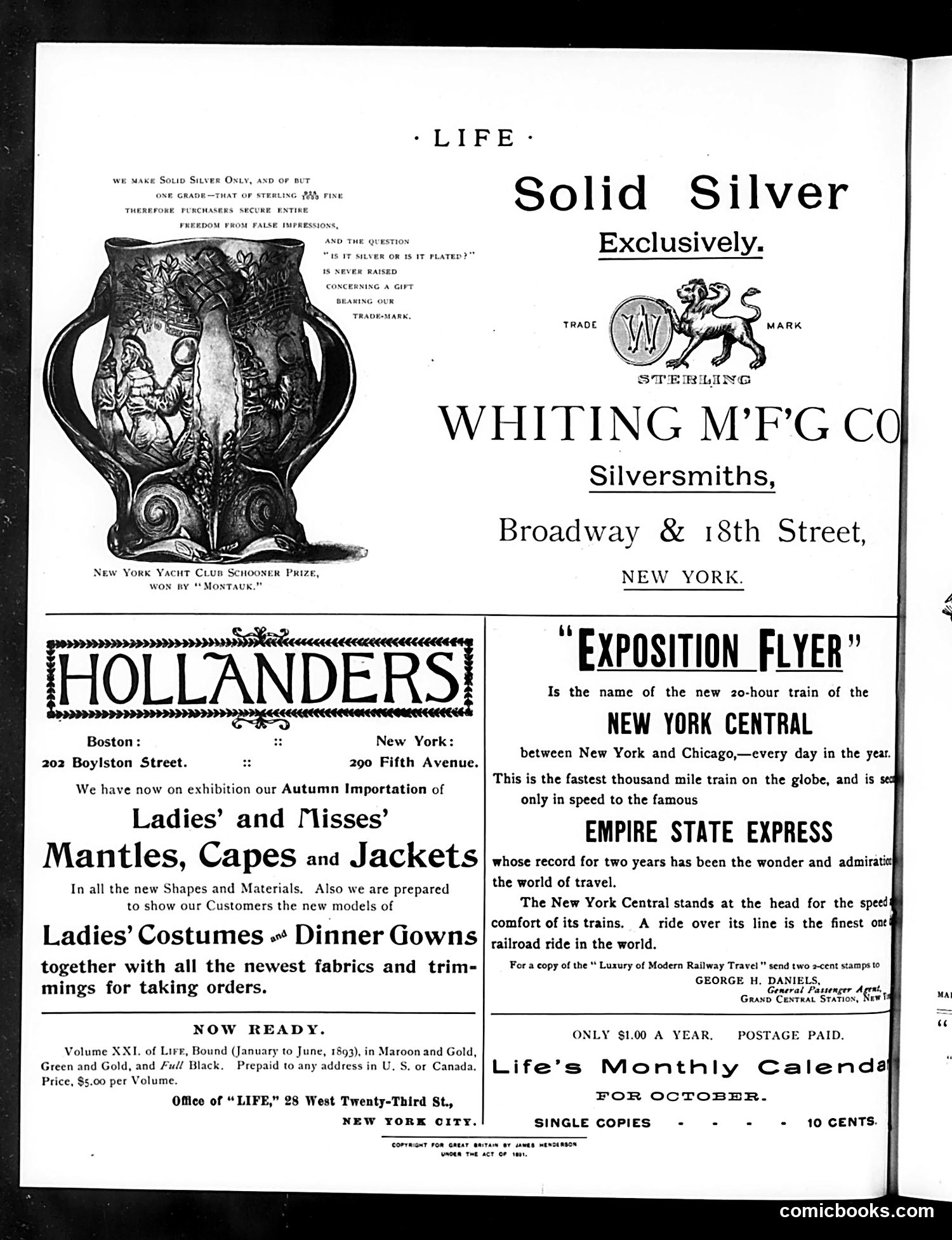
This page is primarily **commercial advertising** rather than satirical content. The dominant elements are: 1. **Whiting MFG Co.** advertisement emphasizing their solid silver goods (not plated), positioned as a luxury silversmith on Broadway & 18th Street, New York. 2. **Hollanders** department store ad (Boston and New York locations) announcing autumn imports of ladies' clothing—mantles, capes, jackets, costumes, and dinner gowns. 3. **New York Central Railway** promotional copy for their "Exposition Flyer" train service between New York and Chicago, contrasting it favorably with the famous "Empire State Express." The decorative vessel image (top left) appears to be the **New York Yacht Club Schooner Prize** won by "Montauk"—a notable achievement worth advertising. The page reflects late-19th century consumer culture and transportation marketing.
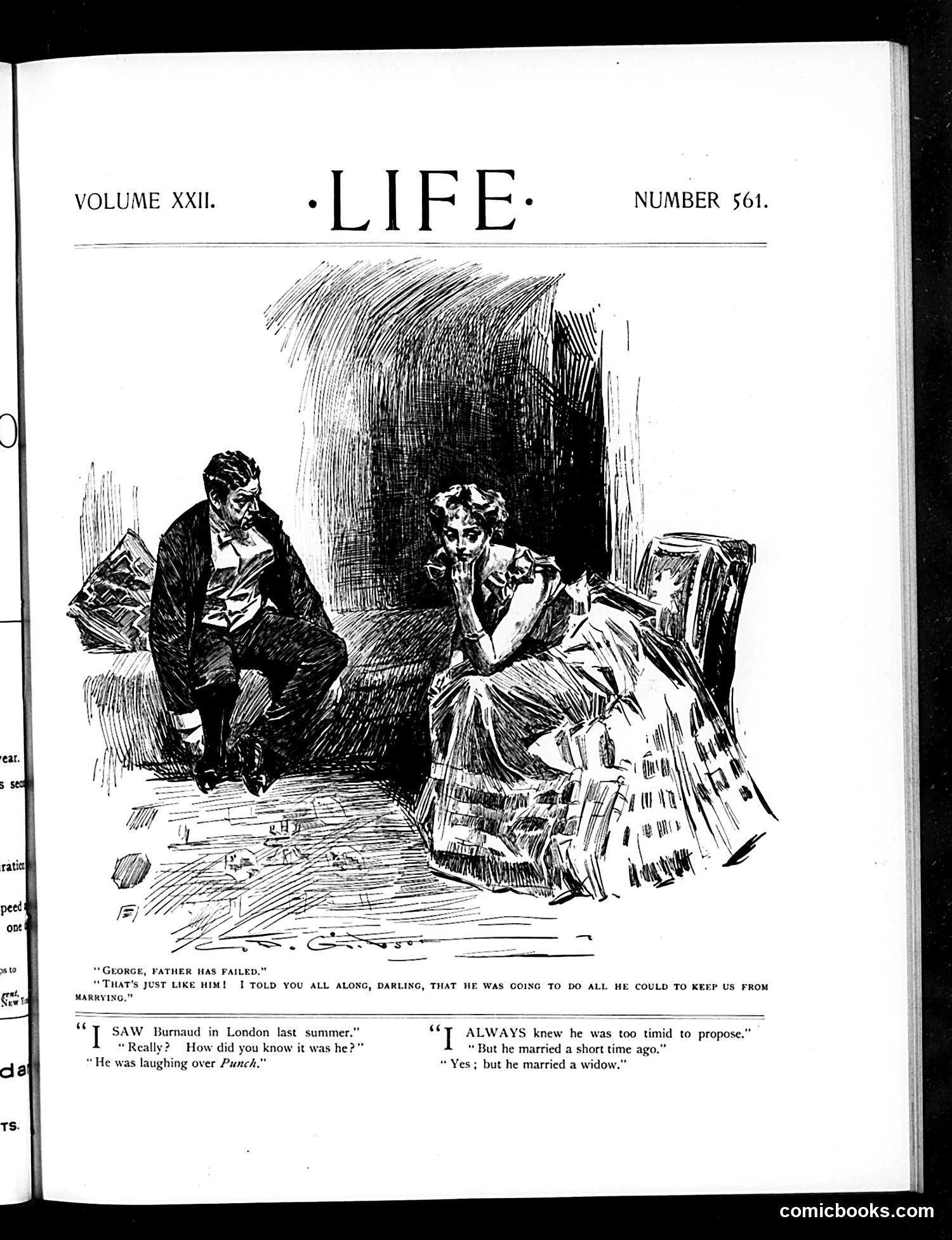
This page from *Life* magazine (Volume XXIII, Number 561) contains a sketch-style cartoon depicting two figures in conversation about romantic misadventures. The caption "George, Father Has Failed" suggests domestic comedy centered on a failed courtship or marriage proposal. The dialogue reveals the joke's structure: a woman tells a man that his father attempted to prevent their marriage by claiming he'd "do all he could to keep us from marrying." The woman then reveals the father's failure—the man married a widow instead, presumably as a rebound or alternative. The humor appears to target both paternal interference in romance and the social awkwardness of hasty second marriages. The sketchy, theatrical illustration style is typical of *Life*'s satirical humor from this era. Without dating information visible, the exact historical context remains unclear.
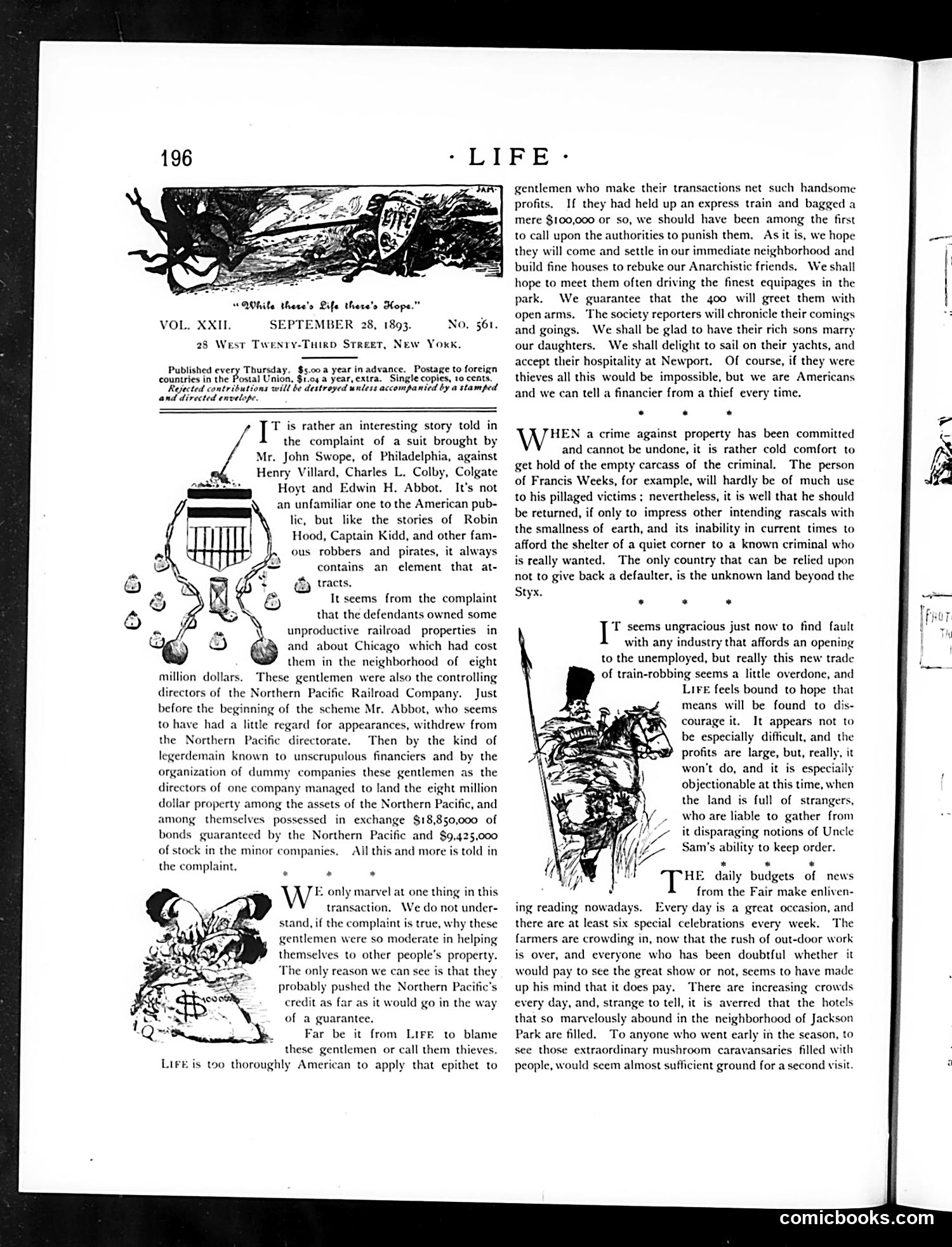
This page discusses a lawsuit against railroad executives, including John Swope (Philadelphia) and others involved in the Northern Pacific Railway Company. The complaint alleges these gentlemen improperly acquired unproductive railroad properties near Chicago worth millions of dollars and manipulated Northern Pacific's credit and stock for personal profit. The cartoons satirize railroad corruption and theft. The illustrated emblems (shield with money bags) symbolize corporate malfeasance. The text argues that while train-robbers like Robin Hood capture public imagination, these "respectable" businessmen commit larger thefts through financial manipulation—a more socially damaging crime because it's harder to prosecute and recover losses. This reflects 1890s Progressive Era concerns about corporate corruption and financial fraud.
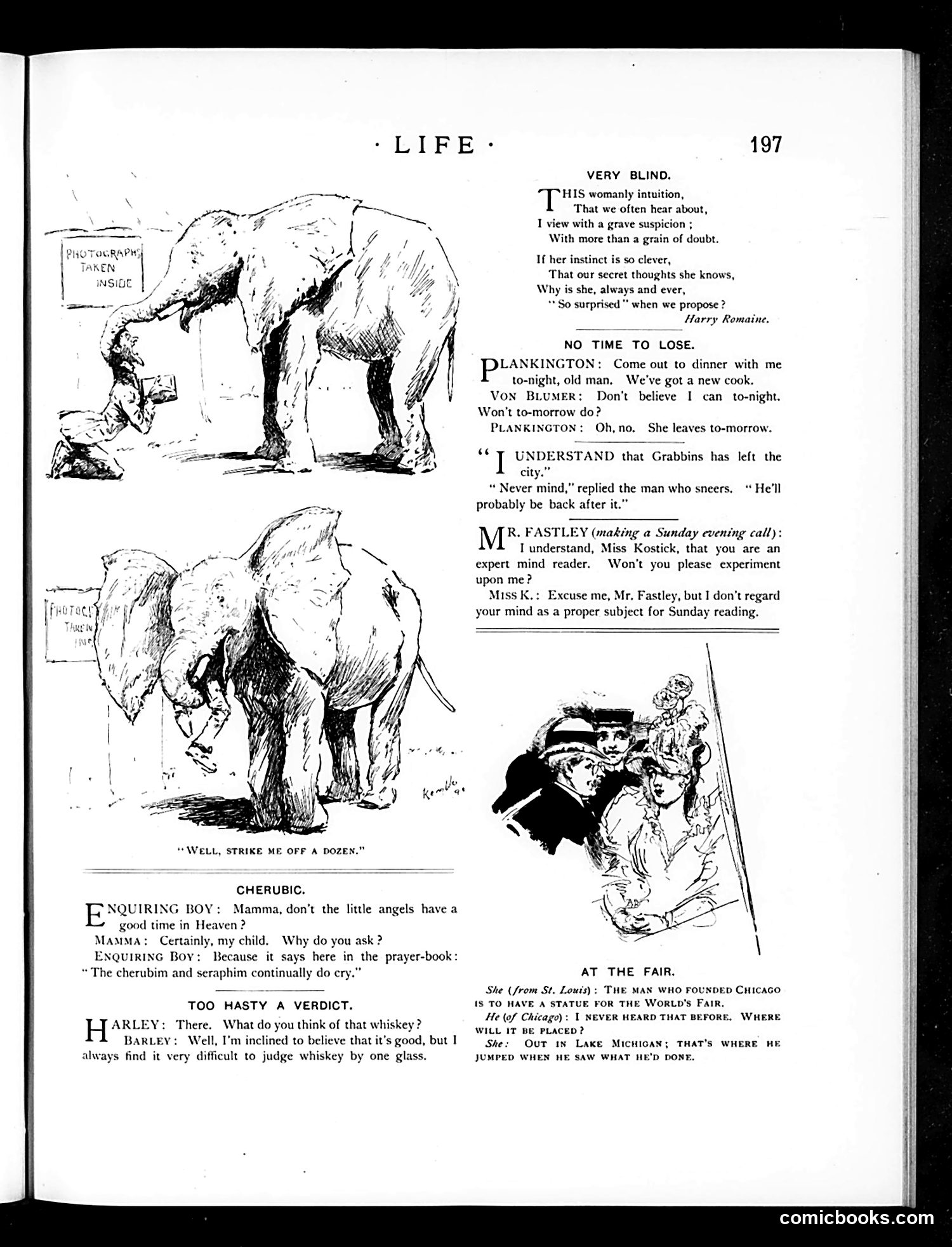
This page contains several unrelated satirical pieces typical of Life magazine's format: **"Very Blind"** - A poem mocking women's intuition, suggesting skepticism about female "instinct." **"No Time to Lose"** - A dialogue joke about a man (Plankington) inviting another (Von Blumer) to dinner, with urgency because a woman leaves tomorrow. The humor relies on innuendo about romantic interest. **"Cherubic"** and **"Too Hasty a Verdict"** - Brief conversational jokes about children and whiskey judgment, respectively. **"At the Fair"** - References the World's Fair in Chicago (appears to be early 1900s). A woman from St. Louis discusses a statue of the fair's founder, with humor about his drowning in Lake Michigan—a darkly comedic reference to an actual historical event. The elephant cartoons illustrate the "strike me off a dozen" joke about quantity, likely sexual innuendo.
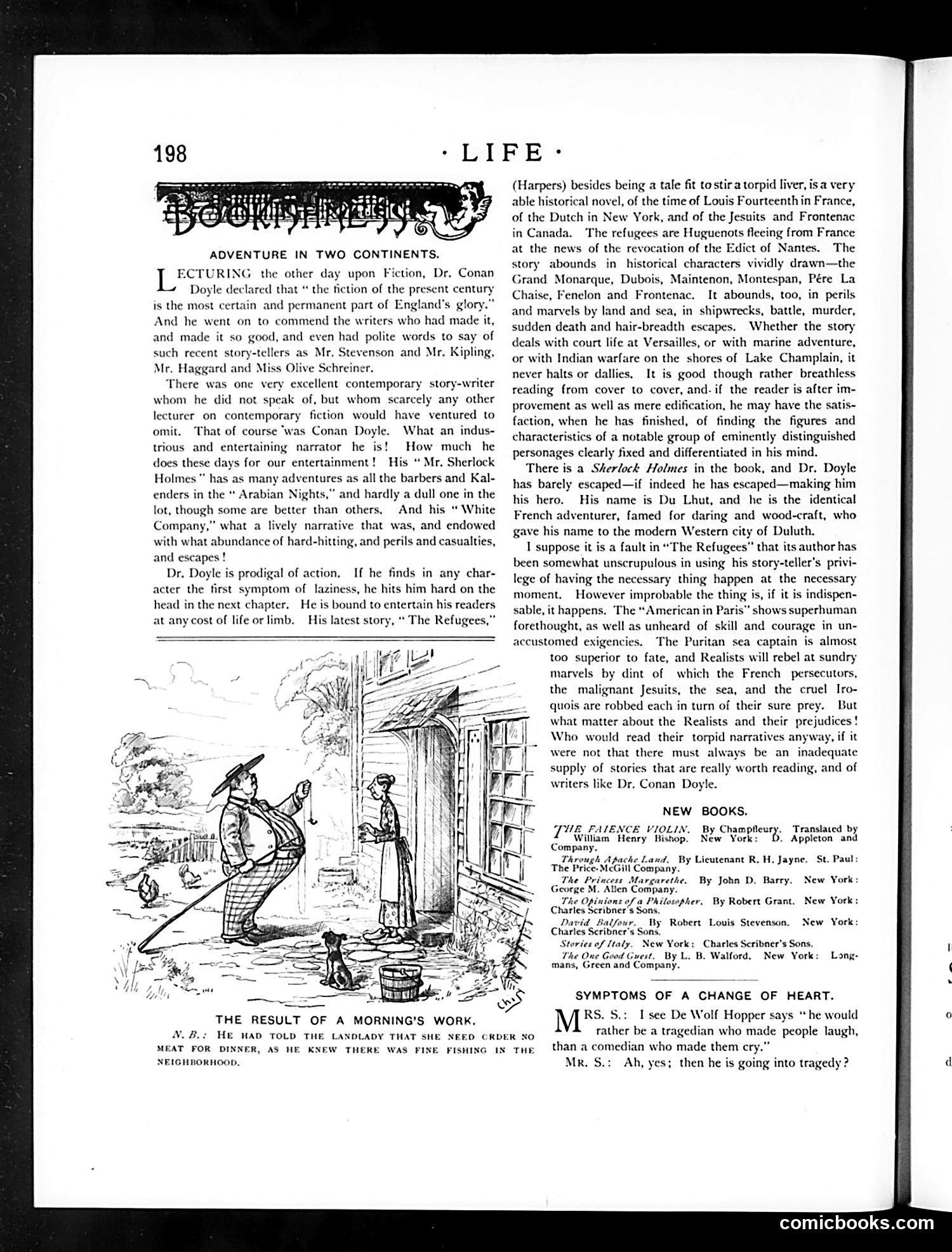
**Main Content:** This page primarily contains a book review essay about works by Arthur Conan Doyle, praising his storytelling ability across historical fiction and adventure narratives. **The Cartoon:** "The Result of a Morning's Work" depicts a man returning home with fishing equipment and a meager catch, while the caption notes he told his landlady he needed "cured no meat for dinner, as he knew there was fine fishing in the neighborhood." The joke is a simple domestic one: his fishing expedition failed completely, contradicting his confident claim to his landlady about securing dinner through fishing. **Context:** This is straightforward comedic satire about male overconfidence and household economics—a relatable domestic humor genre common in early 20th-century magazines, not tied to specific political events.
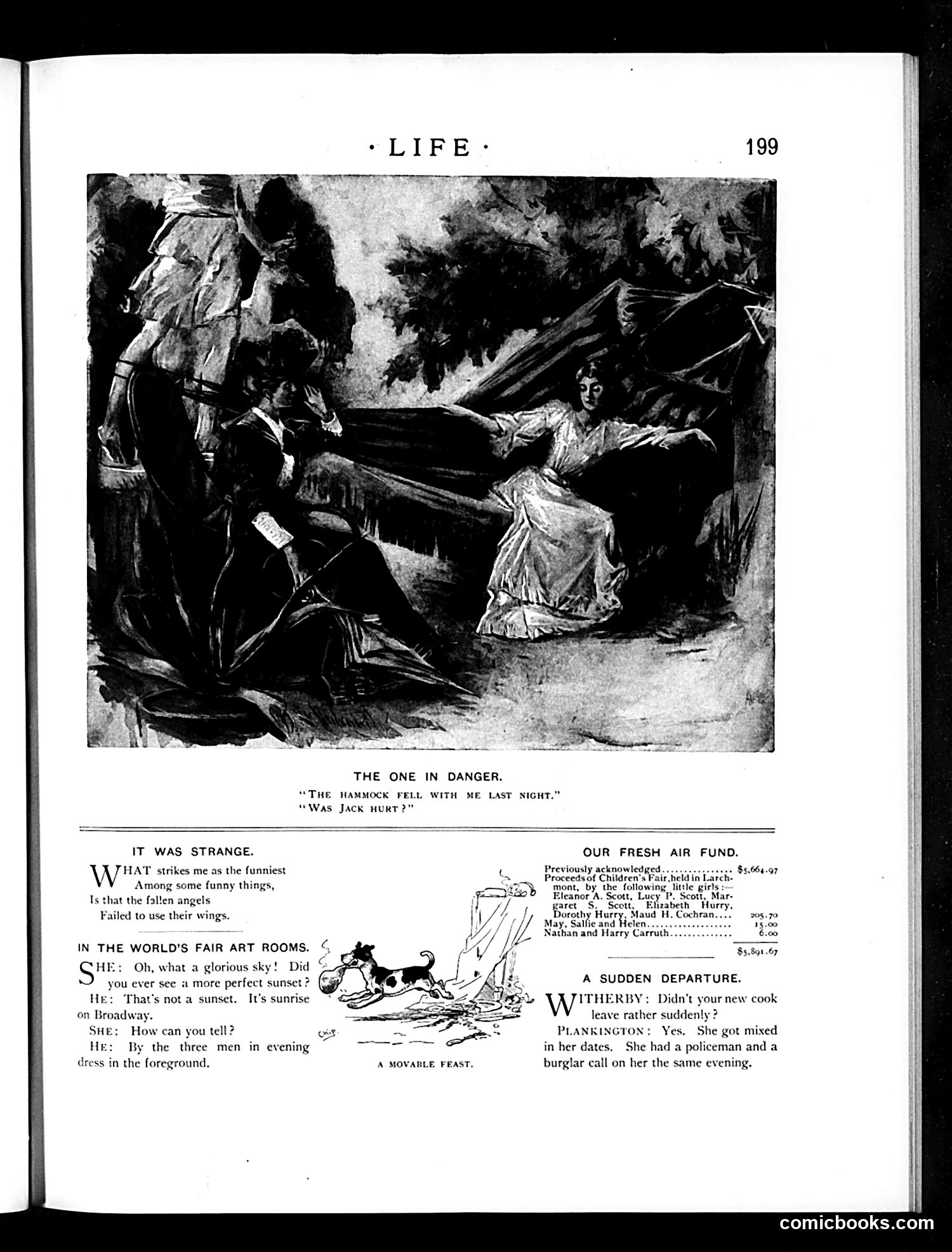
This page contains three separate humorous items rather than a unified political cartoon: 1. **"The One in Danger"** (top): A dramatic illustration depicting what appears to be a domestic crisis, with the caption suggesting someone named Jack may be injured. The subject matter is unclear without additional context. 2. **"It Was Strange"** and **"In the World's Fair Art Rooms"**: A dialogue joke about fallen angels failing to use their wings, set against a World's Fair backdrop. This appears to be lighthearted social commentary rather than political satire. 3. **"A Movable Feast"**: A small cartoon with a dog, likely a domestic humor piece. 4. **"Our Fresh Air Fund"** and **"A Sudden Departure"**: Sections listing charitable donations and a brief anecdote about a cook leaving employment unexpectedly. The page primarily features miscellaneous humor and charitable notices rather than pointed political satire.
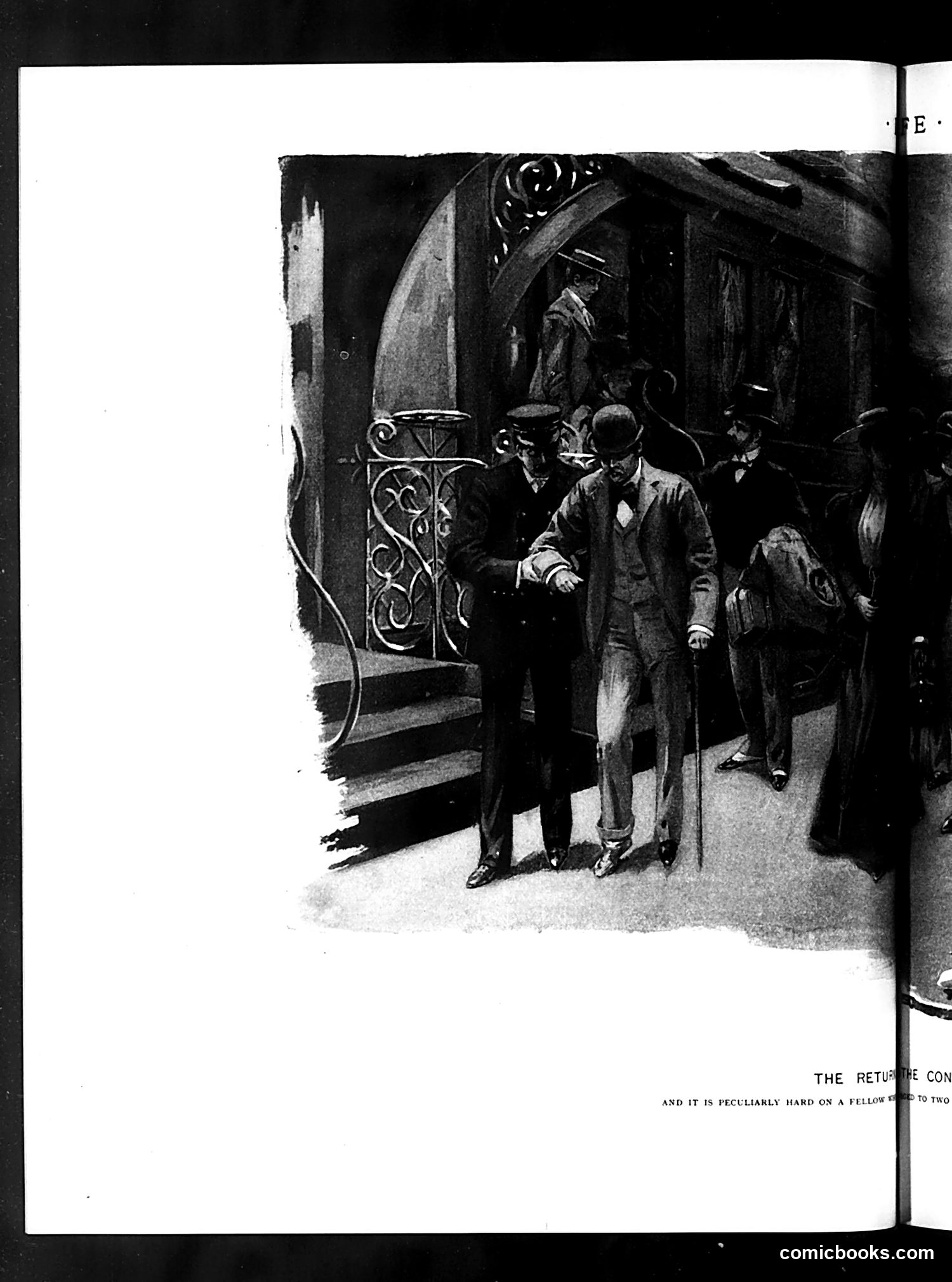
This page appears to be from an early 20th-century *Life* magazine illustration, showing what looks like a formal indoor scene with multiple figures in period dress gathered near an ornate architectural element (possibly a gate or doorway). The partially visible caption at bottom reads "THE RETUR[N] THE CON[...]" and mentions something being "peculiarly hard on a fellow." The specific text is too obscured for certain interpretation. Without clearer caption text, I cannot definitively identify the figures, the political or social reference being satirized, or the intended joke. The formal setting and multiple suited figures suggest this may depict a social or political gathering, but identifying the specific event, individuals, or satirical point would require legible caption text or additional context.
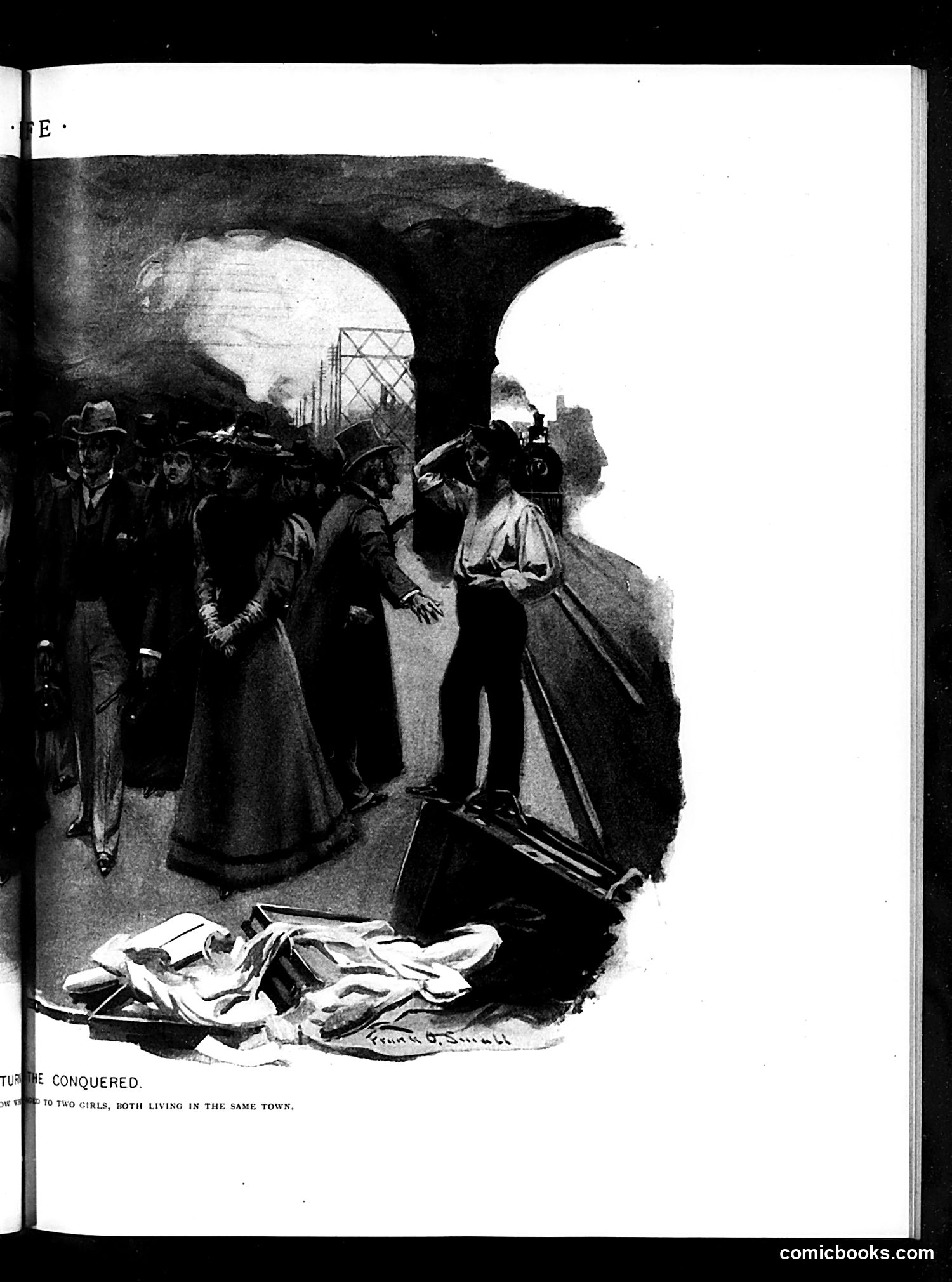
This illustration depicts a tragic scene under a railway viaduct. The visible caption references "two girls, both living in the same town," suggesting a narrative about seduction or moral ruin—common satirical themes in early 20th-century Life magazine. The crowded gathering of formally dressed figures surrounding what appears to be a deceased woman suggests social scandal or tragedy. The railway setting and crowd's solemn demeanor imply this depicts consequences of urban vice or romantic betrayal, likely illustrating a cautionary tale about young women's vulnerability. The title "The Conquered" implies female victimization—possibly critiquing urban dangers, seduction narratives, or social hypocrisy. Without additional context, the specific reference remains unclear, but the cartoon clearly uses melodrama to comment on women's precarious social position in contemporary society.
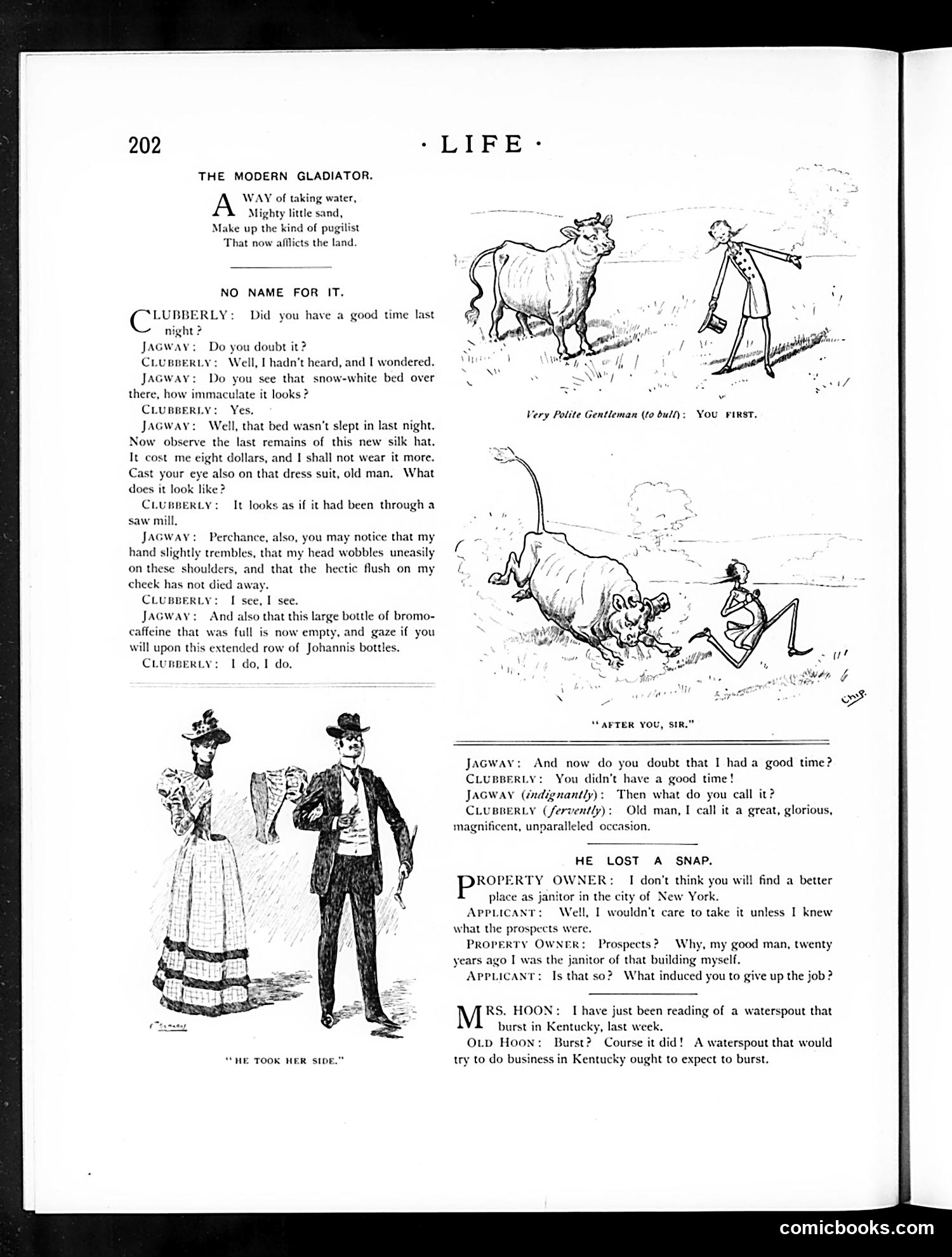
This page contains three separate comic sketches satirizing social pretension and hypocrisy: 1. **"The Modern Gladiator"** and **"No Name for It"**: A dialogue between Clubberly and Jagway mocking excessive consumption. Jagway brags about expensive new purchases (silk hat, dress suit, bromocaffeine bottles) while displaying obvious signs of destitution—a bed that "wasn't slept in," worn clothes, and trembling hands. The satire targets conspicuous consumption masking poverty. 2. **"After You, Sir"**: A visual gag showing a disheveled man chasing a cow, depicting failed social etiquette. 3. **"He Lost a Snap"** and **"He Took Her Side"**: A couple's domestic scene. 4. **"He Lost a Snap"** dialogue: An applicant and property owner discuss a janitor position, with the owner revealing he himself abandoned the job twenty years prior—undermining his authority. 5. **"Mrs. Hood"**: A brief joke about Kentucky's unpredictable weather (waterspouts).
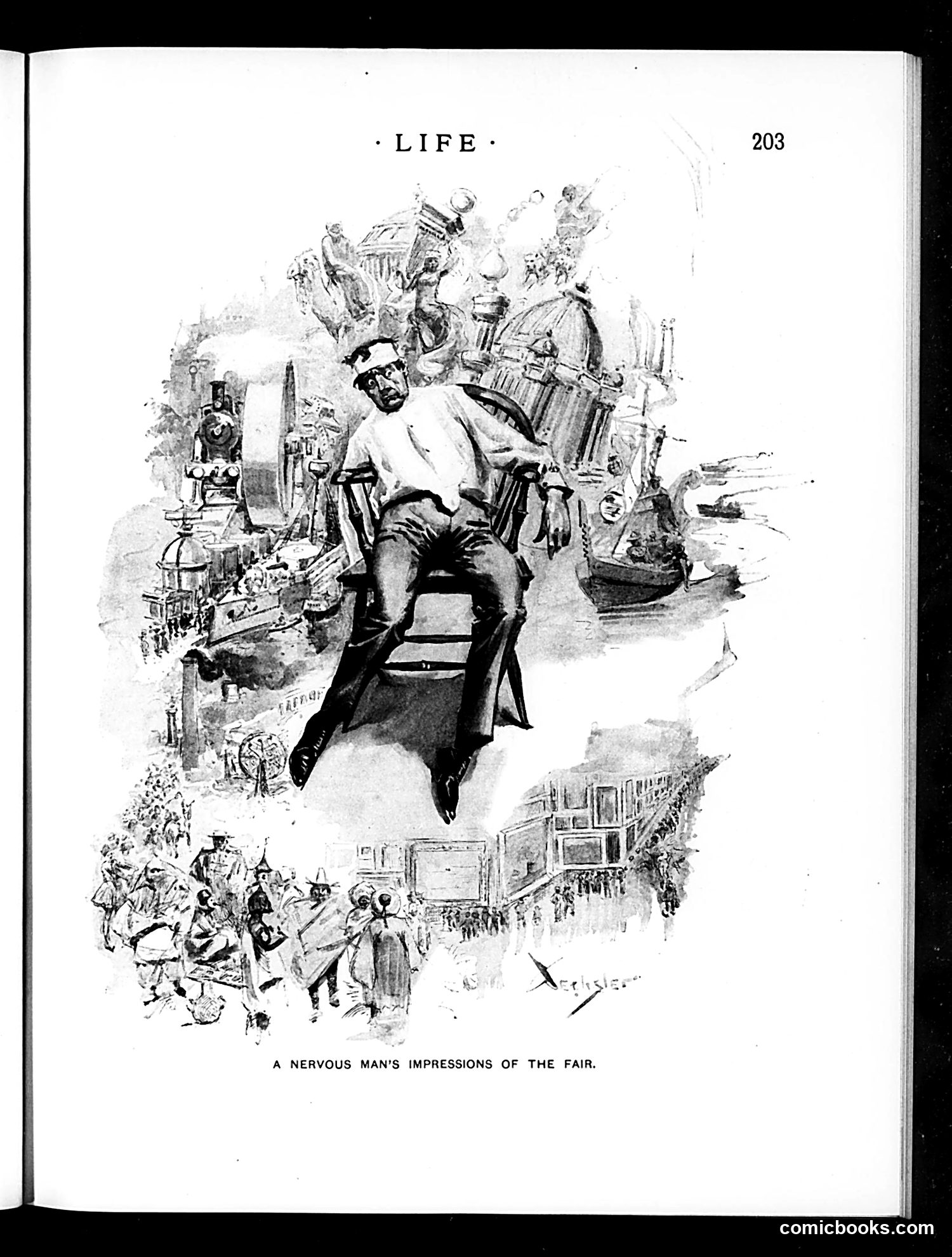
This is a satirical illustration depicting one man's anxious, chaotic mental experience at what appears to be a world's fair or exposition. The central figure sits overwhelmed, his head filled with swirling, disorienting imagery: military equipment, ships, crowds, buildings, and various fair attractions all tumbling together in surreal composition. The satire targets sensory overload—the fair as an overstimulating spectacle that overwhelms the nervous or anxious visitor. Rather than presenting an orderly, progressive display of human achievement (the typical fair's purpose), this cartoon shows the subjective experience of someone mentally unable to process the chaos and noise. It's commentary on modern anxiety amid industrial-age spectacle.
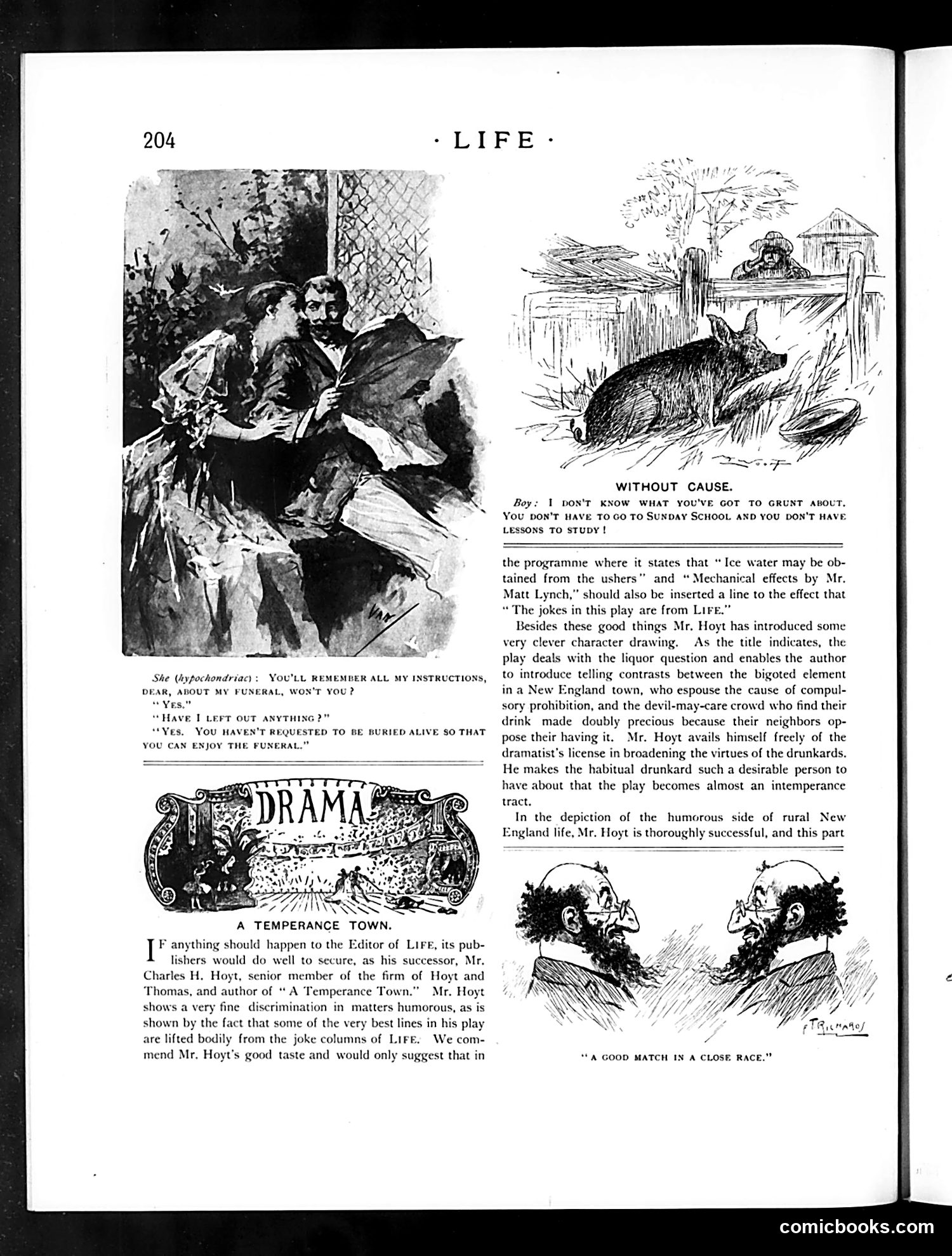
This page contains drama criticism and satirical cartoons from Life magazine. The main content reviews Charles H. Hoyt's play "A Temperance Town," which deals with prohibition debates in New England. The cartoons illustrate domestic and social humor: 1. **Top left**: A hypochondriac woman obsessively discusses her funeral arrangements with her husband, who sarcastically suggests she should request to be "buried alive" to enjoy the entertainment—mocking hypochondriacs' preoccupation with death. 2. **Top right**: A rabbit causes property damage; a boy tells it to stop complaining since it avoids Sunday school and lessons—dark humor about the rabbit's predicament. 3. **Bottom**: Caricatured faces labeled "A Good Match in a Close Race"—likely satirizing political or social competition. The critic praises Hoyt's play for its humor but wryly notes that some jokes are lifted from Life's own columns. The review indicates the play explores tensions between prohibitionists and drinkers in rural New England society.
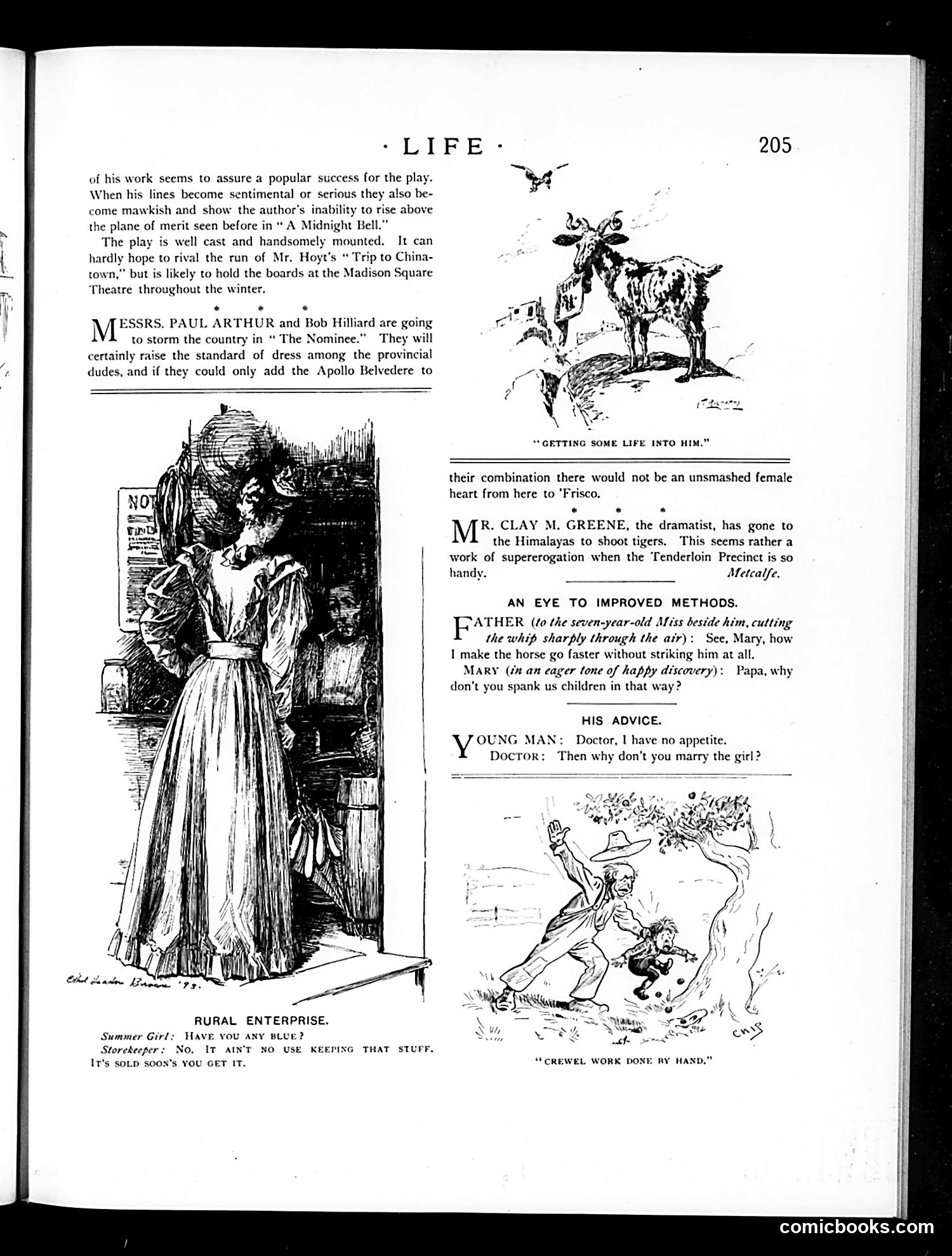
This page contains several unrelated satirical items typical of Life magazine's format: **Theater Reviews** discuss new plays by Paul Arthur, Bob Hilliard, and Clay M. Greene—minor dramatists of the era. The satire mocks their work as derivative and their pretensions (the joke about adding the "Apollo Belvedere" statue references classical ideals these provincial playwrights supposedly lack). **The cartoons** are brief domestic jokes: - "An Eye to Improved Methods" satirizes a father teaching his daughter a cruel horse-training technique, and she naively suggests applying it to children—dark humor about parenting methods. - "His Advice" makes a crude joke about marriage curing appetite loss. - "Rural Enterprise" mocks a summer visitor asking a storekeeper for blue crewel thread; he dismisses it as unsellable in rural areas. These reflect Life's focus on social observation and gentle mockery of American manners, provincial attitudes, and urban sophistication gaps—typical humor for a middle-class readership of the 1890s-1900s.
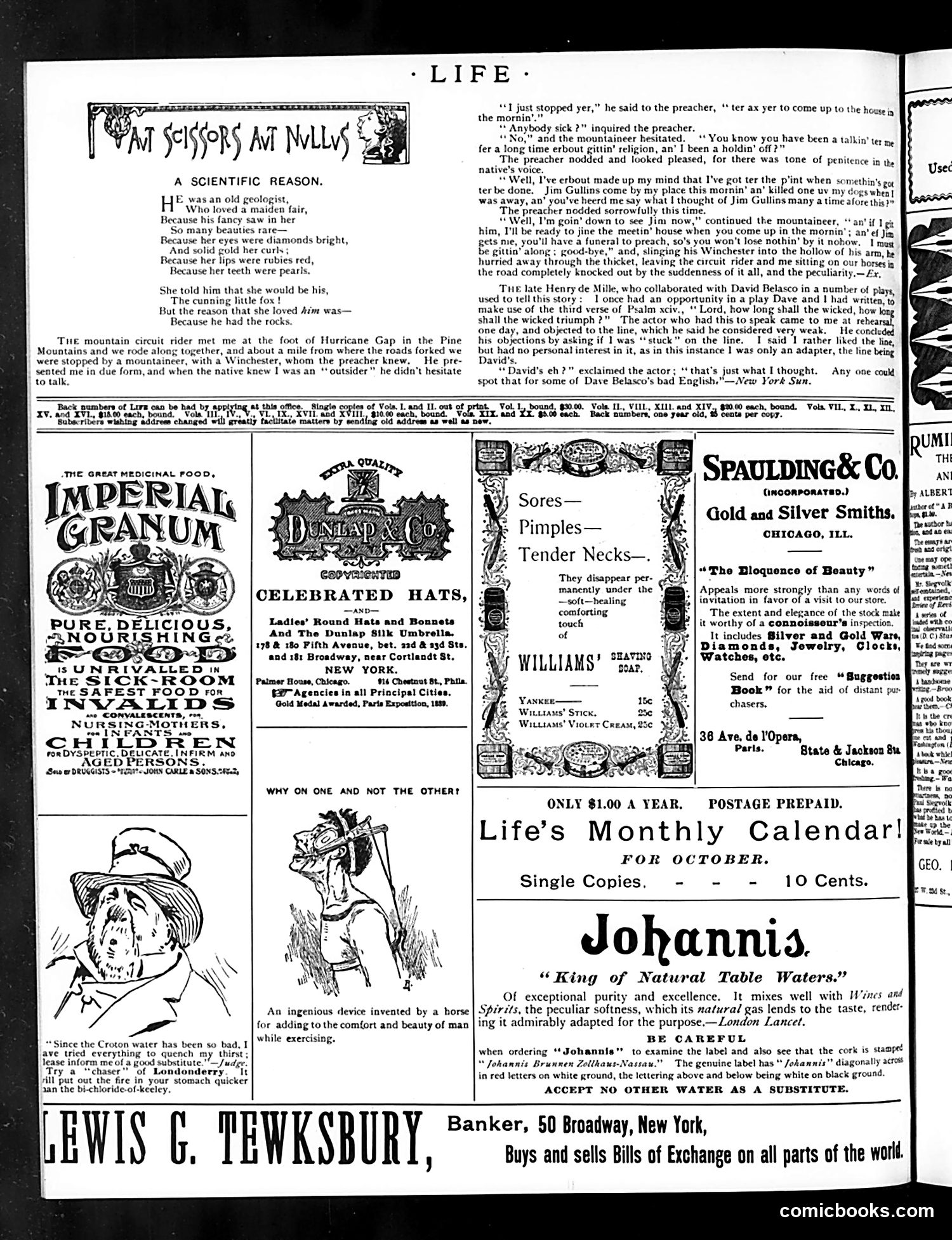
This page contains three distinct pieces of satire: 1. **"Scissors at Nulls" (poem)**: A geological pun mocking a geologist who courts a woman for her material wealth ("rocks"), while she accepts him for his financial resources. The satire targets both male materialism and female mercenary marriage motives—common Victorian anxieties about courtship. 2. **Mountain Circuit Rider anecdote**: A darkly humorous frontier story about a mountaineer who tells a preacher he'll convert to religion *if* he survives a gunfight with Jim Gullins (who killed his dog). The satire mocks both frontier violence and the preacher's naïve optimism, suggesting conditional morality and the gap between religious profession and actual Christian behavior. 3. **Henry de Mille anecdote**: A theatrical in-joke where a famous actor dismisses biblical verse (Psalm 94) as "bad English," not recognizing it as Scripture rather than contemporary dramatic writing. The satire targets theatrical pretension and ignorance. The page is primarily **advertising** (Imperial Geranium, Dunlap hats, Williams' soap, etc.), typical of *Life* magazine's revenue model.
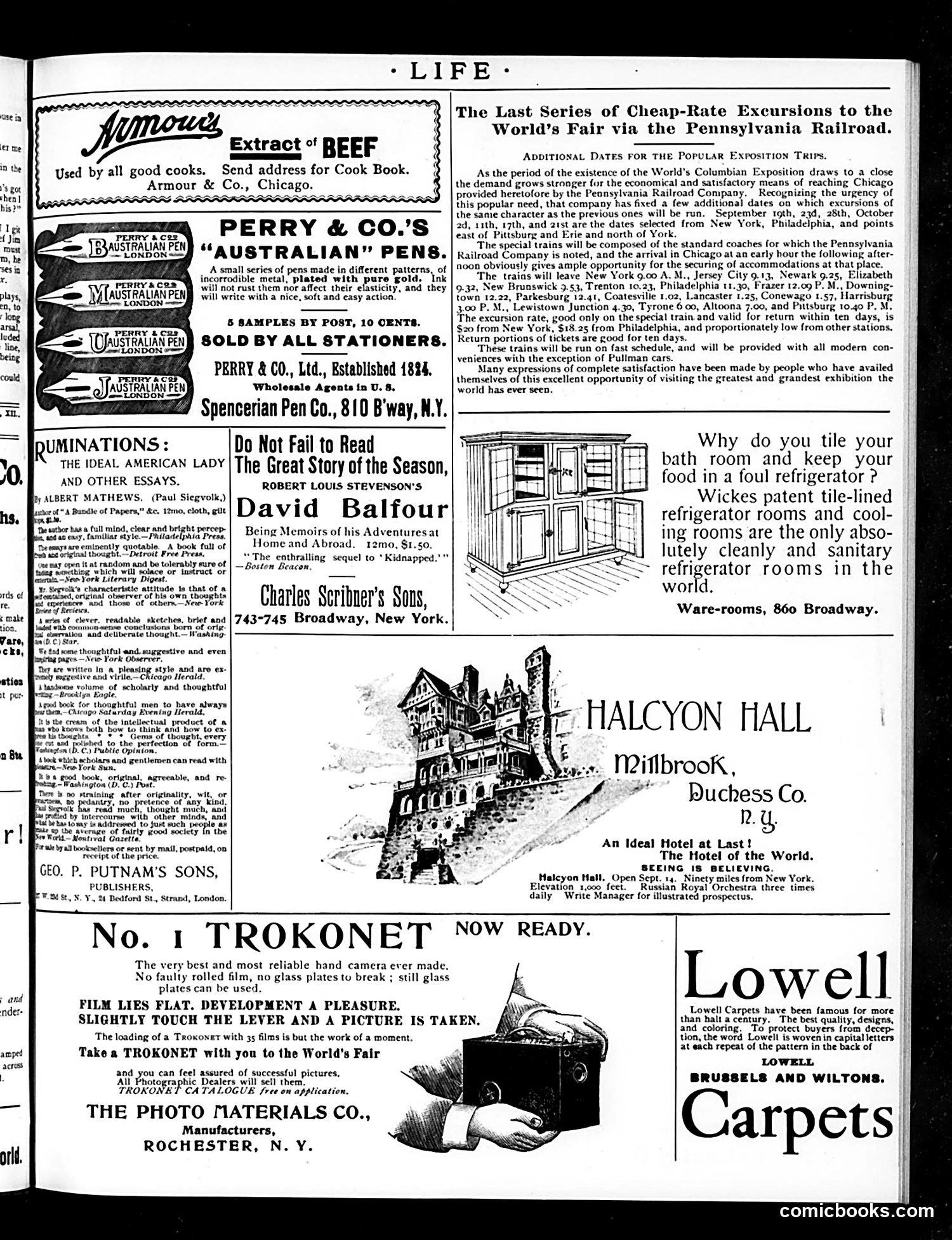
This page is primarily **advertising and promotional content**, not political satire or editorial cartoons. It consists almost entirely of period advertisements for commercial products and services, circa the 1893 World's Columbian Exposition era. Notable content includes: - **Food/product ads**: Armour beef extract, Perry pens, Lowell carpets, Wickes refrigerator rooms - **Book promotions**: Robert Louis Stevenson's *David Balfour* and an essay collection titled *Ruminations: The Ideal American Lady and Other Essays* - **Tourism**: A substantial notice advertising cheap excursion rates to the Chicago World's Fair via Pennsylvania Railroad, with detailed departure times and fares - **Hotel advertisement**: Halcyon Hall in Millbrook, New York - **Camera equipment**: Trokonet hand camera There are **no political cartoons or satirical commentary** visible on this page. It represents straightforward late-19th-century commercial advertising integrated with travel promotion.
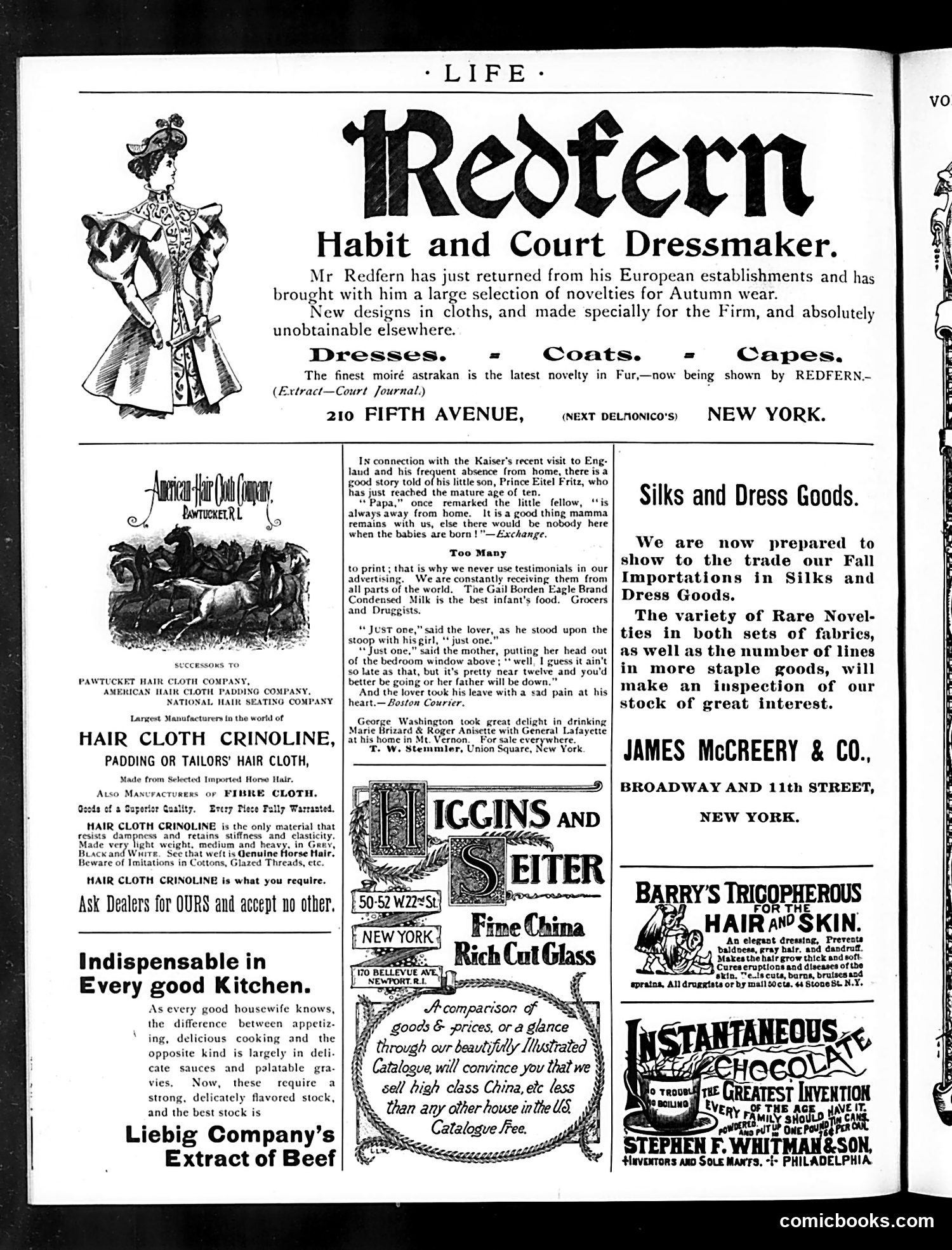
This is primarily a **commercial advertising page** rather than a satirical cartoon page. The layout features multiple advertisements for luxury goods and patent medicines typical of late 19th-century American magazines. The **one brief humorous item** is a joke about Kaiser Wilhelm II's young son, Prince Eitel Fritz. The humor relies on the child's innocent misunderstanding: when remarking that his father is "always away from home," the boy concludes it's fortunate his mother stays, "else there would be nobody here when the babies are born"—suggesting ignorance about reproduction. This plays on contemporary awareness of the Kaiser's frequent absences from Germany. The rest of the page advertises Redfern dressmaking, hair cloth manufacturers, Liebig beef extract, Gail Borden condensed milk, china, silk goods, and hair tonics—all aimed at affluent readers of Life magazine.