
Life, 1893-09-28 · page 6 of 16
Life — September 28, 1893 — page 6: what you’re looking at
What you’re looking at
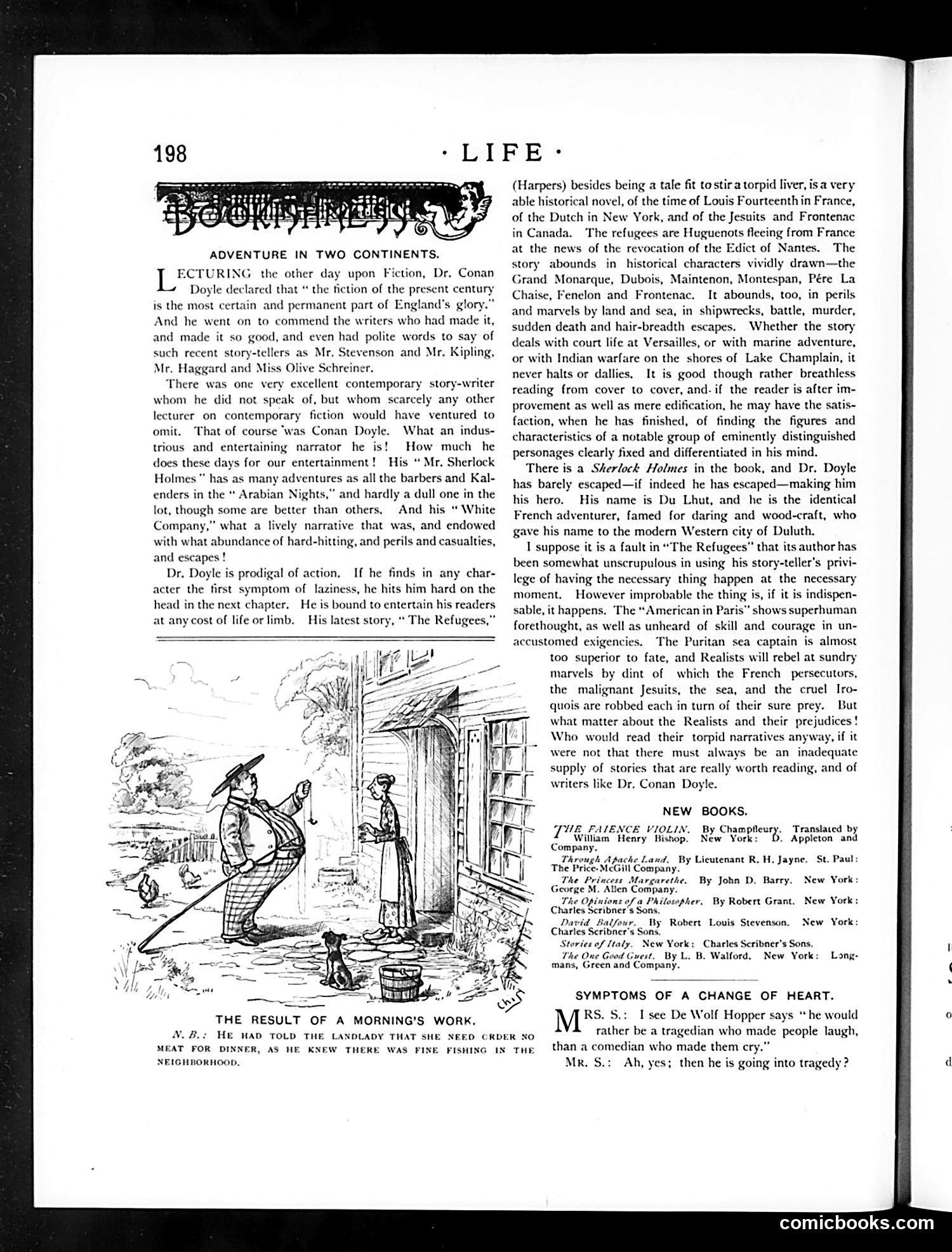
**Main Content:** This page primarily contains a book review essay about works by Arthur Conan Doyle, praising his storytelling ability across historical fiction and adventure narratives. **The Cartoon:** "The Result of a Morning's Work" depicts a man returning home with fishing equipment and a meager catch, while the caption notes he told his landlady he needed "cured no meat for dinner, as he knew there was fine fishing in the neighborhood." The joke is a simple domestic one: his fishing expedition failed completely, contradicting his confident claim to his landlady about securing dinner through fishing. **Context:** This is straightforward comedic satire about male overconfidence and household economics—a relatable domestic humor genre common in early 20th-century magazines, not tied to specific political events.
📄 Transcribed text from this page (OCR, searchable)
Machine-transcribed from the original scan — historical spelling and the odd misread are preserved.
*- LIFE: ADVENTURE IN TWO CONTINENTS. ECTURING the other day upon Fiction, Dr. Conan Doyle declared that “ the fiction of the present century is the most certain and permanent part of England's glo And he went on to commend the writers who had made it, and made it so good, and even had polite words to say of such recent story-tellers as Mr, Stevenson and Mr. Kipling, Mr. Haggard and Miss Olive Schreiner. There was one very excellent contemporary story-writer whom he did not speak of, but whom scarcely any other lecturer on contemporary fiction would have ventured to omit. That of course ‘was Conan Doyle. What an indus- trious and entertaining narrator he is! How much he does these days for our entertainment! His “ Mr. Sherlock Holmes” has as many adventures as all the barbers and Kal- enders in the * Arabian Nights,” and hardly a dull one in the lot, though some are better than others, And his “ White Company,” what a lively narrative that was, and endowed with what abundance of hard-hitting, and perils and casualties, and escapes ! Dr. Doyle is prodigal of action, If he finds in any char- acter the first symptom of laziness, he hits him hard on the head in the next chapter. He is bound to entertain his readers at any cost of life or limb. His latest story, ** The Refugees,” THE RESULT OF A MORNING'S WORK. N.B.: He HAD TOLD THE LANDLADY THAT SHE MEAT FOR DINNER, AS HE KNEW THERE WAS FINE NEIGHBORHOOD, (Harpers) besides being a tale fit to stir a torpid liver, isa very able historical novel, of the time of Louis Fourteenth in France, of the Dutch in New York, and of the Jesuits and Frontenac in Canada. The refugees are Huguenots fleeing from France at the news of the revocation of the Edict of Nantes. The story abounds in historical characters vividly drawn—the Grand Monarque, Dubois, Maintenon, Montespan, Pére La Chaise, Fenelon and Frontenac. It abounds, too, in perils and marvels by land and sea, in shipwrecks, battle, murder, sudden death and hair-breadth escapes. Whether the story deals with court life at Versailles, or with marine adventure, or with Indian warfare on the shores of Lake Champlain, it never halts or dallies, It is good though rather breathless reading from cover to cover, and- if the reader is after im- provement as well as mere edification, he may have the sal faction, when he has finished, of finding the figures and characteristics of a notable group of eminently distinguished personages clearly fixed and differentiated in his mind. There is a Sherlock Holmes in the book, and Dr. Doyle has barely escaped—if indeed he has escaped—making him his hero. His name is Du Lhut, and he is the identical French adventurer, famed for daring and wood-craft, who gave his name to the modern Western city of Duluth. I suppose it is a fault in “The Refugees” that its author has been somewhat unscrupulous in using his story-teller's pi lege of having the necessary thing happen at the necessary moment. However improbable the thing is, if it is indispen- sable, it happens. The “American in Paris” shows superhuman forethought, as well as unheard of skill and courage in un- accustomed exigencies. The Puritan sea captain is almost too superior to fate, and Realists will rebel at sundry marvels by dint of which the French persecutors, the malignant Jesuits, the sea, and the cruel Iro- quois are robbed each in turn of their sure prey. But what matter about the Realists and their prejudices! Who would read their torpid narratives anyway, if it Were not that there must always be an inadequate supply of stories that are really worth reading, and of writers like Dr. Conan Doyle. NEW BOOKS. THE FALENCE VIOLIN. By Champfteury. Translaved by 4 William Henry Bishop. New York: 0. Appleton and Company, Through Apache Land, By Lieutenant R. H. Jayne, St. Paul: The Price- McGill Company. The Princess Margarethe, By John D. Barry. New York: George M. Allen Company. The Opinions of a Philosopher, By Robert Grant, New York: Charles Scribner's Sons, David Balfour. By Robert Louis Stevenson. New York: Charles Scribner's Sons. Stories of Italy. New York: Charles Scribner's Sons. The One Good Guest. By L. B. Walford, New York: Long- mans, Green and Company. SYMPTOMS OF A CHANGE OF HEART. RS. S.: I see De Wolf Hopper says “he would rather be a tragedian who made people laugh, than a comedian who made them cry.” Mr. S.: Ah, yes; then he is going into tragedy ? comicbooks.com