
Life, 1893-09-28 · page 4 of 16
Life — September 28, 1893 — page 4: what you’re looking at
What you’re looking at
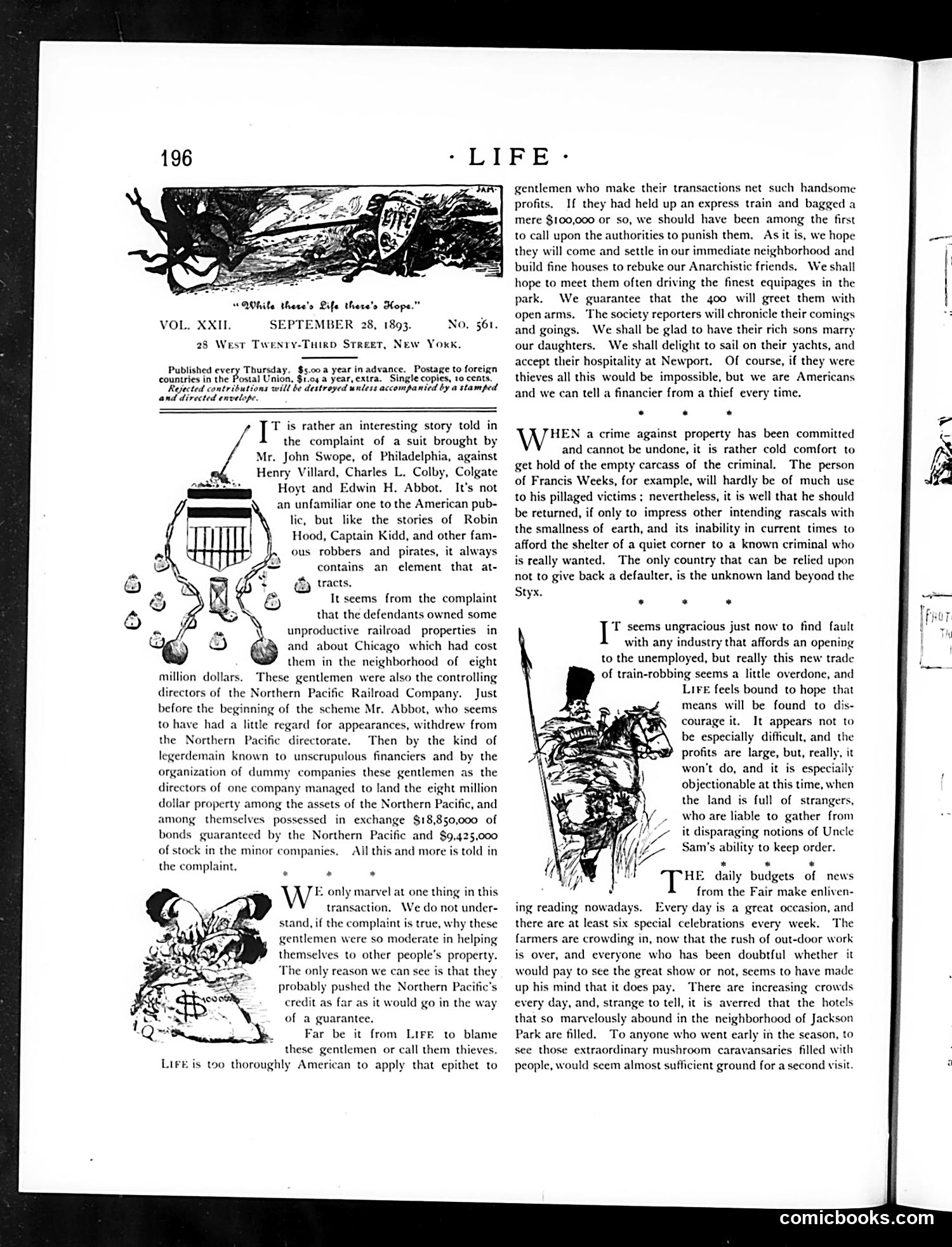
This page discusses a lawsuit against railroad executives, including John Swope (Philadelphia) and others involved in the Northern Pacific Railway Company. The complaint alleges these gentlemen improperly acquired unproductive railroad properties near Chicago worth millions of dollars and manipulated Northern Pacific's credit and stock for personal profit. The cartoons satirize railroad corruption and theft. The illustrated emblems (shield with money bags) symbolize corporate malfeasance. The text argues that while train-robbers like Robin Hood capture public imagination, these "respectable" businessmen commit larger thefts through financial manipulation—a more socially damaging crime because it's harder to prosecute and recover losses. This reflects 1890s Progressive Era concerns about corporate corruption and financial fraud.
📄 Transcribed text from this page (OCR, searchable)
Machine-transcribed from the original scan — historical spelling and the odd misread are preserved.
- LIFE: “While there's Life there’s Hope.” VOL. XXII. SEPTEMBER 28, 1893. No. 561. 28 West Twenty-Tuirp Street, New York. Published every Thursday. $5.00 a year in advance. Postage to foreign countries in the Postal Union, $1.04 a year, extra. Single copies, 10 cents. Rejected contributions will be destroyed untess accompanied by a stamped and directed envel , I" is rather an interesting story told in the complaint of a suit brought by Mr. John Swope, of Philadelphia, against Henry Villard, Charles L. Colby, Colgate Hoyt and Edwin H. Abbot. It’s not an unfamiliar one to the American pub- lic, but like the stories of Robin Hood, Captain Kidd, and other fam- ous robbers and pirates, it always contains an element that at- Gy tracts. It seems from the complaint that the defendants owned some unproductive railroad properties in and about Chicago which had cost them in the neighborhood of eight million dollars. These gentlemen were also the controlling directors of the Northern Pacific Railroad Company. Just before the beginning of the scheme Mr. Abbot, who seems. to have had a little regard for appearances, withdrew from the Northern Pacific directorate. Then by the kind of legerdemain known to unscrupulous financiers and by the companies these gentlemen as the directors of one company managed to land the eight million dollar property among the assets of the Northern Pacific, and among themselves possessed in exchange $18,850,000 of bonds guaranteed by the Northern Pacific and $9,425,000 of stock in the minor companies. Ail this and more is told in the complaint. organization of dummy . . = only marvel at one thing in this transaction, We do not under- stand, if the complaint is true, why these gentlemen were so modera themselves to other people’s property. The only reason we can see is that they probably pushed the Northern Pacitic’s s it would go in the way of a guarantee. Far be it from Lire to blame these gentlemen or call them thieves. Lire is too thoroughly American to apply that epithet to in helping credit as gentlemen who make their transactions net such handsome profits. If they had held up an express train and bagged a mere $100,000 or so, we should have been among the first to call upon the authorities to punish them. As it is, we hope they will come and settle in our immediate neighborhood and build fine houses to rebuke our Anarchistic friends. We shall hope to meet them often driving the finest equipages in the park. We guarantee that the 400 will greet them with open arms. The society reporters will chronicle their comings and goings. We shall be glad to have their rich sons marry our daughters. We shall delight to sail on their yachts, and accept their hospitality at Newport. Of course, if they were thieves all this would be impossible, but we are Americans and we can tell a financier from a thief every time. . * * WHeEX a crime against property has been committed and cannot be undone, it is rather cold comfort to get hold of the empty carcass of the criminal. The person of Francis Weeks, for example, will hardly be of much use to his pillaged victims ; nevertheless, it is well that he should be returned, if only to impress other intending rascals with the smallness of earth, and its inability in current times to afford the shelter of a quiet corner to a known criminal who is really wanted. The only country that can be relied upon not to give back a defaulter, is the unknown land beyond the Styx. Fi a ‘ T seems ungracious just now to find fault with any industry that affords an opening to the unemployed, but really this new trade of train-robbing seems a little overdone, and LiFe feels bound to hope that means will be found to dis- courage it. It appears not to be especially difficult, and the profits are large, but, really, it won't do, and it is especiaily objectionable at this time, when the land is full of strangers, who are liable to gather from it disparaging notions of Uncle Sam's ability to keep order. * « * HE daily budgets of news from the Fair make enliven- ing reading nowad: Every day is a great occasion, and there are at least six special celebrations every week. The farmers are crowding in, now that the rush of out-door work is over, and everyone who has been doubtful whether it would pay to see the great show or not, up his mind that it does pay. There are increasing crowds every day, and, strange to tell, it is averred that the hotels that so marvelously abound in the neighborhood of Jackson Park are filled. To anyone who went early in the season, to see those extraordinary mushroom caravansaries filled with people, would seem almost sufficient ground for a second visit. rems to have made comicbooks.com