
A complete issue · 14 pages · 1893
Life — September 7, 1893
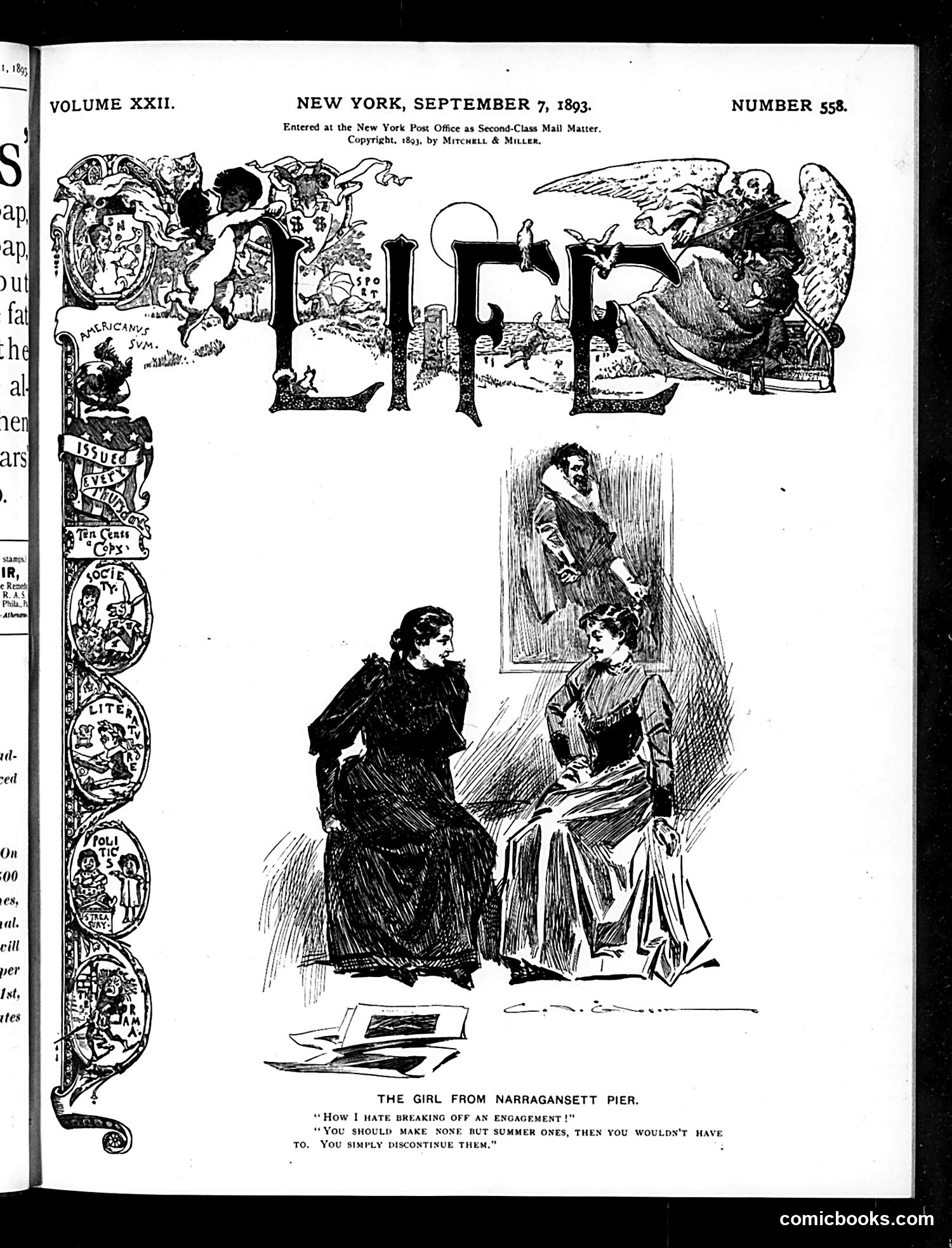
This page from the September 7, 1893 issue of *Life* magazine features a satirical cartoon about broken engagement promises. The illustration shows two women in conversation; one seated woman appears distressed while addressing another. The caption's dialogue reveals the joke: a man promised to end his summer engagements at Narragansett Pier (a fashionable Rhode Island resort) but failed to do so. The seated woman sarcastically suggests he should have made "none but summer ones" instead—implying he maintained multiple simultaneous engagements rather than discontinuing them as promised. The cartoon satirizes the social pretense and romantic duplicity of the era's leisure class, mocking a gentleman's casual infidelity and broken commitments to different women.
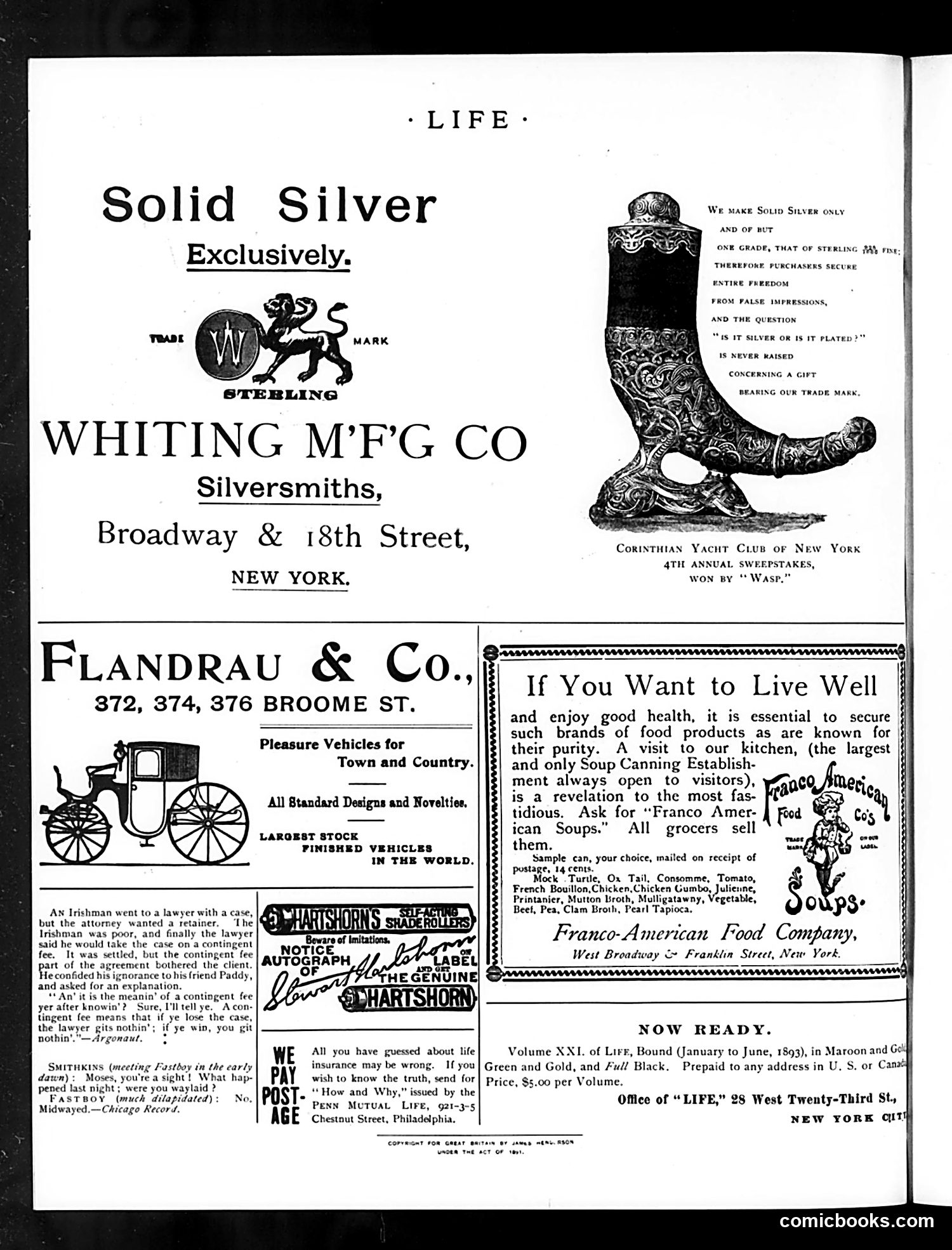
This page is primarily **advertising** rather than satirical content. The main advertisements are: 1. **Whiting M'F'G Co.** - Sterling silver manufacturer emphasizing their exclusive use of solid silver (not plating) 2. **Flandrau & Co.** - Carriage/pleasure vehicle maker advertising their stock and designs 3. **Franco-American Food Company** - Canned soup advertisement 4. A small **anecdotal joke** about an Irishman consulting a lawyer regarding contingency fees—a standard humorous piece common to the era. The only potentially satirical element is this brief story mocking Irish-American stereotypes and legal practice conventions of the 1890s, though it's mild by modern standards. The page demonstrates how Life magazine balanced editorial content with advertising revenue during this period.
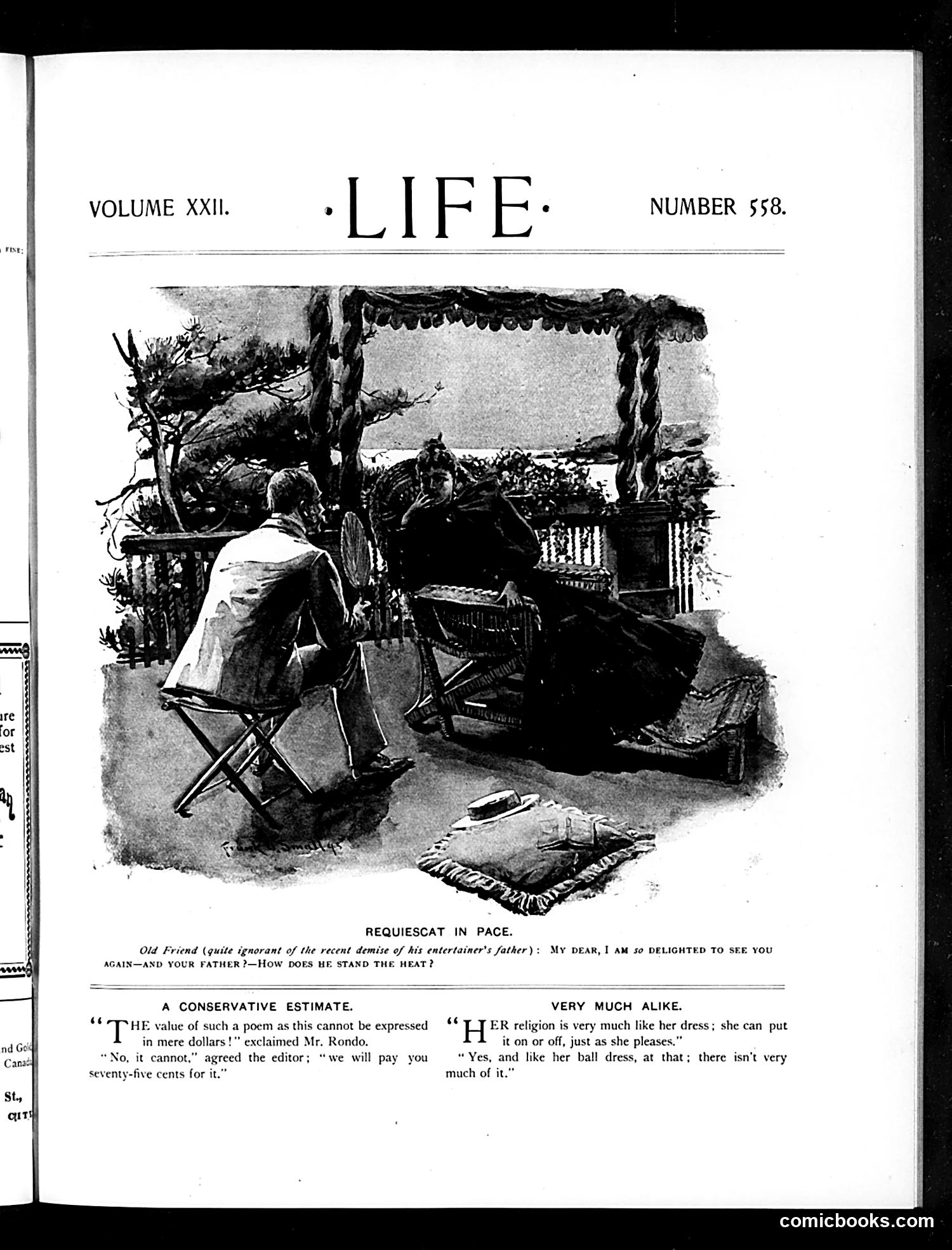
The central illustration, titled "Requiescat in Pace" (Rest in Peace), depicts a man sitting in a chair viewing what appears to be a funeral or wake scene through a window or frame. The caption suggests he's greeting an old friend, remarking on the entertainer's father's death and asking how "he" stands the heat. Below are two brief humorous exchanges: one about a poem's monetary value (seventy-five cents), and another joking that a woman's religion is "like her dress"—removable at will. The satire appears to target social hypocrisy regarding religion and faith, and possibly mocks the commercialization of artistic work. The "heat" reference likely alludes to either summer weather or metaphorical pressure, though the specific context remains unclear without additional historical information.
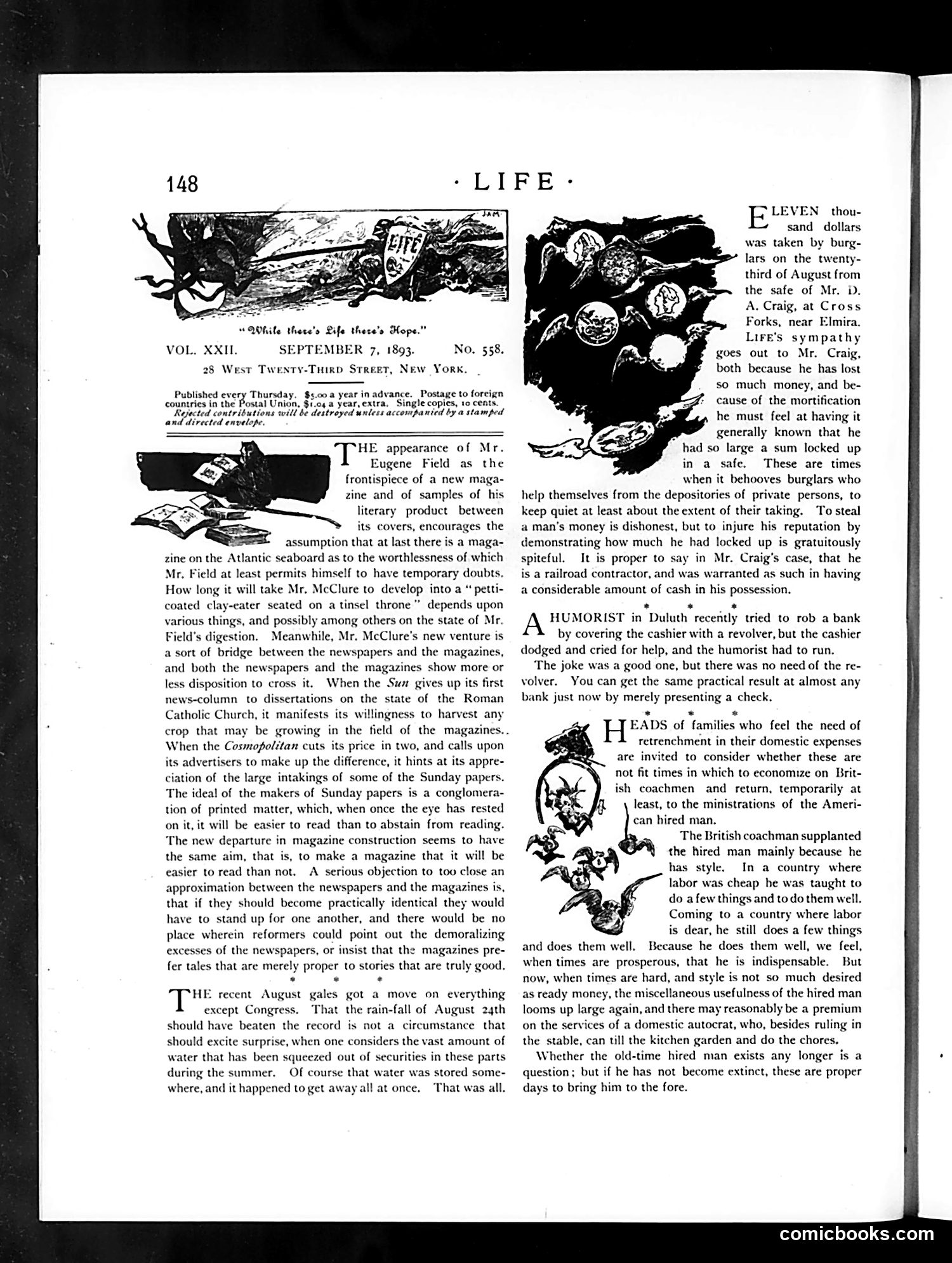
This page contains three distinct satirical pieces addressing contemporary issues: 1. **Eugene Field's new magazine**: The text critiques Field's literary venture, debating whether magazines should differentiate themselves from newspapers or risk becoming redundant. 2. **Bank robbery humor**: A brief anecdote mocks a Duluth humorist's failed bank robbery attempt, suggesting checks are equally effective theft methods—dark commentary on banking security and financial instability during the 1893 economic panic. 3. **Domestic labor commentary**: The illustrated piece discusses hiring British coachmen as domestic staff, arguing that while style matters during prosperity, practical utility matters more during hard times. This reflects anxieties about labor class distinctions and economic efficiency during the depression era. The overall tone reveals anxieties about American institutions—publishing, banking, and labor—during an economically turbulent period.
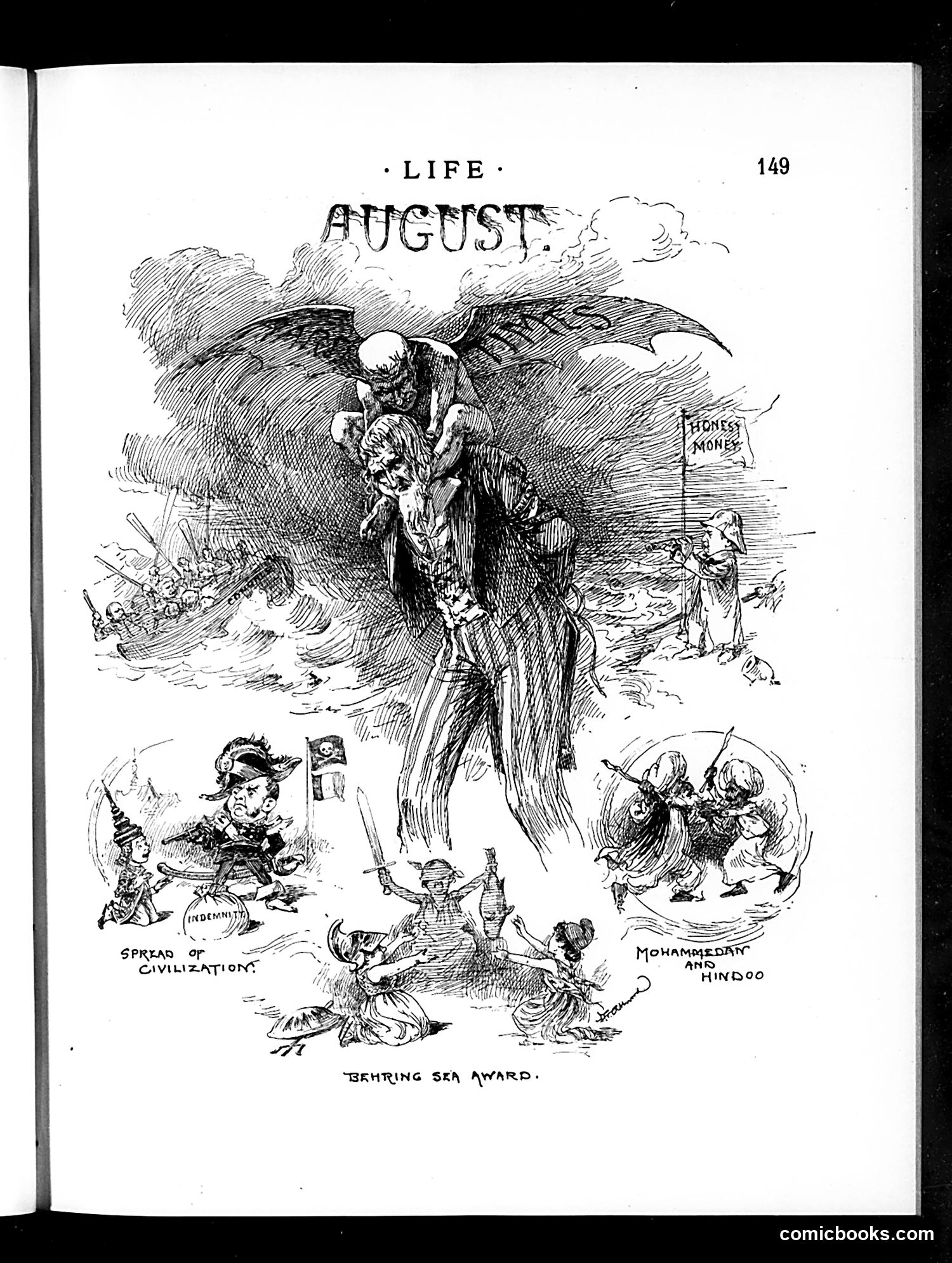
This satirical cartoon uses the personification of August as a demonic figure to critique contemporary issues. The central skeletal demon represents the month itself, with smaller vignettes below showing specific concerns: **"Spread of Civilization"** (bottom left) appears to critique imperial expansion, possibly referencing Bismarck and German militarism with the small uniformed figures and flag. **"Mohammadan and Hindoo"** (bottom right) likely critiques colonial conflicts or tensions in Asia. **"Bruting Sea Award"** (bottom) remains unclear without additional context—possibly referencing naval conflicts or maritime disputes of the era. The overall composition suggests August as a destructive force bringing warfare, colonialism, and religious strife. The satirical tone criticizes militarism and imperial competition of the late 19th century.
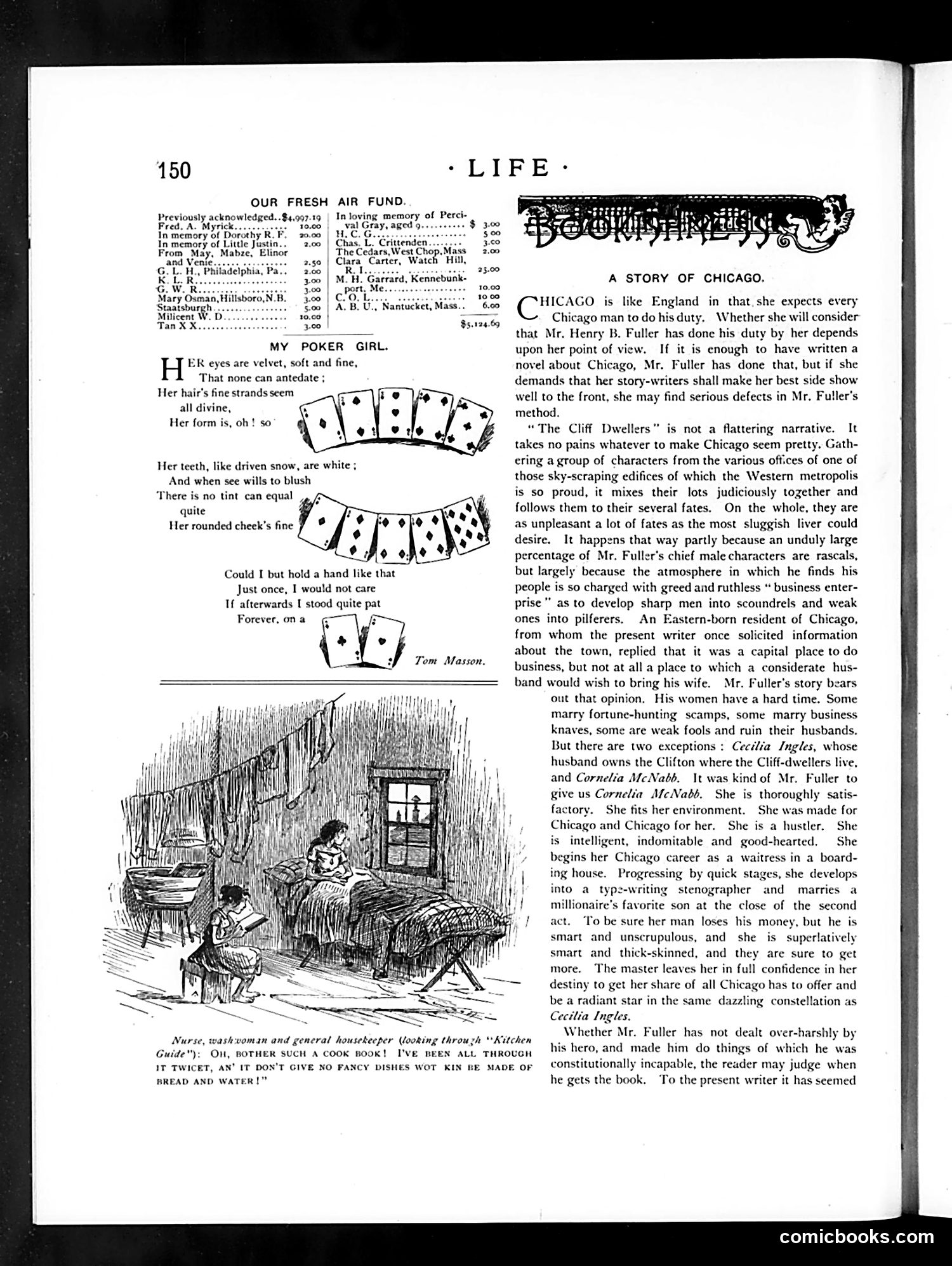
**"My Poker Girl"** is a humorous poem by Tom Mason celebrating a woman with attractive features—"velvet, soft" eyes, fine hair, white teeth, and a pleasant complexion. The accompanying playing card illustrations are decorative elements supporting the romantic theme. **"A Story of Chicago"** is a book review of Henry B. Fuller's work about Chicago. The reviewer critiques Fuller's portrayal of the city and its residents, particularly his female characters like Cornelia McNabb and Cecilia Ingles. The review discusses how Fuller depicts Chicago society—including wealthy businessmen, fortune hunters, and ambitious women—as somewhat morally questionable, driven by greed and social climbing. The sketch shows a domestic kitchen scene illustrating working-class Chicago life.
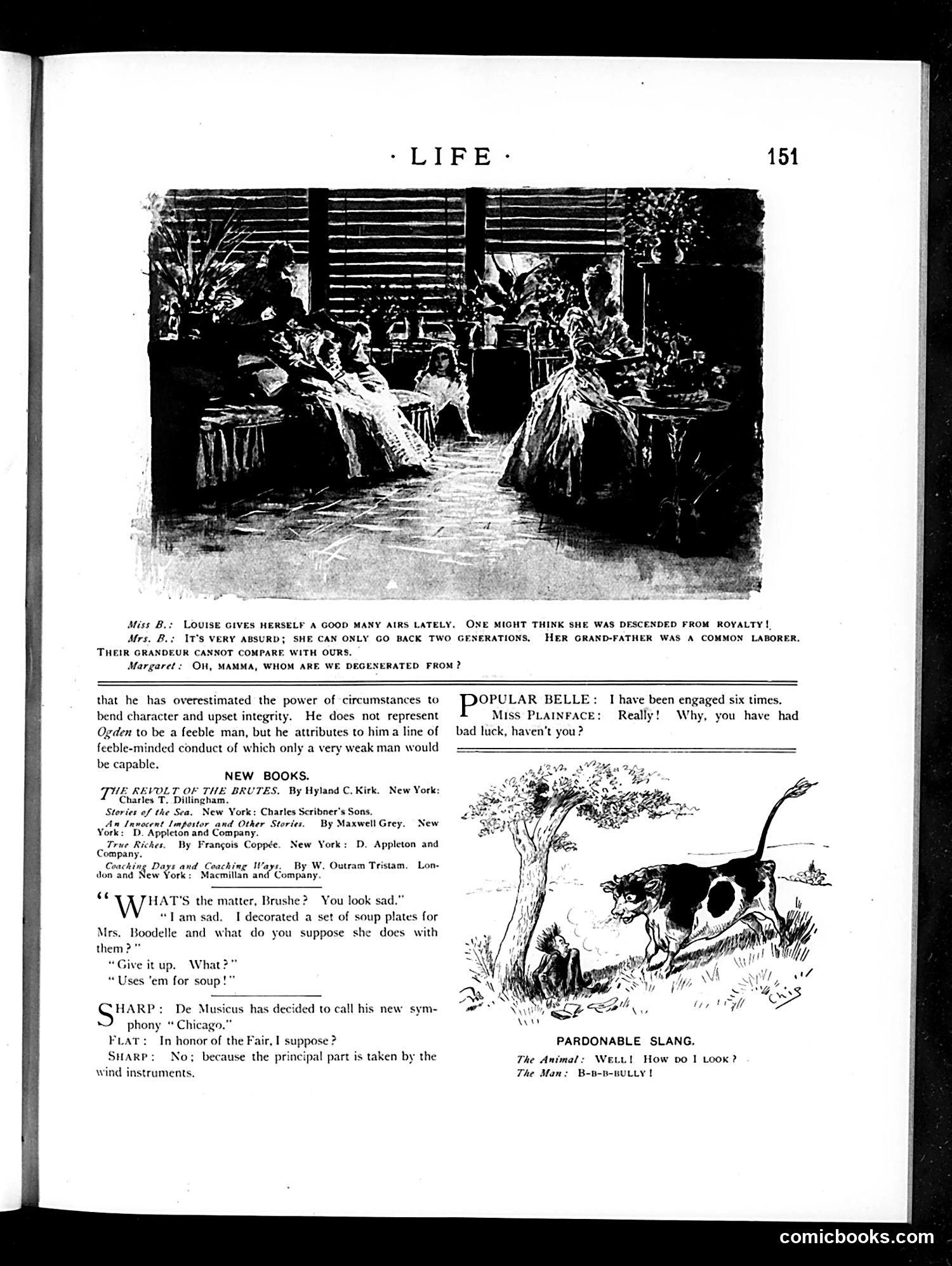
**Top Image:** This appears to be an illustration from a theatrical or literary scene depicting upper-class women in an indoor setting with plants. The caption suggests social commentary about lineage and class—one character notes another woman "gives herself good many airs lately" despite being "descended from royalty," while her grandmother was merely "a common laborer." The satire mocks pretentious social climbing and the arbitrary nature of inherited status. **"Pardonable Slang" Cartoon:** A simple joke about a dog's appearance. When asked "How do I look?" the man responds "B-u-n-bully!"—a pun on the dog's mixed-breed appearance and contemporary slang usage. **Other Content:** New book reviews and various humor pieces, typical of Life's satirical magazine format from this era.
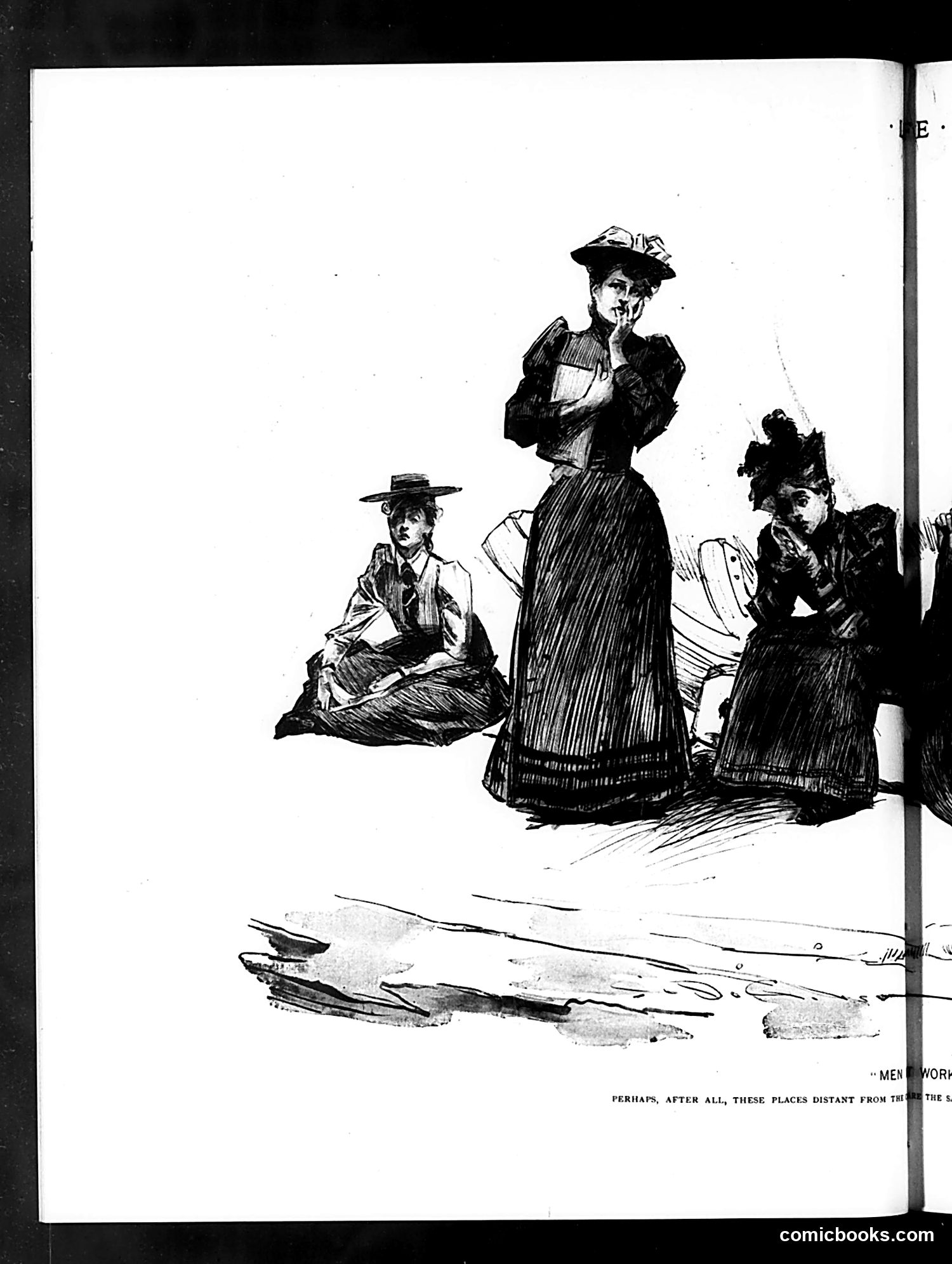
This illustration depicts three women in early 1900s attire discussing "places distant from" somewhere (text is cut off). The caption's incomplete phrase suggests commentary on women's travel or aspirations. The central figure stands prominently in a long skirt with elaborate hat, flanked by two seated women in similar period dress. The artistic style and composition suggest social satire about women's mobility, ambitions, or geographical knowledge. Without the complete caption, the specific target is unclear, but Life magazine frequently satirized women's education, travel aspirations, and social pretensions during this era. The formal poses and careful dress suggest the joke may involve irony about women discussing distant places they've never actually visited, or aspiring to travels considered unsuitable for their gender at the time.
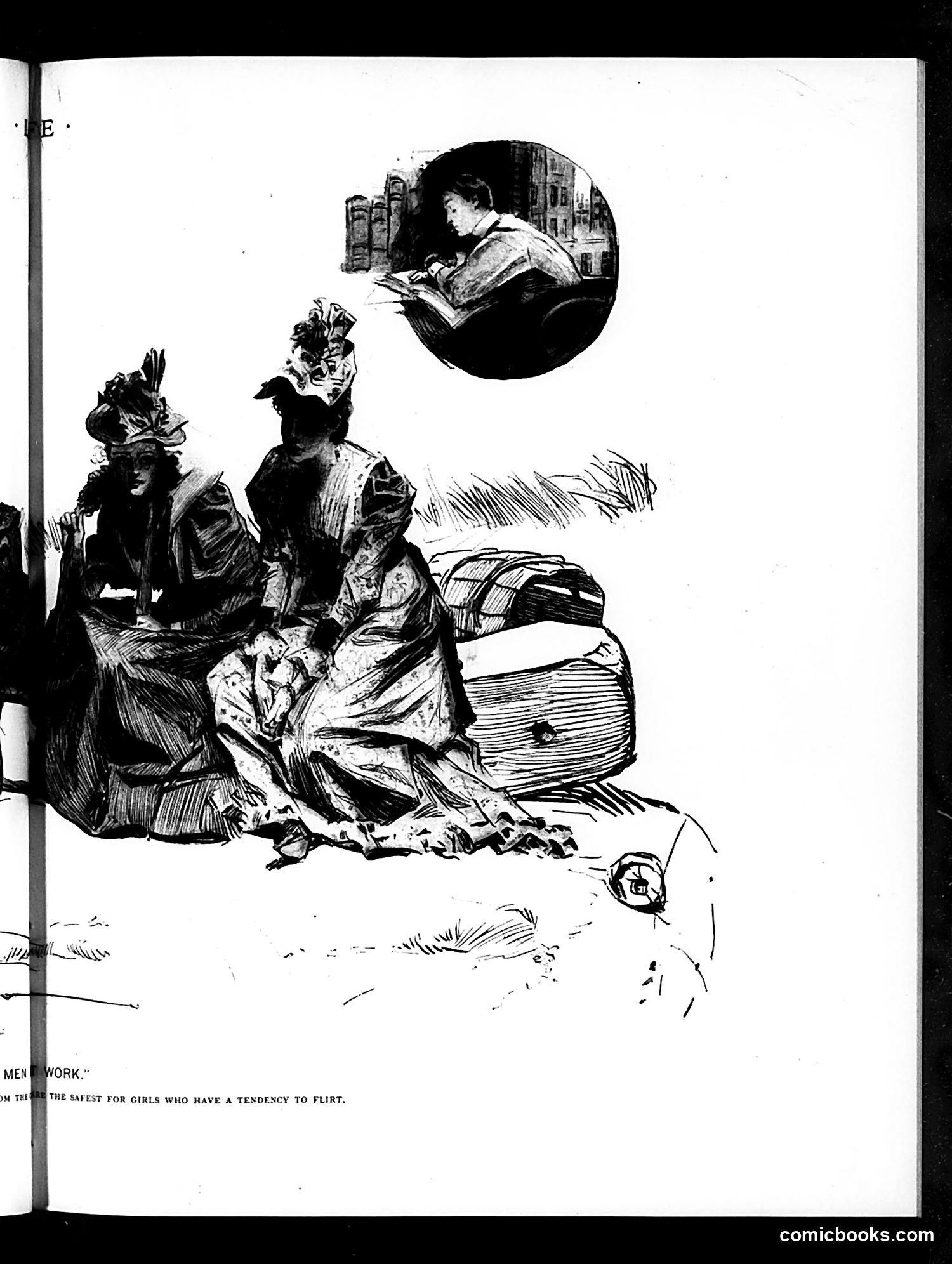
This page contains a satirical illustration about women's leisure and social behavior. The main image shows two fashionably dressed women sitting outdoors with luggage, while a circular inset depicts a woman reading indoors with books visible in the background. The visible caption text references "the safest for girls who have a tendency to flirt," suggesting the cartoon satirizes advice about managing young women's behavior and romantic inclinations. The illustration's style and content reflect early 20th-century gender anxieties about women's independence and social conduct. The contrast between outdoor leisure activities and studious indoor pursuits appears to comment on competing notions of how "respectable" women should spend their time — implying that certain activities (or lack thereof) serve as moral safeguards. The satire targets paternalistic attitudes toward women's behavior and supervision.
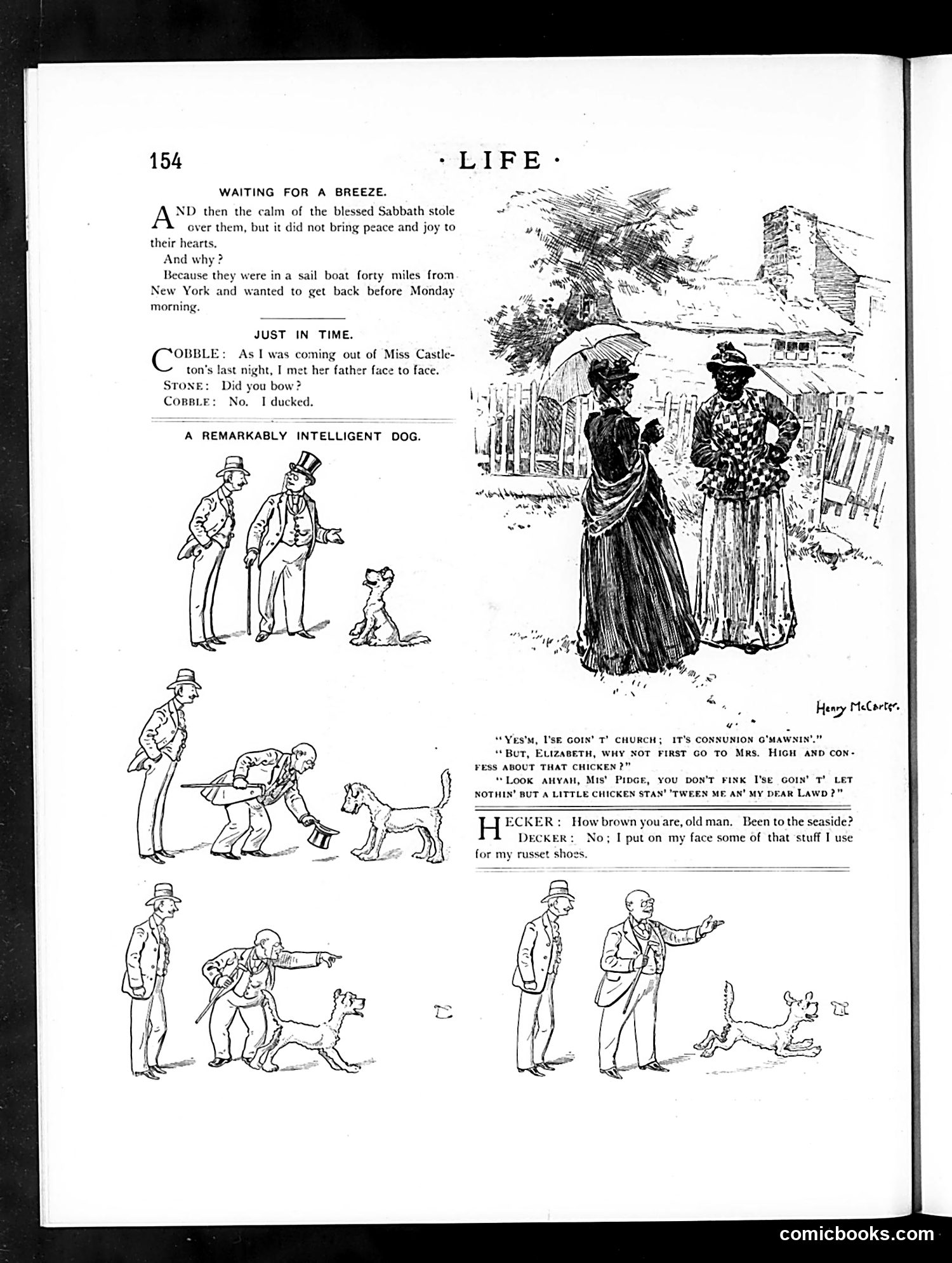
This page contains two separate humor pieces. The top section, "Waiting for a Breeze," depicts urban New Yorkers stuck in a sailboat 40 miles from the city, anxious to return by Monday morning—satirizing how weekend leisure activities become stressful obligations. The main feature, "A Remarkably Intelligent Dog," uses sequential comic panels showing two well-dressed men attempting to train a small dog through various commands and gestures. The dog consistently ignores or misinterprets their instructions, appearing to control the situation instead. The joke satirizes the gap between human expectations of animal obedience and actual animal behavior—a timeless theme made humorous through the reversal of who truly has authority in the master-pet relationship.
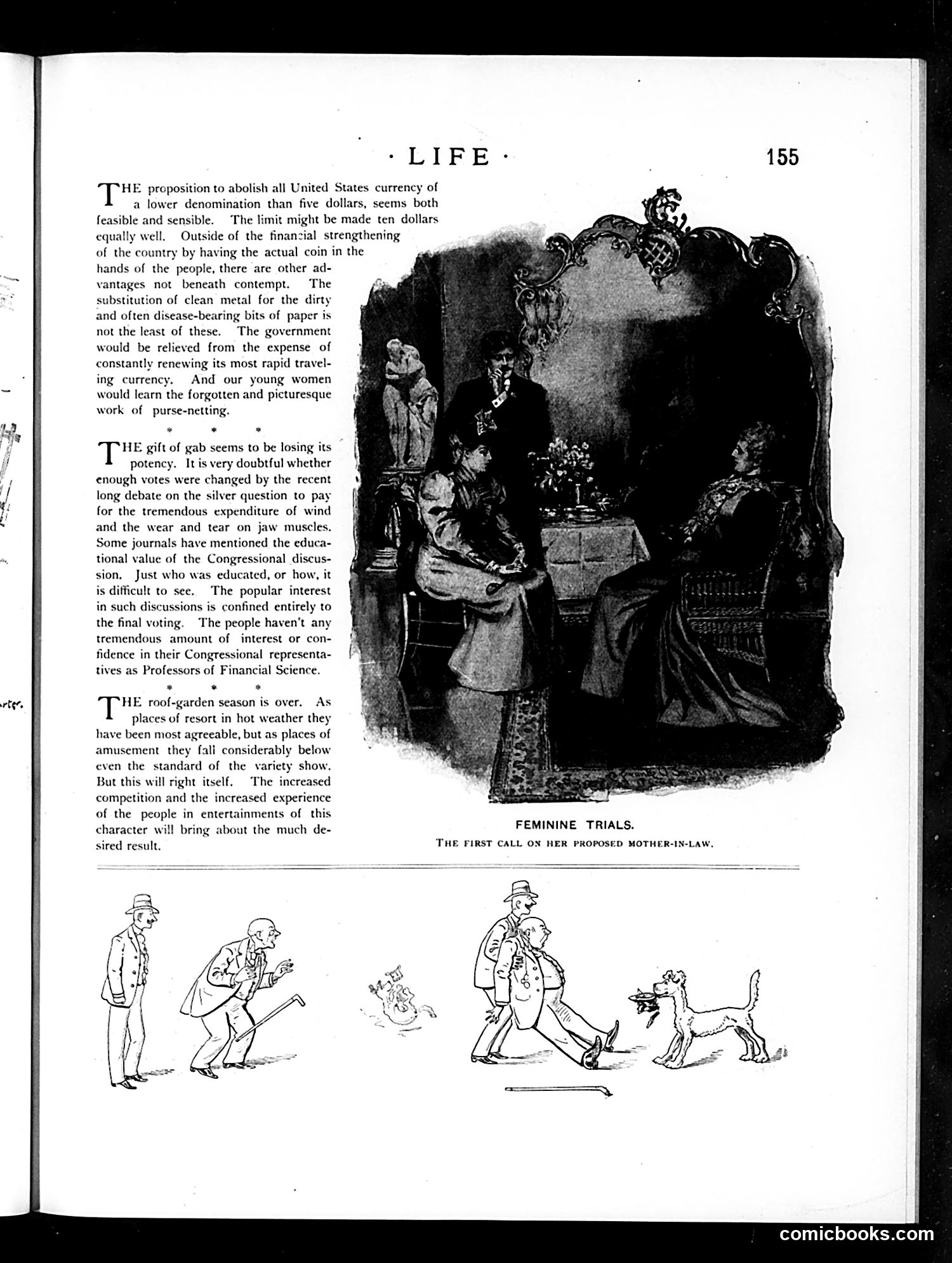
**Top Illustration: "Feminine Trials - The First Call on Her Proposed Mother-in-Law"** This satirical image depicts a woman greeting an intimidating, formally-dressed older woman in an elegant interior. The joke appears to be about the anxiety of meeting one's future mother-in-law—a social situation presented as a "trial" for the young woman. **Bottom Comic Strip: "Feminine Trials" (continued)** A sequence showing a man and woman, then the couple with a dog, illustrating domestic courtship scenarios. The strip likely continues the theme of romantic relationships and social etiquette challenges facing unmarried women. **Left Column Text** Discusses abolishing low-denomination U.S. currency and roof-garden season venues—commentary on economic policy and urban entertainment. These appear unrelated to the feminine-focused illustrations, typical of Life's mixed-content format.
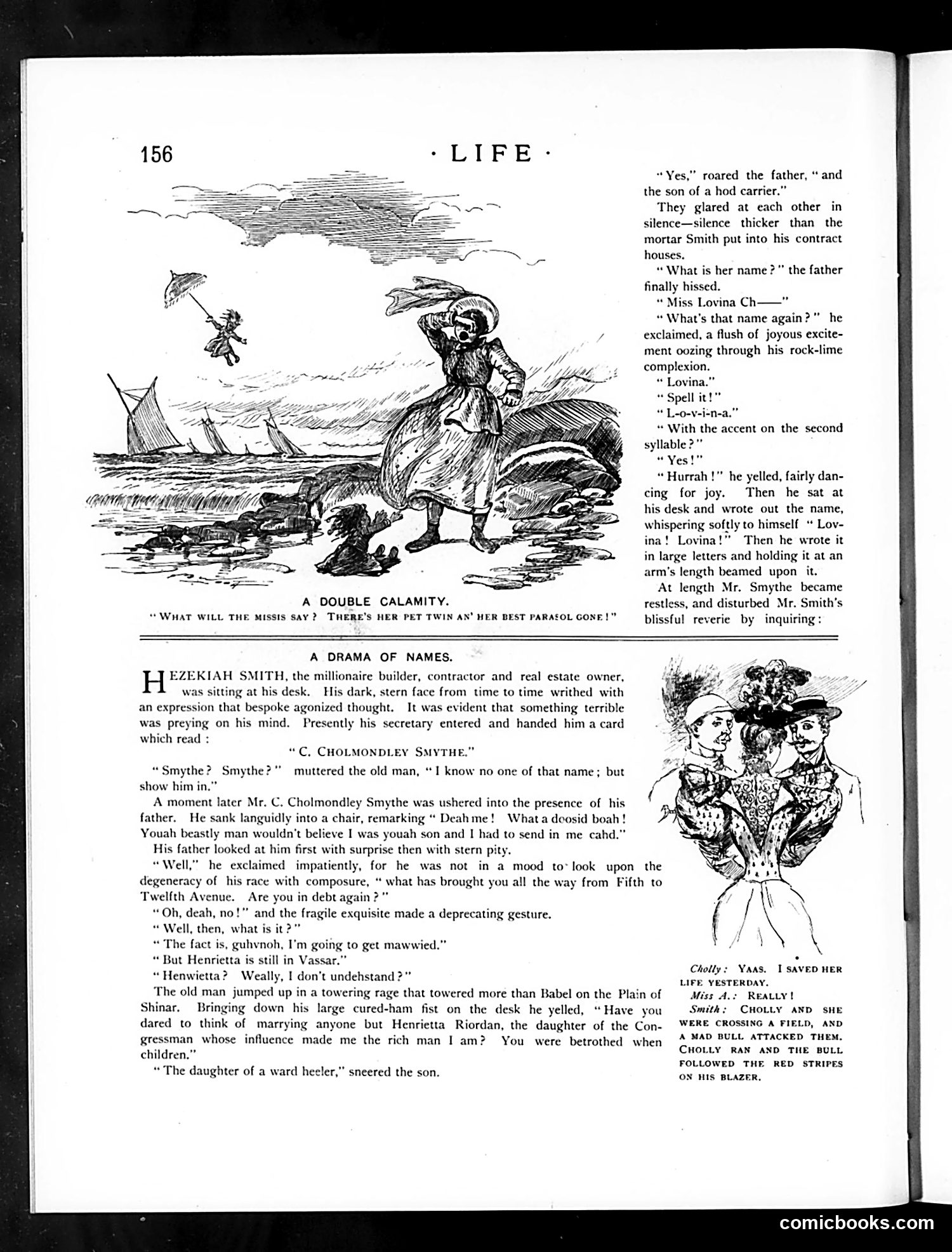
This page satirizes the clash between old money and affectation in Gilded Age America. Hezekiah Smith is a self-made millionaire contractor who built his wealth through practical work ("mortar Smith put into his contract houses"). His son, C. Cholmondley Smythe, represents the opposite extreme: an affected dandy who adopts exaggerated upper-class mannerisms and speech ("Deahme!" "guhvnoh"). The joke centers on Lovina—the son's intended bride. Smith Sr. initially despises her as "the daughter of a ward heeler" (a political operative), but becomes ecstatic upon learning her name, which he treats like a precious commodity. The satire mocks both the father's materialistic values and the son's ridiculous pretension. The accompanying cartoon about the "missis" and parasol suggests domestic chaos—visual humor complementing the verbal satire about social climbing and class anxiety in turn-of-the-century New York.
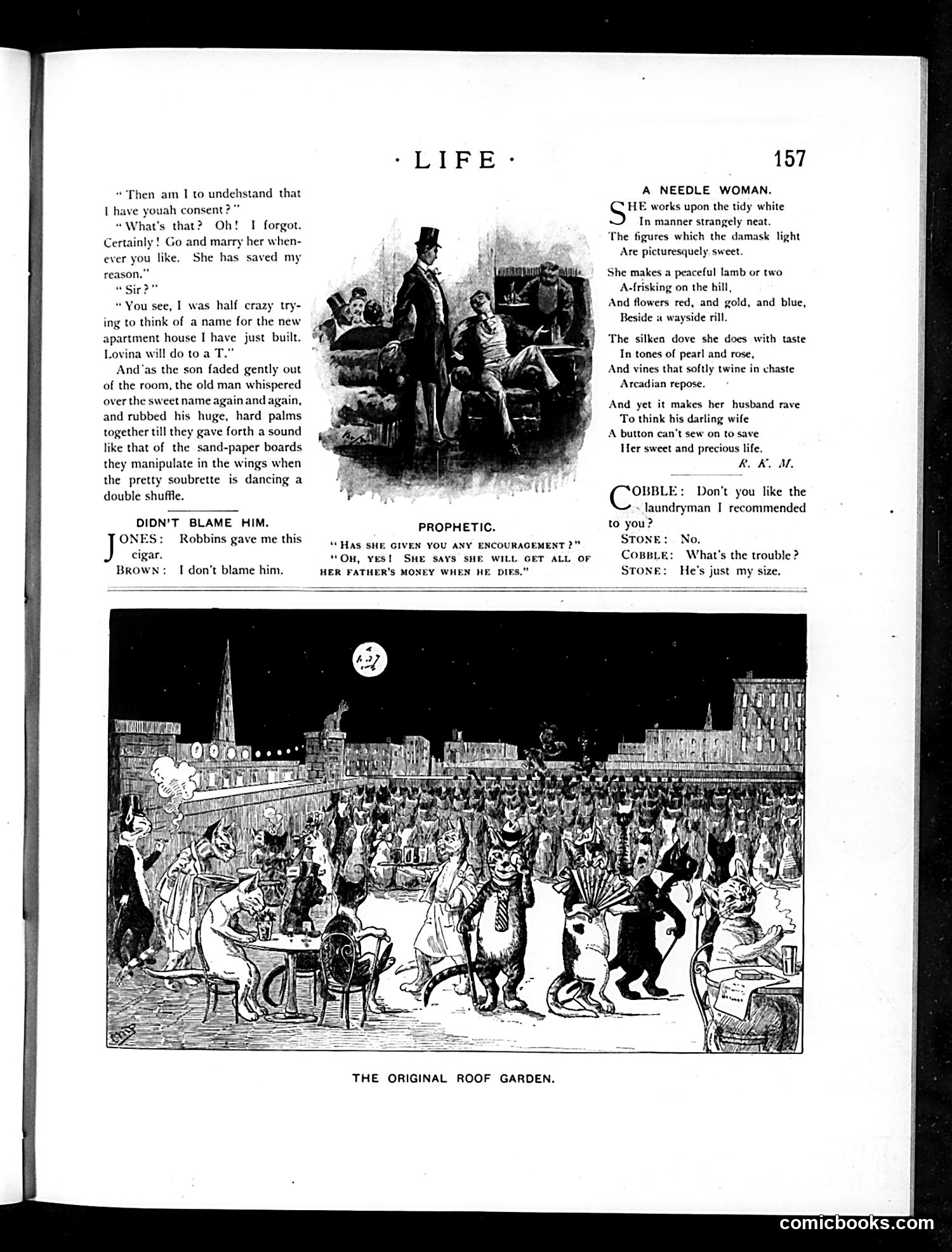
This page contains several satirical pieces typical of early Life magazine: **"Don't Blame Him"**: A brief joke about a cigar—one man gives another a poor-quality cigar, and the recipient doesn't blame the giver because the giver himself is unpleasant company, making the bad cigar fitting. **"Prophetic"**: A darker joke about courtship and money. A young man courts a woman whose father encourages the match—not out of approval, but because she'll inherit the father's money when he dies, making her a more valuable match. **"A Needle Woman"**: A poem mocking the disconnect between a woman's delicate needlework (embroidering pastoral scenes) and her complete inability to perform basic domestic tasks like sewing a button—a common trope critiquing women's impracticality. **"The Original Roof Garden"**: A large satirical illustration depicting a chaotic, carnivalesque rooftop scene with numerous figures carousing, likely satirizing New York's famous roof gardens as venues of excess and moral looseness. The page reflects turn-of-century American attitudes toward gender, class, and urban entertainment.
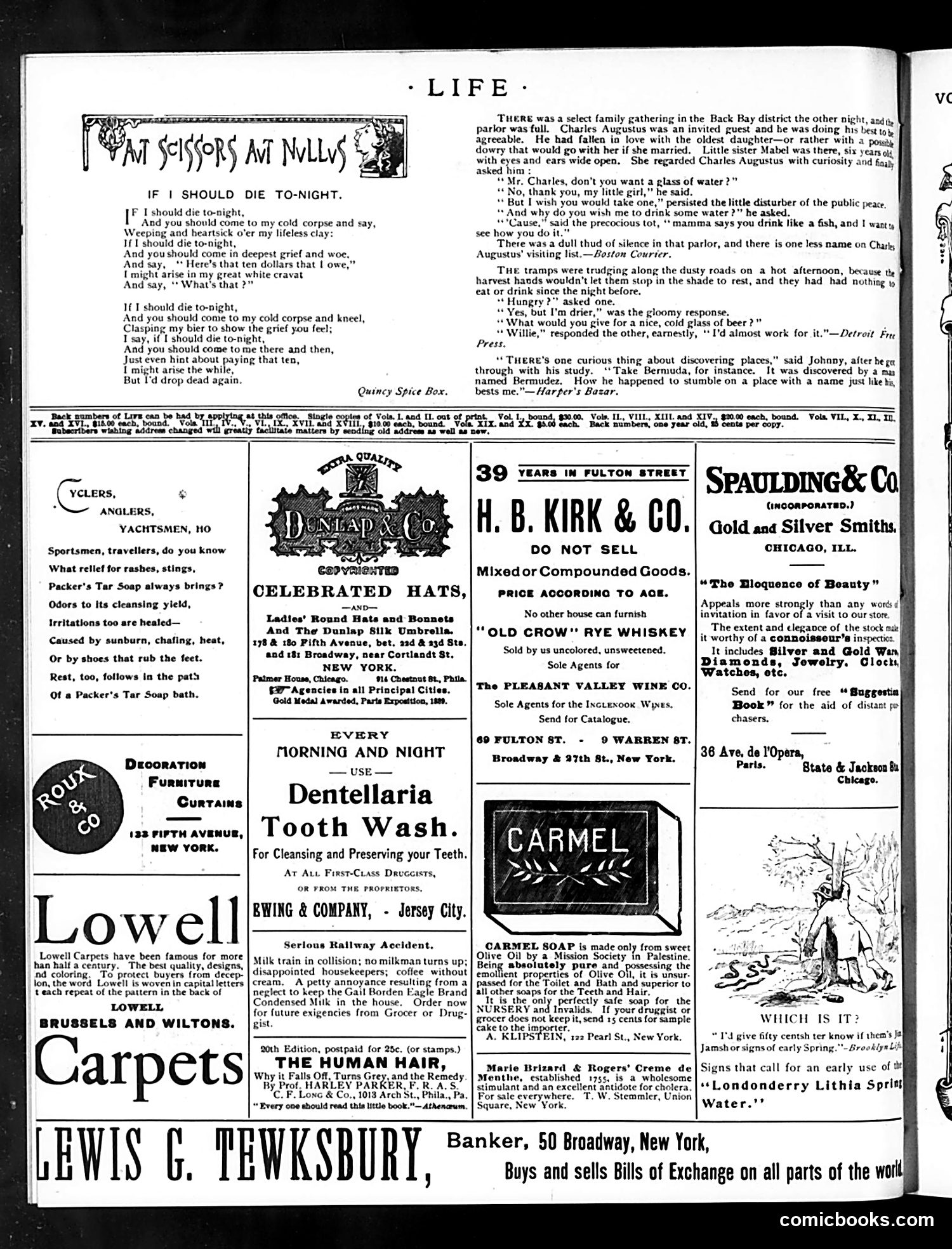
This page is primarily **advertising with literary content**. The main feature is a humorous poem titled "If I Should Die To-Night" by Quincy Spice Box—a comedic meditation on death that subverts typical funeral sentiment. The joke: the speaker claims he'd rise from the dead only if someone mentioned a ten-dollar debt owed to him, suggesting money matters transcend even mortality. Below are three brief humorous anecdotes, likely contemporary social satire about genteel life (a guest's awkward dinner conversation, tramps' thirst, Columbus-like discovery stories). The remainder is **period advertising**: hats, carpets, tooth wash, decoration furniture, and financial services. Notable is the "Carmel Soap" advertisement emphasizing its Palestinian olive oil origin—reflecting early 1900s marketing trends. The page reflects Life magazine's format: mixing satirical humor with commercial content for an affluent audience interested in consumer goods and genteel social commentary.