
Life, 1893-09-07 · page 4 of 14
Life — September 7, 1893 — page 4: what you’re looking at
What you’re looking at
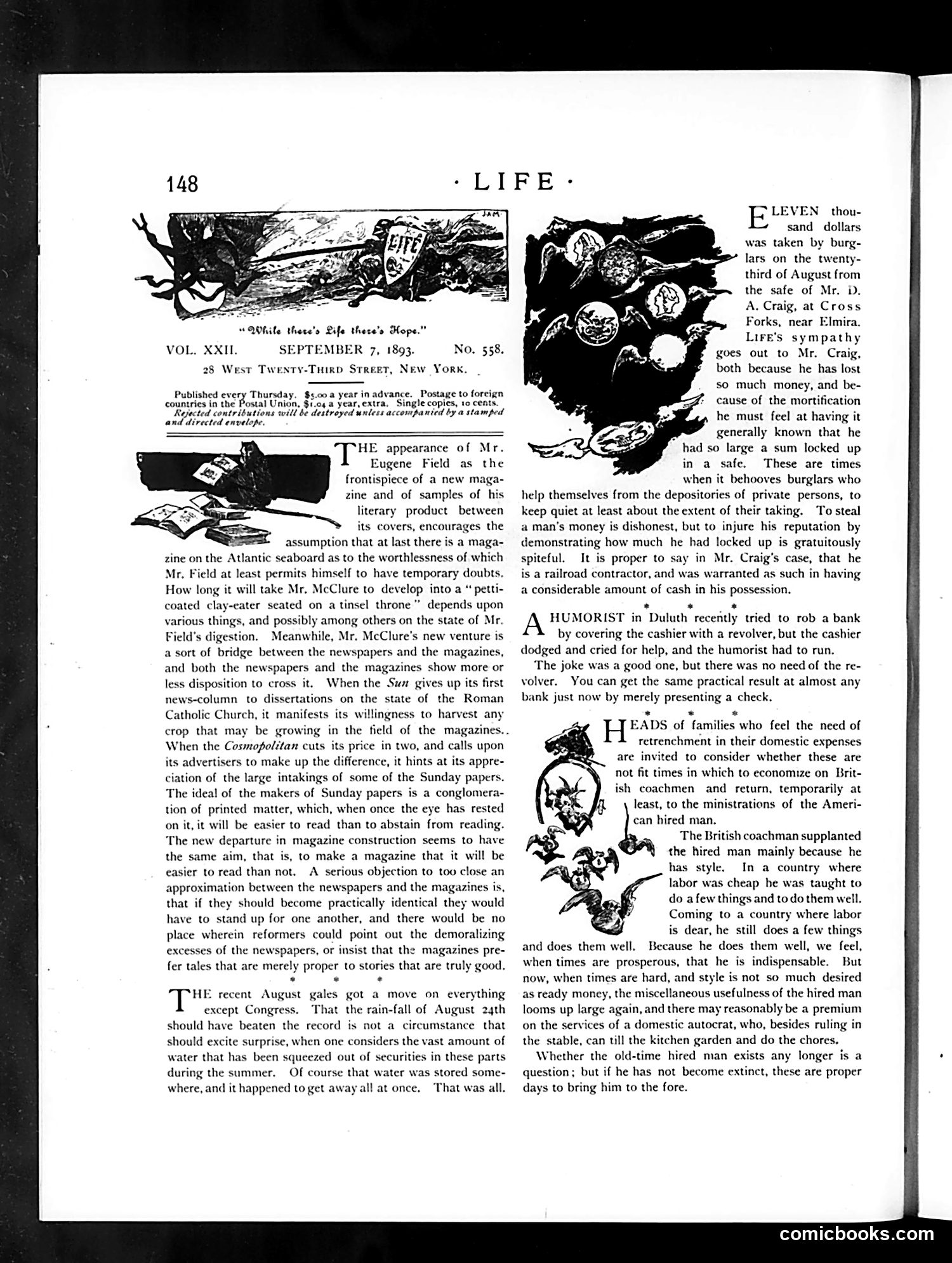
This page contains three distinct satirical pieces addressing contemporary issues: 1. **Eugene Field's new magazine**: The text critiques Field's literary venture, debating whether magazines should differentiate themselves from newspapers or risk becoming redundant. 2. **Bank robbery humor**: A brief anecdote mocks a Duluth humorist's failed bank robbery attempt, suggesting checks are equally effective theft methods—dark commentary on banking security and financial instability during the 1893 economic panic. 3. **Domestic labor commentary**: The illustrated piece discusses hiring British coachmen as domestic staff, arguing that while style matters during prosperity, practical utility matters more during hard times. This reflects anxieties about labor class distinctions and economic efficiency during the depression era. The overall tone reveals anxieties about American institutions—publishing, banking, and labor—during an economically turbulent period.
📄 Transcribed text from this page (OCR, searchable)
Machine-transcribed from the original scan — historical spelling and the odd misread are preserved.
While there's Life there's Hope.” . XXII. SEPTEMBER 7, 1893. 28 West Twenty-Tirp Street, NEw York. No, 558. Published every Thursday. $5.00 a year in advance. Postage to foreign countries in the Postal Union, $1.04 a year, extra, Single copies, 10 cents. Rejected contributions will be destroyed unless accompanied by a stamped and directed envelope, HE appearance of Mr. Eugene Field as the frontispiece of a new maga- zine and of samples of hi literary product between its covers, encourages the assumption that at last there is a maga- zine on the Atlantic seaboard as to the worthlessness of which Mr. Field at least permits himself to have temporary doubts. How long it will take Mr. McClure to develop into a“ petti- coated clay-eater seated on a tinsel throne” depends upon various things, and possibly among others on the state of Mr. Field's digestion. Meanwhile, Mr. McClure’s new venture is a sort of bridge between the newspapers and the magazines, and both the newspapers and the magazines show more or less disposition to cross it. When the Sw gives up its first news-column to dissertations on the state of the Roman Catholic Church, it manifests its willingness to harvest any crop that may be growing in the field of the magazines.. When the Cosmopolitan cuts its price in two, and calls upon i isers to make up the difference, it hints at its appre- ciation of the large intakings of some of the Sunday papers. The ideal of the makers of Sunday papers is a conglomera- tion of printed matter, which, when once the eye has rested on it, it will be easier to read than to abstain from reading. The new departure in magazine construction seems to have the same aim, that is, to make a magazine that it will be easier to read than not. A serious objection to too close an approximation between the newspapers and the magazines is that if they should become practically identical they would have to stand up for one another, and there would be no place wherein reformers could point out the demoralizing excesses of the newspapers, or insist that the magazines pre- fer tales that are merely proper to stories that are truly good. . . « E recent August gales got a move on everything a at the rain-fall of August 24th should have beaten the record is not a circumstance that should excite surprise, when one considers the vast amount of ater that has been squeezed out of securities during the summer. Of course that water w: where, and it happened to get away all at once, in these parts stored some- That was all. LEVEN | thou- sand dollars was taken by burg. lars on the twenty- third of August from the safe of Mr. D. A. Craig, at Cross Forks, near Elmira. Lire’s sympathy goes out to Mr. Craig, both because he has lost so much money, and be- cause of the mortification he must feel at having it F generally known that he had so large a sum locked up in a safe. These are times when it behooves burglars who help themselves from the depositories of private persons, to keep quiet at least about the extent of their taking. To steal a man’s money is dishonest, but to injure his reputation by demonstrating how much he had locked up is gratuitously iteful. It is proper to say in Mr. Craig’s case, that he is a railroad contractor, and was warranted as such in having a considerable amount of cash in his possession. * . * HUMORIST in Duluth recently tried to rob a bank by covering the cashier with a revolver, but the cashier dodged and cried for help, and the humorist had to run. The joke was a good one, but there was no need of the re- volver. You can get the same practical result at almost any bank just now by merely presenting a check. * * * HFA’s of families who feel the need of retrenchment in their domestic expenses are invited to consider whether these are not fit times in which to economize on Brit- ish coachmen and return, temporarily at least, to the ministrations of the Ameri- can hired man, The British coachman supplanted the hired man mainly because he has style, In a country where labor was cheap he was taught to do a few things and to do them well. yo Coming to a country where labor is dear, he still does a few things and does them well. Because he does them well, we feel, when times are prosperous, that he is indispensable. But now, when times are hard, and style is not so much desired as ready money, the miscellaneous usefulness of the hired man looms up large again, and there may reasonably be a premium on the services of a domestic autocrat, who, besides ruling in the stable, can till the kitchen garden and do the chores. Whether the old-time hired man exists any longer is a question; but if he has not become extinct, these are proper days to bring him to the fore. comicbooks.com